
Key Takeaways
- Hybrid delivery, where an agency augments an internal client team, outperformed both agency-only and in-house-only models in a 2025 survey of 1,200 businesses, reshaping what SEO managers are paid to do 11.
- The accounts-per-manager ratio typically peaks between eight and twelve; above that, senior time drains into rework and QA repair, and margin erodes even while utilization looks full.
- Audit each SEO manager against Forrester's four capabilities—keyword research, site monitoring, search marketing optimization, and reporting and analytics—to find which are over-owned, under-owned, or ready to systematize 9.
- Focus next on the coordination surface: name the content-ops, creative-ops, and martech-ops handoffs the manager owns, and move production overhead into approval-first workflows before adding headcount.
The capacity ceiling most SEO agencies hit before they see it coming
Growth stalls in agency SEO practices rarely announce themselves. Retainers keep signing, ranking reports keep going out, and then somewhere between the eighth and twelfth account per manager, the numbers quietly stop working. Deliverables slip a week. QA gets skipped. The senior SEO manager who used to review every technical audit is now triaging Slack messages from five pods.
The reflex is to hire another specialist. The math rarely supports it. Fully loaded cost of a mid-level SEO manager plus the junior specialists and content coordinators that make them productive runs ahead of the retainer growth that new headcount can absorb, especially when onboarding eats the first two quarters. Agencies that scale on this pattern end up with a linear cost curve chasing a flatter revenue curve.
The buyer side is also shifting. A 2025 survey of 1,200 businesses found hybrid delivery models, where an internal team is augmented by an agency, produced a 41% average lift in organic traffic over twelve months, compared with 34% for agency-only engagements and 28% for in-house-only teams 11. That reshapes what SEO managers are actually being paid to do.
This piece is written for agency leaders who already run SEO managers and want more output per manager without sacrificing the strategic layer. The frame throughout is capacity, coordination, and org design, not role definition.
What the buyer market is actually rewarding
The hybrid delivery model is outperforming pure agency and pure in-house
The buyer question is no longer agency versus in-house. It is how the two fit together. A 2025 survey of 1,200 businesses reported by Digital Agency Leaders found that companies running a hybrid model, in which an internal team is augmented by an agency, saw an average 41% increase in organic traffic over twelve months. Agency-only engagements averaged 34%. In-house-only teams averaged 28% 11. The survey is self-reported and cross-sector, so treat the exact percentages as directional. The ordering is what matters, and it is consistent with what agency leaders are seeing in renewal conversations.
That ordering reframes the SEO manager's job description. Pure delivery, where the agency owns strategy, execution, and reporting end to end, is no longer the highest-performing structure in the data. The highest-performing structure requires an SEO manager who can operate as a partnership orchestrator: someone who scopes work jointly with a client's in-house lead, hands off cleanly, absorbs work the internal team cannot cover, and reports against a shared measurement plan rather than an agency-owned one.
Most agencies staffed their SEO management layer for a different world. Managers were promoted for account retention, tactical depth, and QA. Very few were promoted for the skill of running a co-delivery relationship with an equally credentialed counterpart on the client side. That gap is now visible in growth reviews, where hybrid-model clients tend to have the highest expansion revenue and the lowest tolerance for opaque reporting.
The practical implication is that SEO managers should be evaluated against a different rubric than five years ago. Coordination with internal client resources, contribution to a shared roadmap, and clarity of handoff artifacts belong on the scorecard alongside ranking and traffic outcomes. Agencies that ignore this end up losing hybrid accounts to competitors who staffed for it.
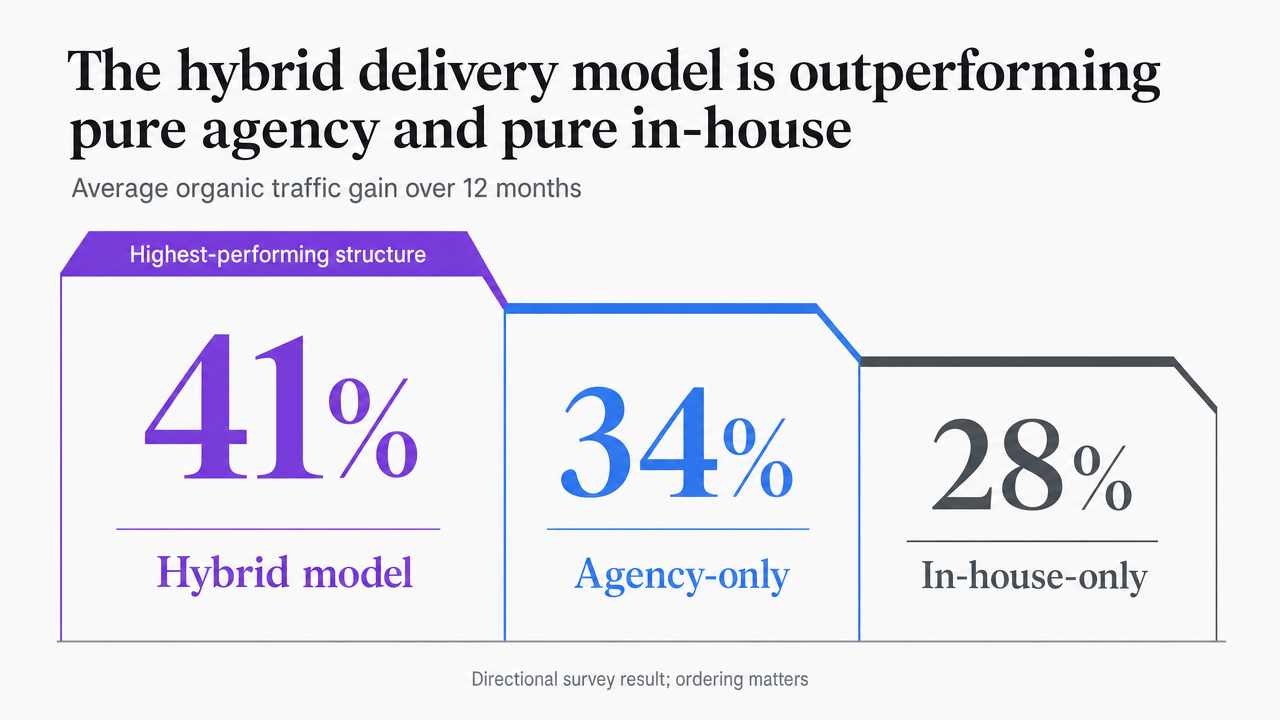 Visualize the 41% vs 34% vs 28% organic traffic gain comparison across delivery models, directly supporting the section's central claim
Market growth is real, but it is not the reason to add headcount
The agency SEO services market is projected to expand from $87.82 billion in 2026 to $165.29 billion by 2030 3. That figure comes from a commercial market research report and, as with most vendor-published market sizing, the methodology varies from analyst to analyst. Treat it as directional confirmation that spend is moving toward search services, not as a precise budget signal.
Even accepting the directional read, the strategic conclusion is not that agencies should staff up to absorb the wave. It is that the share of that spend which flows through a given agency depends on productivity per SEO manager, not on how many SEO managers the agency employs. A market growing at that pace attracts new entrants, in-house teams with real budget, and AI-native competitors pricing below traditional retainers. The agencies that capture disproportionate share will be the ones whose SEO managers cover more accounts, produce more measurable outcomes per hour, and coordinate a wider execution surface without losing quality.
Headcount growth is the lagging response to market growth. Systems, delivery templates, and clearer measurement are the leading responses. The rest of this piece treats SEO management as the operating layer where those leading responses are built.
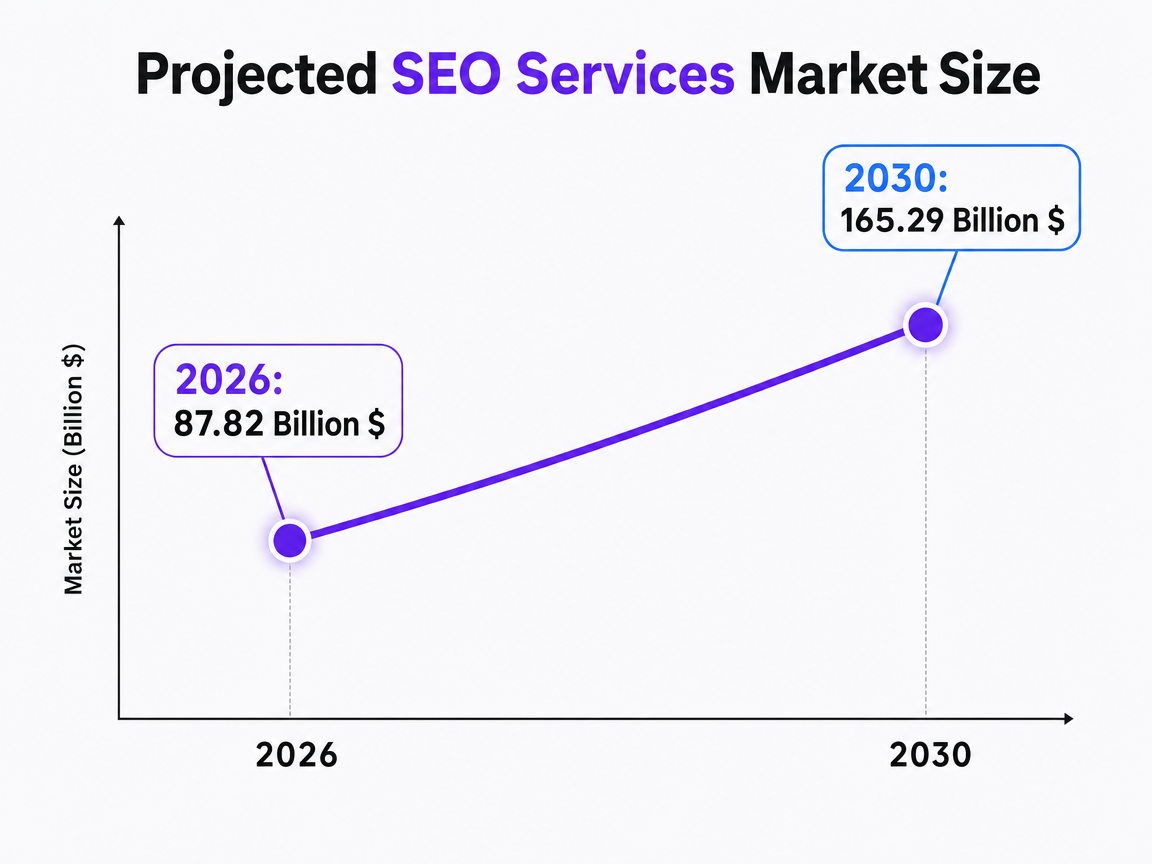 Projected SEO Services Market Size
A time-series chart showing the projected growth of the agency SEO services market in billions of dollars for the years 2026 and 2030.
The capacity math behind the linear-hiring trap
Accounts per manager, and where margin breaks
Every agency has an implicit ratio of accounts per SEO manager, and most have never written it down. The number tends to drift upward under commercial pressure until something visible breaks: a churn event, a missed deliverable that lands in a client's executive review, or a manager quitting after a bad quarter. By that point the ratio has already been wrong for two or three cycles.
The pattern is consistent across the agency leaders who have shared their portfolio structures publicly:
- Below roughly eight accounts per manager, gross margin on the SEO line is healthy but headcount productivity looks low against benchmark.
- Between eight and twelve, margin peaks and managers are stretched but functional.
- Above twelve, quality control migrates from the manager to whoever happens to be in the account channel that week, and the effective margin degrades because senior time gets absorbed into rework and client-relationship repair.
The exact break point varies with account complexity, average retainer, and how much of the execution stack the manager personally touches.
The reason linear hiring does not fix this is that each additional SEO manager arrives with a productivity ramp measured in quarters, not weeks. A peer-reviewed analysis of search performance optimization notes that sustained results require structured methods and continuous monitoring, and that different methods perform differently depending on context, which is a formal way of saying expert judgment does not transfer on day one 8. A new hire covering ten accounts is not the same input as an existing manager covering ten accounts. Treating them as equivalent in a capacity model is where the margin cliff comes from.
The alternative is to fix the ratio by changing what falls inside the manager's scope. Anything that can be templated, automated, or moved to a lower-cost tier without loss of strategic quality raises the ceiling on accounts per manager without adding headcount.
A diagnostic table for your portfolio
The table below is a diagnostic, not a benchmark. It uses variables rather than specific retainer or salary figures so agency leaders can populate it with their own numbers and see where their portfolio actually sits. The point is to compare gross contribution across three capacity tiers using the same inputs.
| Capacity tier | Accounts per SEO manager | Manager utilization | Supporting specialist load | QA and strategy coverage | Gross margin trend |
|---|---|---|---|---|---|
| Under-loaded | Below 8 | Low to moderate | Light; specialists underused | High; manager reviews most work | Positive but sub-scale |
| Peak | 8 to 12 | High | Balanced; specialists fully engaged | Selective; manager reviews strategic work | Highest sustainable margin |
| Overextended | Above 12 | Saturated | Overflowing; QA rework climbs | Reactive; strategy layer degrades | Erodes as rework and churn rise |
Three inputs move the position of the peak tier:
- The first is average account complexity, which is a function of vertical, site scale, and how many stakeholders sign off on work.
- The second is how much of the four-capability stack, meaning keyword research, site monitoring, search marketing optimization, and reporting and analytics, is genuinely systematized rather than performed manually by the manager 9.
- The third is the coordination cost with other channels, which the 2025 martech and marketing operations research identifies as a growing share of execution time in agencies that connect SEO to broader stacks 6.
Agency leaders using this diagnostic tend to find the same thing. The portfolio is not uniformly overloaded. A subset of managers is at peak, another subset is under-loaded because of legacy account assignments, and one or two are past the cliff. Rebalancing the assignments recovers margin faster than hiring, and it exposes which parts of the stack need to be templated before the next expansion.
Experience scalable SEO execution in real time
Test-drive efficient, multi-client SEO workflows and publish content with full oversight before making any commitment.
Auditing the SEO manager's capability stack
Forrester frames four capabilities as the minimum requirement for a competent SEO function: keyword research, site monitoring, search marketing optimization, and reporting and analytics 9. That list is usually read as a tool-selection checklist. It works better as an audit instrument applied to the SEO manager rather than the software.
The audit question is not whether each capability exists somewhere in the agency. It is which capabilities the SEO manager personally executes each week, which are delegated to specialists, and which are systematized to the point that the manager only reviews exceptions. The distribution across those three states is what determines how many accounts a manager can hold before quality degrades.
Keyword research is the capability most often stuck in the manager's own hands. It feels like strategy, so it is protected. In practice, the framework, the taxonomy, and the scoring model are the strategic parts; the pulling, clustering, and gap analysis are executable at a lower tier once the framework is defined. Managers running keyword research end-to-end for eight-plus accounts are absorbing production time that belongs elsewhere.
Site monitoring is the capability most often under-owned. It is treated as a technical alarm system rather than a strategic surface. When a manager only sees monitoring output during a crawl error escalation, drift accumulates between reviews. The audit test is whether the manager can name, for each account, the three technical signals they check on a defined cadence and what threshold triggers a specialist ticket.
Search marketing optimization, meaning the coordinated on-page, content, and link work, is where the manager's coordination role is most visible. This capability crosses into content ops and creative ops, which the next section addresses. The audit question here is whether prioritization is documented or lives in the manager's head. Head-based prioritization does not survive account transitions or PTO.
Reporting and analytics is the capability most often confused with dashboards. Reports are outputs. Analytics is the interpretive layer that turns those outputs into a client conversation and a next-cycle plan. A peer-reviewed analysis of search optimization methods emphasizes that sustained performance depends on structured evaluation frameworks and expert judgment rather than raw metric collection 8. Managers who spend their reporting time formatting numbers instead of interpreting them have not built the analytics capability, only the reporting one.
Running the audit typically produces a predictable pattern. Two of the four capabilities are systematized well, one is over-owned by the manager, and one is under-owned or reactive. That distribution, more than any org chart change, tells the agency where the next investment in templates, specialist tooling, or automation will actually raise the accounts-per-manager ceiling.
Coordination pressure from content ops, creative ops, and martech ops
The SEO manager's job used to end at a brief handed to a writer. That boundary has collapsed. Content demand has climbed across channels and formats, and the 2025 creative operations research reports that marketing teams are being asked to produce significantly more visual content than in previous years, driven by omnichannel distribution and personalization requirements 5. Search content is now one input into a production system that also feeds paid, social, email, and sales enablement, and the SEO manager sits at the coordination seam whether the org chart says so or not.
The workflow implication is not subtle. A benchmark study of content operations found that scaling output depends on aligned workflow, technology, and data strategies, not on individual writer productivity 4. When those three are not aligned, the SEO manager becomes the human bridge, chasing briefs through creative queues, reconciling metadata between the CMS and the analytics stack, and re-briefing work that shipped without the target query intent intact. Every hour spent on that bridge is an hour not spent on strategy or QA, which is the mechanism by which the accounts-per-manager ceiling drops without anyone noticing.
Martech ops adds a second layer of pressure. The 2025 state of martech and marketing operations research frames the modern stack as a coordination problem across tools, data pipelines, and execution systems rather than a tool-selection problem 6. SEO managers who cannot read that stack, meaning the flow from keyword taxonomy to CMS field to analytics event to reporting layer, end up producing recommendations that stall at the integration layer. The recommendation is technically correct and operationally undeliverable.
The practical response is to name the coordination surface explicitly in the manager's scope. Which content-ops rituals does the SEO manager attend, which creative-ops handoffs do they own, and which martech-ops changes require their sign-off. Agencies that leave this implicit pay for it in rework and manager burnout. Agencies that document it recover hours that can be redirected to the strategic layer clients actually pay for.
Scale SEO Management Without Increasing Headcount or Losing Oversight
See how leading agencies orchestrate multi-client SEO delivery by integrating AI-powered workflows—reducing manual processes and maintaining strategic control across all campaigns.
Evidence that structured SEO management moves the numbers
The strongest empirical support for treating SEO management as an operating discipline comes from a peer-reviewed study of tourism businesses that measured the relationship between structured SEO practices and organizational performance. The study reported a correlation of r=0.791 between SEO practices and performance outcomes, with 76% of participating businesses reporting increased website traffic, 71% reporting improved online bookings, and 68% reporting better search engine rankings after implementing structured optimization work 7. The sector limit matters: this is tourism, not agency portfolio work, and the authors themselves caution against generalizing to more complex multi-client environments. Read it as a signal about the mechanism, not a benchmark for agency KPIs.
The mechanism the study surfaces is the one agency leaders can act on. Outcomes tracked with keyword optimization, content optimization, and technical SEO handled as an integrated program, not as isolated tactics. That integration is the SEO manager's job. When the four capabilities from the earlier audit run as connected workflows rather than parallel task lists, the correlation between activity and outcome tightens.
A peer-reviewed analysis of search performance optimization methods reinforces the point from a different angle, concluding that sustained gains require continuous monitoring and structured evaluation rather than one-time execution 8. Managers who own that continuity are the variable that separates portfolios where numbers move from portfolios where activity accumulates without result.
Org-design decisions: promote, embed, or systematize
When SEO leadership graduates into operations
There is a point in an agency's growth curve where the Head of SEO is more valuable outside the channel than inside it. The signal is usually the same: the person best equipped to fix delivery quality across every account is spending their week fixing delivery quality inside a handful of accounts. The org chart is asking a channel leader to do operations work under a channel title.
The SEO Works published a leadership change that maps this transition cleanly. The former Head of SEO moved into an Operations Director role focused on service delivery excellence and client retention, while a new Head of SEO took over a 50-person SEO team 12. Two things are worth noting in that structure. The operations role was carved out of SEO leadership, not imported from a different function, because the institutional knowledge about how SEO gets delivered at scale sits with the person who ran it. And the channel leadership seat remained a discrete role, not a diluted operations seat, because a 50-person delivery team still needs a channel head.
The MultiplyMii Director of SEO Operations scope reinforces the pattern. The role is defined around portfolio-level performance, cross-functional collaboration, and advanced strategy across client accounts rather than execution on any single one 10. Agencies that recognize this transition early convert their most senior SEO manager into a leverage multiplier. Agencies that delay it burn out the person who could have been that multiplier.
Pod embedding versus centralized SEO teams
The embedding decision comes down to what the agency sells. Pods work when the buyer is paying for an integrated channel mix and expects one team to move together. SEO managers embedded in pods sit closer to the account, catch cross-channel dependencies earlier, and produce recommendations that other pod members can actually deliver.
Centralized SEO teams work when the buyer is paying for search expertise as a distinct discipline and expects portfolio-level pattern recognition. Central teams standardize methodology faster, spread learnings from one account across the book, and protect the four-capability stack from being watered down by generalist demands 9. They also make it easier to promote channel leadership into operations without leaving a channel head vacuum.
Most mid-market and enterprise agencies end up with a hybrid: a central SEO team that owns methodology, tooling, and senior review, with embedded SEO managers or specialists dotted-lined into pods. The failure mode of that hybrid is unclear reporting lines, where the embedded manager takes direction from the pod lead on Monday and the central head on Tuesday. Writing down who owns methodology, who owns account outcome, and who owns career development for each embedded manager removes most of the friction.
Where approval-first AI execution changes the ratio
The accounts-per-manager ceiling moves when the manager's time stops being consumed by production coordination. The 2025 martech and marketing operations research frames stack integration as one of the largest sinks of operator time in modern marketing teams 6, and the creative ops benchmark data shows content volume climbing faster than headcount can absorb 5. Both pressures land on the SEO manager.
Approval-first AI execution changes the math by moving briefing, drafting, technical checks, and reporting assembly into a system the manager reviews rather than runs. The manager still owns strategy, prioritization, and the judgment calls that determine whether a recommendation ships. Everything below that layer becomes reviewable output instead of hand-built work product. Platforms structured this way, such as Vectoron, keep the sign-off gate in the manager's hands while removing the production overhead that pushes account ratios into the overextended tier. The org-design decision is no longer whether to add a headcount. It is which parts of the current manager's week should stop being manual.
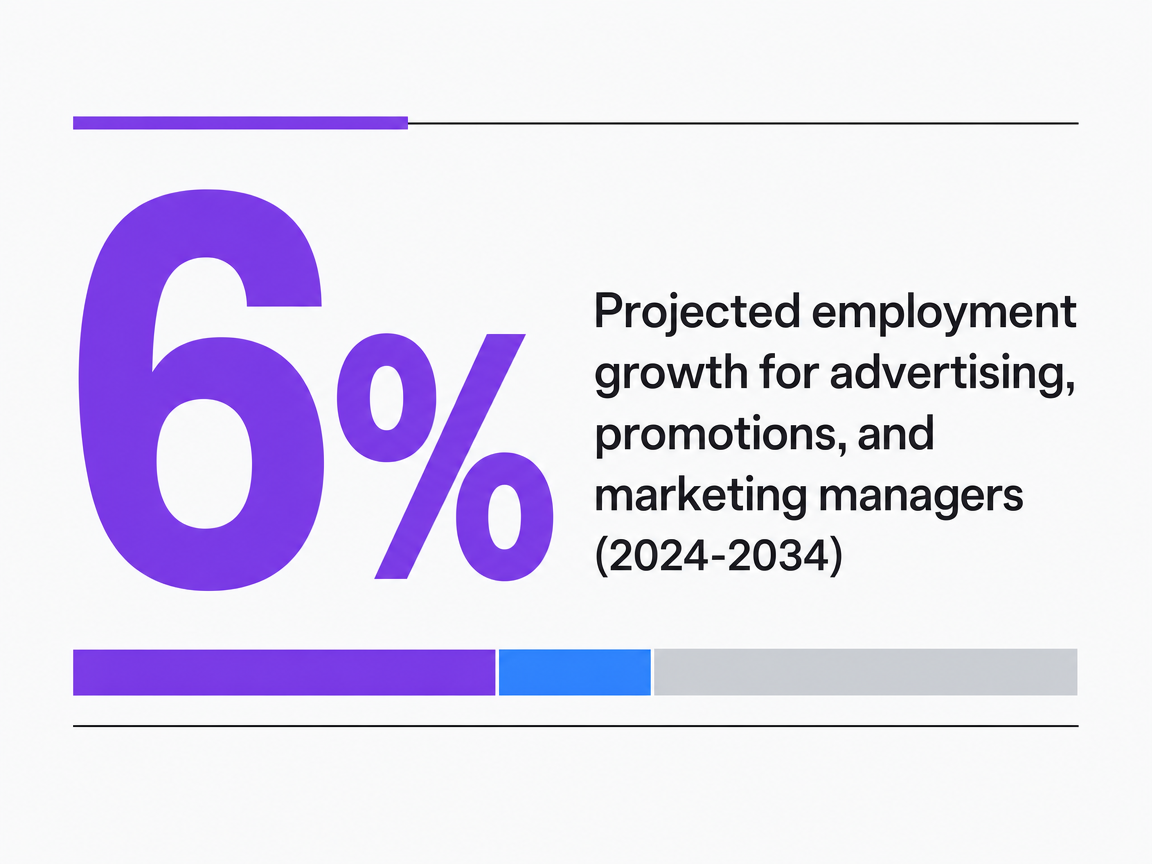 Projected employment growth for advertising, promotions, and marketing managers (2024-2034)
Projected employment growth for advertising, promotions, and marketing managers (2024-2034)
Frequently Asked Questions
References
- 1.Advertising, Promotions, and Marketing Managers.
- 2.GDP by Industry | U.S. Bureau of Economic Analysis (BEA).
- 3.Agencies SEO Services Market Report 2026.
- 4.The State of Visual Content Marketing Benchmark Report.
- 5.The State of Creative Ops – 2025 Edition.
- 6.State of Martech & Marketing Operations Report 2025.
- 7.Corresponding: Author: journals.miu.ac.ug 207.
- 8.Search engine Performance optimization: methods and ....
- 9.Four Search Engine Optimization Capabilities for the Demand Marketer Tech Stack.
- 10.Director of SEO Operations | MultiplyMii.
- 11.SEO Agency vs In-House SEO Team: A Data-Driven Comparison (2026).
- 12.Exciting Changes to Senior Leadership at Digital Growth Agency The SEO Works.