
Key Takeaways
- Crawlable infrastructure sets the ceiling for every downstream tactic, so server-rendered templates, valid canonicals, structured data, and WCAG 2.1 AA accessibility must be built in at the template layer 5, 10.
- Intent-mapped content in YMYL categories converts only when named authors, subject-matter reviewers, primary sourcing, and visible review dates clear a governance checklist, because visibility has consistently outrun trustworthiness 1, 2.
- Trust artifacts and substantiation files now sit inside enforceable federal rules, so reviews, testimonials, disclosures, and outcome claims must be governed before publication rather than reviewed after 7, 11, 3, 6, 9.
- Closed-loop measurement from impression to booked revenue is what turns SEO into a forecast, and HIPAA-covered organizations need a privacy-reviewed tagging plan before that architecture ships 8.
- Mapping every priority query to a funnel stage, service line, location, and conversion event stops writers from optimizing for scroll depth and starts producing pages tied to qualified calls and appointments.
- A five-gate approval workflow with named owners for technical, editorial, trust, privacy, and publishing decisions is what makes the four layers compound instead of stall behind vendor handoffs.
- Multi-location operators should choose an execution model based on approval control, handoff count, and headcount load, since agency stacks and point-tool stacks both break down as location count grows.
- A quarterly rhythm that promotes converters, rewrites rankers that miss, retires dead clusters, and re-substantiates aging outcome claims is what separates a compounding program from a growing backlog 1.
Why Organic Pipeline Stalls Without a Governed Operating System
Most SEO programs stall not because the tactics are wrong, but because they are disconnected. A content agency ships briefs. A technical vendor patches Core Web Vitals. A local-listings tool syndicates NAP data. An analytics contractor rebuilds GA4 events every other quarter. Each function produces output, but none produce a governed pipeline that a VP of Marketing can forecast against.
The symptom is familiar: impressions and rankings improve, yet booked appointments, qualified calls, and sourced revenue drift sideways. The cause is that search is being treated as a stack of tactics rather than a production system with four linked responsibilities: crawlable infrastructure, intent-mapped content built on evidence, trust and compliance controls, and closed-loop revenue measurement. Break any one of them and the others start compensating with volume instead of yield.
The stakes are higher in regulated verticals. Systematic reviews of online health information have found quality to be broadly suboptimal, with editorial, sourcing, and currency gaps that visibility alone does not fix 1, 2. This means a healthcare, behavioral-health, dental, or senior-living page can rank, get clicks, and still fail the trust threshold that converts a visitor into a scheduled patient. The same logic applies to legal and home services, where substantiation and review integrity now sit inside enforceable federal rules rather than best-practice guides.
What follows is an operator-grade framework for turning search into predictable pipeline: four layers, one approval workflow, and a quarterly rhythm that compounds instead of resets.
The Four-Layer SEO Operating System
Layer 1: Crawlable, Accessible Infrastructure
Infrastructure is where pipeline predictability starts, because every downstream tactic inherits its ceiling from what search engines can crawl, render, and evaluate. A service-page template that ships without server-rendered content, valid canonicals, correct hreflang for multi-market operators, and stable Core Web Vitals will cap the return on every content investment behind it. The audit questions are boring and non-negotiable: does the sitemap match the indexable set, do internal links reach every money page within three clicks, does the mobile render match desktop, and does structured data reflect the actual service, location, and provider entities on the page.
Accessibility belongs inside the same infrastructure layer, not in a separate legal review. The ADA.gov small-entity compliance guide identifies WCAG 2.1 Level AA as the technical standard for the covered public-sector web and mobile content addressed by the 2024 rule, and the Department of Justice's broader web-accessibility guidance points organizations to WCAG and Section 508 as the reference standards for making web content accessible 5, 10. Private-sector obligations vary, but WCAG 2.1 AA is the defensible baseline that conversion templates, forms, navigation, and media should inherit by default.
Operationally, this means the accessibility checks live inside the template, not inside a quarterly audit. Form fields carry programmatic labels. Focus states are visible. Color contrast passes on button variants before a designer ships them. Video embeds carry captions and transcripts. Image alt text is written during content production, not backfilled by an intern.
The payoff is compounding. Templates that pass technical and accessibility checks at build time stop generating rework tickets, and organic landing pages start converting at the rate their content quality actually warrants rather than the rate their form friction allows.
Layer 2: Intent-Mapped Content Built on Evidence
Volume-first content strategies fail in high-stakes verticals because the reader is not evaluating prose, they are evaluating trust. A prospective patient comparing behavioral-health providers, a family researching senior living, or a plaintiff weighing a firm reads for credentials, sourcing, currency, and specificity. Ranking is the ticket to the evaluation, not the outcome.
The evidence base for treating this as governance rather than preference is direct. A meta-narrative systematic review of online health information concluded that quality was suboptimal and that the internet did not reliably provide laypeople with trustworthy health information 1. A companion systematic review evaluating e-health quality frameworks reported that all but five of its included studies concluded quality was a problem on the internet 2. Visibility, in other words, has consistently outrun trustworthiness in the categories where the conversion decision carries the highest weight.
Translating that finding into an editorial standard produces a governance checklist that every YMYL page should clear before publication:
- Named author with verifiable credentials
- Clinical or subject-matter reviewer of record
- Primary or peer-reviewed sourcing for factual claims
- A visible last-reviewed date
- Disclosure of any commercial or affiliate relationships
- A substantiation file behind outcome or efficacy statements
What changes when they become a template requirement is that a content operation stops producing pages that rank but fail to convert because the reader cannot locate the signals of authority they came to check.
Intent mapping sits on top of that quality floor. Each priority query is tagged to a funnel stage, a specific service line, a location where relevant, and the conversion event it must produce. Informational queries earn depth and internal links to comparison and decision content. Comparison queries earn structured pros, cons, criteria, and named alternatives. Decision queries earn service pages with pricing signals, provider bios, insurance or eligibility detail, and a form that matches the reader's readiness. Content briefs that skip the stage tag are the ones that produce traffic without pipeline.
Layer 3: Trust, Reviews, and Substantiation as Conversion Levers
Trust artifacts are where regulated-vertical SEO programs most often lose pipeline they already earned. A page ranks, the visitor arrives, the reviews widget loads, the testimonial rotator scrolls, and the conversion decision hinges on whether those artifacts read as credible and clearly disclosed. The federal rules governing that moment tightened materially in 2024, and treating them as a legal afterthought is now a measurable conversion cost as well as a compliance exposure.
The FTC's final Trade Regulation Rule on the Use of Consumer Reviews and Testimonials, 16 CFR Part 465, prohibits creating, selling, buying, or knowingly disseminating fake reviews, prohibits compensation conditioned on a particular positive or negative sentiment, and addresses undisclosed insider testimonials, review suppression, and company-controlled review sites presented as independent 7. The rule became fully effective October 21, 2024, and permits civil penalties for knowing violations, with the accompanying FTC announcement summarizing the prohibited conduct in operational terms marketing teams can build controls against 11. Endorsement disclosure sits alongside that rule: the FTC's business guidance on endorsements, influencers, and reviews states that relationships to a brand must be disclosed and that endorsements must not mislead consumers about the endorser's experience or the advertiser's claims 3, and the agency's endorsement FAQ specifies that a material connection should be clearly and conspicuously disclosed when consumers would not reasonably expect it 4.
Substantiation is the second half of the trust layer. The FTC's small-business advertising FAQ makes clear that consumer endorsements must reflect typical experiences or clearly disclose what consumers can generally expect, and that a generic "results may vary" disclaimer is not enough 6. The agency's health-claims guidance is more pointed: companies must support health-related advertising claims with solid proof, and appropriate substantiation is required before dissemination 9. That standard governs every outcome number, recovery statistic, success-rate figure, and before-and-after image a service page displays.
The operational translation is a governed review-and-testimonial pipeline. Reviews are ingested from verifiable customer records only. Insider or employee reviews are prohibited or clearly disclosed. Incentives, when used, never condition on sentiment. Testimonial pages carry disclosure language rendered in the same visual weight as the endorsement. Outcome claims on service pages carry a substantiation file linking to the underlying data, cited studies, or clinical protocols. Legal review sits inside the same approval workflow as SEO publishing, so a service page cannot ship until the substantiation file is attached and the disclosure block is present. Programs that build this pipeline typically stop losing pages to takedowns and see conversion rates on high-intent templates rise because the trust artifacts finally match the ranking.
Layer 4: Closed-Loop Measurement From Impression to Booked Revenue
Measurement is the layer that decides whether SEO produces a forecast or a story. The four events that define a closed loop are the same across verticals:
- An impression in Search Console
- A session on an indexed page
- A qualified conversion event
- A booked-revenue record in the CRM or practice-management system
Programs that instrument all four can attribute pipeline to specific query clusters, page templates, and content investments. Programs that stop at session or lead count are the ones producing quarterly dashboards no CFO trusts.
The instrumentation itself is unremarkable when it is planned rather than assembled. Search Console is joined to the analytics warehouse at the query and URL level. Server-side event capture reduces reliance on third-party cookies for conversion tracking. Form submissions and call events carry the landing-page URL, the first-touch query where available, and a persistent visitor identifier that survives the handoff to the CRM. Offline outcomes, meaning booked appointments, matter counts, admissions, or contracts, are joined back to the originating session on a scheduled cadence.
Healthcare and other HIPAA-covered organizations require an additional governance step before that architecture ships. HHS has stated that regulated entities may not use tracking technologies in ways that result in impermissible disclosures of protected health information, and that marketing disclosures to tracking vendors may require HIPAA-compliant authorization 8. The operational consequence is a privacy-reviewed tagging plan: sensitive URLs and form fields are excluded from third-party analytics and advertising pixels, server-side tagging replaces client-side pixels on regulated paths, business associate agreements are in place where required, and the measurement schema is documented so a compliance reviewer can audit exactly which fields leave the environment.
Once the loop is closed, the SEO program stops arguing about rankings. Reporting shifts to the metrics a VP of Marketing can defend in a board meeting:
- Qualified calls per template
- Cost per booked appointment by query cluster
- Revenue sourced to organic by service line
- Payback period on each content investment
Those numbers are the ones that make organic pipeline forecastable, and they are only available to teams that treat measurement as the fourth layer of the operating system rather than a reporting task at the end of the quarter.
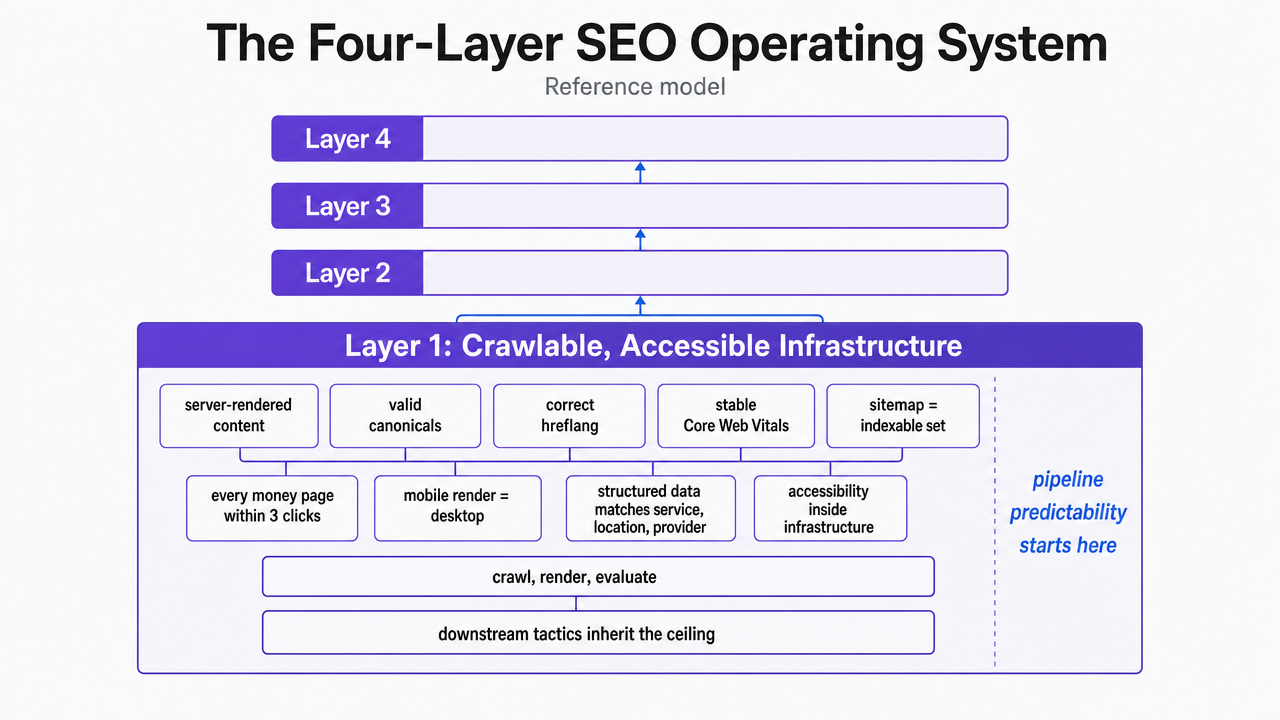 Visualize the four connected operating layers described in the section as a stacked framework, giving readers a reference model for the rest of the article
Test Live SEO Content Execution for 7 Days
Experience pipeline-focused SEO execution in your own environment with measurable output before you commit.
Mapping Search Intent to Pipeline Stages
Intent mapping is the artifact that turns a keyword list into a pipeline plan. Every priority query carries a stage tag, a service line, a location where relevant, and the conversion event the page must produce. Without those four attributes, a brief cannot be scored against pipeline, and the program defaults to publishing whatever fits the calendar.
The pattern that produces predictable pipeline is unglamorous. Informational queries at the top of the funnel earn depth, primary sourcing, and internal routes into comparison and decision pages. Comparison queries earn structured criteria, honest pros and cons, and named alternatives, including the reader's likely shortlist. Decision queries, the ones a VP of Marketing should treat as pipeline surface area, earn service pages with pricing signals where legally permitted, provider or attorney bios, insurance or eligibility detail, geographic specificity, and a form or call path calibrated to the reader's readiness. A behavioral-health admissions page and a periodontal consult page rank on different signals and convert on different artifacts, and one template cannot serve both.
Two operator disciplines make the map work. First, every brief names the conversion event it must produce, so writers stop optimizing for scroll depth and start optimizing for the qualified call or booked appointment the query implies. Second, the map is versioned quarterly against Search Console and CRM data, so queries that produce impressions without qualified conversions are demoted or rewritten rather than defended. Programs that skip the stage tag on briefs are the same ones that later cannot explain why traffic grew and pipeline did not.
The Approval Workflow That Connects the Four Layers
A four-layer operating system produces predictable pipeline only if a single approval workflow governs the handoffs between the layers. Without that spine, technical fixes wait behind content sprints, compliance reviews arrive after publication, and measurement changes lag the pages they were supposed to instrument. The layers exist, but they do not compound.
The workflow that connects them has five gates, each owned by a named function and each producing an artifact the next gate can inspect.
- A technical gate confirms the template renders, indexes, and passes accessibility checks before a brief is written against it.
- An editorial gate confirms the brief carries a stage tag, a conversion event, named sources, and an author with verifiable credentials.
- A trust gate confirms substantiation files are attached to outcome claims, that disclosures on reviews and endorsements are conspicuous, and that the page does not rely on testimonials the FTC's 2024 rule now prohibits 7.
- A privacy gate confirms the measurement schema on the URL excludes fields that would create impermissible disclosures on regulated paths 8.
- A publishing gate releases the page and activates the tracking that will later attribute pipeline back to it.
What makes the workflow operational rather than bureaucratic is that every gate is a queue with a reviewer, a checklist, and a timestamp. Pages move forward when the artifact clears; they do not move forward because a calendar date arrived. Programs that adopt this discipline stop shipping pages that rank without converting and start producing a monthly release cadence a VP of Marketing can forecast against.
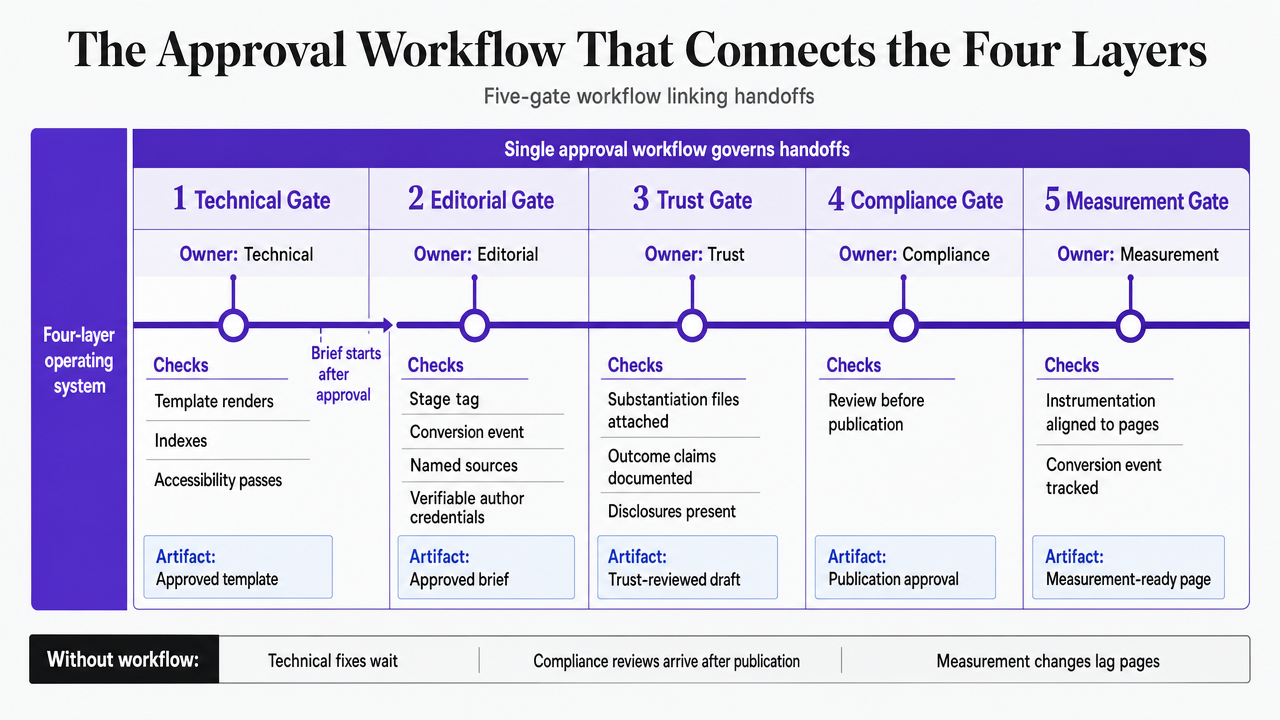 Diagram the five-gate approval workflow described in the section, showing the sequence, owners, and artifacts each gate produces
See How Enterprise Teams Build SEO-Driven Pipeline Without More Headcount
Connect with our experts to review benchmarks, workflows, and AI-powered execution models that leading agencies and brands use to scale SEO pipeline predictably—without agency overhead or additional hires.
If You Manage Multiple Locations: Choosing an Execution Model
The scope of the problem changes when a marketing team is accountable for pipeline across ten, fifty, or two hundred locations rather than a single site. At that scale, the execution model itself becomes a governance decision, because every location multiplies the number of service pages, review widgets, tracking configurations, and compliance artifacts a single approval workflow has to manage. The three models most multi-location operators evaluate are:
- A traditional agency retainer stack
- A fractional in-house team supported by point tools
- A unified AI-assisted execution platform with human approval built in
Each model handles the four operating layers differently. The variables that decide the outcome are scope covered across channels, approval control over what ships, the number of per-channel handoffs required to publish a page, headcount load on the in-house team, and the governance surface the VP of Marketing can actually inspect.
| Variable | Agency retainer stack | Fractional in-house + point tools | Unified AI-assisted platform |
|---|---|---|---|
| Scope covered | Partial; often SEO or content only, other channels on separate contracts | Broad but shallow; depth depends on which tools are licensed | Content, SEO, PPC, backlinks, social, and call intelligence in one workflow |
| Approval control | Reactive; approvals happen after briefs and drafts are produced | Direct but bottlenecked by internal capacity | Approval-first; nothing ships without in-house sign-off |
| Per-channel handoffs | Multiple, one per vendor and channel | Multiple, one per tool integration | One, inside a single Command Center queue |
| Headcount required | Coordinator plus channel owners to manage vendors | Specialist per channel, or generalists stretched across tools | Existing marketing team, no added headcount for execution |
| Governance surface | Fragmented across vendor decks and quarterly reviews | Fragmented across tool dashboards | Single approval log with strategic reasoning attached to each recommendation |
| Indicative pricing | Variable by retainer and channel count | Variable by tool licenses and salary load | $599/mo after a two-week trial |
The decision framework for a multi-location VP is not which model is philosophically superior. It is which model closes the four-layer loop with the fewest handoffs at the governance surface the board expects to see. Agency stacks tend to fail the approval-control test at scale; every location adds another queue, and compliance reviews arrive after publication rather than before. In-house plus point tools tends to fail the headcount test; each additional channel demands another specialist or another tool contract, and the integrations between them decay faster than the team can maintain them. A unified platform with approval-first automation, such as Vectoron, keeps the four layers connected under one workflow and holds headcount flat as location count grows, which is the specific economics that make multi-location pipeline forecastable rather than reactive.
Quarterly Operating Rhythm: What Compounds and What Decays
A four-layer operating system produces compounding pipeline only if it runs on a quarterly rhythm that rewards durable work and retires decaying work on schedule. Without that cadence, programs default to a monthly publishing calendar and treat every asset as if it has the same half-life, which it does not.
The work that compounds is unglamorous and cumulative. Technical fixes to templates apply to every page built on them. Accessibility improvements written into components carry forward to every future release. Substantiation files attached to service pages get reused across new locations, new provider bios, and new comparison content. Named-author bylines and clinical or subject-matter reviewer signoffs deepen the authority signals search engines and readers both weigh in high-stakes categories where information quality has been shown to run suboptimal 1. Internal links from evergreen informational content into decision pages accrue value with every additional cluster added above them.
The work that decays is equally predictable. Outcome statistics age out of their substantiation window. Reviewer credentials go stale when clinicians leave. Local pages drift when hours, insurance panels, or provider rosters change and no one updates the schema. Query clusters that produced impressions last quarter without qualified conversions keep consuming crawl budget and internal link equity unless they are demoted or rewritten.
The quarterly rhythm that keeps the loop closed has four moves:
- Promote what converted
- Rewrite what ranked without converting
- Retire what neither ranked nor converted
- Re-substantiate every outcome claim older than the review window
Programs that run this cadence produce a forecast. Programs that skip it produce a backlog.
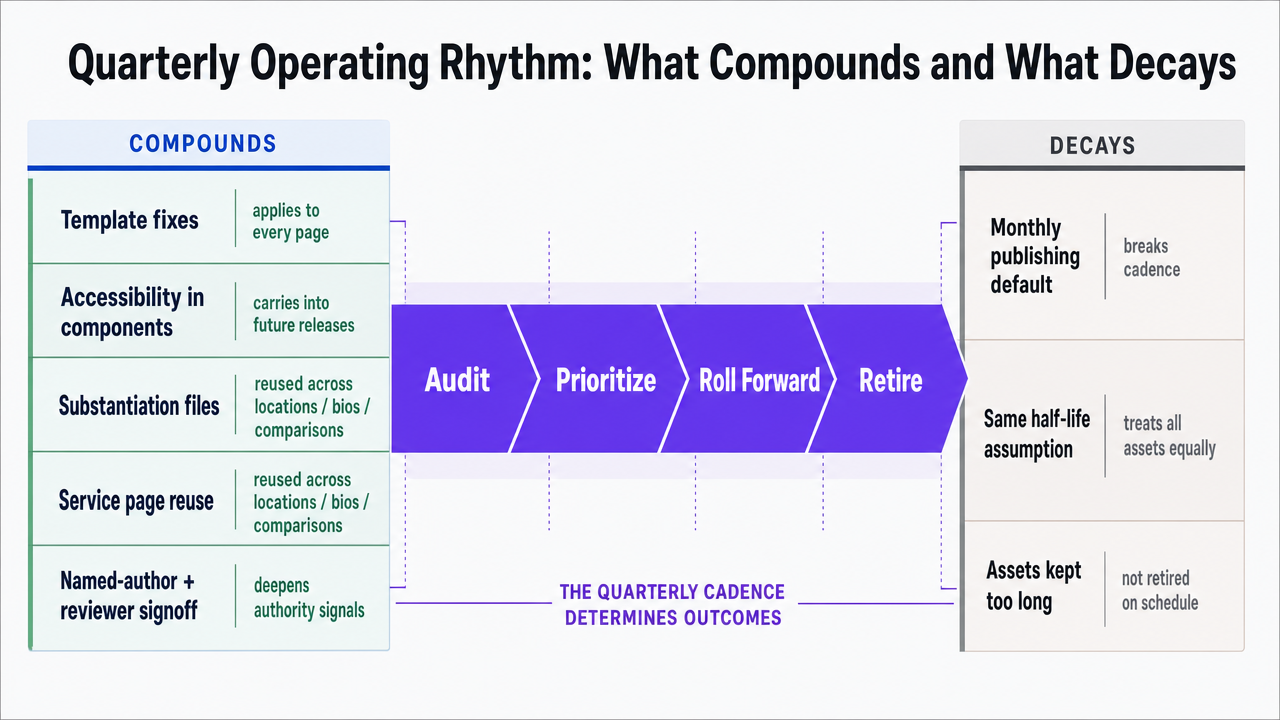 Contrast the compounding work versus decaying work described in the section using a two-column comparison, reinforcing the four quarterly moves
Frequently Asked Questions
References
- 1.Can Patients Trust Online Health Information? A Meta-narrative Systematic Review Addressing the Quality of Health Information on the Internet.
- 2.A framework for evaluating e-health: Systematic review of studies assessing the quality of health information and services for patients on the Internet.
- 3.Endorsements, Influencers, and Reviews.
- 4.FTC's Endorsement Guides: What People Are Asking.
- 5.Accessibility of Web Content and Mobile Apps Provided by State and Local Government Entities.
- 6.Advertising FAQ's: A Guide for Small Business.
- 7.16 CFR Part 465: Trade Regulation Rule on the Use of Consumer Reviews and Testimonials.
- 8.Use of Online Tracking Technologies by HIPAA Covered Entities and Business Associates.
- 9.Health Claims.
- 10.Guidance on Web Accessibility and the ADA.
- 11.Federal Trade Commission Announces Final Rule Banning Fake Reviews and Testimonials.