
Key Takeaways
- Replace volume-times-difficulty scoring with a Revenue Yield Score built on intent fit, committee role, conversion-weighted volume, and AI-surface probability tied to closed-won data.
- Map keywords to buying committee roles—economic buyer, technical evaluator, end user, and champion—rather than linear funnel stages, since parallel stakeholder research no longer converges sequentially 9.
- Treat AI-surface probability as a core scoring input, distinguishing queries that generative engines summarize from those they defer to source pages, since only 16% of brands track AI search performance 8.
- Reserve 20% to 30% of portfolio investment for problem-aware and category-defining queries to avoid harvesting only existing demand while starving future pipeline.
Why Keyword Lists Stopped Predicting Pipeline
The economics of organic search still favor marketers who select the right terms. Lead-generation benchmarks indicate a 14.6% close rate for organic leads, significantly higher than the 1.7% for outbound marketing leads 1. This disparity underscores the value of a revenue-driven keyword program: a smaller volume of precisely targeted visitors converts at a rate eight to nine times greater than cold outreach. Consequently, a poorly managed keyword portfolio can incur costs far beyond what traffic dashboards suggest.
However, the journey from a keyword to a closed deal has evolved. A spreadsheet ranked by monthly search volume and keyword difficulty no longer accurately reflects pipeline potential. AI Overviews now address informational queries, often eliminating the need for a click. Furthermore, buying committees fragment a single decision across multiple roles, each conducting distinct searches. Paid search inventory has become more expensive, while organic search results are increasingly crowded with answer boxes and other features.
Marketing leaders who continue to measure keyword success solely by rank position and session counts are tracking metrics that have become disconnected from revenue. The following sections introduce a portfolio model centered on closed-won data, committee mapping, and a scoring framework that integrates AI surfaces as a measurable input, rather than treating them as a separate channel.
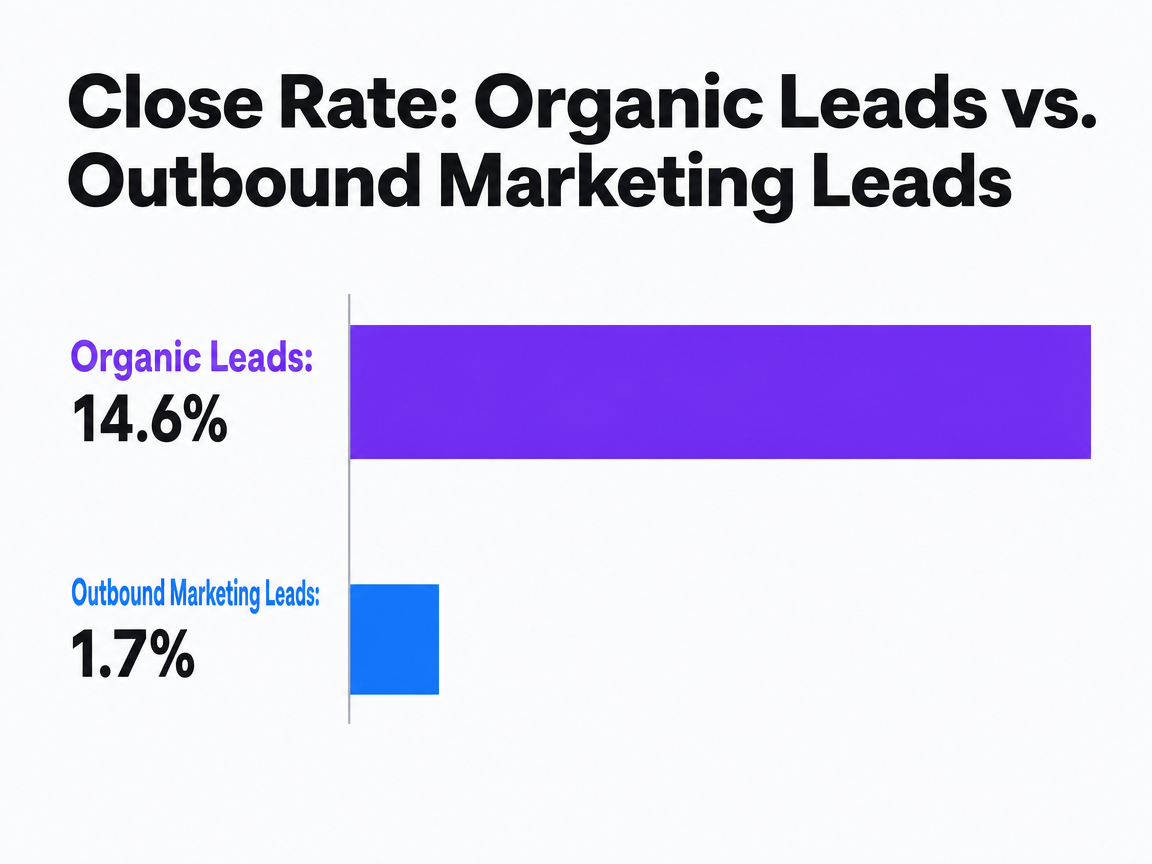 Close Rate: Organic Leads vs. Outbound Marketing Leads
A comparison of the close rates for leads generated through organic channels versus those from outbound marketing efforts.
The Three Forces Rescoring Every Existing Keyword List
Ranking Is No Longer the Same as Reaching a Buyer
Achieving a first-page ranking once guaranteed significant clicks, but this is no longer consistently true. Clickstream analysis from March 2025 revealed that the share of users clicking an organic result decreased by nearly ten percentage points to approximately 40%, while zero-click searches on desktop reached about 27% 6. Two ranked positions that appeared identical year-over-year in a rank-tracking report can now yield vastly different traffic volumes. This is because AI Overviews, expanded SERP features, and longer answer panels often intercept the click before it reaches an organic result.
This shift directly impacts keyword scoring. A position-three ranking for an informational query, now summarized by AI Overviews, may generate a fraction of the sessions it did in 2023, with few of those sessions carrying buying intent. Conversely, the same ranking for a comparison query, which AI engines often defer to source pages, may still attract qualified visitors. Thus, rank position has become an unreliable indicator of actual reach.
Marketing leaders who assess keyword performance based on average position are tracking a metric that no longer correlates directly with traffic, and traffic itself no longer correlates cleanly with pipeline. A robust portfolio requires a scoring input that considers the likelihood of a ranked result generating a click, not just its position.
Paid Search Got More Expensive and Less Productive
Paid search traditionally served as a fallback when organic coverage was weak for high-intent terms. This option is becoming less viable. A B2B paid-search analysis over a recent twelve-month period reported a 29% increase in cost-per-click for non-branded keywords, while clicks on Google search ads declined by 26% during the same timeframe 7. These opposing trends squeeze the unit economics of every marginal paid term.
The implication for portfolio management is that organic discipline now yields greater returns. A non-branded commercial keyword that generates qualified pipeline through organic ranking offers more significant savings than before, as the paid alternative has become substantially more expensive per converted lead. Conversely, a weak organic position on a high-intent term now costs more to supplement with paid coverage than it did in 2023.
This does not advocate abandoning paid search, but rather treating organic and paid efforts as a unified inventory problem. Keywords with rising CPCs and declining ad CTRs should be prioritized for accelerated organic investment. Similarly, keywords with strong organic rankings should be reviewed to identify paid spend that may now be redundant rather than incremental.
Answer Engines Sit Above the Old Funnel
An increasing portion of buyer research now begins within chat interfaces. G2's August 2025 survey of over 1,000 B2B software buyers found that half initiated their buying journey in an AI chatbot rather than a traditional search engine, and 87% reported that AI chatbots are altering their research methods 4. While this sample focuses on software buyers, the trend indicates a broader shift in vendor discovery across various B2B verticals.
For keyword strategy, this introduces a new scoring variable: whether an AI engine will directly answer a query with a summary, defer to source pages, or include it as a citation within a generated response. McKinsey's analysis of AI search advises brands to assess visibility across AI platforms and optimize content structure and topical authority to ensure generative answers draw from their material. It also notes that only 16% of brands currently track AI search performance systematically 8.
Practically, a keyword's value now depends partly on whether it generates a click, a citation within an AI answer, or neither. A portfolio scored solely against Google's traditional blue links is evaluating a diminishing surface. The subsequent section translates this into a buying-committee map that incorporates these changes without requiring a separate channel strategy.
Mapping Keywords to the Buying Committee, Not the Funnel
Why TOFU/MOFU/BOFU Stopped Matching How Deals Get Bought
The traditional top-middle-bottom funnel model assumes a single buyer progressing through three distinct stages. However, modern B2B purchases rarely follow this linear path. Forrester's 2023 buyer journey research highlights longer cycles, information overload, and increased role complexity, with multiple stakeholders conducting parallel research that does not converge in a single sequence 9. A linear funnel cannot effectively categorize keywords searched in different orders by various individuals involved in the same deal.
McKinsey's reframe of B2B selling reinforces this perspective from the seller's side: high-performing organizations have transitioned from a funnel mentality to a customer buying journey mindset. Marketing and sales now orchestrate touchpoints across the entire purchase process, rather than simply passing leads down a pipeline 14. Keyword taxonomy must reflect this evolution. A query like "contract review software pricing" is not merely a bottom-of-funnel term; it represents a specific question from a particular role within a buying committee. The same deal will also involve queries related to security reviews, procurement comparisons, and case studies for internal champions, none of which fit neatly into a linear funnel stage.
Replacing funnel stages with committee roles creates a keyword map that accurately reflects how purchasing decisions are actually made.
Four Committee Roles and the Queries They Actually Run
Most B2B purchase committees involve four key roles:
- the economic buyer who approves the budget,
- the technical evaluator who validates product fit,
- the end user who will operate the product, and
- the champion who builds internal consensus.
Each role conducts distinct queries, and each query carries a different revenue weight. Forrester reports that 74% of business buyers conduct more than half of their research online before making an offline purchase, indicating that committee-specific search behavior often precedes sales conversations 12. This macro context emphasizes the importance of keyword mapping: Google's data shows 49% of all B2B spending now occurs online, making the keyword map an integral part of the deal, not just a discovery layer 2.
Economic buyers typically search for business outcomes, such as "reduce cost per qualified lead," "marketing ROI benchmarks," or "payback period for a content platform." While these keywords may have lower search volumes, they carry the highest conversion weight because the searcher controls the budget. Technical evaluators focus on specifications, with queries like "SOC 2 compliance for marketing software," "API rate limits," or "data residency options." End users conduct task-level queries, such as "how to write a brief for SEO content" or "approval workflow for marketing assets." Champions seek validation, using terms like "vendor X vs vendor Y," "case studies multi-location services," or "reviews of [category]."
The portfolio implication is that each keyword requires a role tag, not a funnel stage. A query that appears low-volume in a standard keyword tool might be the critical search an economic buyer performs before approving a six-figure contract. Conversely, a high-volume query could be an end-user question that has no bearing on the purchase decision. Scoring based on committee role is what distinguishes a keyword list that drives pipeline from one that merely drives traffic.
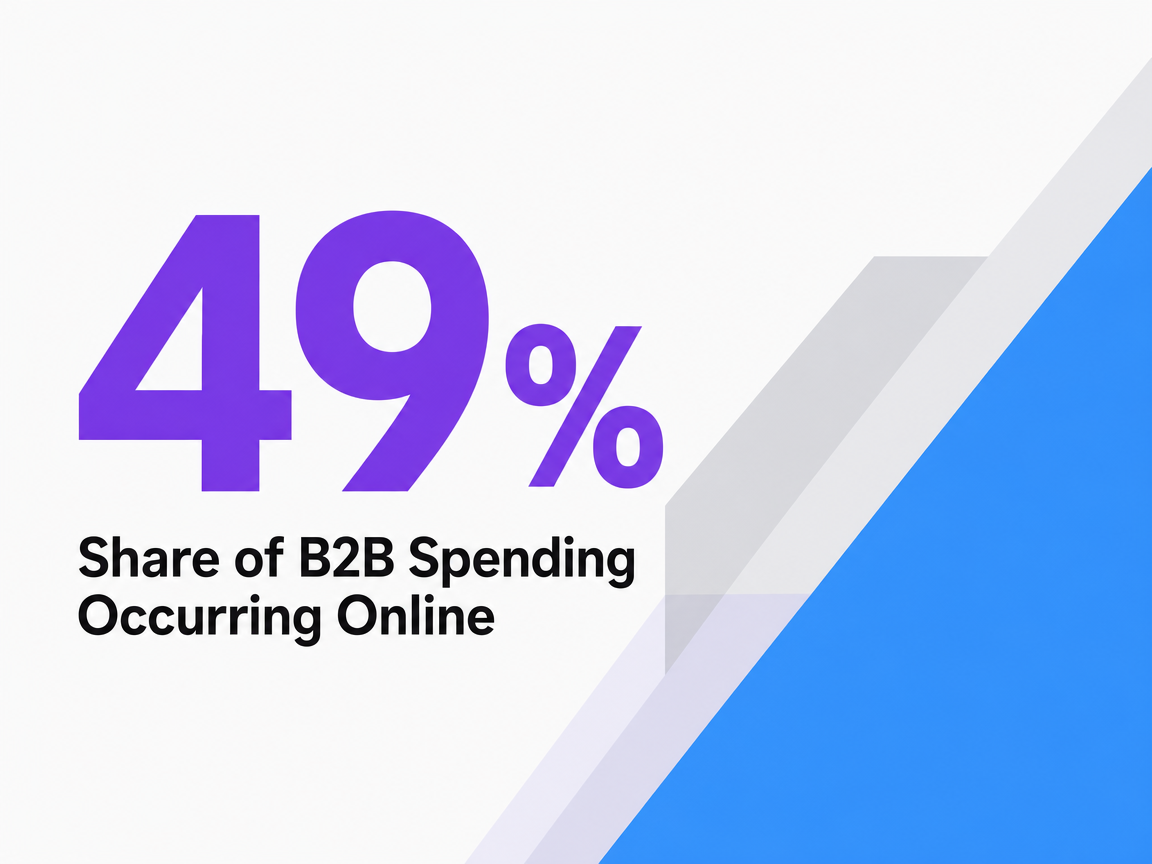 Share of B2B Spending Occurring Online
Share of B2B Spending Occurring Online
Test revenue-focused SEO keyword strategies instantly
Validate high-impact keyword selections and publish live SEO content in your own environment during the trial.
The Revenue Yield Score: A Replacement for Volume-Times-Difficulty
The Four Inputs That Survive a CFO Conversation
The traditional "volume times difficulty" metric is irrelevant in a CFO conversation. A Revenue Yield Score replaces it with four inputs directly aligned with pipeline metrics that finance leaders already track: intent fit, committee role, conversion-weighted volume, and AI-surface probability.
Intent fit : measures how closely a query aligns with a problem the product solves. Search Engine Journal's framework for B2B keyword research recommends rating each keyword's business value on a 1–3 scale for revenue potential, rather than prioritizing volume 5. For example, "reduce cost per qualified lead" scores higher than "what is content marketing," even if the latter has ten times the search volume.
Committee role : assigns each keyword to the relevant buyer, evaluator, end user, or champion, as defined previously. The weight assigned to each role is calibrated using closed-won data, not assumptions. In most B2B deals, economic-buyer queries carry the highest per-query revenue weight because they precede budget approval.
Conversion-weighted volume : multiplies estimated monthly searches by a historical conversion rate for that query type, derived from analytics and CRM data. A query with 200 searches that converts at 4% is more valuable than one with 2,000 searches that converts at 0.2%.
AI-surface probability : estimates whether a query will result in a click, a citation within an AI answer, or no visible surface at all. These four inputs combine to form a single score that ranks the portfolio based on its potential pipeline contribution, rather than just ranking potential.
Scoring an Existing Portfolio Against Closed-Won Data
Most marketing teams already possess the data necessary to score a keyword portfolio against revenue; the challenge lies in connecting it. Closed-won deals from the past twelve to eighteen months are traced backward through CRM attribution to the initial content touchpoint, and then to the keyword that generated the session. Each scored keyword inherits a weight derived from the deals it influenced, not merely the traffic it produced.
This exercise typically reveals three patterns:
- First, a small number of keywords drive a disproportionate share of the pipeline, often terms that rank trackers overlooked due to seemingly unremarkable volume.
- Second, a larger group of high-traffic keywords generates sessions that never appear in attribution paths leading to closed deals.
- Third, a middle group influences pipeline without directly closing deals, which is crucial for committee-aware scoring, as champion and evaluator queries rarely close deals independently.
McKinsey's B2B Pulse research indicates that top-performing companies achieve over 10% annual market share growth by integrating advanced analytics with coordinated marketing and sales execution 10. Scoring keywords against closed-won data is a practical application of this principle, transforming the portfolio from a ranking exercise into a revenue ledger that withstands quarterly business reviews.
Where AI-Surface Probability Belongs in the Score
AI-surface probability is often the most overlooked input, partly because it's new and few teams track it. McKinsey's analysis of AI search reports that only 16% of brands systematically monitor AI search performance, despite generative engines increasingly mediating queries that lead to shortlists 8. The remaining 84% are scoring keywords against a SERP that no longer represents the complete discovery landscape.
The scoring logic is straightforward. Queries that AI Overviews directly summarize—such as definitional, how-to, and broad informational searches—receive lower click probability scores but may score higher on citation probability if the content is structured for AI extraction. Queries that AI engines tend to defer to source pages—like comparisons, specific product evaluations, and deep technical questions—score higher on click probability and warrant traditional optimization. Queries that generative engines interpret as commercial intent often surface citations alongside summaries, meaning the same keyword can generate both a click and inclusion in an AI answer.
Integrating AI-surface probability as a fourth scoring input keeps generative engine optimization within the keyword framework, preventing it from becoming a separate, budget-competing discipline.
Portfolio Economics: What Execution Actually Costs
While a Revenue Yield Score ranks the portfolio, execution cost determines whether that ranking translates into profit. Most VPs evaluating keyword strategy against a CFO's standards encounter a common discrepancy: the score exists in a spreadsheet, but the cost of producing, publishing, and maintaining content for those keywords is spread across agency retainers, tool stacks, freelance rosters, and paid media line items, often without consolidation.
The crucial exercise is to divide scored pipeline contribution by total execution cost, not by content output. Stanford's analysis of search economics noted that SEO companies historically operate on 10–20% profit margins 13, a reminder that discoverability, while leveraged, is not free. The denominator is where most ROI calculations typically falter.
The table below outlines cost categories as variables rather than benchmarks. Honestly filling these in often reveals a total cost higher than what finance departments typically see.
| Execution Cost Category | Traditional Stack (variable) | Integrated AI Execution |
|---|---|---|
| Strategy and retainer | Monthly agency fee | Included in platform |
| Content production | Per-article cost × volume | Included in platform |
| SEO and rank tools | Annual tool stack | Included in platform |
| PPC management | % of ad spend or flat fee | Included in platform |
| Coordination overhead | Internal hours × loaded rate | Approval workflow only |
| Platform fee | — | $599/mo after trial |
McKinsey's B2B Pulse research found that top performers grow market share by over 10% annually by coordinating analytics, content, and sales motions within a single execution model, rather than across multiple vendors 10. The economic argument for consolidation is that coordination cost is often the largest hidden expense in the denominator, and it rarely appears on any invoice.
If a Marketing Leader Manages Multiple Locations
The framework discussed so far assumes a single brand competing on national queries. However, multi-location operators—such as DSOs, law firm networks, behavioral health groups, home services franchises, and senior living portfolios—face a different keyword dynamic. Pipeline is the aggregate of dozens or hundreds of local markets, and a national keyword score that overlooks location-level demand can obscure both opportunities and inefficiencies.
Two adjustments are critical:
- First, conversion-weighted volume must be calculated per market, not as a national average. A query like "orthodontist [city]" may have consistent intent across 40 markets but yield vastly different close rates depending on local competition, payer mix, and intake capacity.
- Second, committee mapping often simplifies in most local service verticals because the buyer, evaluator, and end user are frequently the same person. This elevates the importance of validation queries—reviews, comparisons, and proof-of-outcome terms—relative to enterprise B2B portfolios.
McKinsey's omnichannel research notes that B2B buyers now move seamlessly between digital and human touchpoints, with a location-level digital presence increasingly mediating the initial conversation 11. For multi-location operators, this means the keyword portfolio is not a single list, but a national scaffold with local revenue weights applied to each entry.
See How Leading Brands Identify SEO Marketing Keywords That Correlate with Revenue
Connect with our team to review your current SEO keyword strategy and benchmark it against proven, revenue-driving approaches used by top-performing enterprise marketing teams.
The Demand-Creation Tradeoff Most Frameworks Hide
Scoring keywords solely against closed-won data has a subtle drawback: the portfolio can shrink to include only queries run by existing in-market buyers. A list dominated by comparison terms, pricing pages, and vendor-aware searches will convert well in the short term but may deplete the brand's future audience. Forrester's research indicates that buyers now have longer cycles and more stakeholders, meaning many future deal-closers are not yet conducting bottom-funnel queries today 9.
The inherent tradeoff is that conversion-weighted scoring rewards harvesting existing demand while penalizing demand creation. A keyword that introduces a category to a future economic buyer rarely appears in CRM attribution, as the initial touchpoint occurred months before the opportunity materialized. Removing such queries from the portfolio improves the score but weakens the pipeline that feeds it.
The solution is a budget split, not a scoring adjustment. A robust portfolio allocates a fixed share—typically 20% to 30%—to problem-aware and category-defining queries that may not earn their place based on revenue weight alone. This allocation is reviewed annually against pipeline composition, rather than monthly against rankings.
Operating the Portfolio: Detect, Score, Approve, Measure
A Revenue Yield Score is a static artifact until it is actively managed. Portfolios that consistently generate revenue treat keyword management as a continuous cycle of four motions: detect, score, approve, and measure. Each motion relies on different data sources and operates on a distinct cadence.
- Detect runs continuously. New queries emerge from Google Search Console, internal site search, sales call transcripts, and AI chat citations. McKinsey's analysis of AI search recommends that brands assess visibility across generative platforms in addition to traditional SERPs 8. This means detection now includes monitoring whether content is cited within AI answers, not just whether URLs rank.
- Score occurs weekly or biweekly. New and existing keywords are evaluated based on intent fit, committee role, conversion-weighted volume, and AI-surface probability. Weights are recalibrated as fresh closed-won data enters the CRM.
- Approve decisions are made based on the score. Production, content refresh, and retirement decisions are routed through a single review process, rather than being negotiated across a content vendor, an SEO agency, and an internal editor.
- Measure closes the loop against pipeline contribution, not rankings. For marketing leaders consolidating this cycle into a single execution model, platforms like Vectoron automate the detect-score-approve-measure process, with human oversight for every decision.
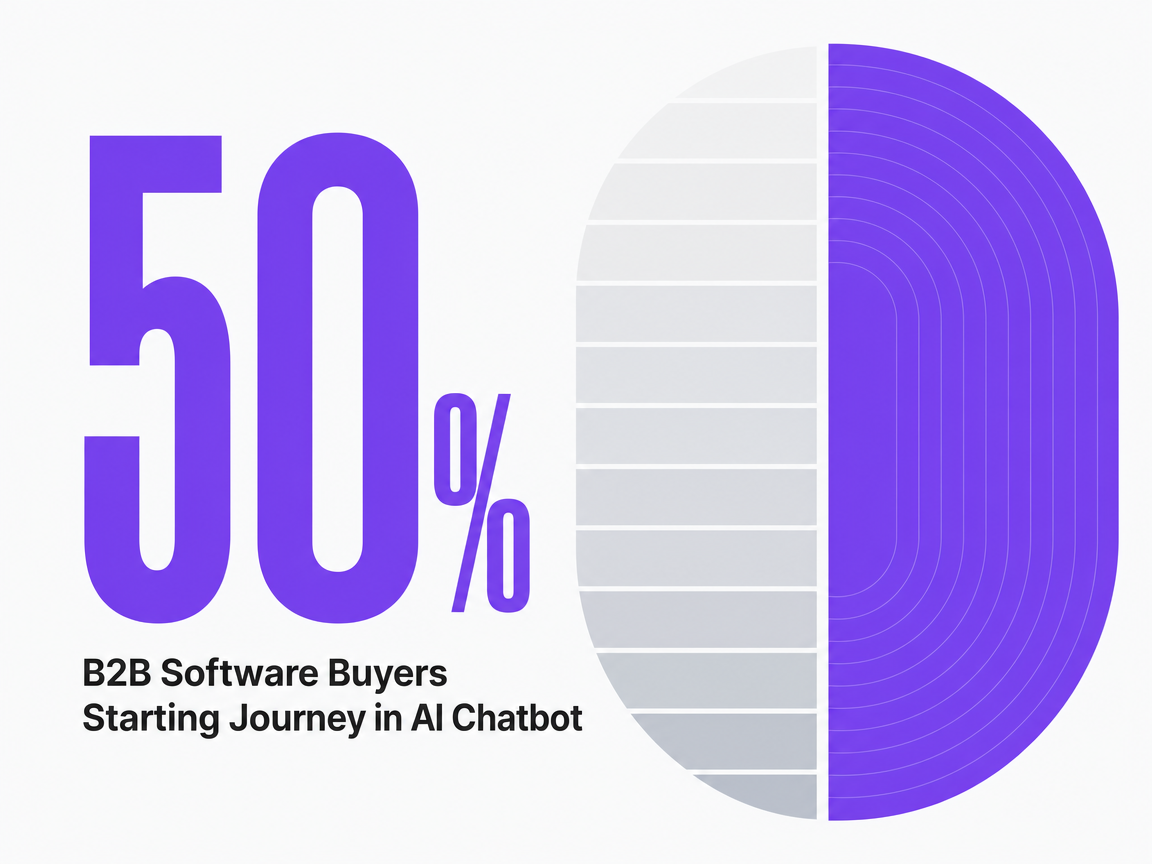 B2B Software Buyers Starting Journey in AI Chatbot
B2B Software Buyers Starting Journey in AI Chatbot
Frequently Asked Questions
References
- 1.B2B Organic Lead Generation Strategies for Sustainable Business Growth.
- 2.B2B marketing: Connecting with new & existing business buyers.
- 3.Traditional B2B Sales and Marketing Are Becoming Obsolete.
- 4.How AI Chat is Rewriting B2B Software Buying.
- 5.B2B Keyword Research Done Right With Practical Examples.
- 6.How did people behave after searching Google in 2024 vs. 2025?.
- 7.Pretty shocking developments in paid search for B2B:.
- 8.Winning in the age of AI search.
- 9.Forrester's 2023 Global Buyers' Journey Survey.
- 10.The multiplier effect: How B2B winners grow.
- 11.The new B2B growth equation.
- 12.Myth Busting 101: Insights Into The B2B Buyer Journey.
- 13.The impact of Internet technologies: Search.
- 14.Future of B2B sales: The big reframe.