
Key Takeaways
- Flat teams stall on organic growth because coordination cost—briefing, revisions, vendor handoffs, and reporting reconciliation—consumes the calendar, leaving no time for the strategic decisions that compound pipeline.
- A scalable SEO plan is an operating model, not a channel calendar: Strategy and Approval stay human-owned, while Production and mechanical Publish and Measure work compress through AI assistance with a named reviewer gating every artifact 1.
- As AI summaries absorb informational queries, KPIs must move from sessions to qualified pipeline by intent tier, with a GEO layer tracking summary presence and citations, since only 16% of brands track AI search performance 2, 4.
- Trust infrastructure protects scaled output: E-E-A-T substantiation, FTC-compliant review processes under the 2024 final rule, and adversarial checks on AI-assisted drafts keep credibility high enough that added volume actually converts 8, 10, 11.
Why flat marketing teams stall on organic growth
Most mid-market marketing teams do not stall on organic growth because they lack tactics. They stall because coordination cost eats the calendar. A team of four running an SEO program across product pages, blog production, backlink outreach, and local listings spends the majority of its week briefing, reviewing, chasing vendors, and reconciling reports. The strategic work—deciding what to publish, what to kill, and what to double down on—gets whatever time is left.
That imbalance shows up in the CFO conversation. Organic traffic may grow, but pipeline does not compound. Peer-reviewed work on digital inbound marketing identifies conversion rate, not raw sessions, as one of the most relevant KPIs for SEO and SEM effectiveness 4. Flat teams often cannot get to conversion analysis at all because production and coordination consume the hours a data-science-led review would require 5.
The second stall point is external. Search behavior is shifting toward AI-generated summaries, and the measurement systems most in-house teams inherited were built for ten blue links. A plan that treats SEO as a content calendar—rather than an operating model with defined decision rights, approval gates, and measurement contracts—cannot absorb that shift without more headcount.
The rest of this article lays out what that operating model looks like: which stages stay human-owned, which become AI-assisted, how KPIs move from traffic to pipeline, and how trust and compliance become part of the pipeline infrastructure rather than a footnote.
The operating model, not the channel plan
What a scalable SEO plan actually decides
A scalable SEO plan is not a list of keywords, page counts, or link targets. It is a set of decisions about who owns what, when work moves forward, and how outcomes get measured. Most plans that fail to scale confuse output with strategy—more posts, more pages, more calls with agencies—without ever fixing the underlying question of decision rights.
A working plan makes four decisions explicit:
- What the program is competing on: the peer-reviewed review of SEO strategy identifies niche differentiation and content-related factors among the major components that determine whether a program can win in its category 3.
- Which stages of work require human judgment and which can be produced or accelerated by AI.
- What constitutes a shippable artifact—the approval standard that governs every page, brief, and outreach asset before it goes live.
- How success is booked: which KPIs feed the CFO conversation and which stay operational.
Once those decisions are written down, the plan stops being a channel calendar and becomes an operating model. Priorities can be re-ranked weekly without renegotiating scope. New pages can enter the queue without a briefing meeting. And the team can absorb changes in search behavior—AI overviews, new ranking signals, review-integrity rules—without adding people, because the model already defines where changes get processed.
Human judgment vs. AI-assisted production across the loop
The SEO operating loop has five stages: Strategy, Production, Approval, Publish, Measure. A flat team scales only when the allocation of human vs. machine work across those stages is deliberate rather than habitual.
Strategy stays human. Deciding which segments to pursue, which pages to retire, and which bets to make against a shifting search landscape is judgment work. Approval also stays human. Every artifact—brief, draft, meta description, outreach email, schema update—should pass a named reviewer whose sign-off is recorded. Publish and Measure are mixed: humans set the release policy and the measurement contract, while systems execute the mechanics.
Production is where the allocation shifts. Harvard's analysis of AI in marketing argues that routine tasks such as writing copy, mining consumer data, and creating visuals—work that once took hours—can now be completed in minutes with AI assistance, freeing marketers to focus on strategy and creative direction 1. For an SEO plan, that reallocation means outlining, drafting, on-page optimization, internal link suggestions, schema generation, competitor gap analysis, and reporting summaries move to AI-assisted production. Editorial judgment, source vetting, positioning claims, and any statement of expertise stay human.
The infographic that belongs in this section makes the allocation legible: Strategy → Production → Approval → Publish → Measure, with the human-owned stages marked at both ends and the AI-assisted compression concentrated in Production and the mechanical parts of Publish and Measure. That visual matters because most flat teams do not have an allocation problem in principle—they have one in practice, with senior marketers still hand-editing meta titles at 9 p.m.
Two rules keep the loop honest. AI-assisted output does not skip approval; the reviewer's judgment is the quality gate. And measurement is not delegated to the same system producing the work, because the paper on data-science methods in digital marketing reinforces the need for analytics-driven prioritization that is independent of production incentives 5. Separating who makes from who measures is what prevents an efficient factory from producing the wrong things faster.
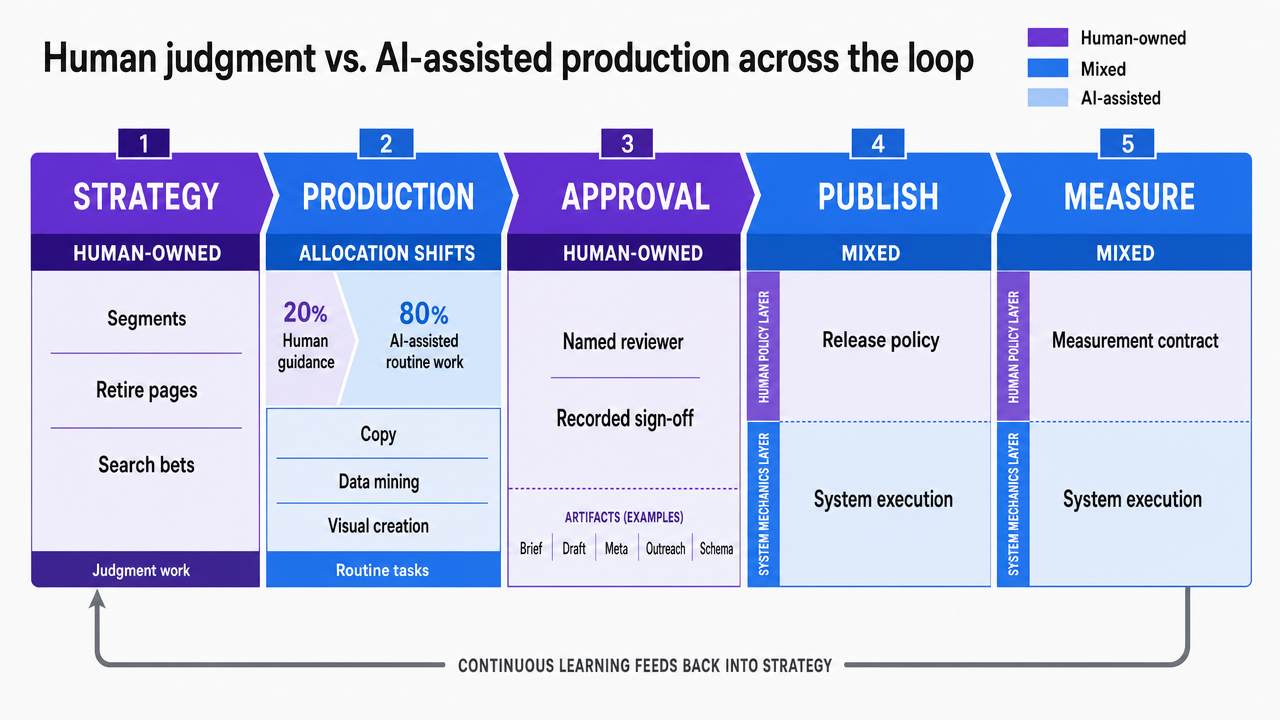 Visualize the five-stage SEO operating loop with human-owned versus AI-assisted allocation, directly matching the section's explicit description of the loop
Coordination cost: where the hours actually go
Flat teams rarely fail because they lack ideas. They fail because coordination consumes the calendar. On a typical week, the hours are not spent writing pages or analyzing rankings—they are spent moving work between people and systems.
Five activities eat the majority of the time:
- Briefing: translating a strategic intent into something a writer, freelancer, or agency can execute.
- Revision cycles: rounds of edits that move a draft between an internal reviewer, an external writer, and a subject-matter expert.
- Vendor handoffs: separate relationships for content, links, technical SEO, and local listings, each with its own portal, contact, and reporting cadence.
- Status reconciliation: pulling data from four tools into one deck for the monthly review.
- Approval chasing: waiting for a legal, compliance, or executive sign-off that was never scheduled.
Every one of those activities is coordination overhead, not production. And every one of them scales with the number of vendors, tools, and reviewers in the loop rather than with the number of pages produced.
The operating model in 2.1 and the allocation in 2.2 attack coordination directly. When Production is compressed by AI assistance and Approval is routed through a single named reviewer, briefing and revision cycles shrink because the brief, the draft, and the review notes live in the same workflow. When vendor relationships consolidate into a governed loop, handoffs and status reconciliation drop. What remains is the work only humans should be doing: setting direction, approving artifacts, and reading the measurement signal. That is the shape of an SEO plan that can grow output without growing the team.
Test a Scalable SEO Workflow in Real Time
Experience hands-on execution of your actual SEO plan with measurable results during your free trial.
Aligning the plan to AI-influenced search
GEO enters the measurement contract
The search interface most in-house teams optimized against for a decade is no longer the interface most users see. McKinsey's analysis of AI-powered search estimates that roughly half of Google searches already include AI summaries, while only 16% of brands systematically track their performance in AI search 2. That is the strategic hinge of any plan being written in the current cycle: adoption on the user side has outrun measurement on the brand side by a wide margin.
The gap matters because it distorts internal reporting. A team looking only at classic rank tracking and session counts can miss the fact that a query now resolves inside an AI summary, with the user never clicking. Traffic charts stay flat or drop, but the brand's presence in the answer surface—citations inside the summary, inclusion in comparison lists, mentions in LLM outputs—may be growing or shrinking without any dashboard reflecting it. The measurement contract has to catch up before the content strategy can.
Practically, that means the plan adds a GEO layer to the existing measurement stack rather than replacing it. Three additions carry most of the weight:
- A tracked set of high-intent queries checked periodically for AI summary presence and citation source.
- A log of brand mentions inside generative engine outputs across the major surfaces.
- A content classification that flags which pages are structured for extractive answers versus which are optimized only for classic ranking.
McKinsey's framing of GEO positions these as diagnostic moves brands can adopt without rebuilding the SEO program from scratch 2.
The measurement contract, written down, is what keeps executive reviews honest as the interface shifts underneath the plan.
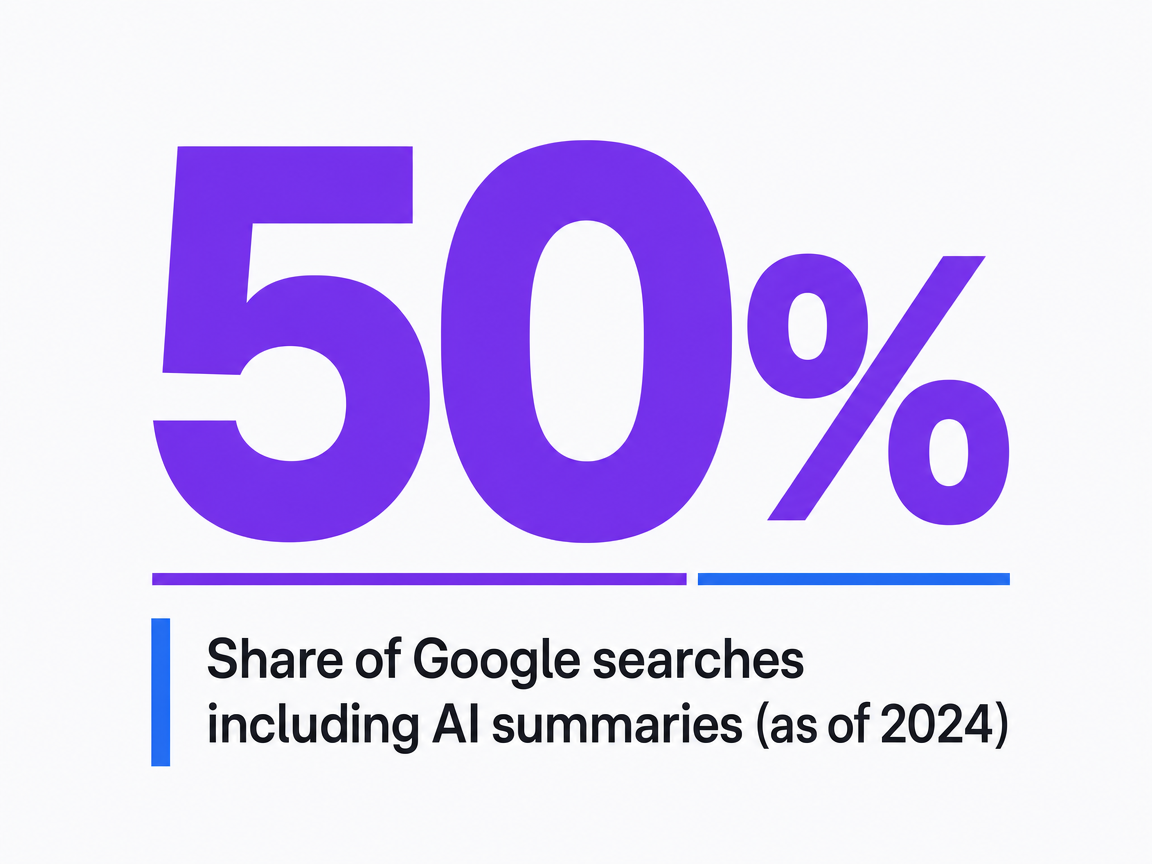 Share of Google searches including AI summaries (as of 2024)
Share of Google searches including AI summaries (as of 2024)
KPIs that move from traffic to pipeline
When AI summaries absorb informational queries, session counts become a weaker proxy for demand. The KPIs that survive the shift are the ones already tied to pipeline. Research on digital inbound marketing identifies conversion rate as one of the most relevant KPIs for SEO and SEM effectiveness—the metric that connects acquisition to economic performance rather than to activity 4.
A working definition helps. A systematic assessment methodology, developed in a health-website context but broadly applicable to service-vertical SEO, defines conversion rate as the share of users who complete a desired goal relative to total users 6. For a mid-market service business, the desired goal is rarely a newsletter signup. It is a booked consultation, a qualified form fill, a scheduled visit, or a call that meets a defined qualification bar.
Three KPI moves follow:
- Replace or supplement session goals with qualified-lead goals at the page and cluster level, so a page's job is measured against pipeline contribution rather than traffic.
- Track conversion rate by intent tier—commercial pages, comparison pages, informational pages—so the team can see where AI summaries are compressing informational demand and where commercial pages still convert at strength.
- Add a data-science-led prioritization cadence: the review of data-science methods in digital marketing reinforces that analytics-driven prioritization outperforms opinion-led backlog management when the volume of possible work exceeds team capacity 5.
The reporting change is small on the surface and large in effect. The monthly review stops asking whether traffic grew and starts asking which pages produced qualified pipeline, at what conversion rate, against which intent.
Strategic inputs a scaled plan must protect
Compression through AI assistance is only safe if the strategic inputs stay intact. The peer-reviewed review of SEO strategy identifies niche differentiation and content-related factors among the major components that determine whether a program can win in its category 3. Those inputs cannot be automated away without collapsing the program into commodity output.
Niche differentiation is the first input to protect. A plan that produces high volumes of generic pages will lose ground in AI-influenced search, where extractive answers reward specificity, first-hand expertise, and distinct point of view over restatement. The editorial standard has to name what the program is competing on—which segments, which questions, which claims the brand can defend—before production scales.
Content-related factors are the second. Structure, depth, source quality, and internal cohesion drive both classic ranking and eligibility for citation inside generative outputs. A single program evaluation of an integrated SEO, content, and backlink effort found that organic search was the most successful channel for acquiring total users, young adults, and return users in that specific program, illustrating how the inputs compound when they work together rather than as isolated tactics 7.
The operational rule is straightforward. AI-assisted production accelerates the execution of a defensible position; it does not create one. The plan protects the inputs by writing them down—segment focus, editorial standard, source policy—before adding volume.
Trust and compliance as pipeline infrastructure
E-E-A-T, review integrity, and synthetic-content controls
Trust signals are not a compliance footnote in a scaled SEO plan. They are what protects the pipeline the plan is built to produce. As production volume rises through AI assistance, the credibility layer around that production has to rise with it, or conversion rates fall even while rankings hold.
The link between trust and conversion is direct. Research on trust and website conversion finds that consumer trust plays a central role in whether traffic becomes action, meaning SEO success depends on the quality of trust signals a visitor encounters, not just the ranking that delivered them 8. For regulated service verticals—law firms, dental groups, behavioral health providers, senior living operators—the trust layer is the difference between a qualified inquiry and a bounce.
Three controls belong in the plan.
The first is E-E-A-T substantiation at the artifact level: named authors with verifiable credentials, source citations on factual claims, and clear editorial ownership on every page. This is what makes a page eligible for both classic ranking authority and citation inside generative outputs.
The second is review integrity. The FTC's 2023 updated guidance expanded the scope of concern to include procuring, suppressing, boosting, organizing, publishing, upvoting, downvoting, or editing reviews to distort consumer perception 9. The 2024 final rule went further, prohibiting buying, selling, or knowingly disseminating fake or false reviews and testimonials 10. For local and multi-location SEO programs where review signals feed map-pack rankings and click-through, the operational consequence is concrete: any process that solicits, filters, or edits reviews needs a documented policy that survives regulatory review.
The third is a synthetic-content evaluation control. NIST's analysis of synthetic content risks notes that a common framework used to measure the quality of synthetic content is to construct attacks and defenses on the system—effectively, adversarial testing of what the production layer produces 11. In an SEO plan, that translates to a review standard where AI-assisted drafts are checked for fabricated citations, invented statistics, and unverifiable claims before they reach the approval queue. The reviewer named in the operating model is the one enforcing that check.
These three controls belong together because they share a single operational purpose: keeping the credibility of the output high enough that scaled production converts. The plan that adds volume without adding these controls will grow traffic and lose pipeline at the same time.
See How Leading Teams Scale SEO Execution—No Extra Hires Required
Request a walkthrough of coordinated, AI-powered workflows that deliver measurable SEO growth, streamline multi-channel campaigns, and keep full strategy oversight—all without increasing team size or vendor complexity.
If you manage multiple locations: consolidating the execution model
Coordination economics across three operating models
The reader shifts here. This section is written for multi-location operators—dental groups and DSOs, multi-site law firms, home services franchises, senior living portfolios, behavioral health networks—where the SEO plan runs against ten, forty, or two hundred locations rather than one brand site. The math changes at that scale, because coordination cost multiplies per location while strategic decisions do not.
Three operating models dominate:
- A traditional agency of record centralizes execution externally, which reduces internal load but adds briefing cycles, revision rounds, and monthly reporting reconciliation for every location under management.
- An in-house team with point tools keeps decisions close but forces a small group to run separate content, backlink, technical, and local-listing workflows across every site.
- A unified AI-assisted execution model with human approval compresses production and reporting into one governed loop, keeping the reviewer named and the strategic decisions in-house while the mechanical work moves to the system.
Harvard's analysis of AI in marketing frames this reallocation directly: routine tasks that once consumed hours—copy production, data mining, visual creation—can now be completed in minutes, shifting human time toward strategy 1.
The variables that matter across all three models are the same: hours per location per month spent on briefing, revision cycles, and reporting; the number of vendor relationships in the loop; and approval cycle time from request to publish. The table below compares those variables without inventing dollar figures.
| Variable (per location, per month) | Agency of record | In-house with point tools | Unified AI-assisted, human-approved |
|---|---|---|---|
| Briefing hours | High — external translation of intent for each asset | Moderate — internal translation, fewer handoffs | Low — brief, draft, and review share one workflow |
| Revision cycle hours | High — multi-party rounds across writer, account, reviewer | Moderate — reviewer and internal producer | Low — reviewer edits directly on AI-assisted draft |
| Reporting reconciliation hours | High — agency deck plus internal tool exports | High — data pulled from separate point tools | Low — single reporting layer |
| Vendor relationships | 1 primary plus specialty subcontractors | 4–6 point tools, often per channel | 1 governed loop |
| Approval cycle time | Days to weeks per artifact | Days per artifact | Hours per artifact |
| Decision rights | Shared, often ambiguous | Internal, but fragmented across tools | Internal, named reviewer per artifact |
The operational read is straightforward for a portfolio operator. Agency models minimize internal hours per artifact but maximize coordination cost per location and lengthen approval cycles. Point-tool in-house models keep decision rights close but leave the same small team reconciling four to six systems across every site. The unified model reduces briefing, revision, and reporting hours per location while keeping the strategic decisions—segment focus, editorial standard, approval authority—inside the operator's team. For a group running SEO across twenty or more locations, the compounding effect of hours-per-location is where the plan either scales without headcount or quietly requires another hire every year.
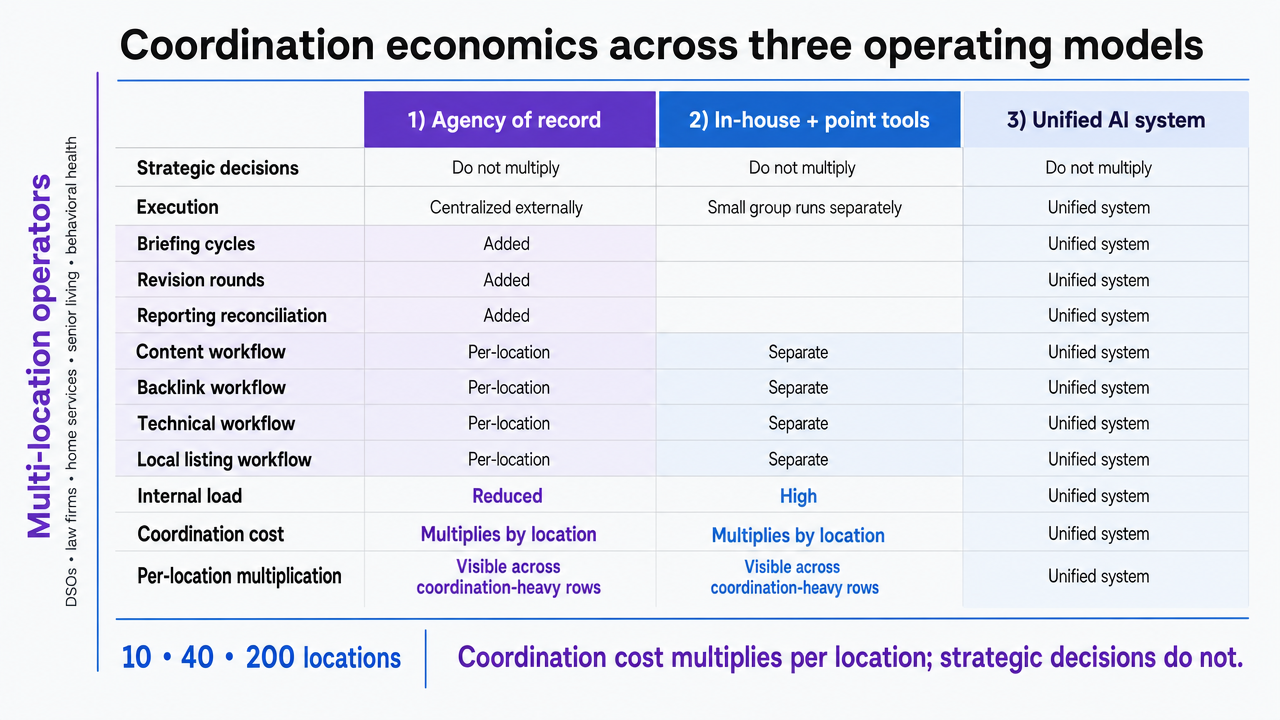 Visualize the section's explicit comparison table of three operating models across coordination variables for multi-location operators
A decision framework: keep human, automate, eliminate
The plan gets operational when every recurring SEO task is sorted into one of three buckets: Keep human. Automate with approval. Eliminate.
Keep human : Covers the work where judgment is the product: segment selection, editorial positioning, source vetting, expert review of any claim tied to legal, medical, or financial outcomes, final approval on every artifact, and the measurement contract that defines what counts as pipeline. The peer-reviewed SEO strategy review names niche differentiation and content-related factors as core determinants of program performance—these inputs belong to named humans, not systems 3. Trust signals sit here too, because trust drives whether qualified traffic converts at all 8.
Automate with approval : Covers the production and mechanical stages. Harvard's analysis of AI in marketing frames the reallocation directly: routine tasks that once took hours—copy production, data mining, visual creation—can be completed in minutes with AI assistance 1. For SEO, that means outlining, first-draft writing, on-page optimization, schema generation, internal link suggestions, competitor gap pulls, rank and citation monitoring, and reporting summaries move to AI-assisted execution with a named reviewer gating publish. Analytics-driven prioritization of the backlog also belongs here, since data-science methods outperform opinion-led sequencing when the volume of possible work exceeds team capacity 5.
Eliminate : Covers work that produces coordination without producing pipeline: standing status meetings whose output is a deck, monthly reports that recreate what a single dashboard already shows, briefing documents that translate the same intent for four different vendors, and any review-solicitation process that cannot survive FTC scrutiny under the 2024 final rule 10. Cutting these frees the hours the first two buckets need to work.
Sorted this way, a scaled SEO plan stops depending on more people and starts depending on clearer decisions.
Frequently Asked Questions
References
- 1.AI Will Shape the Future of Marketing.
- 2.Winning in the age of AI search.
- 3.Search engine optimisation (SEO) strategy as determinants to ... - PMC.
- 4.Digital inbound marketing: Measuring the economic performance of ....
- 5.Using Data Sciences in Digital Marketing: Framework, methods, and ....
- 6.Methodological Guidelines for Systematic Assessments of Health ....
- 7.Process Evaluation of the 'No Money No Time' Healthy Eating ... - PMC.
- 8.Trust and website conversion in consumer responses to green ....
- 9.Federal Trade Commission Announces Updated Advertising Guides to Combat Deceptive Reviews and Endorsements.
- 10.Federal Trade Commission Announces Final Rule Banning Fake Reviews and Testimonials.
- 11.Reducing Risks Posed by Synthetic Content.