
Key Takeaways
- Fixed-cost SEO replaces variable per-deliverable billing with a defined monthly output, a documented production standard, and a stable unit cost per published asset that a CFO can budget against.
- Prioritization should follow a pipeline-weighted page inventory that scores clusters by commercial intent, on-page conversion path, AI-summary exposure, and historical close rate—not by search volume alone.
- Reallocation beats reduction: shift budget toward citable assets, refreshing high-weight existing pages, and joint paid-organic measurement, since sponsored search can reduce organic sales by nearly the same amount it adds 9.
- Build the case in one quarter by producing an intent map and ranked queue, then the production standard and unit cost, then session-to-pipeline measurement using long-cycle attribution logic 15.
Why Variable-Cost SEO Broke in the AI Search Era
The old SEO retainer model assumed a clean equation: publish more, rank more, click more, close more. That equation started fracturing the moment AI Overviews began occupying the top of the results page.
Pew Research analyzed the browsing behavior of 900 U.S. adults in March 2025 and found that users clicked a traditional search result in 8% of visits when an AI-generated summary appeared, compared to 15% of visits without one. Only 1% of visits to pages with AI summaries produced a click on a cited source 2. That is a narrow study, not a universal law, but the direction is what matters for budgeting: the same ranking now returns roughly half the clicks when a summary sits above it.
Variable-cost SEO programs, the kind billed per deliverable or per hour by an outside agency, were designed for a world where publishing volume tracked closely with traffic, and traffic tracked closely with pipeline. When an AI summary intercepts the click, the middle link in that chain weakens. A VP paying a variable rate for briefs, drafts, revisions, and technical fixes is now paying more per booked consultation, not less, because the yield per published asset has dropped while the input cost stayed the same.
The response is not to cut SEO. Search remains the dominant entry point for high-stakes research; 77% of online health seekers, for example, start at a search engine 18. The response is to fix the cost side. A fixed monthly output, produced against a stable standard, converts SEO from an unpredictable line item into a budgeted acquisition system that a CFO can model. The next section defines what fixed cost actually means once pipeline, not rankings, becomes the outcome metric.
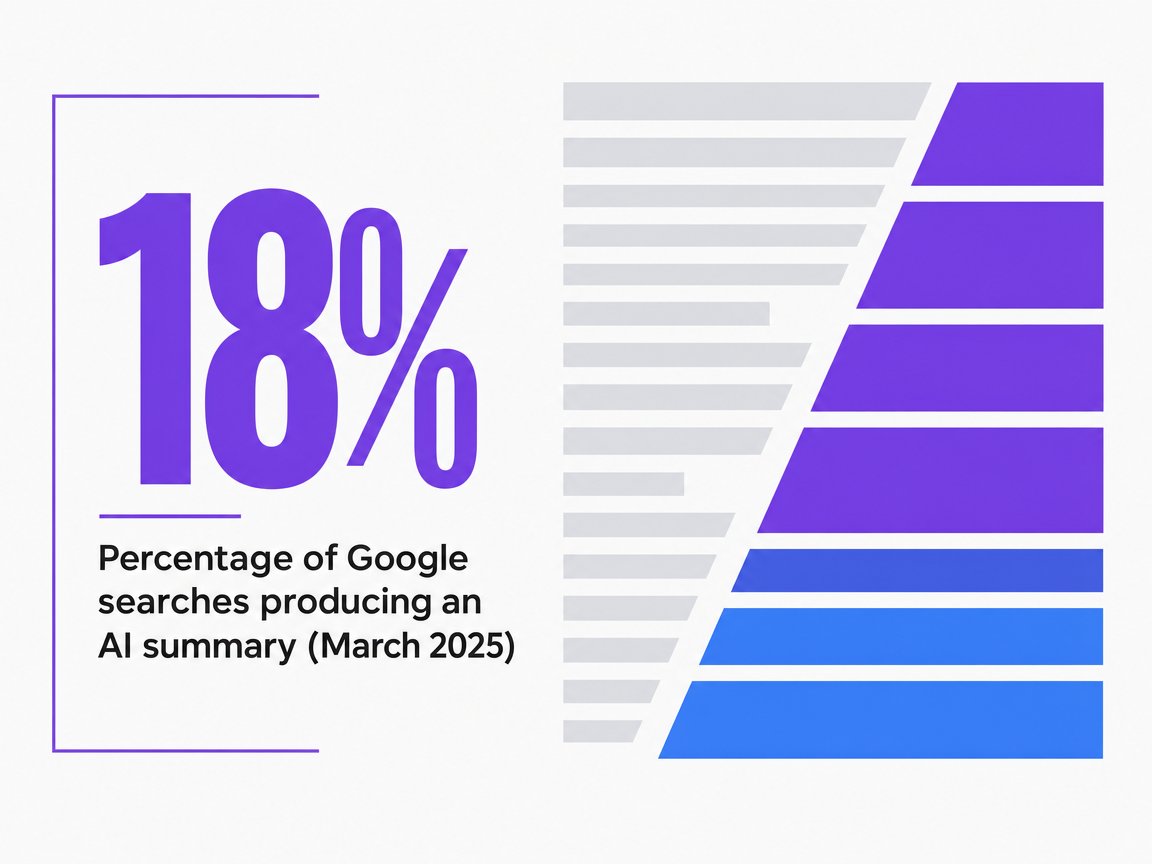 Percentage of Google searches producing an AI summary (March 2025)
Percentage of Google searches producing an AI summary (March 2025)
What Fixed-Cost Actually Means in a Pipeline-First Operating Model
Fixed-cost SEO is not a cheaper retainer. It is a decision to convert a variable production line into a governed one, where the monthly output, the standard that output has to meet, and the measurement layer underneath it are all defined before any work ships.
In a variable-cost model, the invoice moves with the work: five briefs one month, twelve the next, a technical audit dropped in when someone remembers, revision rounds billed by the hour. The output shape is whatever the agency has capacity for that month. In a fixed-cost model, the inputs are held constant. A set number of pages, a set number of updates to existing assets, a set cadence of technical hygiene against Google's Search Essentials baseline 1, and a set reporting rhythm against pipeline metrics. What varies is which pages get produced, not how many.
Three inputs have to be nailed down for the model to hold. First, unit cost per published asset — the fully loaded cost of research, drafting, editing, approval, and publishing for one page at the defined standard. Second, monthly production volume at that unit cost. Third, the intent map that decides which pages the volume gets spent on. Without the third input, fixed cost degrades into fixed waste.
Pipeline-first means the output metric is qualified calls, booked consultations, or SQLs attributed to organic sessions, not keyword rankings or session counts. Academic work on SEO as a discipline treats it as a structured optimization system with measurable inputs and outputs 13, and that framing is what makes CFO-level budgeting possible. A VP who can name the unit cost, the monthly volume, and the pipeline yield per cohort of pages has a line item finance can model. A VP who can only name last quarter's traffic delta does not.
Pipeline-Weighted Page Inventory: The Prioritization Method Most Teams Skip
Most SEO backlogs are still ordered by search volume and keyword difficulty. That worked when a top-three ranking on a 5,000-search-per-month term reliably produced a knowable click yield. It does not work when the same ranking can be intercepted by a summary the searcher never scrolls past.
A pipeline-weighted page inventory reorders the backlog around a different question: what is the expected qualified-pipeline contribution of this page over the next twelve months, given its intent, its position in the buying journey, and its exposure to AI summarization? Pages get scored, not just tracked. The score combines four inputs a VP can defend to finance: the commercial intent of the query cluster, the conversion path available on the page, the probability that the SERP for that query returns an AI summary, and the historical close rate of leads that touched similar pages.
The AI-exposure input is where most teams miss the analysis. Pew's browsing-data study found that 58% of respondents conducted at least one search that produced an AI-generated summary 17. Exposure is not uniform across query types — informational and definitional queries draw summaries more often than transactional ones — but at the page level, the practical implication is direct: an informational asset without an on-page conversion path is now paying for impressions it may never convert into sessions. Instrumenting those pages with a defined next step (a calculator, a consultation booking, a gated diagnostic) is not a UX polish. It is what makes the page worth publishing under a fixed-cost model.
The scoring model itself is straightforward once the inputs are named. Query clusters closest to a booked consultation — a dental group's "cost of full-arch implants in [metro]," a behavioral health network's "how to admit a family member for outpatient care," a law firm's "deadline to file a wrongful termination claim" — get the highest weight. Top-of-funnel definitional pages get a lower weight, but not zero, because they seed brand familiarity and citation surface that academic work links to positioning outcomes 14. Pages that score below a floor get cut from the queue, not deferred. That is the discipline fixed cost demands: the monthly production volume is finite, and every slot spent on a low-weight page is a slot not spent on a high-weight one.
The output is a ranked queue that finance can audit. Each row shows the page, its target cluster, its weight, its projected pipeline contribution, and the unit cost to produce it. A VP presenting to a CFO can point to the top of the queue and say what pipeline that spend is intended to produce, and to the bottom of the queue and say what was explicitly not funded. That is a different conversation than defending a keyword report.
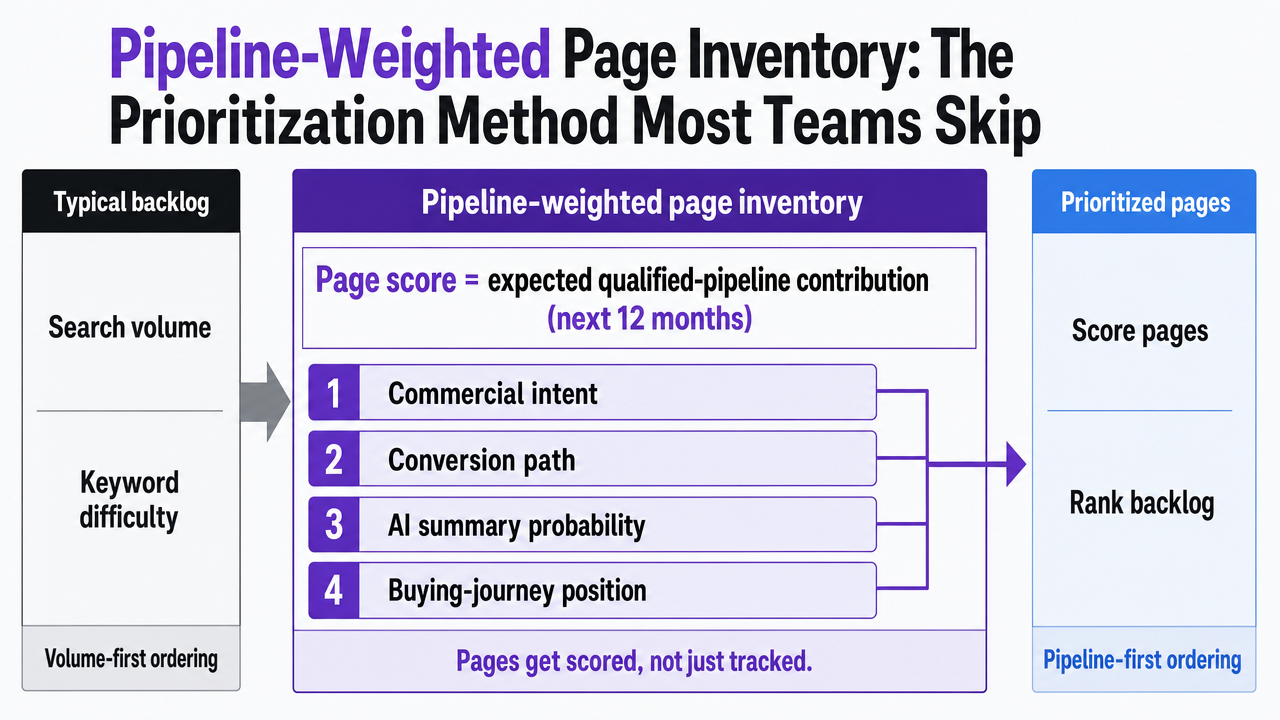 Visualize the four-input scoring framework the section describes for ranking pages by pipeline contribution, since this framework is the operational core of the section but has no chartable numeric data
Test Predictable SEO Pipeline Tactics Risk-Free
Deploy real SEO campaigns and measure pipeline impact before any commitment.
The Production Standard: Compressing Briefing Overhead Without Losing Evidence
The largest hidden cost in a variable-rate SEO program is not the writing. It is the coordination surrounding the writing. Kickoff calls, brief revisions, stakeholder review threads, subject-matter expert scheduling, legal read-throughs, and the second and third revision cycles that follow — those hours accumulate against every deliverable and rarely appear as a distinct line on an invoice. A fixed-cost model only works if that overhead is compressed, and it can only be compressed if the production standard is written down.
A production standard is a documented specification for what a page has to contain before it ships. It is not a style guide. It defines the evidence density expected per claim, the mandatory structural elements (H1, intent-matched H2s, a defined conversion element, internal link targets), the citation rules for any statistic or clinical claim, the reading-level ceiling, and the review path each page has to clear. Google's Search Essentials work — crawlability, unique titles, descriptive headings, useful meta descriptions — sits at the floor of that specification, not the ceiling 1. The DOE's public-sector guidance adds practical hygiene: descriptive link text, proper heading hierarchy, and routine cleanup of stale content 11. Neither is exotic. Both belong in the written standard so no writer, editor, or reviewer has to relitigate them per page.
The compression comes from what the standard removes. When the specification is explicit, briefs shrink from multi-page documents to a page brief listing the target cluster, the intent, the conversion element, and the three or four claims the page has to substantiate. Reviewers stop rewriting drafts to enforce preferences that were never documented. Legal reviews a defined list of claim types, not every sentence. The revision cycle that used to consume half the production budget contracts because the acceptance criteria were agreed to before drafting began.
Evidence density is the standard's non-negotiable clause. In a pipeline-first model, a page for a behavioral health network on outpatient admission steps, or a dental group on implant financing options, has to substantiate its factual claims with sourced references a reviewer can audit. That is the input academic work identifies as SEO's structured, methodological character 13— and it is also what protects the page's citation surface as generative engines begin sourcing answers from the same corpus. A page that meets the standard costs the same to produce whether one goes out this month or ten do. That is what makes the unit cost stable, and what makes the monthly output a number a CFO can plan against.
Reallocating Toward AI-Visible Assets Instead of Cutting Spend
The intuitive CFO response to falling click-through rates is to cut the line item that produces the clicks. That reasoning inverts the actual math. McKinsey estimates that AI-powered search could influence roughly $750 billion in annual revenue by 2028, and frames generative engine optimization as a distinct capability that requires its own diagnostics, KPIs, and content investment — not a subtraction from the SEO budget but a redirection of it 16. A VP walking into a budget review with a proposed organic-search cut is proposing to withdraw from the channel that is being restructured, not the channel that is disappearing.
Reallocation, not reduction, is the defensible position. The fixed monthly budget stays intact; what changes is the composition of the output inside it. Three shifts matter.
The first shift is toward assets built to be cited, not just ranked. Generative engines pull from pages that state claims cleanly, attribute sources, and structure information for extraction. The production standard already covers most of that ground — evidence density, sourced references, clear headings — but the queue has to include page types that AI systems are more likely to surface: comparison pages, definitional pages with unambiguous answers, and pages that consolidate a decision the buyer is actively making. A dental group's page on the difference between all-on-four and traditional implant restorations, written with sourced clinical detail, has a citation surface an AI summary can draw from. A thin ranking-bait page does not.
The second shift is toward updating existing pages rather than shipping new ones. Peer-reviewed work on SEO's strategic value shows that positioning and trust accrue to consistent, well-maintained content, not one-time publishing bursts 14. Under a fixed-cost model, a portion of the monthly slots — a third is a reasonable starting split — gets spent on refreshing the highest-weight pages already in the inventory. That reallocation compounds: the same page can be tuned for AI extractability, updated for factual accuracy, and re-instrumented for on-page conversion in a single production cycle.
The third shift is toward measurement infrastructure. Reallocated budget has to buy visibility into where organic sessions came from, which pages contributed to booked consultations, and which query types are being intercepted by summaries versus still producing clicks. Without that instrumentation, the reallocation argument has no evidence in six months. With it, the VP returns to the same CFO with a comparison the finance side can read: cost held flat, pipeline attribution improved, exposure to AI-mediated queries protected. That is the case a fixed-cost model was built to make.
The Paid + Organic Interaction Problem VPs Cannot Ignore
A predictable outcome of AI-driven click loss is a sales meeting where someone proposes moving organic budget into paid search. The logic sounds tight: if clicks are harder to earn organically, buy them. The evidence says the substitution is not that clean.
Blake and colleagues ran two large-scale experiments on sponsored search behavior and found that adding paid listings increased sales of the sponsored items, reduced organic sales, and produced a net reduction in total platform spending of roughly 1% 9. The paid line moved. The organic line fell by nearly as much. On a channel-by-channel report, the paid campaign looked incremental. On the combined ledger, it barely was — and in that specific experiment, it was slightly negative.
The academic work around paid-organic interaction reinforces the same point from different angles. Ghose and Yang document that whether paid and organic listings act as complements or substitutes depends on query type and listing position, not on channel labels 7. Agarwal's study finds that competing organic results measurably shift sponsored search performance 8. The Stern paper concludes that total click-through, conversion, and revenue outcomes are jointly determined when both listings are present 19. None of that supports the simple story that paid clicks replace organic ones at par.
For a VP defending a fixed-cost SEO line item, the operational read is direct. Report paid and organic against a combined pipeline metric, not two separate dashboards. When a query cluster has strong organic presence, run a holdout test before assuming paid on the same terms adds pipeline. And when the CFO asks whether the SEO budget can be redirected to Google Ads, the answer is not a defense of SEO — it is a request for the joint measurement that would make that trade-off legible in the first place. Cutting the channel that produces the free clicks to fund the channel that partially replaces them is a decision worth making with evidence, not with intuition.
See How Fixed-Cost SEO Delivers Predictable Pipeline—Without Adding Headcount
Request a walkthrough of AI-powered SEO execution workflows proven to reduce overhead and increase qualified pipeline for multi-location brands and agencies managing complex portfolios.
Measuring Fixed-Cost SEO Against Pipeline, Not Rankings
A rankings dashboard tells a VP what happened in the SERP. It does not tell a CFO what happened to the pipeline. Under a fixed-cost model, the measurement layer has to answer three questions in the same report: what did the monthly output cost, what pipeline did that cohort of pages touch, and how did the yield per asset trend against the prior quarter.
The higher-education sector has already worked through most of this problem. UPCEA's framework for quantifying SEO ROI acknowledges that attribution in long-cycle verticals is messy, but argues that ROI can still be defined when program-level tracking connects organic sessions to inquiries and enrollments rather than to rankings 15. The same logic transfers cleanly to a behavioral health network measuring booked intakes, a law firm measuring consultation requests, or a home-services franchisor measuring qualified estimate calls. The metric that matters is the one downstream of the click.
Four measures belong on the fixed-cost report. Unit cost per published asset, held stable by design. Pipeline attribution per page cohort, tracked over the full sales cycle rather than the calendar month. Assisted-conversion rate for informational pages, which captures the value a summary-intercepted page still contributes when it seeds a later branded visit. And query-mix exposure, showing what share of tracked clusters now return AI summaries so the VP can see the composition of the risk, not just its aggregate size.
Rankings still get tracked. They just move down the report. A page ranking third on a high-weight commercial cluster that produced zero booked consultations last quarter is a production problem, not a ranking win. Peer-reviewed work on SEO's strategic role supports treating visibility as an input to brand positioning and pipeline, not as the outcome itself 14. That reframing is what lets a VP walk into a quarterly review with a one-page summary a CFO can read: cost flat, pipeline attribution up or down by a defined amount, exposure to AI-mediated queries quantified, and the next quarter's queue already prioritized against the same measures.
If You Manage Multiple Locations: Consolidation Economics for DSOs, Behavioral Health, and Home-Services Portfolios
The rest of this piece assumed a single-brand marketing org. This section is for the reader running a portfolio: a dental support organization with sixty practices, a behavioral health group with twenty outpatient sites, a home-services franchisor with regional operators, a senior living operator running a dozen communities. The cost math changes shape at that scale, and so does the case for consolidation.
A variable-cost model at a portfolio applies the same coordination tax to every location. Each site needs local pages, review responses, technical fixes on inherited domains, and reporting the regional director can read. In a multi-vendor arrangement, those costs replicate: one agency for content, another for technical SEO, a third for local listings, sometimes a fourth for paid. The briefing overhead compounds per location, and the reporting rarely reconciles across vendors.
A fixed-cost model consolidates the production standard, the intent map, and the measurement layer across the portfolio, then varies only the local instances. What converts from variable to fixed is not the creative work — it is the coordination surface around it.
| Cost Line | Traditional Multi-Vendor Model | Fixed-Cost In-House + AI-Assisted Model |
|---|---|---|
| Monthly retainer per location | Variable — scales with location count | Fixed portfolio budget, allocated by pipeline weight |
| Briefing and coordination hours | Variable — replicates per vendor, per location | Fixed — one production standard applied portfolio-wide |
| Revision cycles per page | Variable — billed per round | Fixed — acceptance criteria defined pre-draft |
| Technical SEO audits | Variable — project-based, scoped per site | Fixed cadence against a documented baseline 1 |
| Content production per location | Variable — priced per deliverable | Fixed monthly volume, prioritized by intent map |
| Reporting and reconciliation | Variable — cross-vendor stitching by internal team | Fixed — unified pipeline report across locations |
Two lines matter most in a CFO review. Coordination hours, because they are the invisible variable that has always scaled with location count, and reporting, because portfolio operators consistently underestimate what it costs the internal team to reconcile three vendor dashboards into one number the board will accept. Fixing both is what makes the per-location unit economics legible.
The intent map does most of the strategic work at portfolio scale. A behavioral health network's inventory looks different from a home-services franchisor's, but the discipline is the same: cluster queries by pipeline weight, produce the highest-weight pages against the shared standard, and instance them per location where the local signal justifies the spend. Peer-reviewed work on SEO's positioning value supports the portfolio-level payoff — consistent, well-maintained content builds visibility and trust that reinforce every location under the brand 14. The pages are local. The production system is centralized. That is what consolidation actually means when the line item hits the CFO's desk.
Building the Internal Business Case in Under One Quarter
A ninety-day window is enough to convert the argument from a whiteboard sketch into a document a CFO will sign. The work breaks into three sprints, each producing one artifact the business case rests on.
- The first thirty days produce the intent map and the pipeline-weighted queue. That means pulling the existing page inventory, scoring each cluster by commercial intent and pipeline history, and identifying the pages worth funding against the ones worth cutting. Google's Search Essentials baseline sets the technical floor the audit runs against 1. The output is a ranked list finance can read.
- Days thirty-one to sixty produce the production standard and the unit cost. Documenting evidence density rules, structural requirements, and the review path collapses the briefing overhead that variable-rate work quietly bills for. The unit cost falls out of the standard: fully loaded research, drafting, editing, and approval for one page at spec. That number is what makes the monthly volume budgetable.
- The final thirty days wire the measurement layer. Session-to-pipeline tracking, assisted-conversion capture for informational pages, and query-mix exposure reporting — the four measures a fixed-cost report has to carry. The UPCEA framework for long-cycle attribution is the closest analog for verticals where the sale takes months, not days 15.
The document that lands on the CFO's desk states the monthly output, the unit cost, the projected pipeline contribution of the top-weighted pages, and the reallocation logic against AI-mediated query exposure. That is a business case, not a pitch. Platforms like Vectoron exist to run the production and measurement layers against that standard, but the case itself belongs to the VP who built it.
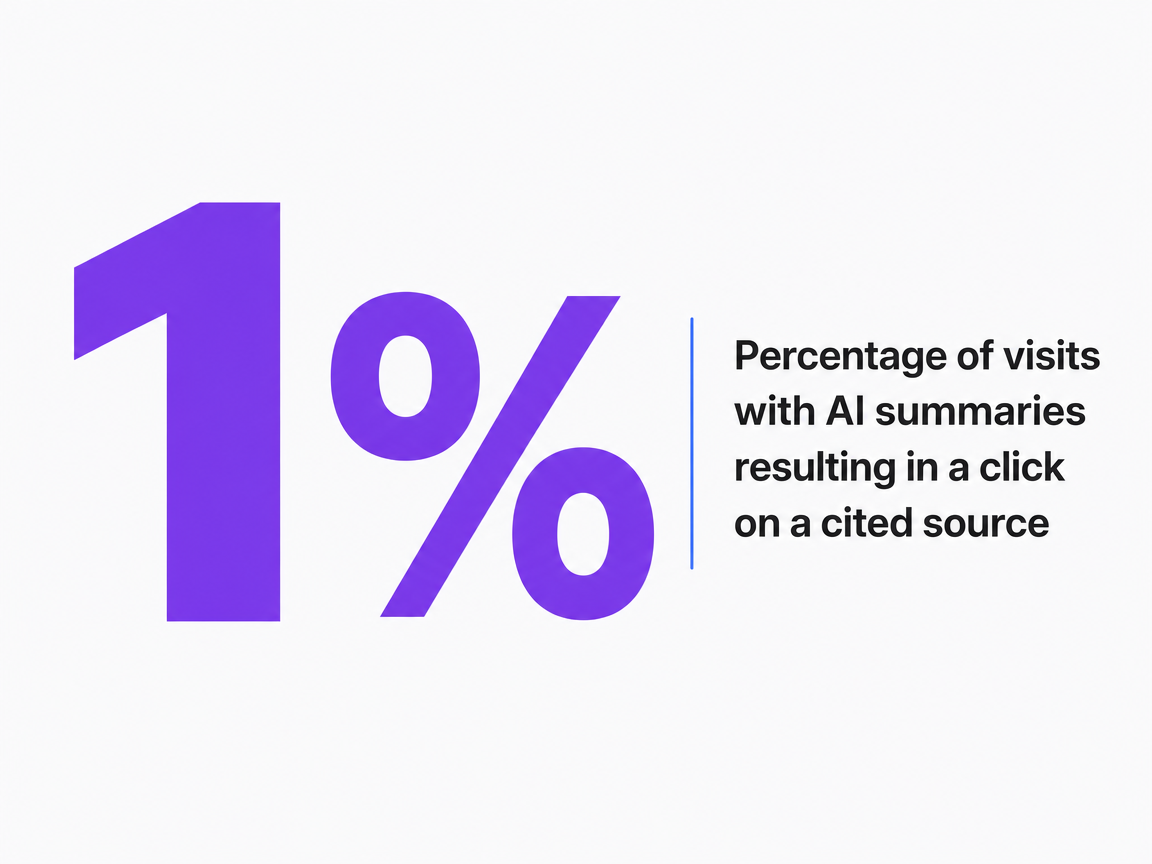 Percentage of visits with AI summaries resulting in a click on a cited source
Percentage of visits with AI summaries resulting in a click on a cited source
Frequently Asked Questions
References
- 1.Search Engine Optimization (SEO) Starter Guide.
- 2.Google users are less likely to click on links when an AI summary appears in the results.
- 3.Search Engines | Pew Research Center.
- 4.Main findings - Pew Research Center.
- 5.Search Engine Users | Pew Research Center.
- 6.Data Memo on Search Engines | Pew Research Center.
- 7.Analyzing the Relationship Between Organic and Sponsored Search.
- 8.Do Organic Results Help or Hurt Sponsored Search Performance?.
- 9.Sponsored Search in Equilibrium: Evidence from Two Experiments.
- 10.Search Engine Optimization Starter Guide.
- 11.Search Engine Optimization Best Practices.
- 12.Search optimization for PDF documents.
- 13.Search engine Performance optimization: methods and techniques.
- 14.Search engine optimisation (SEO) strategy as determinants to brand positioning for online businesses.
- 15.How to Quantify Higher Education SEO ROI.
- 16.Winning in the age of AI search.
- 17.What Web Browsing Data Tells Us About How AI Appears Online.
- 18.Information Triage.
- 19.Analyzing the Relationship Between Organic and Sponsored Search.
- 20.Part 2. What people seek with search engines.