
Key Takeaways
- Ahrefs anchors competitive discovery with a consistent dataset strategists, writers, and account leads can share, though manual handoffs into briefs still consume time.
- Semrush consolidates keyword clustering across diverse verticals, giving strategists a pillar-and-cluster foundation without manually grouping thousands of terms under separate logins.
- Google Search Console offers first-party query data that reveals impression and position shifts before third-party tools, making it essential for portfolio-wide content refresh prioritization.
- Screaming Frog surfaces raw indexability signals other crawlers abstract away, letting technical SEOs triage 50,000-URL sites down to the pages needing immediate intervention.
- Sitebulb scales technical auditing through scheduled crawls and prioritized hints, shifting audit ownership from senior specialists to mid-level strategists without losing quality.
- Clearscope enforces topical coverage and readability at the brief stage, preventing AI-drafted content in regulated sectors from ranking briefly but failing users 3.
- Surfer SEO scores drafts against live SERP data in real time, moving on-page optimization out of the editor's queue for high-volume content teams.
- Frase compresses brief creation from two hours to twenty minutes by grounding outlines in SERP structure, entity coverage, and People Also Ask data.
- Schema App treats structured data as a managed asset, propagating markup updates across templates and reducing regression risk during CMS migrations 6.
- Majestic maps the link graph independently of keyword bias, letting outreach teams disqualify prospects quickly using Trust Flow and Citation Flow thresholds.
- AgencyAnalytics automates white-labeled client reporting, reclaiming the four monthly hours per client strategists typically spend compiling GA4, Search Console, and rank data.
- Vectoron orchestrates discovery, content, schema, authority, and measurement through an approval-gated Command Center, compressing the 6-10 handoff hours lost per client each month.
Why agency SEO stacks are consolidating in 2025
Agency SEO stacks traditionally expanded with each new client vertical, leading to a proliferation of point tools and specialist hours. This model is becoming unsustainable for agencies managing 15 to 80 accounts across diverse sectors like legal, healthcare, and multi-location retail.
The current consolidation isn't primarily about cost reduction but about optimizing specialist time. Research indicates that SEO visibility relies on niche differentiation, valuable content, and consistent strategy over time 2. This persistence is a workflow characteristic, not a tool feature. Agencies that implement repeatable, governed SEO processes outperform those using fragmented toolchains for discrete tactics.
A 2024 review of SEO methods highlights that the discipline now encompasses crawl, content, structured data, and authority signals, all of which require integrated maintenance rather than isolated optimization 7. When multiple point tools each manage a single layer, the cost of integration often negates any efficiency gains from automation.
The 12 tools discussed below are evaluated based on how effectively they compress agency delivery layers and their scalability limitations.
How to read this list: the seven delivery layers
The 12 tools presented are categorized within seven interdependent delivery layers, as identified in a 2024 review of SEO methods 7. Agencies can use this framework to pinpoint where specialist hours are concentrated and where handoffs introduce inefficiencies.
The layers are:
- Discovery — identifying keyword, topic, and competitive opportunities.
- Technical crawl — managing indexability, site architecture, and error resolution.
- Content production — brief creation, drafting, readability assessment, and on-page grading.
- Structured data — deploying and maintaining schema across templates.
- Authority — analyzing link intelligence and off-site signals.
- Measurement — client reporting and outcome tracking.
- Workflow orchestration — the approval process that integrates all other layers.
Each tool is assessed by the layer it addresses, the specialist hours it saves per client per month, and its scalability limits. A Head of SEO managing 30 clients can use this list to identify fragmented layers and prioritize consolidations for maximum margin improvement.
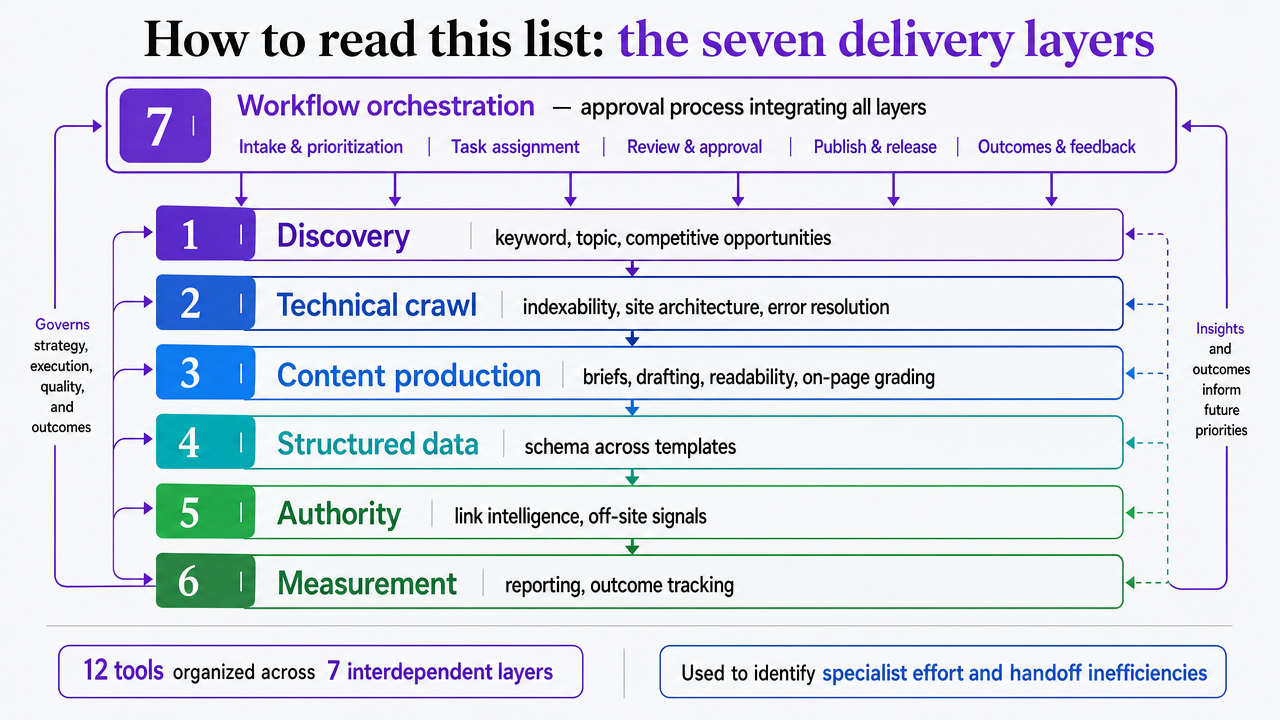 Visualize the seven interdependent SEO delivery layers framework introduced in this section, giving readers a scannable map of how the 12 tools are organized
Discovery layer: keyword and opportunity tools
Ahrefs — the reference dataset for competitive discovery
Ahrefs is a staple in most agency stacks, serving as the primary competitive data source. Its extensive crawl footprint and backlink index provide strategists with reliable data when clients inquire about competitor rankings. For agencies with over 30 clients, its value lies in establishing a consistent source of truth for strategists, writers, and account leads.
Ahrefs significantly streamlines the discovery phase. A strategist can complete a competitive gap analysis and prioritize keywords in an hour, a crucial efficiency for analysts managing multiple accounts. Niche differentiation and content that consistently gains visibility are key SEO performance drivers 2, and Ahrefs helps agencies operationalize the differentiation aspect.
However, Ahrefs doesn't fully integrate research with content output. Strategists still export data into briefs, and these manual handoffs can lead to lost time.
Semrush — keyword clustering across a client book
Semrush is valued for its comprehensive features, including keyword magic, topical clustering, and position tracking, which are applicable across numerous client accounts without requiring custom logic for each vertical. For a Head of SEO managing a diverse client portfolio (e.g., legal, home services, healthcare), the ability to manage multiple keyword sets under one login reduces coordination overhead.
Its clustering feature is particularly underutilized. A 2024 review emphasizes topic architecture as a technical necessity, not merely a content preference 7. Semrush's clustering output provides strategists with a solid foundation for pillar-and-cluster planning, eliminating the need for manual grouping of thousands of terms.
The platform's breadth, however, also contributes to its cost. Agencies often use less than 40% of its modules, and its reporting features are frequently replaced by specialized tools.
Google Search Console — the ground truth most agencies underuse
Google Search Console is a free, first-party data source that is often underutilized by agencies. Unlike third-party tools that estimate keyword performance, Search Console provides actual data on what Google served and what users clicked. This distinction is critical for strategists prioritizing content refresh efforts across a large client base.
The sustained application of an SEO strategy is a more significant determinant of visibility than isolated tactical wins 2, and Search Console is where this persistence is measured at the query level. Impression trends, average position changes, and query-to-page mismatches are visible here before any third-party tool detects them.
Its user interface is not designed for portfolio-wide review. Agencies gain more value by integrating Search Console data into a data warehouse or a dedicated reporting layer, rather than manually reviewing each property.
Technical layer: crawl and site health
Screaming Frog — the crawler agencies still cannot replace
Screaming Frog remains the go-to desktop crawler for most agencies because it reveals raw indexability signals that other tools often abstract. Technical SEOs can quickly address issues like response codes, canonical conflicts, hreflang mismatches, redirect chains, and orphan pages.
For delivery teams supporting 40 clients, it streamlines triage. A single crawl can identify the 300 pages requiring immediate intervention from a 50,000-URL site. A 2024 review highlights crawl accessibility and site architecture as foundational for all other optimization layers 7, and Screaming Frog is essential for auditing these prerequisites.
However, Screaming Frog is licensed per machine and runs locally. Scheduled recrawls, historical comparisons across a portfolio, and multi-analyst collaboration require custom scripting or an additional tool. Agencies with over 20 clients typically pair it with a solution designed for scheduled auditing.
Sitebulb — auditing at portfolio scale
Sitebulb addresses the limitations of Screaming Frog by offering scheduled crawls, visual site architecture maps, and prioritized hint lists. This transforms technical audits from a specialist-only deliverable into something an account lead can review with a client monthly. For a Head of SEO managing 30-plus accounts, this shifts audit responsibilities from senior technical staff to mid-level strategists without compromising quality.
Its prioritization feature is a significant advantage. Instead of providing a client with a 400-item issue export, Sitebulb ranks findings by potential impact and groups them by template. This aligns with content maintenance guidelines, which advocate for regular, structured reviews to eliminate redundant, outdated, and trivial content 10.
Sitebulb primarily identifies issues but doesn't automate fixes or integrate them into an approval workflow. Agencies scaling beyond 50 clients typically connect its output to a ticketing or orchestration system.
Test Automated SEO Execution Before You Commit
Deploy real SEO campaigns and measure impact on client deliverables, risk-free, during your trial.
Content production layer: brief, draft, and readability
Clearscope — brief discipline and content grading
Clearscope's primary function in an agency stack is to grade drafts against ranking terms and topical coverage, enforcing these standards at the brief stage. For delivery teams producing 200 articles monthly across 40 clients, this upstream discipline significantly reduces hours, particularly before a writer begins drafting.
The tool becomes even more critical with AI drafting. Research on health-vertical sites reveals a conflict between SEO optimization and readability: sites optimized for search often fail to meet user readability standards 3. Agencies using AI for drafting in regulated sectors like legal, healthcare, and finance cannot rely solely on generation quality. A grading layer that assesses both topical completeness and reading level prevents AI output from becoming keyword-stuffed, unreadable copy that ranks briefly but converts poorly.
Clearscope grades content but does not manage the approval workflow. Editorial sign-off, client review, and publishing still occur in other systems.
Surfer SEO — on-page scoring for volume production
Surfer SEO is valuable for high-volume agencies because it scores drafts against live SERP data in near real-time. Writers see content scores update as they type, transforming on-page optimization from a post-production audit into an immediate checkpoint. For content teams producing 15 to 25 pieces per client quarterly, this shifts optimization out of the editor's queue.
The tool complements AI drafting workflows by enforcing structural elements like headings, term coverage, and length, which are considered core on-page requirements in a 2024 review of SEO methods 7. Writers using AI with a Surfer outline can produce copy that meets on-page standards on the first pass.
Surfer optimizes for existing rankings, which can encourage conformity. Strategists must still make judgment calls regarding angle, differentiation, and when to deviate from SERP patterns.
Frase — brief generation with SERP grounding
Frase automates brief creation. Given a target query, it compiles SERP structure, competitor headings, entity coverage, and People Also Ask data into a working document. A strategist can then refine this document in 20 minutes, rather than spending two hours building it from scratch. For a 40-client agency producing over 150 briefs quarterly, this reclaimed time allows senior strategists to focus on higher-level strategy.
The SERP grounding is more impactful than Frase's AI drafting features. Empirical research highlights niche differentiation and topical persistence as key drivers of visibility 2. A brief rooted in the live SERP compels writers to address existing competition rather than relying on generic outlines.
Frase briefs are only as effective as the strategist editing them. Unedited SERP scrapes can lead to derivative outlines, and human input is still required for the differentiation that research emphasizes.
Structured data layer: schema at scale
Schema App — governed structured data across large sites
Schema deployment is an area where many agency stacks fall short. A single client site may require Organization, LocalBusiness, Service, FAQ, Article, and Breadcrumb markup across hundreds of templates. Manual JSON-LD coding is prone to regression during CMS migrations or template refactors. Schema App treats structured data as a managed asset rather than a page-by-page task.
Efficiency gains occur in two ways. Schema App maps entities across a site once, then propagates markup updates through templates. For a delivery team managing 40 clients, this shifts schema work from a recurring ticket to a quarterly review. Recent research on autonomous schema markup positions structured data as crucial for SEO evolution and rich-result eligibility, with automation reducing implementation quality gaps often seen with hand-coded schema 6.
Schema App effectively manages the markup layer, but validation still requires a strategist who understands the client's business and its entity relationships. Automated deployment of incorrect schema can amplify errors rather than just output.
Authority and measurement layer
Majestic — link intelligence separated from keyword bias
Majestic excels at mapping the link graph without keyword data influencing the analysis. Its Trust Flow and Citation Flow metrics provide strategists with a reliable way to evaluate prospect lists or address toxic backlink profiles, independent of third-party crawler updates.
For agencies conducting outreach for 30-plus clients, Majestic streamlines the disqualification process. A strategist can quickly filter target lists based on Trust Flow thresholds, routing qualified prospects into an outreach queue. High-quality content earning authoritative links remains a fundamental discoverability requirement in public-sector SEO guidance 9, and Majestic helps enforce this requirement early in the pitch process.
Majestic's link index is authoritative, but it lacks the SERP context that most strategists desire. Agencies typically use it in conjunction with Ahrefs rather than as a replacement.
AgencyAnalytics — client reporting without a full-stack rebuild
Reporting often leads to margin leakage in agencies. A strategist spending four hours monthly per client compiling GA4, Search Console, rank tracker, and call data into a branded deck is time not spent on strategy. AgencyAnalytics automates this process with templated, white-labeled dashboards that refresh automatically.
The measurement layer becomes more critical as client portfolios grow. The sustained application of an SEO strategy is a stronger determinant of visibility than one-off tactical wins 2, and clients are more likely to fund ongoing efforts when they see consistent progress. A reporting layer that displays impression, position, and conversion trends in a single view keeps strategy discussions focused on outcomes rather than deliverable counts.
Templated reports have limitations for sophisticated clients. Enterprise accounts often require custom, warehouse-backed views, which AgencyAnalytics is not designed to provide.
See How Leading Agencies Orchestrate Scalable SEO Execution With AI-Driven Workflows
Connect with our team to discover benchmark data, workflow examples, and performance metrics for multi-client SEO management using automation—without increasing headcount or losing strategic control.
Workflow orchestration layer: where hours actually compress
Vectoron — approval-first orchestration across the delivery loop
While individual tools manage specific layers, none integrate the entire workflow. Vectoron serves as an orchestration platform, connecting discovery, content production, schema, authority work, and measurement into a single, governed workflow. It incorporates human approval gates between signal analysis and execution.
Vectoron's design prioritizes approval. AI strategists analyze live client data—qualified calls, bookings, cost per lead, pipeline movement—and present ranked recommendations in a Command Center. A strategist reviews, approves, or revises these recommendations before implementation. Execution then proceeds based on the approved plan across content, SEO, backlinks, and other channels, with outcomes routed back into the same view.
The primary efficiency gain occurs at the handoff stage, not at the task level. A delivery team supporting 40 clients typically loses 6 to 10 specialist hours per client per month to briefing cycles, status meetings, and vendor coordination. Consolidating these handoffs into a single approval loop provides significant leverage for a Head of SEO.
Orchestration is effective only if strategists trust the recommendation quality enough to approve quickly. Teams that treat the Command Center as a mere formality risk losing the strategic control that the approval gate is designed to maintain.
The consolidation math: point tools versus orchestrated loops
This section focuses on agencies managing 15-plus clients, not solo consultants or in-house teams. At a portfolio scale, tool costs and specialist hours compound in ways not apparent from a single-account perspective.
The table below uses variables for point-tool costs ($X per layer) and specialist hours per client per month (H). Vectoron's $599/month trial price is the only fixed cost. Research on organizations pursuing visibility with limited resources frames SEO as a trade-off between scale and headcount 8, which this table quantifies.
| Delivery layer | Point-tool cost | Specialist hours / client / mo | Collapses under orchestration? |
|---|---|---|---|
| Keyword research | $X₁ | H₁ | Partial |
| Technical crawl | $X₂ | H₂ | Partial |
| Content brief | $X₃ | H₃ | Yes |
| Drafting | $X₄ | H₄ | Yes |
| Schema | $X₅ | H₅ | Yes |
| QA and readability | $X₆ | H₆ | Yes |
| Reporting | $X₇ | H₇ | Yes |
For illustration: an agency using seven point tools at an average of $180/month per tool incurs approximately $1,260 in fixed tool spend before per-client licensing. If layers H₃ through H₇ each save two hours per client per month under an orchestrated loop, a 30-client portfolio could save roughly 300 specialist hours monthly. This is enough capacity to absorb 8 to 12 new accounts without additional hires.
These economic benefits are realized only if the quality of approvals is maintained. Efficiency gains that result in work strategists cannot defend to a client are not true compression; they merely defer rework.
Regulated verticals: where tool choice becomes a compliance decision
Agencies serving clients in legal, healthcare, financial, and public sectors face unique constraints. Tool selection in these verticals is not just about productivity but also about compliance. All crawled, drafted, marked up, and published content must withstand review by compliance officers, bar associations, or state web standards teams.
Three tooling decisions are particularly critical in these sectors. First, readability enforcement during drafting. Health-vertical research shows that sites heavily optimized for search often fail to meet the readability standards users need for decision-making 3. AI drafting exacerbates this issue if no grading layer exists between generation and publication. While a Clearscope or Surfer score isn't compliance evidence on its own, its absence can be a significant vulnerability during regulatory review.
Second, content maintenance cadence. Federal SEO guidance mandates regular web content maintenance, including the removal of redundant, outdated, and trivial content, and ensuring structural elements like alt text meet accessibility requirements 10. Tools like Sitebulb and Schema App can identify content drift; the key is whether the agency has a scheduled process to act on these findings.
Third, authority sourcing. Public-sector SEO guidance defines high-quality content as that produced by an authoritative source on the subject, consistently presented and navigable across the site 9. For regulated clients, this translates to named-author bylines, credential disclosure, and citation discipline, which generic AI drafting workflows do not enforce by default.
The operational implication is clear: any tool integrated into a regulated-vertical stack must generate an artifact—such as a readability score, a schema validation log, a content-maintenance ticket, or an author attribution record—that a compliance reviewer can inspect post-publication.
How Heads of SEO should sequence a stack rebuild
Attempting a complete stack rebuild in one quarter risks client churn. A more effective sequence prioritizes layers in reverse order of potential disruption.
- Begin with measurement. A reporting layer that tracks client impressions, positions, and conversions provides the essential baseline for evaluating all subsequent consolidation decisions. Without it, claims of hour compression lack quantifiable support.
- Next, implement workflow orchestration. An approval-gated loop ensures that downstream tool changes are safe, as strategists can review what has been deployed and reject inappropriate outputs. Empirical studies on SEO strategy determinants highlight persistence as a key driver of visibility 2, and this persistence is maintained when execution flows through a governed queue rather than a strategist's inbox.
- Then, consolidate content production and schema layers, where AI-assisted execution offers the greatest hour savings per client.
- Discovery and technical crawl layers should be consolidated last. These layers change less frequently and incur the highest switching costs, especially during client audits.
The recommended action for this quarter: select two layers for consolidation, meticulously track the hours saved, and present these metrics to the finance lead before proceeding with further changes.
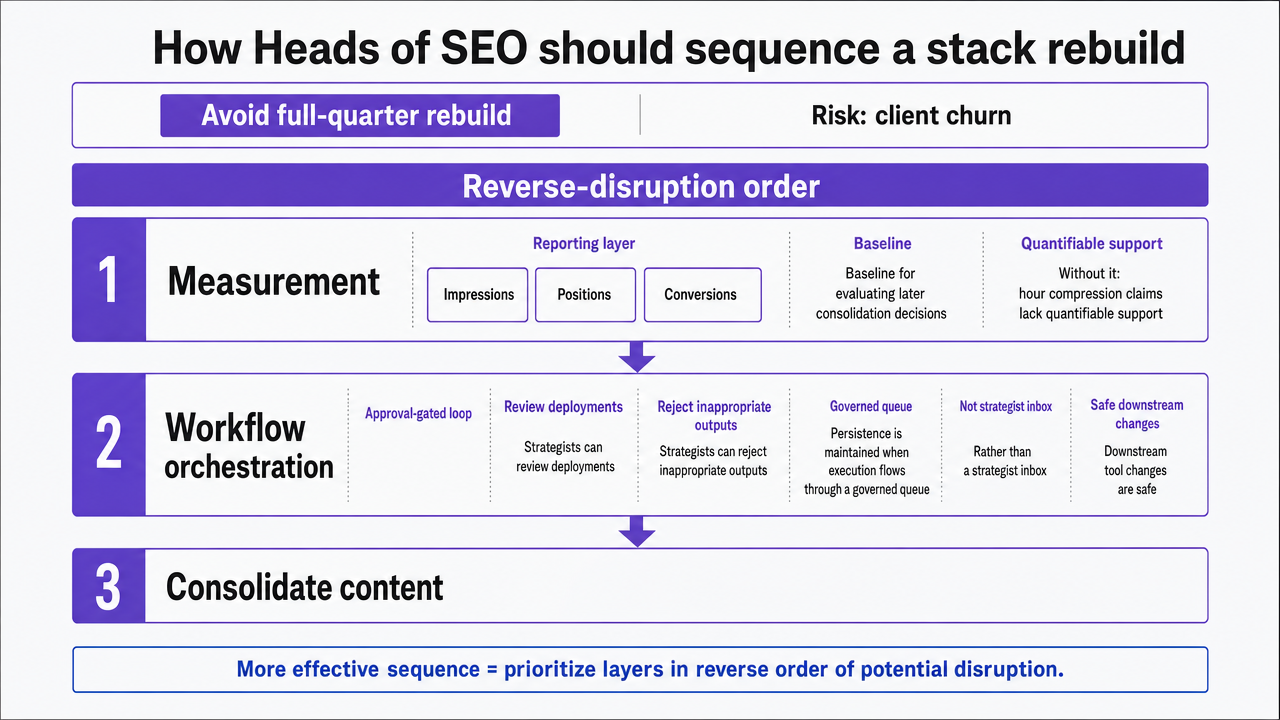 Visualize the recommended sequencing order for consolidating an agency SEO stack, which is explicitly described as a reverse-disruption sequence in this section
Frequently Asked Questions
References
- 1.Search engine optimization: What is it and why should we care? - PMC.
- 2.Search engine optimisation (SEO) strategy as determinants to ... - PMC.
- 3.Search engine optimization and its association with readability and ....
- 4.The SEO effect. Mapping the optimized landscape around ... - PMC.
- 5.Data set of a representative online survey on search engines ... - PMC.
- 6.Autonomous schema markups based on intelligent computing for ....
- 7.Search engine Performance optimization: methods and techniques.
- 8.Becoming visible with limited resources: Non-profit journalists ... - PMC.
- 9.Tapping Into SEO: How Government Websites Can Improve Content.
- 10.Search Engine Optimization Best Practices - Department of Energy.
- 11.3.3 Search Engine Optimization (SEO) | Digital Services & Solutions.