
Key Takeaways
- Google Search Console is the only source reporting Google's own click and impression data, making it the baseline every other search performance number gets validated against.
- Bing Webmaster Tools acts as a corroborating second signal, helping distinguish site-side issues from Google algorithm shifts when traffic moves unexpectedly.
- Ahrefs or Semrush cover competitor visibility, share of voice, and backlink profiles that Search Console cannot, substantiating the authority work a retainer pays for 8.
- GA4 translates organic sessions into conversion events and revenue by source-medium, but only if events map to monetized actions and channel groupings are manually cleaned.
- Experimentation platforms — geo holdouts, template A/B tests, paid-brand pauses — isolate causal SEO lift from seasonal demand and paid search interaction 7.
- CRM and revenue systems close the loop by tying GA4 client IDs to qualified leads and closed revenue, which is what turns form fills into a defensible dollar figure 6.
- Call intelligence captures the phone-based conversions forms miss in service verticals, using dynamic number insertion and transcription to reconcile calls with CRM inquiry data 12.
Why Rankings Dashboards Are Losing Renewals
The rankings deck is losing the renewal conversation. When a CFO or founder asks what organic search returned last quarter, position histories and traffic curves rarely answer the question. They describe activity, not outcomes, and they leave the agency exposed the moment a client audits spend against pipeline.
Forrester's research on measurement-advanced marketing organizations found those groups outperform peers on both revenue growth and marketing efficiency 6. The gap is not driven by better dashboards. It is driven by measurement discipline: connecting channel activity to qualified inquiries, closed revenue, and decisions the business will actually make 1.
UPCEA's SEO reporting framework draws the line agencies should be drawing themselves. Technical and authority indicators — crawlability, backlinks, index coverage — describe SEO health. Organic inquiries, conversions, and pipeline describe SEO success 8. Most agency reports still lead with the first category and hope the second speaks for itself.
The seven tools that follow are organized as a measurement stack, not a shopping list. Each earns its slot by covering a distinct layer — search performance, keyword and authority intelligence, analytics, experimentation, revenue systems, call intelligence, and orchestration — and by producing evidence a client will accept when the contract comes up for review.
The Measurement Architecture Behind Credible ROI Claims
SEO Health vs. SEO Success: Separating the Two Reporting Layers
UPCEA's SEO reporting framework is the cleanest way to organize an agency dashboard. It splits every metric an SEO team touches into two layers: SEO health and SEO success 8. Reports that blur the two are the reports clients stop reading.
SEO health metrics describe how well the site is set up to perform in search. Crawlability, index coverage, internal link depth, Core Web Vitals, schema validity, referring domains, and domain-level authority signals all sit here. They are diagnostic. They tell the SEO team where the site is fragile and what to fix next, but they do not tell a founder whether last quarter's retainer produced revenue.
SEO success metrics are the lagging outcomes the business actually pays for: organic sessions to money pages, organic-attributed conversions, qualified inquiries, booked appointments, pipeline created, and closed revenue 8. These are the numbers a CFO recognizes. They are also the numbers most agency decks bury on slide fourteen behind a ranking heat map.
The practical implication for agency reporting is straightforward. Health metrics belong in the SEO team's working view and in a technical appendix. Success metrics belong at the top of the client deck, ordered by revenue proximity. Every tool selected in the sections that follow gets assigned to one layer or the other. Tools that cannot be tied to either layer come out of the stack.
Applying Forrester and NIST Discipline to SEO KPIs
The health-versus-success split organizes the report. Two outside frameworks decide which metrics inside each layer are worth defending in front of a client.
Forrester's five-step measurement framework asks marketing teams to build data quality, integrated analytics, and ROI-oriented decision cycles before they invest further in tooling 1. Applied to SEO, that means every KPI on the dashboard has to answer a business question the client will act on. Organic sessions to a service page matter because they feed a conversion rate that feeds a booking rate that feeds revenue. Average position on a non-commercial query does not survive that test and should not be reported as a headline number.
NIST's measurement guidance sharpens the filter further. A useful measure is numeric, validated against implementation evidence, and tied to a decision 11. Agencies can run every SEO KPI through the same three questions:
- Is the number quantifiable at the account level, or is it a directional adjective in disguise?
- Is it validated against a second source, such as CRM records or call logs?
- Will someone change what they do next month based on the value?
KPIs that fail any of the three come off the client-facing report. What remains is a short list — usually six to ten metrics — that the tools in the next section have to produce reliably.
Measure Real Client SEO Impact in Days
Validate SEO results and demonstrate ROI with live client data before making a long-term commitment.
The Seven-Tool Measurement Stack
Stack Overview: Which Tool Covers Which Layer
Seven tools, six layers, one report. The stack that follows is organized so each entry owns a distinct measurement job — and so gaps between tools become visible before a client asks about them.
Google Search Console covers the search performance layer: impressions, clicks, and query-level demand at the source. Bing Webmaster Tools supplements that layer with a second engine's data. Ahrefs or Semrush anchor the keyword and authority layer, tracking competitive share of voice and backlink profiles. GA4 owns the analytics layer, connecting organic sessions to on-site conversion behavior. An experimentation platform sits above analytics to isolate causal lift from correlated demand shifts.
CRM and revenue systems close the loop from conversion to pipeline and closed revenue. Call intelligence covers the conversion layer that forms miss entirely in service verticals. The seventh entry — orchestration — is the layer that ties the other six together into a single approval and reporting surface, which the UPCEA framework treats as the difference between reporting SEO health and reporting SEO success 8.
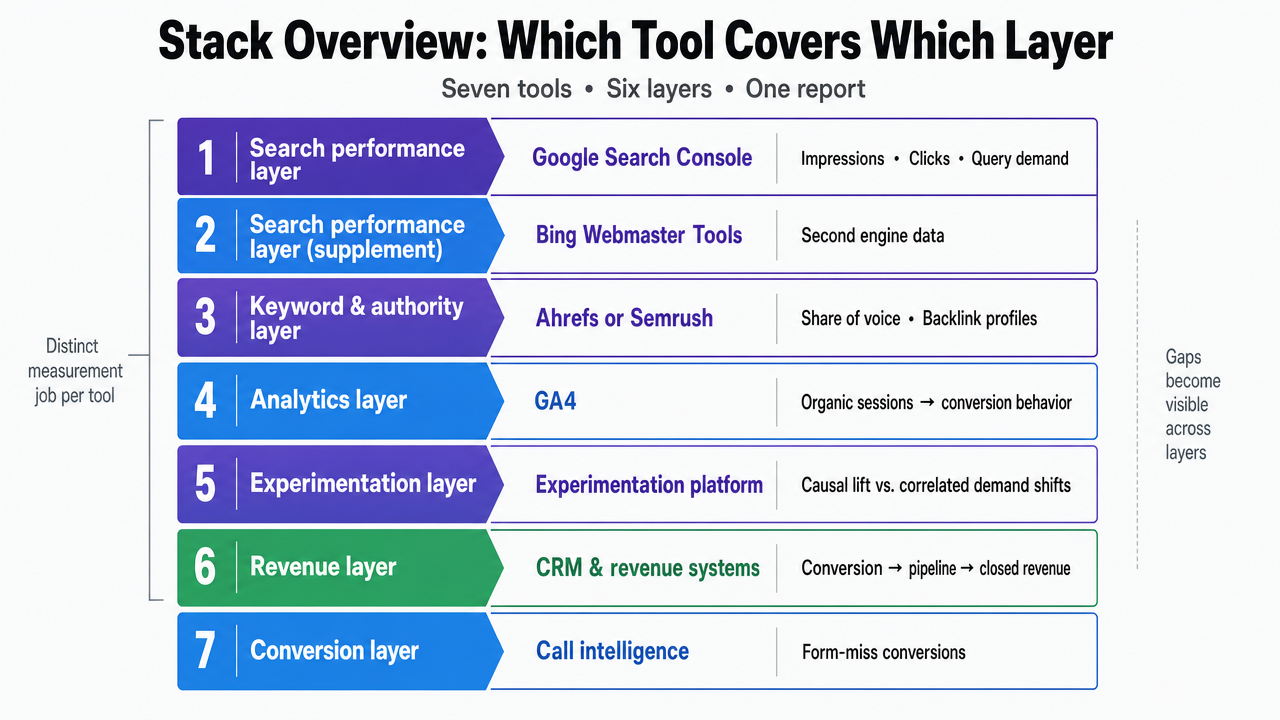 Visualize the seven-tool measurement stack as distinct layers, each mapped to the measurement job it owns, so readers can see the architecture the rest of the section unpacks
1. Google Search Console: The Search Performance Baseline
Search Console is the only tool in the stack that reports on data Google itself owns. Every other search-performance number an agency shows a client is a derivative or a model of what Search Console publishes directly. That makes it the baseline, not the highlight reel.
The value for ROI reporting sits in the Performance report's four core dimensions: impressions, clicks, average position, and click-through rate, sliced by query, page, country, and device. Query-level click data is the closest thing an agency has to demand measurement at the source, and page-level click data is what analytics attribution will later be validated against.
Two disciplines make Search Console useful in a client deck. First, filter to money pages and commercial queries before reporting anything — homepage and brand-term impressions inflate every number without changing revenue. Second, treat position as diagnostic, not as an outcome. The NYU Stern comparison of organic and sponsored metrics is explicit that click-through and relevance signals carry the commercial weight, not raw rank 7. Report the clicks. Keep the position column for the technical appendix.
2. Bing Webmaster Tools: The Underused Second Signal
Bing Webmaster Tools does not replace Search Console. It corroborates it. When a page loses impressions in Google, the same page's trajectory in Bing indicates whether the cause is site-side (both engines drop) or algorithm-side (only Google moves). That distinction changes the recommendation an agency makes next.
For clients running any paid search on Microsoft Advertising, the second data source also matters for joint organic-and-paid measurement — the total-search-value framing the NYU Stern paper argues for when evaluating channel contribution 7. Bing's share is smaller, but the diagnostic value of a second independent signal is high enough that the tool earns a slot even when its traffic contribution does not. Cost of inclusion: zero. Cost of ignoring it: a slower diagnosis when Google traffic moves for reasons that have nothing to do with the site.
3. Ahrefs or Semrush: Keyword and Authority Intelligence
Ahrefs and Semrush do the work Search Console cannot: modeling competitor visibility, mapping backlink profiles, and estimating share of voice on commercial keyword sets. UPCEA lists both platforms alongside Google Analytics and Search Console as standard components of a modern SEO measurement setup 8. Pick one — running both is an audit finding, not a stack.
The client-facing job of these tools is share of voice on a defined commercial keyword set, tracked over time against two or three named competitors. That number belongs in the SEO health layer of the report, not the SEO success layer. It answers whether the site is gaining or losing visibility in the market. It does not answer whether that visibility produced revenue.
Backlink data serves a second purpose: substantiating the authority work the retainer is paying for. Referring domain counts, new versus lost links, and anchor distribution are the artifacts that make a link-building line item defensible. Treat competitive keyword gap reports as an internal planning tool, not a client metric. Clients care about the queries that convert, not the ones a spreadsheet says they should rank for.
4. GA4: Behavior and Conversion Attribution
GA4 is the tool that translates search traffic into on-site behavior a business recognizes. Sessions, engaged sessions, conversion events, and revenue by source-medium are the fields that feed every downstream ROI calculation. Without a clean GA4 implementation, the rest of the stack produces numbers no one can reconcile.
Three configurations decide whether GA4 is usable for client reporting:
- Conversion events must be tied to actions the business actually monetizes — form submissions on service pages, appointment bookings, checkout completions — not scroll depth or PDF downloads.
- Channel groupings must correctly separate organic search from direct and referral, which requires manual review for clients with heavy brand-term direct traffic.
- UTM discipline on any owned campaigns has to be enforced, because organic attribution degrades quickly when paid and email touches are miscoded.
The peer-reviewed healthcare marketing literature is explicit that digital campaigns should be evaluated by monitoring web traffic, click-through rates, conversion rates, and patient inquiries together 5. GA4 is the layer where the first three of those live. The fourth — inquiries — comes from the CRM and call intelligence layers further down the stack.
5. Experimentation Platforms: Isolating SEO Lift from Baseline Demand
The hardest question in SEO reporting is causal. When organic revenue rises, how much of the lift is SEO work and how much is seasonal demand, brand marketing, or a paid search shift? Experimentation platforms — SEO split testing tools, geo holdouts, and structured A/B tests on templated pages — are the layer that produces defensible answers.
For agencies with clients running material paid search budgets, the case is stronger still. The NYU Stern comparison of organic and sponsored metrics argues that total search value has to be measured jointly, because organic and paid clicks interact rather than sit in parallel 7. A well-designed geo test that pauses paid brand terms in matched markets is often the only way to size that interaction for a specific client.
The tool does not have to be expensive. Template-level tests on product or service pages — title tag variants, schema additions, internal link changes rolled out to a random half of a large URL set — produce statistically credible lift numbers using nothing more than GA4 and a spreadsheet. What matters is the discipline of running a controlled comparison, not the vendor logo on the dashboard.
6. CRM and Revenue Systems: Closing the Loop to Pipeline
A conversion in GA4 is a lead. A lead in a CRM is either qualified or it is not. Revenue closes weeks or months later. The gap between those three data points is where most agency ROI stories fall apart, and it is why the CRM has to sit inside the measurement stack rather than beside it.
The mechanic is straightforward: pass GA4 client IDs and source-medium values into the CRM at form submission, then export closed-revenue records back out for reporting. That round trip is what lets an agency say organic search produced a specific dollar figure in signed business last quarter, rather than a specific number of form fills. Forrester's finding that measurement-advanced organizations outperform peers on revenue growth and marketing efficiency depends on exactly this loop being closed 6.
Two disciplines make the CRM layer credible. Lead qualification has to be defined and applied consistently — an agency that reports pipeline against an unqualified lead pool is reporting noise. And attribution windows have to be agreed with the client in advance. A 90-day organic window and a 30-day organic window will produce different ROI numbers on the same underlying data.
7. Call Intelligence: The Missing Conversion Layer for Service Verticals
For agencies whose book includes law firms, dental groups, home services, senior living, or behavioral health, the CRM alone will understate organic performance. In service verticals, prospects call. Forms capture the fraction of demand that prefers typing over dialing, and the ROI story built on forms alone is the ROI story that loses the renewal.
The dental practices marketing study documents the mechanism directly: practices used SEO to increase Google visibility, which resulted in more online inquiries and appointments — a category that includes both form submissions and phone calls to the practice 12. The healthcare digital marketing literature makes the same point when it lists patient inquiries alongside web traffic and conversion rates as the metrics that evaluate campaign effectiveness 5.
Call intelligence is the layer that turns a phone number on a landing page into structured measurement data. Dynamic number insertion attributes calls to organic sessions. Recording and transcription — configured correctly for the vertical — separate a qualified new-patient inquiry from a billing question or a wrong number. AI-based call analysis tags qualified inquiries, flags missed opportunities where intake staff mishandled a lead, and surfaces the intake language patterns that predict conversion. The output is a call-derived conversion count that reconciles with the CRM and closes the reporting gap forms leave behind.
Vectoron as the Orchestration and Approval Layer
The six layers above produce numbers. Something has to produce a report — and, for agencies running a book of accounts rather than one flagship client, something has to produce that report consistently across every account without a senior analyst rebuilding it by hand each month.
Orchestration is the seventh slot in the stack. It is the layer where search performance, keyword intelligence, GA4 events, experiment results, CRM revenue, and call-derived conversions get reconciled into one client-facing view, and where the next month's SEO decisions get queued, reviewed, and approved against that view. Forrester's five-step measurement framework treats integrated analytics and ROI-oriented decision cycles as competencies, not features 1. In a multi-account agency, those competencies live or die by whether the reporting and approval workflow is centralized.
The economics matter for agencies scaling across a portfolio of clients — legal groups, DSOs, home services franchises, senior living operators — where each account carries its own tool stack. The consolidation question is straightforward: what does the measurement layer cost per client account per month before an orchestration layer is added, and what does it cost after.
| Layer | Fragmented stack (per client account / month) | Orchestrated |
|---|---|---|
| Search Console | $0 | Included |
| GA4 | $0 | Included |
| Ahrefs or Semrush seat | Variable by seat count | Included |
| Experimentation platform | Variable by traffic volume | Included |
| Call intelligence | Variable by call volume | Included |
| BI and client reporting | Variable by seat count | Included |
| Orchestration and approval | Analyst hours | $599/month post-trial |
Variable ranges depend on seat count, traffic volume, and account size; the ranges are labeled rather than priced because they move per client. The single fixed number is the orchestration line: Vectoron's disclosed $599/month post-trial for the layer that reconciles the other six and routes every SEO recommendation for human approval before it ships.
The reason to consolidate is not the license spend. It is the analyst hours the fragmented row absorbs — the hours that decide whether an agency can add its next ten accounts without hiring an eleventh specialist.
See How Leading Agencies Quantify SEO ROI With Precision
Get a walkthrough of unified reporting frameworks and approval-first workflows that streamline multi-client SEO measurement—eliminating manual tracking and surfacing actionable insights for your team.
Measurement in Regulated Verticals: Healthcare, Behavioral Health, and Dental
Agencies with a healthcare, behavioral health, or dental book operate under a measurement ceiling the other verticals do not have. HHS guidance is explicit: tracking technologies that transmit information from authenticated pages, appointment portals, or symptom-driven search landing pages to third-party vendors can constitute a disclosure of protected health information under HIPAA 3. That guidance applies to the same GA4, ad-platform pixels, and call-recording configurations most agencies deploy by default.
The consequences reshape the stack. Default GA4 with Google Signals enabled, IP collection on, and event parameters carrying URL paths that reveal a condition or provider name is a configuration the HHS materials treat as high-risk on covered-entity properties 3. The remediation is not to abandon measurement — it is to configure it. Server-side tagging, IP anonymization, exclusion of sensitive URL parameters, and business associate agreements with any vendor that touches the data are the working checklist. HIPAA's Privacy Rule guidance is clear that covered entities must implement safeguards for any PHI used in analysis and reporting 10.
Call intelligence carries the same requirement. Recording and transcription of new-patient calls produces the qualified-inquiry data the peer-reviewed healthcare marketing literature identifies as central to campaign evaluation 5, and the dental practices study documents the same inquiry-and-appointment pattern in that vertical 12. The vendor has to sign a BAA, store recordings in a HIPAA-eligible environment, and give the agency configurable redaction on transcripts before any of that data enters a client report. Agencies that skip the BAA step do not lose the account when a compliance officer notices — they lose it when the client's counsel does.
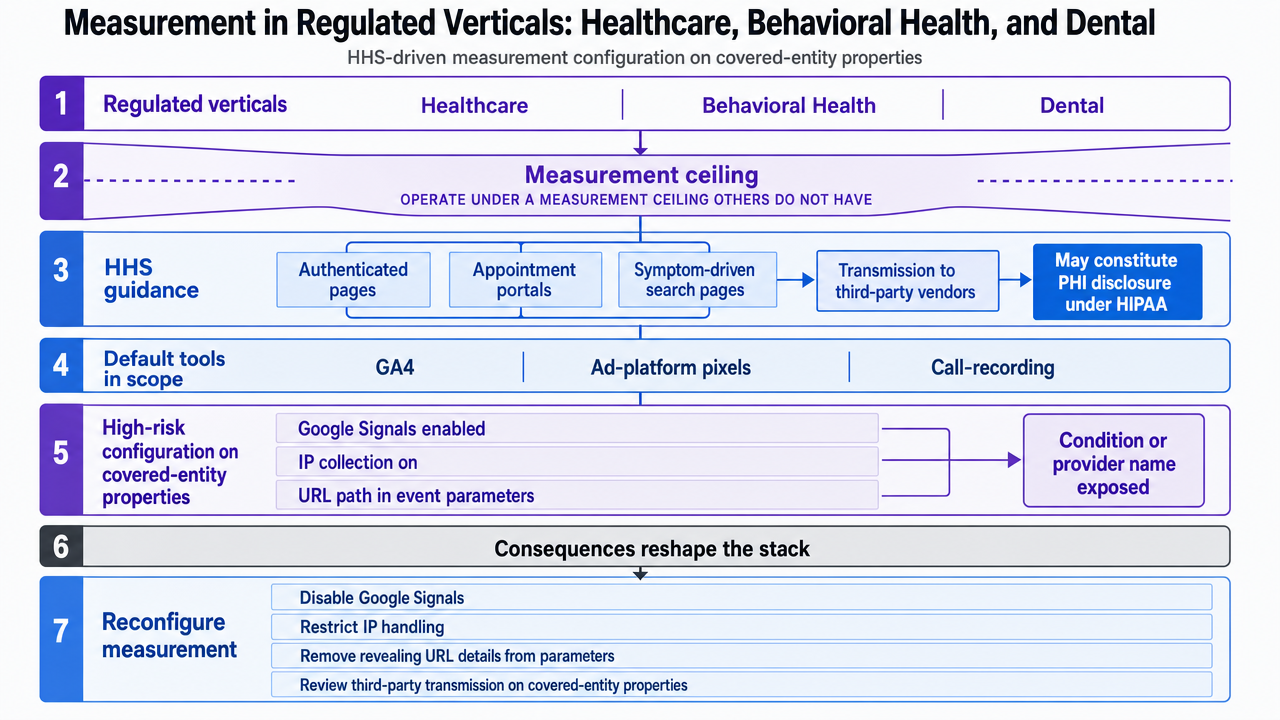 Translate the HHS-driven compliance checklist described in the section into a scannable process infographic covering configuration steps agencies must apply to measurement tools on covered-entity properties
A Selection Rubric for Adding or Cutting a Tool
Every tool in the stack has to justify its slot on the same three questions, applied at the account level. The rubric is borrowed from NIST's measurement guidance, which treats a useful measure as numeric, validated against a second source, and tied to a decision someone will actually make 11.
Applied to a candidate tool:
- Does it produce a number an agency can defend at the account level, not a directional trend?
- Can that number be reconciled against a second source in the stack — Search Console against GA4, GA4 against the CRM, CRM against call intelligence?
- Will the client, the account lead, or the SEO team change next month's work based on what it shows?
A tool that fails one question is a candidate for consolidation. A tool that fails two comes out.
The same rubric works in reverse for adding a tool. If a measurement question the client keeps asking cannot be answered by anything already in the stack, and the answer would change the retainer's roadmap, the gap justifies a new line item. Forrester's measurement-culture commentary makes the organizational version of the same point: the discipline sits with the team, not the vendor list 2.
Frequently Asked Questions
References
- 1.Effective Marketing Measurement And Optimization Delivers Business Results.
- 2.Navigate 2026 With A Measurement-Centered Marketing Culture.
- 3.Use of Online Tracking Technologies by HIPAA Covered Entities and Business Associates.
- 4.Search engine Performance optimization: methods and metrics for measuring search engine results.
- 5.Digital marketing strategies to improve patient engagement in healthcare organizations.
- 6.The Role of Marketing Measurement in Driving Business Growth.
- 7.Comparing Performance Metrics in Organic Search with Sponsored Search Results.
- 8.Tracking the Right Higher Education SEO Metrics for Marketing Success.
- 9.Search engine Performance optimization: methods and metrics for measuring search engine results.
- 10.HIPAA Privacy Rule: Guidance Materials.
- 11.NIST SP 800-55v1 initial public draft, Measurement Guide for Information Security: Volume 1 — Identifying and Selecting Measures.
- 12.Online marketing strategies of dental practices.