
Key Takeaways
- Surfer SEO compresses brief creation and writer self-checks, but approvals, refresh scheduling, and internal linking updates revert to the agency's existing stack once the score turns green.
- Clearscope's conservative, legible scoring model doubles as a client-relations artifact, though editorial queues and approval routing require an Airtable or Notion layer around it.
- MarketMuse evaluates entity-cluster coverage across a domain and flags cannibalization, giving strategists a defensible coverage map rather than a keyword list at portfolio scale.
- Frase compresses SERP research and outline drafting, cutting brief assembly from forty minutes to ten, but scoring depth is thinner and generative output demands provenance controls.
- Page Optimizer Pro works as a narrow diagnostic instrument for underperforming URLs, not a primary tool, because nothing carries forward between single-page audits.
- Semrush On Page SEO Checker earns its slot by eliminating a tab-switch, tying on-page recommendations to tracked keywords and audit findings inside one platform.
- Ahrefs Page Inspect and Content Explorer function as a prioritization layer that decides which pages deserve an on-page pass, with execution handled in a scoring tool.
- Conductor fits enterprise teams and multi-brand portfolios by sharing approvals, assignments, and performance tracking in one workspace, but becomes overhead for mid-market agencies running smaller accounts.
- Vectoron represents the integrated archetype, collapsing briefing, scoring, approval, and publishing against one URL with human sign-off required before anything ships.
Why on-page tooling is now a delivery-economics decision
The question a Head of SEO at a 40-client agency asks about on-page tooling is not which platform produces the highest content score. It is how many strategist hours per client the tool absorbs before a page ships, and how many it leaves on the table for actual strategy.
That framing has shifted the market. Forrester now describes content intelligence as the capture, correlation, and analysis of data about content and its consumption — a workflow discipline, not a single-page audit 3. The 2024 rethink goes further, arguing that AI has expanded content intelligence across strategy, creation, and performance optimization, and that leaders must master it to tune experiences at scale 8. Forrester's 2024 adoption research identifies a cohort of leading B2B adopters already applying AI to content and journey optimization 2. Agencies competing against that cohort cannot run five disconnected point tools per account and hold margin.
This review evaluates nine on-page tools against that operating question. Sticker price matters, but only as one input into strategist-hours-displaced across a portfolio. Feature parity does not.
The three archetypes: how to eliminate categories before comparing tools
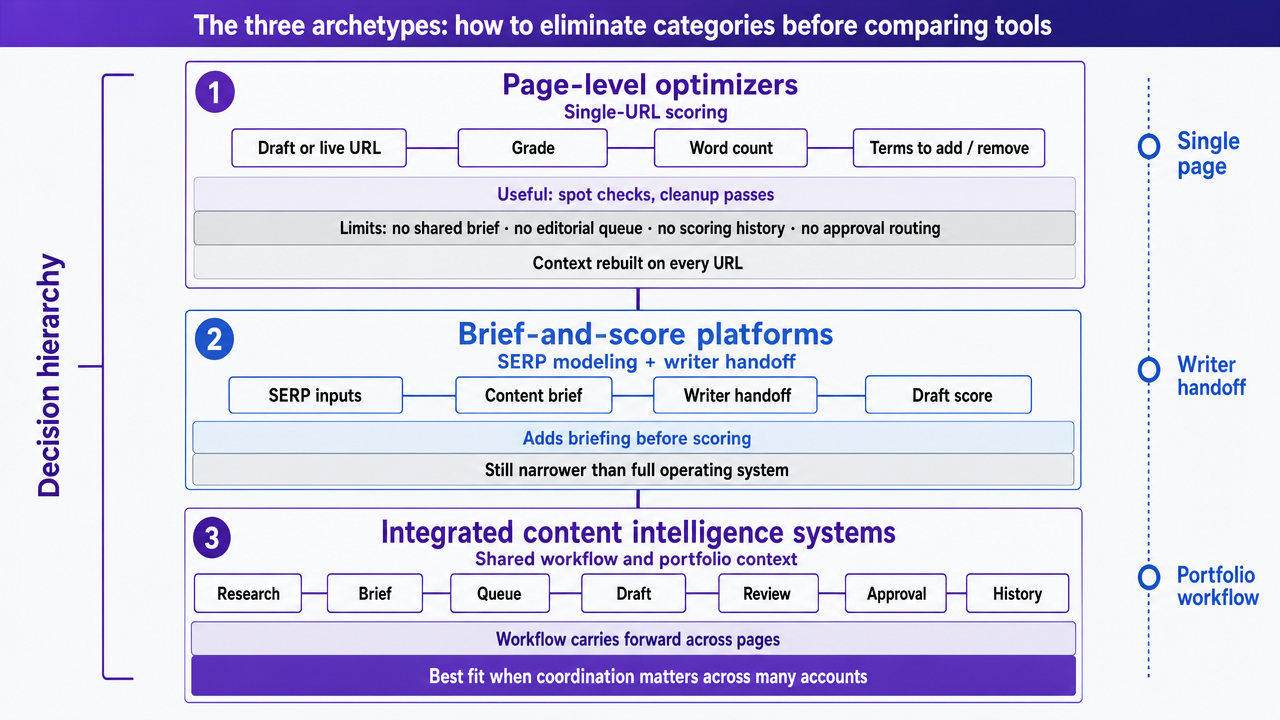
Page-level optimizers: single-URL scoring, no workflow
Page-level optimizers score one URL at a time against a target term. A strategist pastes a draft or a live URL, the tool returns a grade, a suggested word count, and a list of terms to add or remove. That is the entire loop.
The archetype is useful for spot checks and cleanup passes on high-value pages. It fails at portfolio scale for a predictable reason: nothing carries forward. There is no shared brief, no editorial queue, no record of which pages were scored last quarter, and no way to route a rewrite to a client stakeholder for approval. Every strategist rebuilds context from scratch on every URL. Across 40 accounts, the coordination tax eats the time savings the score was supposed to create.
Brief-and-score platforms: SERP modeling plus writer handoff
Brief-and-score platforms sit one layer up. They model the SERP for a target query, extract entities and questions from ranking pages, generate a brief a writer can work from, and score the draft against that brief. Handoff, not just audit.
This archetype absorbs more strategist hours than a single-URL scorer because the brief becomes a durable artifact. A writer no longer waits on a strategist to hand-build one for every assignment. The gap is what happens after the score turns green. Publishing, internal linking updates, refresh scheduling, and performance correlation still live in other tools. Forrester's 2024 content intelligence rethink argues that fragmentation is exactly what marketers now need to close if they want to tune experiences at scale 8.
Integrated content intelligence systems: capture, correlation, and workflow
Integrated content intelligence systems treat on-page work as one step in a governed loop that also covers strategy, production, publishing, and measurement. The distinguishing feature is not a better score. It is that scoring, briefing, approval routing, and performance data share one system of record.
Forrester defines content intelligence as the capture, correlation, and analysis of data about content and its consumption 3. That definition sets a clean line against the first two archetypes. A page-level optimizer captures nothing beyond a single audit. A brief-and-score platform captures the brief and the score, but rarely the consumption data that would tell a strategist whether the scored page actually moved rankings, dwell time, or pipeline. Integrated systems close that loop, which is why the leading-adopter cohort Forrester identifies in its 2024 AI adoption research is consolidating in this direction 2. For an agency running 40 clients, the archetype question comes first: page optimizer, brief-and-score, or integrated system. Tool-by-tool comparison only makes sense once the category is fixed.
 Visualize the three tool archetypes described in the section as a comparison framework, since the article explicitly walks through page-level optimizers, brief-and-score platforms, and integrated content intelligence systems as a decision hierarchy
Evaluation criteria that survive contact with 40 client accounts
Entity and taxonomy coverage as a real selection filter
Most on-page tools still evaluate a page against a single target keyword and a bag of related terms. That worked when the ranking signal was density. It stops working when a strategist has to reconcile 40 client sites, each with its own service pages, location pages, and topical hubs that need to speak the same entity language internally and to the SERP.
The filter is whether the tool understands entities as a taxonomy, not as a term list. Forrester's 2022 survey found that only 24% of B2B content marketers reported having a universal taxonomy, meaning 76% were operating without one 7. That absence is exactly the gap an agency inherits when it takes on a new client. A tool that maps entities to a durable taxonomy, and enforces coverage across a site rather than a page, absorbs the taxonomy-building work a strategist would otherwise do by hand. A tool that only lists NLP-extracted terms per URL rebuilds nothing and leaves the strategist to reconcile overlap across dozens of briefs.
Content scoring depth: beyond keyword presence
Scoring depth is the second filter, and it separates tools that grade a draft on term coverage from tools that grade it on how the content is likely to perform. Forrester's original framing of content intelligence describes technology that helps content understand itself — subject matter, style, effectiveness, and emotional resonance — and cites a direct marketer that recorded a 20%+ uptick in email open rates after applying emotional content intelligence to its copy 9.
That is not a keyword score. It is an evaluation of whether the language on the page matches the intent and register of the audience it targets. For an agency, the practical test is whether the score moves when tone shifts but term coverage stays constant. If the score does not react, the tool is measuring vocabulary, not communication, and a strategist will still have to edit every draft by hand.
Workflow, approvals, and strategist utilization
The third filter is the one most feature comparisons skip. A tool that produces a beautiful brief and a green score, but hands the artifact off to email, Google Docs, and a client-side stakeholder in Slack, has not displaced strategist hours. It has relocated them.
At 40 accounts, workflow is the actual product. That means shared queues, versioned briefs, in-tool review, structured approval routing to client stakeholders, and a record of who signed off on what and when. It also means the score, the brief, and the approval sit against the same URL rather than in three systems that a strategist reconciles on Friday afternoons. Forrester's 2024 rethink of content intelligence points in this direction, arguing that content leaders must master intelligence embedded across many technologies to drive and tune experiences at scale 8. A tool without native workflow forces the agency to build one around it, which is where margin quietly disappears.
Test On-Page SEO Workflows With Full Access
Experience real-time on-page optimization and publish live content while evaluating platform impact on your SEO process.
The nine tools, evaluated against agency delivery
Surfer SEO
Surfer sits squarely in the brief-and-score archetype. Its SERP analyzer pulls ranking pages for a target query, extracts term coverage and structural signals, and produces a content editor where writers work against a live score. For agencies, the appeal is that a strategist can spin up a brief in minutes rather than hours, and a freelance writer can self-check without pinging the SEO team.
The operational limits show up at portfolio scale. Approvals happen in Google Docs or a project management tool the agency already runs. Refresh scheduling lives elsewhere. Internal linking updates require a separate crawl. Strategist hours displaced per client are real but bounded, because everything past the green score reverts to the existing stack.
Clearscope
Clearscope's reputation rests on the cleanness of its scoring model. The report is legible to writers who have never heard of TF*IDF, the term recommendations are conservative, and clients accept the grade as evidence of on-page rigor. That last point matters more than agency Heads of SEO usually admit. A defensible score is a client-relations artifact, not just a writing aid.
The tool remains a brief-and-score platform. It does not manage editorial queues, route approvals, or track which pages were optimized against which target term last quarter. Agencies running Clearscope at scale build a layer of Airtable or Notion around it to hold the operating model together.
MarketMuse
MarketMuse pushes further into content intelligence territory than most of its peers. Its topic modeling evaluates a site's coverage of an entity cluster rather than a single URL against a single query, and its inventory feature flags gaps and cannibalization across a domain. That is closer to the taxonomy-aware evaluation Forrester describes as the discipline modern content leaders must master 8.
For an agency, the practical value is that a strategist can hand a client a coverage map rather than a keyword list, and defend a content roadmap against it. The gap remains workflow. Briefs and scores are strong, but approval routing, publishing, and post-publish performance correlation still depend on the agency's surrounding stack.
Frase
Frase compresses the research step. It ingests SERP results, generates outlines, and drafts sections that a writer can accept, rewrite, or discard. For high-volume agencies producing informational content at pace, that compression is the point. A strategist who spent forty minutes assembling a brief now spends ten.
The archetype is brief-and-score with generative assist bolted on. Scoring depth is thinner than Clearscope or MarketMuse, and the generative output requires the same provenance controls any AI-assisted copy needs before it ships under a client's byline. Frase absorbs research hours cleanly. It does not replace the editorial layer or the approval loop.
Page Optimizer Pro
Page Optimizer Pro is the archetype's honest form: a page-level optimizer that grades one URL against one target term and returns a specific list of adjustments. No brief generation, no workflow, no pretense of content intelligence.
For an agency, its role is narrow and useful. A strategist runs it on a page that should rank and does not, gets a concrete diff, and applies the changes. It does not scale as the primary tool across 40 accounts because nothing carries forward. It scales as a diagnostic instrument a senior strategist pulls out when a page misbehaves.
Semrush On Page SEO Checker
The On Page SEO Checker inside Semrush is a page-level optimizer that benefits from being embedded in a larger platform. A strategist already using Semrush for keyword research, rank tracking, and site audits gets on-page recommendations without buying another seat.
That integration is the tool's real value at agency scale. Recommendations tie back to tracked keywords and audit findings, so a strategist reviewing a client's monthly report can act on on-page fixes in the same session. The scoring model itself is not the point of comparison. What matters is that the tool eliminates a tab-switch, not that it produces a better grade than a standalone scorer.
Ahrefs Page Inspect and Content Explorer
Ahrefs approaches on-page from the link and content-performance side rather than the SERP-modeling side. Page Inspect surfaces how a URL is performing against its target terms, and Content Explorer identifies pages earning traffic and links across a topic. Neither is a content editor in the Clearscope sense.
For agencies, the tool earns its slot as a diagnostic and prioritization layer. Strategists use it to decide which pages deserve an on-page pass in the first place, then execute the pass in a different tool. Treating Ahrefs as the on-page scorer misreads the product. Treating it as the input to a scoring workflow is where the hours actually get displaced.
Conductor
Conductor is one of the few tools in this review built for the enterprise SEO team from the start. Its content guidance, technical monitoring, and reporting sit inside a workspace designed for multiple stakeholders and multiple properties. Approvals, assignments, and performance tracking share a system of record rather than living in email.
That design fits agencies managing large accounts or in-house teams running multi-brand portfolios. The trade-off is scope and pricing structure. Conductor is not published on a self-serve tier, and its footprint is heavier than a mid-market agency running 40 sub-$5K accounts typically needs. Where it fits, it displaces meaningful workflow hours. Where it does not, it becomes overhead.
Vectoron
The last entry sits in the integrated content intelligence archetype and treats on-page work as one step inside a governed loop. An AI content strategist reads live business signals, ranks priorities across a client's site, produces the brief, scores the draft, and routes it to a Command Center where a human approves or rejects before anything publishes. Nothing ships without sign-off, and every recommendation carries the reasoning behind it.
For an agency, the operating consequence is that briefing, scoring, approval, and publishing sit against the same URL rather than in four systems. Vectoron is the platform this review is published on, so the archetype fit is disclosed rather than argued. The evaluation criterion remains the same as for every other tool: strategist hours absorbed per client per month.
Consolidation math: modeling strategist hours across the portfolio
Sticker price is the wrong first question. The right one is how many strategist hours per client per month a tool absorbs, multiplied by portfolio size and blended rate. Forrester's 2024 adoption research shows the leading B2B cohort is already applying AI to content and journey optimization, which means the consolidation math is not hypothetical — it is what competitors are running against 2.
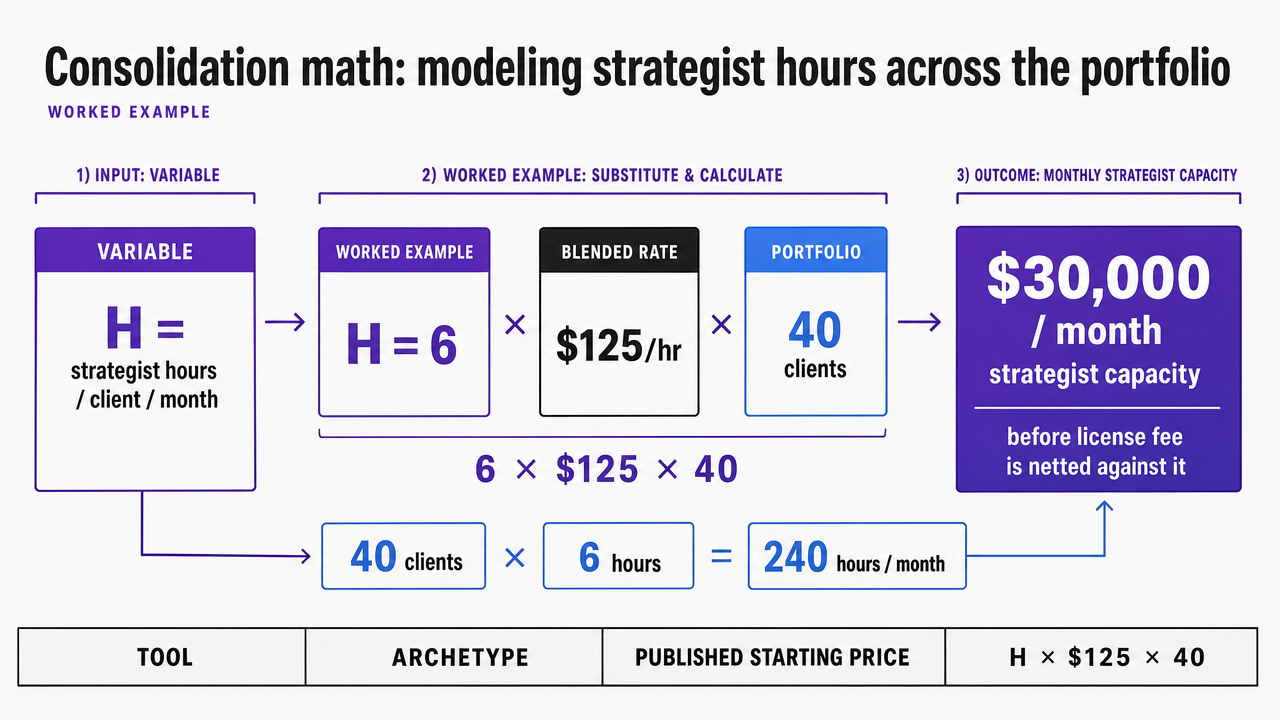
The table below fixes archetype and published starting price where a vendor lists one, and leaves strategist hours displaced per client per month as variable H. A worked example uses H=6 and a $125/hr blended strategist cost, so a 40-client portfolio absorbs 240 hours per month, or $30,000 in strategist capacity, before the tool's license fee is netted against it.
| Tool | Archetype | Published Starting Price | H × $125 × 40 clients (H=6) ||---|---|---|---|| Surfer SEO | Brief-and-score | Published self-serve | $30,000/mo || Clearscope | Brief-and-score | Not published | $30,000/mo || MarketMuse | Brief-and-score (topic-aware) | Not published | $30,000/mo || Frase | Brief-and-score + generative | Published self-serve | $30,000/mo || Page Optimizer Pro | Page-level optimizer | Published self-serve | $30,000/mo || Semrush On Page Checker | Page-level optimizer (bundled) | Bundled in suite | $30,000/mo || Ahrefs Page Inspect | Diagnostic / prioritization | Bundled in suite | $30,000/mo || Conductor | Integrated content intelligence | Not published | $30,000/mo || Vectoron | Integrated content intelligence | Published self-serve | $30,000/mo |
H is the honest variable. A page-level optimizer rarely holds H above 2 across a 40-client book because nothing carries forward between audits. An integrated system can push H toward 8 or 10 when briefing, scoring, approval, and publishing collapse into one record. Heads of SEO should run the multiplication against their own rate and portfolio before ranking any tool on price.
 Translate the section's worked example (H=6, $125/hr, 40 clients = $30,000/month) into a legible calculation infographic that mirrors the numbers cited in nearby prose
If you manage multiple brands or a franchise portfolio
Scope shift: the operating question changes when an agency's book includes a franchise system, a DSO with 60 locations, or a multi-brand parent with shared category pages across sub-brands. The variance is no longer client-to-client. It is location-to-location inside one client, multiplied by brand voice rules the parent will not let a strategist rewrite on the fly.
Page-level optimizers break first in this setting. A location page graded in isolation cannot see whether its entity coverage collides with the 40 sibling pages ranking for the same service in adjacent metros. Brief-and-score platforms handle the individual page but still hand the strategist the reconciliation problem across the portfolio. Integrated systems earn their license here because entity coverage, brand-voice constraints, and approval routing to a franchisee or regional marketing lead sit inside one record rather than three. The multiplication that matters is not clients times hours. It is locations times brand-rule enforcement, and the tool either absorbs it or the strategist does.
Scale On-Page SEO Execution with AI-Driven Precision
See how leading agencies automate high-volume on-page optimizations, maintain quality control, and centralize approvals—without expanding headcount or sacrificing strategic oversight.
Governance for AI-generated on-page work: one consolidated view
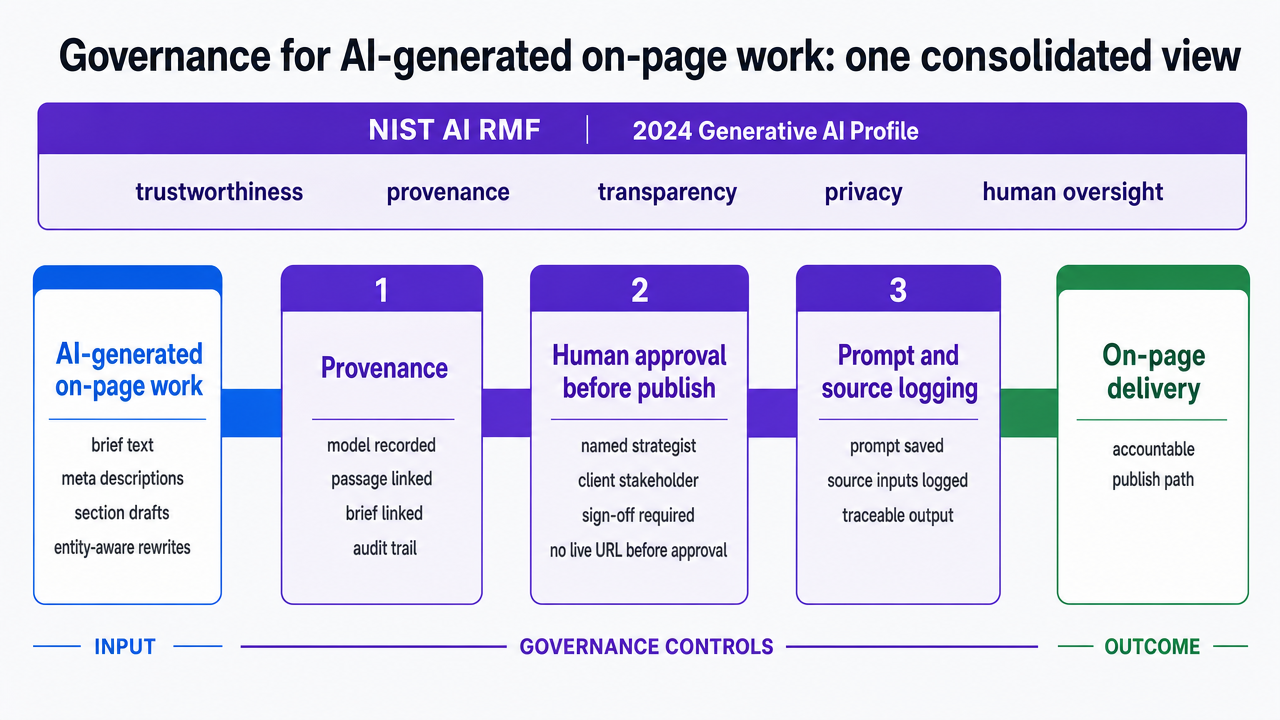
Any tool in this review that generates copy — brief text, meta descriptions, section drafts, entity-aware rewrites — puts the agency on the hook for what ships under a client's byline. NIST's AI Risk Management Framework sets the voluntary baseline for trustworthiness considerations across the lifecycle of AI systems, and its 2024 Generative AI Profile adds specific guidance on provenance, transparency, privacy, and human oversight for generative outputs 4, 5.
Translated to on-page delivery, three controls matter. First, provenance: the tool records which model produced which passage and against which brief, so a client dispute has an audit trail rather than a screenshot. Second, human approval before publish: no generated draft reaches a live URL without a named strategist or client stakeholder signing off inside the system of record. Third, prompt and source logging tied to the URL, so a rewrite six months later inherits context rather than starting blind. Tools without these controls do not disqualify themselves, but the agency absorbs the governance work the platform declined to do.
 Visualize the three governance controls the section explicitly enumerates (provenance, human approval before publish, prompt and source logging), tied to the NIST AI RMF citations in nearby prose
A decision path by delivery model
The archetype question resolves faster once a Head of SEO fixes the delivery model against the tool's job.
An agency running a long tail of sub-$3K retainers with freelance writers is buying research compression, not workflow. A brief-and-score platform absorbs the hours that hurt margin — SERP modeling, term coverage, writer self-check — and leaves publishing where it already lives. Anything heavier becomes shelfware.
An agency running mid-market retainers with in-house strategists and a rotating writer bench is buying editorial durability. Topic modeling that flags cannibalization across a domain, and briefs that survive a strategist handoff, matter more than raw score speed. The tool has to hold the operating model between assignments, not just inside them.
An agency running enterprise accounts, multi-brand portfolios, or franchise systems is buying a governed loop. Briefing, scoring, approval routing, and publishing collapse into one record, or the strategist reconciles four systems every week. Forrester's argument that content leaders must master intelligence embedded across many technologies to tune experiences at scale applies most directly here 8. Fix the delivery model first. The tool shortlist writes itself.
Frequently Asked Questions
References
- 1.Smarter Together: Trends In AI For B2B Marketing.
- 2.The State Of Artificial Intelligence And Machine Learning Adoption In B2B Marketing 2024.
- 3.Getting Smart On Content Intelligence.
- 4.AI Risk Management Framework.
- 5.Artificial Intelligence Risk Management Framework: Generative Artificial Intelligence Profile.
- 6.AI RMF Development.
- 7.Chasing Content ROI? Design Taxonomy To Deliver Access, Automation, And Analytics.
- 8.In The Age Of AI, Marketers Need To Rethink Content Intelligence.
- 9.Introducing Content Intelligence.
- 10.Three Ways Marketers Can Use Content Intelligence To Drive Business Outcomes.