
Key Takeaways
- Treating an SEO online check as a point-in-time scan misses daily drift from plugin updates, tag edits, and redirects; run it as a continuous control process with named owners instead.
- Crawlers see raw HTML while users see rendered pages, so pair every crawl with a rendered-DOM snapshot and throttled mobile view to catch content the index may silently miss.
- Ranking charts describe visibility, not pipeline; separate visibility, segmented traffic quality, and conversion outcomes reconciled against the client's CRM so the audit can explain why calls did or did not land.
- Tag inventories are not data-flow reviews; document per tag what parameters each one transmits, to which domain, under which consent gate, and escalate anything touching sensitive intake fields to privacy counsel 10.
- Accessibility and SEO touch the same headings, labels, alt text, and keyboard paths, so fold the accessibility pass into the same cycle and ticket queue rather than paying two vendors for two incomplete reports.
- A single quarterly malware scan skips detect and respond; split security into continuous monitoring for certificates, plugins, and defacement plus scheduled reviews that confirm HTTPS and HSTS baselines 7.
- At 25 to 40 accounts, checklist audits break because every new client adds crawls, tags, CMS patching, and CRM reconciliations faster than headcount can absorb, forcing a shift to continuous governed QA.
- Fixes are not closed until validated in rendered HTML, Search Console coverage, segmented traffic, and CRM conversions; skipping validation creates a backlog of closed tickets the client finds before the agency does.
- The underlying error is organizational: treat the audit as a loop the delivery org runs, with monitoring handling detection and specialists reserved for judgment calls that do not scale with headcount.
Why Clean Audit Reports Keep Producing Flat Pipeline
Agency delivery leads keep sending clients audit decks full of green checkmarks while qualified calls, booked consults, and pipeline velocity sit flat for another quarter. The reports are not wrong. They are incomplete in a way that routine SEO online checks have trained the industry to accept.
Most audit workflows still equate a passing crawl, a clean metadata sweep, and a Core Web Vitals snapshot with site health. That bundle answers a narrow question: can a crawler reach the HTML and parse it. It does not answer whether rendered content matches the index, whether conversion tags on a client's intake form are quietly shipping sensitive data to third parties, whether a plugin update broke keyboard navigation on the primary service page, or whether the ranking improvement being reported corresponds to any segment the client actually sells to.
The failure mode is structural. Digital.gov's analytics guidance is explicit that web-performance metrics should be interpreted across dimensions such as time, content, marketing source, and audience, not reported as a single traffic number 2. Yet the dominant agency pattern is the opposite: a monthly PDF of rankings and sessions, divorced from goal segments and conversion quality. When the pipeline underperforms, the audit cannot explain why, because the audit was never designed to.
The mistakes that follow are not obscure. They are the predictable output of treating the SEO online check as a point-in-time scan rather than a governed quality-assurance process. Each one is fixable. None of them are fixed by running a different tool.
Treating the Online Check as a Scan Instead of a Control Process
The dominant mental model inside agency delivery teams is that an SEO online check is a scan. A specialist opens a crawler, runs a site through it, exports the issues, resolves what the client's dev team will accept, and moves on. That mental model is where most downstream failures start. A scan produces a snapshot. Client sites change daily: new blog posts, plugin updates, tag manager edits, redirects pushed by a web team the agency does not control, consent-mode changes, CMS version bumps. A snapshot taken on the 1st of the month cannot describe a site on the 14th.
The useful reframe already exists in federal guidance. NIST's Cybersecurity Framework 2.0 organizes risk management around six functions: Govern, Identify, Protect, Detect, Respond, and Recover 5. The framework was written for cybersecurity, but the shape of the loop is exactly what a client SEO audit needs. Govern defines who owns which decision across the agency and the client's internal team. Identify catalogs the plugins, tags, templates, and third-party scripts in play. Protect establishes the baseline configurations the audit expects to find each cycle. Detect runs the continuous checks that flag drift. Respond is the escalation path when drift becomes damage. Recover is the reindex and re-trust workflow after a correction.
Digital.gov's analytics playbook arrives at the same conclusion from the measurement side, warning that improperly implemented tools and incorrectly analyzed data can derail delivery and recommending continuous measurement over isolated reporting 3. The audit stops being an artifact a specialist produces once a month and becomes a control process the agency runs against every account. Specialists still make judgment calls. The scan is no longer the deliverable.
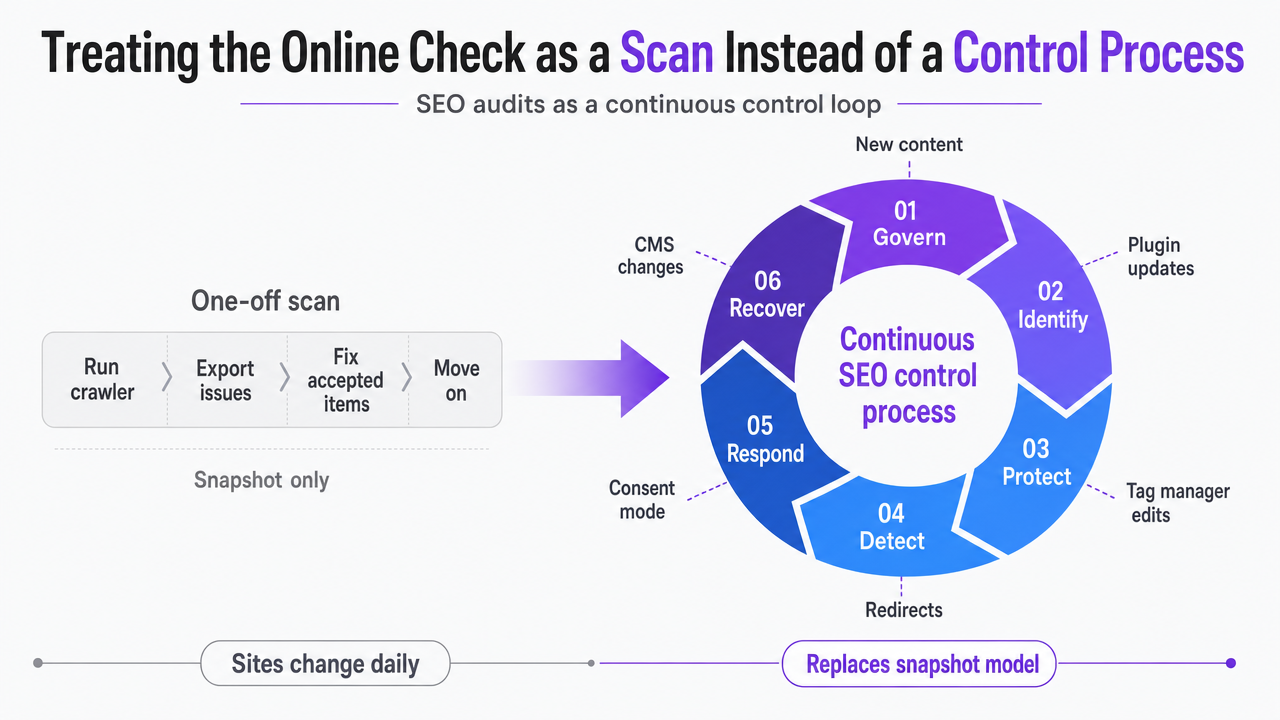 Visualize the six NIST CSF 2.0 functions cited in this section as a continuous control loop applied to SEO audits, replacing the one-off scan model
Confusing Crawl Signals With Rendered Reality
Most crawlers fetch raw HTML. Most client sites render the content that matters in the browser. The gap between those two statements is where a surprising amount of client traffic quietly disappears.
A specialist runs a crawl, sees the service page returning 200, confirms the title tag and canonical, and marks the URL healthy. What the crawl did not see: the FAQ accordion populated by JavaScript after a third-party widget loads, the location schema injected by a tag manager rule, the pricing table that only mounts after a consent banner is dismissed, or the H1 that gets rewritten by an A/B testing script on 50% of sessions. The index may or may not include any of it. The audit report has no way to know, because the audit never asked.
The same blind spot shows up on the measurement side. Digital.gov notes that web-performance metrics should be baselined with proper page tagging and interpreted with documented limitations around sampling, consent, and cross-device behavior 2. When an agency reports that a page is "crawlable and indexable," it is usually making a statement about the fetch, not about what Googlebot renders, not about what mobile users see, and not about what the analytics tag actually captures when a user converts.
The fix is procedural, not technical. Every priority template on a client site, service pages, location pages, intake forms, pricing, FAQs, needs a rendered-content check against the HTML the crawler saw. Agency teams should pair the crawl export with a rendered-DOM snapshot and a live view from a throttled mobile profile, then flag any element that appears in one view but not the others. Discrepancies become tickets with named owners, not footnotes in a monthly deck.
Reporting Rankings as Outcomes
A ranking is an input. A booked consult is an outcome. The habit of putting the first on page one of the client deck and treating the second as a footnote is how agencies end up renewing on relationship rather than on evidence.
The pattern is easy to spot in retention conversations. The report shows the primary service term moved from position 7 to position 3. Non-brand sessions are up 22% quarter over quarter. Core Web Vitals are green on the top ten URLs. The client's response is some version of: the phone is not ringing differently. The specialist defends the numbers. The account enters a slow erosion that nobody on the delivery side can diagnose, because the audit was never built to see past the ranking.
Digital.gov's measurement guidance is direct about what a defensible report requires. Web-performance metrics should be interpreted across dimensions such as time, content, marketing source, and audience, baselined with proper page tagging, and read with documented limitations around sampling, consent, bot traffic, cross-device behavior, and attribution assumptions 2. Most agency reports collapse all of that into two charts: a ranking trendline and a sessions bar graph. The dimensions that would tell the client which content earned which segment, which marketing source converted at what quality, and which audience actually matched the service offer are absent. There is nothing in the report a delivery lead can defend when pipeline stalls, because the report never named a segment or a conversion in the first place.
The fix starts by separating three things that routine audits treat as one.
- Visibility, the ranking and impression layer.
- Traffic quality, the segmented session view with source, content, device, and audience dimensions.
- Conversion outcomes, the forms submitted, calls qualified, consults booked, and the downstream status of each.
A credible audit traces a line from a prioritized URL through the keywords it ranks for, the sessions it draws from the segments the client sells to, and the conversion events it produces. When the line breaks, the audit says where. When rankings rise but the conversion count does not, the audit says whether the gain came from a segment that does not buy, a page that mis-sets expectations, or a tracking configuration that stopped firing after the last tag manager edit.
Agencies serving regulated verticals have a second problem on top of the first. Conversion events on healthcare, legal, and behavioral-health sites often sit behind consent gates, redacted parameters, or server-side proxies, and the numbers that show up in the default analytics view understate real volume. Reports that treat the raw session count as the outcome will tell the client the program is losing when it is not, or that it is winning when the sales team sees nothing. The audit has to name what is being measured, what is being suppressed by design, and how the client's own CRM data reconciles against the site view before anyone draws a conclusion from a trendline.
Correct Critical SEO Online Check Errors Fast
Pinpoint and resolve damaging SEO check issues with real-time, actionable reporting and publishing during your free trial.
Skipping the Tag and Pixel Data-Flow Review
Most SEO audits stop at the tag inventory. The specialist opens Tag Assistant, confirms the analytics tag is firing, verifies the conversion event registers on form submit, and marks measurement healthy. What the audit did not do is trace what each tag actually sends, to whom, under what consent condition, and from which page states. On a brochure site that distinction rarely matters. On a healthcare, behavioral-health, dental, or legal client, it is the difference between a working measurement stack and a regulatory escalation.
The FTC and HHS made the stakes explicit when they warned roughly 130 hospital systems and telehealth providers that technologies including the Meta pixel and Google Analytics can track user activity and may impermissibly disclose sensitive health information to third parties 9. The accompanying model letter put the obligation on the regulated entity to assess whether tracking disclosed protected health information, and reminded non-HIPAA entities that FTC Act and Health Breach Notification Rule obligations still apply 10. The FTC's own technical analysis of pixel tracking describes how embedded JavaScript can collect page interactions and information typed into forms, which is the exact mechanism agencies rely on for conversion attribution 13.
The audit items most teams skip are the ones that matter here.
- Which pages carry which tags.
- Which form fields are inside the DOM those tags observe.
- Whether appointment, symptom, provider, or condition values appear in URL parameters, event payloads, or referrer strings sent to advertising endpoints.
- Whether consent-mode changes have silently rerouted events through server-side containers that nobody on the delivery team can inspect.
- Whether a vendor's SDK was added via the CMS editor without passing through tag governance at all.
The FTC's broader data-practices report notes that pixels, SDKs, and advertising APIs can transmit user activity in ways that create significant privacy harms, and that scrutiny should sit on the data flow rather than the tag label 4.
A defensible data-flow review documents, per tag, the page templates it loads on, the events it listens for, the parameters it transmits, the destination domain, the consent gate controlling it, and the business reason it exists. Tags without a business reason get removed. Tags on intake, scheduling, symptom-checker, or portal flows get escalated to the client's privacy counsel with the payload captured, not with a reassurance that "it looks fine." The FTC's consumer-health guidance is direct that behind-the-scenes tracking of sensitive data contrary to privacy promises can violate the FTC Act, so the audit's job is to surface the flow and route the decision, not to render a verdict 12. Agencies that treat tag review as a measurement task rather than a data-flow task eventually hand clients a conversion report and a legal exposure in the same deliverable.
Treating Accessibility as a Separate Compliance Problem
Accessibility usually lives in a different folder than the SEO audit. A separate vendor runs an automated scan twice a year, the client receives a PDF, and the delivery team goes back to meta tags and internal links. The split is a workflow habit, not a technical reality. The elements that an accessibility review flags are the same elements the SEO audit depends on: heading hierarchy, alt text, link labels, form labels, color contrast, keyboard operability, and semantic landmarks. When those break, assistive technology breaks and so does the signal structure crawlers and ranking systems use to understand the page.
The Department of Justice names the overlap directly. Its ADA guidance identifies color contrast, text alternatives, captions, headings, keyboard navigation, and forms as core accessibility considerations for covered organizations 1. Those are the same fields the SEO audit already touches. A missing H1 is both an accessibility defect and a ranking signal gap. An unlabeled form field is both a screen-reader failure and a conversion-tracking failure. Running two separate audits against the same markup produces two incomplete reports and no owner for the fix.
Agency teams serving public-sector, healthcare, court, senior-living, and civic-information clients carry a sharper exposure. The DOJ's 2024 Title II final rule set technical accessibility standards for state and local government web content and mobile apps, with staggered compliance timelines by entity size 6. For agencies holding those contracts, an accessibility defect surfaced by an end user before it was caught in a routine check becomes a client-escalation event the SEO audit should have prevented. Earlier DOJ guidance makes the same point in broader terms for Title II and Title III organizations 11.
The practical move is to fold the accessibility pass into the same cycle as the technical SEO pass, against the same priority templates, with the same ticket queue. Headings, alt attributes, form labels, link text, contrast ratios, and keyboard focus order get checked when the specialist is already in the page. Defects route to the same backlog with the same owner. Automated scores stay what they are, a starting signal, not a compliance verdict. The audit's job is to catch the defect, document the risk, and route the decision, not to render a legal opinion the agency is not qualified to give.
Running the Security Check Once and Calling It Done
Security on most agency audit checklists is a single line item: run a malware scan, confirm the SSL certificate is valid, note the WordPress version, done. The scan runs once a quarter, maybe once a month on larger accounts, and the result lives in an appendix the client rarely reads. The gap between that habit and what actually protects a client's search presence is wide enough to lose accounts through.
CISA's guidance on content management systems is specific about where the risk sits: outdated CMS software and third-party plugins, weak account controls, insecure sessions, exposed version numbers, and missing monitoring are the recurring failure points that produce hacked pages, spam injections, downtime, redirects, and data exposure 8. Each of those outcomes damages search trust in ways a quarterly scan cannot catch, because the window between a plugin vulnerability disclosure and an exploited site is often days, not quarters. CISA's broader website security guidance adds the transport layer: disable HTTP, enforce HTTPS, and use HSTS where possible 7. Mixed content, expired certificates, and insecure redirects quietly sit on client sites between scans and show up in the audit only after a ranking drop forces someone to look.
The NIST Cybersecurity Framework 2.0 structure referenced earlier applies here directly.
- Govern names who on the agency and client side owns CMS access, plugin approvals, and incident escalation.
- Identify maintains a current inventory of plugins, themes, and third-party scripts per account.
- Protect enforces the HTTPS, HSTS, patching, and credential baselines.
- Detect runs uptime, defacement, certificate-expiry, and version-drift monitoring between formal audits.
- Respond defines the reindex, disavow, and search console workflow when a site is compromised.
- Recover covers backup restoration and the sequence for rebuilding search trust after remediation 5.
A security check that only produces a status flag at audit time skips four of the six functions.
The operational takeaway is to split security into continuous monitoring and periodic review, with named owners for each. The quarterly audit confirms the baseline. The monitoring layer catches the drift that would otherwise reach the client as a ranking drop or a defacement complaint.
Reduce SEO Audit Errors and Scale Multi-Site Performance with Data-Driven Oversight
Connect with our team to see how enterprise agencies automate SEO quality checks, eliminate bottlenecks, and maintain strategic control—without expanding headcount or sacrificing accuracy.
Portfolio-Scale Audits: Where the Workflow Breaks First
This section shifts the frame from a single-client audit to the delivery leads running audits across a book of 10 to 80 accounts. The mistakes described earlier compound at portfolio scale in a way that is rarely visible from inside one account. A specialist who misses a tag-flow defect on one healthcare client has produced one escalation. A delivery org that misses the same defect across 14 healthcare clients has produced a pattern, and the pattern is almost always a workflow problem rather than a specialist problem.
Three operating models dominate the market, and they fail in predictable places. Digital.gov's analytics playbook argues for a continuous operating model, warning that improperly implemented tools and incorrectly analyzed data derail delivery and recommending continuous measurement, documented strategy, deliberate implementation, and ongoing training rather than isolated reporting 3. Mapped against audit practice, that guidance sorts agencies into three tiers.
| Operating model | Audit frequency | Specialist hours per client per month | Escalation path | Failure modes caught | Client-reportable outcomes |
|---|---|---|---|---|---|
| A. Ad hoc specialist audits | On request or when a problem surfaces | Variable; typically concentrated during fire drills (specialist hours × blended rate) | Informal; routed through whichever specialist owns the account that week | Crawl errors, broken metadata, obvious ranking drops | Rankings, sessions, reactive fixes |
| B. Standardized quarterly checklist | Quarterly, with a shared template | Fixed block per cycle (checklist hours × blended rate) | Documented but slow; defects wait for the next cycle | Technical SEO drift, basic security flags, automated accessibility scores | Rankings, sessions, checklist completion rate, select Core Web Vitals |
| C. Continuous governed QA with AI-assisted monitoring and human approval | Continuous detection; scheduled human review | Lower variable hours per account; capacity shifts to judgment work (review hours × blended rate) | Named owners per function; defects route to a live backlog with SLAs | Tag data-flow drift, rendered-content gaps, plugin and certificate drift, accessibility defects on priority templates, segmented conversion anomalies | Visibility, segmented traffic quality, conversion outcomes reconciled to CRM, defect-to-fix cycle time |
Three audit operating models mapped against the continuous-measurement guidance in the Digital.gov Web Analytics Playbook 3. Hour figures are left as agency-defined variables.
Model A fails first and loudest. Audits happen when a client complains, which means the audit's job is to explain a problem that has already cost pipeline. Model B is the current industry default. It catches the defects a checklist was designed to catch, and misses everything the checklist was not updated to include, which in a given quarter can mean a new consent-mode behavior, a plugin vulnerability disclosed last week, or a Title II compliance deadline that moved. Model C is where the Digital.gov playbook points: strategy established, tools configured deliberately, measurement run continuously, data democratized across the team, and training treated as part of delivery rather than overhead 3.
The portfolio economics of the three models are not subtle. Model A spends specialist hours reactively and inconsistently. Model B spends a predictable block of hours per client per quarter regardless of whether the account needs it. Model C spends fewer variable hours per account on scanning and more on the judgment calls that only a senior specialist can make, which is the point at which audit quality stops scaling linearly with headcount. For an agency head of SEO carrying 40 accounts and 8 specialists, the question is not whether Model C produces better audits. It is whether the delivery org can keep running Model B at retention-grade quality without hiring the next three specialists the book would otherwise require.
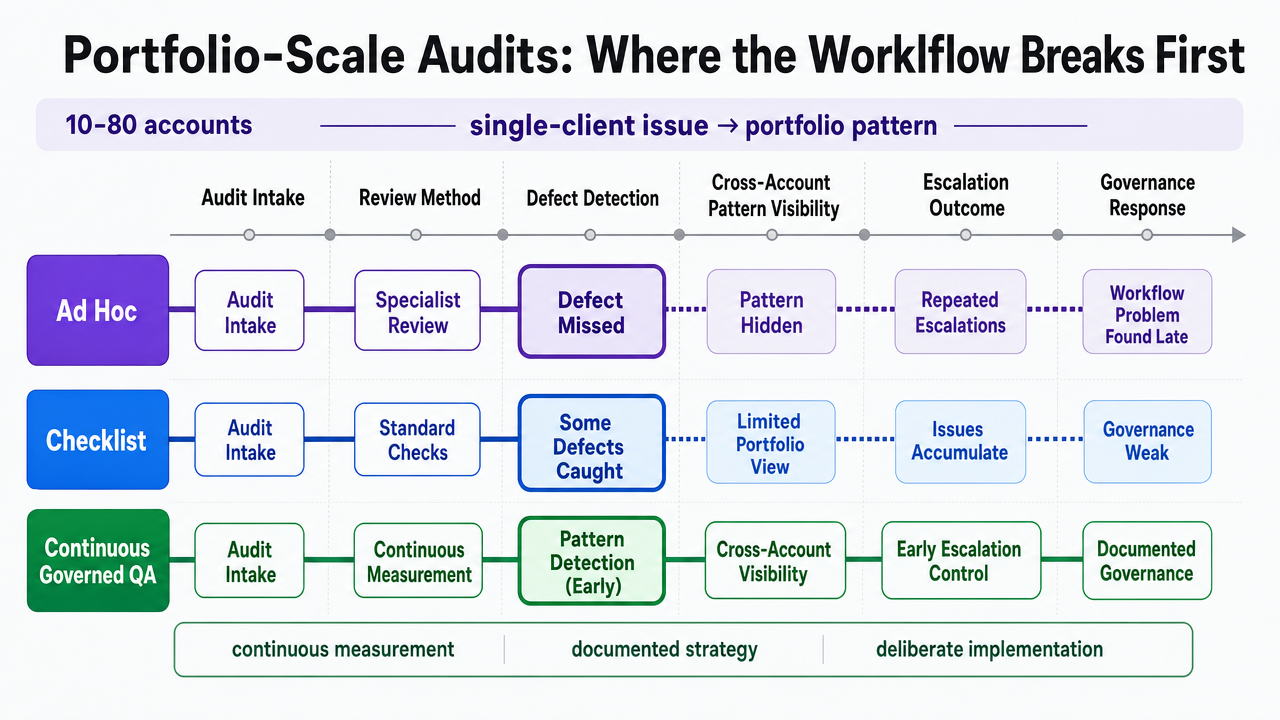 Translate the three-model comparison table in this section into a scannable visual framework contrasting ad hoc, checklist, and continuous governed QA operating models
Shipping Fixes Without Validating Them
The last mistake is the one that quietly undoes the first eight. A specialist finds a defect, writes the ticket, the client's dev team deploys the change, and the audit marks the item closed. Nobody confirms the fix landed in production, rendered correctly for the crawler and the user, propagated to the index, and produced the segment-level traffic or conversion movement that justified the work in the first place.
The gap is routine. A canonical gets corrected in staging and reverts on the next CMS sync. An hreflang block ships with a typo that the pre-deploy check caught but the hotfix bypassed. A consent-mode update changes which events reach the analytics tag, and the conversion count the audit used as its baseline is no longer measuring the same thing. A plugin update reinstates the mixed-content warnings CISA flags as a transport-security failure 7. Each defect was closed. None of them stayed fixed.
Validation is a scheduled step, not an assumption. The ticket closes when the specialist confirms the change in rendered HTML, in Search Console coverage, in the segmented traffic view Digital.gov describes 2, and in the conversion reconciliation against the client's CRM. If any one of the four does not move as predicted, the ticket reopens with the delta captured. Audits that skip validation accumulate a backlog of closed items that are actually open, and the client eventually finds the pattern before the agency does.
The Operating-Model Implication
The mistake behind the eight that preceded it is organizational. Agencies try to deliver governed audits with linear specialist headcount, and the math stops working somewhere between the 25th and 40th account. Each new client adds another crawl to schedule, another tag inventory to maintain, another CMS to patch-track, another accessibility baseline to re-check, another conversion reconciliation to run against another CRM. The checklist grows faster than the team can hire against it, and the first thing that gets dropped is the validation step that would have caught the drift.
Digital.gov's analytics playbook names the exit: establish strategy, implement deliberately, configure tools, democratize data, train teams, and work continuously 3. Translated into delivery terms, continuous monitoring handles detection, specialists handle judgment, and approval sits with named owners on both the agency and client side. The audit stops being a document a specialist produces and becomes a loop the delivery org runs. Platforms built around that loop, including the Vectoron AI Marketing Team Platform, exist because the alternative is adding the next three specialists every book of accounts eventually demands.
Frequently Asked Questions
References
- 1.Guidance on Web Accessibility and the ADA.
- 2.DAP: Digital Metrics Guidance and Best Practices.
- 3.Web Analytics Playbook.
- 4.Examining the Data Practices of Social Media and Video Streaming Services.
- 5.NIST Cybersecurity Framework 2.0: Resource & Overview Guide.
- 6.Justice Department to Publish Final Rule to Strengthen Web and Mobile App Access for People with Disabilities.
- 7.Website Security.
- 8.Content Management Systems Security and Associated Risks.
- 9.FTC and HHS Warn Hospital Systems and Telehealth Providers About Privacy and Security Risks Related to Online Tracking Technologies.
- 10.Model Letter: Use of Online Tracking Technologies.
- 11.Justice Department Issues Web Accessibility Guidance ....
- 12.Collecting, Using, or Sharing Consumer Health Information? Look to HIPAA, the FTC Act, and the Health Breach Notification Rule.
- 13.Lurking Beneath the Surface: Hidden Impacts of Pixel Tracking.