
Key Takeaways
- Adding writers rarely solves content backlogs because drafting is only a fraction of the work; the real constraint is review, verification, and voice calibration around scaled output.
- Route pattern-heavy tasks like outlining, meta, schema, and first drafts to AI, but keep original claims, regulated advice, interviews, and brand voice with human writers 10.
- A five-stage supervised line—intake, drafting, review, publish, measure—combined with NIST, Copyright Office, and FTC checkpoints turns reclaimed hours into defensible throughput 1, 7, 9.
- Focus next on reinvesting freed writer-hours into content refresh and substantiation, using Search Console signals to prioritize the queue rather than chasing net-new volume.
The production bottleneck behind stalled content velocity
Most in-house content teams face a production bottleneck not because writers are slow, but because the surrounding production line cannot absorb the strategic backlog. A typical four-writer team publishing twelve to sixteen posts monthly often has thirty to fifty briefs awaiting, a persistent refresh queue, and a growing list of programmatic pages requested by SEO leads. Adding more writers offers only marginal gains in output while increasing recurring costs, onboarding time, and editorial review burdens.
The shift towards AI in content production is evident in adoption data. Stanford's 2025 AI Index indicates that organizational AI use increased from 55% in 2023 to 78% in 2024, with generative AI use in at least one business function rising from 33% to 71% during the same period 3. Within this trend, content creation is a significant use case: marketing strategy content support accounts for 27% of reported generative AI applications, surpassing knowledge management and personalization, both at 19% 4. This data reflects where teams are focusing their efforts, rather than direct ROI.
For content managers, this means that the throughput advantage will not come from early adoption, but from building a supervised production system around AI before competitors do, given that over a quarter of generative AI activity is already directed towards marketing content.
Why 'more writers' is the wrong lever
Hiring additional writers only resolves capacity issues if drafting hours are the primary constraint. For most in-house teams, this is not the case. A senior writer typically dedicates about a third of their time to drafting, with the remainder spent on research, outlining, editing, formatting, meta-data work, internal linking, and stakeholder revisions. Increasing headcount duplicates all this overhead and expands the editorial review queue, which is often the initial point of content stagnation.
A second issue with relying on headcount is Google's guidance on scaled content abuse. This policy targets high-volume, low-value pages created primarily to manipulate rankings, irrespective of whether they were human- or AI-generated. Teams that push writers to publish faster to address backlog pressure face the same policy risks as those that accelerate AI model output. The key is not volume itself, but the supervision applied to that volume.
A more effective approach is to view writer time as a valuable resource to be reallocated, not simply increased. While drafting minutes are compressible, editorial judgment, source verification, and voice calibration are not. A four-writer team that reclaims drafting hours and reinvests them into review, content refresh, and topical depth will likely out-publish a five-writer team still adhering to the traditional brief-to-draft-to-edit workflow.
The jagged frontier: what to assign to AI and what to keep human
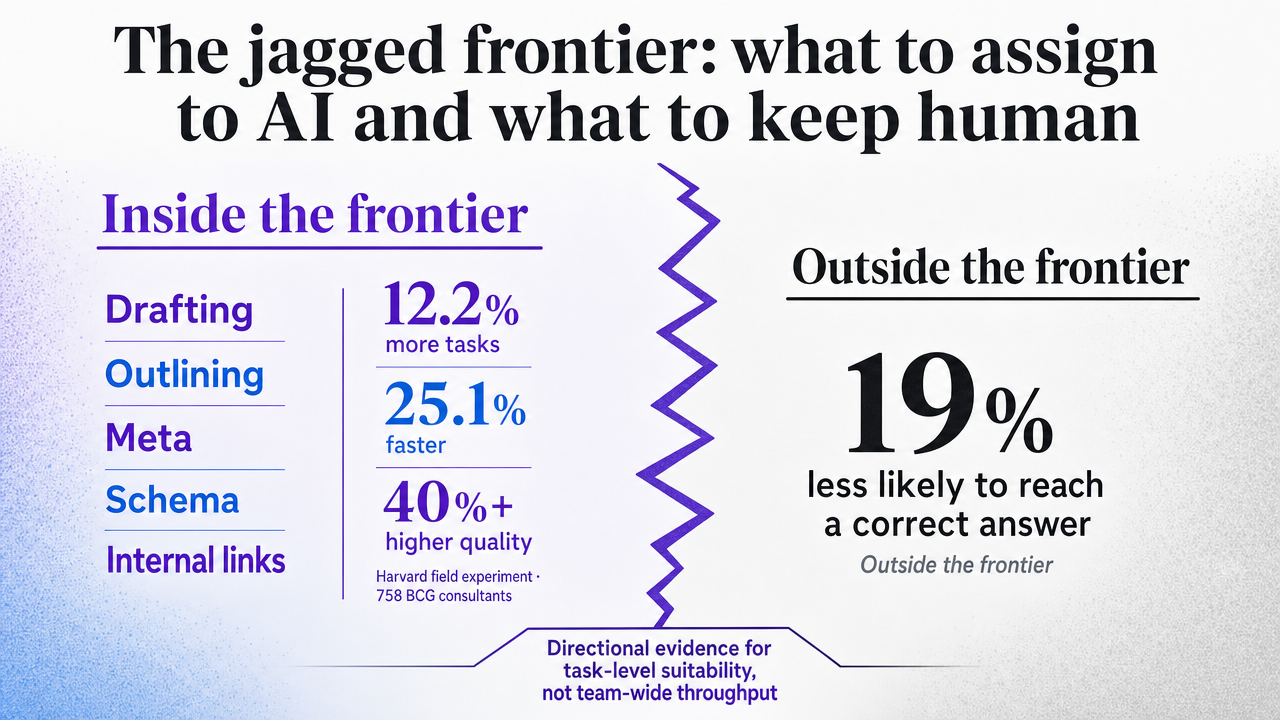
Inside the frontier: drafting, outlining, meta, schema, internal links
A Harvard Business School field experiment involving 758 Boston Consulting Group consultants provides a clear operating principle for content managers. Within what researchers termed the AI capability frontier, participants using GPT-4 completed 12.2% more tasks, finished them 25.1% faster, and achieved results rated over 40% higher in quality. Conversely, outside this frontier, the same users were 19% less likely to arrive at a correct answer 10. This study focused on individual, time-boxed tasks, offering directional evidence for task-level suitability rather than a guarantee of team-wide throughput.
For content operations, this frontier directly applies to specific production steps. Tasks such as first-draft prose from a defined brief, outline expansion, generating meta titles and descriptions, drafting FAQ blocks, creating schema markup, generating alt-text, and suggesting internal links from a known sitemap all fall within this capability. These are pattern-heavy tasks with clear constraints and straightforward verification. A senior editor can quickly confirm their quality.
The practical strategy is to route these tasks through AI models by default, freeing writers from manual execution. A four-writer team that automates outlining and meta-data work alone can typically save several hours per article. This reclaimed time becomes available for tasks outside the AI frontier, such as source verification, original reporting, and the critical review layer that ensures the defensibility of scaled output.
Outside the frontier: original claims, regulated advice, expert interviews, voice
The same Harvard study strongly advises against assigning certain tasks to AI models. When consultants used GPT-4 for problems beyond its reliable range, they were 19% more prone to incorrect answers than those working without it 10. This indicates that confidence increased while accuracy declined. For content teams, this applies to any task where the model cannot self-verify and an editor lacks an efficient way to detect errors.
Four categories should remain human-centric:
- Original expert claims and proprietary data interpretation, where the core knowledge resides with a subject-matter expert;
- Regulated advice in fields like legal, medical, financial, and behavioral health, where plausible but incorrect statements can lead to significant liability;
- Primary interviews and quote synthesis, where subtle paraphrase shifts can alter meaning;
- Brand voice calibration on flagship pages, where the impact of generic language is measured in trust, not efficiency.
This boundary is dynamic, evolving with model advancements and improved verification tools. It requires quarterly auditing against actual published output, rather than adherence to outdated assumptions. Editors should be able to identify, for each production step, whether it currently falls within the AI frontier and what evidence would necessitate a re-evaluation.
 Visualize the task-routing framework distinguishing AI-suitable (inside frontier) work from human-only (outside frontier) work, directly reinforcing the section's central comparison and citing the Harvard field experiment data referenced in nearby prose
Test AI-driven content production at scale now
Produce, approve, and publish SEO-optimised content during your trial—see measurable output before making a commitment.
The five-stage supervised production line
Intake: briefs that constrain the model before it drafts
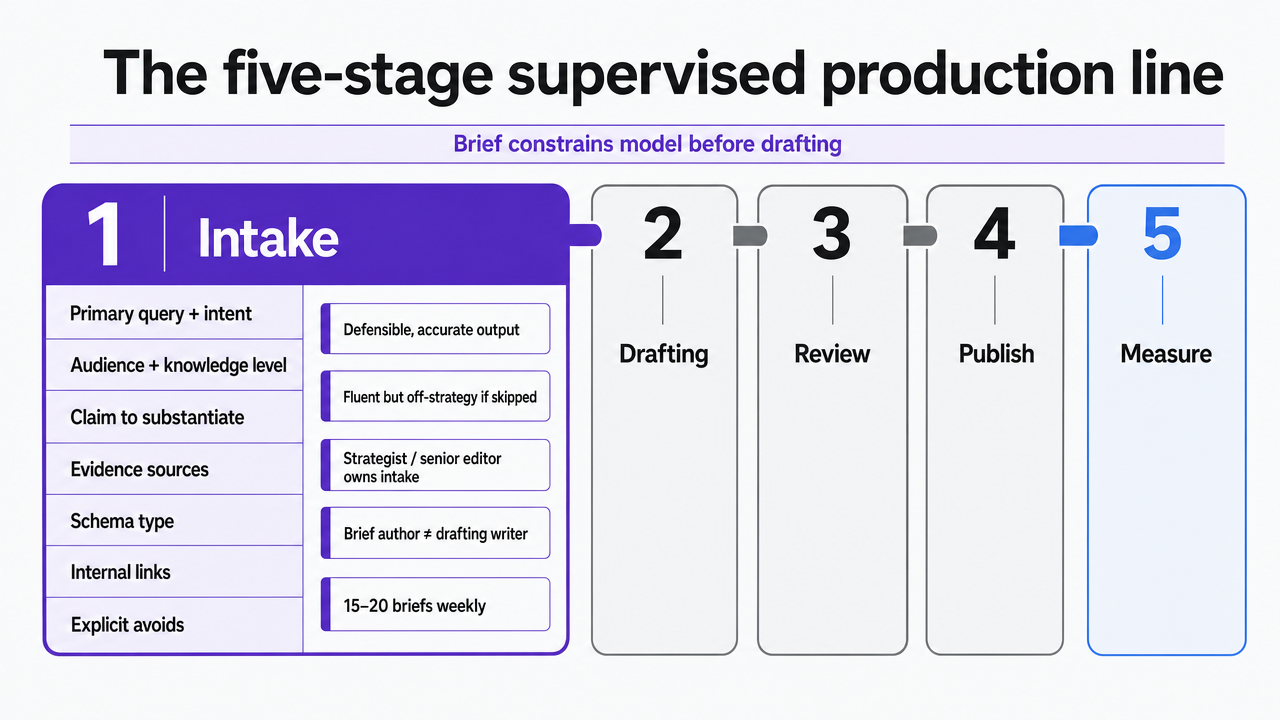
The brief is crucial for ensuring scaled output is defensible and accurate. An effective intake document specifies variables an AI model cannot infer: primary query and intent, target audience and their knowledge level, the specific claim the page must substantiate, internal and external evidence sources, required schema type, and mandatory internal links. It also defines what the page will explicitly avoid, which can be more valuable than what it includes.
Teams that bypass this step often find themselves editing fluent but off-strategy prose. A four-writer team can process fifteen to twenty briefs weekly if a strategist or senior editor, not the drafting writer, owns the intake process. Separating brief authorship from drafting eliminates the tendency to create vague briefs and determine the angle later.
The brief also serves as the initial governance artifact, documenting human editorial intent to support copyright registration and claim provenance 1.
Drafting: assigning AI to frontier tasks and blocking it from the rest
In the drafting stage, the AI frontier becomes a workflow rule rather than a preference. The model handles outline expansion from a locked brief, first-draft prose for informational sections, meta variants, FAQ blocks, schema markup, and alt text. It is explicitly excluded from generating original expert claims, regulated advice paragraphs, quoted interview material, or content for pages critical to brand voice. These sections are either left blank in the draft or marked for human writers to complete.
This division is more effectively enforced structurally than through policy. A well-designed drafting template includes locked sections that the model cannot populate and open sections it can. Writers receive a partial draft with placeholders for human input, rather than a complete draft requiring extensive accuracy checks.
The economic rationale for this split is clear: the Harvard field experiment showed a 12.2% task-completion increase and 25.1% speed gain within the AI frontier, but a 19% decrease in correctness outside it 10. Preventing the model from operating in the latter category safeguards the gains achieved in the former.
Review: the editor as the throughput multiplier
In a supervised production line, the editor transforms from a potential bottleneck into a throughput multiplier. When drafting time is reduced by a quarter and outlining is removed from the writer's queue, the reclaimed hours are reallocated to the review stage. Here, a senior editor can dedicate fifteen to twenty focused minutes per article to critical quality factors: source verification, claim substantiation, voice calibration, and structural coherence.
An effective review checklist is concise and mandatory:
- Every factual claim must link to a cited source;
- Every statistic must specify its study scope;
- Every expert assertion must originate from a named subject-matter expert or be removed;
- Every regulated statement must be flagged for legal or clinical review;
- Voice-sensitive passages must be rewritten to align with the brand's style guide.
A senior editor on a four-writer team can typically clear twenty-five to thirty AI-assisted articles monthly at this depth, roughly double the volume of fully human drafts. This is because AI-assisted drafts arrive in a more consistent and predictable state. Neglecting a robust review layer converts throughput gains into quality debt.
Publish: provenance logging and pre-publish substantiation gate
Publication is the final, cost-effective point for governance. Post-publication corrections are more expensive and reach fewer readers. This stage incorporates two controls: first, a provenance record detailing AI-drafted and human-written sections, consulted sources, and final approvers. NIST's work on synthetic content transparency provides technical patterns for tracking this, and such logs support copyright registration by documenting human contributions 1, 6.
Second, a substantiation gate ensures that every factual claim, testimonial, statistic, and outcome claim is verified against a source before publication. The FTC's endorsement guidance mandates that advertising claims and testimonials be truthful, that endorsers genuinely experienced what they describe, and that material connections are disclosed 9. These standards apply regardless of whether an AI drafted the content.
For high-stakes industries, this gate is a mandatory CMS checklist item, not merely a cultural expectation. Reviewers cannot mark a page ready for publication until every flagged claim has an attached source or documented sign-off.
Measure: routing GSC and analytics back into the queue
The final stage connects published content with future prioritization. Data from Google Search Console, analytics, and pipeline feeds a ranked queue that balances new content briefs against refresh candidates. Pages with high impressions but low click-through rates receive title and meta reworks. Pages on page two with declining positions are expanded or updated with fresh evidence. Pages driving qualified conversions are reinforced with internal links from relevant topical clusters.
Without this feedback loop, scaled production risks becoming volume for its own sake. A supervised line leverages drafting capacity to amplify existing successes, not just to add new pages. For most in-house teams, the highest-return AI-assisted work each month is often content refresh, as historical performance data already indicates which pages warrant further investment.
Measurement also serves to audit the AI frontier. If refresh work on a specific content type consistently underperforms, that category is moved out of the model's queue and back to human drafting. This ensures the production line adapts based on its own output, rather than adhering to outdated assumptions.
 Visualize the five-stage workflow the section explicitly walks through (Intake → Drafting → Review → Publish → Measure), giving readers a single-glance map of the operating model
Governance that keeps scaled output defensible
Three regulatory frameworks influence the operational rules for AI-assisted content, converging into a single workflow rather than requiring separate legal reviews. NIST's AI Risk Management Framework structures governance through four functions: Govern, Map, Measure, and Manage 8. Its Generative AI Profile extends this to address specific risks of generative systems, including inaccuracies, intellectual property exposure, provenance gaps, insufficient human oversight, and inadequate documentation 7. For content teams, these functions translate into editorial checkpoints: Govern assigns AI use policy owners, Map identifies AI touchpoints in the production line, Measure defines quality thresholds and error rates, and Manage triggers corrective actions when content fails review.
The U.S. Copyright Office adds another layer. Its Part 2 report confirms that AI-assisted work is protectable if a human contributes sufficient expressive elements, but purely AI-generated material or work produced solely through prompts is not copyrightable in the United States 2, 5. Registration guidance further requires disclosure of more-than-de-minimis AI-generated content and a description of the human contribution 1. For any page a company intends to protect or enforce, the intake brief, editorial revisions, and reviewer sign-off establish authorship.
The FTC provides the third constraint. Its endorsement guidance mandates that claims and testimonials be truthful, that endorsers accurately represent their experiences, and that material connections are disclosed 9. This standard applies to all promotional content, regardless of its author.
An effective governance layer integrates these three regimes into a single pre-publish CMS checklist:
- A named owner for each page;
- A provenance log detailing AI-drafted and human-written sections;
- Source citations for every factual and testimonial claim;
- A disclosure field for AI contributions when a page is a registration candidate.
At this point, governance becomes a critical gate separating scaled output from scaled liability.
Task-level economics: where the minutes actually move
The throughput calculations are more straightforward at the task level than at the article level. A typical 1,500-word SEO post on a four-writer in-house team generally requires six to eight writer-hours. Drafting accounts for two to three of these hours. Outlining, meta-data work, FAQ blocks, schema, and internal link suggestions add another one to two hours. Research, source verification, expert input, quoting, and voice work consume the remaining time. Editorial review adds an additional thirty to sixty minutes.
The Harvard field experiment quantifies the compressible portion of this work. Across 758 consultants performing writing and analysis tasks, GPT-4 users completed 12.2% more tasks and finished them 25.1% faster within the AI capability frontier 10. Applied to content workflows, this speed gain primarily impacts frontier tasks: outline expansion, first-draft prose from a locked brief, meta variants, FAQ drafting, schema, and alt text. If these tasks constitute four of the seven hours a writer spends per article, a 25% compression frees approximately one hour per post. Multiplied across twelve to sixteen posts monthly, a four-writer team reclaims two to three writer-days.
The allocation of this reclaimed time is more significant than the raw savings. Research, expert input, and in-depth review do not compress at the same rate. Redirecting these reclaimed hours to substantiation and refresh work can typically increase a 12-post month to an 18-to-22-post month without additional headcount, while maintaining review quality. Conversely, if these hours are used for more net-new drafts, quality issues may emerge in subsequent ranking reports.
Streamline SEO Content Output—No Additional Hires Required
Discover how leading marketing teams are leveraging AI workflow automation to accelerate SEO content production while maintaining brand standards and measurable performance gains.
If you manage multiple locations, brands, or practices
The economics of content production change significantly when a content manager oversees output across a portfolio rather than a single site. Agencies serving numerous clients, Dental Service Organizations (DSOs) with multiple practice sites, law firm networks with regional offices, and home services rollups with location pages in various metros all encounter a common challenge: limited per-location content budgets, a strong temptation for templated content, and Google's scaled content abuse policy, which specifically targets near-duplicate pages.
A supervised production line alters the unit economics by redirecting most reclaimed writer-hours towards differentiation rather than solely net-new drafting. Consider an operator with fifteen locations publishing four posts per location monthly. At a baseline of six writer-hours per article, this totals a 360-hour monthly workload. Applying the Harvard field experiment's 25.1% speed gain on frontier tasks like outline expansion, meta variants, and schema drafting frees approximately one hour per article, or 60 hours monthly across the portfolio 10. When these hours are reinvested into location-specific evidence, local expert quotes, and detailed case studies, templated pages become distinct and valuable.
The governance burden also scales differently. A single provenance log, substantiation checklist, and AI use policy can cover all locations if enforced centrally through the CMS. Portfolio operators who attempt to manage this workflow on a location-by-location basis lose the multiplier effect. The economics are only favorable when strategy, review, and measurement are consolidated, and execution is distributed.
The mature endpoint: a specialist strategist model, not a tool stack
Teams that achieve the highest scalability shift their focus from tools to roles. A traditional tool stack requires writers to constantly switch between a drafting model, an SEO plugin, a schema generator, a link auditor, and a compliance checker. In contrast, a specialist strategist model consolidates these functions into distinct AI operators. Each operator is responsible for a defined segment of the production line, reports into the same editorial approval workflow, and adheres to the same governance layer.
This practical structure is familiar to managers of mature editorial teams. A content strategist owns the brief. An SEO strategist manages query mapping, internal linking, and refresh prioritization based on search performance data. A compliance reviewer oversees substantiation and provenance. A publishing operator handles schema, meta-data, and CMS execution. The key difference is that these roles are executed by specialized AI systems within an approval-first workflow, positioning the human editor at the decision point rather than the drafting keyboard. This operational model is central to Vectoron's design and represents the advanced stage most in-house teams reach after exhausting the capabilities of general-purpose drafting models alone.
Frequently Asked Questions
References
- 1.Works Containing Material Generated by Artificial Intelligence.
- 2.Copyright and Artificial Intelligence, Part 2: Copyrightability.
- 3.Economy | The 2025 AI Index Report | Stanford HAI.
- 4.CHAPTER 4: Economy.
- 5.Copyright Office Releases Part 2 of Artificial Intelligence Report.
- 6.Reducing Risks Posed by Synthetic Content: An Overview of Technical Approaches to Digital Content Transparency.
- 7.Artificial Intelligence Risk Management Framework: Generative Artificial Intelligence Profile.
- 8.AI Risk Management Framework.
- 9.Advertisement Endorsements.
- 10.Navigating the Jagged Technological Frontier: Field Experimental Evidence of the Effects of AI on Knowledge Worker Productivity and Quality.