
Key Takeaways
- Portfolio SEO fails as an operations problem, not a tactics problem — delivery workflows built for ten accounts quietly break quality at the edges when stretched across fifty.
- A three-layer architecture holds under scale: standardized site and content architecture at the base, automated monitoring in the middle, and concentrated human judgment at the top.
- Separate commodity SEO from judgment SEO — systematize audits, schema, linking, and brief scaffolds aggressively, but protect topic selection, editorial angle, and link strategy for senior strategists 8.
- Measure the book of business distributionally rather than per page, and place AI inside the commodity slice so accounts-per-FTE rises without diluting the decisions that move rankings 6.
Why Portfolio SEO Breaks Before It Scales
Most agency SEO functions do not fail because the tactics are wrong. They fail because the delivery model was built for ten accounts and is being asked to serve fifty. Strategists who once ran quarterly technical audits by hand now skim log-file samples between status calls. Brief generation slips from three days to ten. Canonical tags drift. Hreflang breaks silently on a client rebuild that nobody was told about. By the time the ranking drop shows up in the monthly report, the regression is six weeks old.
The pattern is consistent across portfolios: quality collapses at the edges first. The flagship accounts stay clean because senior strategists protect them. The mid-tier accounts absorb the shortfall through juniors and templates. The bottom quartile absorbs whatever is left. Peer-reviewed work on SEO strategy still finds it to be a material determinant of visibility outcomes 8, which means the accounts getting the least attention are the ones losing measurable revenue, not just polish.
Heads of SEO already know this. The question is not whether portfolio delivery is fragile. The question is which parts of the workflow should be systematized, which parts should be automated, and which parts should stay in a senior strategist's hands.
The Operations Problem Hiding Inside the Tactics Problem
Heads of SEO tend to reach for tactical answers when portfolio quality slips: a better crawler, a tighter brief template, a new schema library, a junior hire. Each helps at the margin. None of them fix the underlying issue, which is that the delivery workflow itself was never designed for the volume it now carries.
Search evaluation research from NIST makes an adjacent point worth borrowing. Search quality has always been treated as a methodology problem measured across large test collections, not a page-by-page judgment 5, 6. Agencies inherit the opposite habit. Strategists audit one site, fix one canonical, rewrite one title tag, then move to the next account and repeat. The work is real, but the model does not compound. Doubling accounts doubles the hours.
The operating-model literature outside SEO has already worked through this shift. McKinsey's personalization-at-scale research argues that data-driven marketing only scales when firms orchestrate four capabilities in parallel — data, decisioning, design, and distribution — rather than running each campaign as a bespoke project 4. The same logic applies to portfolio SEO. Technical audits, brief generation, internal linking passes, and schema deployment are the SEO analogs of campaign production. Treating them as artisanal work per account is the reason margins compress as the book of business grows.
Reframing scale as a workflow question, not a tactics question, changes what heads of SEO buy, build, and measure next.
A Three-Layer Delivery Architecture
Borrowing the 4Ds: What Personalization Ops Teaches SEO Ops
The most useful blueprint for scaled SEO delivery does not come from SEO literature. It comes from personalization operations. McKinsey's operating-model work identifies four capabilities that have to run in parallel for data-driven marketing to scale: data, decisioning, design, and distribution 4. The framing is deliberately structural. Personalization stops working when firms treat each campaign as a bespoke build; it starts working when the same data pipeline, decision logic, creative system, and delivery channel serve every campaign in the portfolio.
The analogy is not a metaphor. It is an operating-model transfer.
- Data becomes crawl telemetry, log files, rank tracking, and Search Console coverage.
- Decisioning becomes prioritization: which pages to refresh, which technical issues to escalate, which briefs to queue.
- Design becomes the content and schema system that produces on-brand pages predictably.
- Distribution becomes publishing, internal linking, and indexation.
Personalization research is used here as an operating-model analog, not as a claim that SEO is personalization. The transferable insight is narrow and specific: portfolios that orchestrate the four capabilities in parallel outperform portfolios that treat every account as bespoke 2, 4. That reframe is what lets a small SEO team cover more accounts at the same quality bar, and it is the scaffolding under the three layers that follow.
Layer One: Standardized Site and Content Architecture
The first layer is the one most agencies underinvest in because it looks like plumbing. It is not plumbing. It is the substrate that makes everything above it cheaper to run.
Standardized architecture means every client site in the portfolio behaves the same way for crawlers, even when the CMS, industry, and design differ. Canonical rules follow a documented pattern. Pagination handles the same way. Hreflang, when it applies, uses the same implementation across accounts. Schema is deployed from a shared library rather than hand-authored per site. Internal linking follows a hub-and-spoke model with defined depth limits. Templates enforce heading hierarchy, title-tag length, and structured data by default rather than by strategist vigilance.
The payoff is compounding. When architecture is standardized, a technical fix developed for one account ships to forty. A schema update propagates in a release, not a project. Kleinberg's foundational work on hyperlink structure made the case decades ago that authority signals are structural, not page-level 11. Portfolio SEO inherits that logic: sites that share a disciplined architecture inherit disciplined authority flow.
This is also the layer where the 4Ds framework earns its keep. Data, decisioning, design, and distribution have to be codified as reusable systems, not restaged per account 4. The three-layer stack — Standardized Architecture at the base, Automated Monitoring in the middle, Human Judgment at the top — is the SEO analog of that orchestration, and Layer One is where the orchestration either holds or falls apart. Agencies that skip this layer end up automating chaos. Agencies that invest here find that Layers Two and Three cost less to build and produce cleaner outputs.
Layer Two: Automated Monitoring and Regression Detection
The second layer is what catches the six-week-old canonical drift before it becomes a ranking loss. Monitoring at portfolio scale cannot be a strategist opening Search Console per account on Monday mornings. It has to be a running system that watches every site continuously and surfaces exceptions.
The monitoring stack has three jobs.
- Detect technical regressions: canonical changes, robots.txt edits, sitemap breakage, unexpected noindex tags, Core Web Vitals degradation, hreflang errors, sudden crawl budget shifts in log samples.
- Detect ranking and coverage regressions: pages dropping out of the index, keyword clusters losing position, SERP feature eligibility disappearing.
- Detect content decay: pages whose click-through rate or average position has trended down for a defined window.
Each of these is a rules-based or model-based check that runs without a human. The human enters only when the system flags something. This is the point NIST's search evaluation work makes in a different domain: quality is measured as a statistical property of many observations, not a judgment on any single page 5, 6. Monitoring inherits that logic. A single canonical change on one URL is noise. A pattern of canonical changes across a template is a signal that routes to a strategist.
The operational discipline here is threshold design. Alerts that fire too often train strategists to ignore them. Alerts that fire too rarely defeat the purpose. Portfolio operators typically iterate thresholds for two to three quarters before the alert stream stabilizes at a rate a single strategist can triage across dozens of accounts.
Layer Three: Concentrated Human Judgment
The top layer is the smallest by volume and the highest by leverage. It exists to absorb everything the first two layers cannot, and to make the decisions that determine whether the portfolio wins or plateaus.
Concentrated human judgment covers four categories of work.
- Prioritization: which accounts get the next content sprint, which technical debt gets funded, which competitive threats warrant response.
- Topic and angle selection: the editorial call on what a page should argue, not just what keyword it should target.
- Link acquisition strategy: which relationships, digital PR angles, and asset investments are worth the effort.
- Exception handling: the flagged alert from Layer Two that requires a strategist to interpret, not just close.
The design principle is subtraction. Anything a strategist does that a template, a rule, or a model can do at acceptable quality should move down into Layer One or Layer Two. What remains is the work that actually justifies senior compensation. Peer-reviewed SEO strategy research continues to find that strategic choices materially shape visibility outcomes 8, which means concentrating strategist attention on those choices is not a cost-cutting move. It is a quality move that happens to also improve margin.
Agencies that get this layer right measure it differently, too: accounts per senior strategist, not hours per account.
 Potential reduction in acquisition costs from personalization
Potential reduction in acquisition costs from personalization
Test AI-Driven SEO Execution Across Accounts
Experience hands-on SEO optimization at scale and measure the impact across multiple client sites in one workflow.
Separating Commodity SEO From Judgment SEO
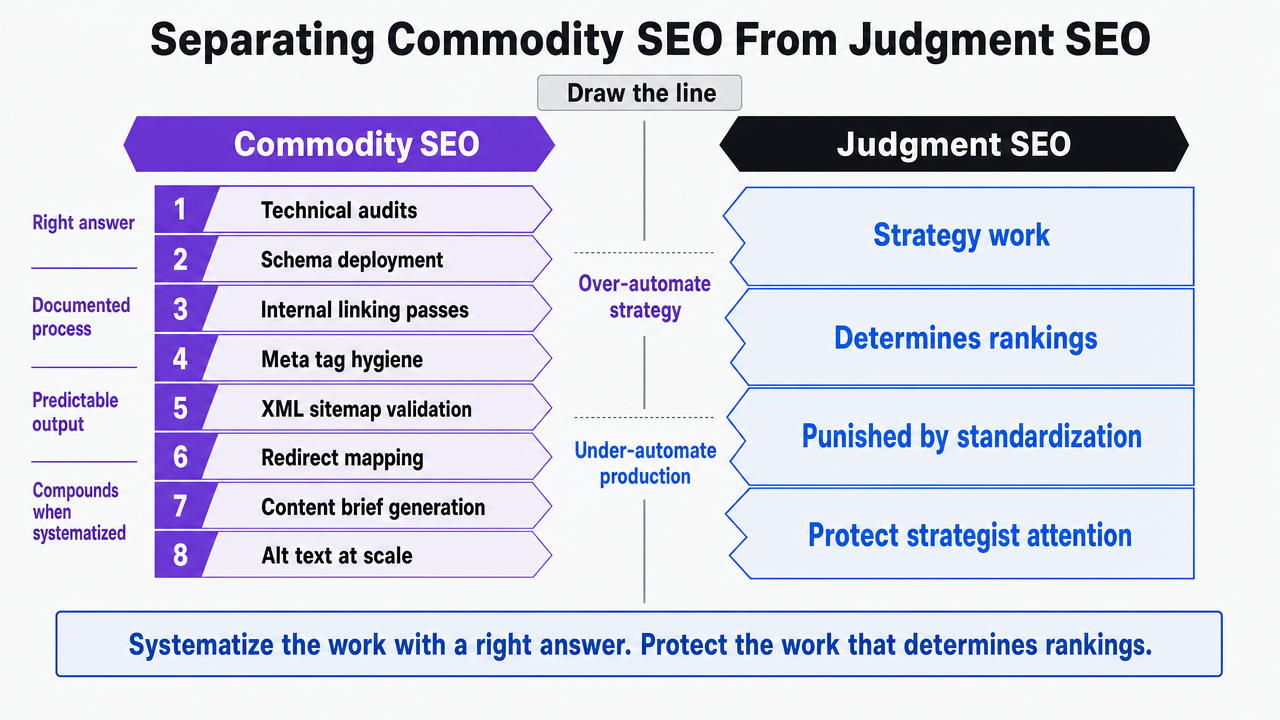
Not all SEO work is created equal, and the failure to say so out loud is what keeps agency delivery models stuck. Some tasks reward standardization. Others punish it. Portfolio leaders who cannot draw the line end up either over-automating the strategy work that determines rankings or under-automating the production work that eats strategist hours.
Commodity SEO is the work that has a right answer, a documented process, and a predictable output. Technical audits against a defined checklist. Schema deployment from a vetted library. Internal linking passes that follow depth and anchor rules. Meta tag hygiene. XML sitemap validation. Redirect mapping during migrations. Content brief generation from keyword clusters. Alt text at scale. These tasks compound when systematized and degrade when left to strategist attention, because they are the first things skipped when calendars fill.
Judgment SEO is the work where the right answer depends on context that a template cannot hold. Topic selection when three keyword clusters look equally viable but only one fits the client's commercial priority. The editorial angle that separates a generic page from one that earns links. Link acquisition strategy in a competitive vertical. Interpreting a Layer Two alert that looks like a regression but is actually a SERP layout change. Deciding when to sunset a page versus consolidate it. Peer-reviewed evidence continues to find that SEO strategy choices materially shape visibility 8, and those choices live here.
The operational rule follows: aggressively systematize commodity work, protect judgment work, and never confuse the two.
 Visualize the comparison between commodity SEO tasks (to systematize) and judgment SEO tasks (to protect), directly supporting the section's operational rule
Measuring Quality at Portfolio Scale, Not Page Scale
Most agency SEO reports still read like page audits stapled together. Rankings for a keyword list. Screenshots of a technical crawl. A note on last month's content sprint. That format made sense when a strategist owned five accounts. It collapses at forty, because a page-level view cannot tell a head of SEO whether the portfolio is healthy or whether three flagship wins are masking twenty accounts in slow decline.
The framing shift worth stealing comes from how search engines evaluate themselves. NIST's search evaluation work treats quality as a statistical property measured across large test collections, not as a verdict on any single page or query 5. The follow-on research is more explicit: standard test cases exist so developers can measure the relative effectiveness of different search approaches at scale 6. Quality is a distribution, not a snapshot.
Portfolio SEO measurement should inherit that logic. The unit of analysis is the book of business, and the questions that matter are distributional.
- What share of accounts gained organic sessions quarter over quarter versus lost them.
- What share have zero critical technical alerts open beyond a defined SLA.
- What share have at least one page ranking in the top three for a commercially prioritized cluster.
- How wide is the gap between the top-quartile and bottom-quartile accounts on those same measures.
Operationally, that means one portfolio dashboard, not forty client dashboards stitched together. Client reports are still produced, but they are downstream artifacts of a measurement system built for the head of SEO first. When the bottom quartile widens, the strategist assignment model has failed, not the tactics.
Designing Content Ops Around How Ranking Systems Actually Behave
Content operations across a portfolio often get built around a keyword list and a publishing calendar. That is the wrong unit of design. Ranking systems do not treat all queries the same, and content ops that ignore that fact end up producing volume that underperforms its brief.
A large-scale field evaluation of machine-learning personalization in web search offers the sharpest available evidence on how much query class matters. In that study, personalization improved clicks to the top position by 3.5% and reduced the average error in the rank of a click (AERC) by 9.43% over the baseline, with the largest gains concentrated in transactional and informational queries and the quality of results rising with the length of a user's search history 7. The scope is worth stating plainly: this is one field evaluation of ML-based personalization in general web search, not a universal benchmark for every SERP, vertical, or SGE-adjacent surface. It does not mean every content investment yields those exact lifts. It does mean the ranking layer is behaving differently across query classes, and content ops should behave differently in response.
The practical translation for portfolio SEO is stratification.
- Transactional and informational queries reward depth, entity coverage, and pages that match a resolvable user intent — the classes where personalization signals push more clicks toward the top result 7.
- Navigational and heavily branded queries reward architecture and disambiguation more than net-new content.
- Query classes with strong baseline rankings for a client rarely justify a full editorial sprint; they justify a maintenance pass.
Content ops should route work accordingly. A brief queue that treats every keyword as equal wastes strategist judgment. A queue that tags each target by query class, commercial priority, and expected ranking-system behavior sends the right work to the right layer — templated production for the commodity slice, senior editorial attention for the pages where angle and entity depth actually shift outcomes.
Scale SEO Execution Without Adding Headcount or Compromising Oversight
Learn how leading agencies streamline multi-client SEO workflows with AI-powered approval-first automation—achieving measurable performance gains and operational efficiency across every account.
Portfolio Economics: What a Governed Model Actually Changes
The economic case for redesigning SEO delivery does not live in a keyword ranking report. It lives in the ratio of accounts to senior strategists, and in what happens to margin when that ratio moves.
Under traditional delivery, the math is linear. Each account consumes a roughly fixed slice of strategist hours per month — technical review, brief production, internal linking passes, reporting, and client communication. Doubling accounts doubles hours, which means doubling headcount or diluting quality. Portfolio operators who have worked the model long enough know the second option is what usually happens, quietly, at the bottom of the book.
A governed-automation model changes the shape of the curve. Layer One absorbs the fixed production work once and reuses it across every account. Layer Two watches the portfolio continuously and only surfaces exceptions. Layer Three concentrates strategist hours on prioritization, editorial judgment, and the flagged issues that actually require interpretation. The result is that accounts-per-FTE stops being a headcount question and becomes a workflow-design question.
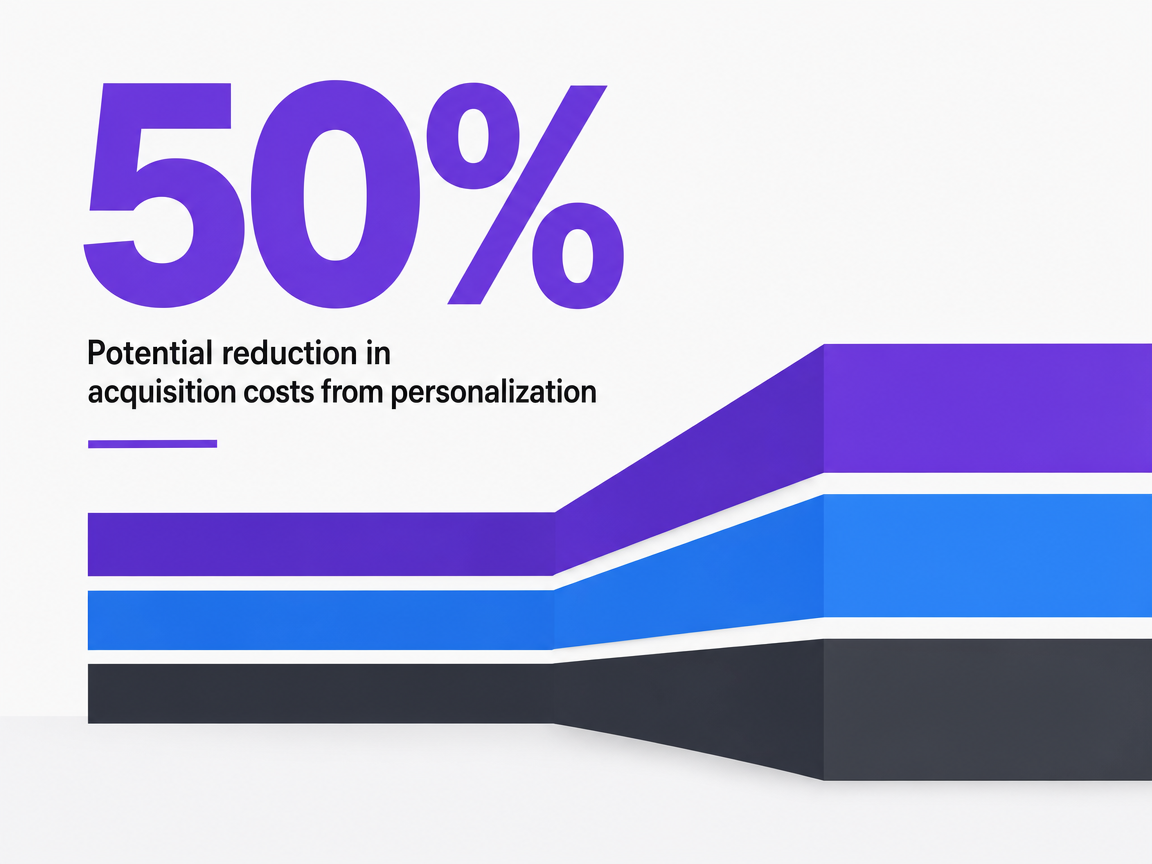
The clearest operating-model benchmarks come from the personalization literature, used here as an analog and not as SEO-specific numbers. McKinsey's work on data-driven marketing operations reports that firms shifting to a governed, orchestrated model see acquisition costs fall by as much as 50 percent, revenues lift by 5 to 15 percent, and marketing spend efficiency improve by 10 to 30 percent 9. Those figures describe personalization programs, not SEO retainers. They are cited here for what the ranges reveal about the direction and magnitude of gains available when execution moves from bespoke campaign work to coordinated systems — the same structural shift portfolio SEO leaders are being asked to make.
The variables that matter for any specific agency are its own. A useful scenario framing uses inputs the head of SEO supplies rather than fabricated dollar figures.
| Input variable | Traditional delivery | Governed-automation delivery |
|---|---|---|
| Strategist hours per account per month | H (baseline) | Directionally lower; commodity work absorbed by Layers One and Two |
| Accounts per senior FTE | A (baseline) | Directionally higher; strategist time concentrated on judgment work |
| Quality variance across the book | Widens as accounts scale | Compresses; monitoring catches regressions portfolio-wide |
| Marginal cost of adding an account | Approaches a full strategist slice | Approaches the cost of monitoring plus judgment time |
The point of the table is not a promised multiple. It is that the economics stop being linear once the workflow is redesigned, and the head of SEO who plugs in real values for H and A will see where the current model breaks and where a governed one bends the curve.
If An Agency Manages Multiple Location-Based Clients
The scope narrows here. This section is for portfolio operators whose book of business skews toward multi-location clients — DSOs, law firm networks, home services franchisors, senior living groups, behavioral health rollups. The delivery model has to hold across accounts and across locations within each account, which changes what standardization actually has to cover.
Location SEO amplifies the architecture argument. A single client with 80 locations is 80 opportunities for template drift: inconsistent NAP data, duplicated service pages competing against each other, canonical loops between city pages, and schema that validates on one location and breaks on the next. Layer One has to enforce a location-page template that renders identically across every market, with structured data, internal links to service hubs, and canonical rules driven by the CMS rather than by the strategist who happened to build that page. Authority still flows through structure 11, and location-page structure is where most multi-location portfolios quietly leak equity.
Layer Two shifts accordingly. Monitoring runs per location, not per client, and the alert threshold is a share-of-locations metric: what percentage of a client's markets have coverage regressions open, not whether the brand-level domain is healthy. That is the portfolio-scale measurement discipline 6applied one level down.
Where AI Fits Without Replacing the Strategist
The framing of AI as a replacement for SEO specialists misreads where the leverage actually sits. In a governed three-layer model, AI is not a headcount substitute. It is the mechanism that lets Layer One and Layer Two run at portfolio scale so Layer Three can concentrate on the work that determines rankings.
The useful placements are narrow and specific.
- Generating first-draft technical audit summaries from crawl and log data.
- Producing brief scaffolds from keyword clusters that a strategist then edits for angle and commercial priority.
- Classifying alerts from the monitoring layer into severity tiers before a human triages them.
- Drafting schema, meta descriptions, and internal linking suggestions against a documented template.
McKinsey's operating-model research on data-driven marketing makes the parallel case that AI extends execution capacity when it sits inside a coordinated system of data, decisioning, design, and distribution rather than functioning as a standalone content generator 3, 4.
What AI should not touch is the judgment work in Layer Three: topic selection when the commercial stakes diverge from the keyword volume, editorial angle, link acquisition strategy, and the interpretation of ambiguous alerts. The right question for a head of SEO is not whether to adopt AI. It is which specific tasks inside the commodity slice move to AI first, and what approval gate every AI output passes through before it ships to a client site.
Frequently Asked Questions
References
- 1.Personalizing at scale.
- 2.What is personalization?.
- 3.The next frontier of personalized marketing.
- 4.Perspectives on Personalization @ Scale.
- 5.Results and Challenges in Web Search Evaluation.
- 6.Building Better Search Engines by Measuring Search Quality.
- 7.Search Personalization Using Machine Learning.
- 8.Search engine optimisation (SEO) strategy as determinants to ....
- 9.Marketing’s Holy Grail: Digital personalization at scale.
- 10.Marketing's Holy Grail: Digital personalization at scale.
- 11.Authoritative Sources in a Hyperlinked Environment.