
Key Takeaways
- Traditional 200-point checklists break at agency scale because they reward completion over impact and create coverage drift, inconsistent pass definitions, and siloed accessibility work.
- Collapsing technical, content, accessibility, and analytics reviews into one crawl-render-review loop eliminates duplicate effort and produces a single prioritized fix list per client.
- A three-tier production system separates automated crawl and indexation checks, specialist review of content and intent, and strategist approval, keeping diagnosis distinct from remediation.
- Treating WCAG 2.2 and Section 508 criteria as pass-fail gates inside the standard audit removes redundant compliance passes since accessibility fixes overlap with technical SEO fundamentals 3.
- Converting findings into a numeric scorecard with defined thresholds per dimension lets delivery leads compare clients, prioritize specialist time, and defend fix sequences without re-analysis.
- Scoring each priority URL against one primary query cluster and its dominant intent avoids segmentation theater, which Forrester notes consumers increasingly reject on privacy grounds 5.
- Portfolio economics hinge on hours per audited URL, where automation coverage, template sampling, and validate-versus-author ratios determine whether margin holds at fifty clients.
- AI-assisted review only preserves value with source attribution, confidence thresholds, approval logs, and rejection feedback loops that keep every finding auditable before deployment 4.
Why the checklist model breaks at agency scale
The classic 200-point SEO checklist, designed for a single specialist auditing one site, fails when a delivery lead manages numerous client domains, each with unique CMS, template debt, and content velocity. This model prioritizes completion over actual impact, focusing on whether a title tag exists rather than if the page is indexed, rendered, and aligned with revenue-driving queries.
Three predictable failure modes emerge:
- Coverage drift occurs as specialists shortcut low-visibility checks under pressure, leading to compounding errors across the portfolio.
- A lack of shared output metrics means different auditors produce inconsistent findings because "pass" is undefined.
- Accessibility is often siloed into a separate compliance track, despite its direct overlap with technical SEO fundamentals like semantic structure, alt text, and keyboard navigation10.
Agencies that successfully protect their margins at scale have shifted from treating audits as static documents to viewing them as governed production loops. This guide details how to structure, measure, and staff such a loop without increasing specialist headcount.
The four reviews to collapse into one audit loop
Many agencies still conduct four distinct reviews on the same URL: a technical crawl, a content quality pass, an accessibility check, and an analytics instrumentation audit. Each review typically has a different owner, template, and report, resulting in redundant work and often conflicting findings.
Consolidating these into a single loop involves conducting one crawl, one render, and one review pass. All dimensions share the same URL inventory, output metrics, and approval gate:
- Technical health assesses render and indexation status.
- Content review evaluates intent match and E-E-A-T signals.
- Accessibility checks semantic structure, alt text, and keyboard navigation, which are intrinsically linked to crawl and rendering fundamentals3.
- Analytics review confirms correct firing of events, conversions, and attribution on the same pages.
This consolidation eliminates duplicate effort, establishes a unified definition of "pass," and generates a single, prioritized fix list per client, replacing multiple competing lists.
A tiered production system, not a linear checklist
Tier 1: automated crawl, render, and indexation pass
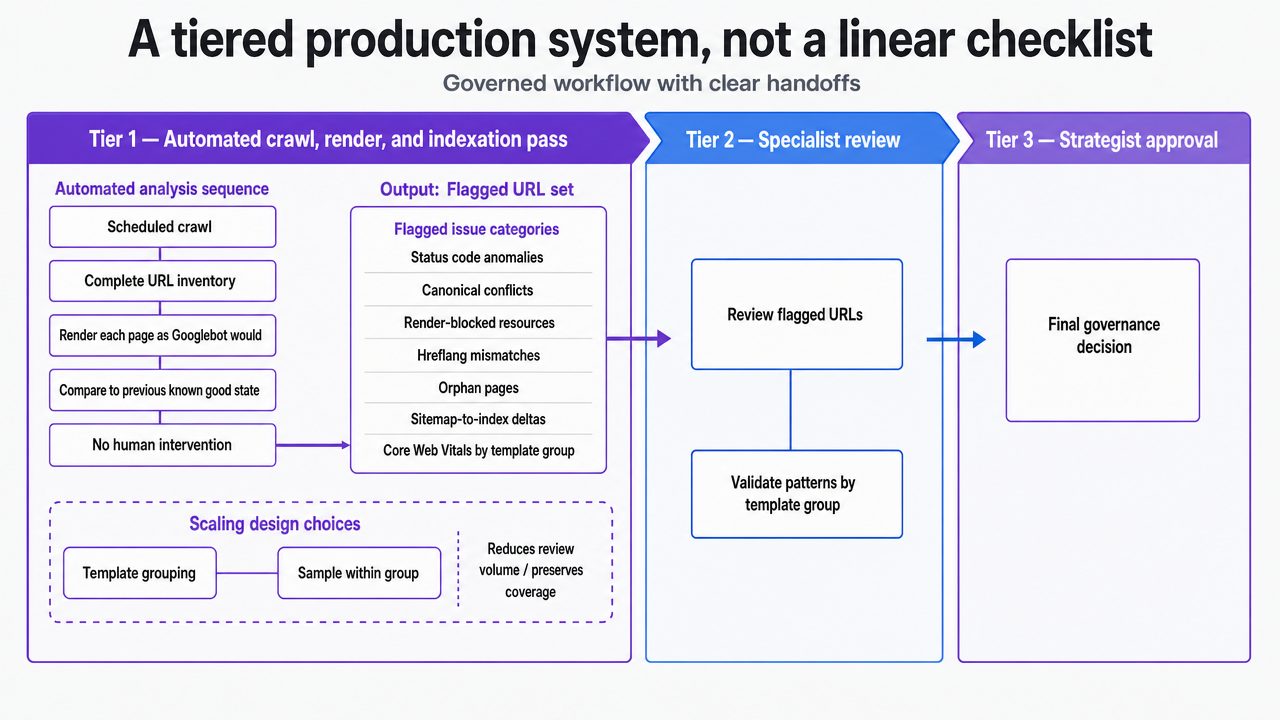
Tier 1 is fully automated. A scheduled crawl retrieves the complete URL inventory, renders each page as Googlebot would, and provides a structured comparison against the previous known good state. This process requires no human intervention. The output is a list of URLs flagged against predefined thresholds for issues such as status code anomalies, canonical conflicts, render-blocked resources, hreflang mismatches, orphan pages, sitemap-to-index deltas, and Core Web Vitals field data by template group.
Effective scaling of Tier 1 relies on two key design choices:
- Template grouping: auditing thousands of URLs individually is inefficient. Grouping by template and then sampling within each group significantly reduces review volume without sacrificing coverage of critical defects.
- Thresholded triage: a URL either passes the automated gate or is escalated to Tier 2 with the specific failed check identified. There is no ambiguous "maybe" category.
The metrics generated by Tier 1 directly inform the client scorecard, including indexation rate against submitted URLs, CWV pass rate at the template level, and orphan URL ratio. Accessibility scans for missing alt text, keyboard traps, and semantic structure violations are integrated into this same pass, leveraging the shared crawl and render infrastructure3.
Tier 2: specialist review for content, schema, and intent fit
Tier 2 addresses areas where automation is insufficient. While a crawler can validate a schema block, it cannot determine if the FAQ schema on a service page aligns with the user's query intent or if the content effectively answers the questions posed by the query cluster. These nuanced judgments require a specialist.
The Tier 2 queue comprises URLs that failed Tier 1, triggered a sampling rule, or were flagged for content refresh by the editorial calendar. Specialists use a fixed review template to assess:
- Intent match against the target query cluster
- The presence and attribution of E-E-A-T signals
- Schema coverage and appropriateness
- Internal link equity flow
- Content depth relative to ranking competitors
Each item is resolved as a pass, a fix, or a rewrite.
This tier is kept efficient by two rules: specialists do not re-verify anything validated in Tier 1, and they do not implement fixes during the review. The review generates a ticket specifying the fix, with execution handled downstream, often by a different resource. This separation of diagnosis from remediation allows one specialist to manage a portfolio without becoming a bottleneck.
Tier 3: strategist approval and publish gate
Tier 3 is the point of concentrated judgment. The strategist does not re-audit the URL but approves or rejects the prioritized fix list, confirms its alignment with client business priorities, and authorizes publication. This gate is binary and time-boxed.
Deloitte suggests that future marketing operating models will be leaner and AI-enabled, with AI handling transactional execution while humans focus on strategy, governance, and experience design6. Tier 3 embodies this division. Automation and specialist review resolve transactional issues, leaving the strategist to make decisions requiring contextual understanding that the system lacks: which fixes to prioritize, which to defer, and which necessitate broader strategic discussions with the client.
The approval record serves as the artifact, documenting each shipped fix with a timestamp, approver, and its originating finding. This audit trail ensures defensibility when clients inquire about changes or regulators, particularly in sectors like healthcare or legal, demand accountability. Without a governed publish gate, tiering merely shifts the bottleneck rather than eliminating it.
 Visualize the three-tier production system (automated crawl, specialist review, strategist approval) described in the section as a governed workflow with clear handoffs
Run a Live SEO Optimization Check This Week
Experience full workflow automation and measure SEO impact directly on published content before committing long-term.
Accessibility as an SEO audit dimension, not a compliance sidebar
Where WCAG 2.2 and Section 508 overlap with technical SEO
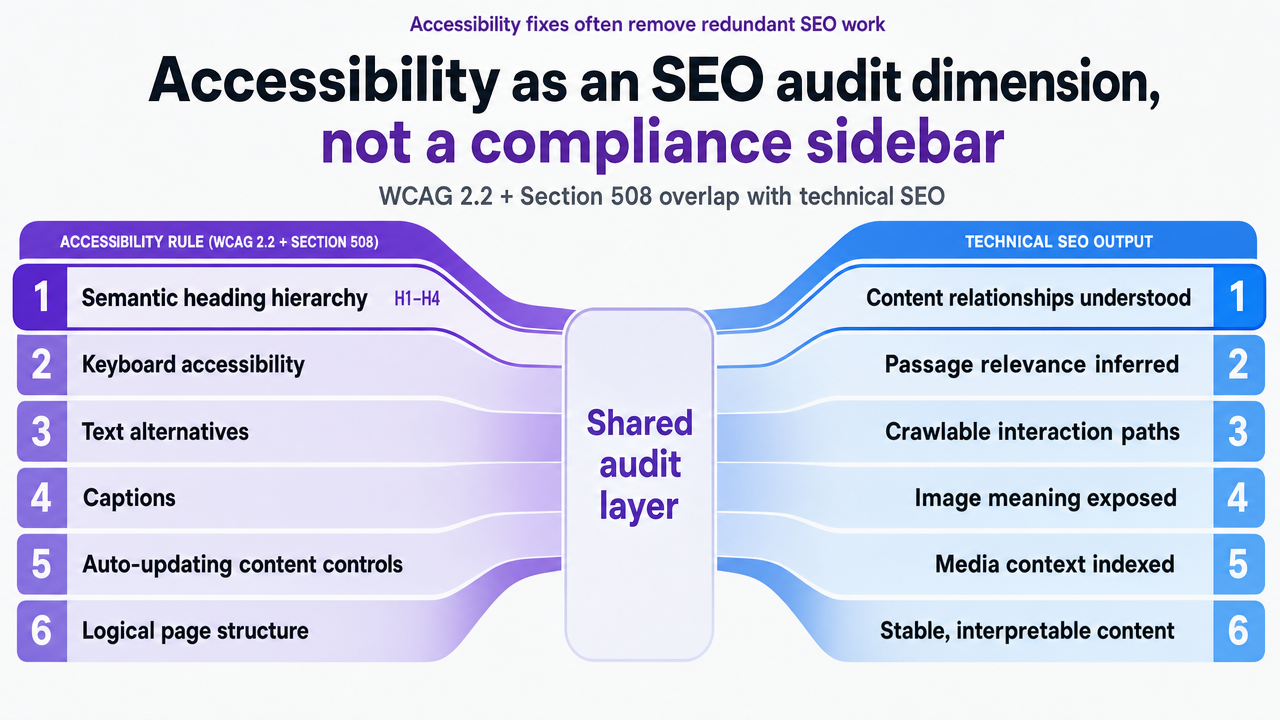
Many agency audit templates still treat accessibility as a separate deliverable, often managed by a compliance lead or front-end developer. This separation creates redundant work because many accessibility fixes directly address technical SEO requirements. WCAG 2.2, a W3C Recommendation, introduces nine new Success Criteria beyond WCAG 2.11. Section 508 guidelines for federal web content cover keyboard accessibility, text alternatives, captions, and controls for auto-updating content3. The overlap with any credible technical SEO checklist is undeniable.
- Semantic heading structure is a prime example: screen readers rely on a logical H1 through H4 hierarchy to understand page structure, just as crawlers use it to infer content relationships and passage relevance.
- Text alternatives are another; alt text is a WCAG requirement for non-text content and crucial for image search understanding.
- Keyboard navigation enforces a rational tab order and visible focus states, resulting in a clean DOM and internal link paths favored by render bots.
- Video captions make transcripts indexable.
- WCAG 2.2 additions like contrast thresholds and target size correlate with layout stability signals that influence Core Web Vitals.
Auditing these criteria twice, in separate reports, wastes specialist time.
Operational rules the auditor should enforce every time
The audit template should include a fixed accessibility block that runs on every URL, rather than generating a separate report on request. Six rules address most common defects across client portfolios:
- One H1 per page with a logical descending hierarchy
- Meaningful alt text on all non-decorative images
- Every interactive element keyboard-operable with a visible focus state
- Programmatically labeled form fields
- Captioned video assets
- No auto-updating content without pause/stop controls3
For agencies serving regulated verticals, accessibility is mandatory. NIST is committed to Section 508 compliance for its websites2, and clients in healthcare, legal, senior living, and public sectors face similar scrutiny. Integrating these six rules as pass-fail gates within the standard audit, instead of a separate compliance pass, ensures repeatability across the portfolio. Each rule links to an output metric tracked on the scorecard, such as alt-text coverage percentage, keyboard-navigable page percentage, caption coverage on video assets, and semantic structure conformance by template group.
 Show the overlap between the six operational accessibility rules and their corresponding technical SEO output metrics referenced in the section
Turning findings into a scorecard tied to revenue
Output metrics per audit dimension
An audit that concludes with a narrative report cannot be effectively compared across clients or over time. The solution is a scorecard where each audit dimension translates into a numeric output metric with a defined threshold. The dimensions already produced by the audit loop map directly:
- Technical health becomes indexation rate against submitted URLs and Core Web Vitals pass rate by template group.
- Content review becomes schema coverage percentage and intent-match rate on priority query clusters.
- Accessibility becomes alt-text coverage percentage, keyboard-navigable page percentage, and semantic structure conformance.
- Internal architecture becomes orphan URL ratio and internal link depth to key pages.
Standardizing these metrics across the portfolio is crucial. McKinsey's analysis found that a one-unit increase in marketing analytics usage correlates with a 0.39% increase in profits and a 0.61% increase in marketing ROI8. For agencies conducting numerous client audits, this emphasizes the importance of measurement discipline. A consistent scorecard with uniform metrics, thresholds, and pass rules across all clients enables delivery leads to assess relative risk, prioritize specialist time, and justify fix sequences in quarterly reviews without re-analyzing data each cycle.
Closing the loop between SEO KPIs and marketing outcomes
A scorecard limited to SEO metrics is incomplete. Indexation rate and schema coverage are important because they influence downstream metrics that clients value, such as qualified organic sessions, form submissions, booked appointments, and revenue per landing template. Connecting these elements transforms the audit from a diagnostic tool into a P&L input.
The mechanics are straightforward but often overlooked. Each priority template group is tagged in analytics to allow organic performance reporting at the same granular level used in the audit. Conversion events verified during the Tier 1 analytics pass feed into the same dashboard. Fix tickets include affected URLs and templates, enabling the scorecard to demonstrate whether technical or content changes achieved their intended KPI movement post-deployment.
McKinsey's research on integrated data and closed-loop measurement suggests a potential 15% to 20% lift in marketing ROI when analytics is treated as a system-level capability across channels, rather than a siloed report9. For an agency SEO lead, this provides a strong argument for investing audit time in establishing robust measurement infrastructure rather than merely creating another appendix slide.
Intent and segmentation without leaning on personalization theater
Intent analysis is where SEO audits either gain precision or become speculative. At portfolio scale, there's a temptation to add personalization to content review, ranking pages by hypothetical audience segments that the site cannot actually detect. Forrester's 2024 report indicates that U.S. consumers are indifferent to corporate personalization efforts and increasingly privacy-aware5. This warns against "segmentation theater," where audit rubrics that reward pages for addressing many personas often result in pages that effectively address none.
A more disciplined approach is simpler. Each priority URL is scored against one primary query cluster and its dominant intent (informational, commercial, or transactional). Content review confirms the page addresses that intent with the required depth, including E-E-A-T signals attributed to a named author or clinician where appropriate for the vertical. Segmentation, when applied, is structural: template families for service, location, and condition pages, rather than inferred behavioral cohorts.
McKinsey's work on personalization reports 5 to 8 times marketing ROI among companies excelling at personalization, a select group studied for maturity rather than representing a market average7. For an SEO audit, this suggests prioritizing accurate intent matching before implementing any adaptive layers.
Scale SEO Optimization Checks Across Clients—Without Compromising Quality
Connect with our team to see how leading agencies automate SEO audits and execution at scale, leveraging AI-driven workflows designed for multi-client oversight and measurable performance gains.
If you manage multiple client sites: portfolio audit economics
Signaling the shift from single-client audit to portfolio delivery
The perspective shifts here from a delivery lead managing one client site to someone responsible for an entire book of business—forty, eighty, or 150 client domains reviewed on overlapping cycles, with inflexible margin targets. At this scale, the question moves from "is the audit thorough?" to "what is the cost per audited URL, and how does that cost scale with client count?" The variable determining whether the delivery model maintains margin at fifty clients or breaks at fifteen is specialist hours per URL. The next subsection explains how tiering impacts this metric.
Hours per audited URL across three delivery models
Three delivery models are available for portfolio SEO delivery, each yielding a different hours-per-URL profile. The consistent variables across all models are:
- URLs audited per client per cycle
- Specialist hours consumed per URL by tier
- The blended specialist rate paid by the agency
The table below uses variables instead of dollar figures, as the leverage lies in the ratios, not in specific agency costs.
| Delivery model | Tier 1 (automated crawl/render) | Tier 2 (specialist review) | Tier 3 (strategist approval) | Hours per audited URL |
|---|---|---|---|---|
| All-specialist review | Not separated | Full manual pass on every URL | Embedded in specialist pass | Hspec |
| Hybrid with automation | Machine-run on 100% of URLs | Manual pass on URLs that fail Tier 1 or hit sampling rule | Batch approval on fix list | (Hspec × failure rate) + Hstrat per batch |
| Approval-first AI-assisted | Machine-run on 100% of URLs; AI drafts Tier 2 findings | Specialist validates AI findings on flagged URLs only | Strategist approves prioritized fix list per client | (Hvalidate × failure rate) + Hstrat per batch |
Two ratios are particularly impactful. The failure rate from Tier 1 dictates how many URLs require specialist time; template grouping and sampling rules significantly reduce this number for mature client sites. The validate-versus-author ratio (Hvalidate divided by Hspec) determines how much specialist time is saved when a specialist reviews an AI-drafted finding instead of creating one from scratch.
McKinsey's research found a 0.39% profit increase and a 0.61% MROI increase for every unit increase in marketing analytics usage8. Applied to portfolio delivery, this implies that models producing lower and more consistent hours-per-URL also generate the standardized measurement that analytics disciplines reward.
Governance for AI-assisted review
AI in the audit loop is primarily a governance issue, not just a productivity one. The specialist time saved only retains its value if every AI-drafted finding has an auditable trail approved by a human before deployment. Without this trail, tiering the review merely industrializes uncertainty.
Four governance controls are essential:
- Source attribution for every AI finding: identifying which crawl signal, rendered element, or schema block triggered the flag. Specialists validating a finding need to see the evidence, not just the conclusion.
- A confidence threshold that routes low-confidence findings to specialist review by default.
- An approval log that records who signed off on each fix, when, and against which finding, ensuring changes are defensible months later.
- A rejection feedback loop that uses specialist overrides to refine future flagging rules, rather than losing this valuable input in ticket comments.
Forrester's marketing analytics landscape highlights the operational challenge of connecting analytics to real decisions, beyond just adopting tools4. Governance makes this connection auditable at portfolio scale.
Running the audit loop the first ninety days
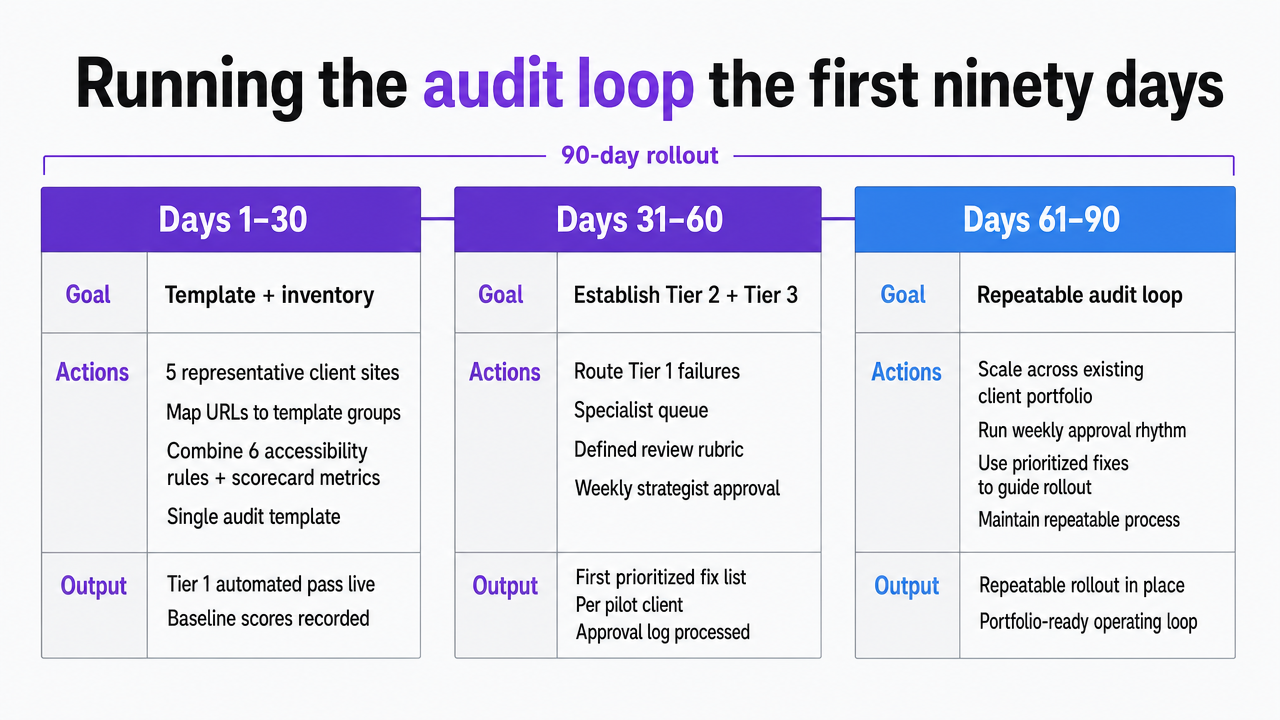
The audit loop doesn't need to be perfect initially; it needs to be repeatable. A ninety-day rollout across an existing client portfolio can be divided into three thirty-day blocks, each with a primary goal and measurable output.
- Days 1 to 30 focus on template and inventory work. Select five representative client sites across different verticals, map their URL inventories to template groups, and integrate the six accessibility rules and scorecard metrics into a single audit template. The output is a functional Tier 1 automated pass on these five sites with baseline scores recorded.
- Days 31 to 60 establish Tier 2 and Tier 3. Route Tier 1 failures into a specialist queue with the defined review rubric, and implement weekly strategist approval. The output is the first prioritized fix list per pilot client, processed through the approval log.
- Days 61 to 90 extend the loop to the remaining portfolio and connect fix outcomes back to the scorecard, making post-deployment KPI movement visible at the template level.
 Visualize the ninety-day rollout plan described in the section as a three-block timeline with concrete outputs per phase
Frequently Asked Questions
References
- 1.W3C WCAG 2.2 Now Available.
- 2.Accessibility.
- 3.Guide to Accessible Web Design & Development.
- 4.The Marketing Analytics Landscape, Q2 2024.
- 5.The State Of US Consumer Personalization, 2024.
- 6.The future of the marketing function: From execution to AI-orchestrated growth.
- 7.The value of getting personalization right—or wrong—is multiplying.
- 8.Marketing Analytics: It works, so why aren't more companies using it?.
- 9.Big Data, Analytics, and the Future of Marketing & Sales.
- 10.Developing Accessible Web Content - Section508.gov.