
Key Takeaways
- Sort keyword clusters by awareness, consideration, evaluation, and decision stages before assigning page briefs, so each template matches the intent and conversion event the query actually warrants.
- Treat every landing page as a scripted sales opening: mirror the visitor's query language, answer it on the first scroll, and match the conversion event to journey stage.
- Instrument organic sessions with stage-specific progression events flowing into the CRM, so pipeline can be traced back to the exact landing URL and query cluster.
- Build a middle-funnel comparison layer with category-versus-category pages, methodology pages, and pricing-transparent scope pages that answer price and risk questions directly 1.
- Consolidate review, testimonial, and disclosure workflows under the FTC's 2023 Endorsement Guides and 2024 reviews rule to protect rankings and shield the client from distortion liability 2, 5.
- Route a monthly intent digest of rising queries, buyer phrasings, and objections to the client's sales and product marketing leads so search research shapes scripts and category naming.
- Feed organic landing pages into segmented retargeting audiences, stage-matched email sequences, and outbound talk tracks so search compounds across a multi-channel demand engine 6.
- Systematize E-E-A-T with documented author rosters, Person and Organization schema, and quarterly entity map reviews so junior staff ship trust-carrying assets without senior sign-off on each post.
- Rebuild internal linking around the sequence a buyer follows from symptom to inquiry, cutting links that send evaluation-stage visitors back to awareness explainers 7.
- Attribute SEO inside the client's CRM using stage-weighted multi-touch influenced revenue, replacing rankings decks with pipeline math that finance teams recognize 9.
- Deploy AI as a supervision layer where senior strategists approve ranked recommendations rather than edit paragraphs, expanding accounts per director without eroding quality.
- Model margin per account and capacity per senior strategist against your own variables to see whether the current delivery stack supports the retainer price being quoted.
Why Pipeline-Grade SEO Looks Different in 2026
Agency SEO leads running portfolios of 15 to 60 accounts no longer get renewed on ranking screenshots. Clients want to see influenced revenue, booked calls, and qualified conversations. That shift changes what belongs in a delivery playbook.
Forrester reports that more than 500 B2B marketers rated their company's website the most effective demand-generation tactic for awareness and consideration. Yet, the same research finds many B2B website experiences fail to engage visitors during evaluation 10, 8. The gap between how important the site is and how poorly it performs is where pipeline-grade SEO earns its retainer. Search brings the visitor. The page has to carry the conversation forward.
The eleven tips that follow are organized around that reality. Each one is written for senior strategists who already know the mechanics of schema, Core Web Vitals, and internal linking, and who now need frameworks that scale judgment across accounts. Every recommendation is tied to a pipeline metric a client will actually pay to see move: SQLs, booked consultations, opportunity influence, and retention. Rankings are treated as leading indicators, not deliverables.
Map Query Clusters to Buyer-Journey Stages Before Touching a Page
Most agency keyword research still produces one flat list sorted by volume. That list is the reason so much organic traffic lands on pages that cannot advance a deal. Query intent varies across the journey, and the asset that answers a research query is not the asset that closes an evaluation query. Senior strategists who sort clusters by stage before assigning a page brief cut rework and lift conversion at the same time.
The clustering framework agencies can standardize across accounts has four buckets:
- Awareness queries name a problem or category.
- Consideration queries compare approaches, methodologies, or vendor types.
- Evaluation queries name specific providers, ask about price, or probe risk.
- Decision queries carry transactional signals such as pricing pages, demo requests, or local intent modifiers.
Each bucket gets a different page template, a different conversion event, and a different measurement window.
Evaluation-stage design deserves particular attention. Forrester's Buyers' Journey Survey, 2023 found that at least one-third of B2B buyers in North America and Europe are primarily influenced by price when making purchasing decisions 1. That share is large enough that evaluation-stage pages which duck pricing, packaging, or scope questions actively suppress qualified inquiries. Agency leads who bake a pricing-transparent block into every evaluation template close the gap between rank and revenue.
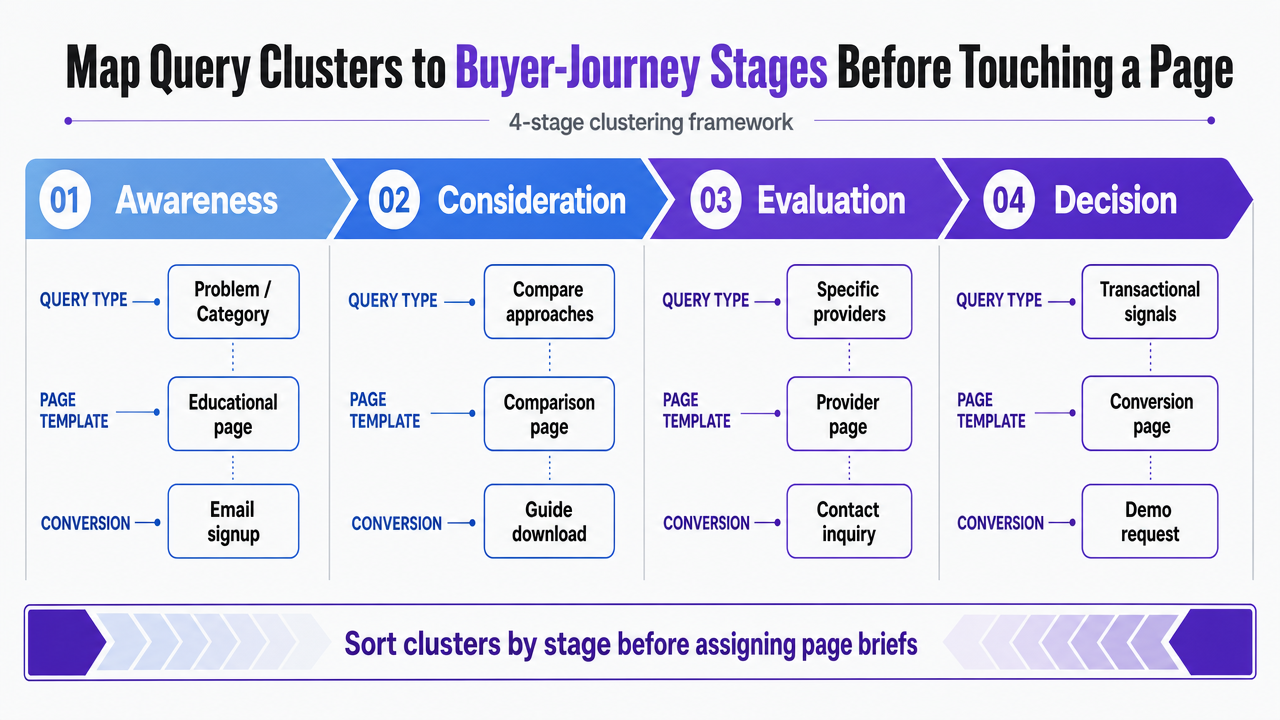 Visualize the four-stage query clustering framework described in the section, showing how each stage maps to a distinct page template and conversion event
Treat the Landing Experience as the First Sales Conversation
Organic search decides which door a prospect walks through. The landing page decides whether the conversation continues. Forrester's research puts the stakes plainly: more than 500 B2B marketers rated their company's website the most effective demand-generation tactic for awareness and consideration, yet the same research body finds that many B2B website experiences no longer meet buyers' expectations and fail to engage visitors during evaluation 10, 8. The site is the single most important asset in the mix, and it is the asset most likely to underperform on the day a qualified visitor arrives.
Agency SEO leads can close that gap by treating each intent-mapped landing page as a scripted opening exchange rather than a document. Three elements carry the weight:
- The headline restates the visitor's query in the visitor's language, not the client's internal category name.
- The first scroll answers the specific question that generated the click, before any brand narrative.
- The primary conversion event matches the stage: a comparison-stage query gets a scoped assessment or scorecard, not a generic "contact us" form that dumps evaluation-stage buyers into the same queue as tire-kickers.
Forrester positions the website as a strategic asset for understanding buyers, not a static delivery mechanism 9. Senior strategists who audit landing pages against that standard replace generic hero blocks with intent-matched proof, price-anchored copy where the stage warrants it, and progression paths that read like the next question a salesperson would ask. That audit becomes a repeatable template across the portfolio, and it is the single change that most reliably lifts SQL rate on existing organic traffic.
Instrument Every Organic Session for Progression, Not Pageviews
Rankings dashboards tell agency leads whether a page shows up. They do not tell anyone whether the visitor who arrived did anything a client would pay for. That gap is why so many retainer reviews devolve into arguments about DR and position changes instead of pipeline. The fix is instrumentation, and it belongs at the session level.
Forrester frames web conversion optimization as the work of supporting buyer decision-making through meaningful interactions, not counting sessions 7. Translated into agency practice, that means each organic landing page needs a defined progression event tied to its stage:
- A resource download for awareness
- A comparison tool completion for consideration
- A scoped assessment or pricing view for evaluation
- A booked consultation for decision
Each event fires into the CRM with the landing URL, query cluster, and stage tag attached, so revenue can be traced back to the exact organic asset that opened the conversation.
Senior strategists who standardize this event schema across accounts stop debating whether SEO is working. They can show the client how many evaluation-stage sessions produced a scoped assessment last month, how many of those became SQLs, and which query clusters carry the highest progression rate. Rankings become a leading indicator inside that model, not the deliverable itself.
Build a Middle-Funnel Comparison Layer That Answers Price and Risk
The middle of the funnel is where most agency content stops working. Awareness posts pull traffic, decision pages capture the ready-to-buy, and the space in between fills up with vague "how to choose a vendor" articles that dodge the two questions that actually decide the shortlist: what does this cost, and what could go wrong.
Forrester's Buyers' Journey Survey, 2023 found that at least one-third of B2B buyers in North America and Europe are primarily influenced by price when making purchasing decisions 1. This indicates that comparison assets which refuse to name prices, packaging tiers, or scope boundaries filter out a large share of qualified demand before a sales conversation begins. Silence on price reads as evasion.
A defensible comparison layer for each client account carries three assets:
- A category-versus-category page that explains when a buyer should pick one approach over another.
- A methodology page that names the risks of common alternatives.
- A pricing-transparent scope page that publishes ranges, inclusions, and exclusions.
Together they answer the two blocking questions and route evaluation-stage traffic into scoped inquiries rather than generic contact forms.
Trial Full-Scale SEO Execution Without Limits
Test advanced workflows by publishing live, pipeline-driven SEO content during your trial—no commitment required.
Consolidate Social Proof Under the FTC's 2023-2024 Review Rules
Reputation assets sit inside almost every pipeline-oriented SEO program: local pack rankings depend on review velocity, service pages lean on testimonial modules, and case studies carry evaluation-stage traffic across the finish line. That entire layer now operates under tighter federal rules that most agency delivery playbooks have not caught up to.
The FTC's 2023 revised Endorsement Guides expanded liability around procuring, suppressing, boosting, organizing, publishing, upvoting, downvoting, or editing reviews in ways that distort consumer perception 2. The 2024 final rule on consumer reviews and testimonials went further, prohibiting the buying, selling, or creation of fake reviews and testimonials that materially misrepresent whether a reviewer actually used the product or service 5. Both apply to the client, not the agency, but agencies inherit the operational exposure the moment a junior specialist gates a review widget, solicits testimonials with an incentive, or writes a case study quote a customer did not say.
Three standing rules keep the social-proof layer defensible across a portfolio:
- Any material connection a significant minority of consumers would not expect must be disclosed clearly and conspicuously, which covers incentivized reviews, affiliate arrangements, and employee endorsements 4.
- Compensating anyone to promote or review a service requires disclosure that reads on the same screen as the endorsement itself, not buried in a footer 3.
- Review-gating flows that route negative feedback away from public display fall inside the FTC's definition of distortion and should be replaced with universal solicitation followed by public response 2.
Senior strategists who consolidate these rules into one client-facing intake, one disclosure template, and one review-response SOP cut legal review cycles and give junior staff a defensible script. That single consolidation protects local rankings, service-page conversion, and the client's brand at the same time.
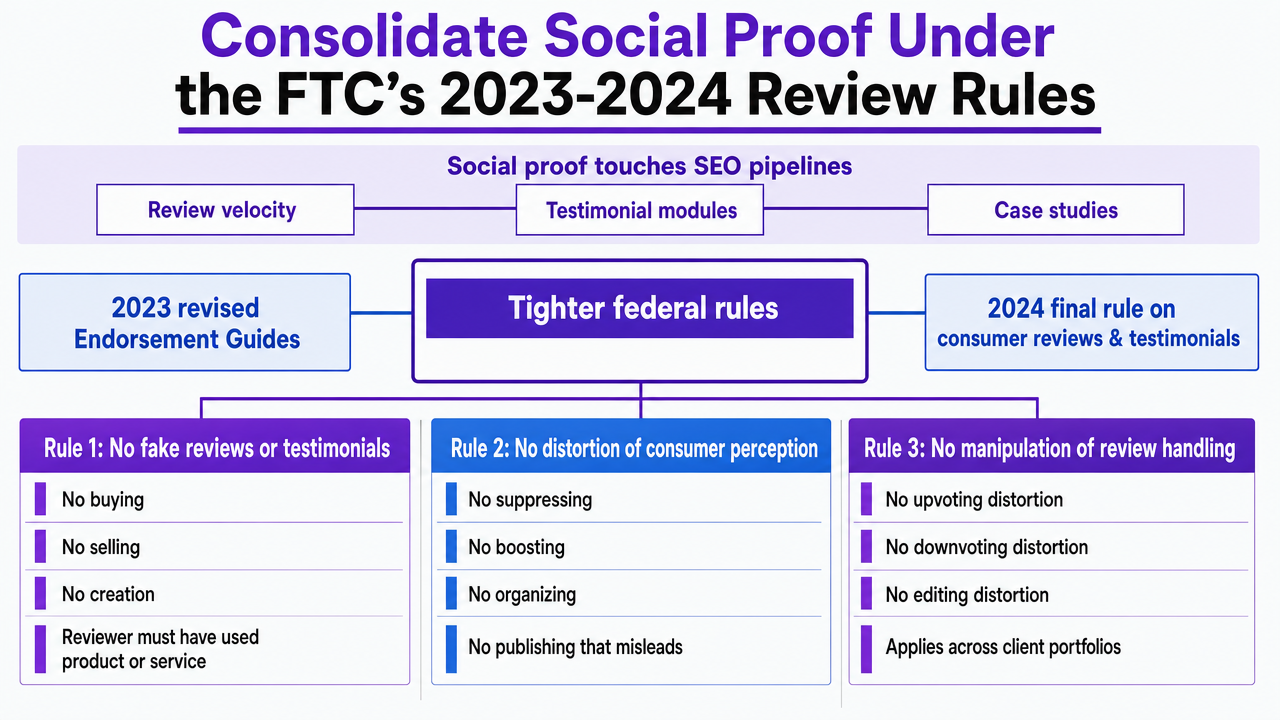 Summarize the three standing FTC-compliant rules for managing social proof across a client portfolio, as enumerated in the section
Turn Search-Intent Research Into Sales and Product Messaging
Keyword research is the most underused sales intelligence asset inside most agencies. It sits in a spreadsheet, feeds a content calendar, and never reaches the client's sales team or product marketing lead. That is a wasted round trip. The same query data that shapes an editorial plan describes, in the buyer's own words, what problems they name, what alternatives they compare, and what objections they carry into a first call.
Forrester positions the B2B website as a strategic asset for understanding buyers, not a static delivery mechanism 9. Senior strategists can operationalize that stance by routing a monthly intent digest to the client's head of sales and product marketing: the top rising queries in each stage bucket, the exact phrasings prospects use, the comparison entities named alongside the client, and the objections surfaced in People Also Ask and forum results. Sales scripts get rewritten against real language. Product marketing sharpens category naming. And the SEO retainer starts influencing decks and discovery calls, not just blog output. That cross-functional feed is what turns a content program into a source of commercial intelligence the client cannot get anywhere else.
Connect Organic to a Multi-Channel Demand Engine
Organic search rarely closes a deal on its own. It opens one. The retainers that survive budget reviews are the ones where SEO output feeds paid retargeting audiences, email nurture sequences, sales outreach lists, and local reputation programs, so a single evaluation-stage visit compounds across channels instead of dying in the analytics report.
McKinsey's B2B growth research quantifies the payoff. In its study of B2B companies, 72% of those selling through seven or more channels grew market share, compared with a far smaller share of narrow-channel sellers 6. The finding covers commercial channel mix, not SEO tactics per se, but the direction applies cleanly to agency delivery: organic assets that plug into a broader engine outperform organic assets that live in a silo. The channel count is a proxy for how many surfaces a buyer can encounter the client on during a research cycle that now spans weeks.
Senior strategists can operationalize this in three moves:
- Every organic landing page pushes its visitors into a segmented retargeting audience tagged by query cluster and stage, so paid social and display can reinforce the exact message the visitor arrived for.
- Evaluation-stage sessions that do not convert on the first visit trigger a stage-matched email sequence rather than a generic newsletter drip.
- The top rising query clusters from organic feed the client's outbound team as talk tracks and account-selection filters, turning search demand into sales-ready signal.
That is the difference between SEO as a traffic line item and SEO as the discovery layer of a demand engine the client will keep funding.
Operationalize E-E-A-T at Portfolio Scale With Author and Entity Systems
E-E-A-T is easy to describe and hard to deliver across forty client accounts. The failure mode is predictable: one flagship client gets bylined authors, expert reviewers, and speaking-circuit backlinks, while the rest of the portfolio ships ghost-written posts under a generic "Team" byline that carries no credibility signal to either Google or a buyer reading the page.
The fix is systematizing author and entity infrastructure so junior specialists produce publish-ready trust assets without senior sign-off on every asset. Three components carry the load:
- Every client account gets a documented author roster with real headshots, credential proofs, LinkedIn handles, and structured Person schema linked to a canonical about page.
- Every content brief names the author before drafting starts, so expertise claims match the byline instead of being retrofitted.
- An entity map ties the client's brand, services, executives, and locations into Organization schema with sameAs references to authoritative profiles such as trade associations, licensing bodies, and verified social accounts.
Forrester frames the website as a strategic asset for understanding buyers, not a static delivery mechanism 9. Author and entity systems make that stance operational: the visitor arriving from a query sees a named human with verifiable experience, and the search engine sees a consistent entity graph across the portfolio. Senior strategists review the roster and entity map once per quarter rather than approving every post.
See How Leading Agencies Automate SEO Optimization Without Sacrificing Control
Speak with a platform expert to review how AI-powered workflows can scale your SEO pipeline, maintain strategic oversight, and deliver measurable client results—no additional hires required.
Rebuild Internal Linking Around Decision Paths, Not Site Sections
Most agency site architectures still mirror the client's org chart. Services live under /services, industries under /industries, resources under /blog, and internal links flow along those bureaucratic seams. That structure is convenient for editors and useless to a buyer moving from a symptom query toward a scoped inquiry.
A decision-path model reorganizes internal links around the sequence a prospect actually follows. An awareness post naming a problem links forward to the consideration asset that compares approaches, which links forward to the evaluation page that names price and scope, which links forward to the decision asset that captures the inquiry. Each hop matches the next question a qualified buyer would ask, and each anchor text carries stage-appropriate language rather than generic "learn more" phrasing.
Forrester frames web conversion optimization as supporting buyer decision-making through meaningful interactions, not counting sessions 7. Internal linking is where that framing lives or dies. Senior strategists can audit each client's top twenty organic entry points once per quarter, trace the forward path from each, and cut any link that sends an evaluation-stage visitor back to an awareness explainer. The result is a portfolio of sites that pull traffic through the funnel instead of scattering it across departments.
Attribute SEO to Influenced Revenue, Not Rankings Reports
The retainer conversation that saves an account rarely starts with a rankings table. It starts with a revenue number the client's CFO already trusts. Agency SEO leads who cannot show which organic sessions influenced closed-won opportunities lose renewal debates to paid channels that report last-click dollars every Monday.
The attribution model that survives that debate is multi-touch, not last-click, and it lives inside the client's CRM rather than a standalone SEO dashboard. Every organic session carries its landing URL, query cluster, and journey stage into the visitor record. When that visitor becomes a known lead, the touch history stays attached. When the opportunity closes, the influenced-revenue calculation credits every organic touch that appeared in the path, weighted by stage:
- Awareness-stage assets earn opener credit.
- Evaluation-stage pages earn assist credit on the deals they progressed.
- Decision-stage pages earn closer credit on the inquiries they captured.
Forrester frames the website as a strategic asset for understanding buyers, not a static delivery mechanism 9. Attribution built on that stance replaces the monthly rankings deck with an influenced-pipeline report the client's finance team recognizes as revenue math. Senior strategists who standardize this schema across the portfolio defend retainer pricing on outcomes, not activity.
Use AI-Assisted Execution to Scale Senior Supervision
The ceiling on agency margin is senior review time. A director who can meaningfully supervise ten accounts cannot meaningfully supervise thirty by working harder. The math breaks before the calendar does. AI-assisted execution changes what that ceiling is made of, but only when it is deployed as a supervision layer rather than a drafting shortcut.
The failure mode is familiar: junior specialists paste briefs into a generic model, ship the output, and senior strategists spend their reclaimed hours fixing tone, citations, and intent mismatches. That workflow lifts volume and drops quality in the same quarter. The workflow that holds up under portfolio scale runs in the other direction. Signals from each client account, such as query movement, conversion drop-offs, CRM stage shifts, and review velocity, feed a ranked recommendation queue. Execution drafts assets against those signals. Senior strategists approve or reject at the recommendation layer, not the paragraph layer, and every approved action ships with the strategic reasoning attached to the client record.
Forrester frames web conversion optimization as supporting buyer decision-making through meaningful interactions, not counting sessions 7. An approval-first execution stack applies that same standard to delivery itself. Senior judgment gets spent on which move to make, not on retyping the move. That is how a portfolio of thirty accounts starts looking like a portfolio of ten to the strategist responsible for outcomes.
If You Manage a Portfolio of Retainers: The Delivery Economics
The prior tips apply to any senior SEO practice. This one is written specifically for agency leads managing a portfolio of retainers, where margin per account and accounts per strategist decide whether the practice grows or stalls. The variables below stay in the reader's own numbers. No dollar benchmarks are invented.
Two ratios govern the P&L:
- Margin per account equals monthly retainer minus delivery hours multiplied by blended hourly rate.
- Capacity per senior strategist equals reviewable hours per month divided by senior review hours per account.
Both move together: cutting review hours per account without cutting output quality is the only lever that expands capacity and margin at the same time.
| Variable | Traditional senior-led delivery | Supervision-layer delivery |
|---|---|---|
| Senior review hours per account per month | Ht | Hs (target: fraction of Ht) |
| Junior execution hours per account per month | Jt | Js |
| Blended hourly rate | R | R |
| Monthly retainer per account | M | M |
| Margin per account | M − (Ht + Jt) × R | M − (Hs + Js) × R |
| Accounts per senior strategist | Reviewable hours ÷ Ht | Reviewable hours ÷ Hs |
The figures are illustrative variables, not benchmarks. What matters is the direction. When approval moves from the paragraph layer to the recommendation layer, H shrinks without J rising in lockstep, and both ratios improve. Agency leads who model their own numbers into that table can see, before signing the next retainer, whether the current delivery stack supports the price they are quoting.
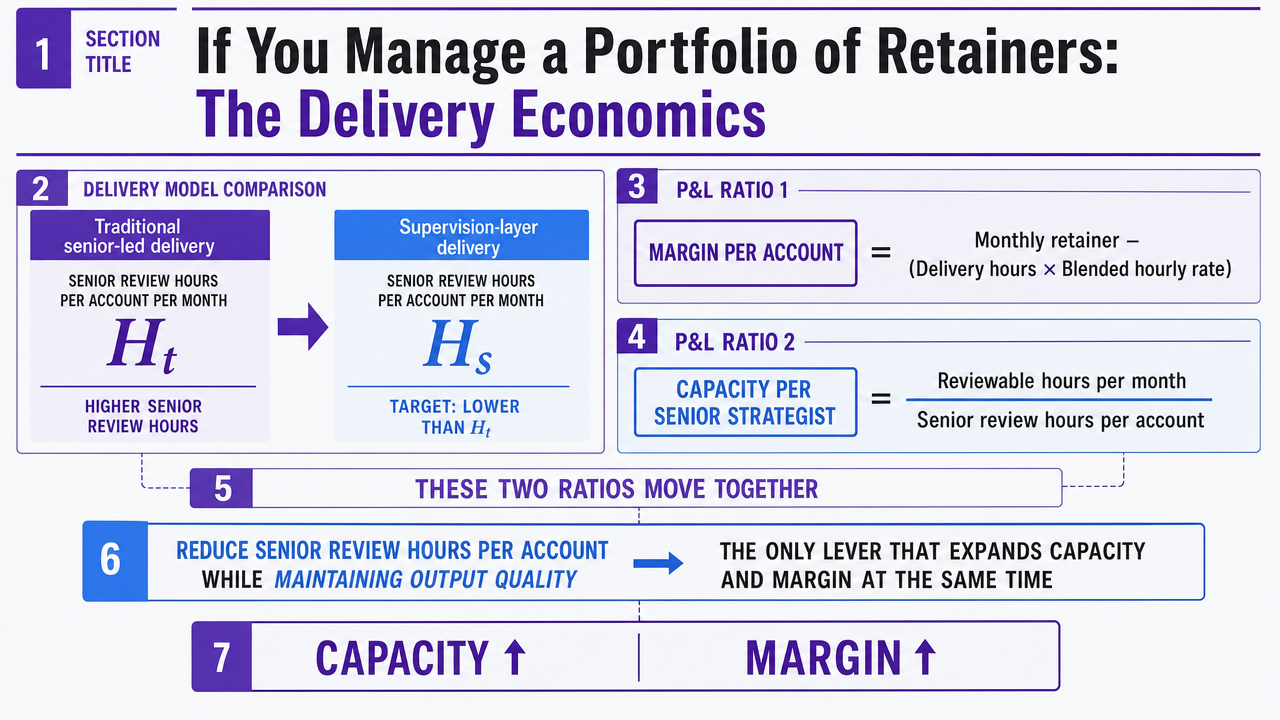 Visualize the two P&L ratios and the shift from senior-led to supervision-layer delivery described in this section's operating model table
Frequently Asked Questions
References
- 1.The State of Business Buying And The B2B Buyers Journey.
- 2.Revised FTC Endorsement Guides Help Businesses Avoid Deceptive Reviews and Endorsements.
- 3.Endorsements, Influencers, and Reviews.
- 4.FTC’s Endorsement Guides: What People Are Asking.
- 5.Use of Consumer Reviews and Testimonials: Final Rule.
- 6.The new B2B growth equation.
- 7.Web Conversion Optimization: A Deep Dive.
- 8.Enabling B2B Buyers Through Your Website.
- 9.Rethinking Web Conversion Optimization For Demand Marketing.
- 10.After A First Date, Would Your B2B Website Get A Second?.