
Key Takeaways
- Semrush compresses first-week diagnostic work across keyword research, audits, and competitive analysis, but reports findings without executing changes, leaving delivery handoffs intact for scaling agencies.
- Ahrefs offers unmatched backlink and content gap depth for specialist workflows, though its point-solution posture requires external systems to translate research into published change.
- Conductor delivers enterprise-grade governance across large content estates, tying briefs, approvals, and technical monitoring into one workflow suited for structured client teams.
- BrightEdge surfaces intent shifts and content decay across massive keyword universes, but its recommendations queue outpaces execution unless paired with dedicated content production capacity.
- seoClarity supports agencies with heavy stakeholder reporting cycles through deep segmentation and portfolio-scale audits, while still leaving publishing and execution to separate tooling.
- Clearscope acts as a strategist multiplier by embedding content grading into the drafting environment, letting one senior lead supervise output from a larger writer pool.
- AgencyAnalytics reclaims strategist hours lost to manual reporting by automating white-labeled dashboards from GSC, GA4, and third-party APIs, without touching optimization work.
- Vectoron collapses the audit-to-publish loop into one approval-gated workflow at $599/month, targeting throughput per strategist rather than adding another layer to the existing stack 15, 16.
Why agency delivery capacity is the new platform selection criterion
The question that used to define SEO platform selection — which tool has the biggest keyword database — has quietly stopped mattering. For the head of SEO running delivery across a client book, the number that decides margin is accounts per strategist, not rows in an index.
Forrester's Q1 2025 landscape report describes an SEO software market splitting into three segments: end-to-end platforms, point solutions, and agency-native tools 4. Its July 2025 blog on the category argues that vendors are increasingly automating the content and technical workflows that used to sit on a strategist's desk, and improving how SEO's impact gets measured 5. That automation is the variable that actually moves throughput.
The pressure on agency P&Ls is not hypothetical. Forrester's State of Search Marketing 2025 finds that over 70% of large enterprises now run an SEO platform or suite as part of their search stack, and identifies AI-enhanced tooling as a differentiator among top performers 13. Clients arriving from that environment expect their agency to deliver at a comparable operating tempo.
What follows is a shortlist of eight platforms, segmented by delivery model rather than feature depth. The evaluation lens throughout is throughput: how many client sites a single strategist can competently manage, and how many revision cycles the platform removes from each engagement.
The click-loss shift that rewrote the platform brief
Rank tracking used to be the scoreboard. It is now a lagging indicator, and the gap is quantifiable.
Pew Research analyzed 68,879 Google searches from 900 U.S. adults in March 2025 and found that when an AI-generated summary appeared at the top of the results, users clicked a traditional organic link in only 8% of visits. Without an AI summary, that figure was 15%. Clicks on links inside the AI summary itself occurred in just 1% of visits 2. The study measured browsing behavior in a U.S. adult panel, not global commercial intent queries, but the direction is hard to argue with: a page can hold position three, win the featured answer citation, and still lose the session.
For an agency head managing retention conversations, that shift changes what a platform has to prove. A tool that reports position gains without showing whether the client's content is being surfaced, cited, or paraphrased inside AI answers is reporting on a shrinking share of the funnel. The renewal question from a sophisticated client is no longer "where do we rank" but "where do we appear when the user never scrolls."
Platform selection in 2025 splits along this line. Systems built for the old scoreboard still produce clean position reports. Systems built for the current search surface treat rankings as one input among several — AI-answer citations, entity coverage, and structured-data completeness sitting alongside them. The rest of this shortlist is organized around that distinction.
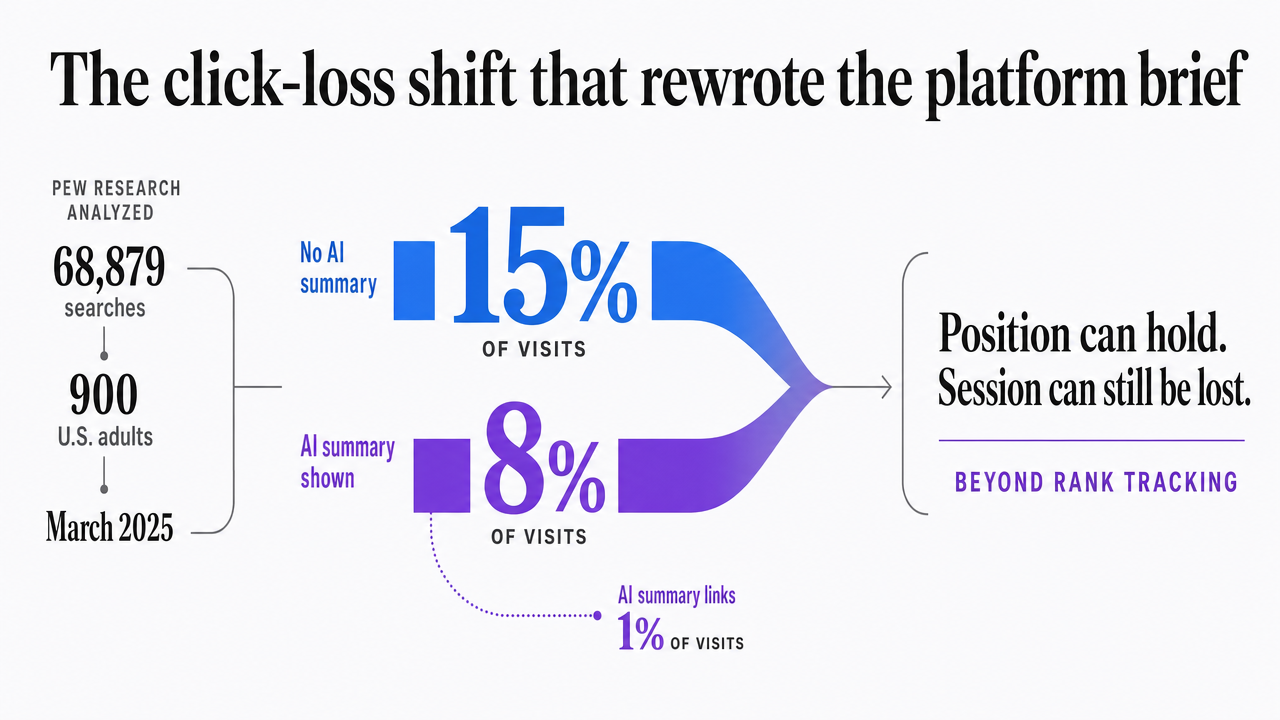 Visualize the Pew Research finding on click-through rate reduction when AI summaries appear, which is the central data point of this section
Three tiers of SEO platforms, mapped to delivery models
Forrester's Q3 2025 Wave and Q1 2025 Landscape reports frame the SEO software market in three functional segments: end-to-end platforms, point solutions, and agency-native tools 3, 4. The distinction is not academic. Each tier assumes a different theory of where a strategist's time should go, and picking the wrong tier is how agencies end up staffing around their software instead of the other way around.
End-to-end execution platforms collapse the audit-to-publish loop into one governed workflow. Technical crawls, content briefs, on-page changes, and publishing controls sit inside a single approval surface. Forrester's July 2025 commentary notes that vendors in this segment are increasingly automating the content and technical workflows that used to occupy a strategist's week, while improving measurement of SEO's contribution to revenue 5. For agencies, the throughput case is straightforward: fewer handoffs, fewer briefing cycles, more accounts per strategist.
Point-solution suites — the segment most agency heads grew up in — offer deep functionality in specific areas: keyword research, backlink analysis, technical crawling, content scoring. They reward specialists who know how to stitch outputs together. They punish teams trying to scale delivery, because the stitching is the work.
Agency-native tools are built around the client-reporting layer rather than the optimization layer. They pull data from Google Search Console, GA4, and third-party APIs to produce white-labeled dashboards, retainer summaries, and pacing reports. They do not replace an optimization platform; they replace the manual work of assembling one.
The shortlist below is organized against these three tiers. An agency running 40 client sites with four strategists faces a different platform math than one running six enterprise accounts with twelve specialists, and the tier that fits is usually visible before any feature comparison begins.
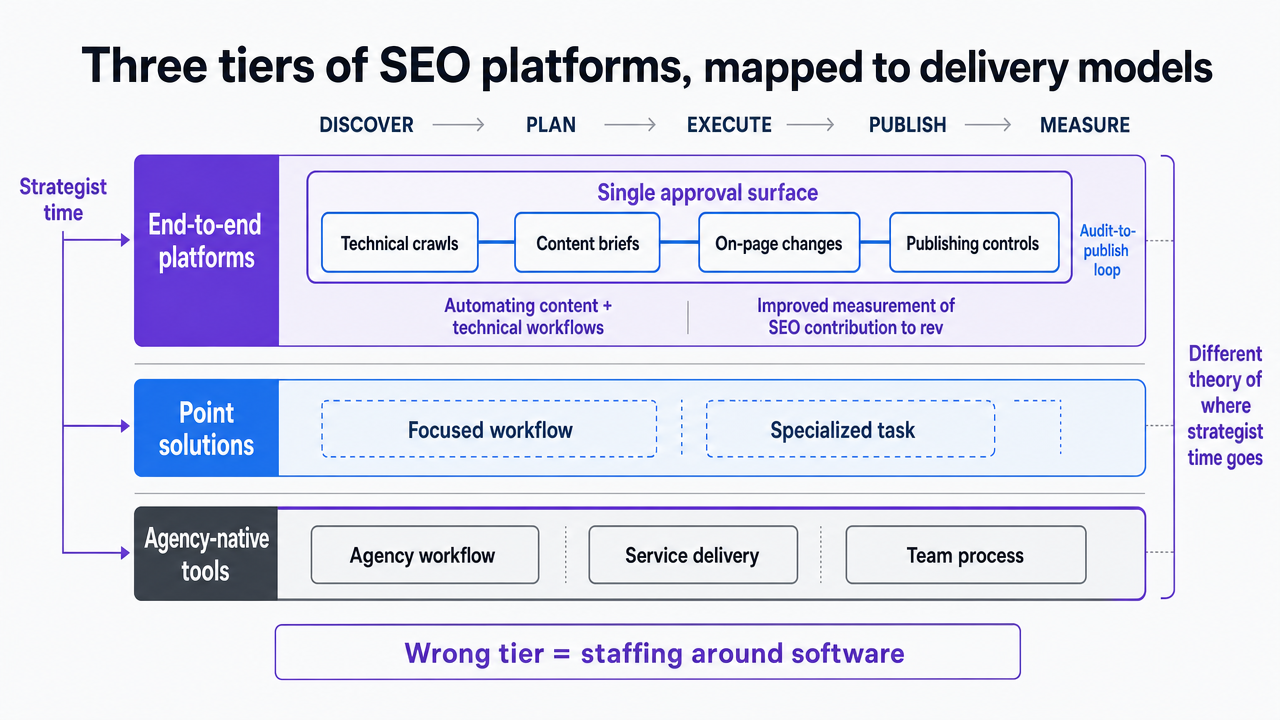 Visualize the three-tier segmentation of the SEO platform market described in this section, based on Forrester's landscape framing
Trial Full-Scale SEO Platform Execution Today
Experience live, client-ready SEO workflow and publish real content before committing long term.
The 8 platforms
Semrush — the incumbent point-solution suite
Semrush is where most agency SEO teams learned the craft, and that familiarity is both its strongest and its weakest argument. The platform bundles keyword research, position tracking, backlink analysis, site audits, and a competitive intelligence layer into one interface, which is what earned it a place in Forrester's landscape of point-solution suites 4.
For an agency running discovery on a new client, few tools compress the first-week diagnostic work faster. A strategist can pull a domain overview, surface top-performing pages, map competitor keyword gaps, and export a technical audit inside an afternoon. That speed matters for pitch cycles and onboarding.
The friction shows up in delivery. Semrush reports what to change; it does not change anything. Every audit finding still has to be translated into a brief, routed to a content or dev resource, and manually reconciled against the client's CMS. Agencies scaling past 20 accounts per strategist tend to describe Semrush as a strong analysis layer sitting on top of a delivery workflow the platform does not touch.
Ahrefs — depth for backlink and content gap workflows
Ahrefs earned its reputation on the strength of its backlink index, and for agencies whose client mix leans on authority-building, that depth is difficult to replicate elsewhere. Its Site Explorer surfaces referring domain patterns, anchor distribution, and lost-link recovery opportunities at a granularity that supports specialist workflows rather than generalist reporting.
The Content Explorer and Keywords Explorer modules extend that same investigative posture to content strategy. Strategists working competitive gap analyses across sizable client rosters use Ahrefs less as a dashboard and more as a research console — the interface rewards analysts who know exactly what question they are asking.
That is also the limitation. Ahrefs sits firmly in the point-solution segment Forrester describes 4, and its outputs still require an external system to move from insight to published change. Agency heads pairing Ahrefs with a separate content optimization tool and a separate reporting layer will recognize the pattern: three subscriptions, three logins, and a strategist doing the integration work by hand.
Conductor — enterprise governance for large content estates
Conductor is built for the client that has more URLs than the strategist can hold in memory. Its positioning inside the enterprise segment of Forrester's Wave centers on governance: workflow management, content briefs tied to keyword strategy, and technical monitoring across sizable content estates 3.
For agencies serving enterprise accounts, the platform's structured content workflow is the differentiator. Briefs, drafts, optimization scores, and approval states live in one place, which reduces the number of standalone project management tools a strategist has to check. The technical monitoring layer flags crawl issues, indexation drift, and structured-data problems against a defined page inventory rather than a rolling sample.
The tradeoff is scope. Conductor is priced and configured for enterprise deployments, and the interface assumes a client team on the other side capable of receiving structured recommendations. An agency running a book of mid-market service businesses will find the governance apparatus heavier than the account size warrants. For enterprise-heavy portfolios, the same apparatus is exactly the point.
BrightEdge — data intensity for pattern-driven strategists
BrightEdge sits alongside Conductor in the enterprise tier and takes a different bet on what strategists actually need. Its DataCube and Data Mind layers emphasize signal detection at scale — surfacing intent shifts, content decay, and topical opportunity across large keyword universes rather than curated tracking sets.
The platform's Recommendations engine attempts to translate that pattern recognition into prioritized actions, which is closer to the automation posture Forrester describes as characteristic of vendors moving up the stack 5. Strategists managing enterprise B2B or retail accounts with tens of thousands of tracked terms rely on BrightEdge for the aggregation work that would otherwise consume analyst hours.
The delivery gap remains, though. BrightEdge tells a strategist what deserves attention; the execution — brief writing, page updates, publishing — still happens outside the platform. Agencies choosing BrightEdge typically pair it with dedicated content production capacity, either in-house or contracted. Without that capacity, the recommendations queue grows faster than the team can act on it.
seoClarity — reporting depth for portfolios with heavy stakeholder cycles
seoClarity is the platform most often mentioned when the conversation turns to reporting velocity. Its differentiator is the breadth of tracked-keyword capacity and the depth of the reporting layer that sits on top, both of which matter for agencies running clients with weekly stakeholder cadences.
The Clarity Audits module handles technical crawls at portfolio scale, and the Sitemetrics and Rank Intelligence layers give strategists the segmentation controls needed to isolate performance by page type, content cluster, or geographic segment. For an agency lead defending renewal on a large retainer, those segmentation controls translate directly into narrative — the client wants to know why one product line moved and another did not, and the platform is built to answer that question quickly.
The consideration is the same one that follows every point-solution suite. seoClarity produces analysis and audit outputs; it does not close the loop into publishing. Agencies pairing it with separate content optimization and execution tooling are still carrying stitching cost on the delivery side.
Clearscope — content optimization as a strategist multiplier
Clearscope narrows its scope deliberately. The platform grades draft content against a target query, scores term coverage, and gives writers a real-time optimization signal that a strategist would otherwise have to provide manually on every draft.
For agencies whose delivery bottleneck is content quality rather than technical audit throughput, that focus is the point. A single senior strategist can supervise output from a larger pool of writers when the grading logic is embedded in the drafting environment rather than applied after the fact. The VA content style guide's caution against thin pages and keyword stuffing maps cleanly onto how Clearscope's scoring is intended to be used — as a floor, not a ceiling 8.
Clearscope is a component, not a system. It does not audit sites, track rankings, or monitor backlinks. Agencies using it well pair it with a broader platform for the technical and measurement layers, treating Clearscope as the writing-desk multiplier rather than the delivery backbone.
AgencyAnalytics — agency-native reporting and client dashboards
AgencyAnalytics sits in Forrester's agency-native tier and solves a specific problem: the manual work of assembling client-ready reports from the outputs of every other tool in the stack 4. It ingests data from Google Search Console, GA4, Google Business Profile, and dozens of third-party APIs, then produces white-labeled dashboards and scheduled reports.
For an agency head, the value is measured in strategist hours reclaimed from monthly reporting duty. A team running 30 clients on manual reporting can lose a full strategist-week per month to slide decks and screenshot assembly. Automating that layer changes the math on how many accounts a strategist can carry.
What AgencyAnalytics does not do is optimize anything. It is a reporting and client-communication surface, not an SEO platform in the optimization sense. Agencies choosing it are choosing to solve the reporting bottleneck first and keep their optimization stack — whether Semrush, Ahrefs, or a full enterprise suite — running underneath it.
Vectoron — approval-first execution across the audit-to-publish loop
Vectoron occupies the end-to-end execution tier Forrester describes as the segment most actively automating content and technical workflows 5. Where the point-solution suites report and the agency-native tools present, this category executes — with an approval gate between recommendation and publish.
The platform organizes work around specialist AI strategists covering content, SEO, PPC, backlinks, social, and call intelligence, coordinated through a Command Center that routes every recommended action for human sign-off before it ships. For an agency head, the operational shift is that the audit-to-publish loop — technical crawl finding, brief, draft, on-page change, publish, measurement — collapses into one governed queue rather than a chain of handoffs across four subscriptions.
Pricing anchors at $599/month after a two-week trial, which places it below the stacked cost of most enterprise point-solution combinations. The design assumption is McKinsey's finding on where AI value actually shows up: from redesigned workflows, not from stacking additional tools on top of the existing process 15, 16. For agencies whose margin problem is throughput per strategist, that assumption is the one worth testing.
Consolidation economics: what changes when 4-6 tools collapse into one
A note on scope before this section develops: the math below is written for portfolio operators — agency heads carrying a book of 20 or more client sites where per-client tooling costs and strategist hours compound quickly. Single-site in-house teams face a different calculation.
Forrester's State of Search Marketing 2025 finds that over 70% of large enterprises now use an SEO platform or suite as part of their search stack, with AI-enhanced tooling flagged as a differentiator among top performers 13. The clients an agency is trying to retain are already operating from a consolidated posture. The question is whether the agency's delivery cost structure can match it.
The table below maps a typical point-tool stack against a consolidated platform across the six functions that show up on almost every agency invoice. Dollar variables are labeled rather than fabricated, because per-seat pricing varies by vendor tier and negotiated contract. The one anchor is Vectoron's stated post-trial price of $599/month.
| Function | Point-Tool Stack | Consolidated Platform |
|---|---|---|
| Technical Audits | Screaming Frog / Sitebulb ($X/mo) | Included |
| Content Optimization | Clearscope / MarketMuse ($Y/mo) | Included |
| Rank Tracking | Semrush / Ahrefs ($Z/mo) | Included |
| Backlink Monitoring | Ahrefs / Majestic ($W/mo) | Included |
| AI-Search Visibility | Emerging point tool ($V/mo) | Included |
| Reporting | AgencyAnalytics / Looker Studio ($U/mo) | Included |
| Anchor pricing | Sum of X+Y+Z+W+V+U per seat | $599/mo (Vectoron, post-trial) |
| Strategist integration hours | H hours/client/month reconciling outputs | Approaches zero |
The line that matters is the last one. Subscription arbitrage is real but secondary; the larger cost sitting in most agency P&Ls is the strategist hour spent reconciling four dashboards into one client narrative. Collapse that reconciliation work, and accounts per strategist moves before any seat fee is renegotiated.
See How Leading Agencies Scale SEO Operations with AI-Driven Workflows
Request a walkthrough of unified SEO and content automation workflows designed for high-volume client portfolios—measurably reduce manual overhead while preserving quality and oversight.
GEO monitoring: the capability that separates current platforms from obsolete ones
Generative engine optimization is no longer an adjacent discipline. McKinsey's analysis of AI-powered search behavior finds that 44% of AI-search users treat those engines as their primary and preferred source of insight, compared with 31% for traditional search, and argues that GEO now needs to sit inside any holistic digital strategy rather than beside it 14. The finding measures self-reported preference among AI-search users, not total query share, but the direction it implies for platform requirements is unambiguous.
A platform without visibility into how a client's content is being surfaced, cited, or paraphrased across AI answer surfaces is reporting on a narrower slice of the funnel every quarter. For an agency head defending renewal, the practical capability list has grown:
- Entity coverage against AI knowledge graphs
- Structured-data completeness against the schemas answer engines prefer
- Citation tracking inside AI Overviews and LLM responses
- Prompt-level share-of-voice against competitor brands
The technical substrate for that visibility is not exotic. Standardized schemas, enriched metadata, sitemaps, and HTTPS — the same signals academic discoverability research has recommended for years — are what AI systems parse when deciding whom to cite 11. What separates current platforms from obsolete ones is whether they measure the outcome of those signals on AI surfaces, or whether they still stop at the classic SERP.
A decision path for the next 30 days
The agencies that move fastest on platform selection tend to run the same short diagnostic before opening a single vendor conversation.
- Week one: count accounts per strategist across the current book, and log the hours each strategist spends on reconciliation work — pulling data from separate audit, content, backlink, and reporting tools into a single client narrative. That number is the baseline any consolidation decision has to beat.
- Week two: audit which clients are already asking about AI-search visibility. The ones who are will not renew with a platform that reports only on classic SERP position. McKinsey's finding that AI-search users increasingly treat those engines as their primary source of insight 14 is already showing up in RFP language.
- Weeks three and four: run a scoped pilot against one tier — end-to-end execution, point-solution suite, or agency-native reporting — on five representative accounts. Measure two variables only: revision cycles per deliverable, and strategist hours saved. The tier that moves both is the one worth signing.
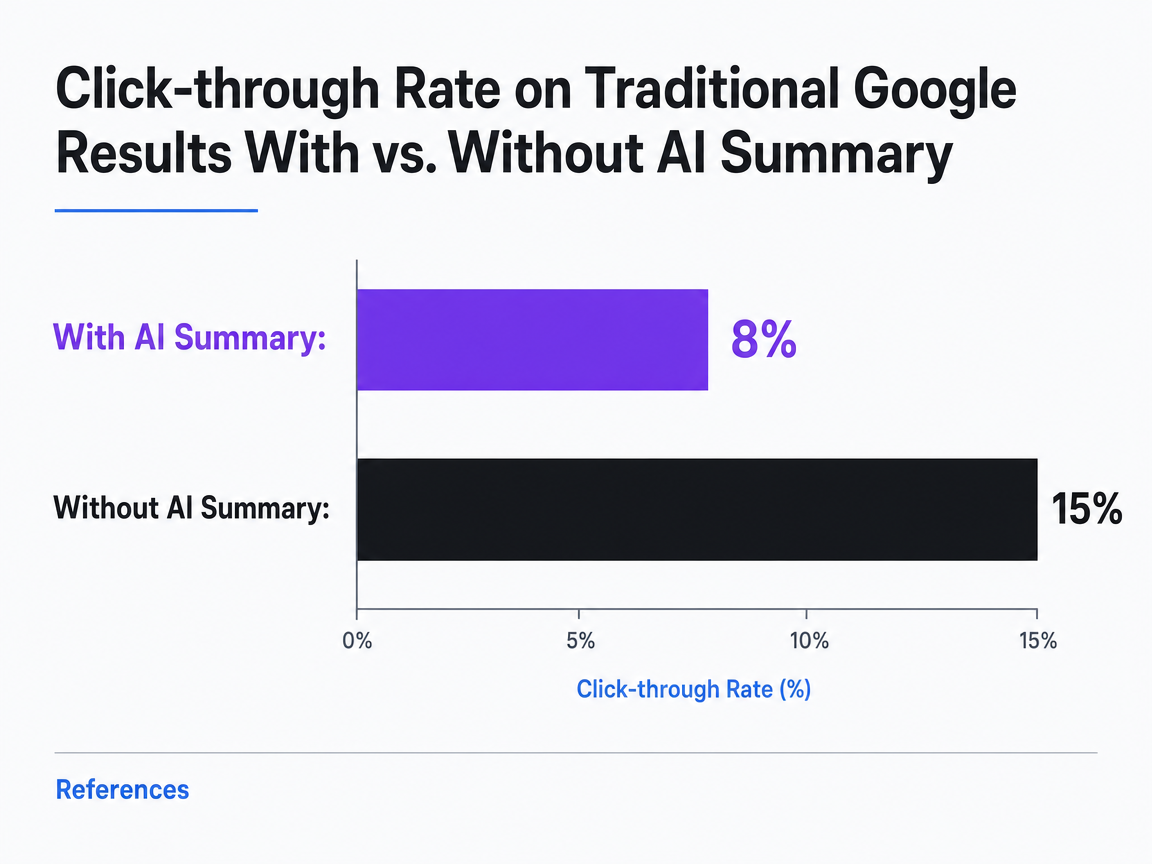 Click-through Rate on Traditional Google Results With vs. Without AI Summary
Comparison of the percentage of Google searches where users clicked a traditional (non-AI) search result, comparing visits that included an AI summary to those that did not. Data from a Pew Research analysis of user browsing behavior.
Frequently Asked Questions
References
- 1.Advanced search engine optimization | Digital.gov.
- 2.Google users are less likely to click on links when an AI summary appears in the results.
- 3.The Forrester Wave™: Search Engine Optimization Solutions, Q3 2025.
- 4.The Search Engine Optimization Solutions Landscape, Q1 2025.
- 5.SEO Must Solve Its Marketing Problem.
- 6.Search Engine Optimization Best Practices.
- 7.Optimize your content | Digital.gov.
- 8.Writing for SEO.
- 9.An introduction to search - Digital.gov.
- 10.Search Engine Optimization for Improved Web Visibility.
- 11.Visibility, Discoverability, Findability, Search Engine ....
- 12.3.3 Search Engine Optimization (SEO).
- 13.The State of Search Marketing 2025.
- 14.New front door to the internet: Winning in the age of AI search.
- 15.The State of AI: Global Survey 2025.
- 16.The state of AI: How organizations are rewiring to capture value.
- 17.What Web Browsing Data Tells Us About How AI Appears Online.