
Key Takeaways
- Traditional single-client audit workflows collapse at portfolio scale because specialist hours get consumed by template-level checks a scanner could flag, pushing audits from quarterly to annual.
- A three-layer review stack separates work by risk: automated scans on every page, templated specialist review of representative pages, and senior strategist plus compliance review on money and YMYL pages.
- Programmatic tiering based on commercial weight, query risk, and traffic concentration removes committee bottlenecks and reclassifies pages automatically when signals change 1.
- Scanners decide deterministic checks like response codes and contrast ratios, but only surface judgment calls such as intent match or claim accuracy, which require human closure 2.
- AI-drafted pages should be graded on sourcing, citation accuracy, and provenance logging rather than detection scores, since detection is one signal, not a verdict on quality 2, 3.
- Regulated verticals demand parallel gates covering plain language, tracking configuration, HIPAA marketing definitions, FTC substantiation for health claims, testimonial provenance, and accessibility on lead forms 5, 6, 7, 8, 10.
- Portfolio economics shift when Tier 1 buys coverage at near-zero specialist minutes, cutting a 100-page audit from roughly 25 hours to between 8.5 and 17 hours 1.
- A single weekly scoring model combining severity, commercial weight, and compliance risk as a multiplier keeps the ship queue honest and prevents skipped reviewer signatures 6, 8.
Why page audits break at 50 clients
The single-client audit is a solved problem. A senior specialist opens a crawl report, reads through templates, checks intent alignment, and delivers a ranked findings doc in a day or two. That workflow does not survive contact with a 50-client roster.
The math is the constraint. A mid-market agency managing 50 accounts at an average of 200 indexable pages per site is responsible for 10,000 pages of surface area. Quarterly review at that volume, done the traditional way, consumes specialist hours the retainer never priced in. Delivery margin compresses. Senior reviewers get pulled into template-level checks that a scanner could have flagged, while high-risk pages for regulated clients wait in the same queue as a plumber's service-area page.
The failure mode is predictable. Audits slip from quarterly to annual. Findings backlogs grow faster than the ship queue. Junior staff inherit the review work without the judgment to catch factual, substantiation, or accessibility risks that carry legal exposure 1, 4.
Scaling page content analysis is a workflow architecture problem, not a tooling upgrade. What follows is the operating model that separates the work by risk, not by client.
The three-layer review stack
Tier 1: Automated checks on every page
Every indexable URL in the portfolio gets scanned. That is the floor, not the ceiling.
Tier 1 handles the checks that machines decide well:
- crawlability
- indexation status
- canonical tags
- response codes
- redirect chains
- structured data syntax
- heading order
- alt-text presence
- image weight
- meta descriptions
- internal link depth
- Core Web Vitals
- color contrast ratios
These are pass-fail or threshold-based signals. A scanner does not need judgment to tell an SEO lead that a service page returns a soft 404, ships a 4MB hero image, or has three H1s.
The Section 508 program is explicit about the scope of this layer. Automated tools support high-volume testing, but teams must identify coverage gaps and compare automated findings against manual results to validate rulesets 1. Translated to agency operations: a clean automated report is a starting position, not a delivery artifact.
Tier 1 runs on a schedule, not on request. Weekly for high-volume clients, monthly for the rest. Findings flow into a single portfolio queue with severity flags, so a broken canonical on a money page for one client outranks a missing meta description on a blog archive for another. The output of this tier is a filtered defect list, not a strategic recommendation. Ranking specialists never open the raw scan.
Tier 2: Templated specialist review of representative pages
Tier 2 is where a human first touches the page. The sampling logic is deliberate: one page per template, not one page per URL.
A typical service-business site collapses into a handful of templates:
- Homepage
- Service detail
- Location page
- Blog post
- Case study or outcome page
- Contact or lead form
A specialist reviews one representative of each template using a fixed rubric, then applies the findings across every URL built from that template. A weak H1 pattern on the service-detail template is a portfolio-wide fix, not a per-page ticket.
The rubric is templated to keep review time bounded:
- Intent alignment against the target query
- Heading hierarchy and scannability
- Internal link relevance and anchor variety
- Schema completeness beyond syntax
- Media captions and useful alt text for screen-reader users, following the plain-language and accessibility conventions in the HHS Web Style Guide for healthcare templates 5
- Form fields, CTAs, and above-the-fold clarity
A mid-level specialist can clear a template rubric in 20 to 40 minutes. That is the operational target. Anything that exceeds the rubric, ambiguous intent, thin content on a commercial query, a testimonial module that needs sourcing, gets kicked up to Tier 3 with a note. The reviewer does not resolve it in place.
Tier 3: Senior strategist plus compliance gate
Tier 3 is reserved. Money pages, YMYL pages, pages with claims, and anything a Tier 2 reviewer escalated.
A senior strategist owns the analysis end to end: query landscape, competitive gap, content depth, factual accuracy, source review, and the strategic call on whether to refresh, rewrite, consolidate, or retire the URL. For regulated clients, a compliance owner runs in parallel. Not the strategist. A separate reviewer whose job is to flag claims that require substantiation, tracking configurations that touch protected health information, testimonials that need provenance, and language that crosses from marketing into a regulated use of patient data.
The compliance gate is a hard stop, not a suggestion. A Tier 3 recommendation does not enter the ship queue until both signatures land. That single rule is what keeps a scaled operation from publishing an outcome claim that lacks scientific support or a location page that leaks PHI through a third-party pixel.
Tier 3 is expensive by design. The whole point of Tiers 1 and 2 is to keep this queue short enough that senior time is spent on the pages where judgment actually changes the outcome.
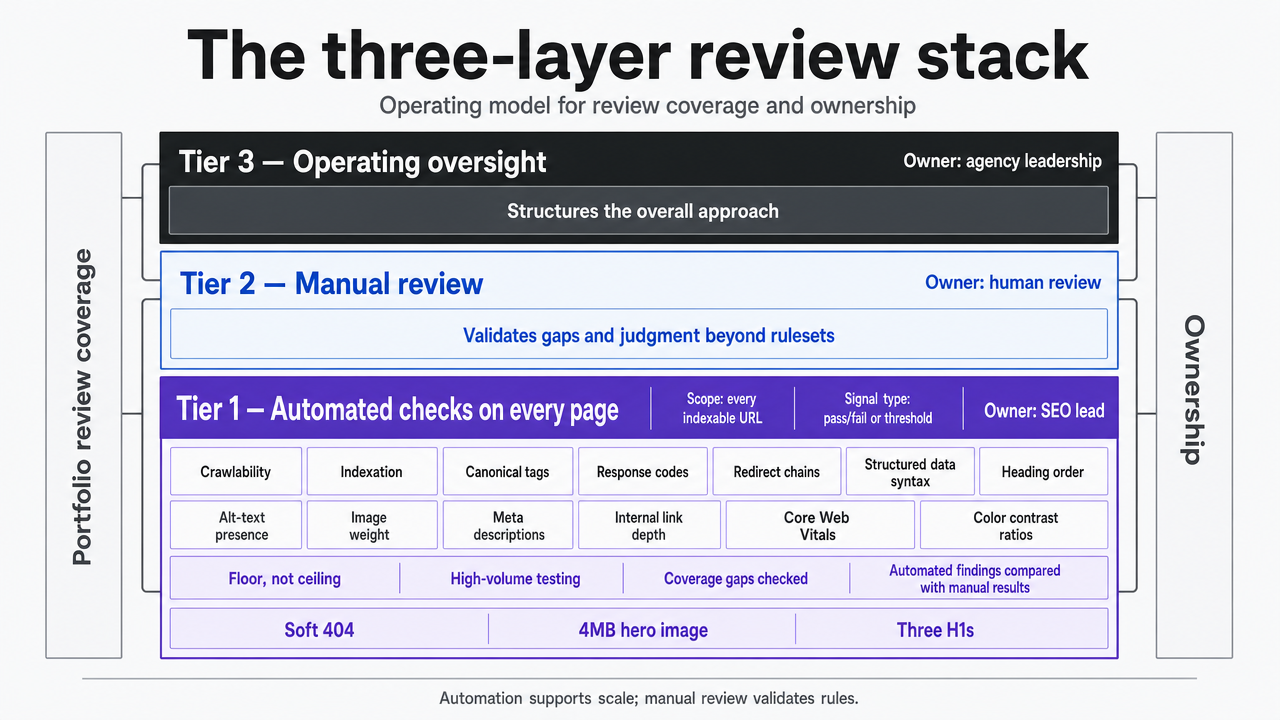 Visualize the three-tier review model that structures the entire operating approach, showing what each tier covers and who owns it
Sorting pages into tiers without a committee
Tiering has to be programmatic. If every page assignment requires a strategist to weigh in, the operating model collapses back into the same bottleneck it was built to remove.
Three signals do most of the work:
- Commercial weight: pages that carry a tracked conversion event, a phone number, or a lead form.
- Query risk: pages targeting YMYL topics, health claims, legal outcomes, financial advice, or anything a compliance owner would want to see before publish.
- Traffic and revenue concentration: URLs in the top decile of sessions or attributed pipeline for that client.
A page hits Tier 3 if it clears any two of the three. It hits Tier 2 if it clears one. Everything else lives in Tier 1 until a signal changes.
The rules run against the crawl output and analytics feed on the same schedule as the automated scan. No meeting. No committee. A page that gained conversion tracking last week gets reclassified this week. A blog post that suddenly ranks for a health-symptom query gets pulled up a tier automatically.
SEO leads audit the tiering logic quarterly, not the tier assignments themselves. That distinction protects senior hours. Reviewers argue about the rules once, then let the rules sort ten thousand URLs 1.
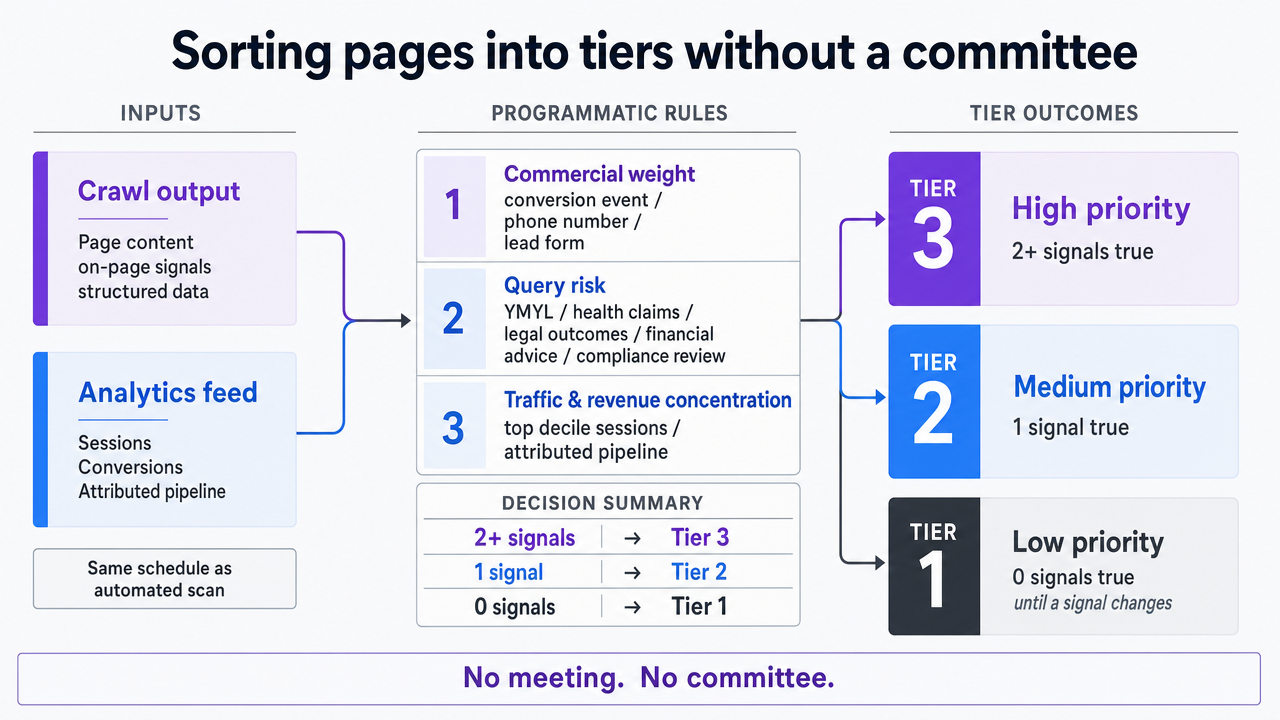 Show the programmatic tiering logic using the three signals described in the section
Test AI-Powered SEO Content Analysis Workflow
Experience measurable, automated content analysis at agency scale on live pages before making long-term commitments.
What automated analysis can decide, and what it can only surface
The tier model only holds if reviewers agree on where the scanner's authority ends. That line is not intuitive, and specialists tend to over-trust or under-trust automated output based on which tool burned them last.
A scanner decides pass-fail checks against a defined ruleset:
- Response codes
- Canonical resolution
- Structured data validity against schema.org
- Heading order
- Contrast ratios against WCAG thresholds
- Image dimensions and weight
- Robots directives and indexation state
- Internal link counts and depth
- Core Web Vitals field data
- Sitemap coverage against the crawl
These have deterministic answers. A canonical either resolves to a 200 or it does not.
A scanner surfaces, but does not decide, anything that requires judgment about meaning:
- Whether a page actually satisfies the query behind a keyword
- Whether an H2 reads as a subhead or a marketing slogan
- Whether alt text is useful to a screen-reader user or just present
- Whether a testimonial is real
- Whether an outcome claim has scientific support
- Whether the page reads as thin because it is thin, or reads as thin because a scanner cannot parse a rich media module
NIST's guidance on generative AI is the cleanest articulation of the boundary. Automated evaluation should compare generated content against known ground truth, use varied evaluation methods, review sources and citations, monitor erroneous output, and maintain human intervention procedures 2. Every one of those actions assumes a human closes the loop.
The practical rule for Tier 2 and Tier 3 reviewers: treat scanner output as a defect list and a question list. Defects go to the ship queue. Questions, anything the tool flagged with a confidence score, a heuristic label, or a semantic guess, go to a human before they become client-facing recommendations. A scanner that reports "content quality: low" has produced a question, not an answer. The reviewer decides whether the page needs a rewrite, a source added, a claim removed, or nothing at all.
Agencies that publish scanner output directly to clients as findings do not scale. They generate churn. The tier model works because it puts a human between the machine's surface signals and the client's inbox on every judgment call, and lets the machine handle the checks it was actually built for.
Evaluating AI-drafted and AI-refreshed pages
AI drafting changes what a reviewer is looking for. The scanner still checks structure. The human is now checking whether the words on the page correspond to reality.
NIST's generative AI profile lays out the evaluation actions that belong in a review rubric: compare generated content against known ground truth, use varied evaluation methods, review sources and citations, monitor erroneous output, and maintain human intervention procedures 2. For agency workflows, that translates into four checks on every AI-touched page:
- Source every factual claim to a document the reviewer can open.
- Confirm cited studies, statistics, and quotes exist and say what the draft says they say.
- Flag any sentence that reads as confident but lacks a source.
- Log the model, prompt, and reviewer for provenance.
AI-detection scores do not belong in the rubric. NIST's pilot study evaluated detector performance using AUC and Brier scores and treats detection as one signal, not a verdict on quality or authorship 3. A page that scores as machine-written can be accurate and useful. A page that scores as human-written can be wrong. The reviewer grades the content, not the origin.
The regulated-vertical gate
Healthcare pages: language, tracking, and marketing rules
Healthcare clients change the review rubric before the reviewer opens the page. Three surfaces need attention on every URL: the language on the page, the tracking configured behind it, and whether the communication itself qualifies as marketing under HIPAA.
Language first. Provider pages, condition explainers, and treatment descriptions should follow plain-language and accessibility conventions, including useful headings, defined terms, and alt text that a screen-reader user can act on 5. Reviewers flag jargon-dense copy, undefined acronyms, and hero images that carry information not repeated in text. The goal is a page a patient can read, not a page a marketing team can defend.
Tracking is the more expensive miss. HHS OCR has stated that disclosures of protected health information to tracking vendors for marketing without HIPAA-compliant authorization can be impermissible, and that authenticated pages require especially careful controls 6. Page-content analysis for healthcare clients has to include what fires on the page, not just what renders. Pixels, session replay, chat widgets, call-tracking scripts, and form handlers all belong on the review checklist. A location page with a symptom checker and a Meta pixel is a compliance question, not a conversion optimization.
The marketing definition closes the loop. HHS defines marketing as a communication about a product or service that encourages recipients to purchase or use it, and, with limited exceptions, marketing uses or disclosures of PHI generally require individual authorization 10. Reviewers apply that definition to personalization logic, retargeting audiences built from site behavior, and any dynamic module that varies content by known patient attributes. Anything that pulls from patient data goes to the compliance owner before it ships.
Substantiation review for health and outcome claims
Claim review is a separate pass. The reviewer is not grading writing quality. The reviewer is asking whether each claim on the page has evidence the client can produce on request.
The FTC requires appropriate substantiation for health-related advertising, and claims about health benefits or safety generally require competent and reliable scientific evidence 8, 9. That standard applies to outcome statistics on treatment pages, comparative statements against other providers, implied medical promises in hero copy, and testimonials that describe results. It applies whether a human or an AI drafted the sentence.
The operational rule is narrow. Every health or outcome claim on the page maps to a source document the client has already approved, or the claim is qualified, softened, or removed before publish. A reviewer does not decide whether evidence is competent and reliable. A reviewer flags the claim, links the draft language to the supporting document or its absence, and routes unresolved items to the client's compliance owner or counsel.
Reviews, testimonials, and the FTC final rule
Review modules are their own audit surface. The FTC's 2024 final rule prohibits businesses from creating, selling, buying, or disseminating reviews they know or should know are fake or false, and specifically addresses AI-generated fake reviews that misrepresent a real person or experience 7.
That rule reshapes what a Tier 2 reviewer checks on testimonial pages, local landing pages, and embedded review widgets. Provenance is the first question. Each testimonial should trace to an identifiable customer and a real experience, with documentation the client can retrieve. Star-rating aggregates and pulled quotes need a source of record. Incentive language that conditions a reward on positive sentiment gets flagged.
AI-assisted workflows raise the bar. A reviewer treats any synthetic or materially altered testimonial as a defect regardless of intent. Composite quotes assembled from multiple customers, stock-photo faces paired with fabricated names, and model-generated reviews inserted to fill a template all fail the check. The reviewer does not rewrite them. The reviewer removes them from the ship queue and routes the module to the client for sourced replacements.
Accessibility as a legal-risk surface on service pages
Accessibility belongs in the regulated-vertical gate because service-business landing pages carry the same legal exposure whether the client is a hospital, a law firm, or a plumber. DOJ guidance identifies color contrast, text alternatives, accessible forms, and keyboard navigation as core website accessibility practices for businesses open to the public 4.
Lead forms are the highest-risk element on most service pages. A form that fails keyboard navigation, lacks visible labels, or traps focus inside a chat widget blocks a subset of prospects and creates a demonstrable barrier. Tier 1 scans catch the mechanical failures. A Tier 2 reviewer runs the form with a keyboard and a screen reader on the representative template, then applies the fix across every URL built from it.
The reviewer does not write legal opinions. Findings are logged as accessibility defects with WCAG references and reproduction steps, then handed to the client. Applicability to a specific site can depend on jurisdiction and evolving case law, and the audit does not substitute for counsel 4.
Scale SEO Content Analysis Without Expanding Your Team
Discover how agencies are automating large-scale SEO page content analysis across clients—maintaining strategic oversight and quality, while reducing time-to-insight and manual effort.
Portfolio economics: reallocating specialist hours across clients
The frame shifts here. Single-client audit math treats specialist time as a per-engagement cost. Portfolio math treats it as a fixed pool that has to cover every account on the roster in the same month. That is the number the delivery lead is actually managing.
The tiered model changes where the hours land. Consider a client with 100 indexable pages, distributed the way most service-business sites distribute:
- roughly 80 pages built from a handful of templates
- 15 pages that carry commercial weight or targeted queries
- 5 pages that trip a compliance or YMYL signal
Tier 1 handles the 80 template-built pages at effectively zero specialist minutes per page. The scanner runs on schedule, findings drop into the queue, and a coordinator triages defects. Tier 2 covers the 15 commercially weighted pages through templated review, budgeted at 20 to 40 minutes per representative template, with fixes applied across every URL built from it. Tier 3 covers the 5 high-risk pages at 90 to 180 minutes each, plus a separate compliance pass for regulated clients.
The hybrid basis is deliberate. Section 508's testing guidance is explicit that automated tools support high-volume testing, but teams must identify coverage gaps and compare automated findings against manual results 1. Applied to portfolio economics, that means Tier 1 buys coverage, not conclusions, and reclaimed specialist hours are the payoff.
| Tier | Pages per 100-page client | Specialist minutes per page | Total specialist minutes ||---|---|---|---|| T1 automated-only | ~80 | ~0 (coordinator triage) | ~0 || T2 templated review | ~15 | 20–40 (per template, applied across URLs) | ~60–120 || T3 specialist + compliance | ~5 | 90–180 + compliance pass | ~450–900 |
The headline number for a delivery lead is not cost per audit. It is specialist hours reclaimed per 100 pages audited. A traditional per-page review at 15 minutes per URL consumes 25 hours. The tiered allocation above lands between 8.5 and 17 hours for the same coverage, with senior time concentrated where judgment changes the outcome. Multiply across 50 clients and the reclaimed pool is what funds retention work, strategic recommendations, and the compliance gate that keeps regulated accounts on retainer.
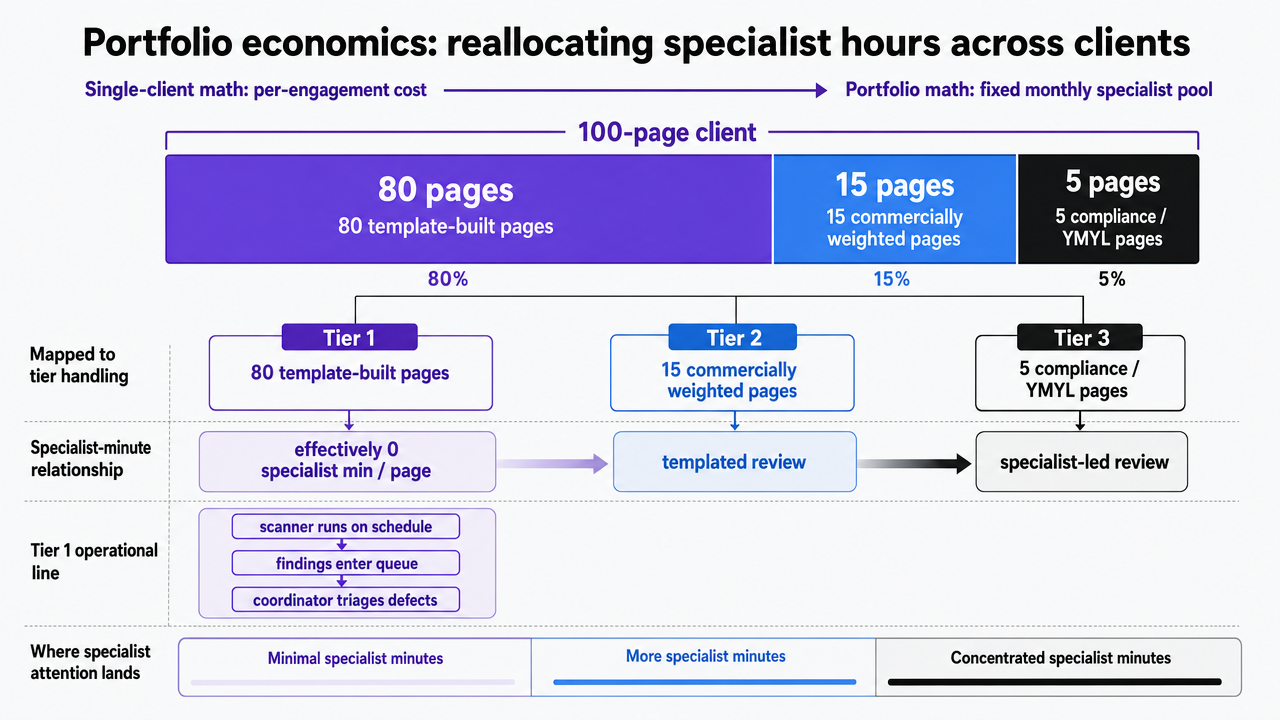 Visualize the specialist-minute allocation table across tiers for a 100-page client, which appears explicitly in the prose
Scoring, prioritization, and the weekly ship cadence
Findings without a score are noise. A scaled operation needs one prioritization formula that runs across every client, so the weekly ship queue reflects portfolio-wide impact instead of whoever complained last.
Three inputs drive the score:
- Severity, from the automated ruleset or reviewer flag.
- Commercial weight, inherited from the tiering signals already applied to the URL.
- Compliance risk, which acts as a multiplier rather than an additive factor: a substantiation gap on a health-outcome page or a tracking misconfiguration on an authenticated healthcare URL jumps to the top of the queue regardless of traffic, because the downside is legal rather than positional 6, 8.
The cadence is weekly. Every Monday, the queue reflows: new Tier 1 defects, new Tier 2 template fixes, unresolved Tier 3 items, and any compliance flags that cleared the gate. Delivery leads ship a fixed number of items per client per week, not a fixed number per agency. That protects smaller retainers from being crowded out by high-volume accounts and keeps utilization predictable.
One rule keeps the model honest: nothing ships without the reviewer signature its tier requires. Speed comes from tiering, not from skipping the gate.
Frequently Asked Questions
References
- 1.Validate Rulesets.
- 2.Artificial Intelligence Risk Management Framework: Generative Artificial Intelligence Profile.
- 3.2024 NIST GenAI (Pilot Study): Text-to-Text Evaluation Overview and Results.
- 4.Guidance on Web Accessibility and the ADA.
- 5.Web Style Guide - HHS.gov.
- 6.Use of Online Tracking Technologies by HIPAA Covered Entities and Business Associates.
- 7.Federal Trade Commission Announces Final Rule Banning Fake Reviews and Testimonials.
- 8.Health Claims | Federal Trade Commission.
- 9.Health Products Compliance Guidance.
- 10.Marketing.