
Key Takeaways
- Phrase selection is a modeling decision across three variables: documented search intent, the site's authority to rank and earn trust, and a mapped path from click to booked revenue.
- Query volume misleads because sophisticated buyers narrow their language as knowledge deepens, so specific procedure, jurisdiction, or credential phrases predict pipeline better than broad terms 7.
- In YMYL categories, trust engineering gates conversion; named expertise, source transparency, clear information, and design cues determine whether ranked traffic books an action 5.
- Portfolio operators should tier production—informational at brand, comparative at region, transactional per location—and concentrate attribution on a phrase-to-revenue ledger joined to CRM opportunity records.
Phrase selection is a pipeline modeling decision
Most demand gen teams still treat SEO phrases as a keyword research output. That framing produces traffic reports, not pipeline. A phrase that ranks and converts is the result of a modeling decision across three variables: the documented intent behind the query, the site's authority to rank and earn trust on that query, and the mapped path from click to booked revenue. When any one of those variables is missing, organic traffic accumulates without translating into sales-qualified opportunities.
The empirical case for treating intent as a primary variable comes from Jansen and colleagues, who analyzed large-scale query logs and defined user intent as
"the affective, cognitive, or situational goal as expressed in an interaction with a Web search engine"
8. That definition matters because it separates what a searcher types from what a searcher wants. A phrase like "urgent care near me" carries transactional weight; "symptoms of strep throat" does not, even if both concern the same clinic.
Practitioner guidance reinforces the same discipline. The Michigan State Digital Experience Studio frames keyword selection around a direct question: are users looking for information, comparing options, or ready to decide 1. Demand gen managers who answer that question before ranking phrases by volume end up with a shorter target list and a higher conversion rate on the phrases they keep.
The sections that follow work through each variable and show how the model applies to healthcare, legal, and multi-location portfolios.
The three variables that separate traffic from pipeline
Intent stage: what the query is actually asking for
Intent is the variable most demand gen teams claim to have solved and most phrase lists still ignore. Jansen and colleagues, working from large-scale query logs, sorted queries into three categories: informational, navigational, and transactional 8. Their empirical finding matters for phrase selection because informational queries dominate the volume distribution, while transactional queries, the ones that map most directly to a booked action, sit as a smaller share of total search behavior 8.
That distribution reframes the volume-first habit. A phrase like "symptoms of strep throat" carries meaningful monthly search volume, but the intent is informational. A phrase like "urgent care near me" carries less volume and vastly more transactional weight. Treating the two as equal candidates because both concern the same clinic produces a content plan that ranks and a pipeline that does not move.
The Jansen framework also gives phrase auditing a working vocabulary. Informational phrases ("how to," "causes of," "what is") signal a searcher building understanding. Navigational phrases signal a searcher looking for a specific brand or property. Transactional phrases ("pricing," "near me," "free consultation," "book") signal readiness to act 8.
Practitioner guidance runs parallel. The Michigan State Digital Experience Studio instructs teams to ask whether users are "looking for information, comparing options or are they ready to make a decision" before selecting terms 1. That single question, applied to every candidate phrase, removes the phrases that would produce traffic without pipeline and keeps the ones that map to a downstream action.
Authority fit: whether the site can rank and convert on the phrase
The second variable asks a harder question: even if the intent is right, can this site actually rank for the phrase, and once a visitor arrives, will the page earn the click through to a conversion? Authority fit is where most phrase lists collapse. Teams pick phrases that match their offering and ignore whether their domain has the signals to compete for them.
Two conditions have to hold. The first is competitive: the domain needs enough topical depth, backlink profile, and technical health to appear on page one for the phrase. The second is credibility: once a visitor lands, the page has to signal expertise clearly enough that the visitor stays and acts. Research on consumer trust in digital health information found that trust judgments turn on perceived expertise and the clarity of information presented 5. A phrase can be ranked correctly for intent and still fail the conversion test if the destination page reads as thin or unverified.
Authority fit produces a practical filter. For every candidate phrase, a demand gen team should be able to name:
- the existing asset that will target it,
- the specific credibility markers on that asset (author bylines, verifiable credentials, cited sources, structured contact and location data),
- the competitors already ranking.
When any of those answers is missing, the phrase belongs on a build list, not a target list.
Phrases where authority is absent are not off-limits. They are longer projects. Treating them as short-term pipeline sources is where forecasts break.
Conversion path: the mapped route from click to booked revenue
The third variable is the one demand gen teams control most directly and neglect most often: the path from click to booked revenue. A phrase without a mapped conversion path is a traffic phrase, not a pipeline phrase.
The Michigan State framework anchors this decision in a direct question about whether users are looking for information, comparing options, or ready to decide 1. Each answer implies a different destination asset and a different pipeline action.
- Informational phrases need an educational asset with a low-friction next step, such as a resource subscription, a saved guide, or a follow-up email sequence that moves the reader toward a comparison-stage decision.
- Comparative phrases need side-by-side content, credential detail, and a clear invitation to a scoped conversation.
- Transactional phrases need a booking or consultation path with the fewest possible steps between click and calendar.
The failure mode is uniform destination design. Sending "causes of chronic back pain" and "orthopedic surgeon accepting new patients" to the same page treats a first-touch reader and a ready-to-book patient identically. The first bounces because the page pushes a booking they are not ready to make. The second bounces because the page reads as educational and delays the action they came to take.
A working conversion path assigns every target phrase to a specific asset, a specific next-step action, and a specific measurable outcome (form submission, call, appointment held). Phrases without that three-part mapping should be deferred until the mapping exists.
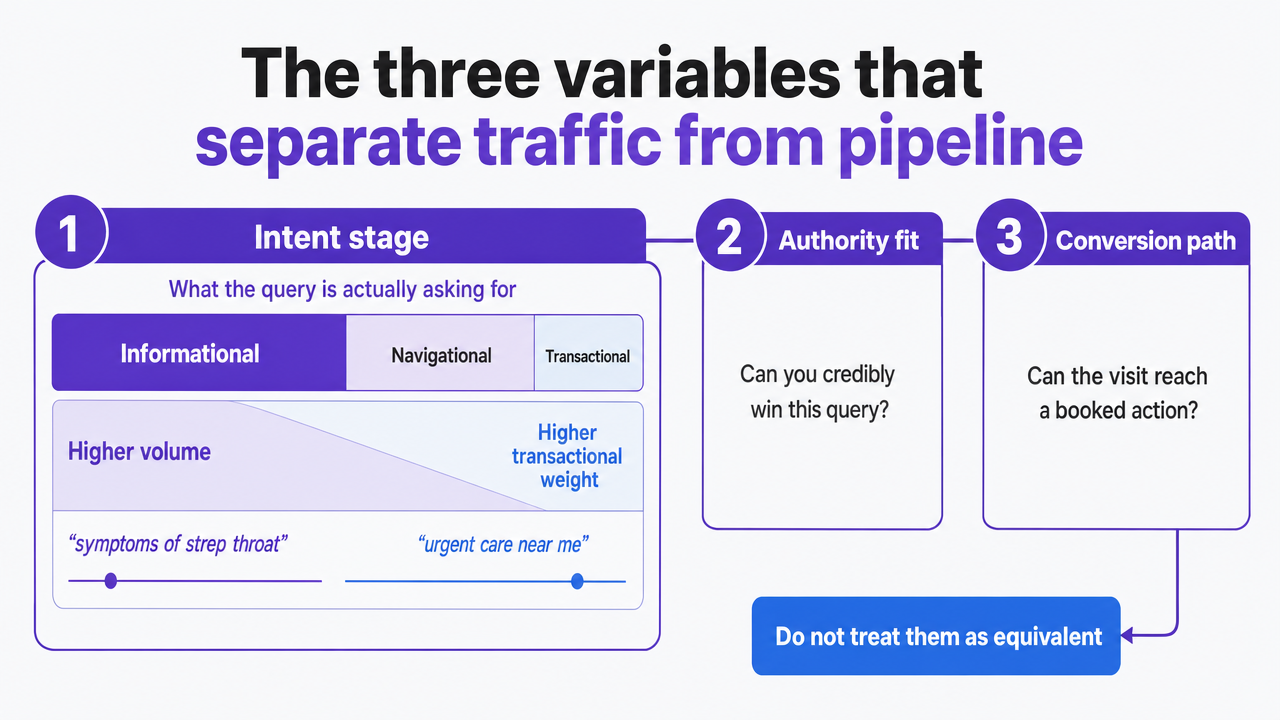 Visualize the three-variable framework (intent stage, authority fit, conversion path) that the section defines as the model for phrase selection
Why sophisticated buyers use narrower phrases than volume tools suggest
Volume-first phrase selection assumes that searchers use the shortest term that describes their problem. Research on how people actually build queries points the opposite direction. Columbia Business School researchers found that consumers are
"strategic" in query formation, adapting terms to better achieve their objectives as their knowledge of a category deepens
7. A patient who has spent an hour reading about herniated discs does not search "back pain." That patient searches for a procedure, a specialty, or a credential.
The practical consequence is that the most valuable phrases for pipeline are often invisible in the volume ranking of a keyword tool. Long, specific, decision-ready queries carry fewer monthly searches, sit lower in autocomplete data, and get filtered out of shortlists built on impression thresholds. That filter removes exactly the phrases sophisticated buyers use when they are closest to acting.
The Columbia work also flags a methodological problem worth naming. Standard keyword tools sample and cluster search demand at a level of aggregation that underrepresents nuance in how experienced users search 7. A phrase like "minimally invasive lumbar microdiscectomy second opinion" will not appear on a volume-sorted list next to "back surgery," yet it signals a searcher who has already priced a first opinion and is looking for a specific provider posture.
Three adjustments follow from this evidence:
- Phrase lists should be built from actual site search logs, sales call transcripts, and consultation intake notes, not only from third-party tools. The language qualified prospects use before they book is the language that predicts pipeline.
- Low-volume phrases that name a specific procedure, jurisdiction, credential, or scoped problem should be kept on the target list even when volume tools rank them near zero. The Jansen intent framework classifies these as transactional or high-comparative queries regardless of frequency 8.
- Informational content should be written toward the vocabulary sophisticated searchers use as they move down-funnel, so the same site captures the reader at the point where the phrase gets narrower and the intent turns transactional.
Volume is a proxy. Buyer specificity is the signal.
Test SEO phrase strategies with live publishing access
Run real SEO phrase experiments and track actual impact in your pipeline before committing.
Trust signals gate conversion in YMYL verticals
Two clinics can target the same phrase, rank in adjacent positions, and produce wildly different booking rates. The phrase is not the variable. The page is.
Research on consumer trust in digital health information identifies the specific drivers that shape whether a visitor acts on what they read. Trust judgments turn on perceived expertise and the clarity of information presented, with transparency and design cues shaping the initial credibility read before the copy is even processed 5. In YMYL categories, where a decision affects health, legal outcomes, or long-term finances, those signals are not stylistic preferences. They are the gate that stands between a ranked click and a booked action.
The operational implication is that phrase strategy and trust engineering cannot be separated. A transactional phrase like "car accident lawyer free consultation" or "pediatric urgent care open now" arrives on a page that has to answer four questions in the first screen: who is the provider, what credentials verify the claim, how transparent is the offer, and how clear is the next step. Sites that answer those questions on the landing page convert traffic the ranking earned. Sites that treat the landing page as a lead form with a headline lose the visitor to a competitor that engineered trust into the layout.
The trust research also flags a risk worth naming. Consumers' trust judgments can be biased by superficial design cues, which means visually polished pages can outperform substantively better ones when credibility markers are missing from the more expert source 5. For demand gen teams, that finding cuts two ways. Investing in verifiable credentials, cited sources, named authors, and clean information hierarchy protects a page that already has substance. Relying on visual polish without those markers builds conversion on a signal that competitors can replicate in a sprint.
A working trust audit for every YMYL landing page checks four elements against the research:
- Named expertise on the page (author, provider, or attorney with verifiable credentials),
- Source transparency (citations, licensing, jurisdiction, or accreditation),
- Clarity of information (structured answers to the specific question the phrase asked),
- Design cues that reinforce rather than mask the substance underneath 5.
Phrases that would rank well but land on pages missing two or more of these elements should be held until the page is rebuilt. Ranking a phrase whose destination does not convert produces the worst outcome in pipeline modeling: a paid-for-in-effort visit that competitors capture on the next search.
Trust is not a brand exercise. It is the conversion mechanism that determines whether phrase-driven traffic becomes pipeline in verticals where the reader has something real at stake.
Mapping healthcare and legal phrases to real pipeline actions
Healthcare: from symptom search to booked appointment
Healthcare pipelines start with a search that rarely names a provider. A parent types "toddler fever 102 how long," then "when to take toddler to doctor," then "pediatric urgent care open now." Three phrases, three intent stages, one household. Demand gen teams that map all three end up in the booking. Teams that only target the last one lose the reader to the site that answered the first question.
The evidence supports treating early-stage informational queries as pipeline assets, not vanity traffic. A systematic review of online search behavior and healthcare utilization found associations between search activity and subsequent healthcare use across multiple studies, though the strength of the link varied by context 4. The review of online health information seeking adds that motivation for these searches is often the desire to make decisions about treatment or provider choice, which places informational phrases directly upstream of a booking action 6.
A working phrase-to-action map for a multi-specialty clinic looks like this:
- Informational queries ("symptoms of strep throat," "is a herniated disc surgical") land on condition explainers that end with a scoped next step: a symptom checker, a saved-for-later guide, or a specialist-match tool.
- Comparative queries ("orthopedic surgeon vs pain management," "in-network pediatricians accepting new patients") land on provider comparison pages with credential detail and insurance clarity.
- Transactional queries ("urgent care near me," "same-day appointment orthopedic") land on a booking path with location, hours, and calendar in the first screen.
Each mapped phrase carries a distinct measurable outcome: guide download, provider-page dwell and click-through to schedule, or completed appointment. That three-tier structure is what turns a symptom search into a booked appointment across a full quarter, not a single click.
Legal: from problem framing to consultation request
Legal pipelines run on a similar arc with sharper stakes. A driver rear-ended at an intersection does not search "personal injury attorney" first. That driver searches "what to do after a car accident," then "do I need a lawyer for a minor accident," then "car accident lawyer free consultation." The phrase that produces the signed retainer is the third one. The phrases that decide which firm the driver trusts by the time the third search happens are the first two.
The Stanford law review analysis of legal help online argues that misaligned or opaque content prevents users from converting even when they arrive on relevant queries, because site structure and content shape the path from understanding a problem to engaging an attorney 2. Firms that publish thin service pages for transactional phrases and ignore the problem-framing stage lose the reader during the research phase to the firm that answered the earlier question.
A working legal phrase map assigns each intent tier to a distinct asset and next-step action:
- Problem-framing queries ("statute of limitations car accident [state]," "who pays medical bills after accident") land on jurisdiction-specific explainers with a scoped follow-up: a case-evaluation checklist or a saved-for-later summary.
- Comparative queries ("contingency fee vs hourly personal injury," "how to choose a personal injury attorney") land on pages that name the firm's attorneys, cite bar credentials, and detail case-type experience.
- Transactional queries ("car accident lawyer free consultation," "personal injury attorney [city]") land on a consultation-request path with attorney names, response-time commitment, and jurisdiction visible above the fold.
Each tier carries a measurable outcome: guide access, comparison-page engagement, or a submitted intake. The consultation request is the pipeline event. Everything upstream is what makes it predictable.
See How Data-Led SEO Phrase Selection Can Stabilize Your Deal Pipeline
Request a walkthrough of pipeline-focused SEO phrase mapping and approval workflows, purpose-built for agencies and enterprise teams seeking repeatable, high-quality lead acquisition without increasing resource spend.
If you manage multiple locations: scaling phrase strategy across a portfolio
This section shifts audience. The framework above applies to any demand gen team owning organic pipeline. What follows is for operators running phrase strategy across a portfolio: DSOs, law firm networks, urgent care groups, senior living operators, and home services franchises where the same service ships from many locations under one brand system.
Portfolio phrase strategy fails in a predictable way. A central team builds a canonical page for the service, then clones it across every location with the city name swapped. Rankings appear briefly, then flatten as duplicate content, thin local signals, and identical trust markers erode the authority that individual pages need to convert. The Stanford analysis of legal help online applies directly: site structure and content shape whether a user moves from understanding a problem to engaging a professional, and cloned pages remove the specificity that shapes that path 2.
A working portfolio model separates phrases into three tiers and stages investment accordingly:
- Informational phrases are produced once at the brand level and syndicated with local schema, since "causes of tooth sensitivity" does not vary by city.
- Comparative phrases sit at the regional or specialty-group level, since credential detail and provider comparison are shared across nearby locations.
- Transactional phrases ("pediatric urgent care [neighborhood]," "personal injury attorney [county]") are built at the location level with location-specific credentials, hours, and intake paths.
The economics work out along the same tiering. Using variables rather than invented figures:
L : the number of locations
P : the average number of target phrases per location
C : the content unit cost
Total production load is not L × P × C, because informational phrases carry a shared cost. A realistic model is (I × C) + (R × C × regions) + (T × C × L), where I is the shared informational set, R is the regional comparative set, and T is the per-location transactional set.
| Phrase tier | Produced at | Volume driver | Pipeline action |
|---|---|---|---|
| Informational | Brand (shared) | I (fixed set) | Guide, subscription, saved resource |
| Comparative | Region or specialty | R × regions | Provider or service comparison |
| Transactional | Per location | T × L | Booking, consultation, intake |
The operational takeaway: transactional phrases carry the pipeline, and their cost scales with location count, so investment discipline belongs at that tier. Informational and comparative work amortizes across the portfolio and should be produced once and governed centrally.
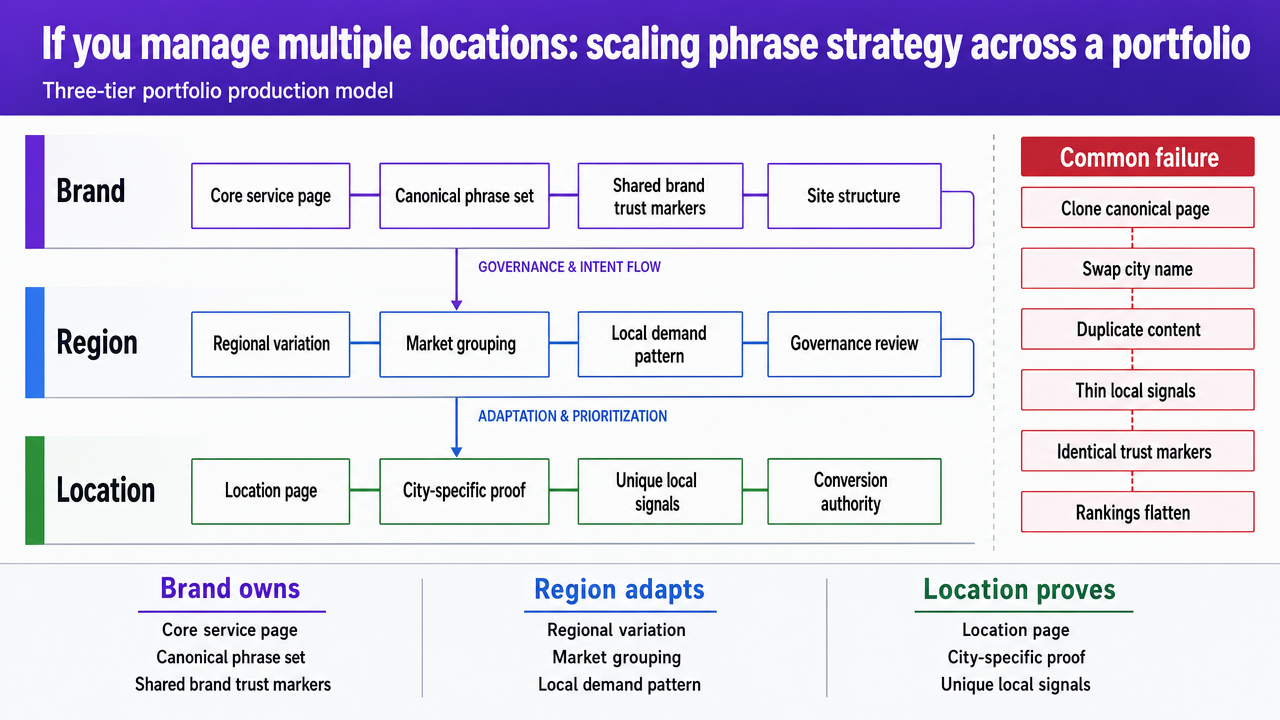 Visualize the three-tier portfolio production model (brand, region, location) described in the section's operating plan and comparison table
Attribution: proving phrase-level pipeline contribution
Phrase selection stops being defensible the moment a demand gen team cannot say which phrases produced which pipeline dollars. Attribution is the artifact that turns the framework into a reporting line the CMO can defend at a board meeting.
A working phrase-level attribution model records four fields for every organic session that enters a mapped conversion path:
- the landing phrase (from search console query data joined to entry URL),
- the intent tier assigned to that phrase during selection,
- the mapped next-step action (guide, comparison view, booking),
- the downstream pipeline event with its value.
Joined against CRM opportunity records, the four fields produce a phrase-to-revenue ledger rather than a rankings report.
Two guardrails keep the ledger honest. First, informational phrases rarely produce same-session pipeline events, so credit needs to travel across sessions using first-touch and last-touch views side by side. The systematic review of online search and healthcare utilization found associations between search activity and later healthcare actions, with the strength of the link varying by context 4. That variance is the argument for reporting both touches, not one.
Second, demand tracked over time is a leading indicator, not a conversion metric. Google Trends research supports monitoring population interest in a topic as a signal of shifting demand, while cautioning against using it for precise forecasting 3. Phrase-level attribution uses trend data to flag rising or fading intent, then relies on the CRM join for the pipeline number.
The output that matters is a quarterly view: target phrase, intent tier, sessions, mapped actions completed, sourced opportunities, and closed revenue. That table is what makes phrase-driven pipeline predictable rather than hopeful.
Frequently Asked Questions
References
- 1.SEO Strategy and Keyword Research.
- 2.The UX of the Internet as a Legal Help Service.
- 3.The Use of Google Trends in Health Care Research.
- 4.Online search behavior related to health and healthcare utilization: A systematic review.
- 5.Understanding consumer trust in digital health information.
- 6.Online Health Information Seeking Behavior: A Systematic Review.
- 7.Search Query Formation by Strategic Consumers.
- 8.Determining the informational, navigational, and transactional intent of Web queries.
- 9.Online Health Information Seeking Behavior: A Systematic Review (full text PDF).
- 10.Understanding consumer trust in digital health information (full text PDF).