
Key Takeaways
- A modern SEO plan operates as a four-layer stack—demand model, priority model, production model, and attribution model—that translates search demand into a booked-pipeline forecast the finance team can audit.
- Clusters should be ranked by expected pipeline contribution using CRM conversion data and deal value, not search volume, with monthly reprioritization to capture the 15 to 20 percent of optimizable marketing spend identified by McKinsey 8.
- AI search belongs inside the plan as a scenario-weighted line item, sizing revenue exposure against McKinsey's projected 20 to 50 percent traditional traffic decline and funding diagnostic tracking most brands still lack 1.
- Multi-location operators should centralize the demand inventory, priority ranking, and attribution KPI while leaving domain evidence and local review with each location, avoiding duplicate cluster work across per-location retainers.
Why the organic plan is now a revenue document
The SEO plan on a VP's desk in 2025 looks less like a keyword taxonomy and more like a pipeline forecast. This shift reflects where the money sits. Forrester's US search marketing forecast indicates search accounts for roughly half of US digital advertising spend, placing organic performance directly within the budget conversation alongside paid media and sales targets 6. When such a significant portion of digital spend relies on search behavior, the CFO expects the organic plan to be justified in terms of pipeline contribution, not just sessions and rankings.
The traditional SEO artifact, a keyword list tied to a content calendar, addressed a different question: what content should the team publish next? The current question is more precise: what organic revenue is the company underwriting for the next four quarters, and what resources, production, and measurement are needed to deliver it? Forrester frames SEO as a strategic investment linked to traffic, leads, and revenue, rather than a cost center to be reduced 5. This framing is only valid if the plan itself incorporates the financial calculations.
A second factor is the impact of AI-powered search, which is reallocating where decision-stage traffic lands. Consequently, traditional organic sessions are no longer a clear indicator of captured demand. A modern plan must account for both channels, quantify the value at risk, and provide the executive team with a defensible view of organic's worth under various AI adoption scenarios. This article treats the SEO plan as such a document: a four-layer framework that translates demand into a modeled revenue stream that the finance team can audit.
The four-layer planning stack
Demand model: mapping the decision journey before the keyword list
The demand model addresses a question that a keyword list cannot: where does organic search actually intercept a buyer, and at what stage does that interception lead to conversion? The output is a decision-journey map that plots organic touchpoints against pipeline stages, rather than a spreadsheet of monthly search volumes.
For high-stakes services, evidence suggests the internet plays a significant role early in the decision journey. For instance, Stanford Legal Design Lab's US Justice Needs data shows that 17% of surveyed respondents use the internet as their primary source for legal problem information, surpassing friends, family, lawyers, and government agencies 3. This figure highlights where the journey begins. However, companion Stanford UX research cautions that initial search visibility does not guarantee trust or action, as many legal-help pages fail usability and credibility tests at the decision point 2.
A demand model built on this evidence distinguishes three types of organic touches:
- Problem-framing queries for readers unaware of the service category
- Comparative queries for those shortlisting providers
- Confirmation queries for readers ready to book but seeking validation
Each touchpoint has distinct production requirements, attribution lags, and potential failure modes.
The demand model produces a demand inventory: identifying addressable clusters, the stage each cluster serves, the company's current organic share, and the pipeline value flowing through comparable stages in paid media. This inventory serves as the input for the priority model, without which prioritization becomes speculative.
Priority model: ranking clusters by expected pipeline contribution
Once the demand inventory is established, the priority model ranks clusters based on their expected pipeline contribution, rather than solely on search volume or difficulty. Four inputs drive this ranking:
- Addressable demand from the inventory
- Current organic share
- Conversion rates of comparable stages in paid media
- Average deal value or customer lifetime value from the CRM
This means a cluster with lower search volume but a higher conversion rate at the confirmation stage can be prioritized over a top-of-funnel cluster with significantly more impressions.
The output is an expected-value column expressed in booked pipeline, not sessions. This metric becomes the decisive factor in every production decision the team makes. If a cluster falls below a certain threshold, it is removed from the plan, even if SEO tools suggest it as an "easy win."
The priority model should be run monthly, not annually, because reprioritization is crucial for maximizing ROI. McKinsey research indicates that 15 to 20 percent of marketing spend can be optimized through improved marketing return on investment (MROI) efforts, allowing for reinvestment or savings 8. In an organic program, this optimization comes from discontinuing efforts on clusters where assumed conversion rates are not met and reallocating production hours to clusters where CRM data shows actual revenue generation. A quarterly cadence is too slow to capture these gains, and an annual cadence misses them entirely.
This model also necessitates a conversation that SEO functions often avoid: some clusters will never justify their production cost through conversion rates. The plan is stronger for acknowledging this. McKinsey also notes that while econometric outputs are valuable, business judgment is still essential, especially when model confidence is low 8. In the priority model, this judgment is captured in an override column with a recorded reason, allowing for review and adjustment in subsequent planning cycles.
Production model: the smallest system that ships evidence-grade content
The production model is often where SEO plans falter. The priority model demands evidence-grade content at a consistent pace, and the typical response involves adding freelancers, brief templates, or another agency. Each addition increases coordination costs and can dilute the review standards that ensure content authority.
A production model designed for a lean team specifies four key elements:
- Who drafts the content
- Who provides domain-specific evidence
- Who approves before publication
- The quality standard for the final asset
In high-stakes industries, domain evidence and approval steps are critical. A confirmation-stage page, read by a prospect before booking a consultation, must accurately reflect what a practitioner would say, otherwise the organic touchpoint fails at its most crucial moment.
The most efficient system treats drafting as a rapid process and review as a deliberate one. Drafting can be templated, structured, and increasingly automated based on the demand inventory and priority ranking. Review, however, requires professional judgment and cannot be rushed. A plan that assumes reviewers have ample time for approvals is likely to experience delays. Therefore, the production model should treat review hours as a fixed constraint and adjust the publication cadence accordingly.
The production model's outputs include a weekly shipping queue linked to the priority ranking, an approval gate with a named owner, and a rejection log. The rejection log is a crucial, often underestimated component. It records reasons for draft rejections, which over time, provides training data to improve first-draft quality and reduce reviewer workload without increasing staff.
Attribution model: booking organic against MMM, not last click
The attribution model determines the financial figures presented to the finance team. Last-click reporting often undervalues organic contributions in service industries because the final confirmation-stage touch that closes a deal typically follows a series of problem-framing and comparative touches that receive no credit. Forrester's ROI framework positions SEO as a strategic investment tied to traffic, leads, and revenue, while also highlighting the limitations of last-click and simple traffic metrics in proving revenue contribution 5. The attribution model within the plan should align with this perspective.
It is important to differentiate between attribution views. A last-click view uses session and conversion events as inputs, reports assisted-to-direct ratios as its KPI, and guides page optimization decisions. However, it fails when a buyer's journey spans weeks and multiple channels. An MMM-informed view, conversely, uses spend, impressions, and outcome data across all channels as inputs, reports channel contribution to booked revenue as its KPI, and informs decisions about allocating production and paid budgets. This view can fail if underlying data is sparse or the model is not regularly updated. Neither view is complete on its own; the plan should specify which decisions each view is authorized to drive.
Operationally, the attribution model in the plan accomplishes three objectives:
- It defines a booked-pipeline KPI that both organic and paid media report against, enabling direct comparison of the two channels.
- It establishes a refresh cadence for the mix model, typically quarterly, to ensure channel elasticities remain current as AI search adoption influences behavior.
- It specifies which decisions each layer of evidence supports: page-level optimization relies on session and conversion data, budget allocation uses the mix model, and cluster-level prioritization is based on CRM outcomes linked back to the demand inventory.
The plan does not require a perfect mix model to be defensible. It needs a stated methodology, documented data sources, and a refresh schedule that the CFO can audit. This artifact transforms organic from a rankings report into a modeled revenue stream, forming the basis for budget discussions.
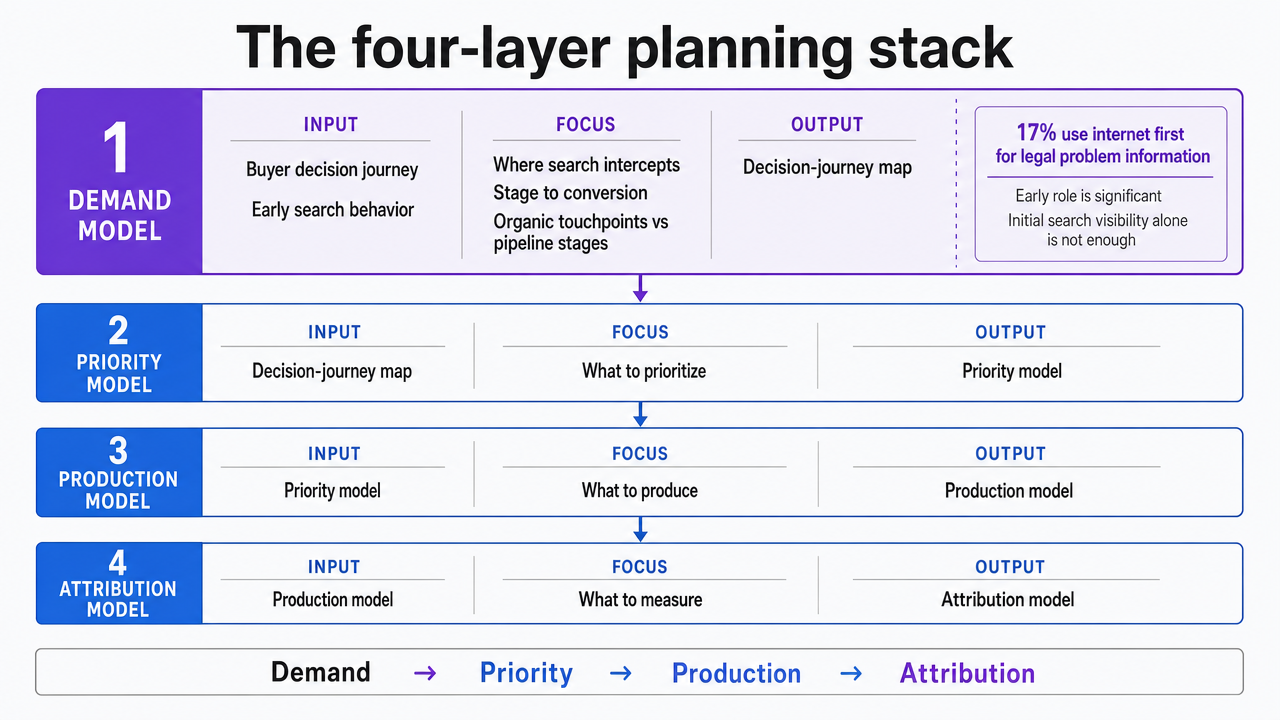 Visualize the four-layer SEO planning framework introduced in this section (demand model, priority model, production model, attribution model), showing inputs, outputs, and how each layer feeds the next
GEO as a line item: pricing the value at risk from AI search
AI-powered search does not necessitate a separate strategy document. Instead, it requires a dedicated line item within the SEO plan, sized according to the revenue it puts at risk. McKinsey's US survey on AI search projects that $750 billion in US revenue will be routed through AI-powered search by 2028. The report also suggests that unprepared brands could see traditional search traffic decline by 20 to 50 percent, and currently, only 16% of brands systematically track AI search performance 1. These are US, survey-based figures with a range of adoption scenarios, not fixed forecasts, and the plan should treat them as such.
The value-at-risk calculation is straightforward once the demand inventory from the priority model is established. For each cluster, the plan applies a scenario band: a low case where traditional search traffic to that cluster remains stable, a base case where it declines by the lower bound of the McKinsey range, and a high case where it declines by the upper bound. Multiplying each case by the cluster's booked-pipeline expected value yields a scenario-weighted revenue exposure. This figure, not a raw traffic delta, is what should be presented in the CFO conversation.
The GEO line item then funds three key areas:
- Diagnostic work: measuring current citation and inclusion rates within AI answers across the most exposed clusters, addressing the tracking gap identified by McKinsey 1.
- Content structuring optimized for LLM retrieval, initially applied to confirmation-stage assets due to their direct path to booked revenue.
- A measurement contract: defining which AI-surface visibility metrics feed into the attribution model and at what frequency.
Sizing this line item is a scoping decision, not an ambitious undertaking. A plan that allocates a defined percentage of production hours to GEO work on the highest-exposure clusters, and aligns the scenario-weighted exposure with that spend, provides the executive team with a defensible answer to the inevitable question: what happens to organic revenue if AI adoption accelerates faster than anticipated?
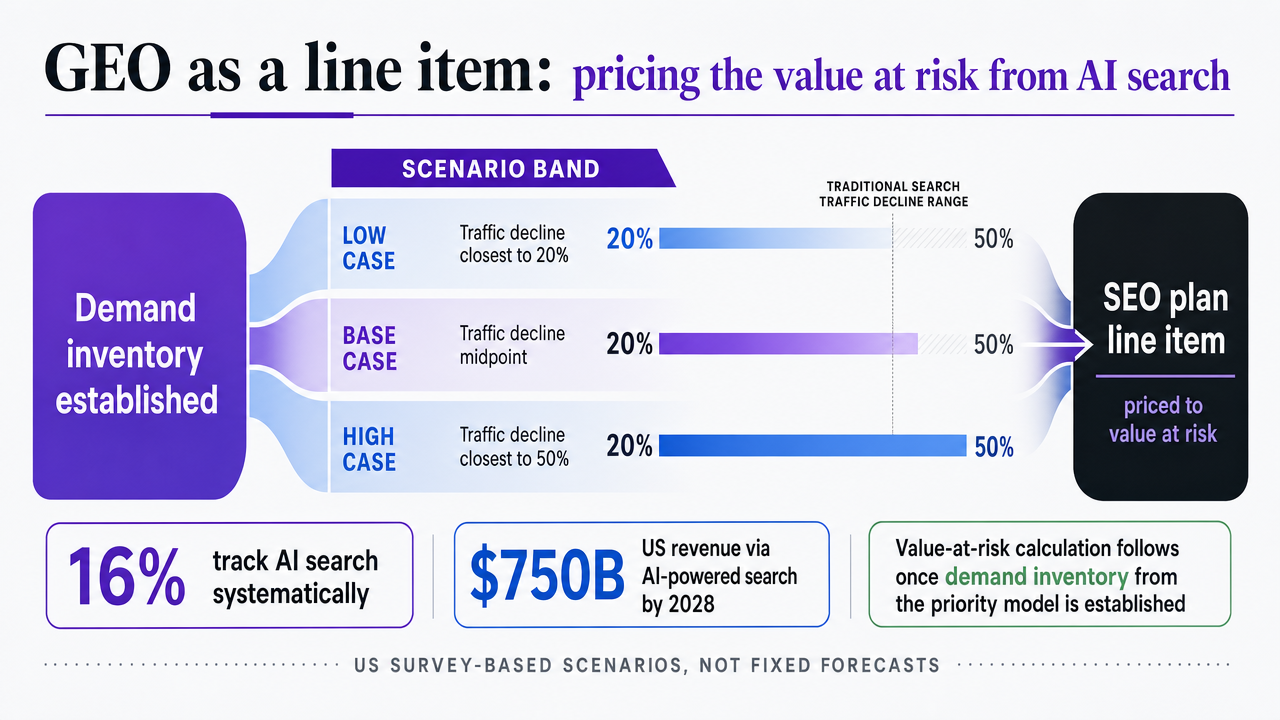 Support the section's scenario-band approach to sizing AI search exposure by showing the low/base/high traffic-decline cases and the 16% tracking-gap statistic cited in the prose
Test Data-Driven SEO Execution Before Committing
Validate your SEO impact with real content published and tracked during your seven-day full-access trial.
Defending the budget in the CFO conversation
The CFO conversation is more productive when the SEO plan is presented as a modeled revenue line with a clear methodology, rather than a mere traffic report. The key difference lies in the artifact itself.
Three inputs make the budget defensible:
- The demand inventory expressed in booked pipeline allows organic to be compared with paid media using the same units, rather than impressions or sessions.
- The attribution methodology, as previously defined, specifies which decisions are based on session data, which rely on the mix model, and the refresh frequency of that model.
- A scenario view that accounts for AI search adoption presents the finance team with the range of revenue the plan underwrites, rather than a single, potentially inaccurate forecast.
Forrester's ROI framework serves as valuable support here, as it positions SEO as a strategic investment tied to traffic, leads, and revenue, and explicitly addresses the weakness a CFO is likely to point out: that last-click and simple traffic metrics alone do not prove revenue contribution 5. Addressing this critique within the plan preempts a common objection.
A second powerful argument comes from the reprioritization math. McKinsey's finding that 15 to 20 percent of marketing spend can be optimized through better MROI discipline provides a strong upside case for the plan 8. This frames the organic budget not just as funding new production, but as enabling monthly reprioritization that reallocates spend from underperforming clusters identified by CRM data. Viewed this way, the budget request is for the authority to move money more efficiently, rather than simply asking for more funds.
The most effective plans conclude the CFO conversation with a single page summarizing: the booked-pipeline forecast by quarter, the methodology and refresh cadence, the GEO scenario band, and a named owner for each number. This transforms organic from a channel the CFO tolerates into one the CFO actively supports.
Planning cadence for a small in-house team
A lean team cannot adhere to the extensive calendar many SEO plans assume. The plan must operate on three distinct loops, each with a defined owner and output, ensuring work progresses efficiently rather than getting bogged down by coordination.
The quarterly loop is for replanning. It involves refreshing the demand inventory, updating the priority ranking based on the previous quarter's CRM outcomes, and re-scoping the GEO line item as new AI search adoption data becomes available. This loop is crucial for realizing McKinsey's MROI release potential: without quarterly replanning, the 15 to 20 percent of optimizable spend remains tied up in clusters already identified as underperforming by the CRM 8. The output is a one-page revenue forecast for the VP to present in executive reviews.
The monthly loop focuses on reprioritization. It reallocates production hours between clusters based on the previous month's booked-pipeline signals and records any overrides in the priority model with accompanying reasons. A monthly cadence is the shortest interval that allows CRM data to stabilize and the longest that prevents significant drift from accumulating. The output is an updated shipping queue and a summary of the rejection log.
The weekly loop is for execution review. It clears the approval gate, resolves blockers related to domain-evidence inputs, and confirms which assets have been shipped against the queue. The output includes a shipped-count and reviewer-hours-used figure, both of which inform the next monthly reprioritization.
These three loops, each with a dedicated owner and specific artifacts, represent the minimum cadence required to maintain a revenue-linked plan without increasing headcount or adding vendors.
If you run multiple locations: one plan, governed centrally
For multi-location operators, the core planning stack remains consistent. The critical questions are where the plan resides and who owns the priority ranking. Many portfolios default to per-location agency retainers, which often result in numerous parallel keyword lists, separate content calendars, and no consolidated view of which clusters are actually driving pipeline. This leads to visible coordination costs for the CFO and redundant cluster efforts that the demand inventory cannot reconcile.
A centrally governed plan utilizes a single demand inventory across the entire portfolio, one priority ranking with location-specific overrides, and a unified attribution model that links each location's CRM data to the same booked-pipeline KPI. Locations retain ownership of the domain-evidence step in the production model, as confirmation-stage pages must accurately reflect local practitioner insights. However, locations do not own cluster prioritization, which is where per-location retainers often duplicate work and where McKinsey's 15 to 20 percent of optimizable marketing spend gets trapped within siloed agency scopes 8.
The economic implications depend on a few key variables. The table below serves as a scoping tool, not a precise quote.
| Variable | Per-location retainer model | Centrally governed plan |
|---|---|---|
| Number of locations | N | N |
| Retainer per location | R (paid N times) | 0 |
| Cluster overlap across locations | Unmeasured; often high | Deduplicated in one inventory |
| Central plan hours | 0 | H (shared across N) |
| Reprioritization cadence | Per-agency, uncoordinated | Monthly, portfolio-wide |
| Attribution KPI | Per-location, mixed methodologies | One booked-pipeline KPI |
Two main consequences arise from this approach. First, cluster overlap is significantly reduced because the demand inventory provides a holistic view of the entire portfolio, preventing redundant efforts to rank the same content in adjacent markets. Second, reprioritization becomes more effective, as the monthly loop directs production hours to locations where CRM data indicates actual revenue generation, rather than to whichever location's agency submits the most prominent report. The plan remains a single, cohesive artifact, with governance maintained by the VP.
Where an execution layer fits the plan
The plan outlined in the preceding sections is a governance framework. It prioritizes demand, quantifies GEO exposure, defines attribution methodology, and sets the operational cadence. However, it does not inherently produce content. The gap between a defensible plan and actual shipped work is where most in-house teams either bring in a vendor or experience delays.
An execution layer functions beneath the plan, not alongside it. Its role is to take the priority ranking as input, generate first drafts based on the demand inventory, route each asset through the designated approval gate, and report shipped-counts and reviewer-hours-used back into the monthly reprioritization loop. The VP retains ownership of the priority model, attribution methodology, and all overrides. Automation in this context replaces coordination overhead, not judgment. Vectoron is an example of an execution layer designed for this structure, where approval remains the fixed constraint and the plan serves as the auditable artifact for the CFO.
See How Data-Driven SEO Planning Connects Directly to Revenue Impact
Request a walkthrough of multi-channel SEO execution workflows that tie keyword strategy to measurable pipeline, without added headcount or complex vendor management.
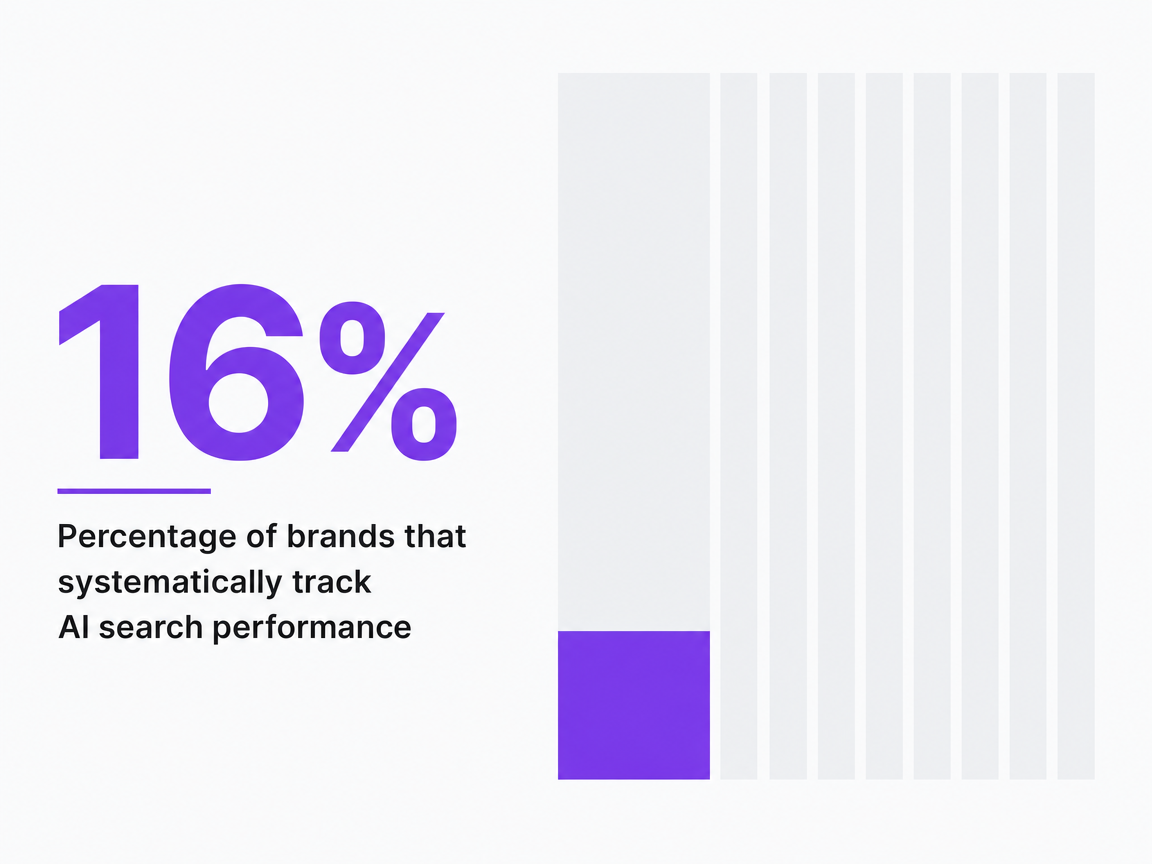 Percentage of brands that systematically track AI search performance
Percentage of brands that systematically track AI search performance
Frequently Asked Questions
References
- 1.New front door to the internet: Winning in the age of AI search (PDF).
- 2.The User Experience of the Internet as a Legal Help Service.
- 3.Data on people's reliance on the Internet for legal problems.
- 4.State of Consumer 2026: Four key trends to watch for.
- 5.The ROI Of SEO.
- 6.Search Marketing Forecast, 2019 To 2024 (US).
- 7.Search Marketing Forecast, 2017 To 2022 (US).
- 8.Marketing Return on Investment.
- 9.New front door to the internet: Winning in the age of AI search.
- 10.Forrester Data: Search Marketing Forecast, 2017 To 2022 (EU-17).