
Key Takeaways
- Treating an SEO platform as governance infrastructure rather than a data source is what protects agency margin, since the workflow determines whether scaled output stays defensible under Google's spam policies 2, 5.
- Six capabilities decide whether a platform governs or just reports: content review, indexability diagnosis 13, Core Web Vitals by template-device pair 7, 8, schema validation 11, generative-search citation tracking 14, and AI usage logging aligned to NIST 9.
- Approval-first workflow is the deciding criterion in a vendor demo, because a platform that blocks publish on duplication, thin content, or failed eligibility checks converts each dashboard signal into an enforceable control.
- Heads of SEO should focus next on portfolio and multi-location accounts, where cross-location duplication detection, required local-evidence fields, and cluster-level page-experience reporting decide whether throughput compounds or collapses.
The platform decision is a governance decision
Most agency conversations about SEO platforms still start with the wrong question: which tool has the biggest keyword index, the freshest backlink graph, or the cleanest rank-tracking UI. That framing treats the platform as a data source. For an agency managing 15 to 60 client accounts, the platform is closer to an operating system, and the operating system either enforces governance or leaks it.
Governance is the constraint that decides margin. Google's spam policies now explicitly cover scaled content abuse regardless of whether pages are produced by automation, humans, or both 2, 5, which means any platform that helps a team publish at volume also carries enforcement risk if the workflow lacks editorial review. At the same time, Google's guidance on AI-generated content confirms that assisted production is acceptable when it results in helpful, original, people-first content 1, 3. The line between the two runs through the platform, not the byline.
The Head of SEO who evaluates platforms as a governance decision asks different questions:
- Where does human approval sit in the publishing loop?
- Which technical, schema, and page-experience checks are enforced before a page ships?
- How is AI use documented and reviewable?
A platform that answers those questions consolidates the controls that keep client work defensible. A platform that ignores them shifts the review burden back onto specialists the agency was trying to scale past.
Six operational capabilities that separate platforms from data sources
An SEO platform earns that name when it governs six specific capabilities, each anchored to a source that already defines what good looks like.
- Content governance maps to Google's people-first quality guidance 1 and its spam policies covering scaled production 5.
- Technical eligibility maps to indexability requirements.
- Page experience maps to the Core Web Vitals framework 7.
- Structured data maps to Google's schema documentation and eligibility rules 10.
- Generative-search visibility maps to emerging academic benchmarks like CC-GSEO-Bench 14.
- AI risk management maps to the NIST AI RMF 9.
The test is simple: for each capability, does the platform produce a defensible audit trail, or does it produce a dashboard? The sections that follow work through each dimension in that order.
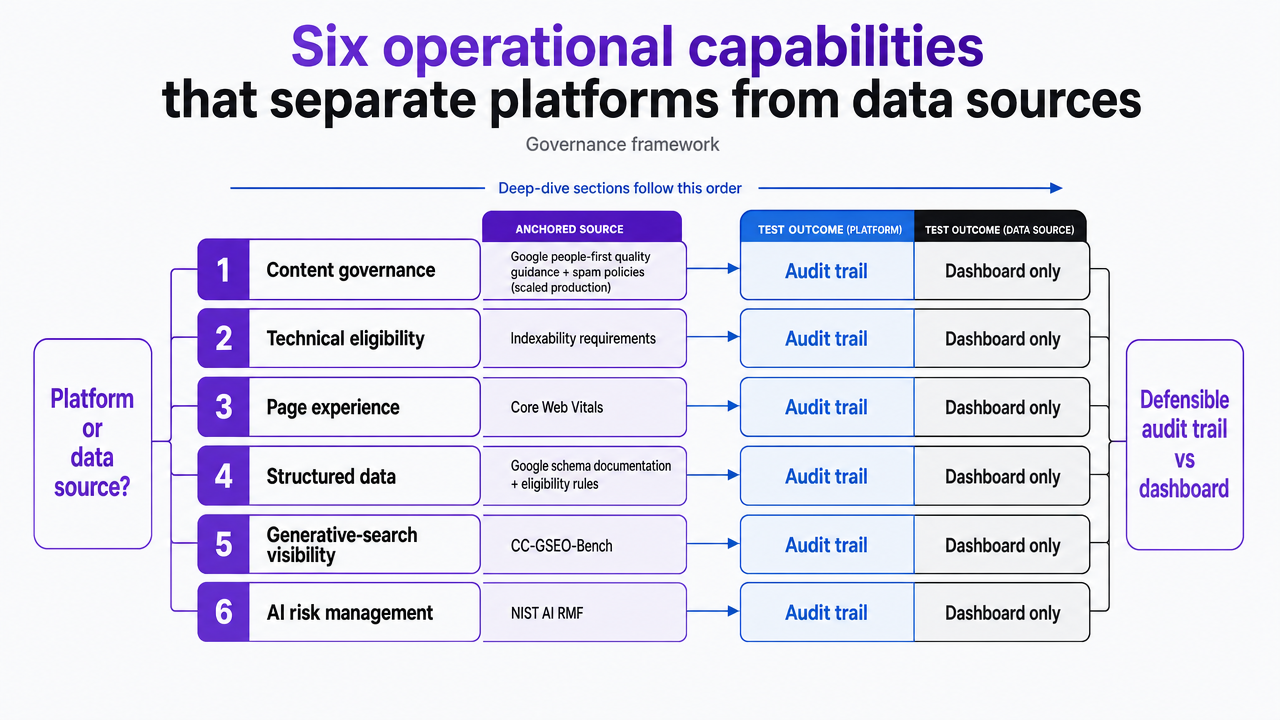 Visualize the six governance capabilities framework that structures the entire article, giving readers a mental map before the deep-dive sections
Content governance: the fault line between assisted production and scaled abuse
Google's March 2024 spam update drew a line most platform vendors still refuse to name out loud. Scaled content abuse now covers pages generated primarily to manipulate rankings rather than help users, and the policy applies regardless of whether they are made by automation, humans, or both 2. The mechanism does not create the violation. The intent and the output do. That single sentence reframes every content workflow an agency runs at volume, whether the drafts come from junior writers, offshore teams, or a language model.
The countervailing guidance is equally direct. Google's position on AI-generated content is that assisted production is acceptable when it results in helpful, original work that satisfies E-E-A-T 3. The practical guidance for generative AI on websites goes further, warning that generating many pages without adding value may violate the scaled content abuse policy 4. Two ideas, one operational conclusion: the platform decides which side of the line the agency's output lands on.
Content governance inside a platform means specific, auditable controls:
- A brief that ties every commissioned page to a documented user need.
- A draft state that requires editor sign-off before publish, with the reviewer identity captured.
- A duplication and near-duplication check that runs across the client's own domain and across sibling client accounts on the same platform.
- Source attribution fields for any claim that requires expertise or firsthand experience.
- Version history that shows what a human changed after an AI-assisted draft, not just that a human clicked approve.
What separates governance from theater is whether the platform blocks a publish action when those controls are incomplete. A dashboard that displays a quality score but still lets a specialist ship 40 near-identical service-area pages in an afternoon is not governance. It is a liability disguised as productivity. The same platform, configured to require unique local evidence, editor review, and a rejection path for thin drafts, produces the same throughput on a defensible footing.
Head of SEO evaluations should test this directly. Ask a vendor to demonstrate what happens when a specialist attempts to publish 25 pages targeting the same query template across a client's location grid, with only city-name variables changing. If the platform ships them, the agency has inherited the enforcement risk. If the platform flags the pattern, holds the batch for editorial review, and logs the decision, the agency has inherited a control. That test is faster than any feature checklist and more predictive of what the platform will cost the agency during the next core update.
Technical eligibility: diagnosing indexability instead of inferring it
A platform that reports "1,247 pages indexed" without explaining which pages are not, and why, is inferring indexability from a rank-tracker sample. Agencies need the opposite. Google's technical requirements are explicit: a page is eligible to be indexed as long as Googlebot isn't blocked and the page has indexable content 13. Diagnosis at the URL level means the platform can answer, for any given page, whether both conditions are met and which control is causing a failure.
The most common source of confusion is robots.txt. Google's own guidance is direct that robots.txt controls crawler requests and is not a mechanism for keeping a web page out of Google 12. Platforms that conflate disallow rules with noindex behavior generate false confidence in audit reports. A URL disallowed in robots.txt can still appear in Search if it is linked from elsewhere, and a URL that returns noindex must be crawlable for that directive to be read at all. An agency platform worth the seat cost distinguishes the two states in its crawl output and flags the contradictions specialists routinely miss on inherited client sites.
Useful diagnostic output includes:
- The response code, the rendered indexability directive, the canonical resolution, and whether the page contains indexable content after JavaScript execution.
- Crawl-budget signals: parameterized URL sprawl, orphaned templates, and redirect chains that consume request quota before the platform reaches the pages a client actually cares about ranking.
None of that requires proprietary data. It requires that the platform treats Google's technical documentation as the specification and reports against it, page by page, rather than aggregating a green-yellow-red score that hides the failing URLs.
The evaluation question for a Head of SEO is whether the platform can produce, on demand, a list of every URL a client is publishing that fails one of Google's stated eligibility conditions 13, with the specific failure named. If that report requires stitching a crawler, a log analyzer, and Search Console exports together, the agency is still doing the diagnosis manually. The platform is only surfacing symptoms.
Test AI-driven SEO execution on real campaigns
Experience measurable SEO workflow gains by publishing live content during your risk-free trial.
Page experience as a reportable service level
Page experience is the one SEO discipline where the reporting standard is already written down. Core Web Vitals set specific thresholds for the three metrics currently in use:
- Largest Contentful Paint at 2.5 seconds
- Interaction to Next Paint at 200 milliseconds
- Cumulative Layout Shift at 0.1 7
A page is classified as having good performance for a metric only when at least 75% of page views meet the good threshold for that metric 8. That definition converts page experience from a subjective health check into a service level an agency can commit to per client, per template, per device class.
Most platforms report Core Web Vitals as a rolled-up site score. That aggregation hides the failing templates behind the passing ones. A commerce client's product-detail template can silently degrade INP while the homepage and blog carry the site average into the green. The reportable unit for an agency is the template-device pair, measured at the 75th percentile of real user data, with the pass/fail state expressed against the published thresholds rather than a proprietary index. Anything less obscures the work the specialist is being paid to do.
Field data matters more than lab data for this purpose. Lab tests using synthetic conditions are useful for diagnosing a specific regression, but the 75th-percentile pass rule is defined against actual page views 8. A platform that only shows Lighthouse scores from a single test location is measuring a different thing than what Google's ranking systems consume 6. Head of SEO evaluations should confirm the platform ingests Chrome User Experience Report data or equivalent field measurement and reports it against the three published thresholds by URL group.
The operational payoff is contractual. Page experience becomes a target the agency can name in a statement of work, monitor weekly, and defend during a quarterly business review. A client SLA that reads "75% of product-detail page views will meet the good threshold for LCP, INP, and CLS within 90 days" is verifiable against the same data Google uses 7, 8. A client SLA that promises "improved site speed" is not. The platform either produces the first kind of number or it does not, and that single capability separates page experience as a reportable service level from page experience as a talking point in a monthly deck.
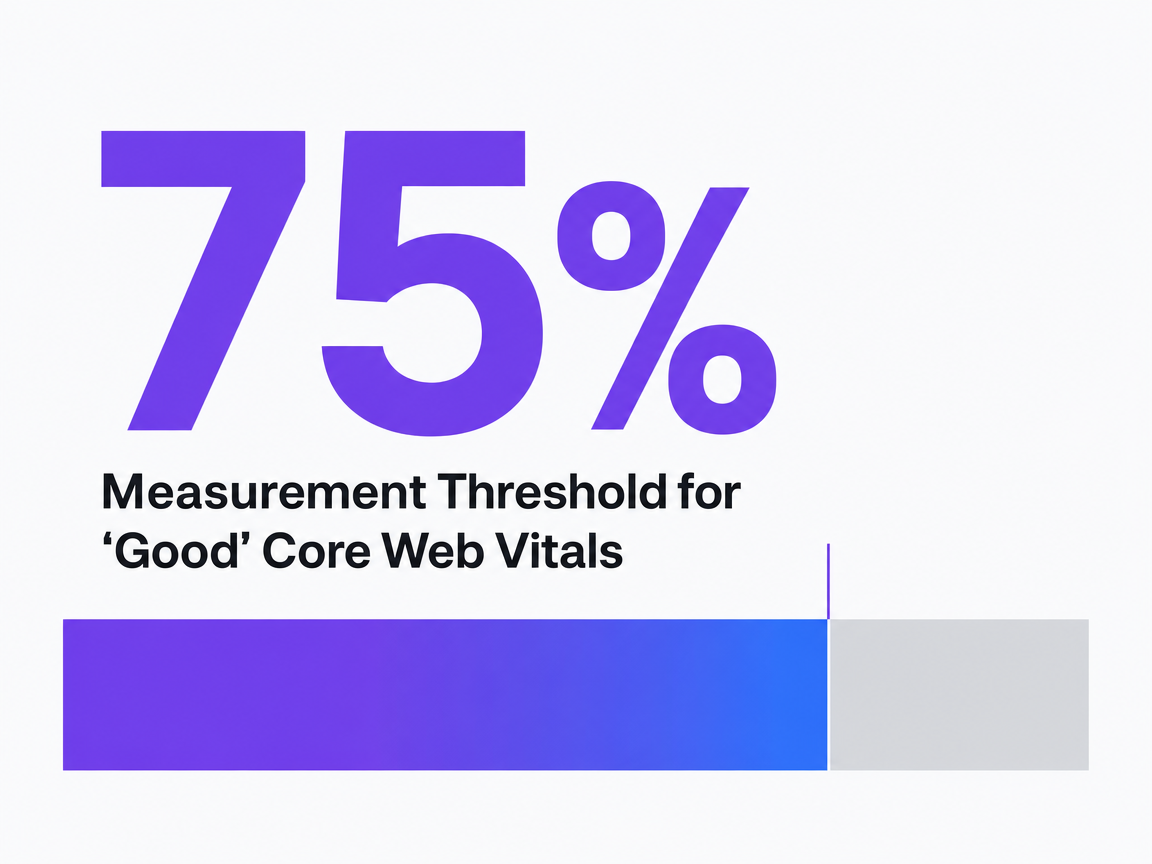 Measurement Threshold for 'Good' Core Web Vitals
Measurement Threshold for 'Good' Core Web Vitals
Structured data workflows that validate, not just emit
Emitting schema is the easy part. Any modern CMS plugin can inject a JSON-LD block into the head of a template and call it done. The harder work, and the one that separates an agency platform from a code generator, is validating that the markup matches the visible content, meets Google's eligibility rules, and stays accurate as pages change. Structured data is a standardized format for classifying page content 10, but classification only earns rich results when it survives Google's guidelines on access, originality, and accuracy 11.
The failure modes are specific:
- Markup that describes content the user cannot see.
- Product schema on category templates that aggregate items with mixed availability.
- FAQ blocks generated from questions the page does not actually answer.
- Review markup pulled from a third-party widget the crawler cannot access.
Each of those patterns violates Google's warning not to mark up irrelevant or misleading content and not to use structured data to deceive or mislead users 11. Agencies discover the problem after a manual action costs a client rich result eligibility across a template family, not before.
A platform that governs structured data runs three checks before publish:
- The schema parses without errors against Google's rich result requirements.
- The entities named in the markup match strings present in the rendered DOM.
- Any required property changes on the page trigger a re-validation.
It also monitors for drift, flagging templates where markup and content have diverged since the last audit. That is the difference between a platform that emits schema and a platform that defends schema.
Generative-search visibility as a new reporting layer
Traditional rank tracking answers a question that is becoming less complete: where does a client's URL sit in a list of ten blue links. Generative search surfaces synthesize an answer and cite a subset of sources, which means a client can lose visibility without losing rank, or gain citation influence without moving a position. Agency platforms that only report SERP position are measuring a shrinking share of the discovery surface.
Academic work has started to name the reporting dimensions that matter here. CC-GSEO-Bench, built on over 1,000 source articles and more than 5,000 query-article pairs, proposes six evaluation axes for generative search: exposure, faithful credit, causal impact, readability, structure, and trustworthiness 14.
Exposure : Measures whether a source appears at all.
Faithful credit : Measures whether the AI answer attributes claims correctly.
Causal impact : Measures whether the source actually shaped the response versus decorating it.
Those are different questions than "did we rank third," and each requires distinct instrumentation. SourceBench adds a complementary lens focused on source quality itself, treating semantic relevance, factual accuracy, and objectivity as measurable properties of the pages AI answers pull from 15. Both benchmarks are recent research artifacts, not agency-ready tooling, and their scope is limited to controlled query-article sets rather than a client's full production traffic.
The practical read for a Head of SEO is that a platform's generative-search reporting should already distinguish exposure from causal influence, log which AI surfaces cited which client URLs, and flag misattribution when an answer credits a competitor for content the client authored. Google's spam policy now explicitly covers attempts to manipulate generative AI responses in Search 5, so any platform that promises to boost AI-answer visibility should also enforce the same content governance controls covered earlier in this article. Platforms that cannot separate the two questions of whether the client was seen and whether the client was cited will underreport the exact discovery loss agencies are being hired to fix over the next 24 months.
AI risk management borrowed from NIST
Enterprise clients in regulated verticals now ask agencies a question that used to sit inside their own IT departments: how is AI use governed in the work product being delivered? The NIST AI Risk Management Framework gives agency heads a vocabulary for that conversation. NIST frames it as a voluntary framework intended to improve trustworthiness in the design, development, use, and evaluation of AI products, services, and systems 16, and the companion generative AI profile extends the same governance language to the models most SEO platforms now embed 9.
The practical translation for platform selection is narrow. An agency does not need to implement the full RMF to benefit from its structure. It needs the platform to produce artifacts the framework's four functions can consume:
- A record of where AI was used in a deliverable (map)
- A documented review of factual and policy risk before publish (measure)
- A control that blocks or routes risky output for human decision (manage)
- Role-based accountability for who approved what (govern)
Those artifacts are the same ones Google's scaled content abuse policy will demand if enforcement lands on a client site 2, which means NIST alignment and spam-policy defense are the same operational work described in two vocabularies.
Platforms that log AI usage per asset, capture reviewer identity at approval, and retain version history across drafts produce that evidence without additional overhead. Platforms that treat AI as an invisible backend feature cannot.
See How Leading Agencies Streamline SEO Execution at Scale
Connect with our team to benchmark your current SEO platform efficiency and discover data-driven approaches to scaling multi-client delivery without expanding headcount.
Throughput per specialist: consolidation vs. stitched point tools
Delivery capacity per specialist is the number Head of SEO conversations circle back to, and it is where platform architecture translates into margin. A stitched stack forces the specialist to move between a crawler, a rank tracker, a content brief tool, a schema generator, a page-experience monitor, and a separate reporting layer, then reconcile the outputs by hand before an approval can happen. Consolidation replaces the reconciliation step with a single audit trail across the same six capabilities.
The variables that decide throughput are auditable, not aspirational:
- Accounts per specialist
- Deliverables per account per month
- Review cycles per deliverable
When the platform enforces indexability checks 13, schema validation 11, and page-experience monitoring at the URL group level 7 inside one workflow, each review cycle closes against one source of truth. When it does not, each cycle absorbs the overhead of exporting, matching, and explaining the discrepancy between tools.
| Variable | Stitched point tools | Consolidated platform |
|---|---|---|
| Tools touched per deliverable | 4–6 | 1 |
| Review cycles before publish | 2–3 (per tool handoff) | 1 (approval gate) |
| Audit trail location | Fragmented across exports | Single record per asset |
| Page-experience SLA reporting | Manual assembly against the 75th-percentile pass rule 8 | Automated per URL group 7 |
| AI usage log per deliverable | Absent or informal | Captured for NIST-aligned review 9 |
The throughput gain is not a productivity claim. It is the elimination of the reconciliation tax that stitched stacks charge on every deliverable, and it is what lets a specialist carry more accounts without shifting review work onto the Head of SEO.
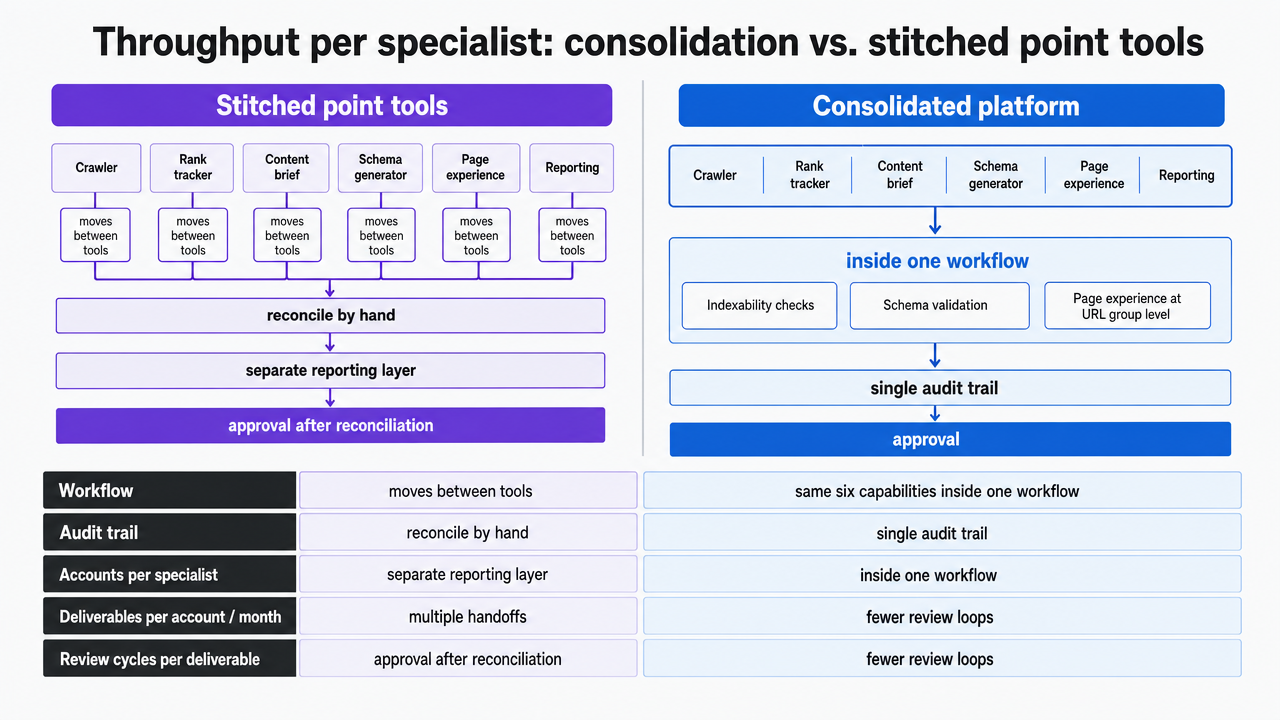 Visualize the comparison table already present in the section, contrasting stitched point tools with a consolidated platform across the five listed variables
If the agency runs multi-location or portfolio accounts
The reader shifts here. Multi-location operators, DSO-style portfolios, franchise groups, and senior-living networks push agency delivery into a different failure mode than single-brand accounts. The same content template repeats across 40, 200, or 1,500 locations, which is exactly the pattern Google's scaled content abuse policy flags when the output exists primarily to manipulate rankings rather than serve users 2. Portfolio work is where governance either compounds or collapses.
The platform requirement narrows to three specific controls:
- Cross-location duplication detection that compares service-area pages against every sibling location on the same account, not just against the open web.
- A local-evidence field that requires unique inputs per location, such as licensed practitioners, on-site photography, hours, or intake specifics, before the page can move to approval.
- Template-device page-experience reporting rolled up by location cluster, so an INP regression on the appointment-booking template surfaces across all 200 sites rather than hiding inside a portfolio average 7.
Portfolio economics reward this discipline. When one template fix corrects indexability 13 or schema drift 11 across every location, the specialist's throughput compounds. When each location is a manual rework, the account stops being profitable at scale.
A short buyer's checklist and where approval-first fits
The evaluation reduces to seven questions a Head of SEO can answer in a single vendor demo:
- Does the platform block a batch publish when duplication or thin-content patterns are detected across a client's own domain 2, 5?
- Does it produce a per-URL indexability report against Google's stated eligibility conditions 13?
- Does it ingest field data and report Core Web Vitals by template-device pair, not as a site average 6?
- Does it validate schema against the rendered DOM rather than just emit it 11?
- Does it separate exposure from causal citation influence in generative-search surfaces 14, 15?
- Does it log AI usage and reviewer identity per asset in a form the NIST RMF functions can consume 9?
- And does the publish action require human approval, or does it default to ship?
The last question decides the other six. Approval-first workflow is what converts each capability from a dashboard into a control. Signals arrive, recommendations are ranked, a specialist or Head of SEO approves, the platform executes, and the outcome routes back to the same record. That loop is where governance and throughput stop trading against each other, which is the operating model platforms like Vectoron are built around.
Frequently Asked Questions
References
- 1.Creating Helpful, Reliable, People-First Content.
- 2.our March 2024 core update.
- 3.Google Search's guidance about AI-generated content.
- 4.Google Search's Guidance on Generative AI Content on Your Website.
- 5.Spam Policies for Google Web Search.
- 6.Understanding page experience in Google Search results.
- 7.Web Vitals.
- 8.How the Core Web Vitals metrics thresholds were defined.
- 9.AI Risk Management Framework - NIST.
- 10.Introduction to structured data markup in Google Search.
- 11.General Structured Data Guidelines.
- 12.Robots.txt Introduction and Guide.
- 13.Google Search Technical Requirements.
- 14.CC-GSEO-Bench: A Content-Centric Benchmark for Measuring Source Influence in Generative Search Engines.
- 15.SourceBench: Can AI Answers Reference Quality Web Sources.
- 16.Artificial Intelligence Risk Management Framework.