
Key Takeaways
- Treat publishing as a governed pipeline with five stages—intent selection, production, technical QA, a single approval gate, and post-publication measurement—rather than a calendar that only tracks what ships and when.
- Google's scaled content policy judges purpose and originality across the pattern of what a site publishes, not raw volume, so a defensible pipeline needs named editors, enforced originality criteria, and authority to drop weak topics 1, 10.
- Portfolio economics turn on holding the editor gate constant while automation absorbs drafting scaffolding and technical QA, shifting editor hours per page down without loosening the originality or Core Web Vitals acceptance criteria.
- Focus next on closing the optimization-expertise gap in YMYL verticals with named subject-matter reviewers, and run generative search visibility on the same loop rather than as a separate workstream 11, 18.
Publishing as a Governed Pipeline, Not a Calendar
Most agency SEO leaders inherit a content calendar and call it a system. A calendar tracks what ships and when. It does not decide whether a page deserves to exist, whether the draft carries original judgment, whether the template renders cleanly for Googlebot, or whether the published URL improved anything measurable ninety days later. Those decisions get made ad hoc, by whichever specialist happens to be closest to the client at the time. That is the operating model breaking under portfolio load.
A publishing pipeline is different. It has named stages, acceptance criteria at each stage, and a single approval gate that fires before release. Intent selection produces a ranked queue. Production yields a draft with sourced claims and a human editor accountable for originality. Technical QA confirms the page is crawlable, canonical, indexable, and within Core Web Vitals thresholds. The approval gate closes the loop before publish. Post-publication measurement feeds the next intent decision.
Google's March 2024 scaled content policy makes the distinction operational rather than philosophical. The policy targets pages produced primarily to manipulate rankings, regardless of whether the production method is human, automated, or a mix 1. Volume is not the violation. Absence of purpose and originality is. An agency running 40 client sites through a governed pipeline can publish more, safely, than one running 10 through an unstructured calendar. The rest of this piece specifies the five stages, the acceptance criteria at each, and the portfolio economics that follow.
The Five-Stage Operating Loop
Intent Selection and Editorial Priority
Intent selection is the stage most agencies skip and later regret. A ranked queue starts with a defensible thesis for why a given URL should exist at all. Google's own editorial framework asks whether a page provides original information, first-hand expertise, and substantive value beyond what already ranks 13. If the answer is unclear before production begins, the page will produce weak signals no matter how clean the technical execution.
At portfolio scale, intent selection needs three inputs feeding a single queue:
- Query demand from Search Console performance data on the client's own domain 6,
- Competitive gap analysis on the SERP, and
- The client's demonstrated expertise or proprietary data.
The third input is the constraint most calendars ignore. A behavioral health group with intake data on cost per admission has a defensible thesis for a page on that topic. The same group has no defensible thesis for a generic overview of anxiety symptoms, and Search Essentials treats commodity coverage as a weaker candidate for both traditional Search and generative features 12.
Editorial priority then ranks the queue against two variables: expected traffic value and the client's ability to produce original substance without a research bottleneck. Topics scoring high on both move first. Topics with strong demand but weak proprietary input move to interview or data-collection tasks before drafting. Topics scoring low on both get dropped from the queue rather than parked in a backlog. A pipeline that publishes nothing this week is preferable to a pipeline that publishes filler that will need pruning next quarter.
Production With Editors Owning Originality
Production is where the AI-versus-human framing breaks down and needs replacing. Google's guidance on AI-generated content draws the boundary at purpose, not method: automation that helps produce useful, original content is acceptable, while automation used primarily to manipulate rankings violates spam policy 2. That distinction has an operational consequence. The editor, not the drafting tool, has to own three things by name: originality, source verification, and factual accuracy against the client's actual practice.
A production stage designed around that division of labor looks different from a traditional editorial workflow. Research aggregation, outline scaffolding, competitive SERP analysis, first-draft prose, schema generation, and internal-link suggestion are repeatable pattern work that automation handles at consistent quality. Editors spend their hours on the parts that cannot be pattern-matched: verifying that a cited study says what the draft claims it says, injecting the client's specific operational detail, removing sentences that read plausibly but assert nothing, and confirming that a page presents information the reader could not assemble from the top ten competing results.
Originality is the acceptance criterion at this stage, and it needs a working definition. A draft passes when it contains at least one of the following:
- Proprietary data from the client,
- A named expert's first-hand judgment,
- A synthesis that reframes existing information in a way not present on the current SERP, or
- A documented process the client actually performs.
A draft that contains none of these fails production regardless of word count, keyword coverage, or readability score. Search Essentials is explicit that eligibility for Search depends on people-first content rather than production volume 12, and a portfolio pipeline that enforces the originality gate at draft review avoids relitigating it at approval.
Technical QA and Discoverability Gates
Technical QA is the stage most exposed to template-level regression, which is why acceptance criteria have to be portfolio-wide rather than per-page judgment calls. The June 2025 Web Almanac reports that 56% of desktop pages passed all three Core Web Vitals, with individual pass rates of 74% for LCP, 97% for INP, and 72% for CLS 8. INP is close to saturated across the web; LCP and CLS are where most template failures cluster. An agency whose client portfolio underperforms these benchmarks has a template problem, not a content problem, and the technical QA gate is where that pattern gets caught before it propagates across new pages.
Core Web Vitals thresholds are defined at the 75th percentile of real-user data: LCP at 2.5 seconds or less, INP at 200 milliseconds or less, and CLS at 0.1 or less 15. A publishing gate that uses field data from the client's existing pages under the same template as its pass/fail signal catches regressions from new components, third-party scripts, or media patterns before the new URL inherits them. Lab tests are useful for pre-publication diagnostics; they are not sufficient as the release criterion.
The discoverability portion of the gate covers a shorter checklist with hard pass/fail outcomes:
- The URL is crawlable and not blocked by robots.txt,
- The canonical tag points to the intended URL,
- The page is included in the correct XML sitemap,
- Structured data validates and describes content actually visible on the page, and
- JavaScript-rendered content is reachable by Googlebot rather than trapped behind client-side hydration 3, 4, 5, 14, 17.
Canonical tags are a signal Google may override 16, so post-publication canonical selection needs monitoring rather than assumed compliance.
At portfolio scale, this checklist is enforced by automation. A human specialist manually verifying twelve items across every URL on 60 client sites is a headcount decision disguised as a quality decision. Automated pre-publication rendering, canonical inspection, sitemap membership verification, and structured-data validation reduce the human check to exception review: which pages failed a gate and why. That is the leverage point the portfolio economics section returns to.
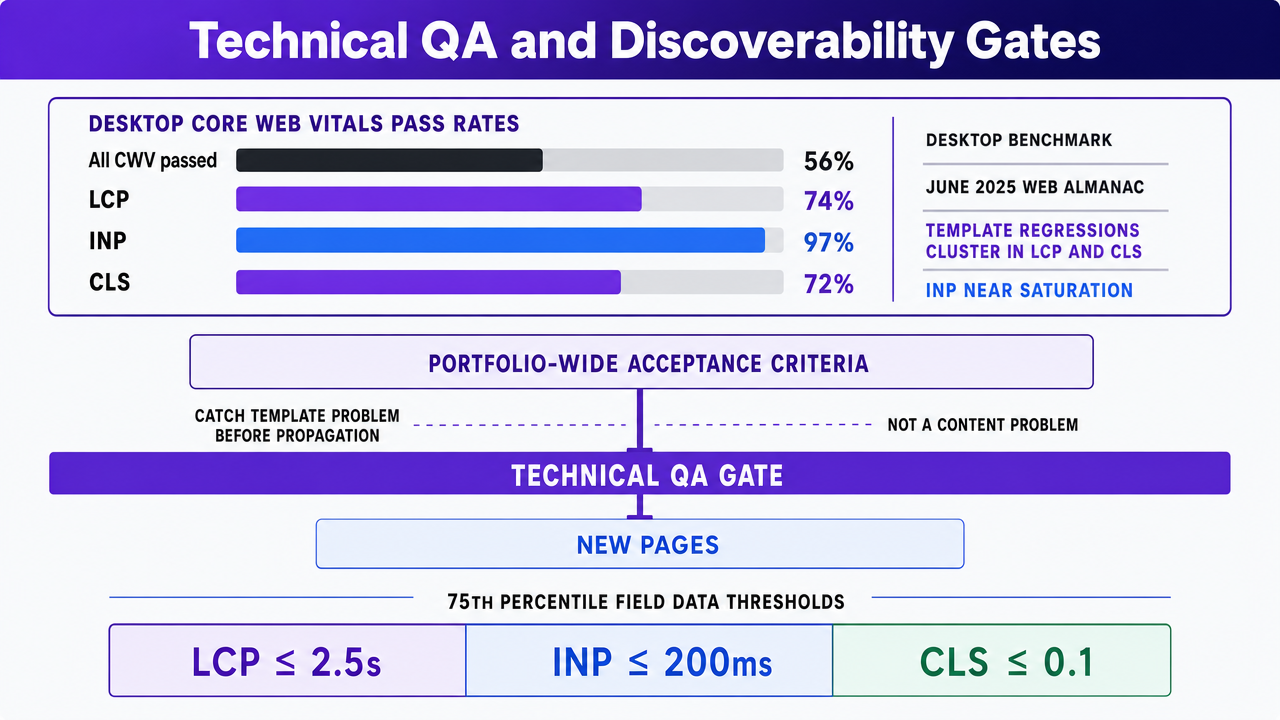 Support the cited Web Almanac benchmark on desktop Core Web Vitals pass rates, which the section uses to argue that template-level regressions cluster in LCP and CLS
The Approval Gate and Release Criteria
The approval gate is a single decision point, not a status meeting. It exists because the four preceding stages produce artifacts that need one accountable person to release. Splitting the decision across three reviewers with vague authority is how agencies discover, six months into a client engagement, that no one owns why a specific page shipped.
Release criteria at the gate are binary and stated in advance:
- The draft passed the originality test with at least one documented source of proprietary substance.
- Sourced claims carry citations to primary sources rather than to other content marketing pages.
- Technical QA returned green on crawlability, canonical, sitemap inclusion, structured-data validation, and template-level Core Web Vitals field data.
- The client's subject-matter reviewer, where the vertical requires one, has signed off on factual accuracy.
Any one failure blocks release; no partial passes.
The person holding the approval gate is authorized to release, revert to production for rework, or drop the page from the queue entirely. Dropping is the option most pipelines lack, and its absence is why weak pages ship. A page that failed originality twice and returned for a third pass is a signal that the intent selection was wrong, not that the draft needs a fourth revision. Feeding that judgment back into the intent queue is what separates an operating loop from a linear content factory.
Google's spam policy assesses purpose across the pattern of what a site publishes, not per-URL intent 10. A single approval gate with authority to drop is the mechanism that keeps the pattern defensible.
Post-Publication Measurement and Refresh Triggers
Measurement is where most publishing systems stop being loops and become one-way conveyors. The Search Console performance report shows impressions, clicks, and average position by query, page, and country 6. Those are Google Search signals, not marketing outcomes. A page that generates impressions without clicks, clicks without qualified leads, or leads without pipeline is a measurement problem the pipeline has to catch before it becomes a strategy problem.
A workable measurement layer collects three data streams for every published URL:
- Search Console query and page performance,
- On-page engagement from analytics, and
- Downstream conversion or lead-quality data from the client's CRM or call tracking.
The last stream is what converts SEO reporting into something an agency head can defend in a client QBR. Impressions and rank movement describe visibility; qualified conversations describe outcome.
Refresh triggers are the operational output of the measurement layer. Four triggers move a URL back into the production queue:
- A page ranking in positions four through fifteen with declining click-through rate over 60 days,
- A page whose primary query has shifted intent based on SERP composition changes,
- A page cited in a factual claim that has since been superseded, and
- A page whose structured data or template has drifted out of Core Web Vitals thresholds on field data.
Each trigger produces a specific rework task rather than a generic "update this page" instruction. Recrawling and reindexing after a substantive edit takes several days 5, so the refresh queue needs a measurement window built in before results are attributed to the change.
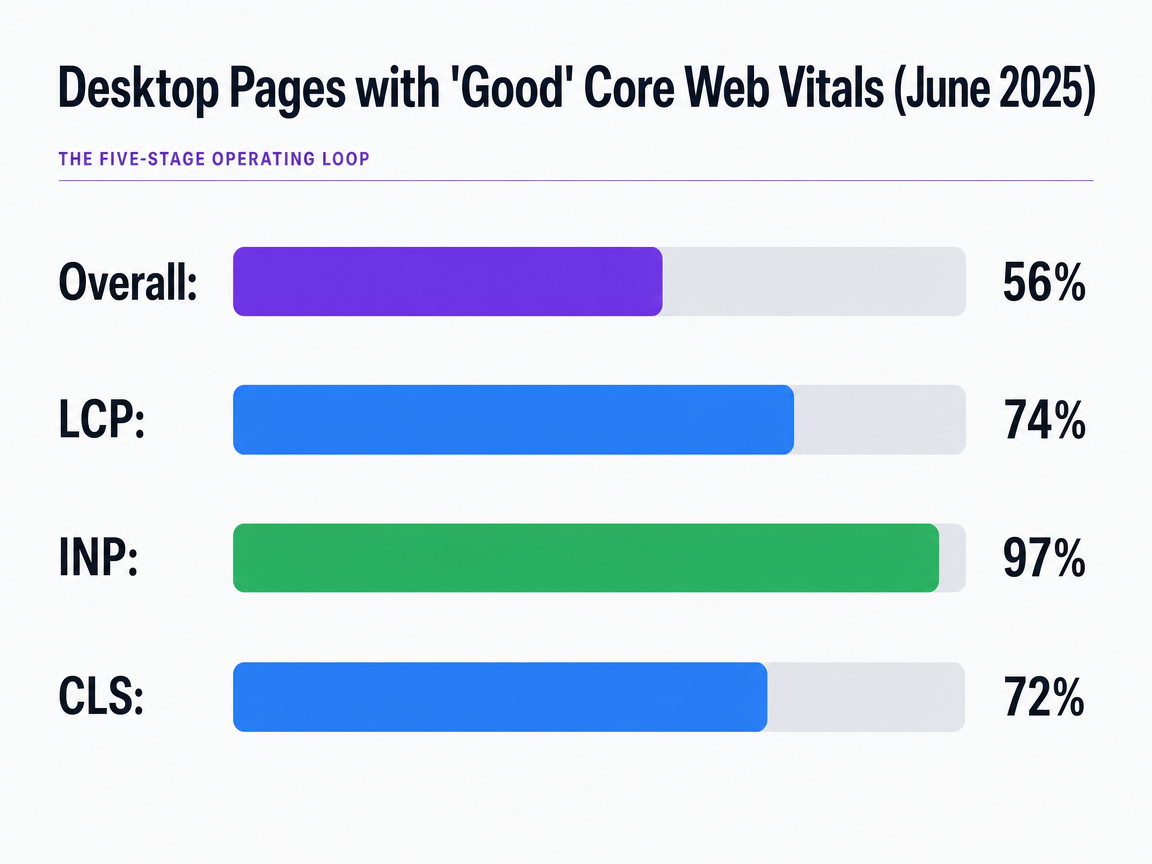 Desktop Pages with 'Good' Core Web Vitals (June 2025)
Percentage of desktop pages achieving 'good' scores for Core Web Vitals as reported by HTTP Archive in June 2025. 'Overall' represents pages passing all three metrics, while LCP, INP, and CLS are individual metric pass rates.
Test a scalable SEO posting workflow now
Publish live SEO content and measure real-world impact during your trial—no delays, no artificial limits.
Where Scaled Publishing Ends and Scaled Content Abuse Begins
The March 2024 policy update reframed a debate the industry had been having in the wrong terms. Google's definition of scaled content abuse targets pages produced primarily to manipulate rankings rather than help users, and the policy applies whether the production method is human, automated, or a mix 1. The word that carries the weight is primarily. An agency publishing 200 pages a month is not violating the policy by volume alone. An agency publishing 20 pages a month whose production process cannot answer who wrote what, what original substance the page contains, and why a reader would prefer it to the current SERP is closer to the enforcement boundary than the first agency.
The operational test separates two patterns that can look identical from the outside. Scaled publishing produces many pages where each one passes an originality gate, carries editorial accountability by name, and answers a specific user query with substance the reader could not assemble from existing results. Scaled content abuse produces many pages built from templated near-duplicates, unreviewed automated output, and topic selection driven by ranking opportunity rather than proprietary substance. The spam policy assesses purpose across the pattern of what a site publishes rather than adjudicating URLs one at a time 10, which means a portfolio's exposure is set by its weakest recurring practice, not its best case study.
Three behaviors move a pipeline across the line regardless of intent:
- Publishing location or service variants that differ only in city name and a few swapped nouns.
- Republishing supplier or syndicated content at scale without adding original analysis.
- Generating pages against keyword lists rather than against demonstrated client expertise.
Each behavior can be produced by a human team or by automation; the production method is not the diagnostic. The diagnostic is whether removing the top-ranking result on that query would leave the reader with meaningful new information from the page in question.
A governed pipeline is what makes the distinction auditable. Named editors on every URL, originality criteria enforced before approval, and an intent-selection stage authorized to reject topics with no proprietary angle produce a defensible pattern. The record of what was rejected matters as much as the record of what shipped. Agencies that can show a queue with dropped topics, revision loops that ended in kills, and editorial ownership traceable to individuals are describing an operating system that scales inside the policy rather than around it.
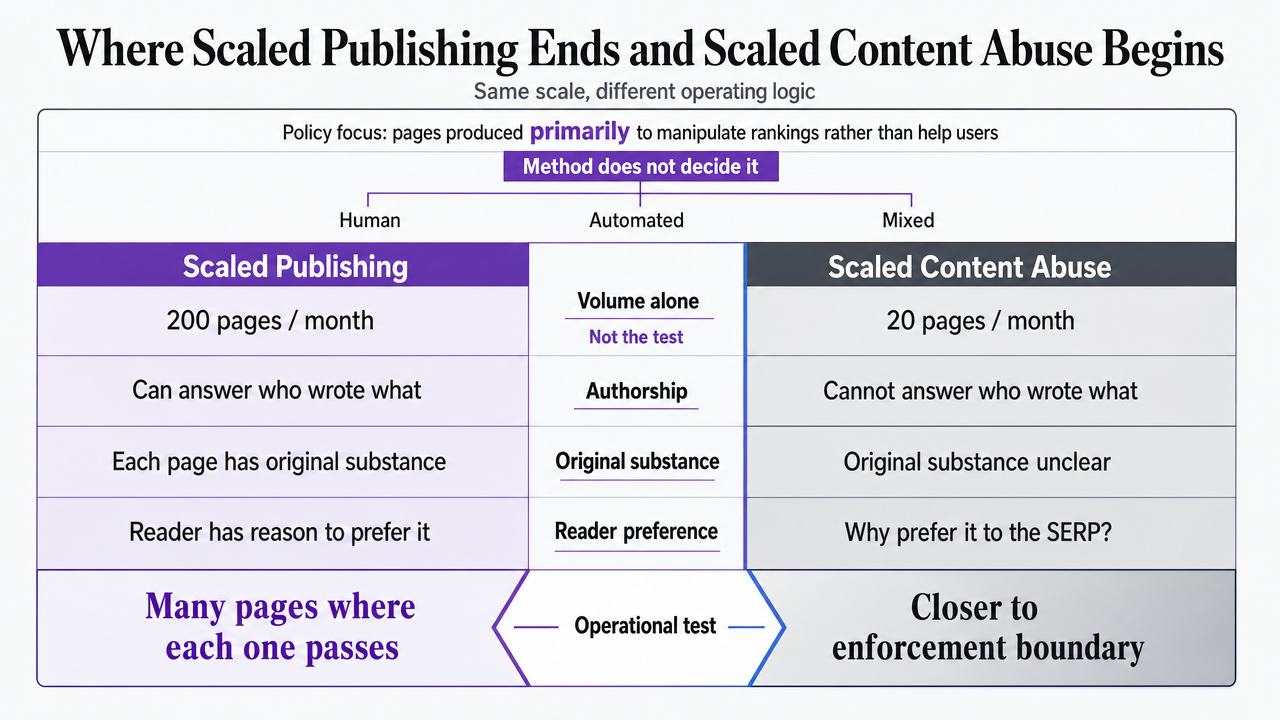 Visualize the section's explicit comparison between scaled publishing and scaled content abuse as two operational patterns
YMYL Verticals and the Optimization-Expertise Gap
Agencies serving legal, dental, behavioral health, senior living, and healthcare clients face a specific problem the general SEO literature underweights. A controlled study of 61 participants evaluating health-related web pages found that non-optimized pages were rated as having higher expertise than optimized pages, and the authors caution that stronger optimization signals can outrank content readers perceive as more expert 18. The sample is narrow and the vertical is health, but the mechanism generalizes to any category where a reader's judgment of expertise carries real consequences.
The operational consequence is that optimization polish and demonstrated expertise are separate variables in the posting pipeline, and a page that scores well on the first can still fail the second. A dental group's page on implant recovery written to keyword coverage and readability targets can rank while presenting information a practicing clinician would flag as generic. In YMYL categories, that gap is the exposure the intent-selection stage has to close before drafting begins.
The editorial gate for regulated verticals adds one criterion the general originality test does not enforce: a named subject-matter reviewer with credentials that match the topic must approve factual content before release. Search Essentials treats first-hand expertise and honest presentation of authorship as eligibility conditions rather than optional signals 12. Pages that cannot name a qualified reviewer belong in the drop queue, not the revision queue.
Scale SEO Posting Across Clients Without Expanding Your Team
See how centralized AI-driven workflows enable agencies to deploy high-volume, high-quality SEO content—maintaining strategic oversight while eliminating manual bottlenecks and briefing cycles.
Portfolio Economics for Multi-Client Operations
The economics shift the moment an agency stops thinking about a single site and starts thinking about a portfolio. A specialist-heavy delivery model prices well at five clients and breaks at fifty. The reason is not that the work gets harder per page. It is that the fixed human hours per page compound linearly against a growing client count while margin does not.
A useful comparison uses only variables the reader controls:
A : Articles per client per month
E : Editor hours per article
S : Specialist hours per article for research and drafting
Q : Technical QA hours per article
R : Pages requiring refresh per quarter
Under a specialist-heavy model, total monthly hours per client equal A × (E + S + Q) plus roughly R/3 refresh hours per month. An agency running 40 clients at 4 articles each, with 2 editor hours, 4 specialist hours, and 1 QA hour per article, absorbs 1,120 production hours monthly before refresh work. That is roughly seven full-time production staff before management, account, or reporting overhead.
An approval-gated automation loop redistributes those hours rather than eliminating them. Research aggregation, outline scaffolding, first-draft prose, schema generation, sitemap membership checks, canonical inspection, structured-data validation, and Search Console pull-throughs are pattern work automation handles at consistent quality, which Google's guidance explicitly permits when the output serves users rather than ranking manipulation 2. The specialist hours (S) collapse toward the research verification portion. The technical QA hours (Q) collapse toward exception review. Editor hours (E) do not collapse. They concentrate on originality, source verification, subject-matter accuracy, and the drop-or-ship judgment at the approval gate.
The leverage point is expressed as a ratio rather than a dollar figure. Under the specialist-heavy model above, editor hours per published page sit at 2. Under an approval-gated loop that absorbs drafting scaffolding and technical QA into automation, the same editor spends 2 hours on the pages that need judgment and closer to 0.5 hours on the pages that pass originality and technical gates on first review. Portfolio-wide, that shifts the editor-hours-per-page ratio from 2.0 toward roughly 0.9 without changing the acceptance criteria at the gate.
The ratio matters more than any absolute number because it dictates whether adding the 41st client requires the eighth production hire. Agencies that hold the editor gate constant while automation absorbs the surrounding pattern work add clients against roughly flat editorial headcount. Agencies that automate drafting without holding the gate produce more pages at lower quality and eventually publish the pattern that draws policy scrutiny.
The refresh queue is where the ratio compounds. R grows every quarter as the published inventory grows, and in a specialist-heavy model refresh work competes directly with new production for the same specialist hours. An approval-gated loop treats refresh as a triggered task with a pre-scoped rework unit, which keeps refresh from cannibalizing net-new output as the portfolio matures.
Generative Search Visibility on the Same Loop
Generative search features have produced a small commercial market for special files, bespoke schema, and chunking patterns pitched as prerequisites for AI Overview inclusion. Google's own guidance rejects that framing. The company states that generative AI features retrieve web content using existing crawling and indexing systems, that Search Console reports visibility in those features, and that specialized artifacts such as llms.txt or AI-specific schema are not required 11.
The operational consequence for a portfolio pipeline is that generative visibility runs on the same five stages already specified. Intent selection favors topics where the client can contribute a unique point of view or first-hand data rather than commodity coverage that a generative system can synthesize from other sources. Production preserves the originality gate. Technical QA continues to enforce crawl access, canonical selection, structured data that reflects visible content, and JavaScript rendering that does not trap substance behind hydration. The approval gate and measurement layer close the loop.
Agencies treating generative search as a separate workstream duplicate labor and introduce artifacts the search system will not use. Agencies treating it as the same loop, calibrated toward non-commodity substance, ship pages that qualify for both traditional rankings and AI-feature retrieval without maintaining two production tracks.
Frequently Asked Questions
References
- 1.What web creators should know about our March 2024 core update and more.
- 2.Google Search’s guidance about AI-generated content.
- 3.Technical SEO Techniques and Strategies.
- 4.Google Crawling and Indexing.
- 5.Structured data type definitions.
- 6.How To Use Search Console.
- 7.Web Vitals.
- 8.SEO | 2025 | The Web Almanac by HTTP Archive.
- 9.Performance | 2025 | The Web Almanac by HTTP Archive.
- 10.Spam Policies for Google Web Search | Documentation.
- 11.Google's Guide to Optimizing for Generative AI Features on Google Search.
- 12.Google Search Essentials (formerly Webmaster Guidelines) | Google Search Central | Documentation | Google for Developers.
- 13.Creating helpful, reliable, people-first content.
- 14.Build and Submit a Sitemap | Google Search Central | Documentation | Google for Developers.
- 15.How the Core Web Vitals thresholds were defined.
- 16.Consolidate duplicate URLs | Google Search Central | Documentation | Google for Developers.
- 17.JavaScript SEO basics | Google Search Central | Documentation | Google for Developers.
- 18.Does Search Engine Optimization come along with high-quality content? A comparison between optimized and non-optimized health-related web pages.