
Key Takeaways
- Monthly reports centered on rankings and sessions obscure pipeline reality; rebuild the reporting contract around CRM-reconciled qualified calls, booked appointments, show rates, and attributable revenue by page and query cluster.
- Keyword-first glossary and explainer pages attract sessions but rarely convert; shift content to address buyer gating questions like eligibility, cost, insurance, and scheduling, with claim substantiation for YMYL categories 9.
- Pre-ticked consent boxes, buried cancellation flows, and hidden pricing inflate submissions while creating enforcement risk; audit every modified page so consent, pricing, and cancellation share prominence with the primary CTA 4.
- Sentiment-gated requests, sentiment-contingent incentives, agency-written testimonials, and bulk negative-review removals now trigger civil penalties under the October 2024 FTC rule; require equal treatment of positive and negative reviewers with auditable records 8.
- Pixels, chat widgets, and call tracking can transmit PHI to vendors without BAAs; require a data flow diagram, signed BAAs, and compliance review for every tracker on authenticated and sensitive unauthenticated pages 1.
- Four federal actions since April 2023 reshaped SEO compliance obligations; ask the agency which of these events prompted documented process changes and where that record lives 1, 3, 6, 7.
- AI-generated pages and call intelligence remain the business's legal responsibility; apply the NIST AI Risk Management Framework to document models used, human review logs, transcript validation, and intent-tagging error rates 5, 6.
- Accessibility overlays satisfy neither users nor conversion goals; test top converting pages with real screen readers and keyboards, then fix semantic headings, labels, focus order, alt text, and CTA contrast 10.
- The DOJ's September 2025 Google remedies increase single-channel risk; require the agency to quantify pipeline dependence on organic search and model booking impact if click-through drops 20-30% in a quarter 3.
- Fragmented vendor stacks across SEO, reviews, listings, call tracking, CRO, and tagging multiply undocumented data handoffs; consolidate under one approval queue with location-level CRM reporting to reduce governance burden 2.
When Rankings Climb But The Phone Stays Quiet
The quarterly SEO review often presents a picture of success: increased non-brand organic sessions, improved keyword rankings, and higher domain authority. However, a deeper look at the operations dashboard might reveal a disconnect, with flat booked appointments and rising cost per qualified lead. This scenario highlights a common problem where SEO efforts, while technically sound, fail to impact the key metrics that matter to a marketing leader focused on pipeline generation: qualified calls, booked consultations, appointment show rates, and attributable revenue.
This discrepancy typically stems not from incompetence, but from a misalignment between what an agency is contracted to report and what the in-house team needs to achieve. Rankings, traffic, and backlinks are easily quantifiable activities. Pipeline, however, is a lagging indicator influenced by factors often outside a standard SEO scope, such as page intent, conversion design, call handling, tracking integrity, and compliance.
The following sections detail ten common failure modes that explain this quiet phone phenomenon. Each represents a governance gap rather than a tactical error, and each has a clear solution that marketing leaders can implement before renewing agency contracts.
Reporting On Activity Instead Of Pipeline
A clear symptom of this issue is the typical monthly report. It often prioritizes keyword movement, session volume, and backlink acquisition. Conversion numbers, if present, are usually form fills or generic GA4 event counts labeled "lead," lacking qualification breakdowns, cost per booked appointment, or CRM reconciliation.
This reporting structure focuses on what the agency did, not on the business outcomes achieved. An SEO agency compensated on retainer has an incentive to report on easily produced and less disputable activities like ranking changes, link building, and page publications. Pipeline metrics, conversely, depend on elements like call handling, intake scripting, and appointment confirmation, which are typically outside the agency's direct control, making them less comfortable to feature in reports.
The solution is a reporting contract that begins with CRM data. Qualified calls, booked consultations, show rates, and attributable revenue, broken down by landing page and query cluster, should be front and center. Rankings and sessions should serve as supporting evidence, not the primary narrative. If an agency cannot link its work to these critical business numbers, the engagement is misaligned with the true objective, and ranking improvements alone will not bridge the gap in pipeline generation.
Content Built For Crawlers, Not Buyers
An audit of content produced by SEO agencies often reveals a pattern: top-performing pages by sessions are frequently keyword-rich glossary entries, generic explainers, or location-service combinations, often padded to significant word counts. While these pages are indexable, internally linked, and rank well, they often convert at a much lower rate than branded pages because they address search queries without actively engaging a potential buyer.
This gap is particularly evident in regulated industries. For instance, a behavioral health network's "what is anxiety" page might attract individuals researching symptoms, not caregivers ready to schedule an intake. Similarly, a dental service organization's "dental implants cost" page may draw price shoppers who are several decision cycles away from booking. Agencies often report these as successes due to ranking and session volume.
Content designed for buyers takes a different approach. It acknowledges the user's decision-making process, addresses common gating questions (e.g., eligibility, cost, insurance, scheduling), and guides them toward a clear next step that an internal team can convert. For Your Money or Your Life (YMYL) categories, such content also incorporates claim substantiation required by regulatory bodies like the FTC, which generic AI-scaled explainers often lack 9. Marketing leaders should ask: how many of our top twenty organic landing pages were written primarily for a keyword versus for the actual person who might become a customer?
Conversion Shortcuts That Create Enforcement Exposure
An agency might report a 14 percent lift in form submissions from a landing page redesign as a win. However, closer inspection might reveal the use of "dark patterns" such as pre-ticked opt-out checkboxes for marketing consent, obscured cancellation paths for consultations, or price disclosures in small, low-contrast text below the fold. While these tactics may boost submission numbers, they simultaneously increase regulatory exposure.
These design choices are now under regulatory scrutiny. A January-February 2024 sweep by the FTC, International Consumer Protection and Enforcement Network, and Global Privacy Enforcement Network found that nearly 76 percent of 642 reviewed subscription websites and apps used at least one possible dark pattern, with nearly 67 percent using multiple 4. While this sample focused on subscription services, the identified patterns—hidden disclosures, interface interference, manipulative defaults, and sneaking tactics—are precisely what performance-focused agencies might employ to quickly increase conversion rates.
The true pipeline impact of such shortcuts is often negative. A pre-ticked consent box inflates the top of the funnel with contacts who haven't actively opted in, leading to lower contact rates, increased complaints, and complications for email and SMS platforms. Buried cancellation flows result in no-show appointments that burden operations. The agency claims the submission lift, while the in-house team bears the brunt of quality degradation and enforcement risk.
The audit question is critical: on every page the agency has modified in the last two quarters, are consent, pricing, and cancellation information presented with the same prominence as the primary call to action?
Test AI-driven SEO execution with live publishing
Experience real-time impact by publishing actual SEO content and tracking measurable results during your trial period.
Review And Reputation Tactics That Trigger The 2024 FTC Rule
Local SEO strategies, especially for multi-location businesses, heavily rely on reviews. Star ratings influence map pack rankings, review volume signals recency to local algorithms, and sentiment impacts prospect perception. This makes reviews a high-leverage area for SEO agencies, but also a place where tactics can easily cross regulatory lines.
The regulatory landscape for reviews has shifted significantly. The FTC's final rule banning fake and deceptive reviews, effective October 21, 2024, authorizes civil penalties for knowing violations 8. This rule prohibits creating, selling, buying, or disseminating fake reviews, and specifically addresses undisclosed insider reviews, incentives contingent on positive sentiment, and the suppression of honest negative feedback 7. The FTC has also clarified that intermediaries are not exempt from liability when acting on behalf of a client 8.
Several common agency tactics now fall afoul of this rule. These include sentiment-gated review requests that direct positive reviewers to public platforms and negative ones to private feedback forms, incentives offered only for positive reviews, agency-written testimonials attributed to customers, and bulk removal campaigns for negative reviews based solely on dispute rather than provable falsity. For healthcare, dental, and behavioral health providers, FTC guidance on health claims adds another layer: reviews and rankings used in marketing must genuinely reflect consumer experience, and health-related claims require substantiation beyond generic disclaimers 9.
Marketing leaders must ask specific questions: Does the review-generation workflow treat positive and negative reviewers equally? Are all incentives disclosed and not contingent on sentiment? Can the agency provide an auditable record of who requested each review, what was offered, and how insider reviews were labeled?
Tracking Setups That Leak Protected Health Information
Attribution, while crucial for SEO, can inadvertently lead to HIPAA violations. An agency might install a conversion pixel on an appointment confirmation page, capture chat widget input on a symptom-checker page, or use a third-party call tracking vendor that records call details, keywords, and page context. Each of these enhances attribution reporting but may also transmit protected health information (PHI) to vendors not covered by a Business Associate Agreement (BAA).
HHS updated its guidance on online tracking technologies in March 2024, providing examples, compliance tips, and enforcement priorities 1. This guidance explicitly states that regulated entities must configure tracking technologies on authenticated pages to ensure PHI use and disclosure align with the HIPAA Privacy Rule. Furthermore, even unauthenticated pages are not automatically exempt if the data collected can reveal a health condition, provider relationship, or treatment interest 1. For example, a pixel firing on a page titled "outpatient detox admissions," combined with an IP address and timestamp, can often constitute PHI.
The marketing leader's audit question is whether every tracker, pixel, chat tool, and call intelligence vendor on the site is covered by a signed BAA, configured to prevent PHI transmission, and documented in a data flow reviewed by the compliance officer. If the SEO agency implemented any of these without such review, the attribution benefits come at the cost of significant enforcement risk that the agency itself does not bear.
The Regulatory Timeline SEO Vendors Are Working Under
Four significant federal actions over the past two and a half years have reshaped the compliance landscape for SEO agencies. Marketing leaders must be aware of these dates, as many agencies' standard playbooks may not have been updated to reflect the new environment.
In April 2023, the FTC, DOJ, CFPB, and EEOC issued a joint statement affirming that existing consumer-protection, civil-rights, and competition laws apply to AI systems, emphasizing that automation does not create a legal loophole 6. This statement provides the regulatory context for all AI-generated content, meta descriptions, review responses, and call summaries produced by agencies.
March 2024 saw HHS update its bulletin on online tracking technologies. This update clarified that pixels and analytics on both authenticated and certain unauthenticated pages can trigger HIPAA concerns if the data collected reveals health conditions, provider relationships, or treatment interests 1. This significantly impacted many healthcare SEO strategies.
Effective October 21, 2024, the FTC's final rule banning fake and deceptive reviews came into force, authorizing civil penalties for knowing violations and removing any safe harbor for intermediaries acting on behalf of clients 7. All pre-existing review-generation workflows require re-auditing against this new standard.
On September 2, 2025, the DOJ announced remedies against Google, prohibiting certain exclusive distribution contracts and mandating that specific search-index and user-interaction data be made available to eligible competitors 3. This action will fundamentally alter the search channel itself. Marketing leaders should ask their agencies: which of these four events prompted a documented change in your work processes, and where is that record?
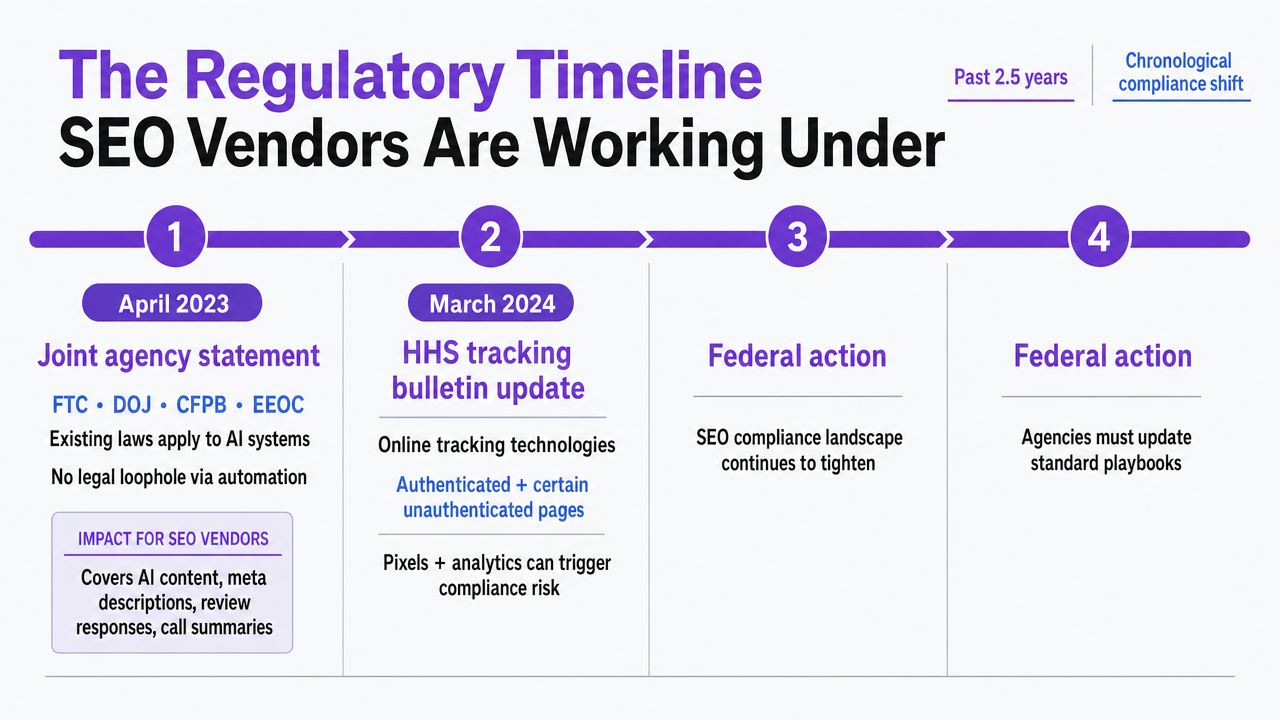 Visualize the four federal regulatory events that reshaped SEO compliance, directly supporting the section's chronological narrative
AI-Generated Content And Call Intelligence Without Governance
Consider a scenario where a dental group's agency rapidly deploys 180 AI-generated location pages that rank well. Simultaneously, the agency uses a call intelligence vendor to transcribe inbound calls, tag intent, and feed a lead-scoring model. If the in-house team has not reviewed the prompts, training data, scoring thresholds, or error rates, issues can arise. A CMO might discover, for instance, a clinical disclosure from a transcript being misrouted into a marketing automation audience.
The regulatory stance on AI was established in April 2023, when federal agencies confirmed that existing consumer protection and civil rights laws apply to AI outputs, meaning automation does not exempt businesses from legal obligations 6. Generated page copy, meta descriptions, review responses, and call summaries are considered advertising and recordkeeping artifacts for which the business is responsible, regardless of the tool used. For health-related claims within this output, FTC substantiation standards still apply 9.
NIST's AI Risk Management Framework 1.0 offers a practical reference for in-house teams due to its voluntary, sector-agnostic nature and focus on governance, mapping, measurement, and management of AI risks 5. Applied to an SEO engagement, this means the agency should be able to identify which models produced specific assets, detail human review processes before publication, validate call intelligence outputs against actual transcripts, and report error rates for intent tagging that routes callers. If the agency can only offer a vendor logo instead of a documented process, a significant governance gap exists.
See How Leading Brands Eliminate SEO Pipeline Bottlenecks with AI Automation
Request a walkthrough of how unified, AI-driven workflows address the most common agency SEO pitfalls—reducing manual oversight, cutting costs, and accelerating pipeline growth at enterprise scale.
Accessibility Treated As Legal Cover Instead Of Conversion Quality
Many SEO agencies approach accessibility as a compliance checkbox, similar to a cookie banner. They might implement a footer widget with font resizing and contrast toggles, then consider the task complete. This narrow focus on ADA exposure misses the broader impact on pipeline generation.
The DOJ's web accessibility guidance for public-facing businesses frames inaccessible sites as barriers that prevent individuals from engaging with an organization 10. For service providers, this is fundamentally a conversion issue. A screen-reader user unable to complete an appointment form, a keyboard-only visitor unable to navigate an intake flow, or a low-vision prospect unable to read pricing information all represent qualified demand that the agency's traffic report counts as a session, but which never translates into a booking in the CRM.
Accessibility overlays rarely fix underlying structural issues. True accessibility and improved conversion rates stem from foundational elements like semantic headings, properly labeled form fields, logical focus order, intent-matching alt text, and sufficient color contrast for calls to action. Marketing leaders should ask if the agency has tested the top ten converting pages with actual screen readers and keyboards, and what the completion rate is for assistive-technology sessions compared to the site average.
Single-Channel Dependence After The DOJ Google Remedies
The DOJ's remedies against Google, announced September 2, 2025, will bar certain exclusive distribution contracts and require Google to make specified search-index and user-interaction data available to eligible competitors 3. While trade press focused on Google's implications, marketing leaders must consider what this means for pipeline plans heavily reliant on a single search surface.
Concentration risk is often overlooked by SEO agencies, whose models are built around familiar search surfaces. A program solely dependent on classic organic blue links is vulnerable to:
- interface changes,
- AI-generated summaries that reduce click-through for informational queries,
- distribution shifts as new entrants access data, and
- ranking volatility during transitions.
These variables are outside agency control and won't appear on monthly ranking reports.
The operational response isn't to abandon organic search, but to require the agency to quantify the proportion of booked pipeline dependent on a single channel. They should propose a defensible floor across owned email, referral, direct, paid, and partner channels, and model the impact on bookings if organic click-through for top commercial queries drops by 20-30% in a quarter. If the agency cannot perform this exercise, the program is a gamble, not a strategic plan.
If You Manage Multiple Locations: Vendor Stack Economics
This section is particularly relevant for marketing leaders managing 15 to 50 locations, as the vendor economics shift significantly for multi-location operations with numerous Google Business Profile listings, intake lines, and local landing page sets.
Many multi-location operators contend with a fragmented vendor stack that has grown organically without consolidation. A typical inventory might include:
| Function | Typical vendor | Monthly cost | Approval touchpoints |
|---|---|---|---|
| Core SEO retainer | National or regional agency | [operator input] | Monthly deck, quarterly plan |
| Link building | Specialist subcontractor | [operator input] | Target list review |
| Review management | SaaS platform | [operator input] | Template and cadence approval |
| Local listings | Listings aggregator | [operator input] | Location data audits |
| Call tracking | DNI vendor | [operator input] | Number provisioning, call scoring |
| CRO and landing pages | Design agency or contractor | [operator input] | Page-by-page review |
| Analytics implementation | Tagging contractor | [operator input] | Tag deploys, data layer changes |
This represents seven distinct line items, contracts, data processors, and potential points where sensitive data (like pixels, chat transcripts, or call recordings) could be forwarded to systems not reviewed by a compliance officer. The United States lacks a comprehensive federal privacy law, leading to fragmented obligations across sectors, states, data types, and business roles 2. Each additional vendor in the stack amplifies the governance burden for the in-house team.
The hidden cost is coordination. Managing seven vendors means seven status calls, seven reporting formats, and seven backlogs to reconcile before a marketing leader can answer a simple question about pipeline by location. The issue isn't necessarily underperforming vendors, but the lack of a unified view across them.
Consolidation becomes a viable strategy when a single execution layer can manage content, local SEO, review workflows, call intelligence, and tagging under one approval queue, with location-level reporting that integrates with the CRM. The audit question is precise: how many of these functions involve data flowing between vendors without documented handoffs, and who approves new tags, numbers, or templates?
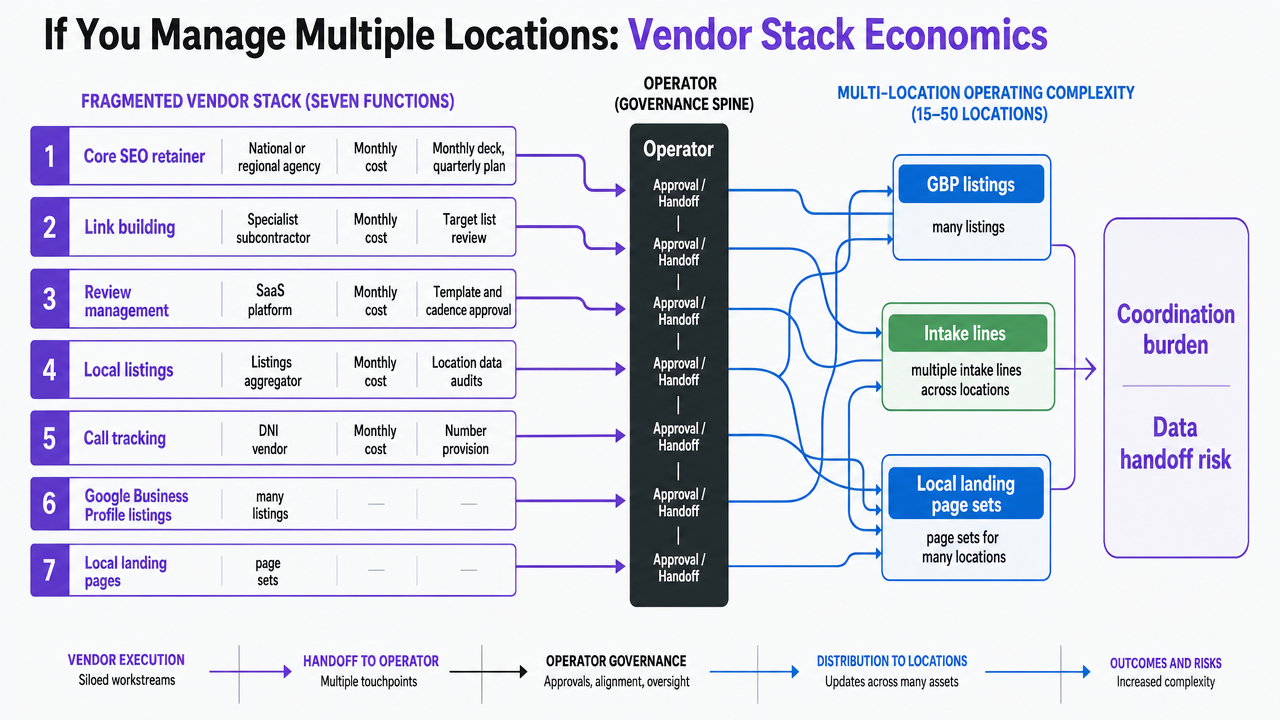 Visualize the fragmented seven-vendor stack described in the section's table, showing coordination burden and data handoff risks
What To Ask In The Next Agency Review
The ten failure modes discussed can be distilled into a concise set of questions for marketing leaders to pose before contract renewal. These questions do not require technical SEO expertise but effectively reveal whether an agency is focused on activity or pipeline generation.
Begin with the reporting contract: Which qualified calls, booked appointments, and attributable revenue figures, broken down by landing page and query cluster, will be featured on slide one of the monthly deck, reconciled against the CRM? If rankings and sessions still dominate the narrative, the reporting focus remains misaligned.
Next, address governance: Can the agency provide a data flow diagram for every pixel, chat tool, and call intelligence vendor on the site, along with signed BAAs where PHI is in scope 1? Which AI models produced which assets, and where is the human review log 5, 6? Does the review-generation workflow treat positive and negative raters identically, with incentives disclosed and not contingent on sentiment 8?
Finally, consider concentration risk: What percentage of booked pipeline relies on a single search surface, and what is the established floor across other channels 3? An agency that can provide written answers to these four questions demonstrates effective program governance. One that cannot is merely reporting on activity. Closing this gap is crucial for improving pipeline generation, and it should be the focus of the next agency review.
Frequently Asked Questions
References
- 1.Use of Online Tracking Technologies by HIPAA Covered Entities and Business Associates.
- 2.Consumer Data: Increasing Use Poses Risks to Privacy.
- 3.Department of Justice Wins Significant Remedies Against Google.
- 4.FTC, ICPEN, GPEN Announce Results of Review of Use of Dark Patterns Affecting Subscription Services, Privacy.
- 5.Artificial Intelligence Risk Management Framework (AI RMF 1.0).
- 6.FTC Chair Khan and Officials from DOJ, CFPB and EEOC Release Joint Statement on AI.
- 7.Federal Trade Commission Announces Final Rule Banning Fake Reviews and Testimonials.
- 8.The Consumer Reviews and Testimonials Rule: Questions and Answers.
- 9.Health Claims.
- 10.Justice Department Issues Web Accessibility Guidance Under the Americans with Disabilities Act.