
Key Takeaways
- Snippet-first paragraph architecture puts a declarative answer in the first 40-60 words, raising extraction rates into AI Overviews without touching the rest of the page.
- Titles now double as citation chips, so leading with a specific noun phrase plus a differentiator like city, year, or dataset earns the tap.
- Entity-clear H2 stacks like What It Is, How It Works, What It Costs let AI summaries assemble answers from clean subsections instead of marketing fluff.
- Treating original data as a quarterly production line gives clients citation-worthy assets competitors cannot replicate without the same operational feed.
- Standardizing Article, FAQPage, and Service plus LocalBusiness schema at the CMS template level fixes coverage across every service and location page, not just hero launches.
- Rewriting intros to skip definitions the AI panel already gave and open with the user's next question keeps post-summary clicks from bouncing.
- Consistent internal anchor text to one canonical page per entity tells extraction systems which URL is the definitive answer for a sub-topic 1.
- A named human review gate owned by one strategist per account turns AI drafts into defensible work and produces a logged sign-off clients can see 2.
- A single FTC-compliant review workflow across the book kills fake or AI-generated testimonials, sentiment-filtered requests, and undisclosed material connections 4, 10.
- Verifiable author credentials on page — license numbers, expertise statements, direct contact — align with Stanford and Fogg credibility research predicting trust 5, 6.
- Editorial provenance logs recording system, prompts, reviewer, and sources per asset give clients an audit trail when compliance officers ask who wrote what 3, 8.
- Direct phone, physical address, matching hours, and real location photography on every page reinforce real-world presence signals tied to perceived trust 6.
Why SEO Split Into Two Tracks This Year
AI Overviews rewrote the job description for agency SEO leads. The old playbook assumed a ranked blue link earned a click. The new SERP routinely answers the query in-panel, cites a handful of sources, and leaves the user to decide whether any citation is worth the tap. That reshapes what agency teams must produce and what they must prove.
Two distinct problems now share the same production calendar. The first is visibility engineering: shaping pages so they get extracted, cited, and clicked when a summary appears above the fold. The second is trust engineering: meeting the credibility, provenance, and compliance bar that AI-era pages face, from E-E-A-T scrutiny to the FTC's rule on fake and AI-generated reviews 4and NIST's risk framework for generative content workflows 9. Most agency pods still run these as one blurred stream of tickets. The 14 tips ahead separate them, assign owners, and score each tactic for repeatability across a client book.
The Two-Track Framework: Visibility Engineering vs. Trust Engineering
Think of the 14 tips ahead as two production lines, not one checklist. Visibility Engineering covers the seven tactics that shape whether a page gets extracted into an AI summary and whether the citation chip earns the click: snippet architecture, title and meta patterns, entity-clear H2 stacks, original data assets, portfolio-wide schema, intro rewrites, and internal link resolution. Trust Engineering covers the seven tactics that let a page survive scrutiny once it does get surfaced: human review gates, FTC-compliant review workflows, verifiable author credentials, editorial provenance for synthetic assets, real-world presence signals, visible correction logs, and governance tied to a named framework.
The split matters operationally because the owners differ. Visibility work sits with strategists and content leads. Trust work maps to the trustworthiness considerations NIST frames across design, development, use, and evaluation of generative systems 9, which pulls in editorial QA, legal review, and account management. Running them as separate queues is what makes the playbook scale across 20-plus clients.
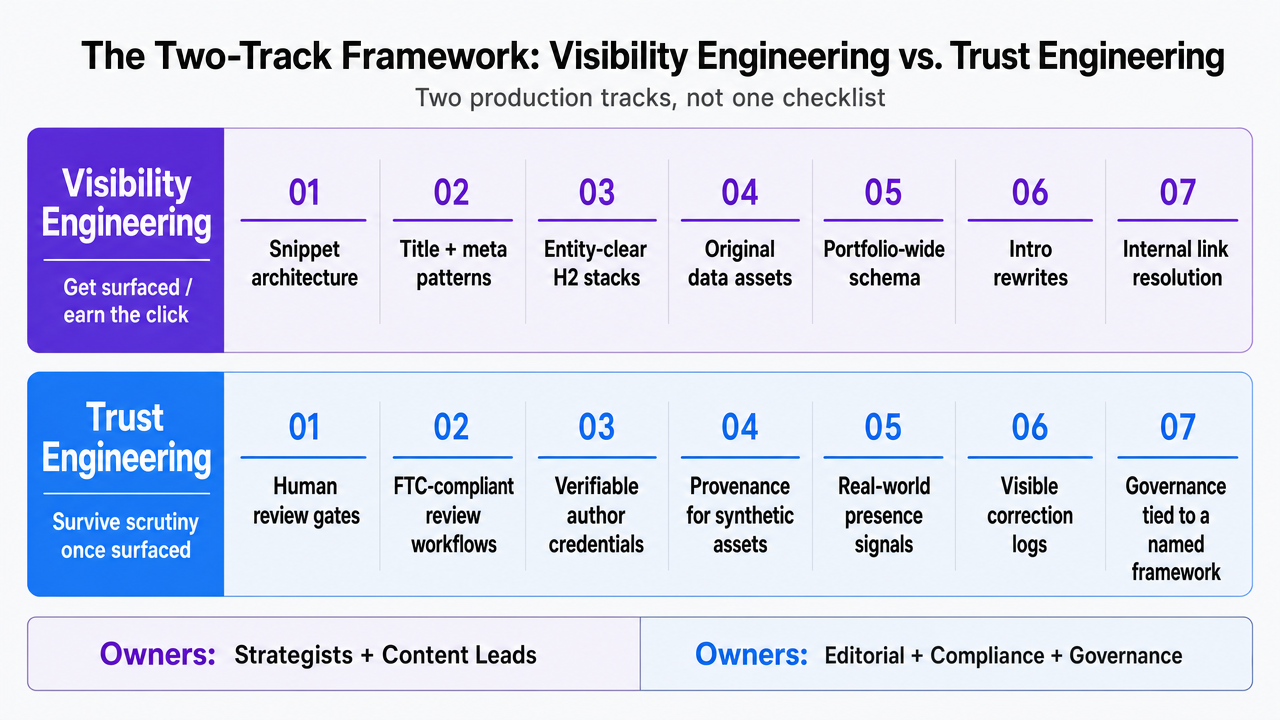 Visualize the article's core organizing framework: two parallel production tracks, each with seven named tactics and distinct owners, so readers can orient to the 14 tips that follow
Test AI-driven SEO execution on live projects
Experience measurable impact by publishing SEO-optimized content with real data and workflow oversight during your trial.
Track One — Visibility Engineering: Getting Cited and Clicked
Tip 1 — Engineer Snippet-First Paragraph Architecture
The first 40 to 60 words of a page now carry disproportionate weight. AI summaries pull extractable, self-contained statements, which means the lead paragraph should answer the query in one declarative sentence, then expand with one qualifying sentence that adds specificity a competing page likely lacks.
Agency teams can templatize this across a client book. For a personal injury firm's "car accident settlement timeline" page, the opening sentence names the typical range in plain language; the second sentence names the variables that move it. For a DSO location page targeting "same-day crown cost," the opener states the price range the practice actually charges, and the next sentence names what's included. Writers stop burying the answer in paragraph three, and extraction rates improve without touching anything else on the page.
Tip 2 — Rebuild Title and Meta Patterns for Citation Chips
Titles have a second job now: they render as citation chips inside AI Overview panels, where a user is deciding between four or five sources at a glance. The chip-era title leads with the specific noun phrase, then adds a differentiator the summary cannot absorb — a city, a credential, a year, a dataset.
Agencies should retire the "Keyword | Service | Brand" default across the book. A pattern like "Slab Leak Repair Cost in Phoenix (2025 Pricing From 1,200 Jobs)" gives the extractor an entity, a modifier, and a reason to click. Meta descriptions should mirror the lead paragraph's declarative answer, not restate the H1. Because generative systems pattern-match on surface text 1, consistency between title, meta, and lead sentence raises the odds the right page gets pulled.
Tip 3 — Deploy Entity-Clear H2 Stacks Across Service Pages
AI summaries assemble answers from subsections, not whole documents. An H2 stack that reads "What It Is / How It Works / What It Costs / Who It's For / Common Mistakes" extracts cleanly. A stack that reads "Our Approach / Why Choose Us / Testimonials" does not.
Rebuilding H2 patterns across a 40-page service library is a one-strategist, two-week project when templated. For an HVAC service-area template, the stack becomes "AC Repair Services in [City] / Common AC Failures We Fix / Repair Cost Ranges / Same-Day Service Area / What to Do Before We Arrive." Each H2 is an entity-plus-modifier the model can map to a user intent. Pattern-based systems reward predictable structure 1, and clear subheadings also give human reviewers a cleaner QA surface when AI drafts move through the queue 2.
Tip 4 — Publish Citation-Worthy Original Data as a Production Line
Original data is the single asset most likely to earn a citation chip against larger competitors. The problem is that most agencies treat it as a hero-page project rather than a recurring unit of production. Flip that. Build a quarterly data drop into the client's content calendar: one survey, aggregation, or internal dataset per quarter, each tied to a mid-funnel query the client already ranks for on page two.
A behavioral health client can publish quarterly admissions-wait-time averages across its facilities. A law firm can publish annual case-type distribution from its own docket. A multi-location dental group can publish average same-day appointment availability by market. Each dataset becomes the one page competitors cannot replicate without the same operational feed, and summary engines reliably cite the originating source rather than aggregators that paraphrase it.
Tip 5 — Standardize Schema Across the Client Book, Not Just Hero Pages
Schema still earns rich results and still disambiguates entities for extraction. The agency problem is coverage, not technique. Most books have clean Organization and LocalBusiness markup on the homepage and nothing structured on the 300 service, location, and resource pages that actually catch long-tail queries.
Standardize three schema types across every client: Article or BlogPosting on every content page with author and dateModified, FAQPage on any page with a question-answer block, and Service plus LocalBusiness on every location and service-area page. Build it into the CMS template once per client, not per page. The payoff is portfolio-wide: a strategist stops hand-coding JSON-LD for one hero launch and starts shipping structured markup on every URL the client publishes.
Tip 6 — Rewrite Intros for the Click Users Still Make
When a user does click past an AI Overview, they arrive skeptical. They already read a summary. The intro has about eight seconds to prove the page offers something the panel did not: a specific number, a scenario the summary skipped, a visual, or a next step. Intros that recap what the user just read get bounced.
The rewrite pattern is subtractive. Cut the "In an increasingly competitive landscape" opener. Cut the definition the summary already provided. Open with the next question the user was going to ask anyway — the one the panel punted on. For a "wrongful termination California" page, that's filing deadlines by county court. For a "root canal recovery" page, that's hour-by-hour expectations for the first 48 hours.
Tip 7 — Build Internal Link Patterns an AI Summary Can Resolve
Internal links do more than pass authority now. They tell extraction systems which page on the site is the canonical answer for a given sub-topic. When five pages across a client site mention "IV sedation," the one that gets cited is usually the one most consistently linked to with that exact anchor from the other four.
Agencies should enforce an anchor-text standard per client: one canonical page per core entity, linked from every related page using the same descriptive anchor. Avoid "learn more" and "click here." For a senior living operator, every mention of "memory care" across the blog, service pages, and location pages points to the single memory-care pillar page using that exact phrase. Pattern-matching systems reinforce the strongest signal they see repeatedly 1, and consistent internal anchors also reduce the ambiguity human reviewers have to resolve during QA 2.
Track Two — Trust Engineering: Surviving the AI-Era Credibility Bar
Tip 8 — Install a Human Review Gate on Every AI-Assisted Draft
AI drafts are faster than any writer on the team. They are also pattern-matched outputs that can confabulate dates, statutes, dosages, and prices without flagging the uncertainty 1. For regulated client work — personal injury, behavioral health, dental, home services with licensing claims — that gap closes with a named human review gate, not with a better prompt.
The gate is a role, not a checkbox. One strategist on each account owns final sign-off before anything leaves the queue, with a documented review step for factual claims, legal language, and any statistic the draft introduces. GAO's deployment guidance makes the operational point directly: generative systems carry limitations and susceptibility to attack that organizations should manage with review, access control, and correction processes 2. Agencies that log the reviewer, the time, and the changes made per draft turn that gate into evidence they can show a client principal when a page is challenged.
Tip 9 — Run One FTC-Compliant Review and Testimonial Workflow Across the Book
The FTC's final rule on consumer reviews and testimonials took effect in October 2024 and carries civil penalties for knowing violations 10. The rule names what agencies can no longer touch: fake or false reviews, including AI-generated reviews that misrepresent a nonexistent reviewer or someone with no actual experience with the business 4; undisclosed insider relationships; review suppression tactics; and incentives conditioned on positive sentiment 10. Separately, the FTC's endorsements guidance requires clear disclosure of material connections between a business and anyone endorsing it, and expects businesses featuring reviews to maintain processes ensuring the reviews reflect genuine customer feedback 7.
One workflow should cover the entire client book. Build a single intake that captures the reviewer's identity verification, the request method, any incentive offered, and the disclosure language attached to endorsements with material connections. Kill template review-request copy that filters by sentiment. Pull any AI-generated testimonial that cannot be tied to a real customer. For legal, healthcare, dental, and behavioral health accounts, route the workflow through client-side legal review before the first batch ships — the rule is federal, but sector obligations stack on top.
Tip 10 — Make Expertise and Author Credentials Verifiable on Page
Credentials buried in a footer bio do not help an extraction system and do not help a skeptical reader who just left an AI summary. Make them verifiable in the page itself. Named author with license number where applicable, a short expertise statement tied to the page topic, a linked professional profile, and the dateModified field surfaced near the byline.
Stanford's Web Credibility work, drawn from research involving more than 4,500 participants, identifies ease of verification, visible expertise, and contact information as practical credibility signals 5. The underlying study predates generative search and should be read as behavioral evidence rather than current platform guidance, but the Fogg quantitative study reinforces the same pattern: real-world presence, expertise, and trustworthiness increase perceived credibility, while amateurism and heavy commercial framing reduce it 6. For a personal injury firm's attorney bio page, that means the bar admission year, the state bar number, two case types the attorney actually handles, and a direct line — not a stock headshot and a mission statement.
Tip 11 — Record Editorial Provenance for Synthetic Assets
Provenance is the production habit most agencies skip and most clients will eventually ask about. For every AI-assisted draft, image, chart, or data asset, keep a record: which system produced the first draft, which prompts shaped it, which reviewer touched it, what sources backed each factual claim, and when it was last updated. NIST's review of synthetic-content transparency names authenticating content, tracking provenance, labeling synthetic content, detecting synthetic media, and auditing systems as the available technical approaches — not any single one as sufficient on its own 3.
The DoD-published multimedia integrity guidance makes the operational version of that point: detection alone is unreliable, so provenance, policy, education, and detection should operate as complementary controls 8. For agencies, that translates to a shared log per client — one row per published asset with the fields above — stored where account managers, legal reviewers, and inheriting strategists can read it. When a client's compliance officer asks who wrote what, the answer is a timestamped record, not a Slack search.
Tip 12 — Display Contact, Location, and Real-World Presence Signals
Real-world presence is a credibility signal the Fogg quantitative study flagged as one of the strongest predictors of trust 6, and Stanford's guidelines treat visible contact information and verifiable identity as baseline moves 5. Both bodies of research predate AI Overviews, so treat them as behavioral evidence rather than ranking guidance — the operational point still holds.
Audit every client site for a direct phone number above the fold on service and location pages, a physical address with embedded map on each location page, hours of operation that match the actual Google Business Profile, and photography of the real location rather than stock interiors. For a multi-location DSO, that means each office page carries its own address, phone, dentist roster, and exterior photo — not a shared template with a dropdown. Agencies running 40 location pages on a single operator should assign one strategist to the audit and ship the fixes as one batch rather than letting them trickle through the queue.
Tip 13 — Operate a Correction and Update Log Clients Can See
Corrections are inevitable on pages that cite statutes, prices, wait times, or clinical details. The question is whether the agency treats a correction as a quiet overwrite or as a visible record. The visible record is the stronger trust move and the cleaner defense when a client principal asks what changed and when.
Run a per-client correction log with the URL, the original claim, the corrected claim, the source that triggered the change, and the reviewer who approved it. Surface a lightweight "Updated on [date]" line on the page itself for anything substantive. GAO's deployment guidance treats correction processes as a core control for AI-assisted operations 2, and NIST's provenance review positions auditability of changes as part of the broader transparency toolkit 3. The log also doubles as a training artifact for new strategists inheriting the account.
Tip 14 — Govern AI Workflows Against a Named Risk Framework
Governance language gets vague fast. Anchor the agency's AI content policy to a named external framework so the review doesn't drift into opinion. NIST's Generative AI Profile is the practical choice: it names the risk categories agencies actually encounter — confabulation, harmful bias, privacy issues, information integrity problems, and weak accountability — and frames them as trustworthiness considerations to incorporate into design, development, use, and evaluation 9. The profile is voluntary and cross-sector, so translation into editorial controls is the agency's job 9.
The translation is short. Source verification required for any numeric claim. Human approval required before publish. Auditability through the provenance log already running under the earlier tip. Escalation path for high-stakes claims in regulated verticals, with legal review in the loop. Write it as a one-page policy per client, reviewed quarterly, signed by the agency lead and the client's marketing owner. That document is what principals point to when a reporter, a regulator, or a competitor asks how the content was made.
See How Leading Agencies Streamline SEO Execution for Higher AI Overview Placement
Request a walkthrough of integrated workflows that automate on-page and technical SEO actions, proven to lift CTR and secure prominent AI Overview features across complex client portfolios.
If You Manage 20+ Client Accounts: Scaling the 14 Tactics
The 14 tactics look different when the unit of analysis is a 25-client book instead of a single engagement. Scope changes which tips compound and which stay linear with headcount. Snippet architecture, H2 stacks, schema templates, internal link standards, and the correction log all compound: build them once per CMS pattern, deploy across 300 pages. FTC-compliant review workflows and the governance policy compound at the agency level: one intake, one framework, applied everywhere. The ones that stay linear are the human review gate, the provenance log entries, author-credential buildouts per attorney or clinician, and quarterly original-data drops — each requires per-account hours no template eliminates.
That split is what the economics table below makes visible. GAO's deployment guidance treats review, access control, and correction processes as core controls agencies must staff for AI-assisted work 2, so the linear columns do not disappear under any staffing model — they get owned by a different role at a different cost.
| Tactic group | Traditional pod | Hybrid freelance + specialist | AI-assisted workflow + approval gates |
|---|---|---|---|
| Template-level work (snippet, H2, schema, internal links, correction log) | N strategists × loaded cost, repeated per client | Specialist builds, freelancers deploy per client | Build once, deploy portfolio-wide at platform cost (trial $599/mo) |
| Portfolio-level governance (FTC workflow, NIST-anchored policy) | Agency lead × hours per client | Specialist retainer, variable | One policy, enforced in workflow at platform cost |
| Per-account linear work (review gate, provenance log, author credentials, quarterly data) | Linear in headcount | Linear in freelance spend | Linear in approver hours; execution automated post-approval |
The reading is straightforward: template and governance work stops scaling with headcount under the third model, while the per-account review hours remain the gating resource. That is where agency margin on a 25-client book is actually won or lost.
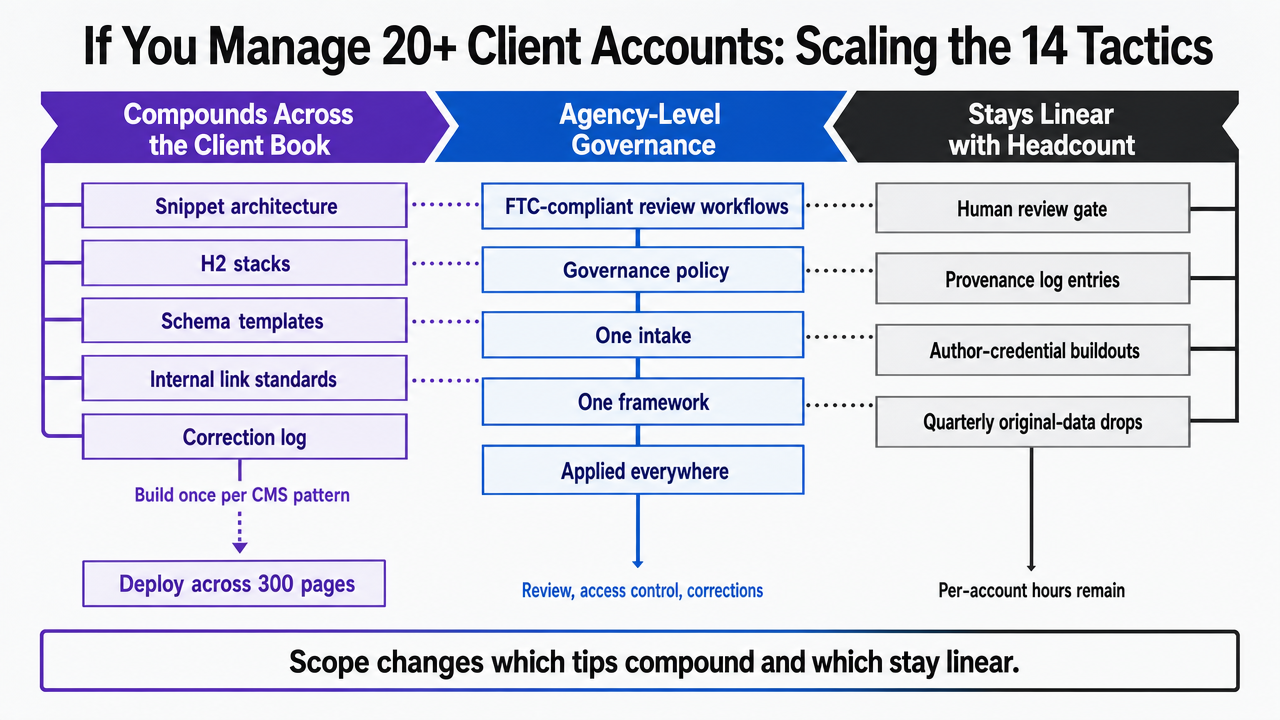 Reinforce the section's economics table by visualizing which tactic groups compound across a client book versus which stay linear with headcount — directly tied to the three-column comparison in the prose
Monday Morning: Which Three Tips to Operationalize First
Three tips return the fastest margin against a 25-client book, and the sequencing matters. Start with the H2 stack rebuild across service pages — one strategist, two weeks per client CMS pattern, and extraction behavior improves on every page the template touches. Ship the FTC-compliant review workflow second, because the legal exposure is non-negotiable and one intake covers the entire book 10. Run the human review gate third, with named approvers per account and a logged sign-off before publish 2.
Everything else — snippet rewrites, schema coverage, provenance logs, correction records — queues behind those three. Agencies piloting approval-first platforms like Vectoron typically route the gate and the log through the same workflow, which is where the per-account linear hours stop compounding against headcount.
Frequently Asked Questions
References
- 1.Artificial Intelligence: Generative AI Technologies and Their Commercial Applications.
- 2.Artificial Intelligence: Generative AI Training, Development, and Deployment Considerations.
- 3.Reducing Risks Posed by Synthetic Content: An Overview of Technical Approaches to Digital Content Transparency.
- 4.Federal Trade Commission Announces Final Rule Banning Fake Reviews and Testimonials.
- 5.The Web Credibility Project: Guidelines.
- 6.What Makes Web Sites Credible? A Report on a Large Quantitative Study.
- 7.Endorsements, Influencers, and Reviews - Federal Trade Commission.
- 8.Strengthening Multimedia Integrity in the Generative AI Era.
- 9.Artificial Intelligence Risk Management Framework: Generative Artificial Intelligence Profile.
- 10.The Consumer Reviews and Testimonials Rule: Questions and Answers.