
Key Takeaways
- Semrush flags AI Overview presence inside Position Tracking, but branded versus non-branded segmentation is manual and LLM citation monitoring sits in a separate module.
- Ahrefs offers strong SERP history and an AI Overview column for period comparisons, though Brand Radar falls short of dedicated LLM citation coverage.
- AccuRanker handles high-volume position tracking with a transparently priced AI Overview add-on and solid API export, but LLM citation tracking is not part of the core.
- SE Ranking bundles AI Overview detection into core position tracking at mid-market pricing, making it suitable for agencies with 15-30 small to mid-sized clients.
- Nozzle records pixel depth and SERP feature composition, quantifying how AI Overviews push organic results down over 1,200 pixels in some cases 9.
- Profound is purpose-built for LLM answer tracking, measuring prompts across ChatGPT, Perplexity, and Gemini with share-of-voice reporting rather than classic keyword positions.
- Otterly.AI polls generative engines for brand mentions and competitive frequency, complementing rather than replacing organic SERP tracking for reputation-focused clients.
- Peec AI structures LLM citation tracking around per-workspace prompt sets, giving agencies consolidated portfolio reporting across multiple client accounts.
- Rank Ranger, now part of Similarweb, delivers enterprise reporting with integrated AI Overview detection and continuity from SGE-era tracking, though pricing skews high per keyword.
- Vectoron is not a tracker but an AI-powered content production layer that converts AI Overview and LLM citation signals into shipped work at scale.
Rank Tracking: The New Divide Between Classic and AI-Powered Tools
The landscape of "SEO rank trackers" has fundamentally changed, now encompassing two distinct categories. One side includes the traditional tools focused on keyword lists, position histories, and SERP feature flags. The other, newer category measures visibility within generative results, such as citation share in AI Overviews and brand mentions in LLM answers from platforms like ChatGPT and Perplexity. While both are called rank trackers, they measure different aspects of search visibility.
This distinction is critical due to the growing scale of AI-powered search. Google reports over 1.5 billion users engaging with AI Overviews2. Relying solely on position data can misrepresent client revenue trends, as query behavior shifts towards generative answers. Agencies that continue to prioritize traditional, cost-per-keyword tracking risk using tools that cannot answer crucial questions about AI-driven click loss and citation presence.
The Scoring Rubric: Differentiating AI Visibility Trackers from Traditional Tools
The Evolution of Position Tracking
Position data, once a premium offering, has become a commodity. Most mid-market tools now provide daily desktop and mobile checks, competitor overlays, and SERP feature flags. The underlying engineering, such as proxy networks and historical data retention, is now standard. This commoditization has driven down the per-keyword cost of classic position tracking.
However, the emergence of AI Overviews, AI Mode, People Also Ask sections, and paid modules has pushed organic results further down the page. A tracker that reports a "position 3" without indicating an AI Overview was triggered provides an incomplete picture, as that position no longer correlates directly with click volume. This discrepancy necessitates a new evaluation framework.
Six Weighted Criteria for AI-Era Tracking
The following rubric prioritizes AI-era capabilities over legacy features. Each tool reviewed in this article is scored against these criteria:
- AI Overview detection and segmentation: The ability to flag keywords that trigger an AI Overview, track the frequency, and segment reporting by branded versus non-branded queries. This segmentation is vital because aggregate CTR numbers can mask significant divergences; for example, Amsive's study found a 15.49% CTR decline on keywords with AI Overviews, while branded keywords saw an 18.68% increase4.
- LLM citation tracking: The tool's capacity to query major LLMs (e.g., ChatGPT, Perplexity, Gemini, Claude) with a defined prompt set and identify if the client's domain is cited as a source.
- Share-of-voice in generative results: Beyond a simple cited/not-cited flag, this criterion assesses how often a domain appears compared to competitors across a corpus of prompts.
- Portfolio reporting: The capability to consolidate AI Overview presence and LLM citation share across multiple client accounts from a single login without manual data export.
- API and data export: The availability of raw data feeds for integration with data warehouses or business intelligence layers, essential for scalable client reporting.
- Price-per-tracked-keyword at agency volume: The effective cost, considering portfolio keyword counts and any AI Overview add-ons, rather than just the advertised tier price.
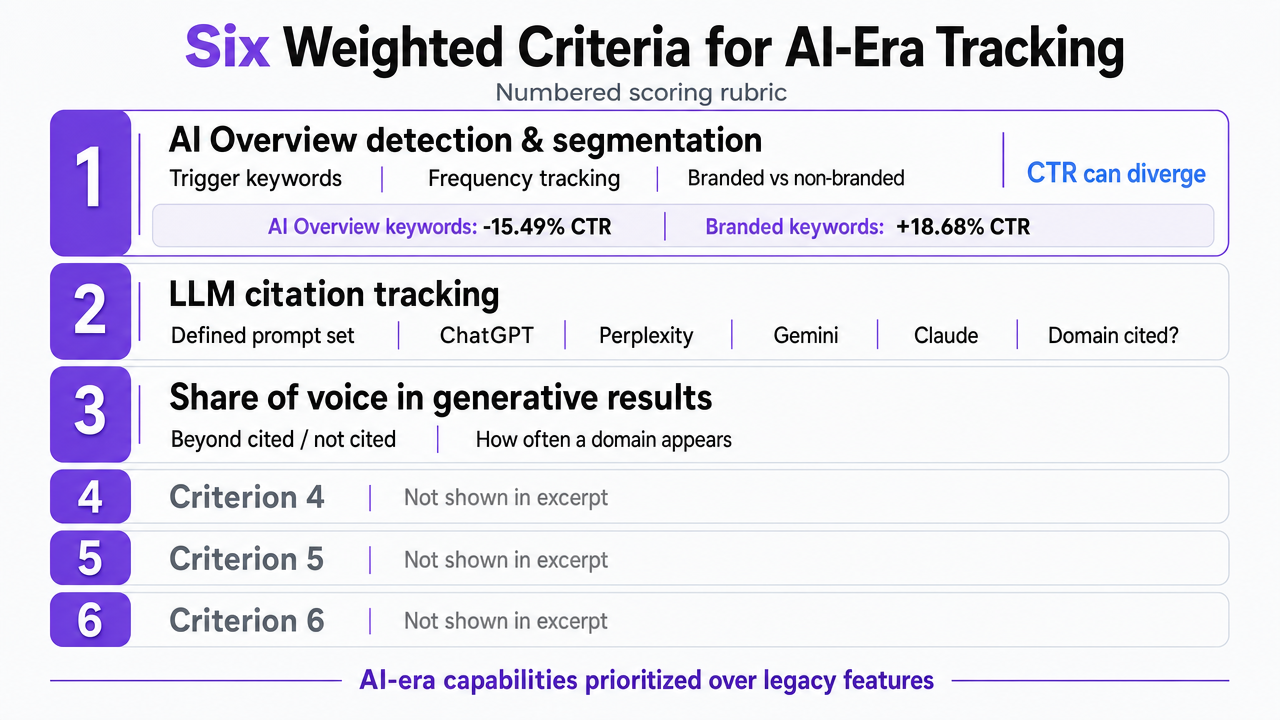 Visualize the six-criteria scoring rubric introduced in this section as a numbered framework
AI Badge vs. Purpose-Built AI Visibility Platform
Two distinct product categories now address AI visibility. The first consists of established rank trackers that have added AI Overview features and marketing. The second comprises newer platforms specifically designed to monitor LLM citations, with prompt-set management, broad model coverage, and answer-text capture as core functionalities.
Key differences include: model coverage (incumbents often track only AI Overviews, while purpose-built platforms poll multiple LLMs); unit of measurement (incumbents use keywords, while AI platforms use prompts, which are typically longer and question-based); and output (incumbents flag presence, while purpose-built platforms extract cited answer text, which is crucial for content strategy analysis).
Why AI Visibility Tracking is a Distinct Measurement Layer
The Impact of AI Overviews on Click-Through Rates
Recent studies highlight the necessity of a dedicated AI visibility measurement layer. Seer Interactive's analysis of over 3,000 queries showed that organic CTR fell by 61% and paid CTR by 68% on queries that triggered an AI Overview, compared to similar queries without one6. This data, derived from client-side traffic across a diverse portfolio, underscores the significant impact of AI Overviews.
A rank tracker that reports position without indicating AI Overview presence misses a critical part of the click story. Agencies relying solely on position deltas might report a client maintaining a high rank while their revenue from that keyword is significantly reduced. The tool itself isn't incorrect; it's simply answering the wrong question for the current search environment.
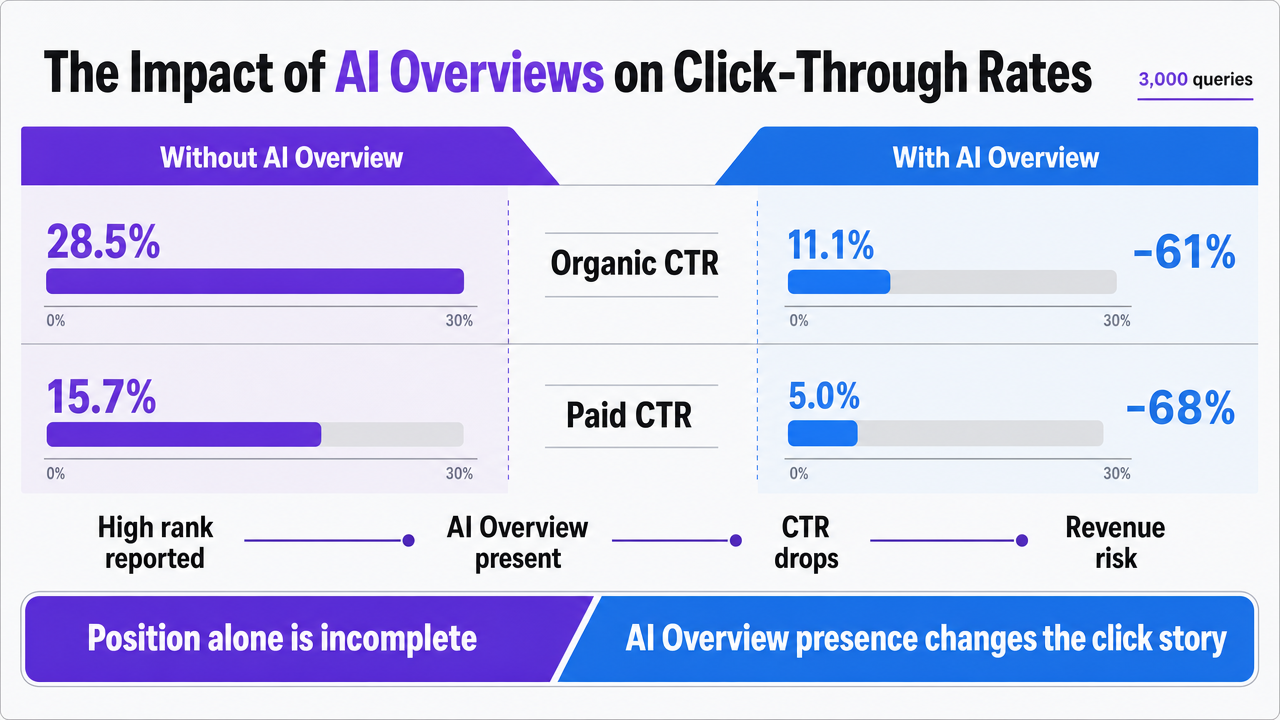 Visualize the dramatic CTR drop on queries triggering AI Overviews, directly supporting the Seer Interactive statistic cited in this section
Understanding the Value of an AI Citation
Being cited in an AI Overview differs from receiving a direct click. Research indicates that on search results pages with an AI Overview, overall result clicks dropped to 8% compared to 15% on pages without one, with clicks to cited sources accounting for approximately 1% of AI Overview visits3. This 1% figure represents a realistic ceiling for downstream traffic from a citation.
For agency reporting, an AI citation primarily serves as a brand impression, a defensive presence against competitors, and a signal of Google's authority recognition for that query. It is not, by itself, a significant traffic driver. Trackers that only report a binary cited/not-cited status without considering impression-weighted share-of-voice may overstate the commercial value. The key question a tool should answer is the frequency of a domain's appearance across a prompt corpus, not just a single instance.
Google's Stance: AI Features and Standard Indexing
Google's Search Central explicitly states that AI Overviews and AI Mode utilize pages already indexed and eligible for snippets in Search, without additional technical requirements1. There is no separate AI schema or parallel index; eligibility for these new surfaces relies on the same crawl, render, and snippet pipeline as classic results.
This has two implications for tool selection: first, a tracker that cannot link AI Overview presence to underlying indexability, snippet formatting, and topical authority provides an incomplete diagnostic. Second, foundational SEO principles remain crucial. Agencies cannot bypass technical SEO simply because a client desires AI visibility; rather, AI visibility adds a new measurement layer on top of existing SEO efforts.
Test AI-Driven Rank Tracking on Live Campaigns
Measure true SEO performance by tracking real keyword movements across your actual client sites during the trial.
Top Tools for AI Visibility and Rank Tracking
Semrush: Broad Feature Set with AI Overview Integration
Semrush is a comprehensive platform offering keyword research, backlinks, position tracking, and site audits. Its Position Tracking feature now includes an AI Overview flag, indicating when tracked keywords trigger an AI Overview. This addresses the basic presence question.
However, deeper segmentation, such as distinguishing between branded and non-branded queries, requires manual setup. LLM citation tracking is a separate module, not a unified answer-monitoring layer across multiple LLMs. While Semrush effectively closes the immediate reporting gap for agencies already using it, new users should note the distinction between its broad feature set and the specialized depth of purpose-built generative search tools.
Ahrefs: Strong SERP History, Limited LLM Citation Coverage
Ahrefs is renowned for its backlink data and extensive SERP feature history. The AI Overview column within its tracking allows analysts to compare query behavior across different periods (pre-AI Overview, initial rollout, and current), providing valuable historical context. This continuity is essential for understanding changes in performance.
The platform's Brand Radar tracks brand mentions in AI answer engines, but its prompt-set management, comprehensive LLM coverage, and cited answer-text capture are not its primary strengths. Agencies relying on Ahrefs for portfolio position tracking may need to supplement it with a dedicated LLM monitor rather than using Brand Radar as a complete solution.
AccuRanker: Scalable Position Tracking with AI Overview Add-on
AccuRanker excels at fast, accurate position tracking for large portfolios, offering efficient refresh cadences, tag-based grouping, and client workspace separation. Its architecture is particularly beneficial for agencies managing numerous accounts and keywords.
AI Overview detection is available as a dedicated, transparently priced add-on. The platform offers robust data export via API, crucial for integrating with custom client dashboards. However, LLM citation tracking is not a core feature. AccuRanker is best suited for agencies prioritizing high-volume position tracking and clean data pipelines, complementing it with a separate LLM monitoring solution.
SE Ranking: Affordable AI Overview Detection for Mid-Market Agencies
SE Ranking provides AI Overview detection as an integrated feature within its core position tracking report, making it an accessible option for mid-market agencies. Its pricing structure is well-suited for client rosters where enterprise-level fees are not feasible.
The platform offers white-label client portals, competitor overlays, and local rank tracking, covering typical mid-market agency deliverables. While it provides sufficient AI Overview coverage for many, LLM answer monitoring is not its focus. Agencies managing 15-30 small to mid-sized clients will find its AI Overview capabilities adequate, but those with brands heavily invested in LLM visibility may require more specialized tools.
Nozzle: Granular SERP Data for Displacement Analysis
Nozzle is designed for analysts who view the SERP as a layout challenge. It records pixel depth, feature composition, and above-the-fold real estate alongside position. This data is critical for understanding how AI Overviews displace organic results; a pre-launch SGE study showed the top organic result could drop over 1,200 pixels when the AI box expanded9. Pixel-depth tracking quantifies this displacement and its impact on clicks.
The platform's reporting depth requires analytical expertise and often a BI layer for rendering raw exports. It is ideal for agencies building custom client dashboards that need detailed SERP layout data. Agencies seeking a turnkey client portal might find other tools easier to deploy.
Profound: Purpose-Built for LLM Answer Tracking
Profound represents the newer category of AI visibility tools, specifically designed to monitor brand presence within LLM answers. Its core features include prompt-set management, scheduled polling across ChatGPT, Perplexity, and Gemini, and the capture of cited answer text.
The platform measures prompts rather than keywords, reflecting how users interact with LLMs. It provides share-of-voice reporting, quantifying how often a client's domain appears against competitors within a prompt corpus. Profound does not offer traditional position tracking. Agencies should consider Profound as a specialized LLM monitor to complement their existing classic rank tracker.
Otterly.AI: Generative Share-of-Voice for Brand Monitoring
Otterly.AI functions more as a brand monitoring tool than a traditional rank tracker. It polls generative answer engines with a prompt set to report brand mentions, frequency, and competitive comparisons. This is particularly valuable for agencies focused on reputation management or clients whose CMOs prioritize brand presence in AI answers.
Otterly.AI does not replace organic SERP position tracking but complements it. Agencies with clients in sectors like professional services or healthcare, where LLM answers influence early-stage consideration, will find Otterly.AI useful for measuring share-of-voice in generative results.
Peec AI: Scalable LLM Citation Tracking for Agencies
Peec AI addresses the operational challenge of managing LLM monitoring across multiple client accounts. It offers per-workspace prompt set management, coverage of major answer engines, and consolidated citation reporting for a portfolio view. This architecture is specifically designed for agencies.
Given the rapid evolution of purpose-built LLM trackers, agencies considering Peec AI should evaluate its current capabilities against the rubric and re-assess at each renewal. The category is still maturing, making long-term standardization a consideration.
Rank Ranger: Enterprise-Grade Reporting with AI Overview Features
Rank Ranger, now part of Similarweb, provides enterprise-level reporting, including custom dashboards, white-label delivery, and advanced SERP feature tracking. It has a history of tracking SGE-era features, offering continuity from experimental generative results to current AI Overviews.
AI Overview detection is integrated into the core product, with reporting layers designed for detailed analysis by device, location, and SERP feature composition. Its portfolio pricing is geared towards enterprise clients. While valuable for teams integrated with the Similarweb data stack, smaller agencies might find more cost-effective options that meet the rubric criteria.
Vectoron: AI-Powered Content Production for Actionable Insights
Vectoron is an AI-powered content production platform designed to bridge the gap between measurement and action. While not a rank tracker itself, it is crucial for agencies looking to act on the insights provided by AI visibility tools. Vectoron enables marketing teams to scale content production without increasing headcount, offering a solution to the execution capacity challenges highlighted by AI-driven click loss.
By automating content creation and optimization based on signals from AI Overview and LLM citation trackers, Vectoron helps agencies move from diagnosing problems to implementing solutions. It ensures that the content produced is aligned with the requirements for appearing in AI Overviews and LLM answers, effectively turning tracker data into approved, shipped work. This platform is essential for agencies aiming to recover revenue and maintain competitive advantage in the evolving search landscape.
Cost-Per-Tracked-Keyword for Multi-Client Portfolios
For agency heads managing multiple client portfolios, the critical cost calculation is the effective cost per 1,000 tracked keywords, including AI Overview detection and LLM monitoring. This differs significantly from the sticker price for single-domain tracking.
Consider a working portfolio of 50 clients, each with 200 tracked keywords, totaling 10,000 keywords. The table below illustrates the structural differences between per-keyword and flat-tier pricing models. Public pricing shifts, so these figures represent structural behavior rather than exact benchmarks.
| Tool | Pricing structure | AI Overview tracking | LLM citation tracking | Scaling behavior at 10,000 keywords |
|---|---|---|---|---|
| Semrush | Tiered flat + keyword caps | Included | Separate module | Amortizes until cap; add-on seats stack |
| Ahrefs | Tiered flat + keyword caps | Included | Brand Radar add-on | Amortizes; overages priced per block |
| AccuRanker | Per-keyword | Add-on line item | Not core | Linear with volume |
| SE Ranking | Per-keyword | Included | Not core | Linear; lowest floor mid-market |
| Nozzle | Per-SERP-check | Included | Not core | Linear with cadence × keywords |
| Profound | Per-prompt / custom | Not core | Included | Prompts, not keywords — separate budget line |
| Otterly.AI | Tiered flat | Not core | Included | Amortizes across brand set |
| Peec AI | Workspace tiered | Not core | Included | Per-workspace scaling across clients |
| Rank Ranger | Custom / enterprise | Included | Add-on | Negotiated; skews high per keyword |
| Vectoron | Subscription (content production) | N/A (action layer) | N/A (action layer) | Scales with content volume, not keywords |
It's crucial to budget for position tracking and LLM monitoring as two separate line items, as they often price on different units (keywords vs. prompts). Modeling these layers distinctly allows agencies to justify the total investment against the actual click losses clients are experiencing.
See How Agencies Track and Optimize AI-Driven Keyword Performance at Scale
Connect with specialists to benchmark your current rank tracking approach against AI-powered workflows designed for high-volume, multi-client SEO delivery—without increasing headcount or losing oversight.
Interpreting Tracker Data: Avoiding Over-Reliance on Single Studies
Various studies on AI Overviews measure different aspects of their impact. For instance, a randomized field experiment reported a 39.8% decrease in organic clicks when AI summaries were shown, with no significant difference in click quality8. These findings are complementary, not contradictory, but operate at different levels of analysis. Understanding the methodology behind each study is key to accurately interpreting tracker data.
The operational rule is to use the tracker's AI Overview flag as a segmentation tool, not a definitive judgment. Divide a client's keyword set into three categories: AI Overview present and cited, present but not cited, and not present. Report performance deltas within each segment. A blended CTR across all three will always be misleading. Research on viewport-based attention demonstrates that presence, position, and cited-source status each influence click behavior differently, necessitating segmented reporting to capture the full picture10. Reconfigure client dashboards with these three buckets before the next reporting cycle to provide a more accurate and actionable view.
Beyond Measurement: Addressing AI-Driven Click Loss with Action
While advanced trackers can identify queries with click loss and client citations, they do not automatically implement schema, rebuild topical clusters, earn citations, or fix technical issues. This gap between measurement and action can strain agency margins. AI Overview and LLM citation trackers are diagnostic tools; revenue recovery depends on subsequent workflow and execution.
Google's guidance consistently emphasizes that AI Overviews and AI Mode rely on standard indexing, snippet eligibility, and core quality signals1. This implies that agencies must maintain strong execution capabilities in content production, technical SEO, and creating citation-worthy assets to move clients from measured loss to recovery. Dashboards alone cannot close this loop. An execution layer that translates tracker signals into approved, implemented work is essential. This highlights the value of pairing top-scoring trackers with platforms like Vectoron, which are built to act on the insights they provide, enabling scalable content production and measurable outcomes.
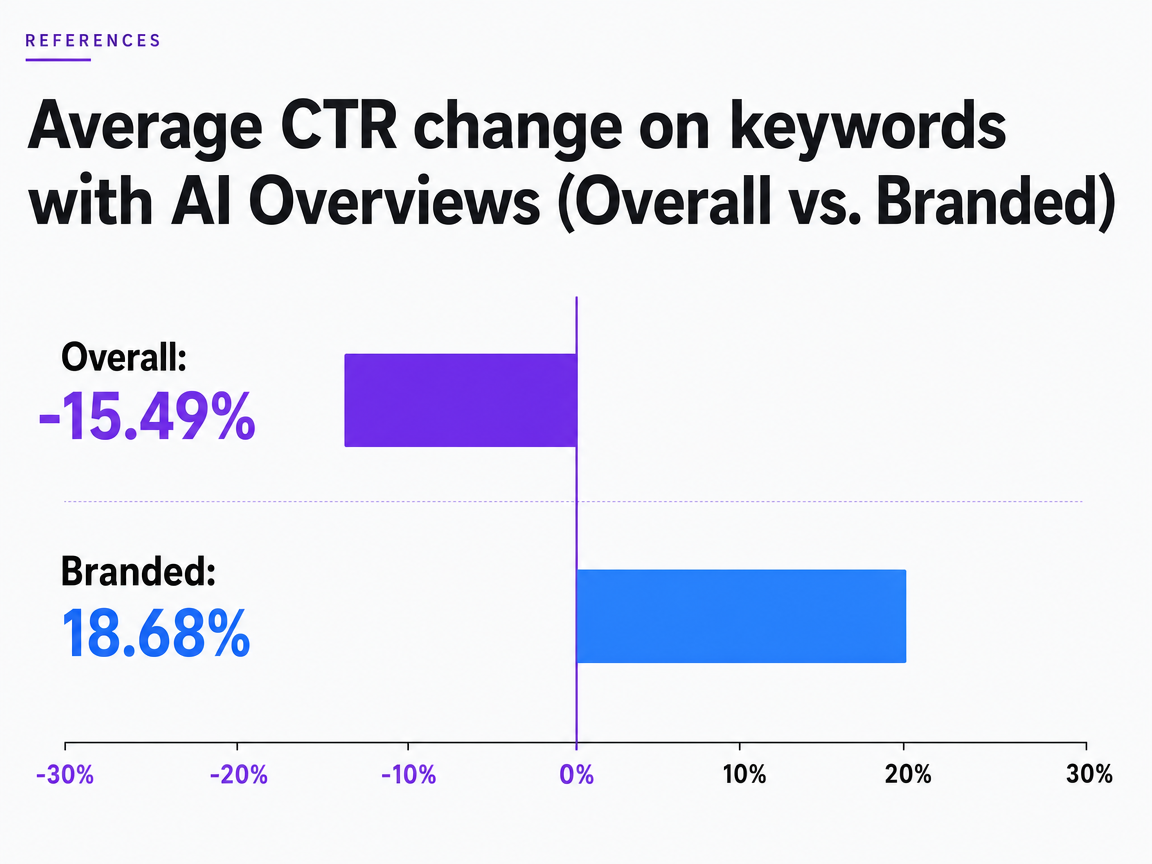 Average CTR change on keywords with AI Overviews (Overall vs. Branded)
An Amsive study shows that while overall CTR declined by 15.49% on keywords with AI Overviews, CTR for branded keywords increased by 18.68%.
Frequently Asked Questions
References
- 1.AI Features and Your Website | Google Search Central.
- 2.AI Overviews and AI Mode in Search - Google Search.
- 3.Investigating Click Behaviors On Google Search Result Pages That Produce an AI Overview.
- 4.Google AI Overviews: New CTR Study Reveals How to Navigate Click Drop-Off.
- 5.Google AI Overview Study - SEO & PPC CTR impact.
- 6.Seer Interactive Research Featured in Inc. Analysis of CTR and AI Overviews.
- 7.AI Overviews - Search anything, effortlessly.
- 8.Google AI Overviews Study Finds Lost Clicks Weren't ....
- 9.Google SGE: Study Reveals Potential Disruption For Brands & SEO.
- 10.Towards Better Measurement of Attention and Satisfaction.