
Key Takeaways
- Rank tracking still signals eligibility because AI Overviews and AI Mode draw from the same index and ranking systems as core Search 1, but it no longer predicts clicks on its own.
- A four-signal model, rank, impressions and CTR, AI Surface Presence from Search Console's generative AI performance reports 3, and conversion contribution, replaces the single rank table as the defensible measurement stack.
- AI-feature impressions should be reported as citation visibility rather than traffic, since AI Overviews cut organic clicks by roughly 39.8% in a controlled test while per-click quality held steady 7.
- Multi-location portfolios and AI-era SERP shifts push analyst load past what manual assembly can absorb, so agencies should automate the data-joining layer and run daily anomaly checks against hourly Search Console data 10.
The Question Every QBR Now Opens With
Agency SEO leads are walking into quarterly business reviews with the same client question stacked at the top of the deck: if rankings held or improved, why did organic clicks flatten? The answer sits between the SERP and the report. AI Overviews, AI Mode, and expanded SERP features now absorb intent that used to convert into a click, and the rank cell in a tracker no longer explains the click line in Search Console.
Google has stated that AI Overviews and AI Mode rely on the same index and ranking foundations as core Search, which keeps classic rank tracking in play as a diagnostic signal 1. What has changed is the translation layer between position and outcome. SparkToro's 2026 clickstream update reports that fewer than one in three Google searches now sends a click to the open web, extending a trajectory that started well before generative features rolled out at scale 6.
That gap is the reason rank tracking gets challenged in the room. The signal is still valid; the story around it is incomplete. The rest of this piece argues that rank remains one input inside a four-signal visibility model, quantifies where rank stops predicting revenue, and lays out how agency delivery teams can rebuild the weekly report, the QBR narrative, and per-account analyst hours without adding headcount.
Why Rank Still Matters: AI Overviews Ride the Same Index
Google's own documentation is the strongest defense of classic rank tracking's continued relevance. In its AI Features guidance, Google states that AI Overviews and AI Mode surface relevant links using the same index, the same ranking systems, and the same foundational SEO requirements that govern core Search 1. There is no parallel corpus, no separate crawler, and no distinct eligibility path that bypasses standard indexing.
The generative AI optimization guide reinforces the point in operational terms: a page must be indexed and eligible for snippets to appear in generative AI features at all 2. That single eligibility rule means the same technical and content signals SEO teams have tracked for years, crawlability, structured content, snippet-worthy passages, and query-matched relevance, remain the price of admission to the AI surface. Rank position is the most direct proxy an agency has for whether a page is competitive within that eligibility pool.
The practical consequence for delivery teams is that rank movement still carries diagnostic weight, even when it no longer predicts click volume with the fidelity it once did. A page that slides from position three to position eleven is losing eligibility for both the traditional blue-link slot and the citation pool AI Overviews draw from. A page that climbs from page two to the top three gains eligibility for both. The signal has narrowed in scope but not in validity.
What has changed is the weight rank should carry inside the report. Treating it as the headline metric misreads the SERP; discarding it misreads Google's own documentation. Rank belongs in the stack as the leading indicator of eligibility, with impressions, AI-feature presence, and downstream conversion carrying the rest of the story.
Where Rank Stops Predicting Revenue
The Zero-Click Gap Between Position and Traffic
The clearest evidence that rank has decoupled from click volume comes from clickstream data, not from tracker exports. SparkToro and Datos measured what actually happens after a Google search in the U.S. and EU using panel data, and the 2024 study found that 58.5% of U.S. Google searches and 59.7% of EU Google searches ended without a single click on any result 5. That measurement covers Google searches specifically, from clickstream panels the authors note have known limitations around mobile iOS coverage. Even with those caveats, the shape of the result is consistent across both regions.
Translated into per-thousand terms, only 360 of every 1,000 U.S. Google searches and 374 of every 1,000 EU Google searches sent a click to the open web in 2024 5. The remainder resolved inside the SERP through featured snippets, knowledge panels, People Also Ask, local packs, video carousels, and AI Overviews, or ended in a refined query or an abandoned session. A page can hold position one across a portfolio of tracked terms and still see impressions climb while clicks flatten, because the SERP surrounding that position is doing more of the answering.
For an agency delivery team, the practical implication is that rank movement should be reported against the impression and click delta from Search Console for the same query set, not on its own. A tracker that shows twelve keywords moving into the top three tells a client something is working at the eligibility layer. Whether that eligibility converts into sessions is a Search Console question, and increasingly an AI-surface question. Reporting rank without pairing it to impressions and clicks now overstates the case in client-friendly directions and gets challenged the first time a CMO opens Search Console themselves.
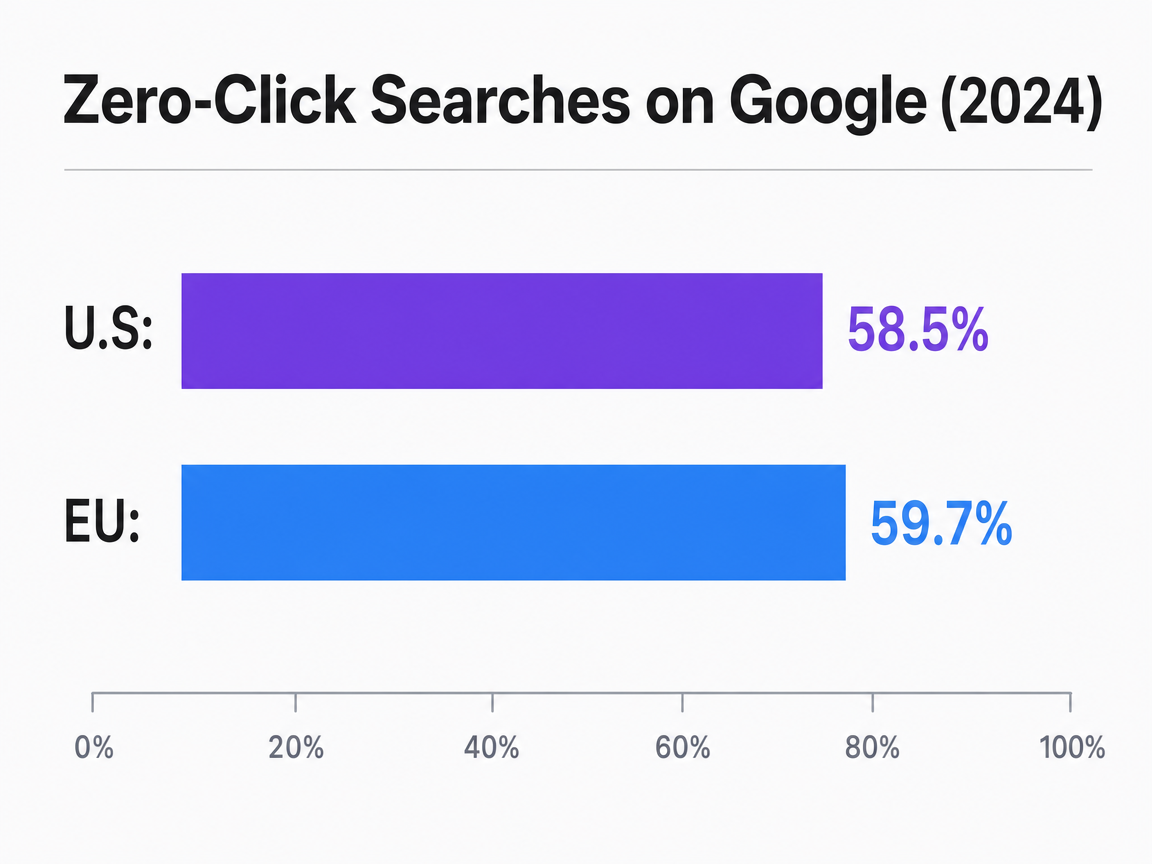 Zero-Click Searches on Google (2024)
Comparison of the percentage of Google searches in the U.S. and EU that ended without a click on any search result in 2024.
What AI Overviews Do to Downstream Clicks
Zero-click behavior sets the baseline; AI Overviews sharpen the effect on the queries where they appear. A randomized field experiment covered by Search Engine Journal reported roughly a 39.8% decrease in organic clicks when AI Overviews were shown to users, compared with control SERPs where they were not 7. That is a within-query comparison against a control, not a market-wide average, and the effect concentrates on informational and mid-funnel intents where the Overview answers the question in place.
The same study delivered a finding agencies should carry into the QBR alongside the click number: several downstream quality metrics were not statistically different between the two groups 7. Users who did click through after an AI Overview behaved comparably on the destination. Fewer clicks, similar quality per click. That reframes the loss from a pure traffic story into a mix story, and it makes the argument for measuring conversion contribution at the query level rather than assuming volume equals value.
Two operational consequences follow. First, informational content sitting in Overview-heavy query clusters will underperform historical CTR curves even when rank is stable or improving; benchmarking CTR against pre-Overview norms will misread the SERP. Second, transactional and bottom-funnel queries, which are less frequently answered fully inside an Overview, retain more of their classic click behavior, which means agencies should segment reporting by intent tier before drawing conclusions about the AI drag on any single account.
The narrower academic evidence points the same direction. A recent arXiv preprint on click behavior across SERPs containing an AI Overview reported that clicks to sources cited inside the Overview occurred in only about 1% of visits, though as a preprint that figure has not yet been peer-reviewed and should be treated as provisional 8. Being cited inside an Overview is a visibility outcome, not a traffic outcome, and reports should label it that way.
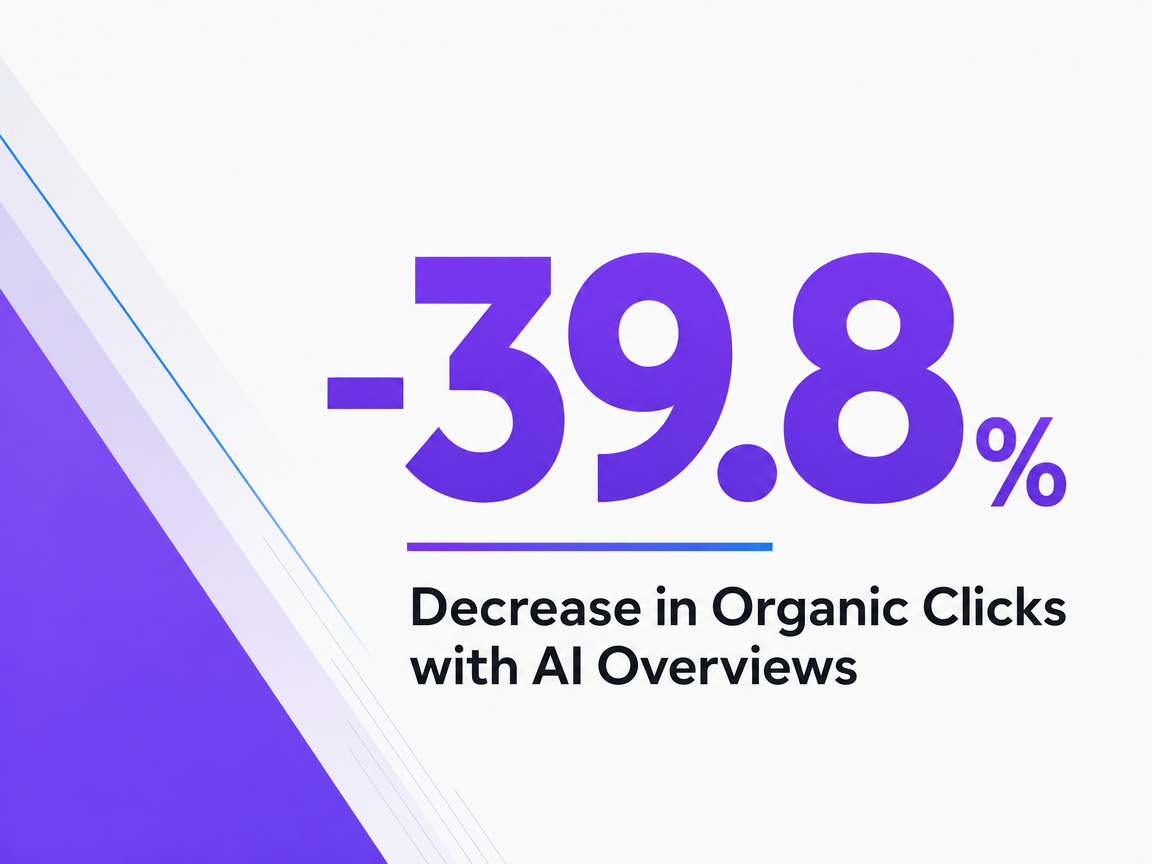 Decrease in Organic Clicks with AI Overviews
Decrease in Organic Clicks with AI Overviews
Test AI-powered SEO tracking at scale now
Experience live, data-driven rank tracking and reporting on actual client sites during your trial period.
The Four-Signal Visibility Model
Rank, Impression Share, AI Surface Presence, Conversion Contribution
The measurement stack that survives AI SERPs treats visibility as four distinct signals, each answering a different question and each pulled from a different first-party or operational source. Rank answers whether a page is eligible to be surfaced at all. Impression share and CTR from Search Console answer whether that eligibility translates into visibility and clicks for the queries a client actually cares about. AI Surface Presence answers whether the page is showing up inside AI Overviews and AI Mode, and Conversion Contribution answers whether any of it moves pipeline.
Google closed the reporting gap on the third signal in June 2026 by introducing dedicated generative AI performance reports inside Search Console, which show how often URLs from a site appeared in generative AI features across Search and Discover 3. That release matters for the model because it turns AI Surface Presence from an inferred metric, previously estimated through third-party SERP scrapers, into a first-party impression count sitting next to the same clicks and average position data delivery teams already pull. Google's parallel announcement of new Search Console insights and site-owner controls extended the picture with page-level and country-level breakdowns for AI-feature visibility 4.
Each signal maps to a fixed data source, which is what makes the model repeatable across accounts:
- Rank comes from the agency's chosen rank tracker.
- Impressions and CTR come from the Search Console Performance report.
- AI Surface Presence comes from the generative AI performance report inside Search Console 3.
- Conversion Contribution comes from CRM records, call intelligence platforms, and booking systems, joined back to landing pages and query clusters.
Reported together, the four signals produce a coherent story: eligibility, visibility, AI-surface presence, and revenue contribution, in that order. Reported in isolation, any single signal now overstates or understates what the account is actually doing.
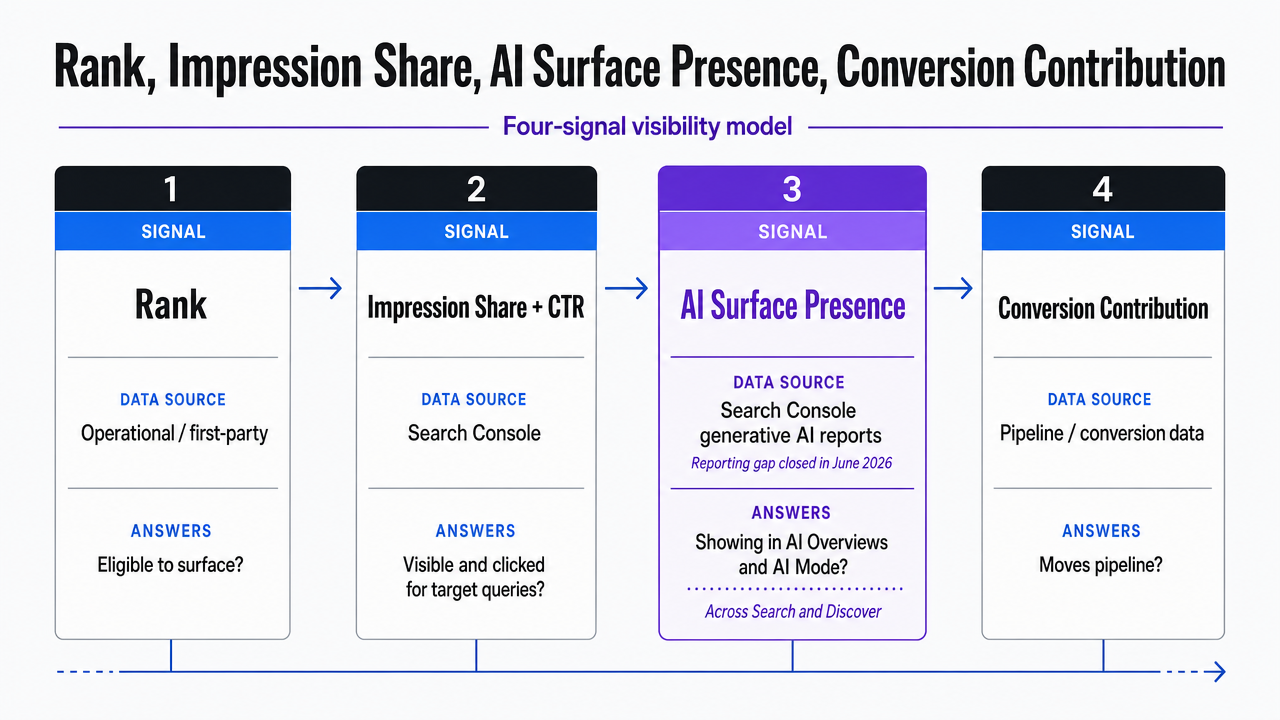 Visualize the four-signal visibility model as a framework diagram, mapping each signal to its data source and the question it answers, directly supporting this framework section
Reading AI Surface Presence Without Overcounting Traffic
The trap inside the new generative AI performance reports is treating an AI-feature impression like a classic SERP impression. They are not the same event. An impression inside an AI Overview means a URL was cited or surfaced within the generated answer; it does not mean a user saw the citation, expanded the source list, or clicked through 3. Reporting AI-feature impressions as if they were equivalent to blue-link impressions will inflate visibility numbers in the QBR and set up a credibility problem the next quarter.
The academic signal on click-through from those citations is thin and points downward. A recent arXiv preprint on click behavior across SERPs containing an AI Overview reported that clicks to cited sources occurred in only about 1% of visits, though as a preprint that figure remains provisional and has not been peer-reviewed 8. Treated as an order of magnitude rather than a fixed rate, it argues for reporting AI Surface Presence as a visibility and brand-exposure metric, not a traffic driver.
The clean way to present the signal in a client report is to separate AI-feature impressions from Search impressions on the same query set, label the AI column as citation visibility, and show clicks against Search impressions only. Conversion Contribution then carries the revenue question independently. That structure preserves the value of being cited inside an Overview without importing a traffic assumption the data does not support.
Rebuilding the Weekly Report and the QBR Narrative
The weekly rank report was built for a SERP that no longer exists. A single table of tracked terms, colored green and red against last week's positions, treated rank as a proxy for everything downstream. That shortcut worked when the ten blue links did most of the answering. It stops working the moment an AI Overview, a featured snippet, and a local pack sit above the fold on the same query.
The replacement is a two-tier report. The weekly tier stays diagnostic and short: rank deltas from the tracker, paired to impression and click deltas from Search Console for the same query set, plus a flag column for queries that gained or lost AI-feature presence in the generative AI performance report 3. Any rank movement without a matching impression or click movement gets annotated, not celebrated. That single pairing kills the most common client objection, that the tracker says one thing and Search Console says another, because both are now on the same page.
The QBR tier is where the narrative shifts. Instead of leading with position gains, delivery teams should lead with eligibility, translate it into visibility across both Search and AI features, and close on conversion contribution from CRM and call data. Google's Search Console Insights refresh already frames trending queries and click-impression movement as the interpretive layer clients respond to, which makes it a useful spine for the QBR story rather than the tracker export 9.
Two changes make the new report defensible in the room. Query-intent segmentation separates Overview-heavy informational clusters from transactional queries before any CTR comparison is drawn, so a decline in one tier does not get read as an account-wide problem. And AI Surface Presence is reported as citation visibility, not as traffic, keeping the client's expectations aligned with what the data actually supports.
If You Manage Multiple Locations: Consolidating the Stack Across a Portfolio
The audience shifts here from single-account delivery to agencies running SEO across multi-location operators: DSO groups, multi-site behavioral health networks, home services franchisors, senior living portfolios, and regional law firm rollups. The four-signal model still holds, but the operational math changes. Every location multiplies the number of Search Console properties, the tracked keyword set, the CRM feeds, and the AI-feature impression data streams that have to be pulled, joined, and interpreted for the QBR.
The cleanest way to keep the stack coherent across a portfolio is to standardize the per-location report as a fixed row structure, then aggregate. Each location gets the same four signals sourced from the same four systems, with a variable analyst-hour load that scales with location count unless the assembly is automated.
| Signal | Data Source | Update Cadence | Analyst Hours / Location / Month |
|---|---|---|---|
| Rank | Rank tracker (local-pack and organic, per location) | Weekly | H1 |
| Impressions / CTR | Search Console Performance report 9 | Weekly, with hourly detail for the last 24 hours 10 | H2 |
| AI Surface Presence | Search Console generative AI performance reports 3 | Weekly, page- and country-level 4 | H3 |
| Conversion Contribution | CRM, call intelligence, booking system, joined to landing pages | Monthly for QBR, weekly flag on anomalies | H4 |
Total monthly analyst load per portfolio equals (H1 + H2 + H3 + H4) multiplied by location count. A fifty-location DSO with three hours per signal per location produces six hundred analyst hours a month before any strategic interpretation happens. That is the point at which manual assembly stops paying for itself and the agency either raises the retainer, absorbs the cost, or automates the data-joining layer.
Two portfolio-specific reporting rules keep the aggregate defensible. Segment queries by local intent tier before rolling up CTR, because branded and near-me queries behave differently from informational clusters that AI Overviews answer in place. And report AI Surface Presence at the property level rather than blending it into a portfolio average, since generative AI impressions can concentrate in a handful of locations and get washed out in a mean 3.
See How AI-Driven Rank Tracking Changes SEO Performance Measurement
Request a walkthrough of unified AI-powered SEO and rank intelligence workflows for agencies managing multi-site or high-volume accounts—learn how leading teams quantify impact beyond position reporting.
Faster Feedback Loops Replace Static Snapshots
The weekly cadence that governed SEO reporting for a decade was a limitation of the tools, not a strategic choice. Trackers pulled once a week, Search Console lagged two to three days, and analysts assembled the picture on Monday. That rhythm no longer matches the SERP. AI Overview eligibility, snippet swaps, and query-cluster movement now shift within days, and a seven-day gap between measurement and interpretation is where accounts lose ground quietly.
Google's December 2024 Search Console update closed part of that gap by adding a recent-performance view with hourly clicks, impressions, average CTR, and average position for the last available 24 hours 10. That is not a dashboard novelty. It gives delivery teams a mechanism to detect a same-day CTR collapse on a priority query cluster, cross-check it against a suspected AI Overview rollout, and flag it before the client notices the traffic dip in their own analytics.
The 2025 Search Console Insights refresh reinforced the direction, surfacing trending-up and trending-down queries as the interpretive lens rather than static position tables 9. Agencies that move to a daily anomaly check on hourly data, with weekly rollups reserved for the client report, catch AI-era SERP shifts while they are still actionable.
Scaling Analyst Time Without Adding Headcount
Six hundred analyst hours a month on a fifty-location portfolio is not a hiring problem. It is an assembly problem. Rank exports, Search Console Performance data, the generative AI performance report 3, and CRM-joined conversion data all live in separate systems, and the labor cost sits in pulling, normalizing, and reconciling them per property before any strategic reading happens. Adding an analyst per fifteen accounts fixes throughput; it does not fix margin.
The lever that moves margin is automating the join layer, not the interpretation. Rank deltas paired to Search Console impression and click deltas for the same query set can be assembled without human touch. AI Surface Presence pulled from the generative AI performance report at page and country level can be attached to the same query rows 4. Hourly anomaly checks against the recent-performance view flag same-day CTR collapses before an analyst opens the account 10. What the analyst does then is read the assembled picture, decide what it means for the account, and write the QBR narrative.
An approval-gated execution layer, of the kind Vectoron's Command Center provides for agency delivery teams, keeps that separation intact: automation assembles and drafts, humans approve and interpret. Rank stays in the report. The report stops costing what it used to.
Frequently Asked Questions
References
- 1.AI Features and Your Website | Google Search Central.
- 2.Google's Guide to Optimizing for Generative AI Features on Google Search.
- 3.Introducing Search Generative AI performance reports in Search Console.
- 4.New opportunities, control and insights for website owners.
- 5.2024 Zero-Click Search Study.
- 6.In 2026, Less than One Third of Google Searches Still Send a Click.
- 7.Google AI Overviews Study Finds Lost Clicks Weren't Lower Quality.
- 8.Investigating Click Behaviors On Google Search Result Pages That Produce an AI Overview.
- 9.The new Search Console Insights report is here.
- 10.An improved way to view your recent performance data in Search Console.