
Key Takeaways
- AccuRanker suits volatility-heavy portfolios through daily refreshes, on-demand pulls, and clean Google Search Console reconciliation, letting strategists flag ranking shifts before clients notice traffic changes.
- Ahrefs Rank Tracker earns its place by co-locating position data with backlink and content indexes, shortening the path from ranking drops to evidence-backed link-building upsell proposals.
- Semrush Position Tracking consolidates paid and organic reporting in one platform, which strengthens QBR narratives for CMOs who want a unified view of search performance.
- SE Ranking fits mid-market agency books through white-label reporting, branded templates, and scheduled delivery, reducing analyst hours spent assembling client decks each month.
- Nozzle captures the full SERP and pipes rank, feature, and share-of-voice data directly into BigQuery, removing reconciliation work for agencies with an existing BI layer.
- STAT Search Analytics anchors enterprise share-of-voice reporting with daily refreshes across very large keyword sets and warehouse-ready APIs suited to portfolio-level oversight.
- Sistrix's Visibility Index acts as an early churn-defense signal, often surfacing domain-level declines before individual keyword reports or client traffic dashboards register the shift.
- Vectoron sits above rank trackers as an execution layer, converting ranking signals and GSC, GA4, and call-tracking inputs into approval-gated actions inside a Command Center workflow.
Why rank tracking only matters when it feeds a revenue model
Rank position is not a KPI; it's an input. Agencies that retain clients understand that keyword movement is a variable within an economic model leading to pipeline or booked revenue, not a standalone metric. McKinsey's analysis of over 400 companies found that a one-unit increase in marketing analytics use correlated with a 0.39% lift in profits and a 0.61% lift in marketing ROI, with the greatest gains occurring when analytics were applied across multiple decision areas rather than isolated 9. This suggests that rank data must integrate with conversion rates, customer acquisition costs, or pipeline metrics to justify its value.
For an SEO Head, this means a rank tracker is valuable only if its data can be easily exported and integrated. This requires clean Google Search Console reconciliation, GA4 event mapping, and an API that allows a BI layer or client-facing dashboard to query data efficiently. Tools that merely provide position screenshots offer a reporting artifact, while those that integrate position, impression, and click data into a revenue model provide a defensible number for quarterly business reviews (QBRs).
The evaluation lens: from SERP position to a defensible dollar figure
This evaluation focuses on one key question: can a rank tracking platform integrate keyword position data into a client's revenue model without manual data entry? Three criteria are paramount. First, measurement integrity. A rank tracker's precision, recall, and response time are critical 4. This includes refresh cadence, location and device granularity, SERP feature capture, and how well scraped positions align with Google Search Console impressions. Discrepancies between tools should be resolved by matching GSC data.
Second, integration depth. Position data must reside within the same analytical layer as sessions, conversions, and pipeline data. McKinsey advocates for translating disparate marketing metrics into a unified currency on a single dashboard 2. This necessitates GA4 event mapping, GSC property-level data pulls, and a well-documented API with manageable rate limits for agency BI teams.
Third, portfolio behavior. Factors like cost per tracked keyword, white-label reporting, user seats, and refresh service level agreements determine a tool's viability for agencies managing multiple clients.
Eight rank tracking tools evaluated for agency ROI reporting
AccuRanker: refresh cadence for volatility-heavy portfolios
AccuRanker emphasizes speed, offering daily refreshes by default and on-demand refreshes in most plans. This is crucial for clients in volatile SERPs, such as legal or home services, where Google core updates can significantly alter keyword rankings rapidly. For an SEO Head, daily refreshes allow for proactive identification of volatility, enabling timely client communication rather than reactive explanations.
For portfolio management, AccuRanker's Google Search Console connector reconciles tracked positions with impression and click data, minimizing discrepancies in QBRs. Its stable API facilitates piping position data into a BI layer without frequent technical issues. The trade-off is that AccuRanker is primarily a rank tracker, not a comprehensive research suite, requiring agencies to pair it with separate crawling and backlink tools. This modularity suits teams building a composable tech stack.
Ahrefs Rank Tracker: pairing position data with backlink-driven upsell cases
Ahrefs' value for agencies lies in its integrated suite. Rank Tracker data is co-located with Site Explorer, Content Explorer, and backlink index, streamlining the diagnostic process when rankings drop. This allows strategists to quickly move from identifying a ranking decline to analyzing backlink gaps and proposing link-building upsells with supporting evidence.
For QBRs, the Rank Tracker module provides granular data on location, device, and SERP features. Weekly refreshes are standard, with daily options on higher tiers, which is sufficient for most stable client portfolios. A challenge for agencies managing many clients is Ahrefs' per-project keyword accounting, which requires careful allocation of keyword slots from a shared workspace pool. While GA4 integration exists, agencies often route rank data through their own BI layer for revenue modeling, as Ahrefs' dashboards are less robust for this purpose.
Semrush Position Tracking: integrated paid and organic reporting for QBRs
Semrush's strength for agencies is its comprehensive platform, where Position Tracking integrates with paid keyword databases, ad copy history, and PPC tools. This enables strategists to create a unified view of paid and organic search performance, which is valuable for QBRs where CMOs seek combined search insights. This consolidation simplifies deck preparation and strengthens the overall narrative.
Research on paid search indicates that higher positions significantly increase profits, with the first ad position generating approximately 80% of total profits after accounting for advertising costs 8. While this is paid-search data, the principle that top positions capture a disproportionate share of value applies directionally to organic search, making movement into the top three a high-signal event for QBRs. Semrush's limitations for large portfolios include weekly refresh cadences on standard tiers, keyword limits that quickly push agencies to higher-cost plans, and API rate limits that can constrain extensive BI data pulls. It excels for clients needing combined paid and organic reporting but may not be ideal for agencies requiring real-time volatility monitoring on standard plans.
SE Ranking: white-label reporting for mid-market agency books
SE Ranking is a popular choice for mid-market agencies due to its robust white-label reporting capabilities. Its report builder supports branded domains, custom templates, and scheduled delivery, reducing the time analysts spend manually compiling client decks. The platform offers daily rank checks on standard plans, integrates with GSC and GA4, and captures SERP features suitable for local and mid-market national campaigns. Its Lookup and audit modules provide a comprehensive view for smaller clients who may not require full Ahrefs or Semrush subscriptions.
At portfolio scale, SE Ranking's API is functional but less mature for high-volume BI piping compared to AccuRanker. Its SERP database, while adequate for most commercial verticals, is not as extensive as enterprise-level tools for long-tail research. For agencies managing 20 to 50 mid-market clients where reporting is a key client touchpoint, SE Ranking often provides a cost-effective solution that preserves profit margins.
Nozzle: SERP feature capture and BigQuery pipes for custom dashboards
Nozzle is designed for agencies with advanced reporting needs, capturing the entire SERP, not just the ranked URL, with every check. This allows strategists to diagnose traffic drops by identifying new SERP features like People Also Ask blocks, expanded AI overviews, or Local Pack insertions, rather than relying solely on position numbers. Its native BigQuery pipe is a key differentiator for agency BI teams. Rank, SERP feature, and share-of-voice data are directly ingested into existing data warehouses used for GA4 and CRM data, eliminating the reconciliation step between position and revenue. This warehouse-first design makes Nozzle suitable for agencies that already use a unified BI layer for client reporting.
Nozzle's pricing and structure are geared towards teams that build their own reporting interfaces. Agencies without BI capabilities or a data engineer may find it challenging to utilize its full potential. However, for agencies with the necessary infrastructure, Nozzle streamlines the integration of rank data with other critical business metrics.
STAT Search Analytics: enterprise share-of-voice for portfolio-level oversight
STAT, now part of Semrush, is a benchmark for enterprise share-of-voice tracking. It offers daily refreshes across all keywords by default and is built to handle large keyword sets (e.g., 50,000 to 500,000 terms per market). For agencies serving enterprise clients where category share is the primary reporting unit, STAT is a well-established solution. Its Data View builder allows strategists to segment keyword sets by intent, product line, or funnel stage, enabling QBR narratives that link SEO efforts to specific commercial objectives rather than a blended visibility number. The API is engineered for high-volume warehouse ingestion.
STAT's cost profile typically places it beyond the reach of mid-market agencies, and its interface is optimized for analysts rather than client-facing exports. Agencies requiring polished client decks out-of-the-box often pair STAT with a separate reporting layer or route data through their own BI environment.
Sistrix: visibility index as a churn-defense signal
Sistrix's Visibility Index is particularly useful for agencies seeking early churn signals. This index aggregates ranking positions across a large keyword sample for a domain, weighted by search volume and expected CTR, generating a single trendline that often indicates changes before individual keyword reports. When a client's index declines before their internal traffic dashboards reflect a shift, strategists gain a proactive advantage for diagnosis and client communication. Sistrix's European origins are reflected in its strong market coverage in Germany, the UK, France, Spain, and Italy, making it a primary tool for agencies with European client bases.
Sistrix is not designed as a full agency reporting stack. Its keyword-level tracking is not its primary strength, GA4 integration is limited, and its white-label reporting capabilities are less advanced than SE Ranking or Semrush. Its optimal use is diagnostic: monitoring an index per client, setting alert thresholds, and establishing response protocols when the trendline shifts.
Vectoron: an execution layer above pure rank trackers
Vectoron operates as an execution layer, distinct from traditional rank trackers like AccuRanker or STAT. It takes inputs from rank tracking, GSC, GA4, and call-tracking signals to generate ranked, reasoned recommendations. These recommendations then proceed through a Command Center approval workflow before implementation. This shifts the role of a rank tracker from mere measurement to informing actionable strategies. For an SEO Head, this means the tracker identifies issues, and Vectoron facilitates the agency's response.
In a QBR context, Vectoron streamlines the process. Instead of manual analysis and memo drafting, the platform presents recommendations with supporting data, allowing strategists to approve, edit, or reject them. Content briefs, on-page optimizations, and internal linking changes are executed post-approval, accelerating the cycle from rank movement detection to published response. Vectoron complements existing rank trackers, providing the layer that translates measurements into governed actions across a client portfolio without requiring additional strategist headcount.
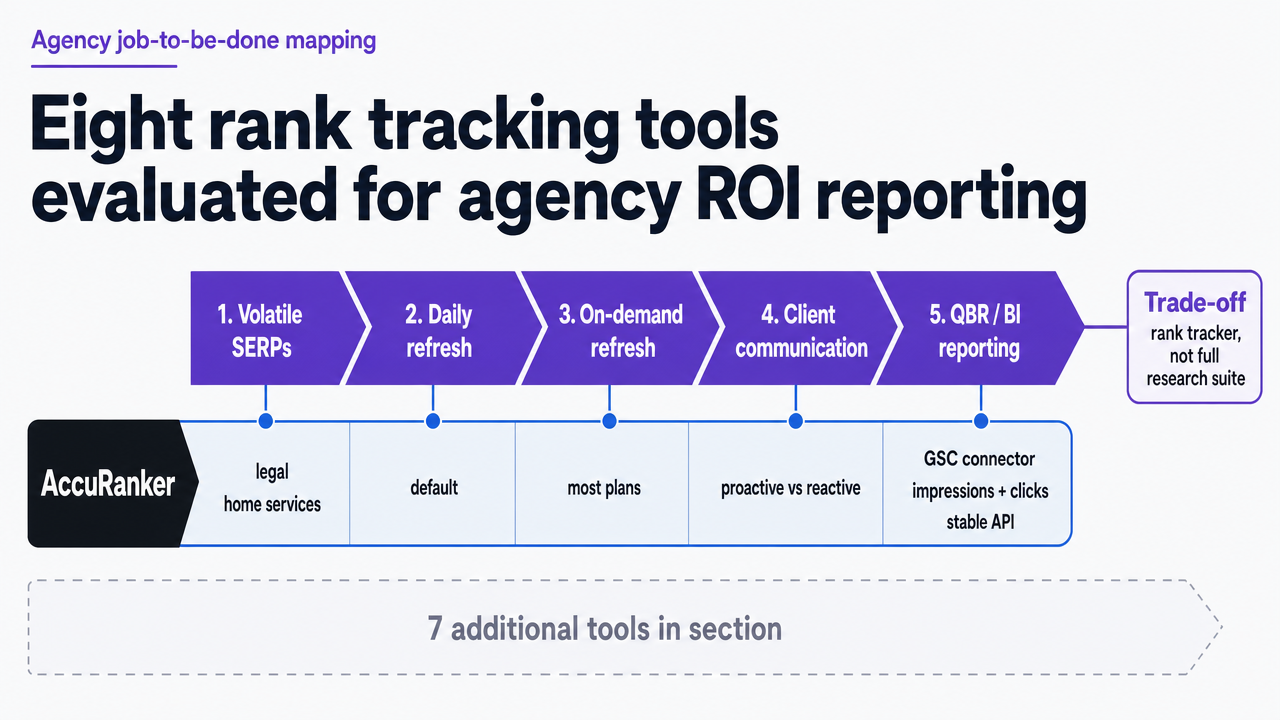 Visualize the eight tools mapped to their agency job-to-be-done, giving readers a scannable comparison framework that mirrors the section's structure
Track Real Client Rankings With Full Access
Validate ranking improvements and demonstrate ROI to clients using actual campaign data during your trial period.
If you manage a client portfolio: the economics of tracked keywords at scale
For an SEO Head managing a book of business, the economics of rank tracking change significantly. Consider a portfolio of 25 clients, each tracking 500 keywords, totaling 12,500 keyword slots. Three variables primarily influence the total cost of ownership:
- Cost per keyword slot per month
- Refresh frequency (daily refresh typically costs more than weekly)
- Analyst hours saved per client per month — heavily influenced by whether rank data flows via an API into a shared dashboard or requires manual copy-pasting into individual client decks
| Variable | Manual reporting path | API-piped path |
|---|---|---|
| Keyword slots (25 x 500) | 12,500 | 12,500 |
| Cost per slot per month | S | S |
| Refresh multiplier (weekly vs daily) | 1.0x to 2.0x | 1.0x to 2.0x |
| Analyst hours per client per month | H | H x 0.3 to 0.5 |
| Portfolio monthly cost | (12,500 x S x M) + (25 x H x rate) | (12,500 x S x M) + (25 x H x 0.4 x rate) + BI overhead |
McKinsey's research on analytics suggests that 15% to 20% of marketing budgets can be reallocated without impacting ROI when measurement identifies underperforming spend 10. This principle applies to agency portfolios, where the tracked-keyword layer provides the evidence for such reallocation, justifying API access to client GA4 properties.
Attribution honesty: what rank movement can and cannot claim
A common credibility issue in QBRs is the unsupported leap from rank charts to revenue charts. An SEO Head must clearly define what rank movement can and cannot claim. Academic work on position and conversion, such as Rutz, Bucklin, and Sonnier's analysis of paid search, found that higher positions increase both click-through and conversion rates 6. Roughly one-third of new conversions were attributed to increased click-throughs, and two-thirds to increased conversion rates, after accounting for selection and unobserved heterogeneity. While this is paid-search data, it serves as a directional warning: attributing conversions solely to rank gains can overstate the effect, as underlying query, intent, and audience factors also drive both rank and conversion.
To maintain credibility in client decks, agencies should use precise language. Rank movement can claim impressions and clicks, verifiable through Google Search Console, but not conversions directly. Conversion claims should be linked to GA4 events tied to the specific landing pages receiving incremental sessions. Revenue claims are further downstream, residing in the client's CRM or pipeline system. Each layer of attribution is defensible individually; the compound claim is only defensible when each connection point is explicitly demonstrated, not merely assumed.
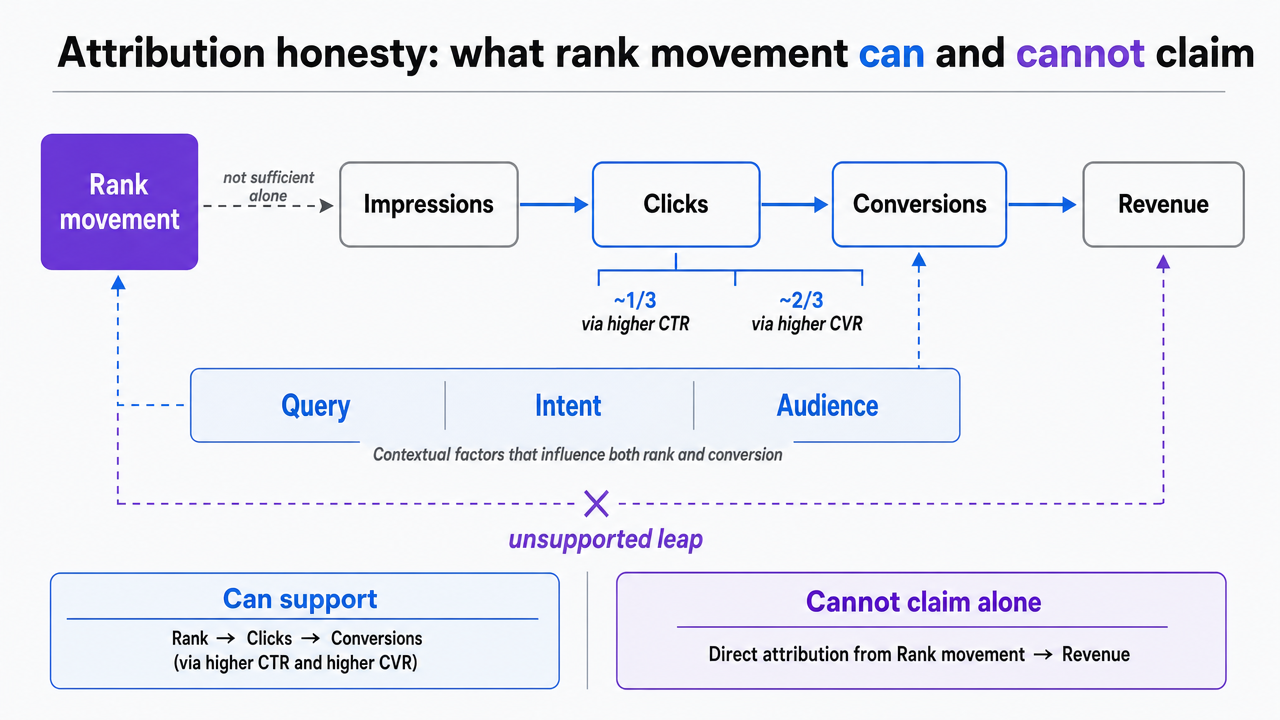 Illustrate the attribution chain the section describes, showing how rank connects (or fails to connect) to impressions, clicks, conversions, and revenue
See How Top Agencies Benchmark SEO Performance With Data-Driven Rank Tracking
Request a walkthrough showing how unified rank tracking and reporting can streamline SEO accountability, improve client retention, and demonstrate ROI across large client portfolios.
Where AI-augmented tracking fits without overpromising
Most rank trackers now incorporate some form of AI, including anomaly detection, forecast bands, cannibalization alerts, and natural-language querying. While generally useful, these features rarely replace human analysts. McKinsey's research on generative AI in marketing and sales found revenue uplifts of 3% to 15% and sales ROI uplifts of 10% to 20% for firms seriously investing in AI, particularly those with established data and workflow foundations 12. In rank tracking, AI features are valuable when they accelerate the process from keyword signal to approved action, rather than simply generating more charts.
Two use cases demonstrate real value. Anomaly detection across a large keyword portfolio (e.g., 12,500 keywords) can identify share-of-voice drops that a human analyst might miss. AI-drafted client narratives for QBRs can reduce deck preparation time from hours to minutes, provided the underlying data is clean. Other AI features, especially generative forecasts not grounded in GSC and GA4 data, often introduce noise that an SEO Head must filter before presenting to clients.
A short shortlist by agency job-to-be-done
The evaluated tools are best categorized by their suitability for specific agency needs rather than a single ranking. For agencies managing volatility-heavy portfolios in sectors like legal or home services, AccuRanker is recommended for its daily refreshes and GSC reconciliation, complemented by Sistrix's Visibility Index for early churn detection. For QBRs requiring combined paid and organic reporting for CMOs, Semrush offers a unified view, with movement into the top three positions being a key signal. Enterprise share-of-voice tracking across large keyword sets is best handled by STAT feeding a data warehouse, or Nozzle for agencies with in-house data engineers. Mid-market agencies prioritizing white-label reporting should consider SE Ranking, potentially paired with Ahrefs for backlink-driven upsell opportunities.
Beyond these, an execution layer that translates approved rank signals into actionable work is crucial for scaling a portfolio without increasing strategist headcount. Vectoron fulfills this role, sitting above the rank tracker to convert measurements into governed actions.
Frequently Asked Questions
References
- 1.Using marketing analytics to drive superior growth.
- 2.The secret to great marketing analytics? Connecting with decision makers.
- 3.How To Measure Marketing ROI.
- 4.Search Engine Performance Optimization: Methods and Metrics for Evaluating Search Engine Results.
- 5.Comparing Performance Metrics in Organic Search with Sponsored Search Advertising.
- 6.A Latent Instrumental Variables Approach to Modeling Keyword Conversion in Paid Search Advertising.
- 7.Using Data Sciences in Digital Marketing: Framework, Methods, and Performance Metrics.
- 8.An Empirical Analysis of Search Engine Advertising.
- 9.Marketing Analytics: It works, so why aren't more companies using it?.
- 10.“Smart analytics” can tap up to 20% of lost ROI.
- 11.Gen AI's ROI.
- 12.Marketing and sales soar with generative AI.