
Key Takeaways
- Google Search Console anchors the stack because it reports what Google actually served, including AI Overview impressions and clicks, giving agencies first-party ground truth for revenue models 1.
- AccuRanker tags SERP feature presence per query at daily cadence, letting strategists segment CTR modeling by SERP archetype so position 1 on an Overview-affected page is not mistaken for clean-SERP click share.
- Ahrefs Rank Tracker earns its slot for competitor delta and share-of-voice data that fuel retention and expansion narratives at QBRs, not for reconciling against a client's GSC clicks.
- Semrush Position Tracking covers desktop, mobile, and ZIP-level rankings inside one taxonomy, which matters for multi-location service brands where national averages hide location-specific slippage.
- SEOmonitor forecasts sessions and revenue from ranking trajectories, making it the tool a strategist runs when a client's finance team wants a projection tied to specific position moves.
- Looker Studio paired with the BigQuery GSC export builds custom client dashboards that update automatically, paying back strategist hours within a quarter on portfolios over roughly 15 accounts.
- Vectoron sits downstream of tracking as an AI execution platform with a specialist SEO strategist and Command Center approval flow, absorbing the analyst hours between rank data and shipped action.
Why Rank Tracking Became a Revenue Attribution Problem
Rank tracking used to be a monitoring job. A Head of SEO pulled weekly position deltas, dropped them into a client deck, and called the retainer defended. That workflow is broken. The SERP a rank tracker measures in 2026 is not the SERP a client's customer sees, and the gap between the two is now large enough to invalidate most standing agency reports.
The clearest evidence is what happens to click-through rate when an AI Overview appears on the same page. A 2026 organic CTR benchmark study of clean versus AI-Overview-affected SERPs found position 1 averages 39.8% CTR on clean SERPs, dropping to 19% when an AI Overview is present 4. The rank did not change. The click economics collapsed by roughly half. Any revenue model that multiplies estimated search volume by a static positional CTR curve is now overstating projected traffic on every affected query.
Google's own tooling has caught up to this reality faster than most agency reporting has. As of June 2026, Search Console reports impressions and clicks from generative AI features alongside traditional organic results 1, meaning first-party visibility into AI surfaces is available to any agency willing to wire it into client dashboards. The teams still exporting third-party average position and calling it performance are choosing to work without that signal.
The strategic consequence for a Head of SEO is straightforward. Rank tracking is no longer a position-monitoring problem. It is a revenue-attribution problem, and the tools worth evaluating are the ones that let a portfolio-scale team model clicks and revenue against SERP features, not against a curve that no longer exists.
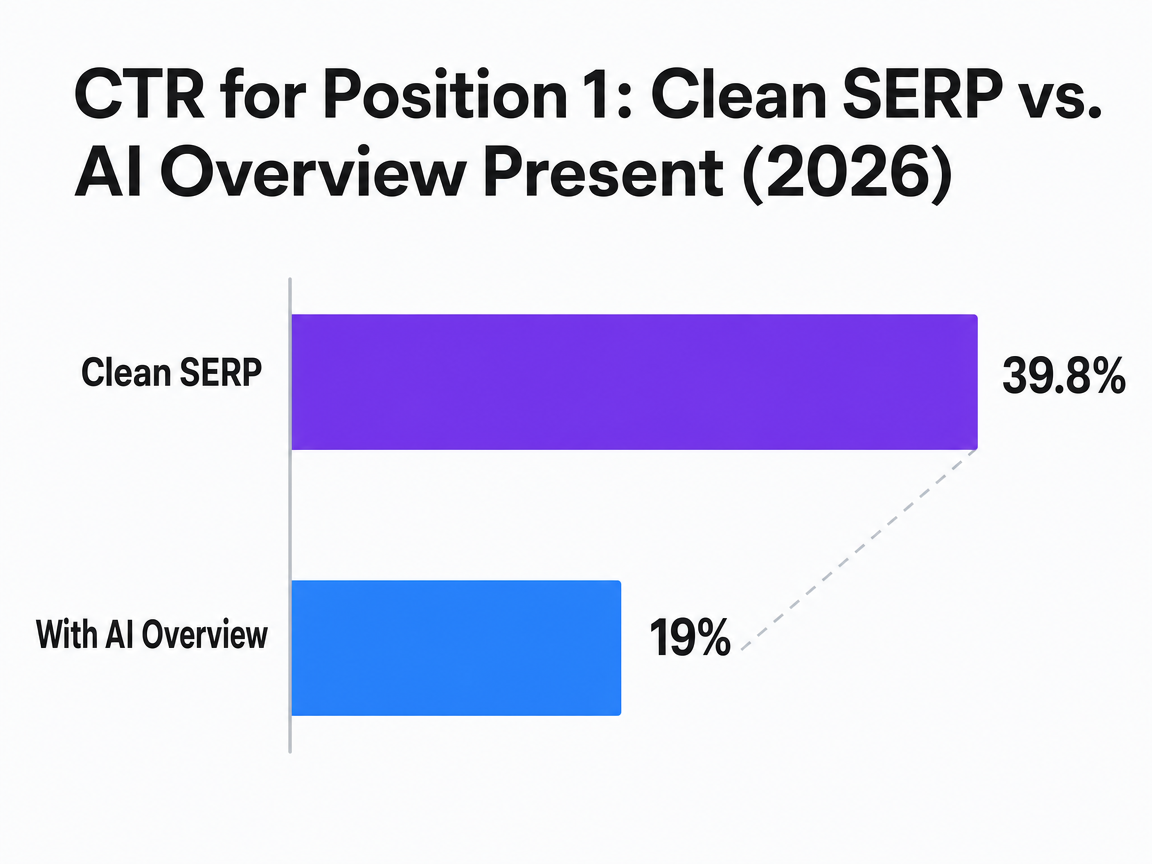 CTR for Position 1: Clean SERP vs. AI Overview Present (2026)
Compares the average Click-Through Rate (CTR) for the #1 organic search result on a clean Search Engine Results Page (SERP) versus a SERP where a Google AI Overview is also present. This data highlights the significant impact of AI features on user click behavior.
The Rubric: Four Criteria That Separate Infrastructure From Dashboards
Most rank tracker comparisons rank features. That is the wrong axis for an agency Head of SEO. The right axis is whether the tool produces defensible client revenue narratives at portfolio scale. Four criteria separate the tools that qualify as agency infrastructure from the ones that produce good-looking dashboards.
- First: revenue attribution logic. The tool has to let an analyst convert a query-level ranking change into a modeled click and conversion delta, not just a position delta. That means the platform accepts custom CTR curves, or exposes clicks and impressions at the query level directly, so a strategist can build the position 3 to position 1 revenue case a client will actually sign an expansion order against.
- Second: SERP-feature awareness. A rank tracker that reports position 1 without flagging whether an AI Overview, featured snippet, or product pack sits on the same SERP is reporting a number that no longer predicts traffic. The tool must capture SERP feature presence per query and let the analyst segment CTR modeling accordingly.
- Third: first-party data integration. Since Search Console reports what Google actually served rather than what a third-party crawler inferred 2, the stack has to ingest GSC at the query level and reconcile it against crawled rank data. Tools that cannot pull GSC via API are working from an estimate of an estimate.
- Fourth: portfolio-scale operation. Alerts, anomaly detection, and prioritization have to run across 40 accounts without a strategist manually reviewing each one. If the workflow assumes weekly human interpretation per client, the tool is a dashboard, not infrastructure.
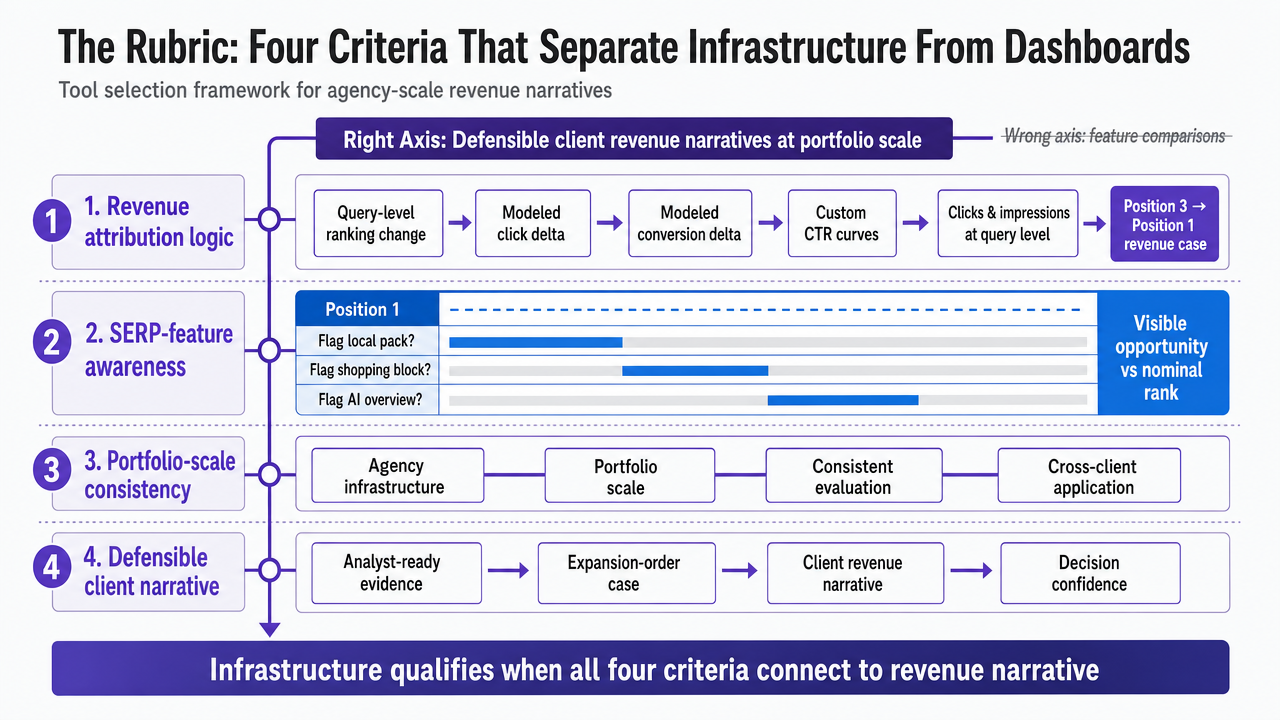 Visualize the four evaluation criteria explicitly enumerated in this section as a framework the reader can apply to tool selection
Track Real SEO Gains Before You Commit
Measure actual client rank improvements and ROI impact with live campaigns during your trial.
The Seven Tools Worth Evaluating in 2026
Google Search Console: The Non-Negotiable Source of Truth
Every serious agency stack starts here, and not because GSC is the flashiest interface. It starts here because Search Console reports what Google actually served, not what a third-party crawler inferred from a datacenter proxy 2. For an agency Head of SEO building revenue models, that distinction determines whether a client narrative survives scrutiny.
The Performance report is the substrate. It exposes clicks, impressions, CTR, and average position at the query and page level, and as of June 2026 it also reports impressions and clicks from AI Overviews and AI Mode alongside traditional organic results 1. That means an agency can finally quantify what portion of a client's visibility is being routed through generative surfaces versus blue links, per query, without buying a separate AI-visibility subscription.
The operational point is sharper than the feature list. As one 2026 GSC guide put it, making decisions about title tags, ranking drops, or content priorities without checking GSC first is working blind 3. Agencies that only export third-party rank data into client decks are diagnosing symptoms with the wrong instrument.
GSC also gives agencies the position-level CTR benchmarks that revenue models depend on. A 2026 performance report guide documents expected CTR by position on GSC data, anchoring position 1 in the 25–35% range and stepping down through positions 2–10 5. Those ranges are the substrate for any credible position 3 to position 1 revenue case a strategist takes to a client.
The limitation: GSC is per-property. It does not federate across a 40-client portfolio without an export layer, which is why the tools that follow exist.
AccuRanker: SERP-Feature-Aware Position Tracking at Portfolio Scale
AccuRanker earns its slot because of what it captures alongside position: SERP feature presence per query, refreshed daily, across large keyword sets. For a Head of SEO managing dozens of accounts, that is the difference between a report that flags a client ranking #1 and a report that flags a client ranking #1 on a SERP where an AI Overview is now consuming half the click share.
The job it does in an agency workflow is straightforward. It watches large keyword universes, tags which SERPs have Overviews, featured snippets, product packs, or local packs, and lets an analyst segment CTR modeling by SERP archetype. That segmentation matters because applying a clean-SERP CTR curve to an Overview-affected query overstates projected clicks materially, and a strategist cannot correct for that without knowing which queries sit under which SERP type.
Where it fits in the rubric: strong on SERP-feature awareness and portfolio-scale operation, moderate on revenue attribution because click and conversion modeling still happens downstream, and dependent on GSC for first-party validation. Agencies that pair AccuRanker's daily SERP snapshot with GSC's query-level clicks are effectively running an inferred-rank tool against a first-party ground truth, which is the correct architecture for a defensible client narrative.
Ahrefs Rank Tracker: Competitor Delta and Share of Voice for Retention Narratives
Ahrefs earns its place in the stack for the neighboring dataset, not the rank table itself. When a client asks why the retainer is worth another twelve months, the answer that closes is usually a competitor delta: the client gained X share of voice on the tracked keyword set while two named competitors lost Y. That story requires a tool that indexes competitor rankings and backlink movement at scale, and Ahrefs does that job in fewer clicks than most.
Its rank tracker is inferred, not first-party. A Head of SEO should treat the position numbers as a directional comparison across competitors on the same crawl, not as the number to reconcile against a client's GSC clicks. The inference layer is fine for share of voice; it is not fine for the revenue model.
Against the rubric, Ahrefs scores high on portfolio-scale operation and competitor visibility, moderate on SERP-feature tagging, and weak on native revenue attribution. Its use case in the agency workflow is retention and expansion narrative construction, not the position 3 to position 1 revenue projection. Agencies that treat it as the primary source of truth are the ones that get surprised when GSC clicks tell a different story to the client's CFO.
Semrush Position Tracking: Local and Multi-Device Coverage Across Client Rosters
Semrush earns the slot on breadth. Its Position Tracking module covers desktop and mobile separately, tracks by ZIP code and city, and holds up across a client roster that includes national e-commerce, multi-location home services, and single-location professional services. For an agency with a portfolio spanning multiple verticals and geographies, the ability to run all of it inside one keyword-tracking taxonomy has real operational value.
The local granularity is the underrated part. A dental group with 22 locations does not care about national average position; it cares whether the Salt Lake City office ranks in the local pack for "emergency dentist" and whether the Phoenix office slipped two spots after a competitor opened. Semrush lets a strategist build that view per location without spinning up 22 separate trackers.
On the rubric, it is strong on portfolio-scale operation and multi-device coverage, competent on SERP-feature flagging, and dependent on GSC integration for first-party clicks. The revenue attribution layer is thinner than SEOmonitor's forecasting model, but the tradeoff is broader vertical and geographic coverage in one workspace. Agencies running mixed portfolios often keep Semrush as the primary tracker and layer specialized forecasting or first-party reconciliation on top.
SEOmonitor: Forecasting Traffic and Revenue From Ranking Movement
SEOmonitor is the tool built specifically for the revenue conversation. It ingests search volume, seasonality, and ranking trajectories, applies a CTR model, and outputs projected sessions and revenue for a campaign period. For a Head of SEO who has to walk into a QBR and defend the retainer against a client's finance team, that output is the artifact that keeps the account.
The interesting part in 2026 is how the CTR model handles AI Overview presence. Any forecasting tool that still applies a static positional CTR curve to affected queries is producing inflated projections. Agencies evaluating SEOmonitor or any forecasting layer should press the vendor on whether the model discounts CTR when SERP features are detected, and how frequently that detection refreshes. If the answer is vague, the forecast is decorative.
Against the rubric, SEOmonitor is strong on revenue attribution and campaign-level forecasting, moderate on portfolio-scale operation because forecasting workflows are more analyst-intensive than pure tracking, and dependent on clean GSC input to keep projections grounded. It earns its slot as the tool a strategist runs when the client asks what happens if the agency moves the top 40 commercial keywords from position 6 to position 3.
Looker Studio + BigQuery GSC Export: The Custom Reporting Layer
This is not a rank tracker; it is the layer that turns rank tracking into client-facing revenue narrative at portfolio scale. Google's BigQuery export from Search Console dumps daily query-level performance data into a warehouse, and Looker Studio renders it into client dashboards that update without an analyst touching them.
The reason it belongs on this list: no packaged rank tracker can produce the exact reporting view a client demands. One client wants revenue attributed by product category; another wants organic clicks segmented by branded versus non-branded intent; a third wants weekly deltas by service line and geography. Trying to force those views through a third-party tool's canned templates costs strategist hours every week. A warehouse-plus-BI setup pays back that time within a quarter for any portfolio over roughly 15 accounts.
The pattern Google itself demonstrated with a Site Impression bubble chart, plotting clicks, impressions, CTR, and position on one canvas to prioritize opportunities 7, is exactly what a Looker Studio layer operationalizes across a client portfolio. On the rubric, it is strong on revenue attribution and first-party data integration, strong on portfolio-scale operation once built, and weak on out-of-the-box SERP-feature awareness, which is why it pairs with AccuRanker or Semrush upstream rather than replacing them.
Vectoron: AI Marketing Execution Platform With an SEO Strategist and Command Center
Vectoron is not a rank tracker, and framing it that way misreads the category. It is an AI marketing execution platform with a specialist SEO strategist that reads live business signals, ranks priorities, and routes recommended work through a Command Center approval workflow before anything ships.
Where it fits in the agency stack is downstream of the tracking layer. The tracking tools above generate query-level, position-level, and CTR-level data. The strategist layer reads that data alongside qualified calls, bookings, and cost per lead, then surfaces ranked recommendations: which pages to optimize, which titles to rewrite, which queries have moved from Overview-safe to Overview-affected and need a modeling adjustment. Every recommendation carries the reasoning, and every approved action executes without a separate briefing cycle.
Against the rubric, Vectoron does not replace GSC as the source of truth or AccuRanker as the SERP-feature scanner. It replaces the analyst hours currently spent translating rank tracker output into an action queue and a client-ready narrative. For a Head of SEO whose bottleneck is strategist capacity rather than data collection, that is the slot. For agencies whose bottleneck is still data quality, the earlier tools in this list come first.
Why Impression-Weighted Averages Are Sabotaging Client Reports
The average position field in a client report is one of the most dangerous numbers in agency SEO, and most reports lead with it. The reason it misleads is structural. Google Search Console defines average position as the average rank of the highest-ranking URL for each query, weighted by impressions 6. That weighting quietly hands the entire trendline to whichever queries produced the most impressions in the period, which are rarely the queries that produce revenue.
A concrete pattern: a client's high-volume informational query drifts from position 8 to position 6, adding tens of thousands of impressions. Ten commercial queries that actually drive booked calls slip from position 3 to position 5. The dashboard shows average position improving. Revenue is falling. The strategist who reports the average has just certified the wrong story.
The distribution of clicks makes this even more consequential. Synthesized 2026 CTR data shows the top 5 organic positions capture roughly 67% of all clicks on a clean SERP 9. The revenue lives in a narrow band of query-position combinations, not in a portfolio-wide average. The same source cautions that a rising CTR paired with falling impressions is not a win, it is a traffic decline hiding behind a ratio 9.
The operational fix is to strip average position and average CTR from the top of every client report and replace them with query cohorts: commercial queries in positions 1–5, commercial queries in positions 6–10, and the AI-Overview-affected subset of each. That view survives client scrutiny. The average does not.
See How Leading Agencies Track SEO Performance Across Every Client Account
Connect with our team to benchmark your current rank tracking workflow against AI-driven reporting solutions designed to streamline multi-client management and accelerate measurable client revenue.
If You Manage 25–75 Client Accounts: Portfolio Economics of a Consolidated Stack
The economics change when a Head of SEO stops thinking about one client and starts thinking about a portfolio. At 25 accounts, a strategist can still hand-inspect each performance report weekly. At 75 accounts, that workflow does not exist. The math forces a consolidation decision, and the shape of that decision determines gross margin per account for the next fiscal year.
The variables an agency owner already tracks are the ones that drive this calculation: number of clients in the pod (C), tracked keywords per client (K), analyst hours per week spent on manual reporting per account (H), and the correction factor an analyst must apply to CTR models on AI-Overview-affected queries. On a portfolio where a meaningful share of tracked commercial queries now sit under AI Overviews, and where position 1 CTR on those SERPs runs closer to 19% than to the clean-SERP benchmark 4, every account carries a modeling adjustment step that did not exist two years ago. Multiply H by C, and the hours line is where margin quietly leaves the business.
Consolidation collapses that line in three places. First, a warehouse layer built on the BigQuery GSC export produces the client-facing revenue view without an analyst rebuilding it per account. Second, a SERP-feature-aware tracker running across the full keyword universe removes the manual step of checking which queries need the Overview-adjusted CTR curve. Third, query-level cohort analysis replaces impression-weighted averages, which is the analytical discipline the underlying data actually supports 6.
The operational outcome is that one strategist covers a portfolio previously staffed by two or three, with the query-level rigor intact rather than sacrificed. That is the leverage point. It is not a licensing story; it is a workflow story, and the licensing follows.
Assembling the Stack: How to Match Tools to Client Segments
The stack is not one tool. It is a small set of tools mapped to client shape, and the mapping is where a Head of SEO earns margin. Three archetypes cover most agency portfolios.
- National e-commerce and content sites. GSC as the source of truth, AccuRanker for daily SERP-feature tagging across large keyword sets, and a BigQuery-plus-Looker layer for the client-facing revenue view. SEOmonitor enters when the client's finance team wants a forecast tied to specific position moves.
- Multi-location service brands. Semrush for ZIP-level and mobile-versus-desktop coverage across every location, GSC per property for click reconciliation, and Looker Studio to roll location-level query cohorts into a single portfolio view. Ahrefs sits alongside for the competitor share-of-voice narrative at QBRs.
- YMYL and regulated verticals where rater guidelines put a ceiling on which pages can hold top positions 10. Here the stack leans harder on GSC for first-party trust signals, AccuRanker for SERP-feature volatility, and a strategist layer that turns the tracking output into a ranked action queue rather than a report. That is where Vectoron's Command Center covers the analyst hours a portfolio at 40-plus accounts no longer has.
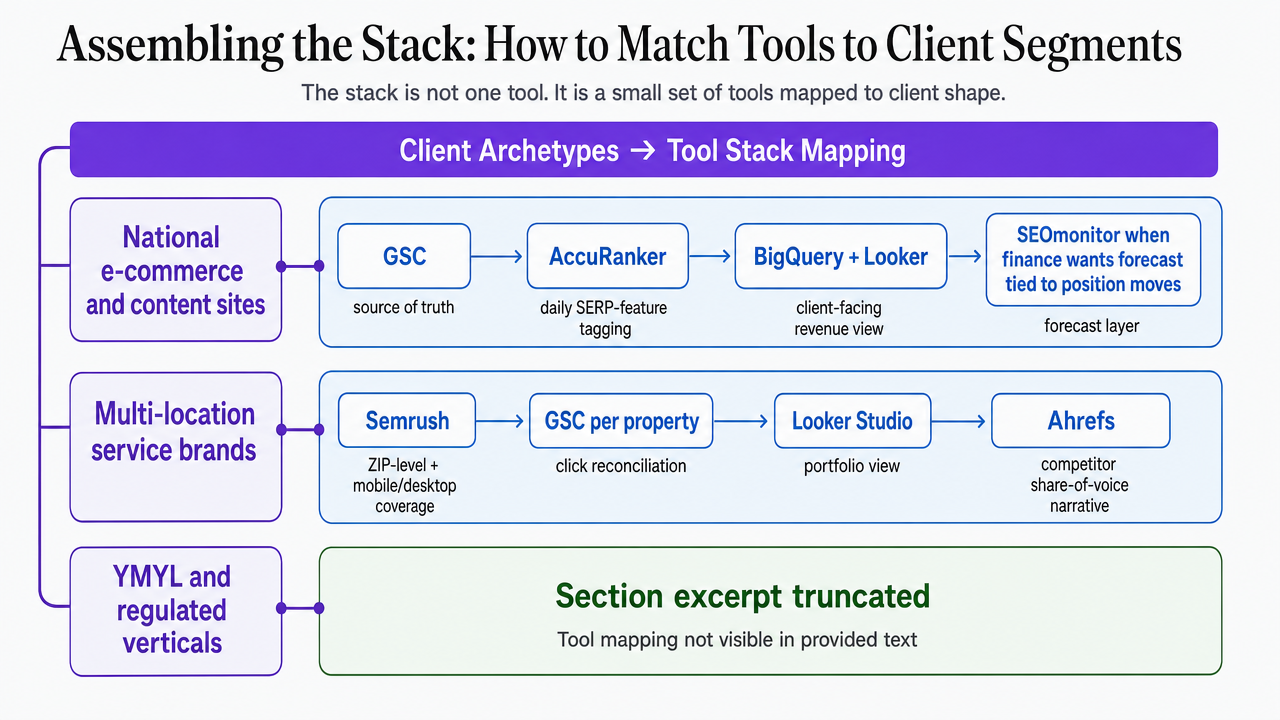 Visualize the three client archetypes and their mapped tool stacks described explicitly in this section
Frequently Asked Questions
References
- 1.Introducing Search Generative AI performance reports in Search Console.
- 2.Google Search Console | The SEO Handbook.
- 3.Google Search Console 2026: All Reports Explained.
- 4.SEO CTR Benchmarks 2026: Organic Click-Through Rates by Position.
- 5.Google Search Console Performance Report: Complete Guide to Every Metric and Filter.
- 6.Why Averages Mislead.
- 7.Optimizing website performance with a Search Console bubble chart.
- 8.The Effect of Ad Rank on the Performance of Keyword ....
- 9.Google Search Console Performance Report & Search Analytics.
- 10.Search Quality Evaluator Guidelines.
- 11.Google search ad click-through rate (CTR) in the United States as of June 2021, by position.