
Key Takeaways
- Semrush works as the end-to-end anchor because it covers most of Forrester's 28 enterprise capability criteria under one login, cutting context switches across large client portfolios 10.
- Ahrefs earns its spot as the research spine, letting specialists run link audits, keyword expansion, and SERP intent reviews from a shared index without deduplication overhead.
- Conductor fits the top decile of retained enterprise accounts, where role-based views and stakeholder management displace the custom decks agencies would otherwise build each month.
- Screaming Frog stays on the desktop for migration QA, log-file correlation, and diagnostic sweeps where horizontal platforms trade crawl depth for breadth.
- AccuRanker functions as a precision rank utility for volatile verticals and SERP-feature monitoring, feeding data downstream rather than opening a second client dashboard.
- AgencyAnalytics compresses the reporting hours that scale linearly with account count, retiring the screenshot-and-paste seat so specialists focus on analysis clients renew for.
- Vectoron sits above the stack as a workflow orchestrator, routing ranked recommendations through human approval and shifting seat economics toward accounts-per-specialist capacity.
Why agency throughput, not database size, decides the shortlist
Every SEO vendor benchmarks its keyword universe. Almost none benchmark the metric an agency Head of SEO actually defends to ownership: accounts per specialist per month, and the hours it takes to move each one from rank pull to client-ready deck. Forrester's Q1 2025 SEO Solutions Landscape frames modern platforms around time-to-value and workflow depth, not index size, and that reframing is the reason a tool shortlist looks different in 2025 than it did three years ago 7.
The economics reinforce the point. Forrester estimates enterprise organic search budgets run between $100,000 and $500,000 annually, and argues that rank tracking alone no longer justifies that spend to executives who want measurement tied to pipeline 11. For an agency running 20 to 150 client accounts, the same logic compounds: every hour a specialist spends deduping keywords, screenshotting SERPs, or reformatting a monthly deck is an hour not spent on strategy, remediation, or retention.
The seven tools that follow are grouped by the throughput problem they solve, not by feature parity. A rank tracker, a technical crawler, and an orchestration layer do not compete. They stack. The shortlist is built accordingly.
The three-lane market: end-to-end, point, agency
Forrester's Q1 2025 Solutions Landscape sorts the SEO software market into three lanes that behave differently at the P&L: end-to-end platforms, point solutions, and agency tools 7. The distinction matters because an agency Head of SEO who evaluates a rank tracker against a stakeholder-reporting platform is comparing tools that were never meant to solve the same problem. Forrester's own commentary reinforces the split, noting that vendors across all three lanes are now racing to keep pace with generative AI and prove SEO's value to executives 8.
End-to-end platforms concentrate on breadth. The Forrester Wave evaluated seven enterprise providers across 28 criteria spanning keyword research, technical auditing, performance tracking, and stakeholder management 10. That criterion set is the closest thing the market has to a capability baseline, and it explains why enterprise buyers pay for platforms even when a point tool wins on a single dimension. Point solutions go deep on one job: a technical crawler, a rank monitor, a backlink index. Agency tools focus on the delivery layer, wrapping data from multiple sources into client-ready reporting and workflow.
An agency shortlist mixes lanes because no single lane covers the full retainer scope. The question is which combination collapses specialist hours per account without leaving a capability gap the client will notice.
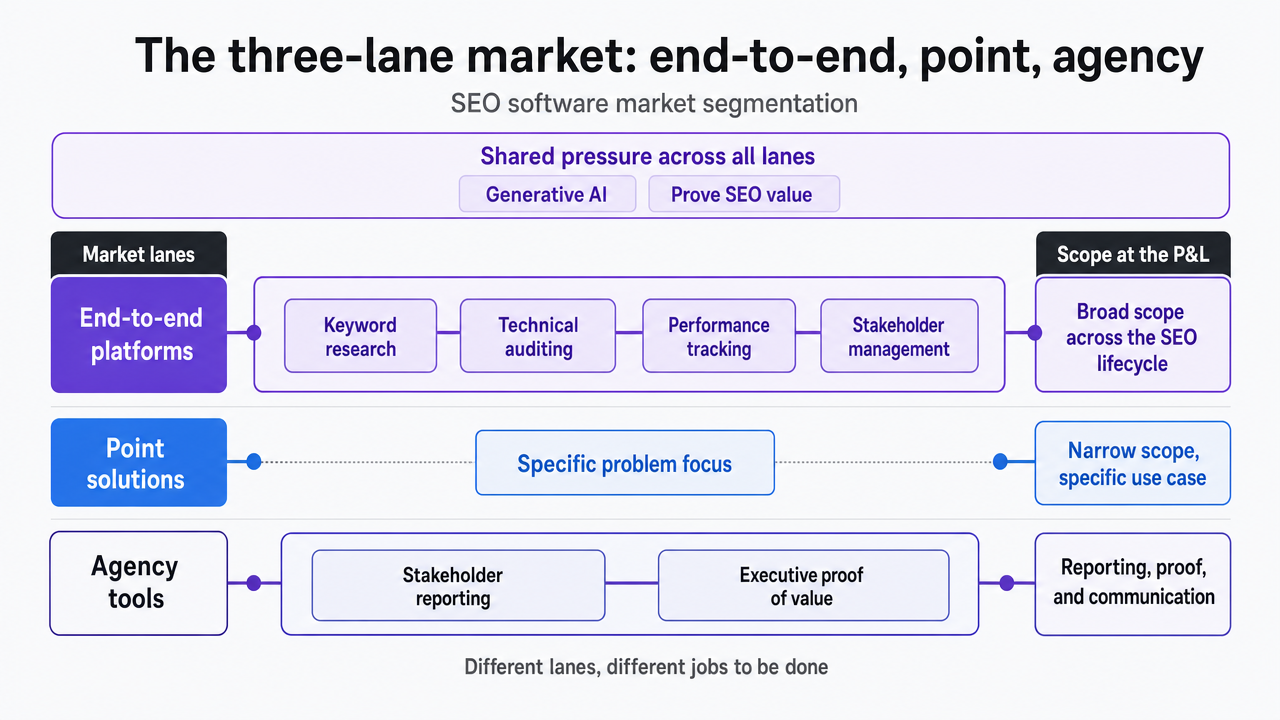 Visualize Forrester's three-lane market segmentation described in this section, giving readers a scannable framework for how end-to-end platforms, point solutions, and agency tools differ in scope
What to stop paying for before adding another seat
Before evaluating a new platform, an agency Head of SEO gets more leverage from auditing what current seats already cover. Forrester's argument for consolidation is blunt: the SEO tools market is ripe for it, and marketers should stop paying separately for capabilities modern platforms have already absorbed 11. Three line items surface repeatedly in agency stack audits.
- Manual rank pulls are the first. When a specialist logs into a rank tracker to export CSVs into a client deck, the tool has failed at the workflow layer. Any platform selected in 2025 should push scheduled rank data directly into the reporting surface the client sees.
- Keyword deduplication and list hygiene are the second. Agencies still pay junior specialists to reconcile keyword sets across a research tool, a tracker, and a content brief. Modern platforms unify the keyword object across those steps.
- Screenshot reporting is the third. Monthly decks assembled by hand consume specialist hours that scale linearly with account count. Retire the seat that only produces screenshots. The savings fund the platform that eliminates the task.
Test SEO workflows at scale with real data
Validate multi-client ranking improvements on live projects before making any commitment.
Seven tools worth an agency's evaluation cycle
Semrush: the end-to-end anchor for portfolio visibility
Semrush earns its place on an agency shortlist because it covers most of the 28 capability criteria Forrester used to evaluate enterprise SEO platforms: keyword research, technical audit, performance tracking, and stakeholder-facing reporting under one login 10. For a Head of SEO managing 40 to 100 accounts, that breadth translates into fewer context switches per specialist and a single source of truth when a client asks why traffic dropped last week.
The portfolio-visibility case is where Semrush pays back its seat cost. Position Tracking, Site Audit, and the Projects layer let a specialist assemble a per-client dashboard once and monitor deviations across the book without re-running work. Backlink Analytics and Keyword Gap sit inside the same account structure, so a competitive review that used to require three tools now lives in one workspace.
The tradeoff is depth. Point solutions win on specific dimensions—a dedicated crawler surfaces more technical detail, a dedicated rank tracker updates more frequently—and Semrush's report exports still need editorial polish before they reach a retainer client. Treat it as the horizontal spine of the stack. Layer point tools where retainer scope demands it, and use the API to push rank and audit data into the reporting surface clients already read.
Ahrefs: the backlink and keyword research spine
Ahrefs sits in the point-solution lane by choice. Its crawl infrastructure and link index are the reason specialists open it, and the platform has expanded around that core rather than trying to become the reporting hub. For an agency that runs competitor gap analyses, disavow reviews, and content-cluster planning across dozens of accounts, Ahrefs behaves like a research spine the rest of the stack calls into.
The workflow economics favor concentration. A senior specialist can complete a link audit, a keyword expansion, and a SERP intent review inside one interface, then hand the outputs to a content lead or a client-services manager for execution. Site Explorer, Keywords Explorer, and Content Explorer share the same underlying index, which removes the deduplication tax that shows up when research is spread across three tools.
Ahrefs does not replace a full technical auditor for JavaScript-heavy stacks, and its rank tracking is competent rather than category-leading. The stakeholder-management gap Forrester flagged as a defining criterion of enterprise platforms is real here 10. Position Ahrefs as the depth tool that feeds the reporting layer, not as the reporting layer itself. Two or three shared seats across a specialist pod typically cover a mid-sized book without the license creep that a per-user tool creates.
Conductor: enterprise stakeholder management for retained accounts
Conductor is built for the retained enterprise account, and it shows up on an agency shortlist when the client roster includes brands whose internal SEO teams need cross-functional visibility. Forrester's Wave graded seven enterprise platforms across 28 criteria spanning keyword research, technical auditing, performance tracking, and stakeholder management, and stakeholder management is the axis where enterprise platforms concentrate value that point tools do not attempt to deliver 10.
That distinction matters at the agency P&L. When a retained client has a product marketer, a web engineering lead, and a category director who all need SEO context, Conductor's role-based views and integrated reporting reduce the number of custom decks the agency assembles each month. The platform's content guidance modules also give in-house writers a shared brief format, which cuts the revision cycles that eat specialist hours.
The cost profile is enterprise. Conductor is not the tool an agency deploys across a long tail of small accounts, and its ROI compresses when the client lacks the internal stakeholders the platform was designed to coordinate. Reserve it for the top decile of accounts by retainer size, where stakeholder-management workflow and executive-grade reporting justify the seat spend and displace the internal reporting burden the agency would otherwise carry.
Screaming Frog: the point solution for technical audit depth
Screaming Frog is the technical crawler that agency SEO teams keep on the desktop even when an end-to-end platform covers audit basics. It is a point solution in the strictest sense: no reporting layer, no stakeholder view, no client login. What it offers is crawl depth that horizontal platforms trade away for breadth.
For an agency, the utility is concentrated in three workflows:
- Migration QA
- Log-file correlation
- Diagnostic sweeps when a horizontal audit surfaces a symptom without a root cause
A specialist can configure custom extraction, JavaScript rendering, and structured data validation in a single crawl, then export findings into whatever reporting surface the client sees.
Two operational notes shape how it sits in the stack. Screaming Frog runs locally, which means crawl scale is bound to the specialist's machine and licenses attach to seats rather than accounts. Budget one license per technical SEO on staff, not per client. Pair it with a horizontal platform that handles scheduled monitoring, and reserve Screaming Frog for the deep-dive work that justifies a senior specialist's hour rate. It retires the seat of any generic crawler that duplicates its function without matching its depth.
AccuRanker: rank tracking as a precision utility
AccuRanker is a rank tracker in a market where end-to-end platforms have absorbed rank tracking as a feature. It earns shortlist attention because precision and refresh frequency still matter for a subset of agency work: volatile verticals, SERP-feature monitoring, and accounts where the client's own team checks rankings daily and expects the agency's numbers to match.
Forrester's argument that rank tracking alone no longer justifies enterprise SEO spend is the correct frame 11. AccuRanker responds to that reality by treating rank data as a utility layer other tools call into. Its API and integrations feed rank series into reporting platforms, BI tools, and content-optimization workflows, which is how an agency gets the accuracy without carrying a second full reporting stack.
The practical positioning inside an agency: use AccuRanker where the horizontal platform's tracking cadence or SERP-feature coverage falls short, and route the data downstream rather than opening a second client dashboard. On a 60-account book, that usually means a subset of enterprise or high-volatility clients, not the entire portfolio. Where the horizontal platform's tracking is sufficient, adding AccuRanker is duplicative and hard to defend at renewal.
AgencyAnalytics: reporting layer for multi-client delivery
AgencyAnalytics sits in Forrester's third lane: agency tools built for the delivery layer rather than for research or auditing 7. Its job is to consolidate data from the rank trackers, crawlers, analytics platforms, and ad accounts an agency already runs, then produce client-facing dashboards and scheduled reports without a specialist rebuilding the deck each month.
The throughput math is straightforward. If a specialist spends four hours per client per month assembling and formatting a report, a 40-account book absorbs 160 specialist hours in reporting alone. A reporting layer that pulls the same data automatically and applies a template compresses that number toward the review and commentary step, which is the part clients actually pay for.
The limits are worth naming. AgencyAnalytics does not generate new insight; it displays data other tools produce. If the underlying rank tracker or crawler is thin, the report is thin. It also does not replace the strategic narrative a senior lead writes on top of the numbers. Treat it as the surface layer that retires the screenshot-and-paste seat, freeing specialists to spend their hours on the analysis clients renew for rather than the formatting they never notice.
Vectoron: workflow orchestration across the execution loop
Vectoron enters the shortlist in a different lane than the other six. It is not a rank tracker, a crawler, or a reporting surface. It is a workflow-orchestration platform that coordinates specialist AI strategists across content, SEO, PPC, backlinks, social, and call intelligence, with a Command Center that routes every recommendation through human approval before execution. That framing maps to Forrester's observation that the SEO market is now split between end-to-end platforms, point solutions, and agency tools all racing to keep pace with generative AI and prove SEO's value 8.
For an agency Head of SEO, the practical question is what work the orchestration layer absorbs. Signals from live client data—qualified calls, bookings, cost per lead, pipeline—feed ranked recommendations that a specialist approves or rejects, and approved work executes without the briefing cycles and vendor handoffs that consume specialist hours in a traditional stack. The seat economics shift from per-tool licenses toward accounts-per-specialist capacity, which is the metric ownership tracks.
The tradeoffs are the ones any orchestration layer carries. It sits on top of data other tools produce, so the rank, audit, and analytics feeds still need to be reliable. And it changes the specialist's job from execution to review, which requires QA discipline the agency has to build. It retires the coordination overhead, not the judgment.
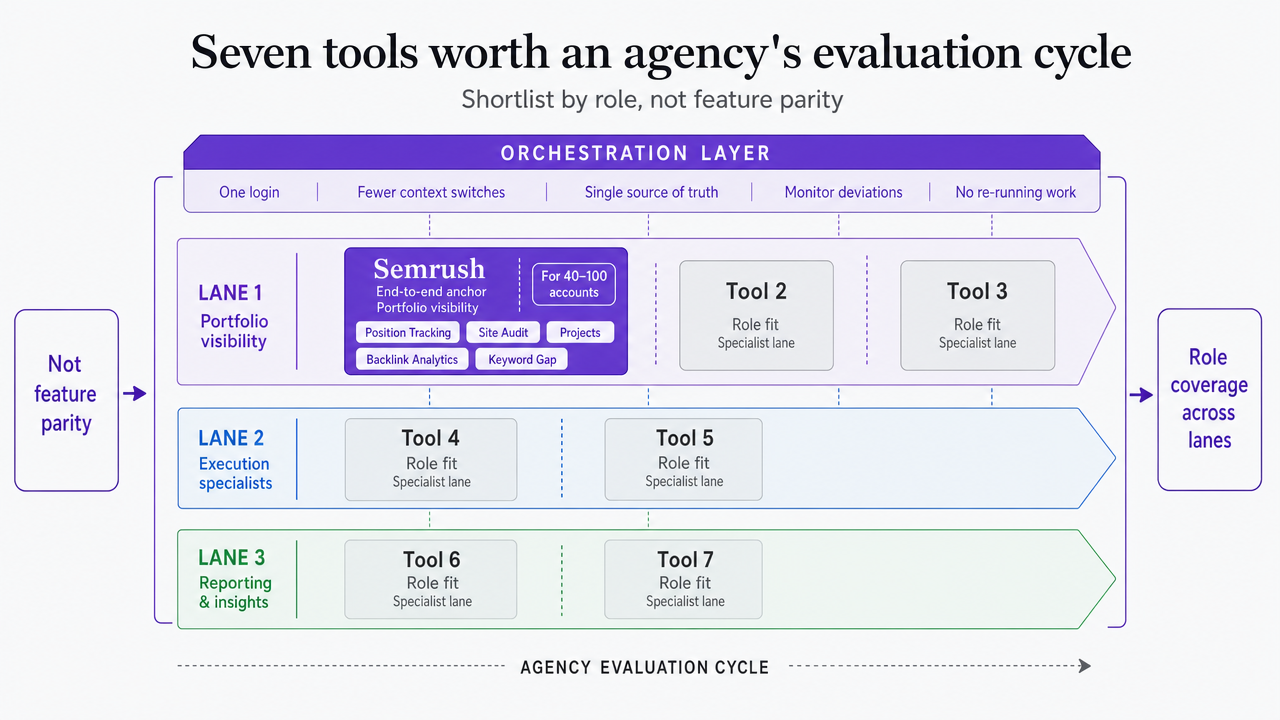 Show how the seven recommended tools stack across the three market lanes plus an orchestration layer, reinforcing the article's core thesis that the shortlist is composed by role, not feature parity
Stack economics: mapping seats, hours, and consolidation potential
The defendable number an agency Head of SEO brings to ownership is not tool cost. It is accounts per specialist per month, and the workflow hours behind each account. Forrester puts enterprise organic search spend between $100,000 and $500,000 annually and argues the market is ripe for consolidation because much of that budget is spread across overlapping point tools 11. For a 60-account agency book, the same logic scales down: every duplicated seat is an hour of specialist time that could have absorbed another client.
The table below breaks the retainer stack into five categories and leaves the dollar figures as variables the agency fills in against its own contracts. The point is not the total. It is the direction of consolidation once the horizontal platform, the research spine, and the reporting layer are in place.
| Category | Typical seats per specialist | Workflow hours per client per month | Consolidation potential |
|---|---|---|---|
| Rank tracking | 1 (often duplicated in horizontal platform) | 1–2 | High — absorbed by horizontal or reporting layer |
| Technical audit | 1 shared crawler + 1 horizontal | 2–4 | Medium — keep point crawler for depth |
| Content optimization | 1–2 per specialist | 3–6 | High — unify keyword object and brief |
| Backlink monitoring | 1 shared research spine | 1–2 | High — one index feeds the pod |
| Reporting | 1 delivery-layer seat | 3–5 | High — retires screenshot assembly |
Two lines drive the math. Reporting and content optimization together consume the largest share of monthly hours, and both consolidate cleanly. Move those hours off the specialist calendar and the accounts-per-specialist ratio moves with them — which is the metric ownership actually tracks against the seat spend.
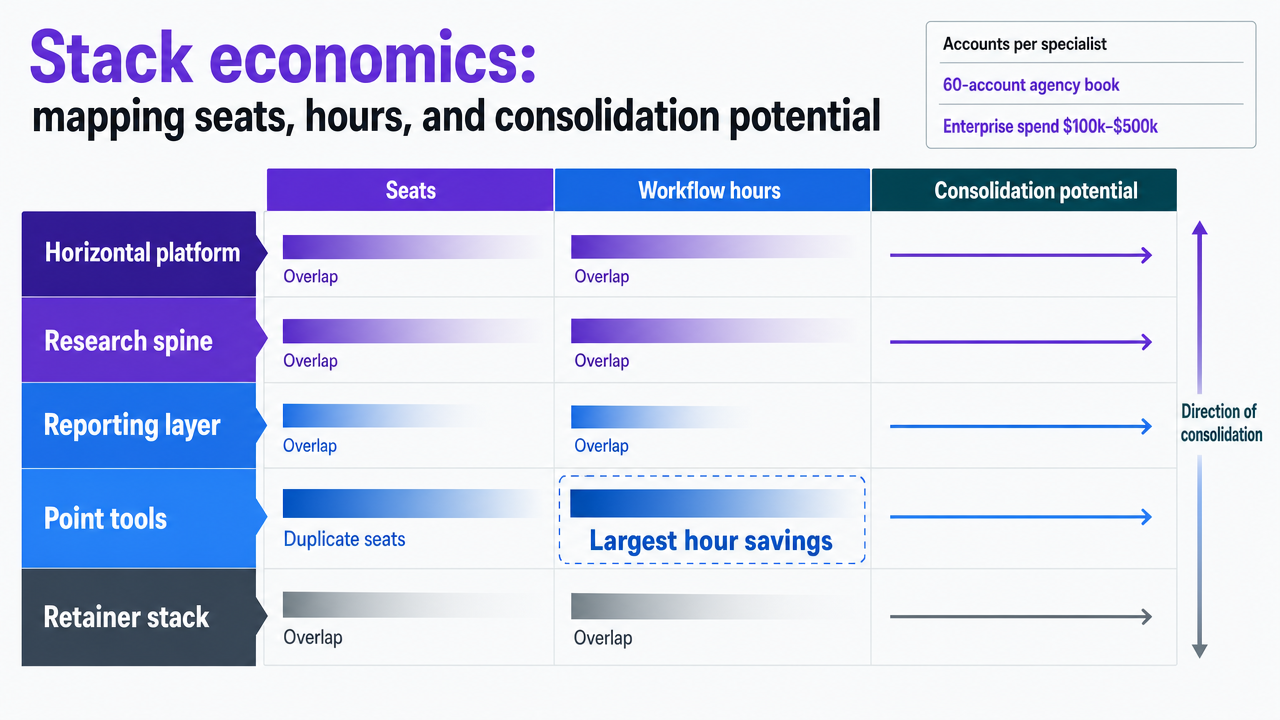 Translate the section's table of five stack categories, workflow hours, and consolidation potential into a visual reference that reinforces where the largest hour savings sit
Generative search readiness as a selection criterion
The SERP a rank tracker measured in 2022 is not the SERP a client sees in 2025. Forrester's coverage of generative AI in search argues that genAI is reshaping how buyers discover brands and reviving the strategic case for SEO, which means the platforms an agency selects now have to account for AI Overviews, cited passages, and generative answer surfaces alongside the classic ten blue links 9. A tool that only tracks organic position and ignores generative eligibility signals is measuring a shrinking share of the visibility surface.
Two questions separate the shortlist. First, does the platform surface which pages and passages are being cited or summarized in AI answer surfaces, and does it flag structured-data or content-format gaps that make a page ineligible? Second, does the reporting layer distinguish AI-influenced impressions from classic organic clicks so a client's monthly deck reflects the real visibility mix?
Forrester's own framing is that vendors across every lane are racing to keep pace with genAI while proving SEO's value to executives 8. Treat generative-search readiness as a scoring criterion in the RFP, not a roadmap promise the vendor plans to ship later.
See How Leading Agencies Streamline SEO Ranking Analysis at Scale
Request a walkthrough of unified SEO ranking workflows proven to reduce manual tracking, accelerate reporting, and maintain quality oversight—even across hundreds of client projects.
If you manage a multi-location or franchise portfolio
The shortlist logic shifts when the reader is a portfolio operator running SEO across 30, 200, or 800 locations under one or more brands. Forrester's Q1 2025 Landscape flags multi-location as a distinct use case in the vendor mix, and the reason is operational: the unit of work is the location, not the client, and the reporting hierarchy has to roll up by region, brand, and franchisee without a specialist rebuilding it each cycle 7.
Three capabilities move up the priority list:
- Location-level rank and visibility tracking that segments by market rather than aggregating to a brand average that hides underperformers.
- Template-driven technical audits that flag the same schema, hreflang, or NAP error across the portfolio in one pass.
- Permissioned reporting that lets a franchisee see their own location without exposing the full network.
Horizontal platforms cover the first two adequately at scale. The permission layer is where agency tools and orchestration platforms earn their seat, because that is the workflow a single-account platform was not built for.
AI content quality and disclosure inside the SEO stack
Once AI is producing briefs, drafts, or on-page recommendations inside the SEO stack, two questions move from theoretical to operational. Is the output measurably good, and is what ships to the client legally clean?
NIST's Generative AI Evaluation Program treats output quality as a measurable property, not a vendor claim. The text evaluation task assesses whether AI-generated writing is distinguishable from human writing and how believable it reads, which is the closest public benchmark an agency has for scoring the content its stack produces 5, 6. Build the same discipline into the QA checklist: sample outputs weekly, score them against a rubric, and treat model drift as a defect the specialist flags, not a mystery.
Disclosure is the second question. When AI-assisted content includes reviews, testimonials, or endorsement language a client publishes, the FTC's revised Endorsement Guides govern what has to be disclosed, including for fake reviews and synthetic personas 2, 3. The agency's role is to keep that boundary visible in the workflow, so approved copy carries the disclosures the client's counsel would require before it reaches the site.
Frequently Asked Questions
References
- 1.Endorsements, Influencers, and Reviews.
- 2.Revised FTC Endorsement Guides.
- 3.16 CFR Part 255: Guides Concerning the Use of Endorsements and Testimonials in Advertising.
- 4.AI measurement and evaluation.
- 5.Generative Artificial Intelligence Evaluation Program (GenAI).
- 6.GenAI - text-2026 - NIST AI Challenges.
- 7.The Search Engine Optimization Solutions Landscape, Q1 2025.
- 8.SEO Must Solve Its Marketing Problem.
- 9.GenAI Reshapes Shopping And Revives SEO.
- 10.The Forrester Wave™: SEO Platforms, Q3 2020.
- 11.Every Company Needs An SEO Platform.