
Key Takeaways
- Google Search Console is the pre-click ground truth for impressions, clicks, CTR, and position, and should reconcile any conflicting data from commercial rank trackers 1.
- Bing Webmaster Tools adds a free, independent second data set that captures queries feeding Copilot and ChatGPT search surfaces, widening total visibility reporting 7.
- Ahrefs contributes portfolio-scale keyword depth and content gap analysis, though its sampled positions should defer to Search Console query data during reconciliation 1.
- Semrush's Position Tracking produces a volume-weighted visibility percentage that resists cherry-picking and anchors renewal conversations in competitor market share.
- AccuRanker's daily refresh with SERP feature detection separates genuine ranking losses from layout shifts like AI overviews, which matters during client incident response 12.
- STAT Search Analytics handles enterprise-scale portfolios by segmenting keyword sets by intent, location, device, and SERP feature for share-of-voice reporting 1.
- Profound and peer GEO trackers measure citation prominence in AI answer surfaces using experimental metrics that should be reported as leading indicators, not ROI inputs 14.
- GA4 turns ranking movements into revenue claims by joining qualified organic sessions, conversion rates, and assisted paths that last-click reporting systematically understates 6.
- HubSpot and Salesforce close the loop by receiving GA4 attribution on lead records and crediting closed-won revenue back to organic touches over a rolling twelve-month window 8.
- Dreamdata and multi-touch attribution platforms assign fractional credit across buyer journeys, producing the organic contribution number that survives CFO review 13, 15.
- Vectoron coordinates execution by translating Search Console and GA4 signals into ranked recommendations that carry strategic reasoning and require human approval before shipping 1.
Why Rank Data Alone Stopped Winning Retainer Renewals
Position tracking used to carry the quarterly review. A movement from page two to position four was enough evidence that the retainer was working. That era is closing. Procurement teams, in-house marketing leads, and CFOs now ask a sharper question: what did that ranking change contribute to pipeline?
The reporting gap is well documented. Google's own guidance separates pre-click metrics such as impressions, clicks, CTR, and position from post-click behavior including sessions, engagement, and conversions, and treats the two views as complementary rather than interchangeable 1. A rank tracker that stops at position tells one half of that story. When a client asks why organic sessions rose but demo requests did not, position data cannot answer.
Industry frameworks have moved with the question. Practitioner guides now define SEO program ROI as revenue attributed to organic search minus program cost, divided by program cost, and specify a working stack of Search Console, GA4, and CRM data to compute it 8. Academic work reinforces the point: analytics-based studies link SERP positioning to sales revenue, not to rankings in isolation 11. For agency heads defending a book of 15 to 80 accounts, the operative question is which ranking tools shorten the distance between a keyword movement and a defensible revenue number.
The Scoring Rubric: From Position Change to Closed-Won Revenue
Before evaluating any tool, delivery leads need a rubric that mirrors how clients now judge the retainer. The formal definition of SEO program ROI, expressed as (Revenue attributed to organic search − SEO program cost) ÷ SEO program cost, sets the terminal metric 8. The academic ROI formulation is identical in structure: profit over cost, applied to search programs 5. Everything upstream of that number is instrumentation.
Four axes matter when scoring an SEO ranking tool against that rubric:
- The first is rank data fidelity: how accurately the tool captures position, SERP feature presence, and query-level movement without smoothing away volatility.
- The second is GSC and GA4 integration depth, because Google's own guidance treats Search Console pre-click data and Analytics post-click behavior as complementary halves of a single measurement view 1.
- The third is revenue attribution support, meaning how directly the tool feeds, or plugs into, a stack that maps qualified sessions to conversion rate and lead value in GA4 and CRM 4.
- The fourth is multi-client scalability: whether the tool holds up across 15 to 80 accounts without manual reconciliation on every report.
The rubric produces a stack, not a shortlist. Source-of-truth data platforms sit at the base. Commercial rank trackers and visibility platforms sit above them. A revenue and attribution layer sits on top and translates position deltas into pipeline and closed-won numbers. The ten entries below are placed inside that stack rather than ranked against one another, because a rank tracker and an attribution platform are not substitutes. Each tool is judged on how much it compresses the distance between a keyword movement and a defensible client ROI number.
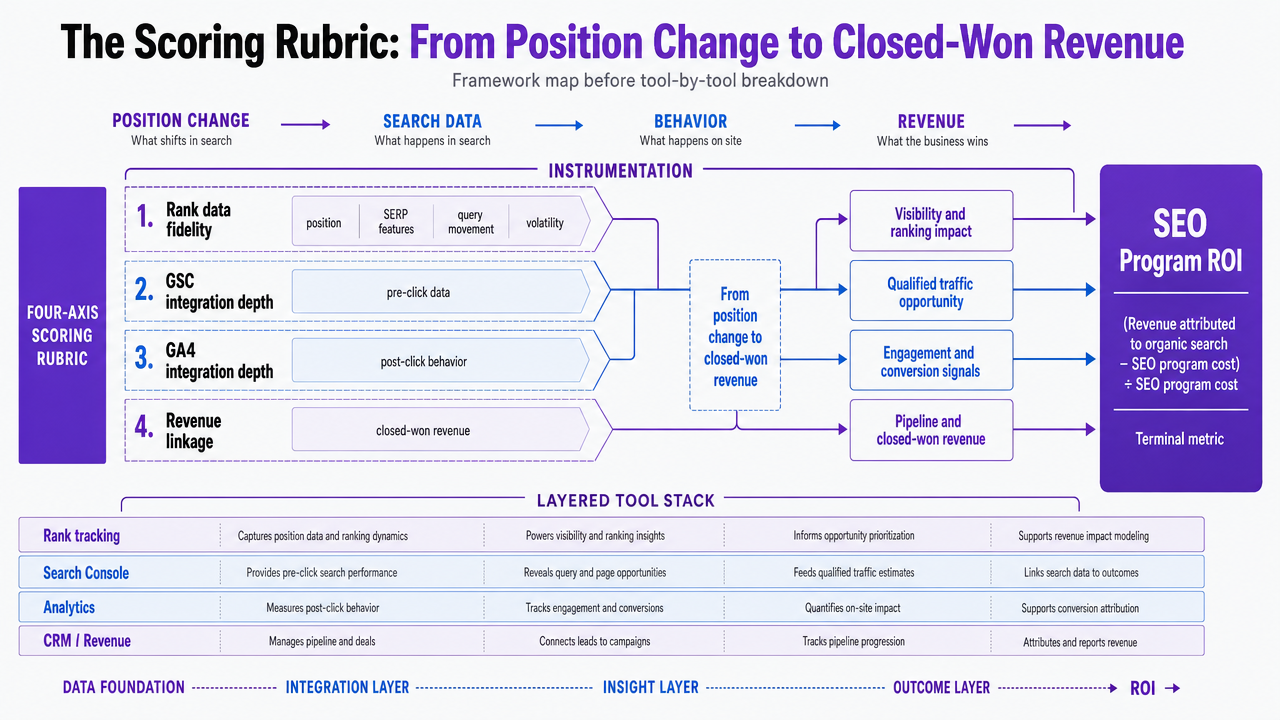 Visualize the four-axis scoring rubric and the layered tool stack described in this section, giving readers a framework map before the tool-by-tool breakdown
The Source-of-Truth Data Layer
Google Search Console: The Pre-Click Ground Truth
Every commercial rank tracker calibrates against, contradicts, or resells the data Google itself publishes. Search Console is the only source that reports impressions, clicks, CTR, and average position drawn from the query stream Google actually served 1. Third-party trackers sample SERPs; Search Console reports what happened.
That matters for retainer defense because CTR is where a position claim either survives or collapses. Practitioner benchmarks put healthy organic CTR at roughly 3 to 5 percent for non-branded commercial keywords and 20 to 40 percent for branded queries 8. A client account showing position gains without CTR movement in the non-branded 3 to 5 percent band is a signal that the tracked ranking is either below the fold, sitting under an AI overview, or capturing a query with weak commercial intent. Delivery leads who anchor reporting to Search Console query data catch this before the client does.
The operational read: treat Search Console as the pre-click ledger against which every commercial rank tracker is reconciled. When Semrush or Ahrefs reports a jump the query report cannot corroborate, the query report wins.
Bing Webmaster Tools: The Overlooked Second Data Set
Bing Webmaster Tools rarely appears in agency stack diagrams, and that omission costs reporting teams a second, independent view of query data. Practical audit blueprints now pair Search Console with Bing Webmaster Tools to widen the picture of keyword rankings, impressions, clicks, and click rates before layering on-site behavior data 7. The two data sets are not redundant. Bing captures queries that Copilot and ChatGPT search surfaces increasingly draw from, which means a share of AI-mediated discovery routes through Bing's index before it reaches a client's site.
For agency heads managing 15 to 80 accounts, Bing Webmaster Tools is free, API-accessible, and adds a compliance layer to any claim about total organic visibility. When a quarterly review asks whether traffic loss is Google-specific or search-wide, the Bing query report answers in minutes.
The Commercial Rank Tracking Layer
Ahrefs: Index Freshness and Keyword Portfolio Depth
Ahrefs earns its place in an agency stack on the strength of its crawl cadence and the size of its keyword database. For delivery leads managing 30 to 80 accounts, the operational value is portfolio breadth: a single project can hold thousands of tracked keywords across brand, non-brand, and competitor sets without the manual grooming smaller trackers demand.
The reporting caveat is that Ahrefs positions are sampled, not observed. When a Search Console query report shows a client sitting at position 4.2 for a commercial term and Ahrefs shows position 6, the query report is closer to what Google actually served 1. Treating Ahrefs as the discovery and competitive-gap layer, and Search Console as the reconciliation layer, resolves that tension without discarding either data set.
Where Ahrefs shortens the distance to ROI is content gap analysis at scale. Feeding its Top Pages and Content Gap outputs into a GA4 view filtered to organic sessions surfaces which uncaptured queries are most likely to convert on existing page templates 4.
Semrush: Position Tracking Tied to Visibility Percentage
Semrush's Position Tracking module reports a visibility percentage that weights each tracked keyword by its search volume and current rank, producing a single portfolio-level number that clients can follow across quarterly reviews. That aggregation is useful precisely because it resists cherry-picking. A visibility score that rises while a handful of head terms fall tells a more honest story than a slide showing only the wins.
The instrumentation gap sits downstream. Visibility percentage is a leading indicator; it does not, on its own, feed the SEO ROI calculation. Reporting teams should pair the Semrush visibility trend with the GA4 organic-sessions-to-conversion path so a rising visibility number is either corroborated by qualified sessions and lead volume or flagged as a mismatch 4. Practitioner guides describe this pairing as the working method for isolating organic revenue and matching it against program cost 6.
For agency heads, Semrush's operational strength is competitor visibility comparison inside the same module, which anchors renewal conversations in relative market share rather than absolute position.
AccuRanker: SERP Volatility and Daily Refresh Fidelity
AccuRanker specializes in one job: daily, on-demand rank refreshes with SERP feature detection. For agencies whose clients occupy volatile verticals such as legal services, home services, or behavioral health, the refresh cadence matters. A weekly tracker averages away the intraday movement caused by algorithm updates and AI overview rollouts; a daily refresh catches it.
The reporting utility shows up during incident response. When a client emails on a Tuesday asking why sessions dropped overnight, AccuRanker's daily grain lets the delivery lead separate a genuine ranking loss from a SERP layout change that pushed the blue link below an AI overview. Systematic literature confirms that ranking and CTR remain valid experimental indicators of SEO impact, which is why capturing the day the position moved, rather than the week, is what makes the causal claim defensible 12.
Where AccuRanker stops being useful is revenue reconciliation. It reports position, not pipeline, and must be paired with GA4 and CRM data to translate volatility into cost or revenue impact.
STAT Search Analytics: Enterprise SERP Segmentation at Scale
STAT is built for keyword portfolios in the tens of thousands, which is why enterprise agencies and in-house teams at national brands adopt it. Its differentiator is segmentation: any tracked keyword set can be sliced by intent, location, device, or SERP feature and reported as its own share-of-voice trend. For a delivery lead running a book of multi-location clients, that segmentation lets a single project answer questions at the metro, category, and intent levels without exporting to a spreadsheet.
The pre-click view STAT produces maps cleanly onto Search Console's impression and position data, which Google's own documentation frames as the pre-click half of a complete organic measurement view 1. STAT does not replace Search Console; it segments the pre-click surface at a granularity Search Console does not natively support.
The operational read: STAT earns its cost when a client roster demands share-of-voice reporting by segment. Below that scale, AccuRanker or Semrush cover the same territory with less overhead.
Prove ranking gains with real published data
Test full SEO workflow and track measurable ranking changes on live client sites—no commitment required.
The AI Search Visibility Layer
Profound and Peer GEO Trackers: Measuring Citation Prominence
A rising share of client discovery now happens inside AI answer surfaces where the ten blue links never render. Traditional rank trackers do not see this territory. A new class of generative engine optimization trackers, including Profound and its peers, monitors whether client domains appear in AI-generated responses across ChatGPT, Perplexity, Gemini, and Copilot, and how prominently they are cited.
The measurement primitive is different from a SERP position. Recent methodology work defines visibility in AI search as the frequency and prominence of brand mentions inside generated responses, and proposes position-adjusted citation prominence and subjective source relevance as the working metrics 14. A domain cited first in a Perplexity answer for a commercial query is closer to a position-one blue link than to a position-eight one, but neither Ahrefs nor Semrush will report it.
The candid caveat: these metrics are experimental, and there is no consensus yet on how citation prominence translates into qualified sessions or revenue 14. For agency heads, the operational read is to track AI citation share on a defined query set per client, report it alongside traditional rankings, and flag it as a leading indicator rather than a ROI input. Ignoring the layer leaves a growing blind spot in the retainer review; over-claiming its revenue contribution invites the same scrutiny that killed vanity-metric reporting.
The Revenue Reconciliation Layer
GA4: Qualified Sessions, Conversions, and Assisted Paths
GA4 is where a ranking movement becomes a revenue claim. The reporting model treats Search Console as the pre-click view and GA4 as the on-site view of sessions, engagement events, and conversions, and Google's own guidance frames the two as complementary halves of a single measurement surface 1. For agency reporting, that pairing is the mechanism that turns a position gain into a qualified-session count tied to a defined conversion.
The B2B ROI model that most delivery teams now run through GA4 connects three variables: qualified organic sessions, conversion rate on those sessions, and average lead value drawn from CRM 4. A monthly report that shows position gains for a target keyword cluster, a matching lift in qualified sessions to the mapped landing pages, and a stable conversion rate produces a defensible revenue number without invention.
Assisted paths are where reporting either gains or loses credibility. GA4 attribution reports credit organic search for touches that precede a final paid or direct conversion, and practitioner guides recommend explicitly modeling those assisted conversions rather than reporting last-click alone 6. Delivery leads who ignore assisted paths systematically understate organic contribution on longer B2B cycles.
HubSpot and Salesforce: Closing the Loop to Pipeline
The retainer question is never about sessions. It is about pipeline and closed-won revenue, and that view lives in the CRM. The working stack for SEO program ROI is Search Console, GA4, and a CRM platform such as HubSpot or Salesforce, with organic-attributed revenue divided by program cost to produce the reported number 8.
Two integration mechanics matter:
- The first is passing GA4 client IDs and first-touch source data into CRM lead records, so a demo request tagged organic in GA4 arrives in Salesforce with the same attribution intact.
- The second is defining a rolling window, typically twelve months, over which closed-won revenue is credited back to organic touches 8. Without that window, long sales cycles produce ROI numbers that swing wildly month to month and invite the wrong renewal conversation.
For agency heads, the operational read is that the CRM integration is not a nice-to-have on top of a rank tracker. It is the layer that converts qualified sessions from GA4 into pipeline and closed-won values a client CFO will accept.
Dreamdata and Attribution Platforms: Multi-Touch Credit for Organic
Multi-touch attribution platforms such as Dreamdata sit above GA4 and the CRM, and their job is to assign fractional credit across every touch in a buyer journey rather than defaulting to first or last click. The methodology is well established. Google Research describes multi-touch attribution as a framework that estimates the relative contributions of the multiple touches a user encounters prior to conversion, and the same approach transfers directly to journeys that mix organic search, paid, email, and direct visits 13.
The commercial case for adding this layer is quantified. Synthesized industry guidance drawing on Gartner reports that organizations implementing comprehensive marketing attribution models see 37 percent higher marketing ROI, and that companies using advanced attribution models report 15 to 30 percent efficiency gains and 15 to 30 percent lower customer acquisition costs 15. The scope on those figures matters: they describe organizations running comprehensive attribution programs, not the general market.
For agency heads, this is where retainer defense actually happens. A rank tracker alone cannot answer why closed-won revenue moved. An attribution layer, feeding on GSC pre-click data, GA4 behavior, and CRM outcomes, produces the fractional organic contribution number that survives a CFO review. Practitioner guidance specifically recommends W-shaped attribution for B2B accounts as a more honest read of organic's role than last-click 6.
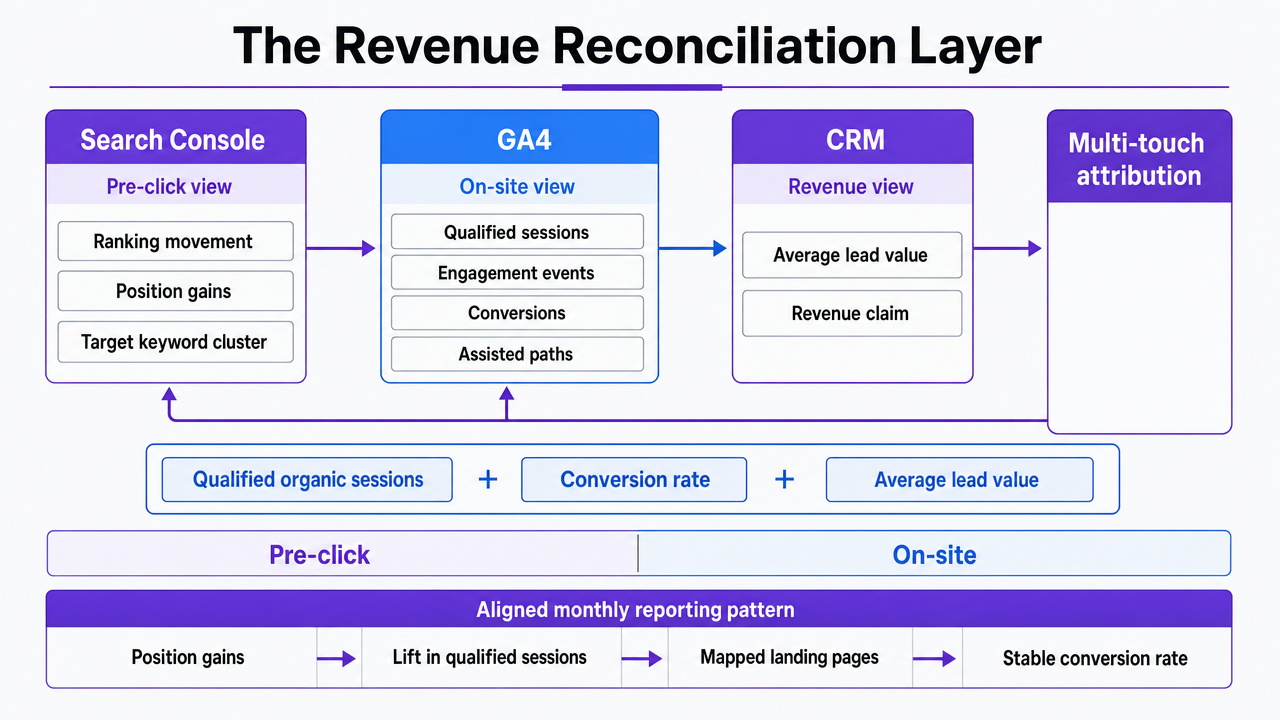 Map the closed-loop data flow from pre-click ranking signals through GA4 behavior into CRM revenue and multi-touch attribution, which is the operational spine of this section
The Execution Coordination Layer
Vectoron: Connecting Ranking Signals to Approved Delivery
A rank tracker reports what moved. A GA4 view reports what happened next. Neither answers the question that consumes the second half of most delivery weeks: which piece of content, technical fix, or internal linking change actually ships against the position that slipped, and who approved it. That coordination gap is where retainer margin quietly erodes across a book of 15 to 80 accounts.
Vectoron sits at that layer as an AI marketing execution platform with specialist strategists for content, SEO, PPC, backlinks, social, and call intelligence, coordinated through a Command Center approval workflow. It reads live signals from the same measurement stack the rest of this shortlist feeds, including Search Console pre-click data and GA4 post-click behavior 1, and translates a keyword movement or a conversion-rate drop into a ranked queue of recommendations. Every recommendation carries the strategic reasoning behind it and waits for human sign-off before execution.
The operational read for agency heads: this is not a rank tracker substitute. It is the layer that shortens the distance between a signal surfaced in AccuRanker or Semrush and an approved deliverable landing on a client site, which is where the ROI formula finally closes.
See How Leading Agencies Quantify SEO ROI With Unified Ranking Tools
Request a custom walkthrough of advanced SEO ranking and reporting workflows that connect platform data directly to client ROI—purpose-built for agency teams managing multi-client portfolios.
The Ten-Tool Scoring Matrix
The rubric introduced earlier scores each tool on rank data fidelity, GSC and GA4 integration depth, revenue attribution support, and multi-client scalability, using a 1 to 5 scale where 5 indicates the tool is a primary source for that axis and 1 indicates the axis is out of scope 1, 4, 6, 8.
| Tool | Layer | Rank Fidelity | GSC/GA4 Depth | Revenue Attribution | Multi-Client Scale |
|---|---|---|---|---|---|
| Google Search Console | Data | 5 | 5 | 2 | 4 |
| Bing Webmaster Tools | Data | 4 | 2 | 1 | 3 |
| Ahrefs | Rank | 3 | 3 | 2 | 5 |
| Semrush | Rank | 3 | 3 | 2 | 5 |
| AccuRanker | Rank | 5 | 3 | 1 | 4 |
| STAT | Rank | 4 | 3 | 1 | 5 |
| Profound (GEO) | AI Visibility | 2 | 1 | 1 | 3 |
| GA4 | Revenue | 1 | 5 | 4 | 4 |
| HubSpot/Salesforce | Revenue | 1 | 3 | 5 | 4 |
| Dreamdata | Revenue | 1 | 4 | 5 | 3 |
Read the matrix as a stack diagnostic, not a leaderboard. No single row scores 5 across all four axes, which is the point: proving ROI requires selections from each layer, not a champion tool.
Where Ranking Tools Stop Being Useful
Every tool in this shortlist has a ceiling, and delivery leads who miss it lose renewals. Ranking tools stop being useful at the boundary between position data and the conversion event that follows. A tracker can prove a client moved from position 8 to position 3. It cannot prove that movement generated a demo request, a booked call, or a signed contract.
The reporting gap is structural. Search Console reports impressions, clicks, CTR, and position; GA4 reports sessions, engagement, and conversions; the two views must be joined at the landing-page level to produce a single organic performance picture 1. A CRM must sit downstream of that join to convert conversions into pipeline and closed-won revenue 8. When any layer is missing, the ROI number is either fabricated or absent. Systematic reviews of experimental SEO studies confirm that rankings, CTR, and traffic remain valid leading indicators, not terminal metrics 12. The operational read for agency heads: budget the rank tracker, but budget the analytics and attribution layers alongside it, because the retainer is defended at the revenue layer, not the position layer.
If the Book Includes Multi-Location Clients
A scope note for delivery leads managing multi-location rosters: the stack described above holds, but the segmentation layer becomes non-negotiable. A dental group with 40 practices, a home services franchisor with 120 territories, or a behavioral health network with 25 clinics cannot be reported on at the domain level. The pre-click view has to be sliced by location before it means anything to the client.
Search Console supports property-level and URL-prefix segmentation, which lets reporting teams isolate impressions, clicks, CTR, and position by location page cluster 1. STAT and, at smaller scale, AccuRanker extend that segmentation to tracked keyword sets by metro. GA4 then joins those pre-click segments to location-specific conversion events, and the CRM credits the closed-won revenue back to the originating location 8. Without that per-location join, the ROI number reported for the parent brand hides the three underperforming markets that will surface in the next quarterly review.
Frequently Asked Questions
References
- 1.Using Search Console and Google Analytics Data for SEO.
- 2.Deeper Integration of Search Console in Google Analytics.
- 3.Measuring SEO Performance 101: Metrics.
- 4.Google Analytics and SEO: Managing Your Organic Traffic (2026).
- 5.Comparing the Return on Investment of Search Engine Marketing and Search Engine Optimization.
- 6.SEO ROI: How to measure and prove organic search value.
- 7.How to Audit Your Organic Search SEO Performance.
- 8.Calculating SEO Program ROI.
- 9.Search engine Performance optimization: methods and techniques.
- 10.Harnessing Search Engine Optimization experience to enhance the visibility of websites.
- 11.Evaluating SEO effectiveness using Google Analytics metrics.
- 12.Systematic Literature Review: Implementasi Search Engine Optimization.
- 13.A Time To Event Framework For Multi-touch Attribution.
- 14.Don't Measure Once: Measuring Visibility in AI Search (GEO).
- 15.Marketing Attribution That Actually Works.