
Key Takeaways
- Screaming Frog delivers benchmark JavaScript rendering and transparent methodology, but its desktop architecture caps usefulness around 15 concurrent audits before agencies need sharding or a cloud crawler 12.
- Sitebulb wins on rating transparency by exposing the rule and priority band behind every hint, scoring 7.2/10 in weighted evaluations and easing client defense of audit grades 6.
- Semrush Site Audit adds an AI Search Health axis covering structured data, entity clarity, and answer-engine surfaces, which matters for agencies fielding AI Overviews questions 7.
- Ahrefs Site Audit prioritizes throughput, recomputing Health Scores quickly across large content portfolios so strategists managing 20+ accounts can ship reports faster 7.
- Google Search Console provides no composite score but remains the free ground-truth layer for indexation, Core Web Vitals field data, and structured data validity 16.
- Lumar handles enterprise-scale crawls with a documented severity model and rendered-vs-raw comparison, though credit-based pricing penalizes agencies with unpredictable onboarding volume 9.
- SE Ranking covers multi-client dashboards, rank tracking, and automated auditing at pricing that fits the 10–30 client tier, with credible JS-rendered auditing for mid-market sites 9.
- DeepCrawl-class cloud crawlers score 8.1/10 in weighted evaluations, outperforming desktop tools on scale ceiling and reporting speed once portfolios pass 30 clients 6.
- Vectoron does not generate its own rating but ingests scores from other tools and routes ranked recommendations through approval workflows, improving cost per shipped recommendation 13.
Why 'rating tools' deserve their own shortlist
Most agency shortlists often combine platforms that provide SEO data with those that offer a definitive rating, such as a site health score or audit grade. This distinction is crucial for agencies managing multiple clients. When a strategist handles numerous accounts, the score itself becomes a key deliverable, and its underlying methodology underpins the audit's credibility.
Agencies expanding their client base without increasing headcount typically standardize on tools with transparent scoring logic that can be applied across diverse client portfolios 12. This requires robust crawl fidelity for JavaScript-rendered sites, clear weighting behind composite scores, and multi-client dashboards that support quarterly retention reviews 10. A simple feature list doesn't address these operational needs.
This review evaluates nine tools—eight established rating platforms and one approval-workflow layer that processes their output—using a consistent five-axis rubric. The rubric is detailed in the following section, allowing readers to adjust its weighting based on their specific portfolio composition. Research has shown that structured, multi-criteria scoring yields different rankings compared to popularity-based lists 14. This review aims to apply a similar rigorous evaluation tailored to agency operating conditions.
The five-axis rubric behind every score in this review
Each tool in this shortlist is assessed using the same five criteria. The assigned weighting is justifiable but can be adjusted; the composite score can change significantly if a portfolio primarily consists of JS-heavy SaaS sites or multi-location service brands. The rubric is designed for re-weighting rather than strict adherence.
- 1. Crawl fidelity (25%). This axis evaluates whether the tool renders JavaScript using a current Chromium build, compares the rendered DOM against raw HTML, and supports custom data extraction via XPath or CSS selectors. Without accurate rendered-DOM parity, ratings for Single-Page Application (SPA) and JavaScript-framework properties are inherently unreliable 3, 9.
- 2. Rating methodology transparency (20%). This criterion assesses how clearly a strategist can understand the derivation of the composite score, which checks are weighted, and what thresholds trigger a downgrade. A study evaluating 30 SEO tools found that structured, inspectable scoring produced significantly different rankings than reputation-based lists 14. Opaque scores are difficult to defend during client escalations.
- 3. Multi-client scale ceiling (20%). This measures the tool's capacity for properties, URLs, and simultaneous crawls before performance or cost becomes prohibitive. This axis differentiates desktop crawlers from cloud-native platforms and directly correlates with the 1–10, 10–30, and 30+ client tiers discussed later in this review 12.
- 4. Reporting throughput (20%). Key features for agency platforms include white-label reporting, multi-client dashboards, and scalable rank-tracking 10. Throughput here is quantified by the time required to generate a client-ready report per property.
- 5. Unit economics per client (15%). This considers seat cost, per-URL crawl credits, and, most importantly, the cost per shipped recommendation, which is derived from the implementation rate and rework rate 13.
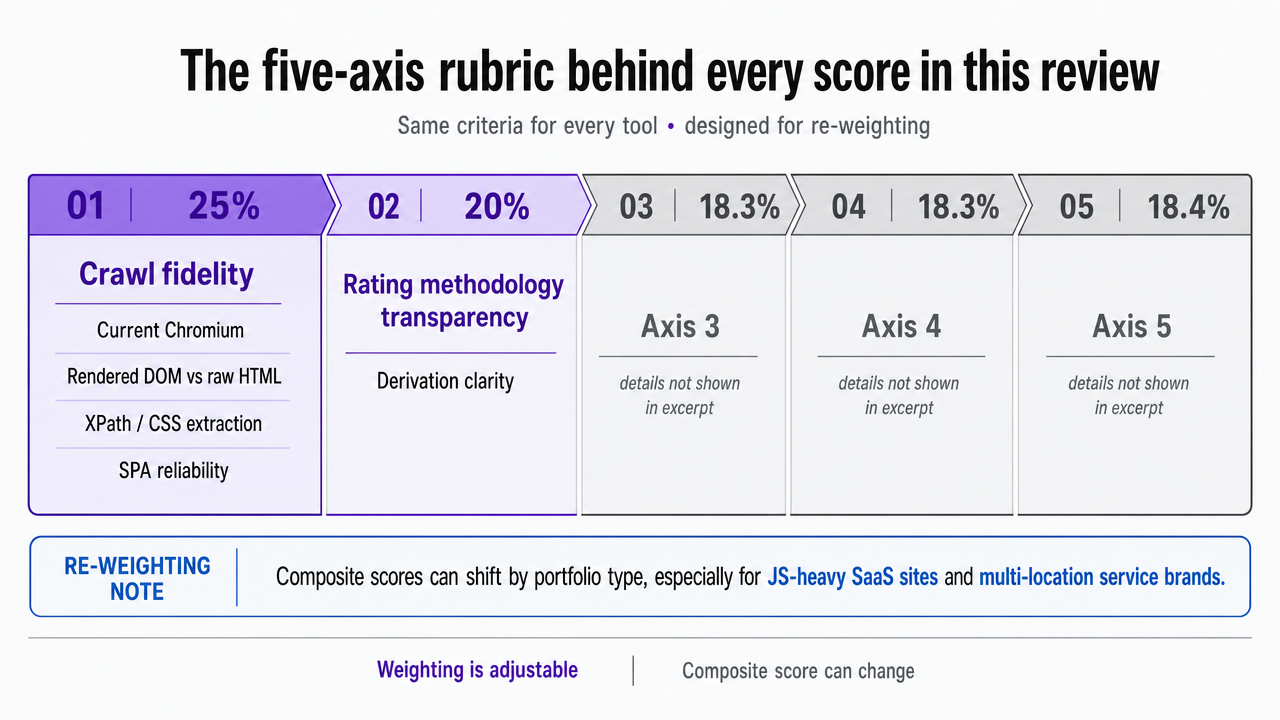 Visualize the five weighted evaluation axes that structure every tool score in the article, giving readers a scannable reference for the rubric
Test AI-driven SEO insights on real campaigns
Evaluate actual SEO rating impact across client sites with unrestricted platform access for seven days.
The nine SEO rating tools, scored on the rubric
Screaming Frog: the JS-rendering benchmark with a ceiling
Screaming Frog's SEO Spider is a leading tool for rendered-DOM extraction. Its paid version offers Chromium 128 JavaScript rendering, XPath and CSS custom extraction, and native integrations with GA4 and Search Console. This feature set is essential for audit-grade ratings, especially for single-page applications 1, 5. Its rating methodology is highly transparent, as strategists control all checks contributing to the report, ensuring clarity on what impacts a score.
However, Screaming Frog faces limitations at scale. As a desktop crawler, it is constrained by workstation memory. Its composite score is 6.4/10 in evaluations that penalize throughput and team usability 6. While suitable for portfolios with 1–10 clients, agencies with more than 15 concurrent audits often need to distribute crawls across multiple machines or combine Screaming Frog with a cloud crawler for larger, scheduled runs 12.
Score on the rubric: High on crawl fidelity and methodology transparency, mid on unit economics, low on reporting throughput and multi-client scale ceiling.
Sitebulb: the transparency winner for audit-grade ratings
Sitebulb offers the most inspectable rating logic in its category. Each hint includes a prioritization band and exposes the underlying rule, enabling strategists to defend audit grades in client reviews without needing to reverse-engineer reports. Weighted evaluations place its desktop composite at 7.2/10, outperforming Screaming Frog in reporting speed and team usability, though it trails cloud crawlers in scale ceiling 6.
Its rendering fidelity is strong, treating JavaScript crawling, rendered-vs-raw HTML comparison, and structured data validation as core outputs 9. The rendered-DOM comparison view significantly speeds up diagnostics for JS-heavy properties, reducing the need for extensive Chrome DevTools sessions.
Sitebulb's Cloud tier extends its capabilities for agencies managing 10–30 clients, but its per-project pricing model alters the unit economics. Score on the rubric: High on methodology transparency and reporting throughput, mid-to-high on crawl fidelity, mid on scale ceiling and unit economics.
Semrush Site Audit: AI Search Health as a rating axis
Semrush's Site Audit is notable for being one of the first mainstream suites to incorporate AI visibility as a rating dimension. Its 2025 AI Search Health score includes structured data coverage, entity clarity, and answer-engine surface checks alongside traditional site health metrics 7. This AI-focused scoring axis is crucial for agencies addressing client inquiries about AI Overviews.
While its crawl fidelity is competent for standard properties and adequate for most JS frameworks, the methodology behind its composite score is less transparent than Sitebulb's. Strategists can see failed checks but not always the specific weights that caused a score drop, which can be problematic when explaining score fluctuations to clients.
Semrush excels in reporting throughput, offering multi-project dashboards, scheduled crawls, and white-label reporting as standard features, meeting essential agency platform requirements 10. Score on the rubric: High on reporting throughput and multi-client scale ceiling, mid-high on crawl fidelity, mid on methodology transparency, with strong differentiation on the AI axis.
Ahrefs Site Audit: throughput-first scoring for content portfolios
Ahrefs' Site Audit is designed around a Health Score that rapidly recomputes across large content sets, making it ideal for portfolios focused on publishers and enterprise blogs 7. Its features, including scheduled portfolio-wide crawls, prioritized issue queues, and multi-project reporting, meet agency needs for multi-client dashboards, rank tracking, and automated auditing without requiring additional integration layers 10.
While JavaScript rendering is supported, it is not its primary strength; Sitebulb and Screaming Frog offer more in-depth diagnostics for SPA properties. Ahrefs' key advantage lies in its speed from crawl to client-ready report, a critical throughput metric for strategists managing 20+ accounts.
Methodology transparency is moderate; the Health Score is documented but not fully weighted within the application. Score on the rubric: High on reporting throughput, high on multi-client scale ceiling, mid on crawl fidelity, mid on methodology transparency.
Google Search Console: the free ground-truth signal
Google Search Console does not provide a composite rating, but it is an indispensable tool. It is the sole source for Google's own indexation status, Core Web Vitals field data, and structured data validity 16. All other tools in this shortlist infer data that Search Console reports directly.
Its multi-property access, delegated permissions, and API make it scalable for agencies. Search Console is considered a foundational component in technical audit toolkits, serving as the ground-truth layer beneath any crawler 5, 8. Score on the rubric: Mid on crawl fidelity (as it is not a crawler), high on methodology transparency (Google's own signals), high on unit economics (free), low on reporting throughput without an additional reporting layer.
Lumar: cloud-crawler scale for enterprise properties
Lumar (formerly Deepcrawl) is designed for large-scale properties that challenge desktop crawlers, such as extensive e-commerce catalogs, multi-language enterprise sites, and JS-heavy platforms with millions of URLs. It is recognized for its effectiveness in auditing JavaScript-heavy sites at scale, offering native rendered-vs-raw HTML comparison 9.
Lumar's rating methodology is more prescriptive than Screaming Frog's, applying its own severity model on top of the crawl. This model is documented and consistent across properties, which is beneficial for strategists managing numerous clients. Reporting throughput is strong at the portfolio level. However, unit economics can be a trade-off, as its credit-based pricing favors agencies with predictable crawl volumes over those with fluctuating client onboarding.
Score on the rubric: High on crawl fidelity and multi-client scale ceiling, high on reporting throughput, mid on methodology transparency, low-to-mid on unit economics for smaller portfolios.
SE Ranking: mid-market rating coverage with rank-tracking depth
SE Ranking is included for its ability to cover the three essential agency pillars—multi-client dashboards, rank tracking, and automated site auditing—at a price point suitable for portfolios with 10–30 clients 10. It is also recognized for credibly handling JavaScript-rendered auditing for mid-market properties 9, extending its utility beyond its common perception as primarily a rank-tracking tool.
Its site health score is straightforward, which is an advantage for onboarding junior analysts, as it requires less explanation of composite score changes. Reporting throughput is good, and white-label output is included in the standard tier.
Score on the rubric: Mid-to-high on reporting throughput, mid on crawl fidelity and methodology transparency, high on unit economics for the 10–30 client tier, mid on multi-client scale ceiling above that range.
DeepCrawl-class cloud crawlers: the scale-ceiling reference point
Cloud crawlers, as a category, address the limitations of desktop tools. In weighted evaluations considering crawl depth, reporting speed, scale ceiling, team usability, and total cost of ownership, cloud crawlers achieve a composite score of 8.1/10, surpassing Sitebulb desktop (7.2) and Screaming Frog (6.4) 6. This performance gap is primarily due to their superior scale ceiling and reporting speed, as cloud infrastructure can manage concurrent portfolio-wide crawls that would take hours on a desktop workstation.
The trade-off is the total cost of ownership for smaller portfolios, where fixed platform costs may outweigh the benefits of increased scale. However, for agencies with over 30 clients or single properties exceeding seven-figure URL counts, the performance gap widens significantly, as desktop tools become unviable regardless of their methodological strengths.
Score on the rubric: High on crawl fidelity, high on multi-client scale ceiling, high on reporting throughput, mid on methodology transparency, low-to-mid on unit economics below the 30-client threshold.
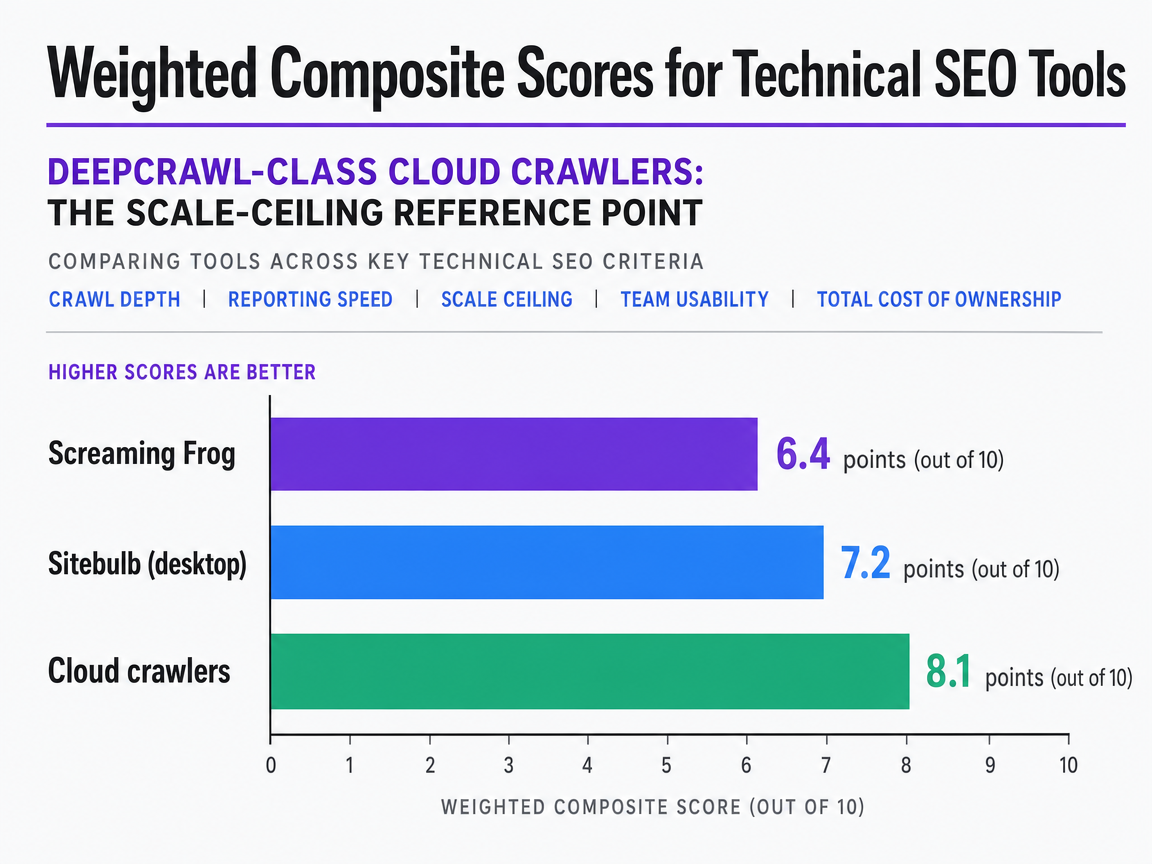 Weighted Composite Scores for Technical SEO Tools
A comparison of weighted composite scores for different types of technical SEO tools, based on criteria like crawl depth, reporting speed, scale ceiling, team usability, and total cost of ownership. Higher scores are better.
Vectoron: turning ratings into approvable, ranked work
Vectoron occupies a unique position in this rubric because it does not generate its own crawl-based site health score. Instead, it functions as an approval-workflow layer that ingests ratings from other crawlers and suites—such as Search Console signals, Sitebulb hints, and Semrush composites. It then transforms these into ranked, approvable recommendations, managed through a Command Center. The key scoring axis it addresses is the one identified by automation-QA literature as the true ROI metric for any rating stack: the implementation rate and rework rate of the recommendations a rating tool provides 13.
Rendered-DOM diagnostics are still performed upstream by a crawler. Vectoron's value lies in accelerating the throughput from rating to completed work, as every ranked recommendation includes strategic reasoning and routes for human approval before execution.
Score on the rubric: Not applicable on crawl fidelity, high on reporting throughput as an execution layer, high on multi-client scale ceiling, and significantly strong on the unit-economics denominator that matters at portfolio scale—cost per shipped recommendation, rather than just cost per seat.
Matching tools to client-portfolio archetypes
JS-heavy SaaS: rendering fidelity as the dominant axis
For portfolios heavily weighted towards SPA-based SaaS properties, the rubric prioritizes rendering fidelity. The critical question is whether the tool renders the DOM accurately, mirroring Googlebot's behavior, or if it only scores the raw HTML shell. Research using Screaming Frog and Lighthouse demonstrates that client-side rendered content leads to significantly different indexability outcomes compared to server-side output. This means ratings derived from unrendered crawls can inaccurately assess site health depending on the framework 15.
Two tools are particularly suited for this archetype. Screaming Frog, with its Chromium 128 rendering and XPath extraction, provides the necessary diagnostic depth for rendered-DOM parity, custom field extraction from JS-mounted components, and structured data validation post-hydration 1, 5. Sitebulb's rendered-vs-raw comparison view then translates these signals into an audit grade that strategists can confidently present to clients without needing Chrome DevTools sessions 9. While Semrush and Ahrefs can support reporting, they should not be the primary rating source when content relies on JavaScript hydration.
Multi-location service brands: rating throughput per property
For multi-location portfolios, such as dental groups or home service franchises, the primary focus shifts from crawl depth to throughput per property. A portfolio of 40 locations does not require in-depth rendered-DOM diagnostics for every crawl. Instead, it needs a consistent rating generated quickly enough to provide a monthly score for each location without constant manual oversight.
SE Ranking and Ahrefs Site Audit are well-suited for this archetype because their Health Scores rapidly recompute across similar property templates. Both tools also meet the essential agency requirements of multi-client dashboards, rank tracking, and automated auditing 10. Search Console remains the authoritative source for local visibility signals and Core Web Vitals field data for each location 16. While rendered-DOM tools are still valuable for initial onboarding audits and framework migrations, they are not typically part of the monthly rating cycle for these portfolios.
Enterprise content and e-commerce: scale ceiling before everything
For enterprise publishers and large e-commerce catalogs, the scale ceiling becomes the most critical rubric axis. When a single property exceeds a million URLs, or a portfolio requires simultaneous crawls across faceted navigation, seasonal product listing pages (PLPs), and multi-language variants, desktop tools become unviable. Such crawls would either queue for hours or necessitate distribution across multiple analyst workstations.
Lumar effectively handles high crawl volumes and applies a documented severity model that remains consistent across properties. It also offers rendered-vs-raw comparison for the JavaScript-heavy sections of otherwise traditional catalogs 9. Ahrefs Site Audit provides the necessary throughput for content-heavy sites, where rapid Health Score recomputation across large publishing sets is more critical for strategist capacity than incremental crawl depth 7. Screaming Frog remains valuable for spot diagnostics and custom extraction—using XPath rules against rendered DOM—when a cloud crawler flags an anomaly requiring closer investigation 3.
See How Leading Agencies Standardize SEO Ratings Across Client Portfolios
Connect with our team to review live demos of multi-site SEO rating workflows engineered for agencies handling high client volumes—without adding headcount.
If you manage 10+ clients: rating-stack economics
This section is intended for agency operators managing 10 or more concurrent client engagements. Solo consultants and in-house single-site teams may skip ahead, as the economic calculations below become relevant only when a portfolio reaches a size where seat costs, crawl credits, and reporting hours accumulate across multiple accounts.
The scalable-SEO literature categorizes agency portfolios into three tiers: 1–10, 10–30, and 30+ clients, recommending progressively more robust tool stacks as client volume increases 12. The table below applies these tiers to four common stack archetypes. Pricing is based on sourced variables rather than arbitrary list prices. The crucial metric is not the invoice sticker price, but the cost per shipped recommendation, calculated as (seat cost + crawl credits) ÷ (issues caught × implementation rate × [1 − rework rate]) 13.
| Stack archetype | 1–10 clients | 10–30 clients | 30+ clients |
|---|---|---|---|
| Desktop crawler + GSC baseline | 1 seat × license | Sharded across 2–3 analyst machines | Not viable as primary rating source |
| All-in-one suite (Semrush/Ahrefs tier) | Base seat × projects cap | Agency seat × project add-ons | Enterprise seat × API credits |
| Cloud crawler + suite | Overkill; fixed cost exceeds value | Per-URL crawl credits × suite seat | Committed credit pool × suite seat |
| Approval-workflow layer on top | Optional | Per-workspace fee × consumed ratings | Per-workspace fee × consumed ratings |
The denominator in the cost per shipped recommendation formula is key. A stack that halves seat cost but reduces the implementation rate from 70% to 40% is ultimately more expensive per shipped recommendation. Tracking issues caught, implementation rate, response time, and rework rate transforms tool cost from a mere line item into a critical operating metric 13.
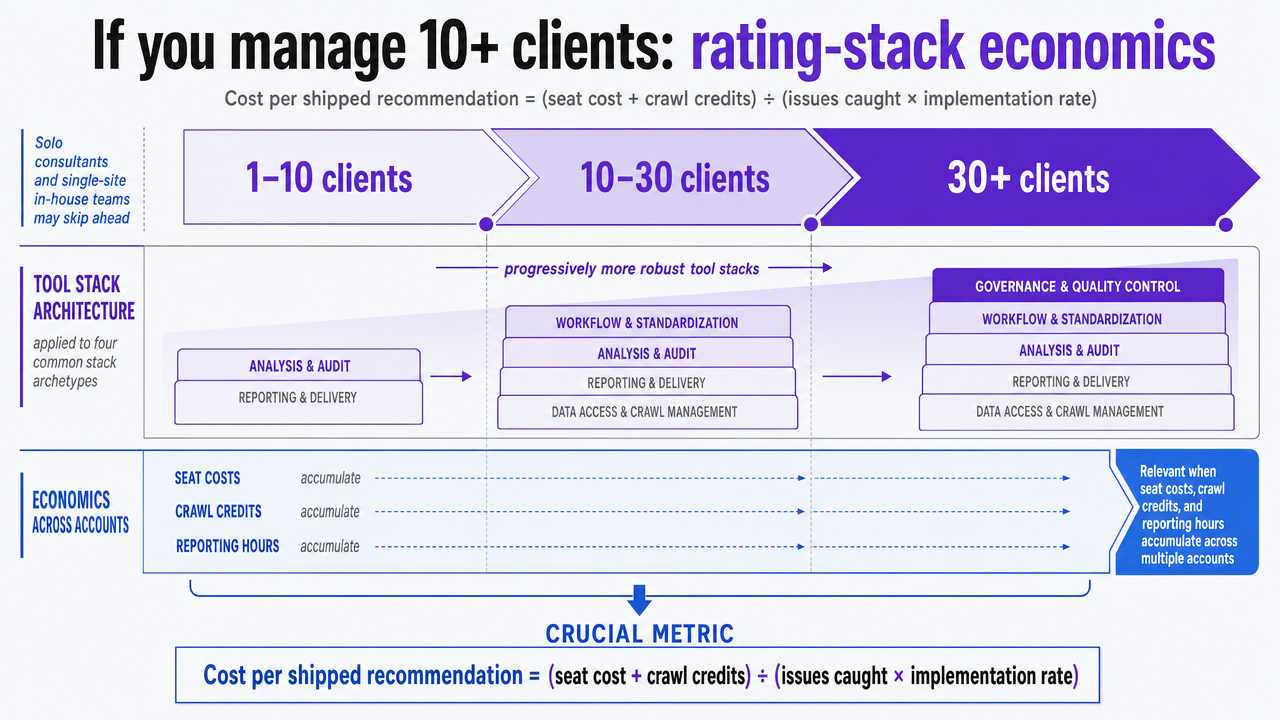 Visualize the three portfolio tiers (1-10, 10-30, 30+ clients) and how tool stack architecture shifts across them, reinforcing the article's operating model
How to run the rubric on your own stack next quarter
The rubric is adaptable, but its effectiveness depends on strategists applying it to live properties rather than relying solely on vendor demonstrations. A structured five-step evaluation—assessing campaign volume, defining automation needs, evaluating AI support, reviewing reporting capabilities, and conducting trials on actual client campaigns—consistently outperforms simple feature-grid comparisons 11.
Select three properties from your current client book that challenge different axes: one JS-heavy SPA, one multi-location template, and one large-catalog or high-URL-count site. Run your existing tool stack and a challenger tool against each, then score both using the five axes and weights that accurately reflect your portfolio's composition. The most important composite score is not the tool's self-reported health score, but the QA denominator: issues caught, implementation rate, response time, and rework rate over a 30-day period 13.
Two safeguards ensure an honest trial. First, baseline every property against Search Console's own indexation and Core Web Vitals field data to measure the rating tool against ground truth, not against another rating tool 16. Second, treat the trial as a capacity test, not just a features test. If a challenger tool increases the implementation rate by 15 points using the same strategist hours, the composite score has already provided a clear answer.
Frequently Asked Questions
References
- 1.Best Technical SEO Audit Tools in 2026 (Free + Paid).
- 2.Best 7 SEO Technical Audit Tools 2026 - Internetzone I.
- 3.Best Technical Seo Audit Software – 2026 Buyer's Guide.
- 4.How to Perform a Technical SEO Audit: The Complete Step-by-Step Guide.
- 5.Best Technical SEO Audit Tools for 2026 - Ighenatt Blog.
- 6.Technical SEO Tools Comparison.
- 7.Technical SEO Tools Comparison: Auditing for Search and AI Visibility.
- 8.Technical SEO Audit Guide.
- 9.Top 7 Technical SEO Tools In 2026.
- 10.Which Platforms Are Great for Managing SEO Across Clients?.
- 11.Which Platform Is Best for Managing Multiple SEO Campaigns?.
- 12.How to Build a Scalable SEO System for Agencies (2026 Guide).
- 13.Scaling Your SEO Services: How Automation Helps.
- 14.Development of Criteria and Evaluation of Search Engine Optimization Tools.
- 15.Evaluating Server-Side and Client-Side Rendering for Content Websites.
- 16.Search Engine Optimization (SEO) Starter Guide.