
Key Takeaways
- Looker Studio works as a free reporting layer under 15 accounts with native GA4 and Search Console connectors, but lacks anomaly alerts, approval holds, and white-label wrappers.
- AgencyAnalytics fits 30- to 100-client books through master templates, bulk rollouts, and native alerts that make the 80% reporting-time reduction reachable in practice 6.
- DashThis suits agencies serving PDF-preferring clients in legal, healthcare, or senior living, delivering branded static reports quickly but offering limited alerting and execution-loop fit.
- Semrush My Reports earns its place when Semrush is already the research spine, keeping keyword, audit, and backlink audit trails one click from every chart.
- Ahrefs Portfolios and Dashboards suit retainers built around link acquisition and ranking movement, bundling backlink and position deltas per client without a second license.
- SE Ranking hits the 15- to 60-account range with reliable alerting on 20% traffic drops, ranking losses, and index-coverage failures at mid-market pricing 8.
- Vectoron treats reporting as one node in an AI-coordinated delivery loop, routing ranked recommendations with reasoning through human approval before execution across channels 11.
Why reporting became the visible edge of agency delivery in 2026
Client-facing reports used to be a monthly artifact. In 2026, they function as the live surface where an agency's delivery operation is either exposed or defended. Two forces pushed reporting into that position.
The first is measurement scope. Search Console now publishes a separate generative AI performance report covering impressions, pages, countries, devices, and dates for AI-surface visibility 14. A monthly deck that still shows only classic organic rankings and GA4 sessions no longer reflects the search environment the client is actually competing in. Forrester notes that AI-era measurement pushes data preparation, governance, and access decisions into the reporting stack itself rather than treating them as adjacent problems 11.
The second is buyer behavior. Stanford's 2025 AI Index found that 78% of organizations used AI in at least one business function in 2024 12. Agency clients are running their own AI pilots and comparing timelines. A report that arrives on the 14th, references data through the 3rd, and repeats last month's commentary looks slow against that baseline.
This is why the shortlist below is not organized by feature count. It is organized around what an owner running a 15- to 150-account book actually sees in a P&L: how much labor a report absorbs, how often it slips, and whether the tool feeds the next round of execution or just documents the last one.
The P&L case for automating client SEO reports
Reporting labor is one of the few agency costs that scales linearly with headcount and never bills at premium rates. On a 40-client book, the math tends to look like this: a strategist or account manager spends roughly two to five hours per client per month pulling data from GA4, Search Console, Semrush or Ahrefs, dropping it into a template, writing commentary, and cycling through internal review. At the higher end, that is 200 hours a month absorbed by production that clients treat as table stakes.
Agency workflow analysis of client-reporting automation puts the ceiling on that reduction at roughly 80% of reporting time when data pulls, formatting, and delivery are handled by a scheduled workflow rather than by hand 6. The scope matters: this is a practitioner benchmark drawn from agency operations, not an experimental study, and it assumes the agency has redesigned templates and approval steps to actually let automation run.
Applied to a mid-sized book, the delta shows up cleanly in a single table. Variables are marked so owners can substitute their own numbers rather than trust invented ones.
| Delivery model | Hours per client-report/month | Reports per month (40-client book) | Monthly reporting labor hours | Implied labor cost at $X/hr blended ||---|---|---|---|---|| Manual baseline | H | 40 | 40 × H | 40 × H × $X || Automated (−80%) 6| 0.2 × H | 40 | 8 × H | 8 × H × $X |
At H = 4 hours and a blended $75/hr, the manual row runs 160 hours and $12,000 a month. The automated row runs 32 hours and $2,400. The recovered 128 hours is not free margin — some of it goes back into commentary quality, QA, and strategy calls that clients actually notice. But even redirecting half of it lifts strategist capacity on a book that would otherwise need a new hire to grow.
The second-order effect is retention. Reports that slip past the promised cadence signal delivery drift. Scheduled workflows remove the most common failure mode: a strategist juggling six accounts on the same reporting week.
 Time saved on reporting with automation
Time saved on reporting with automation
Test Drive Automated SEO Reporting Workflows Now
Generate and deliver comprehensive SEO reports using real client data before you commit.
How to score an SEO reporting tool: a three-axis rubric
Data coverage: GA4, Search Console, and the new generative AI performance report
The first cut is whether a tool ingests the actual surface search now runs on. GA4 and the classic Search Console Performance report are table stakes; every serious vendor connects to both. The differentiator in 2026 is whether the tool pulls the new Search Console generative AI performance report, which exposes impressions, pages, countries, devices, and dates for visibility inside AI Overviews and Search's generative surfaces 14. A client asking why a page that used to rank third now shows flat sessions needs an answer that lives in that report, not a guess pieced together from ranking exports.
Coverage extends deeper than the Performance tab. Search Console's Indexing, Experience, Enhancements, and Links reports carry the diagnostic signal that separates a status update from a work order 9. Tools that surface only aggregate traffic and top queries push strategists back into the Search Console UI to explain anomalies, which defeats the point of automation. The scoring question is whether Indexing coverage issues, Core Web Vitals bands, and link movement appear in the dashboard alongside sessions and conversions 3.
Peer-reviewed measurement research reinforces the same point: reports that fail to connect technical SEO signals to business outcomes distort strategic decisions 1. Coverage is not a checklist; it is whether the client dashboard can answer the next question without a second tool.
Automation depth: scheduled delivery, anomaly alerts, approval routing
The second axis measures whether the tool actually runs the workflow or just holds the data. Three mechanics decide that: scheduled delivery, anomaly alerts, and approval routing.
Scheduled delivery is the baseline. Looker Studio's documentation describes recurring PDF delivery with staggered schedules across reports, which is the minimum an agency should expect from any paid alternative 10. The operational question is not whether a tool sends on a cadence but whether it lets a strategist stagger 40 accounts across a reporting week without a spreadsheet on the side.
Anomaly alerts are where most tools thin out. Practitioner guidance for agency reporting fixes the working threshold at a 20% traffic drop, paired with ranking losses on priority keywords and data-source disconnections as trigger conditions 8. That number is worth treating as the default alert configuration rather than a suggestion. Below 20%, noise from seasonality and sampling swamps signal. Above it, a strategist should hear about the account before the client does. A tool that cannot fire on a 20% drop before the next scheduled report is a document generator, not a delivery system.
Approval routing is the third mechanic. Automated reports that ship straight to clients without a human check produce the failure mode workflow guides warn about: fast, branded, and wrong 7. Score tools on whether a strategist can hold, edit, and release before send — not on whether they promise automation.
Execution-loop fit: does the tool feed an AI-assisted delivery workflow
The third axis is the one most feature matrices ignore. A report is worth more when the insight it surfaces routes into the next piece of work rather than sitting in a PDF archive. That means the tool has to expose data — through APIs, warehouses, or native integrations — that AI-assisted planners, briefing systems, or content and PPC workflows can read.
Forrester frames this as measurement folding into execution: AI now automates data preparation and feeds insights directly into scenario planning and media execution, rather than handing static outputs to a separate team 11. McKinsey's work on agentic marketing workflows describes organizations pushing that logic further, running data gathering, optimization, and reporting inside one loop 4.
The scoring question for an agency owner is narrower: when the report flags a strike-zone page in Search Console positions 8–20 9, does that finding become a brief in the content queue this week, or does it wait for a strategist to notice it during monthly prep? Tools that stop at the dashboard force a manual handoff. Tools that push structured signals into a downstream execution layer collapse two steps into one and start looking less like reporting software and more like delivery infrastructure.
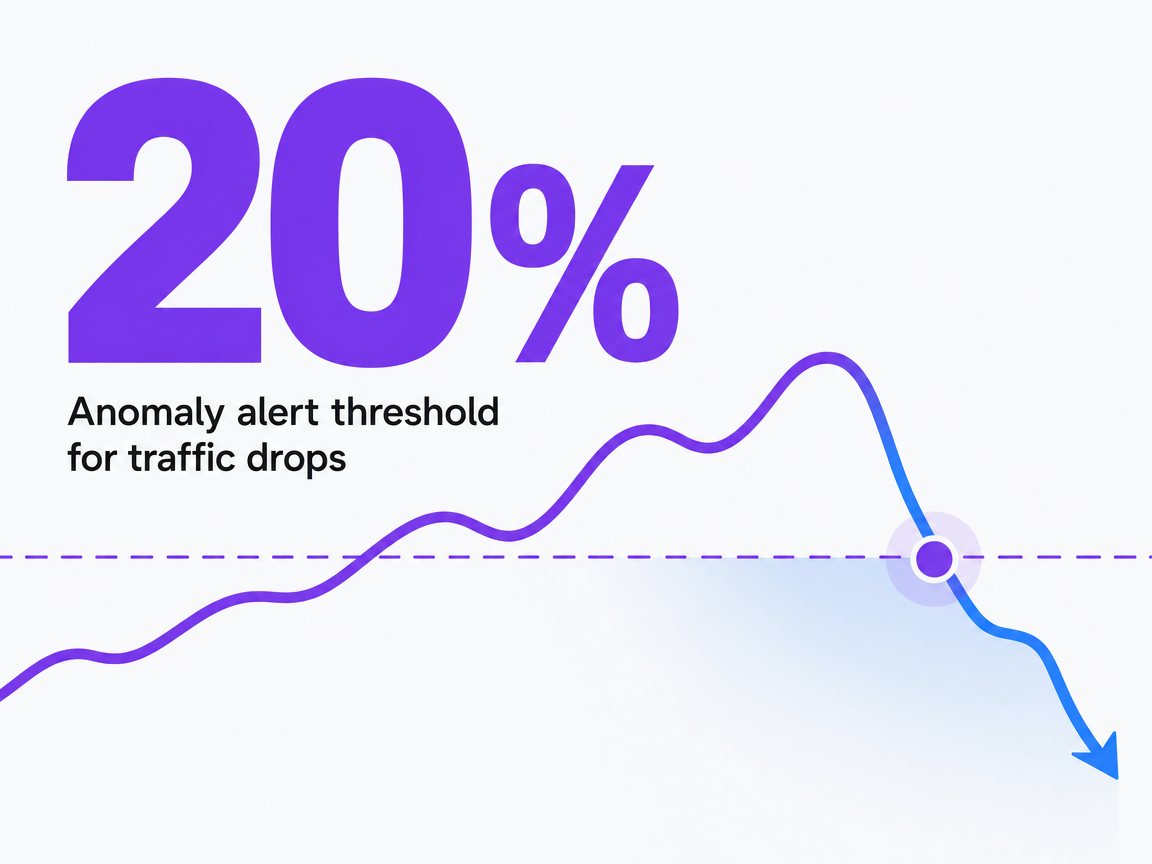 Anomaly alert threshold for traffic drops
Anomaly alert threshold for traffic drops
The seven SEO reports software options worth comparing in 2026
Looker Studio: the default free layer with real scheduled delivery
Looker Studio anchors the low end of the market because it is free, connects natively to GA4 and Search Console, and ships with genuine scheduled delivery. Google's documentation confirms recurring PDF delivery and lets a strategist stagger schedules across reports, which is enough to hold a small book without a paid tool 10.
Data coverage is strong on the Google side and thin everywhere else. Search Console's Performance, Indexing, and Experience signals flow in through the native connector 3, and the new generative AI performance dimensions become available as that API surfaces 14. Third-party connectors for Semrush, Ahrefs, or call tracking cost extra and add a failure point.
Automation depth stops at delivery. There are no native anomaly alerts on a 20% traffic drop, no approval hold before send, and no built-in white-label wrapper. Execution-loop fit is limited to what an agency builds itself in BigQuery.
Score Looker Studio as the correct choice under roughly 15 accounts, or as the client-facing skin on top of a warehouse the agency already runs. Above that count, the missing alert and approval layers push labor back into the strategist's calendar.
AgencyAnalytics: template speed for high-volume books
AgencyAnalytics is built for the operational problem Looker Studio ignores: dozens of accounts on the same reporting week. Master templates, per-client variables, and bulk rollouts let a strategist stand up 40 reports from a single change, which is the mechanic that makes the 80% time-reduction benchmark reachable in practice 6.
Data coverage is broad. Native connectors reach GA4, Search Console, Google Business Profile, and the major paid platforms, plus rank tracking inside the same tool. Search Console Performance and Indexing signals arrive without a second license 9, though generative AI performance dimensions depend on how quickly the vendor tracks the new API 14.
Automation depth is the real differentiator. Scheduled delivery, white-label domains, and configurable alerts on traffic and ranking movement are native, which lets an agency set the 20% drop threshold as a default trigger 8. Approval routing is lighter than dedicated workflow tools.
Execution-loop fit is moderate. The API exists but is not the product. Score it as the default paid pick for a 30- to 100-client SEO or full-service book.
DashThis: white-label PDFs when clients still want static reports
DashThis sits in a narrower lane. It exists because a meaningful share of clients — legal, healthcare, senior living, and older SMB accounts — still expect a branded PDF in an inbox, not a live dashboard link. The tool builds those PDFs quickly from prebuilt templates and delivers them on a schedule.
Data coverage is adequate rather than deep. GA4, Search Console, and the standard paid ad platforms connect natively. Search Console Indexing and Experience signals are shallower than what a strategist gets inside the source UI 9, and generative AI performance dimensions rely on the vendor's connector cadence 14.
Automation depth centers on delivery and formatting. Scheduled sends, white-label branding, and preset widgets are native. Anomaly alerts and approval routing are lighter than in workflow-oriented tools, so a strategist should hold the send until QA rather than trust auto-delivery 7.
Execution-loop fit is low by design. Score DashThis when the book skews toward PDF-preferring clients and reporting is treated as documentation, not a signal source.
Semrush My Reports: keeping the audit trail inside the research tool
Semrush My Reports earns its slot when the agency already runs Semrush as the research spine. The advantage is not the report builder itself — it is that keyword tracking, site audit findings, backlink movement, and position changes live in the same platform the strategist uses for daily work, so the audit trail behind every chart is one click away.
Data coverage skews toward Semrush-native metrics: Position Tracking, Site Audit, Backlink Analytics, and Traffic Analytics. GA4 and Search Console connect through the report builder, and Search Console's Performance signals surface cleanly 3. Generative AI visibility depends on how Semrush layers its own AI Overview tracking against the new Search Console API 14.
Automation depth covers scheduled delivery, white-label PDFs, and template reuse. Anomaly alerts on positions and site health are native, though the 20% traffic-drop trigger requires a companion configuration 8. Approval routing is minimal.
Execution-loop fit is moderate through the API and workflow integrations. Score it when the license is already paid for and consolidation matters more than a purpose-built reporting UI.
Ahrefs Portfolios and Dashboards: link and ranking depth without a second license
Ahrefs Portfolios and Dashboards solve a specific problem: agencies whose retainers are built around link acquisition and ranking movement need those signals in the client report without exporting to a second tool. The Portfolio grouping lets a strategist bundle domains per client and surface backlink, referring-domain, and keyword-position deltas on one view.
Data coverage is deep on the Ahrefs side and depends on connectors elsewhere. GA4 and Search Console integrate for organic traffic and query-level signal 3, but the tool is not a full multi-channel reporter. Generative AI visibility surfaces through Ahrefs's own AI tracking rather than the native Search Console generative AI report 14.
Automation depth includes scheduled PDF delivery, alerting on ranking and backlink changes, and dashboard sharing. The 20% traffic-drop threshold works cleanly against the GA4 connector 8, though approval routing before client send is manual.
Execution-loop fit is API-dependent. Score Ahrefs Portfolios as the reporting layer when link-building is a headline deliverable, not as the primary reporting tool for a full-service book.
SE Ranking: mid-market pricing with alerting that actually fires
SE Ranking often gets read as a cheaper AgencyAnalytics substitute. That undersells it. The tool bundles rank tracking, a site audit crawler, backlink monitoring, and a report builder at a price point that lets a 20-account book carry the license without a margin conversation, and the alerting layer works reliably against the thresholds practitioners actually use.
Data coverage spans GA4, Search Console, Google Business Profile, and the standard paid platforms. Search Console Performance and Indexing signals reach the report builder 9, and generative AI performance dimensions become usable as SE Ranking maps them into the connector 14.
Automation depth is the differentiator at this tier. Scheduled white-label delivery, per-client thresholds, and native alerts on traffic drops, ranking losses, and index-coverage failures let a strategist configure the 20% drop trigger as a default and get notified before the report ships 8. Approval workflows are lighter than dedicated systems.
Score SE Ranking as the correct paid pick for growing agencies in the 15- to 60-account range where the AgencyAnalytics price step is not yet justified.
Vectoron: reporting as one node in an AI-coordinated delivery loop
Vectoron belongs on this list for a different reason than the other six. It is not primarily a reporting tool; it is an AI marketing execution platform in which reporting is one surface of a broader delivery loop that also runs content, SEO, PPC, backlinks, social, and call intelligence through a single approval workflow.
Data coverage pulls the same core sources — GA4, Search Console including the new generative AI performance dimensions 14, call tracking, and paid platforms — into a Command Center rather than a PDF. Search Console's diagnostic reports feed the same view strategists use to review recommendations 9.
Automation depth is where the model diverges. Scheduled delivery and anomaly alerts are present, but the operating unit is a ranked recommendation with the reasoning attached, held for human approval before execution. That maps to the approval-routing failure mode workflow guides describe 7and to Forrester's description of measurement folding into execution rather than sitting adjacent to it 11.
Execution-loop fit is the axis Vectoron scores highest on, matching the agentic-workflow pattern McKinsey documents 4. Score it when reporting has already been automated and the next constraint is coordinated execution across channels.
See How Top Agencies Automate SEO Reporting and Client Delivery
Get a walkthrough of automated reporting workflows that eliminate manual effort, reduce turnaround times, and deliver data-rich SEO insights to clients—while maintaining agency-level oversight at every stage.
If you manage a multi-client book: how to pick without a migration
For owners running 40 to 150 accounts, the selection question is rarely which tool scores highest on a rubric. It is which tool absorbs the fewest migration hours while closing the gap that is actually costing margin. A full rip-and-replace across a live book tends to burn six to ten weeks of strategist time and produces two months of reports that look inconsistent to clients.
The practical path is to diagnose the binding constraint first.
- If reports ship on cadence but strategists still hand-pull data, the gap is template automation — AgencyAnalytics or SE Ranking sit on top of the existing stack without touching client-facing dashboards.
- If reports ship late because anomalies go undetected until the reporting week, the gap is alerting, and configuring a 20% traffic-drop trigger inside the current tool solves more than a platform switch would 8.
- If the report itself is fine but the insights never route into next month's work, the gap is execution-loop fit, and the fix is a downstream layer rather than a new reporting UI 11.
Stage the change. Move five accounts first, run parallel reports for one cycle, and only cut over the book once the new tool clears a full month without a client-visible discrepancy 7.
What a 2026-grade monthly client report actually contains
The shape of a defensible monthly report has shifted enough that most agency templates from 2023 now read as incomplete. Six blocks belong in the current version.
- Organic performance across both surfaces: classic Search Console Performance data alongside the generative AI performance report, which exposes impressions, pages, countries, devices, and dates for AI Overviews and Search's generative surfaces 14. Splitting the two prevents the blended-traffic story that hides where a page is actually losing visibility.
- Indexing and technical health from Search Console's Indexing, Experience, and Enhancements reports 9, with Core Web Vitals bands surfaced next to the pages driving revenue, not as a separate appendix 3.
- The strike-zone view: pages sitting in positions 8–20 with high impressions, which is where content refreshes return more per hour than net-new work 9.
- Conversion outcomes tied to organic sessions in GA4, connecting technical signals to business results rather than reporting rankings in isolation 1.
- Anomalies from the reporting period — traffic drops crossing the alert threshold, index-coverage failures, ranking losses on priority terms 8.
- Next month's ranked recommendations with reasoning attached, so the report ends where the next round of work begins 11.
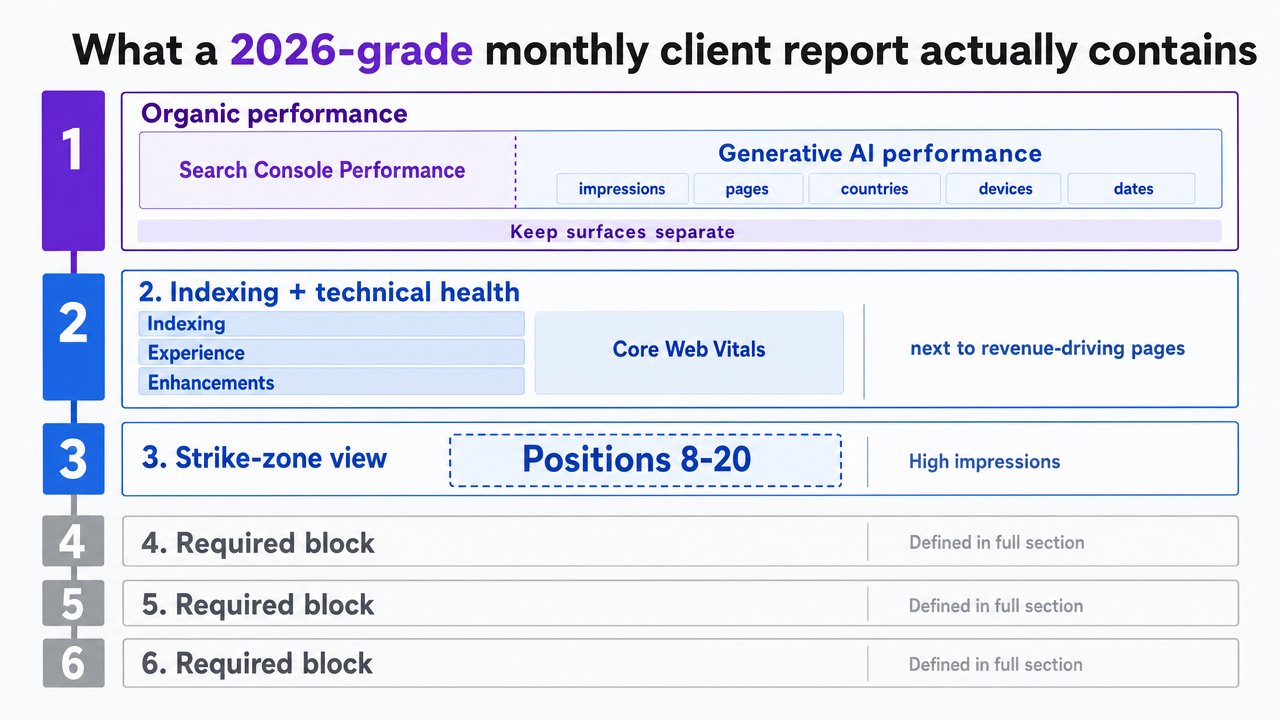 Visualize the six required blocks of a modern client report as an ordered process/structure, directly matching the six numbered blocks described in the section prose
Frequently Asked Questions
References
- 1.Digital Marketing Performance Evaluation Methods.
- 2.Dimensions of Performance Measurement in Digital Content Marketing.
- 3.एसईओ और डेवलपर के लिए Search Console | Google Search Central | Documentation.
- 4.Reinventing marketing workflows with agentic AI.
- 5.The future of marketing in the age of AI.
- 6.Automate Agency Client Reporting: Save 80%.
- 7.Automate Agency Client Reports in 2026: Save 20 Hours per Month.
- 8.SEO Business Report Software 2026: Best Agency Reporting Tools.
- 9.Google Search Console Guide 2026: Every Report Explained.
- 10.Schedule automatic report delivery | Looker Studio | Google Cloud Documentation.
- 11.Marketing Measurement In The Age Of AI.
- 12.CHAPTER 4: Economy.
- 13.Miracle or Myth? Assessing the macroeconomic productivity gains from Artificial Intelligence.
- 14.Introducing Search Generative AI performance reports in Search Console.