
Key Takeaways
- Frame the 90-day sprint around the pipeline equation (Search Volume × CTR × CVR × ACV) rather than traffic curves, so each month targets a specific variable clients can defend in QBRs 3.
- Pick sequencing by diagnostic, not preference: technical-first for indexation and Core Web Vitals gaps, conversion-first for sites with pages in positions 11–25, and brand-first for multi-location service accounts 10, 3, 7.
- The highest-leverage Month 1 move is rewriting 8–15 striking-distance pages in positions 11–25, because existing ranking signals convert to CTR gains faster than new content can mature 6.
- Focus next on portfolio economics: standardize the weekly fix/ship/promote cadence, protect the Head of SEO's QA gate on briefs and rewrites, and report day-1-to-day-90 pipeline deltas by cluster 5, 8, 4.
Why the Pipeline Equation Beats the Traffic Curve
Traffic is not the deliverable; pipeline is. This distinction is crucial for a 90-day roadmap's success in quarterly business reviews.
The Starr Conspiracy's 2024 benchmark revealed that organic search contributed a median of 27% of sourced pipeline for B2B SaaS content engines. While the largest share among tracked channels, it's still a minority contribution that requires continuous defense against other channels like paid, outbound, and events 1. This median varies based on sales motion and Ideal Customer Profile (ICP) maturity. For delivery leads, this means organic efforts must quickly compound to justify their pipeline attribution.
To align a 90-day plan with this reality, focus on the pipeline equation rather than the traffic curve. One B2B SaaS case study defines this as Search Volume × CTR × Conversion Rate × Average Contract Value 3. Traffic is just one component, and not the one with the highest short-term elasticity.
For an agency Head of SEO, this reframes the sprint. Days 1–30 focus on improving CTR through striking-distance rewrites and title optimization. Days 31–60 target conversion rate with intent-mapped content clusters. Days 61–90 involve conversion experiments and building authority signals. HubSpot's benchmarks support this, showing that over 60% of marketers consider inbound their highest-quality lead source, making pipeline framing more acceptable to clients than session counts, provided consistent reporting 11. Each phase is specifically designed to impact a particular variable.
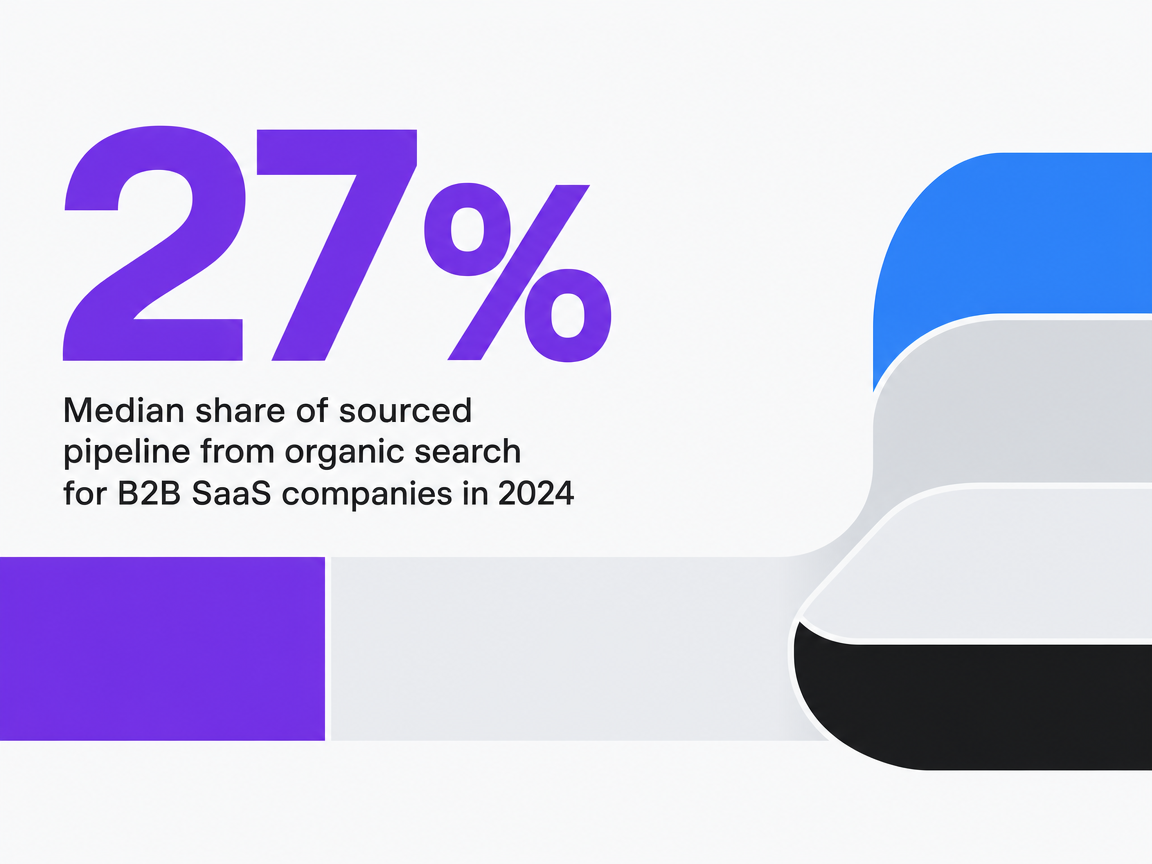 Median share of sourced pipeline from organic search for B2B SaaS companies in 2024
Median share of sourced pipeline from organic search for B2B SaaS companies in 2024
Three Sequencing Schools and How to Pick One Per Client
Technical-First, Brand-First, or Conversion-First
While the ultimate goal is consistent, the order of operations in a 90-day SEO plan varies across three dominant schools, each prioritizing a different variable of the pipeline equation.
The technical-first approach dedicates days 1–30 to tracking setup, baseline capture, and audit fixes. This is followed by a content cluster in days 31–60, and link outreach with conversion work in days 61–90. This method establishes a weekly fix/ship/promote rhythm that scales across accounts 5. Another similar template frames days 31–60 as "build" (fix, plan, set the pipeline) and days 61–90 as "ship" (production rhythm, first wins, scaled cadence) 8. Both prioritize Search Volume and CTR by ensuring crawl and indexation health before introducing intent-mapped assets.
The brand-first school reorders the sprint to prioritize entity cleanup, Google Business Profile optimization, citation and NAP consistency, schema implementation, and Core Web Vitals. A Brand for SEO Scorecard is captured as the day-1 baseline 7. This approach primarily moves the trust variable, focusing on knowledge-graph and local signals that determine a site's eligibility to rank for target queries. The trade-off is that bottom-of-funnel (BOFU) pipeline work is deferred to later in the quarter.
The conversion-first school challenges the traffic assumption entirely. In one B2B SaaS case, sessions remained flat over 90 days, yet demo requests doubled and organic Customer Acquisition Cost (CAC) decreased by 40%. This was achieved by prioritizing page-level intent alignment and offer clarity on existing traffic, rather than acquiring new sessions 3. This method primarily boosts Conversion Rate (CVR) and is effective only for sites with a sufficient Search Volume × CTR base. Applied to a site with low traffic, it would yield no pipeline.
A Decision Rule Heads of SEO Can Defend to Clients
Selecting the appropriate sequence is a diagnostic decision, not a matter of preference. It depends on three factors: the technical baseline, the existing keyword footprint, and the client's location model.
If a site has significant indexation issues, thin title coverage, or unresolved Core Web Vitals—fundamental prerequisites for appearing in search results according to Google Search Central—the technical-first sequence is the only viable option 10. No downstream efforts will compound until crawlability and hygiene are addressed. The fix/ship/promote cadence from the 30/60/90 templates is specifically designed for these scenarios 5, 8.
For sites with hundreds of ranking URLs, particularly those with pages in positions 11–25, a conversion-first approach is recommended. The case study in ref_3 illustrates this: if a sufficient Search Volume × CTR base exists, CVR becomes the limiting factor. Page-level rewrites and offer alignment can generate pipeline within the quarter without waiting for new content to mature.
If the client operates across multiple physical locations—such as DSO groups, home services franchises, or multi-office law firms—the brand-first sequence is most effective. Entity consistency, Google Business Profile (GBP) optimization, and NAP (Name, Address, Phone) work significantly improve local visibility in ways pure content cannot. The Brand for SEO Scorecard provides a measurable baseline for pipeline discussions 7. It's important to inform the client upfront that BOFU content velocity will be delayed by approximately 30 days, and the Quarterly Business Review (QBR) should reflect this.
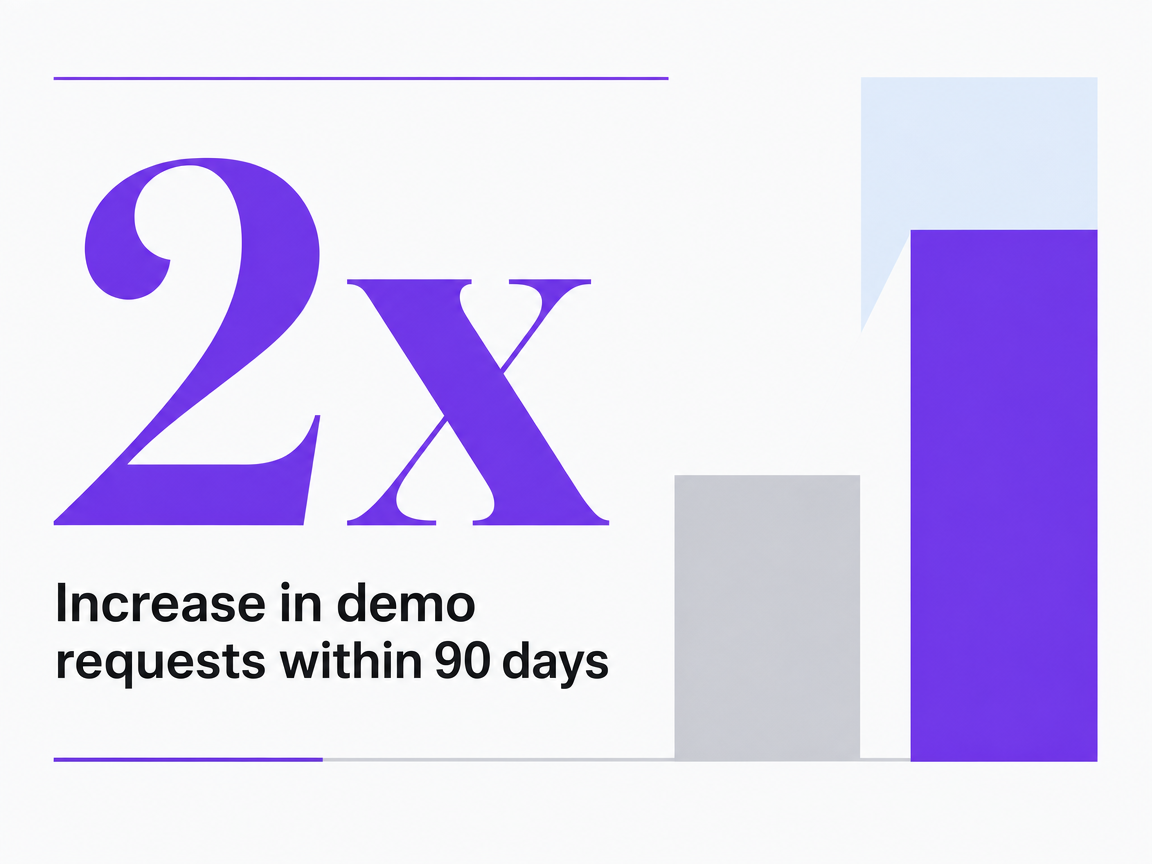 Increase in demo requests within 90 days
Increase in demo requests within 90 days
Days 1–30: Measurement, Audit, and Striking-Distance Wins
What the Specialist Ships Weekly and What the Client Sees
The initial 30 days are critical for agency roadmaps, often failing due to undefined delivery cadences. A successful Month 1 involves four weekly deliverables, each transparent to the client and tied to a measurable variable for QBR discussions.
Week 1 focuses on baseline capture. The specialist connects Search Console, GA4, and rank tracking, exporting current position distribution and conversion path data. The client receives a one-page baseline showing sessions by intent tier, ranking distribution, and pages contributing to bookings or demos. This document, referenced in standard 90-day frameworks, ensures QBR discussions are data-driven 4.
Week 2 involves audit and keyword-to-page mapping. Crawl errors, indexation gaps, title coverage, and Core Web Vitals are prioritized based on pipeline impact, not just severity, addressing Google Search Central's prerequisites for visibility 10. The client receives a list of the top 10 fixes and their estimated CTR or crawl consequences.
Week 3 is dedicated to implementing fixes. This includes title rewrites, meta description consolidation, redirect cleanup, and schema patches in a single deployment. The 30/60/90 templates emphasize this fix/ship/promote rhythm for scalability across multiple accounts 5, 8.
Week 4 delivers the striking-distance list and initial quick-win rewrites. The client receives a ranked opportunity report. The Head of SEO performs a QA check on all published changes before they go live.
Striking-Distance Rewrites as the Highest-Leverage Move
Rewriting pages already ranking in positions 11–25 is the fastest way to impact pipeline in the first 30 days. These pages already demonstrate topical relevance, are indexed, and have an existing keyword footprint. Moving such a page to position 8 significantly boosts CTR without the delay of aging new assets.
The B2B SaaS 90-day sprint literature recommends rewriting 8–15 existing pages in positions 11–25 to push them into the top 10. This is identified as the quickest CTR lever and the most efficient use of specialist hours in Month 1 6. This range is an operational target; sites with fewer than 8 candidate pages may not be suitable for a conversion-first approach, a point to discuss with the client upfront.
These rewrites are strategic, not merely cosmetic. Each page's title and H1 are optimized for its actual query cluster. On-page copy is restructured to address the rewarded SERP intent, internal links are updated from higher-authority pages, and schema (FAQ, HowTo, Product) is tightened. Specialists aim for two to four rewrites per week. The Head of SEO's QA ensures that each rewrite preserves the ranking signals that initially brought the page into the striking-distance band.
The client deliverable at the end of Month 1 is a before/after table of rewritten pages, their starting positions, and the CTR delta. This table serves as a reference for the Month 2 cluster build.
Test a 90-day SEO execution workflow now
Experience hands-on execution of a full SEO roadmap and measure impact with real published content.
Days 31–60: Intent-Mapped Clusters Built for Buying Committees
Cluster Architecture Tied to the CTR and CVR Variables
Month 2 transitions from fixing to building, with the unit of work shifting to cluster architecture. This architecture must simultaneously improve Search Volume × CTR (through new query coverage) and Conversion Rate (through intent alignment). Neglecting either leads to rankings without pipeline impact.
Practitioner literature suggests mapping 5–7 topic clusters, each with 15–20 supporting articles, optimized with snippet-friendly meta descriptions and FAQ schema to capture SERP features 9. While aspirational for a single client in 30 days, this is the long-term goal. The realistic Month 2 deliverable is the hub-and-spoke framework for two to three clusters and the first 6–10 supporting articles per prioritized cluster, with the rest scheduled for subsequent months.
Cluster selection is crucial for CVR. Each cluster should address a specific buying-committee question (e.g., economic buyer, technical evaluator, end user, procurement), not just a keyword theme. The four-component SEO plan (keyword/topic, content, technical, on-page, links) serves as a checklist for each cluster brief. Existing pages ranking in positions 5–20 should be absorbed into the new hub structure rather than creating new content, as absorbing rankings is faster than earning them 4.
The weekly rhythm continues: fixes on Monday, new content mid-week, and promotion/internal linking on Friday 5, 8. The QA gate reviews cluster briefs before writing begins, preventing the compounding cost of intent-misaligned briefs across numerous supporting articles.
If You Manage Multi-Location Service Clients: The Brand-First Detour
The cluster-first approach for Month 2 assumes a single-domain client with a strong entity footprint. For agency Heads of SEO managing multi-location service accounts (e.g., DSO groups, home services franchises), the sequencing changes, and this must be communicated at kickoff.
For these clients, days 31–60 involve a brand-first detour before any cluster expansion. This work includes entity cleanup, comprehensive Google Business Profile completion for all locations, citation and NAP consistency audits, LocalBusiness schema deployment, and Core Web Vitals remediation on location pages. All efforts are measured against the Brand for SEO Scorecard baseline established in Month 1 7. Content clusters are then moved to Month 3, as local visibility is the primary constraint, and cluster architecture won't convert without local pack traffic.
This shift has two operational consequences. First, the deliverables change from supporting articles to location-page rewrites, schema deployments across multiple locations, and citation reconciliation. Second, pipeline reporting must be reframed. Qualified calls and booked appointments by location replace demo requests as the CVR proxy, and the QBR compares call volume against the entity work completed that month.
It's crucial to disclose at kickoff that BOFU content velocity will be delayed by approximately 30 days compared to a single-domain account. This trade-off is valuable for multi-location clients because the entity foundation dictates the effectiveness of subsequent cluster work, but only if the client agrees in writing beforehand.
Days 61–90: Conversion Experiments and Authority Signals
Month 3 shifts focus from ranking proxies to directly impacting pipeline. Having established the technical foundation in Month 1 and intent-mapped clusters in Month 2, days 61–90 aim to convert existing traffic into more pipeline through page-level conversion experiments and authority signals.
The Discovered Labs B2B SaaS engagement serves as a reference: sessions remained flat, but demo requests doubled and organic CAC dropped 40% by optimizing page-level intent and offer clarity 3. This highlights that for sites with existing traffic, CVR is the highest-elasticity lever in Month 3, not sessions. This specific case was for a site with an existing traffic base, and the CVR lift is not reproducible on a starved site.
Conversion experiments during this period are targeted. Specialists conduct one primary experiment per week on high-traffic pages, such as optimizing hero copy, reducing form fields, rebuilding social proof based on buying committee objections, or refining pricing/comparison pages 6. The 30/60/90 template combines this conversion improvement phase with a linkable asset launch and outreach cadence 5. These run in parallel because they address different variables: experiments boost CVR, while outreach and linkable assets strengthen authority signals to maintain CTR gains from Month 1.
Authority building in Month 3 is disciplined. One 2025 blueprint suggests targeting 20–30 high-quality links alongside skyscraper content 9. This volume is vertical-dependent; regulated industries may not achieve it. A defensible target involves sourcing partner, association, and vendor citations from the client's network, plus promoting a single linkable data asset to a targeted outreach list.
AI Overview and generative surface visibility are tracked in this phase, integrated into the weekly rewrite queue. Citation gap analysis against AI answers and extractability fixes on high-value cluster pages are implemented 6. The 30/60/90 roadmap templates acknowledge that direct pipeline attribution from AI answer citations is still experimental 8. The Head of SEO reports AI citation share as a leading indicator, not a direct pipeline metric, until attribution improves.
The day-90 client deliverable is a quantitative comparison of sessions, ranking distribution, conversion rate by cluster, and sourced pipeline value from day 1 to day 90 4. If the initial diagnostic and sequence selection were correct, the pipeline column will show movement, regardless of session changes.
See How Top Agencies Deliver 90-Day SEO Results Without Adding Headcount
Request a walkthrough of an AI-driven SEO execution platform built for agencies—streamline client delivery, approval, and reporting for high-volume, multi-channel campaigns.
Portfolio Economics: What It Actually Costs to Run This Across 20+ Accounts
The roadmap described is effective for a single account. However, a Head of SEO must also consider the cost of scaling this motion across 20, 30, or 50 client accounts without proportionally increasing the specialist team. Portfolio delivery, not individual account strategy, determines margin.
The following framework helps agency leads model against their blended specialist rate. Dollar figures are omitted as hourly costs vary; the focus is on hour distribution. Research anchors the deliverable volumes per phase and the consistent weekly cadence required across all accounts.
| Phase | Specialist hours per account | Sourced deliverable anchor | Head of SEO QA hours |
|---|---|---|---|
| Days 1–30: audit, baseline, striking-distance | Variable — set locally | 8–15 rewrites of pages in positions 11–25 6 | Fix-list sign-off + rewrite QA gate |
| Days 31–60: cluster build | Variable — set locally | 6–10 supporting articles per prioritized cluster, toward 5–7 clusters × 15–20 articles 9 | Cluster brief approval before draft |
| Days 61–90: conversion + authority | Variable — set locally | Weekly fix/ship/promote rhythm; linkable asset + outreach cadence 5, 8 | Experiment approval + link target review |
Three cost drivers compound across a portfolio. Cluster briefs are the most expensive per specialist hour because an intent-misaligned brief impacts numerous supporting articles 9. Striking-distance rewrites offer the cheapest pipeline lift due to existing ranking signals 6. Reporting cadence, specifically the day-1-to-day-90 comparison document for QBRs, has a fixed setup cost per account but minimal marginal cost if tracking is correctly implemented in Week 1 4.
Agencies often underestimate the Head of SEO's QA hours. Every deliverable—fix lists, rewrites, cluster briefs, experiments, outreach targets—requires approval. Across 20+ accounts, this becomes a bottleneck: either QA hours scale linearly, compressing margins, or the gate is skipped, leading to quality regression. Neither is sustainable long-term.
Where Margin Comes From at Portfolio Scale
Portfolio margin is driven by production throughput, not just strategy hours. The 90-day sequence must scale across many accounts without doubling the specialist team or collapsing the QA process. McKinsey emphasizes that integrated growth engines, built as systems rather than stacks of hours, outperform fragmented tactics 12.
Three levers contribute to margin at scale. First, compressing production hours per deliverable (cluster briefs, rewrites, schema deployments, reporting) directly impacts the arithmetic. Second, standardizing the weekly fix/ship/promote cadence across all accounts eliminates coordination overhead and improves specialist utilization 5, 8. Third, maintaining the Head of SEO's approval gate, rather than delegating it, prevents quality degradation as volume increases.
This combination forms the operational premise of Vectoron: AI strategists generate recommendations and artifacts, with human approval before publication. The 90-day roadmap remains consistent, but the underlying hours required are significantly reduced.
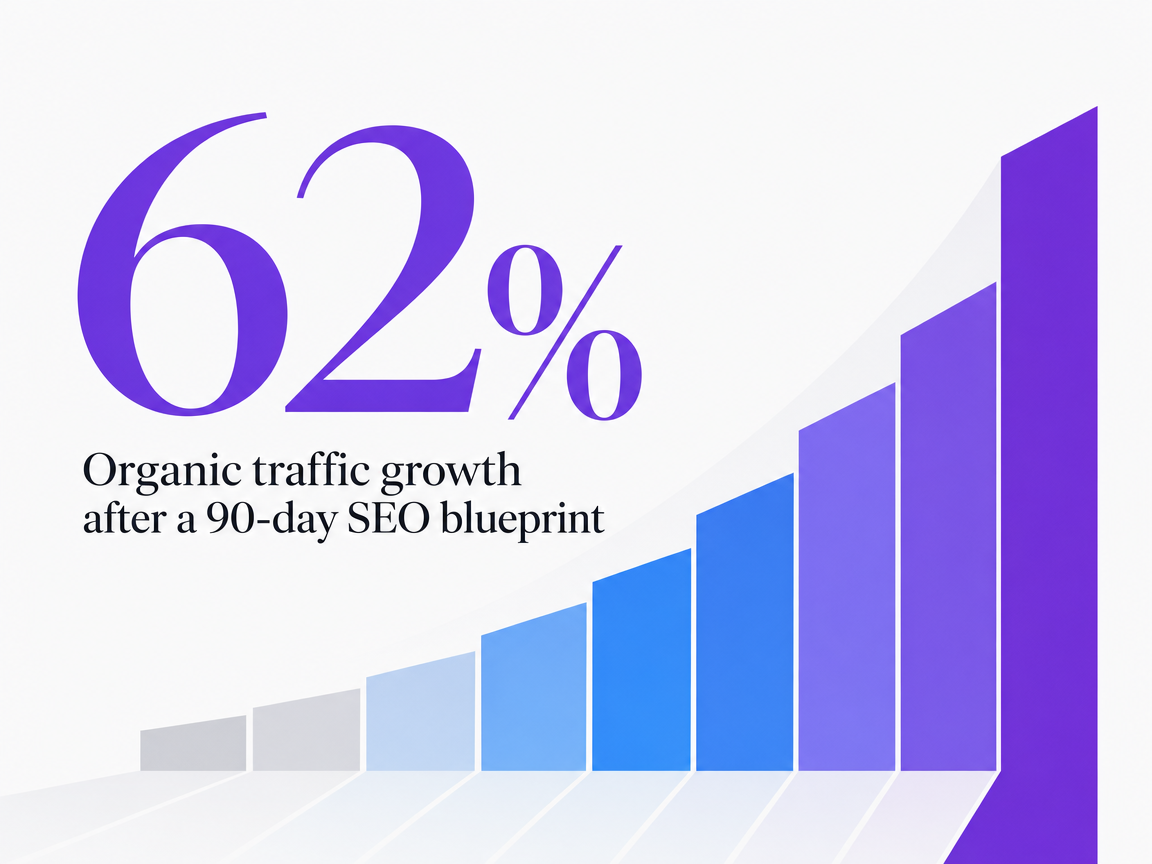 Organic traffic growth after a 90-day SEO blueprint
Organic traffic growth after a 90-day SEO blueprint
Frequently Asked Questions
References
- 1.B2B SEO + Content Engine Benchmarks 2024.
- 2.90-Day SEO blueprints.
- 3.SaaS SEO case studies: How B2B Companies Grew Organic Pipeline to 6-Figure MRR.
- 4.SEO Marketing Plan: Template, 90-Day Framework, Examples.
- 5.Search Engine Optimization Strategy: 30/60/90-Day Plan.
- 6.90-Day SEO + GEO Sprint for B2B SaaS.
- 7.B2B SEO for 2026: The 90 Day Brand First SEO Roadmap.
- 8.30/60/90-Day SEO Roadmap | SEOTopSecret.
- 9.The ultimate 90-day SEO strategy blueprint 2025 | Matthew Khorsandi.
- 10.Search Engine Optimization (SEO) Starter Guide - Google Search Central.
- 11.Marketing Statistics.
- 12.The new B2B growth equation.