
Key Takeaways
- Scalable agency delivery runs three parallel tracks — technical substrate, content and entity authority, and governance and measurement — cloned across clients rather than rebuilt per account 2.
- Every task moves through the same Govern → Prioritize → Brief → Build → QA → Launch → Monitor → Optimize gates, so strategists own judgment while specialists own execution 1.
- GEO belongs inside existing tracks, scored against a four-stage maturity progression, with AI-referred traffic segmented separately because it converts 40–80% higher than baseline organic 5, 6.
- The 15-account ceiling breaks when standardized GTM, GA4, Search Console, and Looker Studio templates replace bespoke client stacks — one documented setup supported more than 30 clients 7.
Why agency roadmaps break at 15 clients
A single strategist can run five client SEO roadmaps by memory. At ten, the calendar starts to slip. Somewhere between twelve and fifteen accounts, the delivery model quietly fractures: analytics setups drift, prioritization becomes a function of whoever emailed most recently, and monthly reports get rebuilt from scratch because no two clients share the same measurement stack.
The breakage is not a talent problem. It is a template problem. Agencies that scale past this ceiling stop treating each client's roadmap as a bespoke document and start treating it as a clone of a shared operating model — one that combines a technical substrate track, a content and authority track, and a governance and measurement track running on shared time-boxes 10. The alternative — custom roadmaps, custom dashboards, custom KPI definitions per account — consumes strategist hours that should go to judgment calls, not reporting hygiene.
The four roadmap examples that follow are worth cloning precisely because they were built to be cloned: a 90-day technical sprint, a 12-week three-track model, a 12-month enterprise phase plan, and a GEO overlay for AI search. Each phase ties to a KPI from a shared measurement layer, and each stage passes through the same approval workflow 1.
The operating model behind every scalable roadmap
Three parallel tracks: technical substrate, content and authority, governance and measurement
The roadmap templates that survive contact with a portfolio share a structural feature: they run three tracks in parallel rather than sequencing SEO as a linear list of deliverables. The clearest articulation of this comes from a 12-week enterprise operating model that splits work into Track 1 (Technical Substrate), Track 2 (Content and Entity Authority), and Track 3 (Governance and Measurement), each broken into week-by-week activities that a delivery lead can lift and adapt per client 2.
Track 1 handles crawl health, indexation, template-level fixes, and Core Web Vitals — the substrate work that gates everything downstream. Track 2 is where the priority query basket lives: 200 to 500 queries baselined for rankings and AI citation share, feeding an information-gain pillar calendar and a programmatic content pipeline with editorial review 2. Track 3 is the plumbing — dashboards, KPI definitions, review cadence, and the approval gates that keep the other two tracks honest.
Running the tracks in parallel matters because the alternative — finish technical, then start content, then bolt on measurement — leaves the strategist re-baselining data every time a phase closes. Seven-theme syntheses of enterprise SEO practice reach the same conclusion: technical, content, authority, and operational dimensions have to integrate rather than sit in separate project plans 10. For an agency, the payoff is that the same three-track grid can be cloned across a home services client, a multi-location behavioral health group, and a SaaS account without redesigning the delivery model each time.
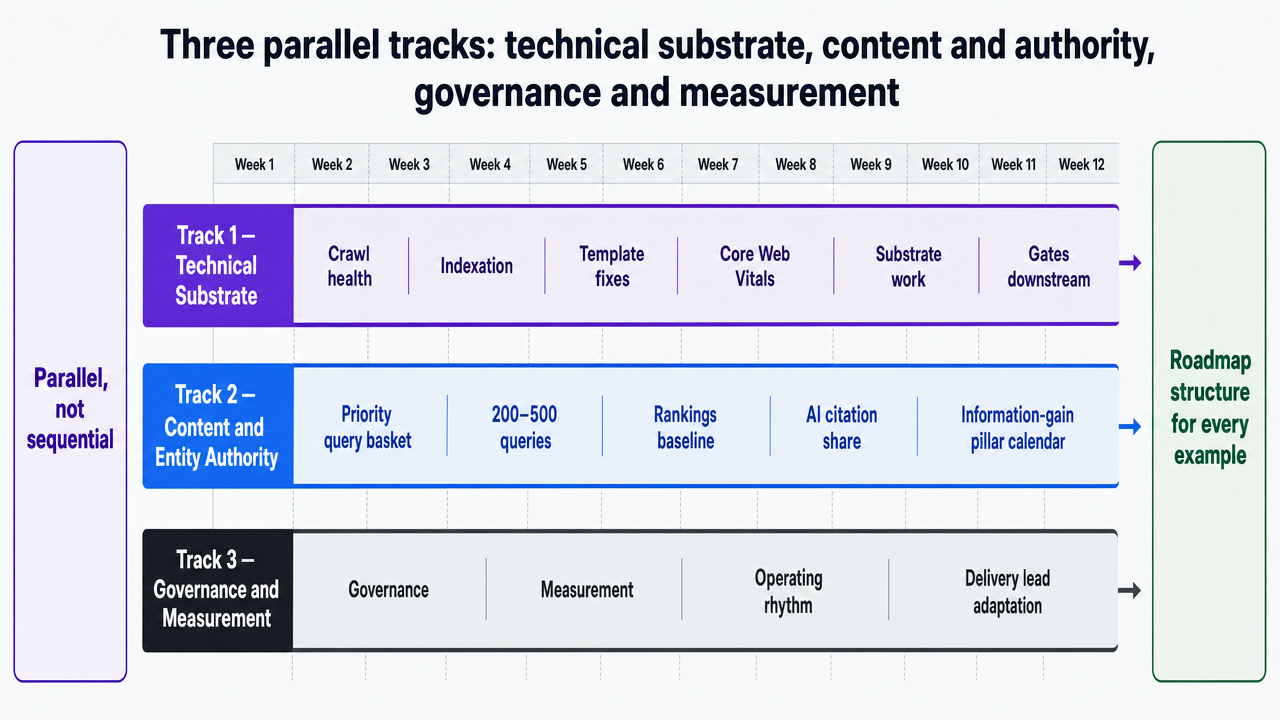 Visualize the three-track operating model that structures every roadmap example in the article, showing how technical, content, and governance tracks run in parallel rather than sequentially
The Govern to Optimize workflow as connective tissue
Three tracks in parallel only stay coherent if every task inside them moves through the same workflow. The Govern → Prioritize → Brief → Build → QA → Launch → Monitor → Optimize sequence is the connective tissue that makes this possible, with ownership, approval paths, and quality standards defined at each stage 1.
Read it as eight gates rather than eight steps:
- Govern sets the operating model and scoring rubric.
- Prioritize scores initiatives by opportunity and risk, so a technical fix on a high-traffic template outranks a net-new blog cluster for a mid-authority page.
- Brief converts a scored item into a spec the production team can execute against.
- Build and QA are self-explanatory but non-negotiable — the QA gate is where template-level regressions get caught before launch.
- Launch, Monitor, and Optimize close the loop by feeding measured outcomes back into the next round of prioritization 1.
For an agency Head of SEO, the workflow does two jobs at once. It compresses the strategist's cognitive load: instead of tracking each client's tasks in a bespoke system, every account moves the same items through the same gates. And it makes delegation safe. Junior specialists can own Build and QA; senior strategists own Govern and Prioritize. The approval gates are what let one strategist supervise many accounts without the roadmap turning into a rumor.
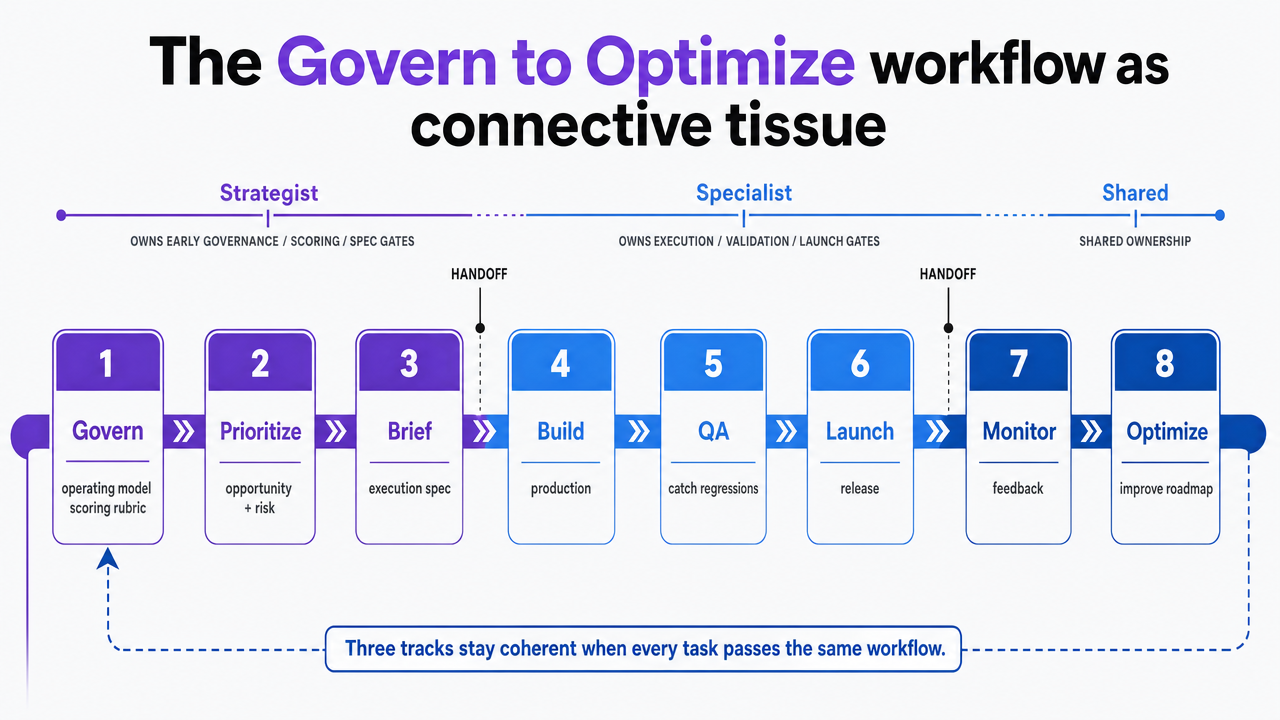 Illustrate the eight-gate workflow that governs every task across every client roadmap, showing ownership handoffs between strategist and specialist roles
Roadmap Example: the 90-day technical sprint for a new client
The 90-day technical sprint is the roadmap most agencies clone first, because it maps cleanly onto the onboarding window a new client will tolerate before demanding evidence of progress. The version worth stealing splits the quarter into three 30-day blocks with distinct exit criteria 9.
- Days 1–30 — baseline and inventory. The first month is not for fixes. It is for establishing crawl and indexation baselines and a full content inventory, so that later work has a defensible before-and-after 9. In parallel, revenue-tied measurement gets stood up across GA4, Search Console, and the client's CRM before any prioritization decision is made 4. Skipping this step is the single most common reason a 90-day plan produces activity without attribution.
- Days 31–60 — template-level fixes and internal linking. With baselines in hand, the sprint moves to high-impact template fixes and automated internal linking 9. Template-level is the operative phrase. A single fix to a location page template or a product schema block ships value across thousands of URLs at once, which is how a strategist running many accounts earns back hours. Individual page-by-page cleanup belongs in a later maintenance cadence, not a sprint.
- Days 61–90 — dashboards, automation, recurring audits. The final block deploys enterprise dashboards and automated reporting feeds, then locks in a recurring audit cadence to prevent regression 9. This is where the sprint hands off to the ongoing three-track model rather than dead-ending in a slide deck.
Two disciplines make the sprint clone well across accounts. Every task passes through the same Prioritize and QA gates the operating model already defines 1, and the day-30 measurement stack is identical across clients so the day-90 dashboard is a template swap, not a rebuild. When both hold, a strategist can run a fresh 90-day sprint for a new account in the time it used to take to write the kickoff document.
Test a scalable SEO roadmap workflow now
Experience end-to-end SEO roadmap execution and publish real client deliverables before committing.
Roadmap Example: the 12-week three-track model
Where the 90-day sprint is dominated by technical work, the 12-week three-track model runs technical, content, and governance in parallel from week one — which is what makes it the reference template for clients who cannot afford a quarter of substrate work before content or measurement moves 2.
- Track 1 — Technical Substrate. Weeks 1–4 baseline crawl, indexation, and Core Web Vitals, then move to template-level fixes and schema across the top-traffic templates. By week 8, automated internal linking rules are live; weeks 9–12 harden monitoring so regressions surface before the next monthly review 2. This is a compressed version of the technical work in the 90-day sprint, run alongside content rather than ahead of it.
- Track 2 — Content and Entity Authority. The distinguishing move here is the priority query basket: 200 to 500 queries baselined for rankings and AI citation share in the first two weeks, then used to drive an information-gain pillar calendar and a programmatic content pipeline with editorial review and templates 2. A fixed query basket is what lets a strategist judge content performance against a stable denominator rather than a shifting keyword list, which matters when the same person is reviewing content output across many accounts.
- Track 3 — Governance and Measurement. Track 3 stands up the shared KPI layer, dashboards, and review cadence in weeks 1–3 so the other two tracks have somewhere to report into by the time they ship anything. Every initiative in Tracks 1 and 2 moves through the same Prioritize, Brief, QA, and Launch gates 1, which is what keeps the parallel work from collapsing into three uncoordinated backlogs.
Two adjustments make the template hold across clients. Regulated verticals — behavioral health, legal, senior living — need Track 3 approval gates widened to include compliance review before Launch, which typically pushes each content cycle out by a week rather than restructuring the tracks. And when a client comes in with a functional analytics stack, weeks 1–3 of Track 3 shorten to an audit, freeing that time for Track 2 to start publishing sooner.
Roadmap Example: the 12-month enterprise phase plan
The 12-month enterprise phase plan is the roadmap that agencies reach for when a client's site is too complex, too regulated, or too politically layered to compress into a quarter. The reference version breaks the year into four phases — assessment and governance design in months 1–2, technical normalization in months 3–5, content operations rollout in months 6–9, and measurement and scale in months 10–12 — each with its own key activities and sample KPIs 3.
- Months 1–2 — assessment and governance design. The opening phase is diagnostic, not productive. A maturity assessment, stakeholder mapping, and governance design set the scoring rubric that everything downstream will be prioritized against 3. The KPI here is not traffic. It is coverage: how many templates, markets, and business units are inside the operating model versus outside it.
- Months 3–5 — technical normalization. Three months of substrate work — template-level fixes, schema, crawl and indexation cleanup — run against the baselines established in phase one 3. Sample KPIs include indexed URL ratio, template pass rate against Core Web Vitals thresholds, and reduction in crawl waste. Because these are template-level, one fix reaches thousands of URLs, which is what keeps the phase from dragging into month six.
- Months 6–9 — content operations rollout. With the substrate normalized, content operations move from ad-hoc production to a governed pipeline: editorial calendar tied to the priority query basket, brief templates, QA gates, and cross-market localization where relevant 3. KPIs shift to published-per-cycle throughput, share of voice on tracked queries, and pipeline lead time from brief to launch.
- Months 10–12 — measurement and scale. The closing phase finalizes dashboards, aligns reporting cadence, and moves the client to a shared KPI set that governs the next year's roadmap decisions 3. This is where the plan hands off to the recurring three-track model rather than ending in a retrospective deck.
The phase plan clones well when phase gates are treated as approval events, not calendar milestones. A client that finishes technical normalization early moves into content ops early; one that stalls in governance design does not get to skip it. Every gate passes through the same Prioritize and QA checkpoints 1, which is what makes a 12-month plan a template rather than a bespoke engagement.
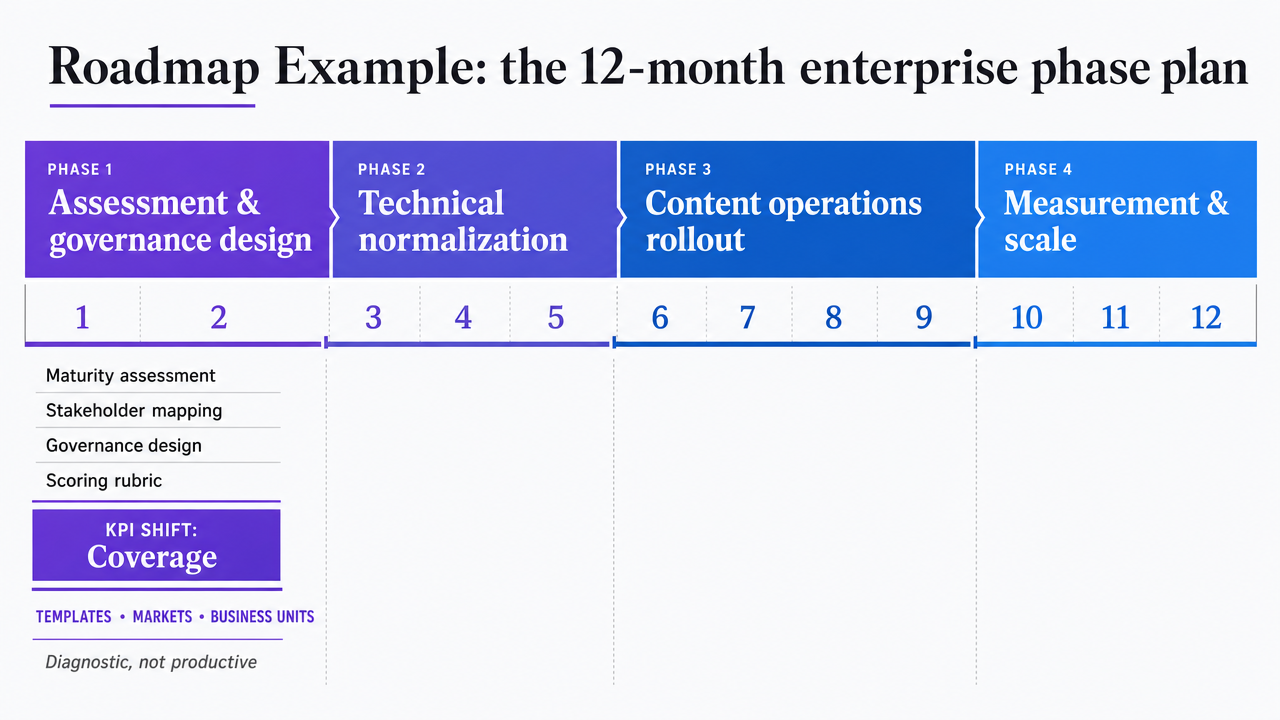 Visualize the four-phase 12-month enterprise roadmap with its distinct activities and KPI shifts across each phase
The AI-search overlay: layering GEO onto existing roadmaps
Where GEO maturity fits the four-stage progression
Generative engine optimization does not deserve its own roadmap. It deserves a lane inside the three-track model already running. The cleanest way to decide what belongs in that lane, and when, is to score each client against a four-stage GEO maturity progression — Ad Hoc, Reactive, Structured, and AI First — that grades both AI visibility and the maturity of the processes producing it 5.
A client at Ad Hoc has no citation monitoring, no schema discipline aimed at AI surfaces, and no view of which queries trigger AI answers in their category. The roadmap addition is small: a citation baseline against the priority query basket in Track 2, plus schema hardening inside the existing Track 1 template fixes. Reactive clients already track AI mentions but respond one query at a time; the roadmap shift is to add answer-gap analysis to the monthly prioritization gate rather than standing up a parallel workstream. Structured clients get information-gain content and entity consolidation baked into the standing content calendar. Only AI First clients justify dedicated GEO experimentation cycles.
Grading each account this way stops the common mistake of running the same GEO scope across a portfolio when three-quarters of the book is still at Ad Hoc or Reactive.
AI-traffic KPIs and how they change roadmap targets
Once GEO work is inside the roadmap, the measurement layer has to carry AI-referred traffic as a first-class segment rather than a footnote in the organic report. The reason is that AI-referred visitors behave differently enough from baseline organic that mixing them into a single number hides the signal.
Benchmark ranges from an AI search measurement framework show the scale of the gap: AI-referred traffic runs bounce rates 15–25% lower, pages per session 20–40% higher, session duration 25–50% longer, and conversion rates 40–80% higher than baseline organic, with top performers exceeding those ranges 6. The scope matters. These are deltas comparing AI-referred sessions against baseline organic sessions inside the same measurement framework — not a claim that total site conversion rises 40–80% when AI traffic appears. Read as segment behavior, they explain why an AI-referred session is worth tracking separately in the roadmap's KPI layer.
Three roadmap changes follow. First, Track 3 dashboards add an AI-referred segment in GA4 with its own engagement and conversion columns, so the monthly review compares like with like. Second, the Track 2 priority query basket gets an AI citation share column alongside ranking position, giving content prioritization a second axis. Third, target-setting shifts: because AI-referred sessions convert at materially higher rates in the source's benchmark table, a small share of AI traffic can move the pipeline number more than the raw session count suggests, and Track 3 reporting has to surface that or the client will underweight the work.
See Real-World SEO Roadmaps That Scale Without Extra Headcount
Request tailored examples of AI-powered SEO workflows designed to help agencies coordinate and accelerate client delivery while maintaining quality control and measurable outcomes.
If you manage 15 or more accounts: turning roadmaps into a template library
Standardized analytics as the scaling substrate
For agency leads managing 15 or more accounts, the roadmap stops being a document and starts being a template library. And the library only holds together if every client sits on the same measurement stack. A case study covering more than 30 high-growth SEO clients makes the mechanism explicit: the agency began by auditing and standardizing GTM, GA4, and Search Console setups across every account, then built a custom, branded Looker Studio dashboard template capturing core KPIs, content engagement, and top landing pages for at-a-glance performance review 7. The point of the exercise was not prettier reports. It was ensuring every site was measured in a consistent, reliable way, so the team could read performance across the book without translating between stacks 8.
Once that substrate is in place, the four roadmap templates already discussed clone cleanly. Track 3 in the 12-week model, days 61–90 of the technical sprint, and the measurement-and-scale phase of the 12-month plan all point at the same dashboard schema rather than each client's bespoke build. A KPI defined once — organic-attributed pipeline, indexed URL ratio, AI-referred conversion rate — carries the same meaning across every account, which is what makes portfolio-level review possible in a weekly cadence rather than an ad-hoc scramble.
The prerequisite work is unglamorous: a GTM audit, event schema alignment, GA4 conversion definitions, Search Console property consolidation, and one Looker Studio template with tokenized client variables. Skip it, and every subsequent standardization effort compounds against a broken denominator.
Portfolio economics: where non-standardized delivery breaks
The scaling ceiling is quantifiable if the reader plugs in three variables: hours per client per month, number of active clients, and blended strategist cost per hour. The interesting number is not cost — it is where those hours go. In a non-standardized model, a disproportionate share of monthly hours per account is consumed by analytics setup drift, bespoke reporting rebuilds, ad-hoc prioritization debates, and briefing cycles that restart from scratch each time. In a template-library model, those hours compress into a fixed onboarding cost plus a much lower monthly maintenance load, because the dashboard, the KPI set, and the prioritization rubric already exist.
| Delivery activity | Non-standardized model | Template-library model |
|---|---|---|
| Analytics setup per new client | Rebuilt per account | One-time template deploy |
| Monthly reporting | Manual rebuild | Dashboard refresh against shared KPI set |
| Prioritization | Ad-hoc per client meeting | Scored backlog against shared rubric 1 |
| Content briefing | Bespoke per request | Seven-stage pipeline with brief templates 4 |
| Portfolio review cadence | Not feasible above ~12 accounts | Weekly, dashboard-driven |
The anchor evidence is the standardized analytics engine that served more than 30 SEO clients out of a single template stack 7. That number is not a promise of headcount ratios — it is a demonstration that the operational ceiling most agencies hit around 15 clients is imposed by the delivery model, not the strategist's capacity. What breaks at 15 is the assumption that each client deserves a custom stack. What replaces it is a template library where the strategist's hours move from production and reporting hygiene toward judgment: which items in the scored backlog ship this cycle, which template-level technical fix reaches the most URLs, and which clients need a manual override to the standard cadence.
Approval-gated execution across many accounts
Standardized analytics and a template library still leave one question open: how does a single strategist stay accountable for what ships across many accounts? The answer is the approval gate. When every task moves through the same Govern → Prioritize → Brief → Build → QA → Launch → Monitor → Optimize sequence, and each gate has a defined owner and quality standard, the strategist's role narrows to the gates that actually require judgment — Govern, Prioritize, and the final QA sign-off before Launch 1. Build and Monitor can be run by junior specialists or automated systems reporting into the same workflow.
This is the operational shape behind a category of AI marketing execution platforms now emerging: approval-gated systems that read live client data, rank priorities against a shared rubric, produce briefs and drafts against the template library, and route every material decision through a human sign-off before anything publishes. The strategist stops brokering tasks across tools and starts approving ranked recommendations. Vectoron is built for this pattern, and it is where the four roadmap examples above stop being documents and start being a delivery system a lean team can actually run at 15, 30, or 50 accounts.
What a strategist actually does when the roadmap is a template
Once the four roadmaps clone off a shared operating model, the strategist's job description changes. Production and reporting hygiene move to junior specialists and automated feeds. What remains is judgment: scoring the backlog at the Prioritize gate, deciding which template-level technical fix reaches the most URLs this cycle, and signing off at QA before Launch 1.
Three questions absorb most of the week:
- Which items in each client's scored backlog ship this cycle.
- Which clients need a manual override to the standard cadence — a compliance-heavy content review, a migration freeze, a phase gate that has not cleared.
- Where in the portfolio a template itself needs to be revised because a pattern is failing across accounts, not just one.
That last question is the one a template library exposes and a bespoke delivery model hides. When every client runs the same three tracks against the same KPI set 10, a regression in one shows up as a signal about the template. The strategist stops chasing individual client fires and starts maintaining the system that runs them.
Frequently Asked Questions
References
- 1.What workflows help scale SEO across large organizations?.
- 2.Enterprise SEO Strategy in 2026: The Operating Model for Large Organizations.
- 3.Enterprise SEO Strategy: A Pragmatic 2026 Roadmap.
- 4.Enterprise SEO Management: Teams & Workflows.
- 5.The 4-Stage GEO Maturity Framework: How Ready Is Your Brand for AI Search?.
- 6.AI Search Measurement Framework: KPIs and Benchmarks.
- 7.Standardized Analytics Engine Accelerates Reporting for 30+ High-Growth SEO Clients.
- 8.Standardized Analytics Engine Accelerates Reporting for 30 ....
- 9.Technical SEO for Large Websites: 90-Day Enterprise SEO Strategy Guide.
- 10.Enterprise SEO Strategies That Consistently Perform for Large Organizations.