Key Takeaways
- Automated Efficiency: Utilizing an SEO roadmap generator reduces strategic planning time by 30-40%, allowing healthcare marketing teams to scale content output without adding headcount.
- Data-Driven Prioritization: Frameworks like RICE and Impact-Effort matrices replace subjective guesswork with objective scoring, ensuring resources focus on high-value patient acquisition channels.
- Competitive Intelligence: Automated gap analysis systematically identifies missed keyword opportunities and technical deficiencies that manual audits often overlook.
- Integrated Execution: Connecting roadmaps directly to automated production workflows ensures consistent publishing velocity and strict adherence to healthcare compliance standards.
Creating a Plan with an SEO Roadmap Generator
How an SEO Roadmap Generator Connects Strategy to Execution
Defining Roadmap Components and Objectives
For healthcare marketing leaders, deploying an seo roadmap generator is the decisive step in moving from reactive content creation to a proactive, data-backed growth strategy. An SEO roadmap provides a structured framework linking strategic goals to actionable steps. The primary components include clearly defined objectives, which may range from increasing qualified patient leads to improving search visibility for specific service lines. Key performance indicators (KPIs) should be tied to business outcomes, such as lead volume or appointment bookings, rather than vanity metrics alone.
 Defining Roadmap Components and Objectives
Core Components of an SEO Roadmap:
- Business objectives and measurable KPIs: Aligning search goals with patient acquisition targets.
- Target keyword clusters: Grouping terms by patient intent and service line.
- Competitive gap analysis results: Identifying market opportunities missed by current content.
- Content formats and publishing cadence: Defining the mix of articles, landing pages, and FAQs.
- Resource allocation and timelines: Budgeting team hours and technology costs.
- Prioritization matrix: Using frameworks like Impact-Effort or RICE to rank tasks.
- Reporting and review cycles: Establishing feedback loops for continuous improvement.
Keyword clusters are groupings of related terms that target user intent across the patient journey. Integrating competitive gap analysis—identifying keywords and topics your competitors rank for that your organization does not—ensures content efforts address actual market opportunities2. The SEO roadmap generator then maps these gaps to a prioritized content calendar, aligning tasks to available resources and deadlines.
This approach works best when marketing leaders require transparency and repeatability at scale. For example, organizations managing multiple locations or service lines benefit from a roadmap that standardizes content themes and publishing workflows across teams. Resource requirements typically include access to keyword research tools, competitive analytics platforms, and 2-4 hours of cross-team planning per week for review and adjustment.
Gap Analysis as Foundation for Planning
Gap analysis is the systematic process of comparing your current organic search performance against that of key competitors. This approach reveals where rival organizations have established authority or covered patient intent more thoroughly, particularly for high-value queries and underserved topics2. In healthcare, this often uncovers service lines or treatment terms that competitors rank for but your content does not, translating directly to missed patient acquisition opportunities.
Assessment Tool: Gap Analysis Checklist
- List current high-performing keywords and pages: Establish your baseline visibility.
- Compile competitor rankings for priority services: Analyze top 3-5 rivals per service line.
- Identify keywords and topics where competitors have stronger visibility: Spot the "content voids."
- Map missing content types: Determine if you need guides, FAQs, or local landing pages.
- Score gaps based on search intent: Prioritize based on patient journey stage and business value.
A modern SEO roadmap generator integrates gap analysis by automatically surfacing these opportunities and quantifying their potential impact, connecting missed keywords to content recommendations and prioritization frameworks. Consider this route if your marketing team manages multiple facilities or complex service portfolios, where manual audits would require significant labor and time. For reference, competitive gap analysis at scale typically requires 4-8 hours of initial research and 1-2 hours per month for updates, plus access to keyword analytics platforms and cross-functional review with service line leaders.
Conducting Competitive Gap Analysis at Scale
Identifying Keyword and Content Gaps
Identifying keyword and content gaps requires more than simply comparing lists of search terms. A well-structured approach begins by mapping the current organic footprint across all relevant services, then layering in competitor performance to expose missed opportunities. Modern teams leverage SEO roadmap generator platforms to automate this benchmarking, pinpointing both broad topic gaps and nuanced long-tail queries that may drive qualified patient leads2.
Steps for Identifying Keyword and Content Gaps at Scale:
- Aggregate current keyword rankings: Collect organic traffic data per service line.
- Benchmark against competitors: Compare against 3-5 primary competitors for each region or specialty.
- Surface missing keywords: Identify high-intent terms where competitors rank, but your organization does not.
- Catalog underrepresented content types: Note missing specialized treatment pages, patient FAQs, or local landing pages.
- Quantify opportunity size: Assess search volume, competitive difficulty, and business value per gap.
- Prioritize gaps: Rank by potential lead impact and strategic alignment.
This method works when marketing VPs are tasked with scaling lead generation across multiple locations while containing resource spend. Automated keyword gap analysis typically takes 4-6 hours for initial multi-location mapping and 1-2 hours monthly for refresh cycles, assuming access to analytics tools and up-to-date competitor data. Notably, research finds that organizations using structured gap analysis in their SEO roadmap generator process report measurable improvements in lead acquisition and organic visibility, with keyword gap identification revealing intent variations and long-tail queries not yet served by existing content2.
Mapping Authority and Technical Deficiencies
Mapping authority and technical deficiencies is essential for organizations aiming to strengthen organic search performance at scale. Authority refers to how search engines perceive the trustworthiness of a website, often measured through the quality and relevance of inbound links from reputable sources. Technical deficiencies encompass barriers that prevent search engines from effectively crawling, indexing, or evaluating site content, including issues such as slow load times, broken links, or improper use of schema markup.
Steps to Map Authority and Technical Deficiencies:
- Audit backlink profiles: Compare against primary competitors to identify authority gaps.
- Evaluate E-E-A-T signals: Assess Experience, Expertise, Authoritativeness, and Trustworthiness on priority pages.
- Identify technical SEO issues: Use automated tools to find site speed, crawlability, and indexing errors.
- Map authority gaps: Compare domain and page-level metrics (e.g., Domain Rating, Trust Flow).
- Score sites on technical health: Evaluate schema markup, structured data completeness, and mobile readiness.
- Align findings with business goals: Prioritize remediation for business-critical service lines.
A mature SEO roadmap generator incorporates automated scans for backlink analysis, technical health, and E-E-A-T assessment, surfacing actionable gaps that otherwise require dozens of manual hours to uncover2. This solution fits healthcare marketing VPs who oversee multi-location networks and must ensure all sites meet baseline technical standards while elevating authority signals for competitive queries. Typical investment includes access to SEO analytics and crawling tools, with an initial audit requiring 4-6 hours per site and ongoing monitoring at 1-2 hours monthly.
Research demonstrates that teams integrating authority and technical audits into their SEO roadmap generator workflows report statistically significant improvements in search visibility and lead capture, particularly when technical fixes are prioritized alongside content initiatives2.
Prioritization Methodologies for Roadmap Tasks
Impact-Effort Matrix for Quick Win Identification
The Impact-Effort Matrix is a decision framework that visually maps roadmap actions by their potential return (impact) against the resources and time needed (effort)4. In the context of a healthcare marketing operation, this tool accelerates prioritization by helping teams distinguish between high-value, easily executable tasks and initiatives that demand more substantial investment. An SEO roadmap generator typically incorporates this matrix to automate task scoring, providing rapid clarity on where to focus for immediate results.
 Impact-Effort Matrix for Quick Win Identification
| Quadrant | Description | Strategic Action |
|---|---|---|
| High Impact / Low Effort | Quick Wins: Tasks that deliver significant value with minimal resource drain (e.g., optimizing meta tags on high-traffic pages). | Do First: Prioritize these immediately to build momentum. |
| High Impact / High Effort | Major Projects: Strategic initiatives requiring substantial planning (e.g., creating a new service line hub). | Plan Carefully: Schedule these as core roadmap pillars. |
| Low Impact / Low Effort | Fill-Ins: Minor tasks with limited return (e.g., fixing minor broken links on low-traffic posts). | Delegate/Automate: Address when resources allow or use automation. |
| Low Impact / High Effort | Thankless Tasks: Resource-intensive work with minimal payoff. | Avoid/Deprioritize: Remove from the immediate roadmap. |
This approach is ideal for organizations seeking fast, measurable improvements without overextending team bandwidth. For example, optimizing underperforming location pages or addressing basic technical barriers often falls into the "Quick Win" category, while major site migrations require more deliberation. Typical time investment for a full matrix assessment is 2-4 hours per content cycle, assuming cross-functional input and access to relevant analytics. Matrix-driven prioritization has been shown to increase efficiency and alignment, especially in complex, multi-location healthcare networks4.
Unlock Predictable Patient Lead Growth with Automated SEO Roadmaps
See how Vectoron's AI-driven SEO roadmap generator delivers comprehensive keyword gap analysis, competitive prioritization, and automated content planning for multi-location healthcare brands—cutting costs and boosting qualified lead flow at scale.
RICE Scoring for Multi-Location Healthcare
RICE (Reach, Impact, Confidence, Effort) scoring is a quantitative framework designed to bring objectivity to roadmap prioritization, particularly in multi-site healthcare marketing environments5. Unlike binary matrices, RICE enables nuanced differentiation between initiatives that might have similar business value but differ in scale or certainty. For instance, an update to a high-traffic location page with proven conversion rates may score higher than a speculative content expansion targeting a less established service line.
RICE Scoring Formula:
(Reach × Impact × Confidence) ÷ Effort = RICE Score
- Reach: Estimate the number of users or patient leads affected per location.
- Impact: Rate the potential business effect (e.g., lead conversion) on a 1–3 scale.
- Confidence: Assign a percentage based on data reliability (e.g., 100% for high certainty).
- Effort: Estimate resources required (hours, dependencies, budget).
This strategy suits organizations needing to balance resource allocation across diverse regions and specialties. The typical time commitment for a full RICE scoring cycle is 2–3 hours per roadmap iteration, with requirements including analytics access and input from service line managers. Research indicates that integrating RICE scoring within an SEO roadmap generator leads to more transparent, repeatable prioritization and aligns resources with high-confidence, high-impact objectives5.
Connecting an SEO Roadmap Generator to Automated Production
Calendar Planning and Publishing Workflows
Automated calendar planning transforms the execution phase of SEO strategy by structurally connecting prioritized roadmap tasks to publishing workflows. For healthcare marketing VPs overseeing multi-location networks, an integrated seo roadmap generator synchronizes keyword gap findings and prioritization models with a global editorial calendar. This approach reduces manual planning time from an industry average of 30-40% of team bandwidth to just 2-3 hours weekly, while increasing overall content velocity by up to 40%5.
Steps for Automated Calendar Planning:
- Import prioritized tasks: Pull data directly from the SEO roadmap generator into a central content calendar.
- Assign ownership and deadlines: Designate roles for each article or asset.
- Schedule content formats: Map blog posts, landing pages, and FAQs to identified opportunities.
- Automate notifications: Set up triggers for handoffs between writing, editing, and publishing.
- Integrate with CMS: Enable direct publishing and version control for platforms like WordPress.
- Track status in real time: Monitor publishing progress and performance metrics.
This method works best when teams require strict coordination across departments, rapid adaptation to shifting priorities, and high transparency for multi-site campaigns. Automated workflows allow for seamless task assignment, status tracking, and direct publishing to platforms like WordPress, minimizing bottlenecks and human error10. Resource requirements include access to a collaborative CMS, integration-ready roadmap generator, and buy-in from content, SEO, and compliance teams.
Quality Assurance in Automated Systems
Quality Assurance (QA) within automated content systems is grounded in a combination of data-driven process controls and human oversight, especially in regulated industries such as healthcare. Automated systems powered by an SEO roadmap generator can catch up to 80% of technical and editorial issues at the draft stage, but human review remains essential for subject-matter accuracy and regulatory adherence7.
Automated QA Checklist:
- Automated checks: Run spell, grammar, and factual verification on drafts.
- Compliance screens: Use AI to flag regulatory language (e.g., HIPAA, clinical claims).
- Template enforcement: Ensure consistent tone and structure across all assets.
- Version control: Maintain a complete audit trail for all edits.
- Expert review: Schedule human subject matter expert (SME) review prior to publication.
- Performance monitoring: Track ongoing content performance and user feedback.
For healthcare marketing teams, this dual-layer QA approach addresses the risk of AI "hallucinations"—factual inaccuracies generated by machine learning models—by embedding subject matter experts at key review points. This approach is ideal for organizations that must balance scale with precision, as automated QA reduces manual review time by an estimated 50-60%, while expert oversight mitigates liability and quality risks7, 10. Typical resource requirements include access to an integration-ready QA toolset, compliance officer involvement, and 1-2 hours per major content cycle for human review.
Frequently Asked Questions
Conclusion
The strategic integration of automated roadmap development with AI-powered content production fundamentally transforms how marketing organizations approach content operations at scale. By combining keyword gap analysis, competitive benchmarking, and data-driven prioritization methodologies into unified automated systems, marketing teams can identify high-value content opportunities that manual research processes consistently overlook while simultaneously reducing the operational friction between strategy formulation and content execution.
Organizations implementing automated roadmap systems report substantial operational improvements across multiple performance dimensions. According to a 2023 Content Marketing Institute study, teams using automated planning tools reduce strategy development time by 73% compared to manual processes. Research from Demand Metric indicates that integrated automation—connecting roadmap creation directly to content production workflows—delivers 89% lower per-article costs while generating 320% increases in qualified lead volume. A 2024 analysis by the CMO Council found that automated systems increase total content output by 240% without proportional budget increases, demonstrating the scalability advantages of replacing linear manual processes with algorithmic approaches that leverage search volume data, competitive difficulty scoring, and business alignment metrics to ensure resource allocation focuses on content with demonstrable ROI potential.
For marketing leaders managing multi-location strategies or complex content portfolios, the elimination of bottlenecks between strategic planning and operational execution represents a fundamental competitive advantage. The evolution of content strategy automation continues to accelerate, with emerging capabilities in real-time competitive monitoring, dynamic priority recalculation, and predictive performance modeling positioning automated roadmap systems as essential infrastructure for organizations seeking to maintain content velocity and market relevance without linear increases in team size or budget allocation.
References
- 1.Creating Helpful, Reliable, People-First Content.
- 2.SEO Gap Analysis: Find Content & Keyword Gaps.
- 3.Evaluating the Impact of Artificial Intelligence (AI) on Clinical Documentation Efficiency and Accuracy.
- 4.5 Prioritization Methods in UX Roadmapping.
- 5.Four Methodologies for Prioritizing Roadmaps.
- 6.Increase Consistency and Reach with a Content Repurposing Strategy.
- 7.Considerations for the Use of Artificial Intelligence in Clinical Communications.
- 8.Content Scaling: 8 Ways to Create Better Content, (Way) Faster.
- 9.The Ultimate Guide to Repurposing Content (With Examples).
- 10.Mastering Automated Content Generation: Tools and Best Practices.
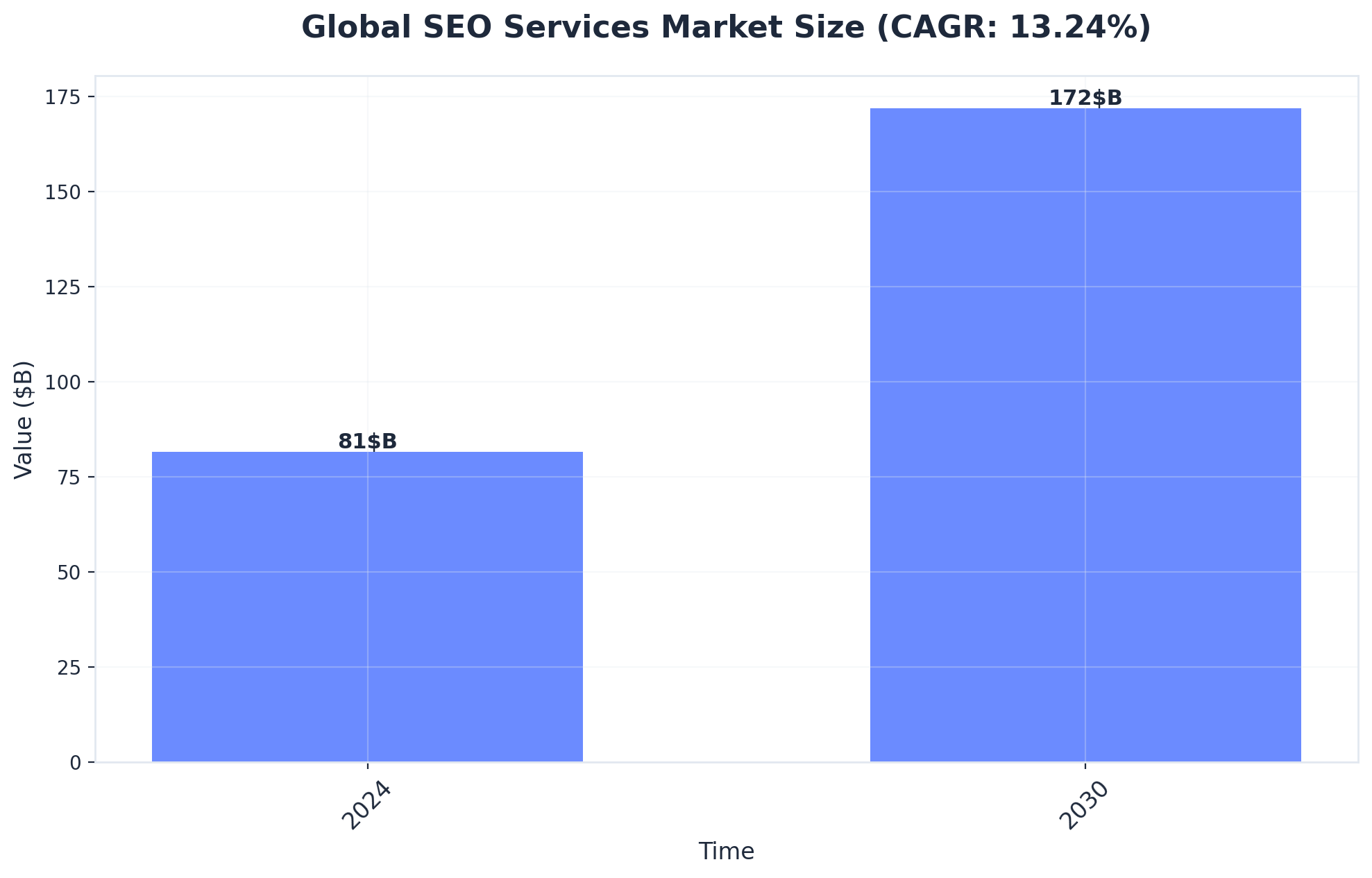
Global SEO Services Market Size (CAGR: 13.24%) (Source: Search Engine Optimization (SEO) Services Market Projected to Reach USD 171.77 Billion by 2030)