
Key Takeaways
- Treat the roadmap as a governance layer built on four codified decisions—intake, prioritization, execution workflows, and measurement—so strategy stays consistent across every account instead of varying by strategist.
- Prioritization works only when deprecation precedes addition, every item traces back to an accepted intake goal, and concurrent initiatives are capped by strategist capacity rather than client demand 12.
- Measurement should split leading implementation signals reported weekly from lagging outcomes reported quarterly, with one primary metric per initiative set at intake and anchored in Search Console data 4, 5, 3.
- Scaling past roughly 20 accounts requires shifting QA, brief drafting, and reporting to automation with human exception review, while intake acceptance, threshold cuts, and closure sign-offs stay with named approvers 7.
Why the Roadmap Is the Governance Layer, Not the Deliverable
An SEO roadmap template in a spreadsheet is not a true template; it's a static document. What truly scales across a client portfolio is a governance layer that dictates what enters the queue, what is cut, who approves, and which metrics define success. Heads of SEO managing numerous accounts often encounter the issue of variance: each strategist creates a unique plan, uses different metric definitions, and reports based on client inquiries. This variance makes a delivery organization unscalable.
The solution is to reframe the roadmap as a template that codifies four critical decisions, preventing ad hoc choices for each account. These decisions include: accepted inputs, work ranking, execution workflow, and performance metrics. Peer-reviewed strategic reviews discuss SEO in terms of niche differentiation, valuable content, targeted keywords, and scalable link building 8. A template ensures these components are consistently applied across all accounts.
Governance is key. Purdue's framework for metric selection—one goal, one primary metric, and a defined causal chain 4—is not merely a reporting preference; it's a rule enforced by the template before any workstream begins. The following sections detail the four layers of this governance structure and the decision rights that maintain its integrity.
The Four-Layer Template Architecture
Intake: What Enters the System and What Gets Refused
Intake is often overlooked by agencies, appearing as mere paperwork. However, it functions as a crucial refusal mechanism, establishing rules for which client requests, audit findings, and stakeholder desires are accepted into the queue and which are rejected.
A robust intake layer captures three specific inputs and rejects all others:
- A business goal articulated in the client's operational language, such as organic inquiries per practice location or booked estimates per service area.
- The causal chain linking that goal to a search behavior the site can influence. Purdue's model is relevant here: a single goal maps to a single primary metric, with explicit intermediate steps 4. If a strategist cannot concisely define this chain, the item is refused.
- The constraint set, including regulated content requiring legal review, separate GBP ownership for locations, or subdomains the client will not consolidate. These constraints define execution possibilities and must be identified upfront, not mid-sprint.
What intake refuses is as important as what it accepts. This includes:
- Ad hoc keyword lists without a mapped goal
- Competitor screenshots lacking a hypothesis
- Audit exports with hundreds of line items and no prioritization
Such items are documents, not actionable work, and admitting them leads to junior strategists creating extensive decks that are never implemented.
The template artifact for intake is concise: a one-page record per initiative, detailing the goal, primary metric, causal chain, and constraints. This record serves as the authorization for progression to the next layer; without it, an item cannot enter the queue.
Prioritization Logic: Cutting Is a Roadmap Decision
Many roadmaps falter at prioritization by treating it as a scoring exercise. This approach, where tasks are scored, sorted, and worked top-down, typically collapses after one quarter due to new requests and stakeholder demands. A sustainable approach relies on a consistent rule set.
The primary rule is deprecation before addition. Cal Poly's guidance emphasizes publishing fewer, higher-quality pages, focusing on high-traffic landing pages, and avoiding thin content 12. Within a roadmap template, this guidance becomes a prioritization rule that removes underperforming URLs from the execution queue before new workstreams are assigned. Consolidation, redirection, and removal are treated as primary work items, ranked against new content creation.
Cut-versus-keep rule inside the prioritization layer: thin, low-traffic, or duplicate URLs are routed to deprecation before any new brief is opened, applying the “fewer, better pages” standard as a queue filter rather than an audit note 12.
The second rule links to the intake record: every candidate work item must reference an accepted goal and its primary metric. Items lacking this reference are not merely deprioritized but returned to intake, preventing unauthorized projects from entering the roadmap.
The third rule establishes a ceiling. The template caps the number of concurrent initiatives per account based on strategist capacity, not client demand. For example, a 25-account portfolio with three initiatives each means 75 active workstreams. The template makes this count visible before any additional initiative is accepted for a client.
The output of this layer is a ranked, capped queue with explicit cuts. If a strategist cannot identify what was refused in a given cycle, the prioritization layer is not functioning effectively.
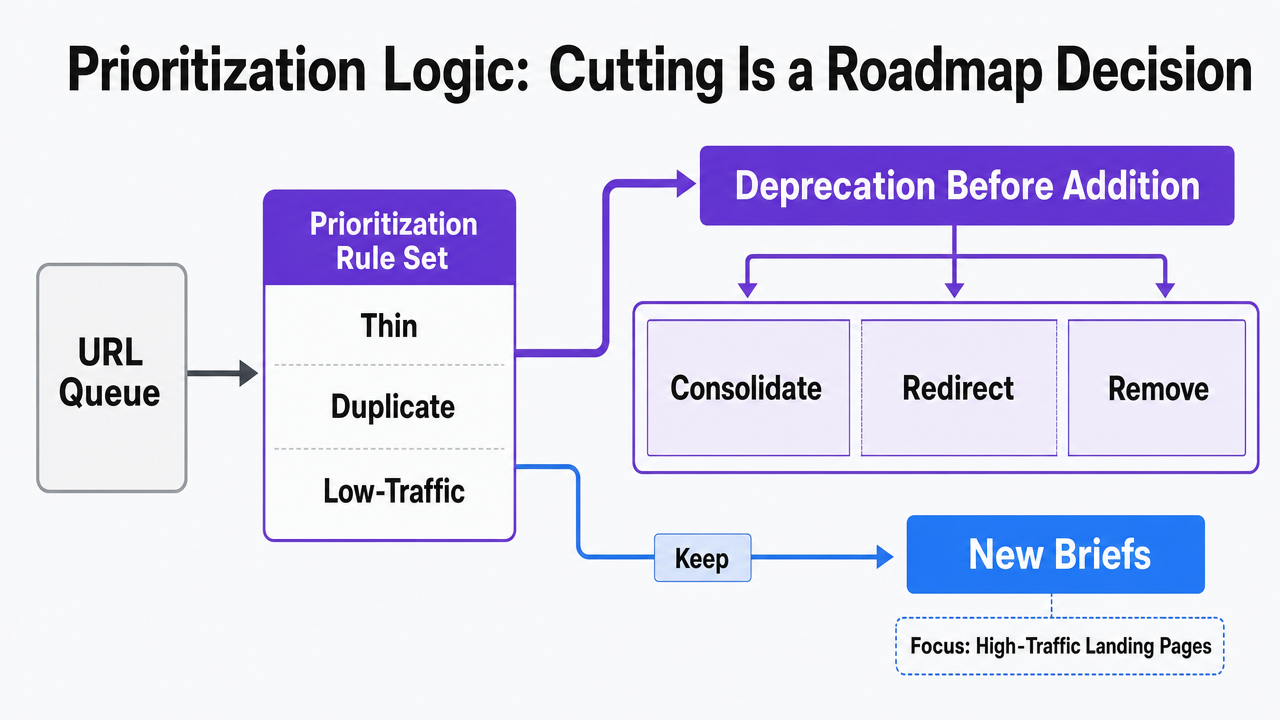 Visualize the cut-versus-keep prioritization rule that routes thin, duplicate, or low-traffic URLs to deprecation before new briefs are opened, directly supporting the section's core prioritization logic
Execution Workflows: Six Workstreams the Template Must Absorb
Execution is where roadmap templates often become overly specific, leading to varied workflows across clients. The solution is to define workstream lanes at the template level, allowing tasks within each lane to vary by account.
Michigan Tech's framework provides the template's lane structure 13:
- Setting an SEO strategy
- Publishing relevant and authoritative content
- Regularly updating content
- Building a link-worthy site
- Optimizing for mobile and technical SEO
- Integrating SEM
These are six parallel lanes, not sequential phases. Every account operates all six lanes concurrently at varying intensities. The template requires each initiative to declare which lane(s) it occupies before execution begins.
Six parallel workstream lanes at the execution layer — strategy, authoritative content, content updates, link-worthy site, mobile and technical SEO, and SEM integration 13 — with the four strategy components (niche differentiation, valuable content, targeted keywords, scalable link building) 8 mapped across the content and link lanes.
Within these lanes, the four strategic components from peer-reviewed literature—niche differentiation, valuable content, targeted keywords, and scalable link building 8—map directly to the content and link lanes. Niche differentiation and targeted keywords serve as inputs in the strategy lane. Valuable content is the output of the authoritative content and update lanes. Scalable link building is a distinct lane, not a subtask within content.
The template's role is to standardize handoffs between lanes, not the individual tasks. A brief from the strategy lane must contain consistent fields, regardless of the client. A page exiting the content lane must pass uniform on-page checks—title, headings, alt text, structured data—identified as fundamental by readability and SEO literature 7. The technical lane conducts its crawl, indexation, and Core Web Vitals cycle on a consistent cadence across all accounts.
Client-specific variations occur in intensity and sequencing within each lane, but the lane structure and handoff contracts remain constant. This distinction enables junior strategists to manage multiple accounts without developing unique operating models for each.
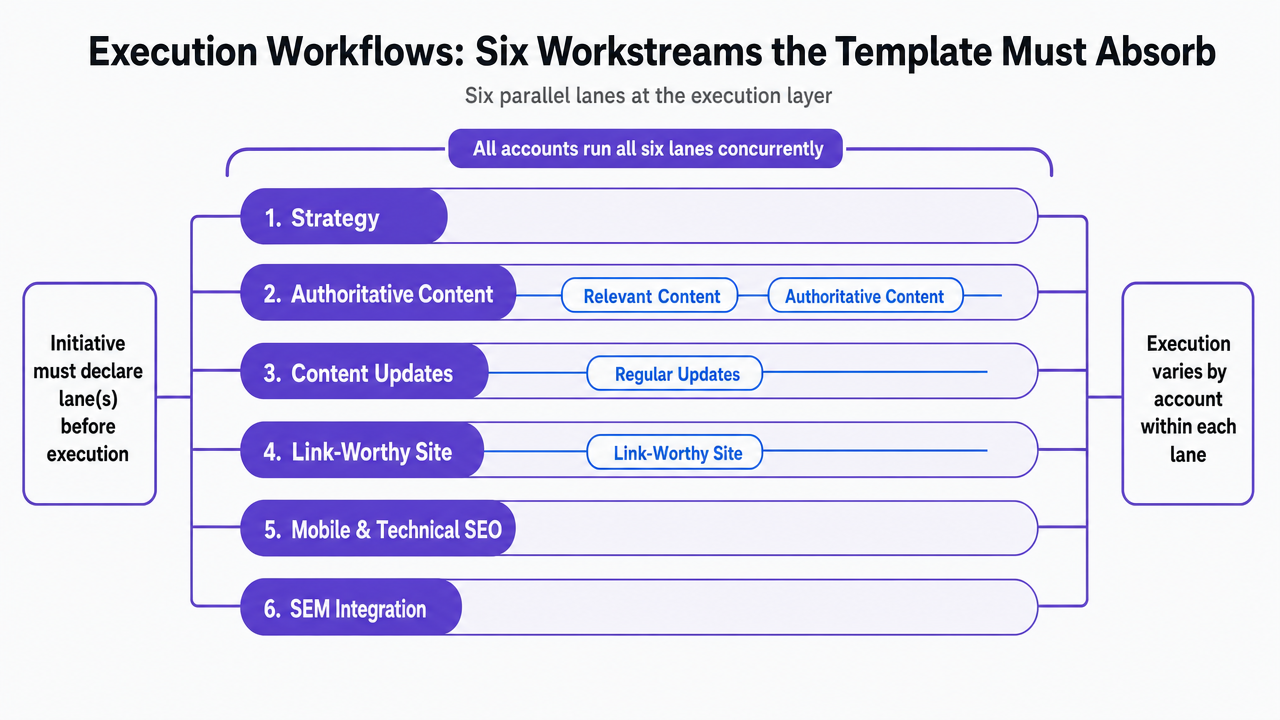 Diagram the six parallel workstream lanes and map the four strategic components onto the content and link lanes, directly visualizing the execution framework described in the section
Measurement Contracts: Leading Indicators vs Lagging Outcomes
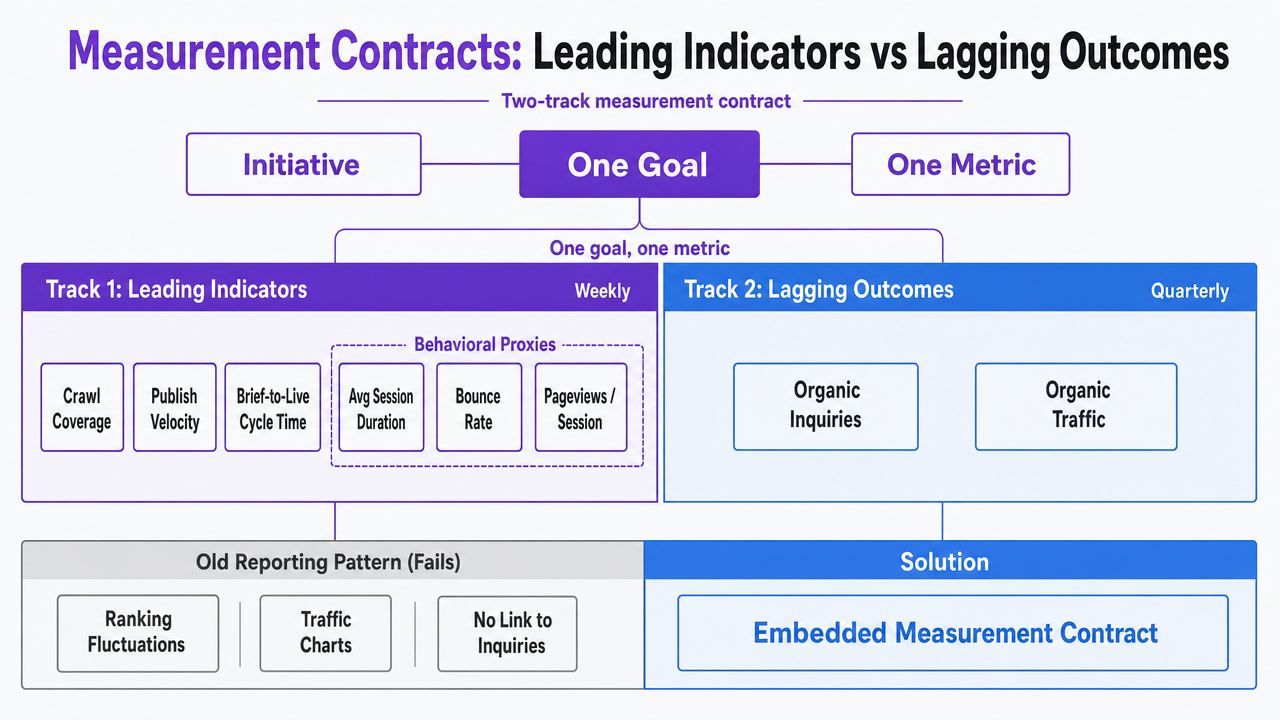
The measurement layer of roadmap templates either builds or erodes client trust. A common failure involves weekly reports focused on ranking fluctuations, monthly reports on traffic charts, and quarterly reviews that fail to explain impact on inquiries. The solution is a two-track measurement contract embedded within the template.
UPCEA's framework distinguishes between leading implementation metrics and lagging outcomes like organic inquiries and organic traffic 5. The template incorporates both, assigning different reporting cadences. Leading indicators—crawl coverage, publish velocity, brief-to-live cycle time, and engagement signals such as average session duration, bounce rate, and pageviews per session, which Washington State's guide identifies as behavioral proxies for content performance 1—are reported weekly due to their frequent movement. Lagging outcomes are reported quarterly, aligning with their resolution timeframe.
Measurement contract at a glance: leading implementation metrics (crawl coverage, publish velocity, brief-to-live cycle time, session duration, bounce, pageviews) report weekly; lagging outcomes (organic inquiries, organic traffic, pageviews from organic search) report quarterly, following the UPCEA leading-vs-lagging separation 5, WSU engagement metrics 1, and Purdue's goal-to-metric mapping 4.
Purdue's goal-to-metric mapping underpins both tracks: one goal, one primary metric, with pageviews from organic search as the primary metric for a traffic goal 4. The template enforces this discipline across the portfolio: every initiative accepted at intake carries a single primary metric into the measurement layer. While secondary metrics can populate dashboards, only the primary metric determines an initiative's success.
The operational surface is also standardized. Google Search Console provides impression, click, and position data across all accounts 3, with analytics platforms supplying engagement metrics. This standardization enables reporting analysts to produce numerous weekly reports without redefining metrics for each.
The measurement contract also specifies what will not be reported. This includes vanity keyword rankings without traffic, share-of-voice indices lacking business relevance, and any metric not traceable to a primary goal. This exclusion mechanism prevents the reporting layer from becoming bloated, ensuring client reviews focus on outcomes rather than excessive context.
 Visualize the two-track measurement contract splitting leading weekly metrics from lagging quarterly outcomes, with the one-goal-one-metric discipline anchoring each initiative
Decision Rights and Approval Routing
The four layers require clear decision-making. Without defined roles for who accepts intake, approves prioritization cuts, signs off on briefs, and certifies measurement contracts, the template's effectiveness diminishes. The template addresses this by assigning decision rights to roles, not individuals.
Intake acceptance rests with the account strategist. Prioritization cuts and additions above a specified threshold—such as new URL creation, deprecation of ranking pages, or work on regulated content—are routed to the Head of SEO or a delegated senior. Execution briefs are approved by the strategist, but publishing to a live site requires a second signature: an editor for content, a technical lead for schema and site changes, and a compliance reviewer for legal and health verticals, where U.S. Department of Energy guidance on alt text, unique titles, and content maintenance sets accessibility standards 11.
Approval routing is crucial for managing volume. Every work item receives a routing tag upon intake, indicating ownership, approver, and closure evidence. A brief without a named approver cannot proceed. A published change without a measurement owner cannot be closed. This routing creates an auditable trail.
Practically, this means a junior strategist managing multiple accounts does not make unilateral decisions on cuts, republishes, or link acquisition. The template routes these decisions upstream. The strategist focuses on throughput within lanes and record quality, allowing senior oversight to scale without direct involvement in every meeting.
Test a Data-Driven SEO Roadmap in Practice
Build and deploy a custom SEO roadmap using real data—track measurable impact before making a commitment.
Portfolio Economics: What Holds and What Snaps at Scale
Portfolio scaling tests template design against practical limitations. A roadmap effective for 10 accounts may fail at 25 or 50, not due to strategy weakness, but because human-dependent components consume unsustainable hours. A Head of SEO managing a delivery organization must understand which components scale and which break under increased volume.
Three components consistently scale:
- Intake, because the one-page record requires finite work per initiative.
- Prioritization, because its rule set—deprecation before addition, required intake reference, and capped concurrent initiatives—does not become harder with more accounts, only more frequent.
- The measurement contract, because the primary metric is set at intake and requires no reinterpretation, with Purdue's one-goal-one-metric discipline ensuring definition consistency 4.
Conversely, three components tend to break:
- Manual QA for every published page typically fails around 20 accounts, as the on-page checklist for titles, headings, alt text, and structured data 7 exceeds senior reviewer capacity.
- Bespoke reporting narratives become unsustainable when producing numerous unique weekly summaries consumes an analyst's entire week, even with standardized Search Console data 3.
- Prioritization sign-off is the last to break, as the Head of SEO becomes a bottleneck for every cut decision if escalation thresholds are not adjusted for volume.
The table below illustrates how layers behave across three portfolio tiers, using strategist hours per account per month and brief-to-live cycle time as variables. These values are directional and vary by vertical, but the shifts in ownership are critical.
| Roadmap component | 10 accounts | 25 accounts | 50 accounts | Ownership at scale |
|---|---|---|---|---|
| Intake record | Strategist, 1–2 hrs/account/mo | Strategist, 1–2 hrs | Strategist, 1–2 hrs | Template-owned |
| Prioritization cuts | Head of SEO reviews all | Head of SEO reviews threshold items | Delegated senior reviews; rule-driven cuts auto-apply | Human-owned above threshold |
| Content briefs | Strategist authored | Strategist authored, template-enforced fields | Template + assist authored, strategist approves | Shifts to automation-owned |
| On-page QA (titles, headings, alt text, schema) 7 | Manual per page | Manual sampling + checklist | Automated checks, human exception review | Automation-owned |
| Deprecation decisions 12 | Case by case | Rule-driven queue | Rule-driven queue at scale | Template-owned |
| Weekly reporting | Analyst per account | Standardized template, analyst reviews | Generated from standard KPI surface, analyst annotates exceptions | Automation-owned |
| Brief-to-live cycle time | Baseline | Holds if handoff contracts enforced | Holds only with automated QA and reporting |
Portfolio scaling behavior across three account tiers. Cal Poly's “fewer, better pages” standard governs the deprecation queue 12 and Purdue's goal-to-metric discipline governs reporting definitions 4. Values are directional; the ownership column is the operating decision.
Two patterns emerge from this analysis. First, components that scale to 50 accounts are those already codified as rules or standard artifacts within the template. Second, components that fail are those that remained human-owned at 10 accounts and were not re-owned as volume increased. Scaling is not solely a hiring problem; it requires reassigning tasks. QA, reporting, and brief drafting transition from human-owned to automation-owned with human exception review, while cuts, approvals, and strategic sign-offs remain human-owned but escalate based on thresholds rather than every item.
Governance Requirements in Regulated Verticals
Regulated verticals necessitate that the template enforce specific requirements, rather than altering its fundamental structure. Legal, healthcare, dental, and senior living accounts have claim-substantiation rules, accessibility obligations, and content-freshness expectations that convert optional template fields into mandatory ones. A Head of SEO managing a diverse portfolio needs these requirements embedded directly in the template, not managed ad hoc.
The U.S. Department of Energy's public-sector guidance establishes a baseline for accessibility: alt text on every graphic and image for SEO and Section 508 compliance, unique page titles, clear naming, and routine removal of redundant, outdated, and trivial content 11. Within the template, these items are part of the intake constraints record and reappear as blocking checks in the execution lane. A page lacking alt text cannot pass content QA. A page with a duplicated title cannot be published. Enforcement occurs at the handoff, preventing post-publication audits.
Content maintenance is a governance concern in these verticals. Cal Poly's guidance on maintaining high-traffic pages and avoiding thin content 12 translates into a rule for scheduling periodic freshness passes on regulated pages—such as treatment descriptions or service disclosures—with legal or clinical review required before republishing. The measurement contract similarly incorporates a compliance-reviewer sign-off as a closure condition for initiatives involving regulated content, alongside the primary metric.
Access a Data-Driven SEO Roadmap Template for Multi-Client Operations
Request a proven template and workflow framework designed to help agencies efficiently scale SEO strategy, task management, and reporting across multiple client accounts—without adding specialist headcount.
Where the Roadmap Meets the Paid Channel
Roadmaps developed in isolation from paid search misrepresent SEO's impact and misprice the work. NYU Stern research on organic and sponsored search interaction demonstrates that combined paid and organic listings improve conversion performance compared to organic-only conditions 10, and a companion paper notes significant differences in conversion rates and keyword characteristics between the two channels 9. A template that ignores the paid side may attribute wins to SEO that were influenced by paid efforts.
The solution is a shared keyword surface, not a merged team. The template requires each intake record to indicate whether target queries are also being bid on. The measurement layer then distinguishes between organic-only queries and those with concurrent paid coverage. This allows a Head of SEO to justify pausing organic effort on a query where the client is winning on paid, framing it as a strategic portfolio decision.
Inbound marketing literature reinforces this at the budget level: integrating SEO and SEM is a cost-optimization decision, not one of channel loyalty 14. The roadmap does not manage the paid channel, but it acknowledges its presence and influence.
Automating Execution Only After the Template Exists
Applying automation to an untemplated roadmap accelerates variance, producing briefs, publishing pages, and reporting faster, but with inconsistent definitions. Speed amplifies existing discipline, highlighting the importance of sequence: template first, then automate.
The layers dictate what can be safely automated. Intake remains human-driven because refusing work requires judgment. Prioritization automates rule-driven cuts—such as thin, duplicate, or low-traffic URLs routed to deprecation under Cal Poly's fewer-and-better-pages standard 12—while threshold decisions escalate to the Head of SEO. Execution automates repeatable tasks: brief drafting against fixed fields, on-page checks for titles, headings, alt text, and structured data 7, and the accessibility standards specified by the U.S. Department of Energy for regulated content 11. Measurement automates the reporting surface, including Google Search Console impressions, clicks, and positions 3, with analysts annotating exceptions.
Decision rights remain with humans: intake acceptance, cuts above threshold, brief approval, and the sign-off that closes an initiative against its primary metric 4. AI marketing execution platforms, including Vectoron, are designed to handle the automatable middle while routing all decisions through named approvers. This leverage is only realized once the four layers are codified; otherwise, automation merely accelerates incorrect work.
Frequently Asked Questions
References
- 1.Part 4: Measuring Your Success | Web Communication.
- 2.Search engine Performance optimization: methods and techniques.
- 3.¿Cómo medir el éxito de mi estrategia de posicionamiento en Google?.
- 4.Choosing the Right Metrics to Measure Success and Performance.
- 5.Tracking the Right Higher Education SEO Metrics for Marketing Success.
- 6.SEO: Where to Start | Web Communication.
- 7.Search engine optimization and its association with readability ....
- 8.Search engine optimisation (SEO) strategy as determinants to ....
- 9.Comparing Performance Metrics in Organic Search with Sponsored Search.
- 10.Analyzing the Relationship Between Organic and Sponsored Search.
- 11.Search Engine Optimization Best Practices.
- 12.Search Engine Optimization.
- 13.Six Ways to Improve Your Site's Ranking (SEO).
- 14.Digital inbound marketing: Measuring the economic ... - PMC.
- 15.Differences of Search Engine Digital Footprints Between ....