
Key Takeaways
- Standard vendor checklists fail portfolio operators because they assume one site and one decision-maker, missing the throughput, compliance, and scaling questions that actually determine performance across multiple locations.
- Retainer agencies, freelance stacks, in-house teams, and AI execution platforms each carry distinct cost structures, and three of the four default compliance ownership back to the client regardless of who produced the content.
- Regulatory fluency spans HIPAA marketing authorization 6, FTC substantiation 9, ADA template-level conformance 7, and CCPA and CalOPPA tagging obligations 4, 5, and qualified vendors map workflows against all four.
- Measurement is the substrate, not a deliverable, and portfolio operators should require account-level rollup reporting, durable attribution definitions, and a written data dictionary reconciled against the posted privacy policy.
- Vendor access to CMS, DNS, analytics, and ad accounts is a breach surface, so require named accounts with role-based permissions, multi-factor authentication, defined offboarding windows, and a written inventory of installed scripts 2, 10.
- Site architecture and content quality bars should treat location pages as templated extensions with consistent schema, named authors, cited sources, and reading levels matched to audiences making real decisions from search results 3.
- A five-question procurement framework, covering invoice behavior at the next location, owned compliance regimes, available artifacts, throughput cycle time, and contractor rotation, should outweigh any deliverable list during vendor selection.
The vendor checklist is the wrong tool for portfolio operators
The standard rubric for evaluating SEO services for small business assumes a single site, a single decision-maker, and a single growth goal. That rubric fails the moment an operator runs more than one location, brand, or service line. The questions worth asking shift from "does this vendor do keyword research" to "can this delivery model produce compliant, technically sound, locally relevant output across a portfolio without coordination drag."
The aggregate stakes justify the harder question. Pew Research reports that U.S. small businesses employed an estimated 56.4 million workers in 2021 and generated more than $16.2 trillion in revenue 1. Search-driven customer acquisition sits on top of that base, which means the operating choice between retainer agency, freelance stack, in-house hire, and AI-driven execution is no longer a niche procurement debate. It is a margin question repeated across thousands of growth programs.
For multi-location healthcare operators, agencies running delivery for client portfolios, and SaaS growth teams coordinating SEO across regions and product lines, the relevant evaluation criteria are throughput, regulatory fluency, measurement ownership, and the marginal cost of adding the next site. A checklist of deliverable types cannot answer any of those.
The rest of this article reframes the selection question along those four axes, then closes with a procurement framework built to survive expansion rather than break at the next location opening.
Four delivery models, four economic shapes
Retainer agency, freelance stack, in-house team, AI execution platform
Four delivery models dominate the SEO services landscape for small business operators, and each carries a distinct economic shape that determines whether it scales with a portfolio or collapses under it.
- The retainer agency bundles strategy, content, and technical work under a monthly fee, typically scoped per site or per location. Account managers translate between client and execution teams, which adds coordination overhead but provides a single contractual throat to choke. Compliance review usually sits with the client unless explicitly negotiated, which becomes a problem when the work touches HIPAA-regulated content or FTC-substantiated claims.
- The freelance stack assembles independent specialists: a content writer, a technical SEO, a link builder, sometimes a separate analytics consultant. Cost per deliverable is lowest here, but the coordination tax falls on the operator. Quality varies by contractor, and regulatory fluency is rarely a hiring criterion in the freelance market.
- The in-house team converts variable agency spend into fixed salary, benefits, and management overhead. Throughput is capped by headcount, and most internal SEO hires are generalists rather than specialists across content, technical, local, and paid integration. For a single brand with deep domain knowledge, the model produces strong work. For a portfolio, headcount math breaks before location three.
- The AI execution platform is the newest category. It treats SEO as a continuous production workflow run by software, with human approval gates rather than human labor at each step. Pricing is typically subscription-based and account-level rather than per-site. Compliance review can be embedded in the production pipeline if the platform is built for regulated verticals, which matters given the volume of search-driven health information seeking documented in clinical literature 3.
Comparing the models on throughput, coordination, and scaling cost
The four models look similar on a capabilities list and diverge sharply on operating math. The variables that actually predict performance at portfolio scale are cost structure, throughput unit, coordination overhead, compliance review ownership, and the marginal cost of adding the next location or service line.
| Variable | Retainer Agency | Freelance Stack | In-House Team | AI Execution Platform |
|---|---|---|---|---|
| Cost structure | Monthly retainer, often per site or per location | Per deliverable or hourly across multiple contractors | Fixed salary, benefits, management overhead | Account-level subscription |
| Throughput unit | Deliverables per retainer tier, capped by account team capacity | Deliverables per contractor, capped by coordination bandwidth | Deliverables per FTE, capped by headcount | Deliverables per workflow cycle, capped by approval throughput |
| Coordination overhead | Account manager plus internal handoffs between strategy and production | Operator coordinates every contractor directly | Internal management plus cross-functional handoffs | Approval workflow inside a single interface |
| Compliance review ownership | Client unless contractually transferred | Client by default | Client, often without dedicated regulatory expertise | Embedded in production pipeline when built for regulated verticals |
| Marginal cost of adding a location | New retainer line item or per-location fee | New contractor scope per discipline | Additional headcount above a threshold | Incremental subscription tier, not a new contract |
Two patterns stand out. First, the retainer agency and freelance stack both price work in units that scale linearly with location count. Adding a tenth clinic to a healthcare portfolio means a tenth retainer or a tenth contractor brief. Second, compliance ownership defaults to the client in three of the four models, which means the operator absorbs the cost of HIPAA review, FTC substantiation, and ADA conformance regardless of who produced the content.
The Pew snapshot of small businesses, with 56.4 million workers and over $16.2 trillion in revenue concentrated across millions of operators 1, explains why per-location pricing persists: the long tail of single-site buyers makes per-site billing rational for the seller. It also explains why portfolio operators routinely overpay. They are buying a pricing model designed for someone else.
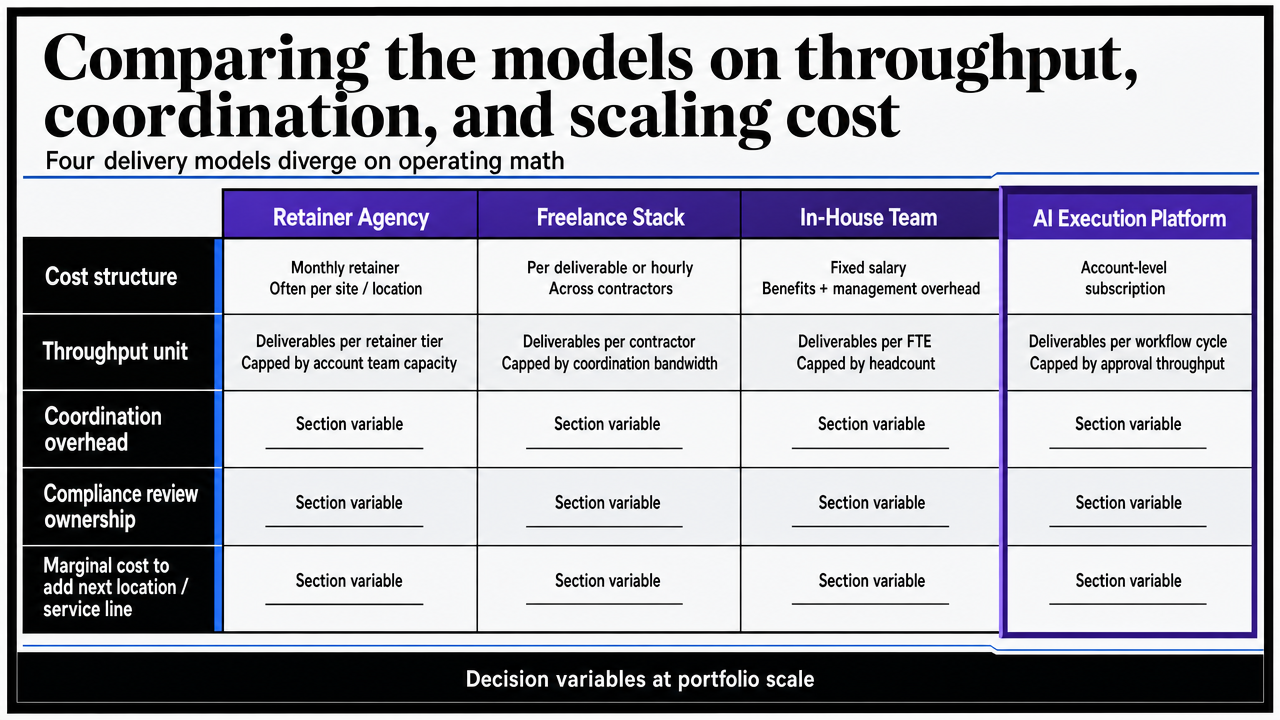 Visualize the four delivery models comparison across the five operational variables already presented in the section's table, reinforcing the decision framework for portfolio operators
If you manage multiple locations: account-level versus per-location billing
This subsection narrows the scope to operators running more than one location, brand, or service line. The economics shift in a specific way the moment that second site goes live.
Per-location billing treats each site as an independent engagement. A retainer agency charges a separate fee for each clinic, branch, or franchise unit. A freelance content writer scopes a separate brief per location page. An in-house hire's capacity is divided across locations until the math forces a second hire. Each model assumes the unit of work is the site, and prices accordingly.
Account-level billing treats the portfolio as the unit. One subscription, one strategy, one approval queue covers every site, location, and service line under a single growth program. The marginal cost of adding location eleven to a ten-location healthcare group is close to zero in the production layer, because the workflow already runs continuously across the account.
The practical test for portfolio operators is straightforward: ask any vendor what happens to the invoice when a new clinic opens. If the answer is "we add a line item" or "we scope an additional engagement," the pricing model is per-location. If the answer is "the existing plan covers it," the pricing model is account-level. The second model rewards expansion. The first taxes it.
This is not an argument that account-level pricing is always cheaper at low location counts. It is an argument that the cost curve flattens differently. Operators with three or more sites, or with active expansion plans, should run the math on year two and year three, not month one.
Regulatory fluency as a selection criterion, not a footnote
HIPAA marketing rules and PHI in tracking, remarketing, and content
For healthcare operators, the first vendor question is not whether the SEO team can write a service-line page. It is whether the team understands that the act of writing, tagging, and remarketing that page may move protected health information across systems that were never authorized to hold it.
HHS guidance is direct on the threshold. Under the HIPAA Privacy Rule, a covered entity must obtain authorization for any use or disclosure of protected health information for marketing, with narrow exceptions for certain treatment communications and face-to-face encounters 6. The exceptions are narrower than most marketers assume, and they do not generally cover the digital tracking infrastructure that powers modern SEO and paid integration: pixels on appointment confirmation pages, remarketing audiences built from condition-specific landing page visits, conversion events tied to form fills that include diagnostic context.
NIST's updated implementation guidance for the HIPAA Security Rule, SP 800-66 Rev. 2, reinforces the operational frame: covered entities are responsible for the confidentiality, integrity, and availability of electronic protected health information across the systems they control or contract for 13. An SEO vendor that recommends a third-party analytics pixel on a urology, oncology, or behavioral health page without specifying what data fields are collected and where they are transmitted has just expanded the covered entity's risk surface without authorization.
The selection test is procedural. A qualified vendor should be able to describe, without prompting, which pages on a healthcare property are treated as PHI-adjacent, which tags are permitted on those pages, which conversion events are scrubbed of identifiers before transmission, and whether business associate agreements are in place with any data processor that touches the resulting events. The systematic review of online health information seeking confirms why this matters at scale: search is a primary entry point for patients making care decisions, which means the highest-intent traffic on a healthcare site lands on exactly the pages where PHI handling is most constrained 3. Vendors who cannot answer the procedural questions should not be near the tag manager.
FTC substantiation and disclosure for SEO content claims
SEO content is advertising. The FTC treats it that way regardless of whether the page sits under a /blog/ path or a /services/ path, and it expects the same substantiation and disclosure standards that apply to any other marketing channel 9.
The practical consequences show up in the brief, not the byline. Service pages that claim faster recovery times, higher success rates, or comparative outcomes need underlying evidence on file before publication. Reviews and testimonials embedded for local SEO benefit carry endorsement disclosure obligations. Comparative language about competitors invites substantiation requests. The FTC's broader advertising guidance reiterates that truthful, non-misleading, substantiated claims are the baseline expectation across online marketing, and that the agency periodically updates its rules as digital practices evolve 11.
For a portfolio operator, the question is whether the SEO vendor builds substantiation into the content production workflow or treats it as the client's problem after delivery. A retainer agency that ships fifty location pages a month without a substantiation log has just transferred regulatory exposure back to the operator at fifty times the rate of a single-site engagement. A freelance content writer is almost never engaged for this layer at all.
The selection criterion: ask any prospective vendor for a sample claim review record, not a sample blog post. The absence of one is the answer.
ADA accessibility as both legal exposure and ranking signal
Web accessibility sits in an unusual position on the criteria list because it is simultaneously a legal obligation and a technical SEO input. The DOJ has stated that the ADA applies to the websites of businesses open to the public and points to the Web Content Accessibility Guidelines as the working technical benchmark 7. Search engines reward the same underlying signals: semantic HTML, alt text on meaningful images, keyboard-navigable interfaces, sufficient color contrast, and accurate heading hierarchy.
The convergence matters for vendor selection because it exposes which providers actually audit code versus which run a Lighthouse report and paste the score into a deck. A genuine accessibility pass produces a remediation list with specific WCAG criteria, affected templates, and a fix order. A surface audit produces a number.
For multi-location healthcare operators, the exposure compounds. Every location page inherits the parent template, which means a single accessibility defect in the template multiplies across the portfolio. A vendor that cannot describe its accessibility testing process at the template level, separate from page-level spot checks, will ship that defect into every new location launch. The DOJ guidance does not grant small-entity exemptions for portfolio scaling 7. Neither does Google's rendering pipeline.
CCPA, CalOPPA, and the tagging stack a vendor recommends
The analytics conversation usually begins with GA4 configuration and ends with conversion goals. For any operator with California traffic, which in practice means any operator with national reach, the conversation has to include the legal layer underneath the tags.
CCPA grants California consumers the right to know what personal information is collected and to opt out of its sale, and it imposes notice obligations on businesses that meet its thresholds 4. CalOPPA requires operators of commercial websites that collect personally identifiable information from California consumers to conspicuously post a privacy policy disclosing the categories of information collected and to address Do Not Track signals 5. An SEO vendor recommending a tag manager configuration, an enriched event schema, or a third-party remarketing pixel is making decisions that flow directly into both regimes.
The selection question is whether the vendor's default analytics implementation is compatible with the operator's privacy policy and consent architecture, or whether it forces a policy rewrite after the fact. Healthcare operators carry the additional HIPAA layer on top of these privacy obligations, the FTC substantiation duties on the content itself, and the DOJ's ADA accessibility expectations on the underlying templates. Taken together, the regulatory surface area an SEO vendor touches in a healthcare context spans HHS marketing authorization rules 6, DOJ web accessibility guidance 7, FTC substantiation and disclosure requirements 9, and the California AG's CCPA and CalOPPA obligations 4, 5. That is one procurement question, not four. Vendors who can map their workflow against all four are qualified. Vendors who treat any of them as someone else's job are not.
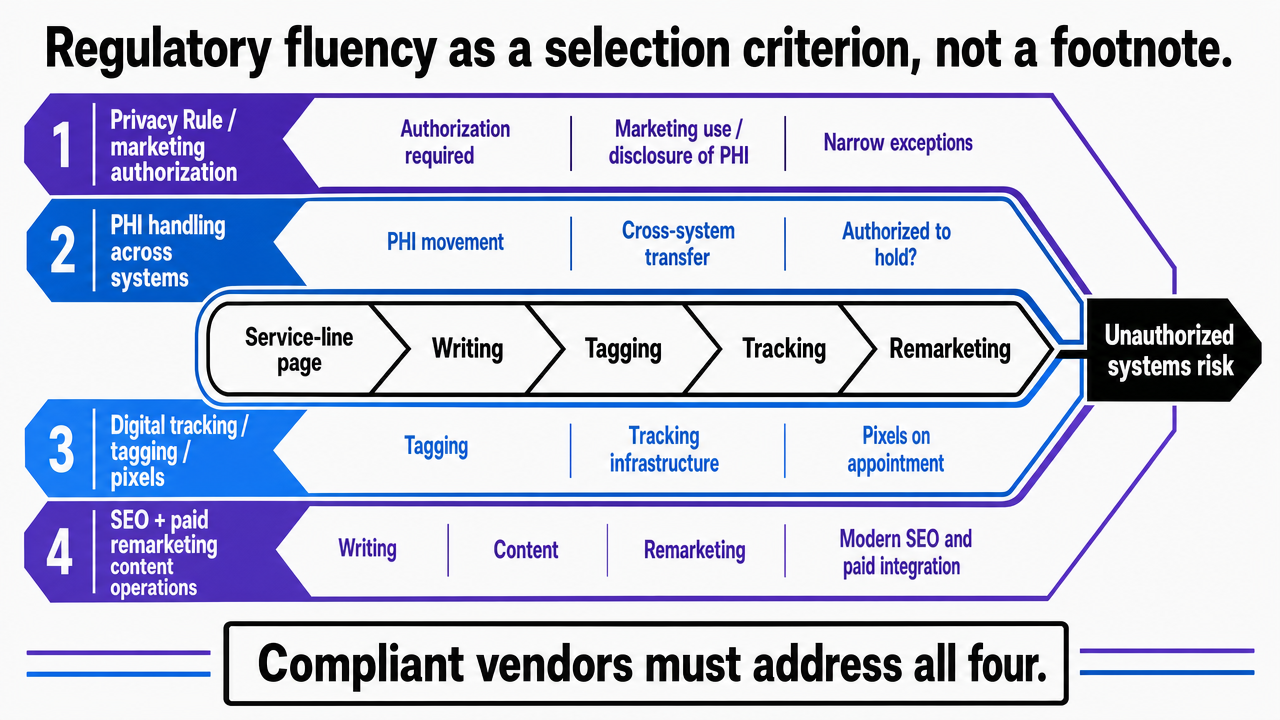 Map the four overlapping regulatory regimes an SEO vendor touches in a healthcare context, directly supporting the section's closing point that compliant vendors must address all four
Test AI-driven SEO workflows on real campaigns
Experience measurable SEO execution and publish live content before deciding on your next growth solution.
Measurement infrastructure is part of the buy
Measurement is not a deliverable an SEO vendor produces alongside content. It is the substrate that determines whether any of the other deliverables can be defended, optimized, or attributed. A vendor that does not own its measurement stack is selling motion, not outcomes.
The baseline configuration is unremarkable on paper: GA4 with server-side event collection where feasible, Search Console verified at the property and domain level, a tag manager with documented event schemas, and conversion definitions that map to real business outcomes rather than vanity engagement metrics. The differentiating question is whether the vendor configures this stack against the operator's privacy posture or treats configuration as a separate billable phase.
CCPA imposes notice and opt-out obligations that flow directly into tag firing logic for any operator with California traffic 4. CalOPPA layers privacy policy disclosure requirements on top, including how the site responds to Do Not Track signals 5. A vendor recommending enriched event parameters or a remarketing pixel without reconciling those events against the posted privacy policy is creating a documentation gap the operator inherits.
For portfolio operators, three measurement capabilities separate qualified vendors from the rest:
- First, account-level reporting that rolls up across locations rather than forcing manual stitching of per-site dashboards.
- Second, attribution definitions that survive when a service line is added or a location moves.
- Third, a written data dictionary listing every custom event, its trigger, its parameters, and the privacy basis for collecting it.
Vendors who cannot produce the third artifact on request have not built the first two reliably.
Vendor access risk: who touches the CMS, DNS, and ad accounts
An SEO engagement is also an access grant. By the time a vendor ships its first deliverable, it has typically requested administrator rights to the CMS, DNS records for schema and verification, Google Analytics and Search Console, Google Ads and the tag manager, and frequently the hosting control panel. Each credential is a potential breach path that travels with the contractor list, not the contract.
NIST treats this as a shared responsibility problem. Its Small Business Cybersecurity Corner frames security across vendors and service providers as a continuous obligation rather than a one-time onboarding step, and points small operators toward scalable practices drawn from the Cybersecurity Framework 2. The FTC's small business guidance is more operational: vet web hosts and vendors, limit access to sensitive data, and assume that compromised credentials can disrupt online presence and search visibility 10.
The selection test has four parts:
- First, individual named accounts with role-based permissions, not shared logins.
- Second, an offboarding checklist that revokes access within a defined window when contractors rotate.
- Third, multi-factor authentication required on every system the vendor touches, including the tag manager and DNS registrar.
- Fourth, a written inventory of which plugins, scripts, and third-party services the vendor has installed, because each one is an inherited attack surface the operator now owns.
See How Automated SEO Delivers Measurable Gains for SaaS and Agency Teams
Request a walkthrough of AI-driven SEO workflows proven to cut manual coordination by 65% and improve ranking velocity for multi-site and high-volume content operations.
Site architecture and content quality bars worth holding
Architecture is the cheapest lever an SEO vendor can pull and the one most often skipped. The SBA's baseline for a small business site, a clear home, about, products or services, testimonials, and contact structure with a contact page that includes email, phone, and address, plus directions for foot-traffic locations, exists because users and crawlers both reward predictable information architecture 12. For a portfolio operator, that baseline is the template, not the destination. Location pages need consistent schema, parent service pages need to nest hierarchically rather than sprawl flat, and internal links should mirror the customer journey rather than chase keyword density.
Content quality bars are where most retainer agencies underdeliver at scale. A defensible standard names the author, cites primary sources for any clinical or technical claim, and treats reviews and testimonials as evidence that carries FTC endorsement obligations rather than decoration. The systematic review of online health information seeking found that search engines are commonly a first step in health decisions, with literacy and education shaping what users do with the results 3. That puts a floor under healthcare content: accuracy reviewed by qualified personnel, reading level matched to the audience, and no claim shipped without a source on file.
A procurement framework that survives the next location
The selection question collapses into five tests a portfolio operator can run on any prospective vendor in a single discovery call:
- First, how does the invoice change when location eleven opens. Account-level pricing answers in a sentence; per-location billing answers with a new statement of work.
- Second, which compliance regimes does the vendor own inside its production workflow, not after delivery. A qualified answer names HIPAA marketing authorization 6, FTC substantiation 9, ADA conformance 7, and CCPA notice obligations 4 without prompting.
- Third, what artifacts does the vendor produce on request: a substantiation log, a WCAG remediation list at the template level, a data dictionary tied to the posted privacy policy, and an access inventory mapped to NIST's shared-responsibility frame 2.
- Fourth, what is the throughput cycle from approved brief to published page across the portfolio, measured in days rather than meetings.
- Fifth, what happens to existing work when a contractor rotates off the account.
Operators evaluating SEO services for small business at portfolio scale should weight these five answers above any deliverable list. Vectoron is one option built against this framework.
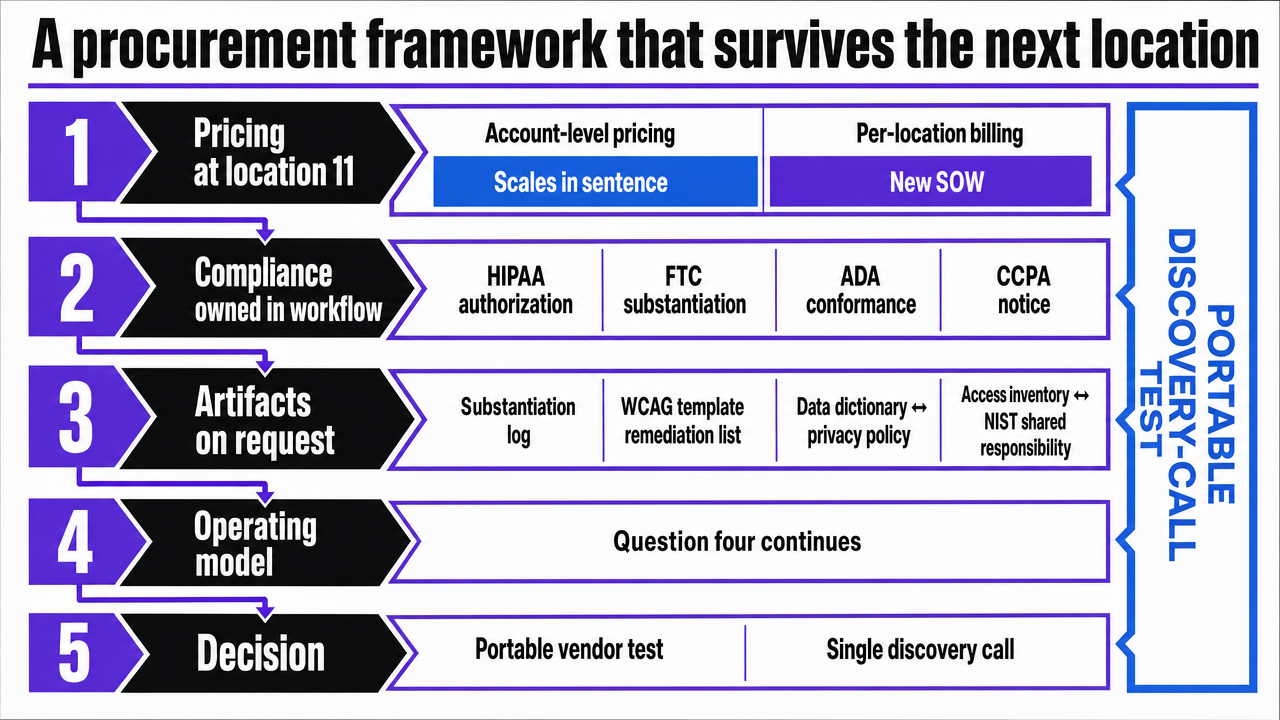 Visualize the five-question procurement framework introduced in this section as a sequential evaluation flow, giving readers a portable decision tool
Frequently Asked Questions
References
- 1.A look at small businesses in the U.S..
- 2.Small Business Cybersecurity Corner | NIST.
- 3.Online Health Information Seeking Behavior: A Systematic Review.
- 4.California Consumer Privacy Act (CCPA) – Frequently Asked Questions.
- 5.California Online Privacy Protection Act (CalOPPA).
- 6.HIPAA Privacy Rule and Marketing.
- 7.Guidance on Web Accessibility and the ADA.
- 8.Small Business is a Big Priority: NIST Expands Outreach to the Small Business Community.
- 9.Online Advertising and Marketing.
- 10.Cybersecurity for Small Business.
- 11.Advertising and Marketing.
- 12.5 Essential Pages For Your Small Business Website - SBA.
- 13.NIST Updates Guidance for Health Care Cybersecurity.