
Key Takeaways
- The eight SEO workstreams fail when procured separately because each one generates outputs the next depends on, and disconnected vendors break that signal flow.
- Keyword and intent research functions as a continuous demand pipeline, feeding the other workstreams with current signals from Search Console, GA4, and SERP movements rather than static spreadsheets.
- Technical SEO sets the backend floor for crawlability and indexation, and treating it as a one-time audit ignores how code changes constantly introduce new crawl issues 4.
- On-page optimization and information architecture turn isolated URLs into a connected content graph through hierarchy, internal links, and intent-matched titles 1.
- Content development is distinct from on-page SEO because ranking and readability are separate outcomes, and unreadable pages convert poorly even when they rank 11.
- Off-page authority should be measured by referring-domain growth weighted for topical relevance, not raw link counts, since algorithms devalue volume-based acquisition 15.
- Local SEO captures geography-bound intent closest to conversion, so the signal worth tracking is calls, directions, and form fills per location rather than brand-level impressions.
- Structured data makes pages machine-readable for rich results and AI answers, but markup that contradicts visible content gets discounted, so validation matters more than presence 5.
- Analytics closes the feedback loop by turning Search Console and GA4 data into weekly backlog decisions, distinguishing genuine feedback from monthly reporting PDFs 2.
- Coordination cost is the hidden line item across disconnected vendors, where five contracts and five reporting surfaces force the growth lead to act as the integration layer.
- Multi-location operators must scale content velocity per site, with the one-article-per-week minimum applying to each location rather than the brand program as a whole 13.
- Running the eight workstreams as one system shrinks the signal-to-action gap from quarters to days, whether through an in-house operations role or a unified orchestration layer.
Why the Eight Workstreams Fail Apart and Compound Together
Most growth teams procure SEO as eight distinct services: a technical audit, content creation, link building, local listings management, schema implementation, analytics consulting, keyword research, and performance tracking. While individual tasks may be completed, the synergistic compounding effect often fails to materialize.
Academic research consistently identifies these core workstreams. A 2024 conference paper from Georgia Southern highlights four key levers for organic ranking improvement: keyword selection, audience-tailored content, link building, and site architecture 14. The University of Illinois further operationalizes this into five executable steps: keyword research, on-page SEO, technical SEO, off-page SEO, and tracking via GA4 and Search Console 2. Including local visibility, structured data, and continuous content development brings the comprehensive list to eight.
The inherent flaw is structural. Each workstream generates outputs crucial for the next. Keyword research without analytics feedback can become misaligned. Content lacks visibility if technical health is poor. Links are less effective without strong on-page substance. When managed by separate vendors, these handoffs introduce latency, redundant reporting, and a lack of clear ownership, preventing the services from operating as a cohesive system.
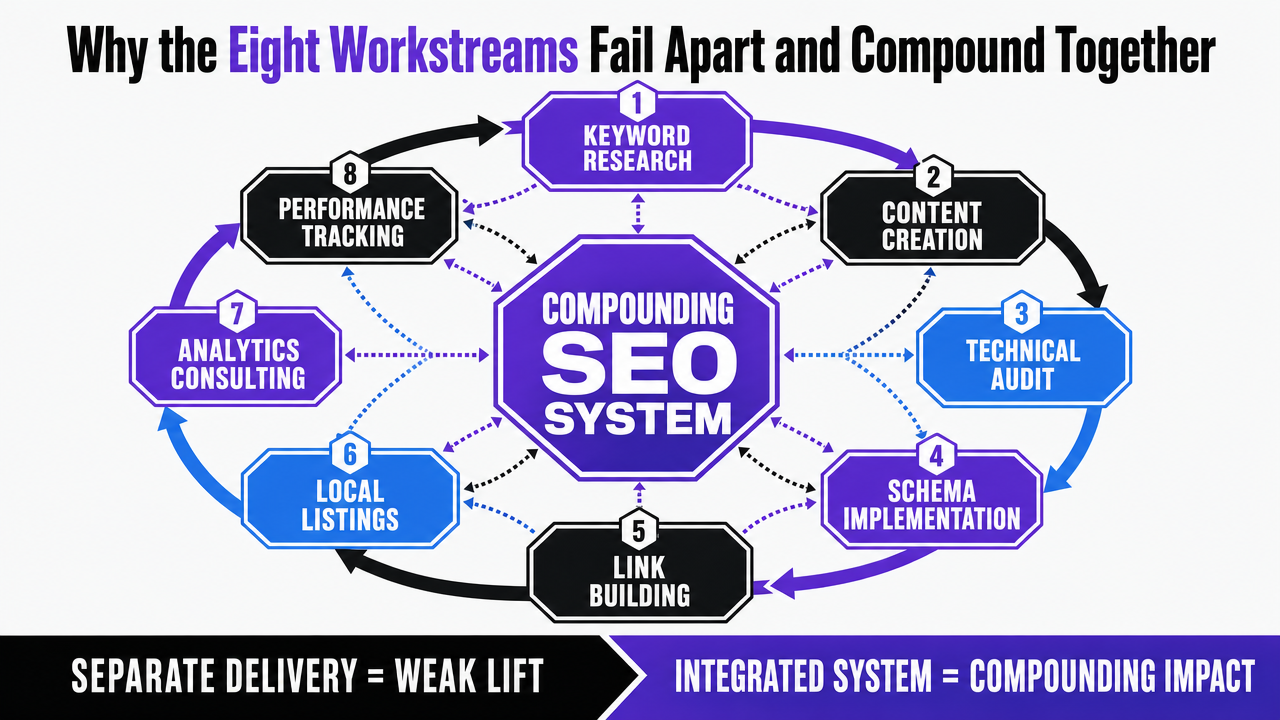 Visualize the eight interconnected SEO workstreams as a unified system, showing how outputs from one feed into the next, supporting the core thesis of the article
Keyword and Intent Research as a Demand Signal Pipeline
Keyword research is not a one-off task but a continuous process. It transforms query logs, competitor analysis, and audience behavior into a strategic topic map that guides the other seven workstreams. The true output is not merely a spreadsheet of search volumes, but a prioritized cluster of user intents linked to specific pages, continuously updated with data from Search Console.
The Georgia Southern synthesis emphasizes keyword selection as one of the four primary levers for organic rankings 14. Three of these four levers directly depend on the insights derived from keyword research. Outdated keyword data leads to content targeting irrelevant queries. Missing cluster maps result in incorrect internal linking strategies. Without proper demand signal modeling, backlink outreach may focus on the wrong anchor topics.
The critical distinction lies between vanity metrics like head-term volume and actionable inputs like intent shape. For example, a query like "seo services list" indicates a buyer evaluating vendors, not a novice seeking a definition. The ranking page must address vendor scope, not just define SEO. By treating research as a continuous feed—incorporating Search Console queries, GA4 engagement, competitor SERP movements, and support ticket language—all subsequent workstreams operate on current signals rather than outdated assumptions.
Technical SEO: Crawlability, Indexation, and the Backend Floor
Technical SEO forms the foundational layer for all other workstreams. Michigan Tech defines it as
"the process of optimizing the technical aspects of a website to improve its search engine rankings"
by facilitating easier crawling and indexing for search engines 4. If pages are inaccessible or slow for crawlers, other SEO efforts are undermined. Content remains unindexed, internal links lead to dead ends, and schema validation becomes irrelevant for pages not in the index.The University of Illinois outlines the practical scope: backend elements that enable search engines to
"crawl, index and rank"
the site, highlighting site speed as
"a crucial ranking factor"
2. Key recurring inputs include:
- mobile rendering
- page speed
- URL structure
- XML sitemap hygiene
- robots directives
- canonical logic
Common failure points include faceted URLs creating duplicate content, JavaScript delaying content rendering, and sitemaps listing 404 pages. Each issue, seemingly minor in isolation, can significantly degrade overall site performance.
A common procurement error is treating technical SEO as a one-time audit. While Michigan Tech recommends a "comprehensive site audit" to identify issues like broken links, slow pages, and mobile usability 3, this audit is merely a starting point. Websites are dynamic; code updates, template changes, and new product pages constantly introduce new crawl challenges. The true measure of success is not the audit score, but the ongoing changes in indexed pages, crawl budget consumption, and Core Web Vitals, fed back from Search Console to the engineering team.
On-Page Optimization and Information Architecture
On-page optimization translates topic clusters into pages that are both crawler-friendly and user-readable. This involves optimizing titles, meta descriptions, headings, URL slugs, image alt text, and internal link anchors. Google's own starter guide, hosted by Columbia, emphasizes building a
"naturally flowing hierarchy"
to make it
"as easy as possible for users to go from general content to the more specific content they want"
1. This hierarchy is not cosmetic; it provides routing logic for crawlers to understand page purpose and for users to navigate effectively.
Stanford Medicine's web services team provides practical guidance for regulated environments:
- maintain a "flat" site structure
- establish internal links between related pages
- correct broken links
- optimize images for speed
- submit both HTML and XML sitemaps 5
A flat structure is crucial because excessive clicks from the homepage to key pages dilute crawl priority and authority flow. Internal linking is the primary mechanism for distributing this authority.
A common pitfall is treating on-page SEO as a checklist performed only once per page launch. Effective on-page optimization ensures each page targets a single, clear intent, with a matching title, headings that progress logically, and descriptive internal links from relevant cluster pages. Without these connections, new content can become an "orphan" in the index. While it might rank, it won't contribute to compounding growth. On-page optimization transforms a collection of URLs into a connected content graph.
Test Every Essential SEO Service in Action
Experience a live SEO workflow and publish real, production-ready content during your free trial period.
Content Development and the Readability Gap
Content development is the process of creating the actual pages identified by keyword research and structured by on-page optimization. It differs from on-page SEO, despite often being conflated by agencies. On-page SEO focuses on elements like titles, headings, and internal links for existing pages, while content development determines the page's argument, supporting evidence, and overall usability for the reader.
This distinction is vital because ranking and readability are separate outcomes. A peer-reviewed analysis of diabetic retinopathy websites revealed that many top-ranked patient-facing pages, while optimized for search engines, were written at a reading level inaccessible to patients 11. This highlights a broader principle: optimizing for crawlers and writing for human readers are distinct editing processes. Neglecting readability can lead to traffic that bounces, hindering conversion and growth.
A digital marketing analysis for private healthcare practices suggests a baseline of at least one new article per week, minimum 400 words, targeting one to three keywords 13. This cadence is a minimum for a single site. The key metric is not word count, but whether published pages effectively address the intents identified by research and are clearly written for the target audience. Content development that overlooks readability creates indexed inventory that ranks and gets clicks but fails to convert, a detrimental outcome for growth teams.
Off-Page Authority and Link Acquisition
Off-page SEO builds trust signals that search engines cannot infer solely from the website itself. This is primarily achieved through citations, or backlinks. When other domains link to a page, they essentially endorse its value. Search algorithms weigh these endorsements based on the authority of the linking domain. Educational guidance from the University of Georgia identifies backlinks as
"one of the most important ranking factors in Google's algorithm,"
noting that links from reputable sources, including .edu sites, convey authority and trust more effectively than less robust referral patterns 15.
The operational difference is crucial. Volume-based link buying often targets a metric that algorithms have learned to devalue over two decades. Authority-weighted acquisition, conversely, focuses on acquiring the few links that genuinely impact rankings—earned placements in research citations, industry directories, journalistic sources, and topical hub pages from credible domains. The same UGA guidance warns against manipulative schemes, underscoring why off-page efforts should be integrated with content and digital PR, rather than managed as a separate, isolated procurement 15.
The key signal to monitor is the growth of referring domains, weighted by topical relevance, rather than a simple raw link count. A few high-quality citations from authoritative domains within the relevant industry will significantly outperform hundreds of low-context links.
Local SEO and Query-Pattern Behavior
Local SEO focuses on capturing intent tied to specific geographic locations. Its inputs differ from other SEO workstreams, encompassing:
- Google Business Profile signals
- consistent citations across directories
- optimized location-page architecture
- review velocity
- proximity-weighted query data
The desired output is not just traditional blue-link rankings, but also map-pack visibility and direction requests.
Research into query behavior explains the necessity of this distinct workstream. A 2024 analysis of anonymized search logs revealed unique behavioral patterns for health-related queries, including surges in searches linked to symptom onset and diagnosis 10. A systematic review of online health information seeking confirms that search engines are the primary discovery method, and that accessibility and navigation are critical for users to find and trust information 9. These findings apply broadly to any high-consideration industry where buyers conduct extensive research before engaging with a vendor: local queries, while often not the first, are typically closest to conversion.
A common mistake is to view local SEO merely as a directory listing task. While citation hygiene is important, it alone does not drive rankings. The most valuable signal to track is conversion actions per location—calls, direction requests, form fills—segmented by query intent, rather than aggregate impressions across a brand profile.
Structured Data and Schema as a Machine-Readable Layer
Structured data is the workstream that converts page content into a format search engines can easily interpret without ambiguity. Schema markup labels entities—such as an article, a person, a service, a location, a review, or an FAQ—enabling the index to map them to features like rich results, knowledge panels, and increasingly, AI-generated answers that directly cite source pages.
The operational process is straightforward: JSON-LD blocks are added to templates, validated using Google's testing tools, and kept synchronized with the on-page content. A common failure occurs when markup contradicts the visible content. For instance, a LocalBusiness schema listing hours that differ from the footer, or a MedicalEntity tag on a page no longer relevant to that condition, will be flagged and discounted. Stanford Medicine's web guidance emphasizes that technical signals should reinforce, not misrepresent, what users actually see 5.
The key signal to track is rich result eligibility and impression share for structured features in Search Console, rather than merely the presence of markup. Schema without validation is decorative. When integrated into the content production workflow, schema becomes the essential layer that makes pages intelligible to all downstream consumers of the search index.
See How Leading Teams Operationalize All 8 Essential SEO Services—Without Agency Overhead
Request a walkthrough of a unified SEO operating system built for agencies and enterprise brands. Discover workflow, reporting, and execution benchmarks with real-world output across every service listed in this article.
Analytics, Search Console, and the Feedback Loop
Analytics is the workstream that completes the feedback loop. Without it, the other seven operate in isolation: content is published, links are acquired, and schema is validated, but there's no clear understanding of which actions influenced rankings, traffic, or pipeline. The University of Illinois positions tracking through GA4 and Google Search Console as the fifth operational step of SEO, not an optional reporting add-on 2. Michigan Tech's web team similarly stresses that benchmarking with Google Analytics, Search Console, and SEO software is essential for measuring the effectiveness of other SEO efforts 3.
The crucial distinction is between reporting and feedback. A monthly PDF of impressions and clicks is reporting. In contrast, a weekly analysis of Search Console query data that informs content backlog adjustments, identifies pages with declining CTR, and uncovers new intents missed by keyword research—that is feedback. A peer-reviewed analysis of digital health centers confirmed that SEO implementations significantly impact traffic and engagement, but cautioned against using rankings alone as a proxy for quality 12. Teams that confuse these two optimize for dashboard metrics instead of actual business outcomes.
The most valuable signals to track are not aggregate sessions, but rather which queries gained or lost ground, which pages converted, and which workstream should receive the next priority task.
Coordination Cost: The Hidden Line Item Across Disconnected Vendors
The eight SEO workstreams incur a hidden cost: the overhead of transferring information between them. A technical audit firm might identify a faceted-URL issue in a PDF report. If the content agency doesn't review this, they might publish new pages on affected templates, leading to duplicate content issues. A link vendor might pitch anchors to pages still awaiting engineering fixes. A local SEO specialist might update citations based on an outdated location list. Each vendor delivers their scoped service, but the compounding effect is lost due to a lack of coordination.
The University of Illinois guidance presents the five canonical steps—keyword research, on-page, technical, off-page, and analytics—as a sequential process where each step informs the next 2. Fragmented procurement disrupts this sequence. Engaging five separate vendors means managing five contracts, five reporting schedules, five definitions of success, and five distinct interpretations of the same Search Console data. The growth lead effectively becomes the integration layer, manually relaying information between different parties.
This coordination cost is evident in structural inefficiencies, not in any single invoice line item. Consider the handoff points for a multi-location operator using separate vendors for technical audits, content, links, local SEO, and analytics: five vendors, five contracts, at least five reporting interfaces, and an approval process that must clear each one before any page changes. Each handoff introduces latency between signal and action—the delay between insights from Search Console and their implementation in the next sprint. This delay is where ranking progress stalls.
If You Run Multi-Location Healthcare or Multi-Site Operations
Content Velocity and Patient-Facing Cadence
For organizations managing multiple locations—such as a regional dental group or a multi-site physical therapy network—the content workstream requires a different approach. The recommended content cadence for a single private practice becomes a per-location minimum, not an overall program total.
A peer-reviewed digital marketing plan for hearing healthcare practices suggests posting at least one new article per week, of at least 400 words, targeting one to three relevant keywords, as a baseline for attracting new patient inquiries 13. For a five-location group, this benchmark scales to approximately five articles per week across location-specific pages, in addition to brand-level hub content. Many operators fail to meet this localized content velocity, often publishing brand-wide content while location pages remain static for extended periods.
The key signal to track at the location level is published pages per month versus indexed pages per month versus organic conversions per month. A location consistently producing one article per week, with internal links to its service pages and city-modified intent terms, will outperform a location publishing nothing, even if the brand site has higher domain authority. Velocity at the individual location level is crucial for compounding growth.
Procurement Models: Separate Vendors vs. Single-Account Orchestration
The complexity of procurement increases with each additional site. A single-practice operator might manage the handoff overhead between a technical firm, a content agency, and a link vendor. However, a twenty-location operator cannot. In such cases, vendors either bill per location—multiplying contract costs—or treat the brand as a single account, allowing individual locations to fall out of the workflow.
The structural differences between these two procurement models are clear:
| Variable | Separate Vendors (per workstream) | Single-Account Orchestration ||---|---|---|| Number of contracts | 5+ (technical, content, links, local, analytics) | 1 || Reporting surfaces | 5+ dashboards and PDFs | 1 consolidated view || Approval cycles per change | One per vendor in sequence | One, against a unified plan || Per-location billing exposure | Often multiplied by site count | Account-level, not per-site || Handoff points between workstreams | At least 4 between the five lanes | Internal to the workflow || Owner of integration work | The growth lead, by default | The orchestration layer |
The University of Illinois guidance frames the five canonical workstreams as a sequence where each step feeds the next 2. When procurement fragments this sequence across multiple vendors, the growth lead becomes the de facto integration layer. Consolidating procurement, however, makes the workflow itself the integration layer. For operators managing more than three sites, the latter model is essential for scaling velocity without increasing coordination headcount.
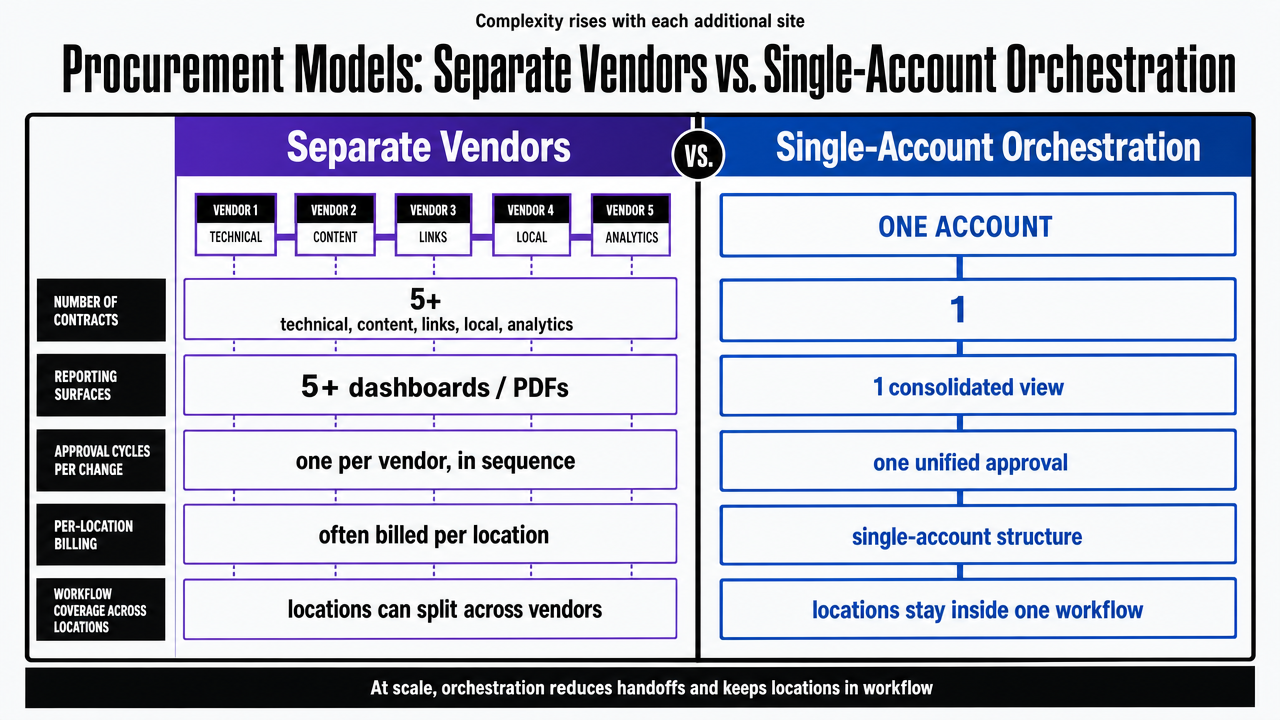 Render the comparison table from this section as a clean side-by-side visual showing the structural differences between fragmented vendor procurement and unified orchestration
Running the Eight as One System
The eight SEO workstreams generate compounding growth only when a unified plan ensures information flows between them promptly. Keyword research informs content creation. Content development relies on technical health. On-page optimization integrates the page into its content cluster. Off-page efforts secure citations that strengthen the page's authority. Local SEO routes intent to specific locations. Schema makes content machine-readable. Analytics then guides the next action. The University of Illinois guidance emphasizes these steps as a sequence, not a disconnected menu of services 2.
For a growth lead, the practical question is where the integration responsibility lies. Multiple vendors shift this burden onto the growth lead. A single orchestration layer—whether an in-house SEO operations role or an AI platform like Vectoron that coordinates all eight workstreams under one account-level plan—reduces the signal-to-action gap from quarters to days. The true deliverable is not eight separate services, but a single, integrated system that publishes, ranks, and converts more efficiently than fragmented procurement models allow.
Frequently Asked Questions
References
- 1.Search Engine Optimization Starter Guide (Google PDF hosted by Columbia University).
- 2.SEO Implementation: How to Execute SEO Strategies.
- 3.Six Ways to Improve Your Site's Ranking (SEO).
- 4.Technical SEO - Michigan Technological University.
- 5.SEO Best Practices | Web Services - Stanford Medicine.
- 6.Visibility of Moodle applications in Central Asia: analysis of SEO.
- 7.What is SEO – Search Engine Optimization?.
- 8.10 Reasons Why SEO Is Important for Small Businesses.
- 9.Online Health Information Seeking Behavior: A Systematic Review.
- 10.Search Engine Use for Health-Related Purposes: Behavioral Data From Web Search Logs.
- 11.Search engine optimization and its association with readability and content of websites on diabetic retinopathy.
- 12.Applying Website Rankings to Digital Health Centers in the United States for Quality Improvement: Cross-sectional Study.
- 13.Digital Marketing for Private Practice: How to Attract New Patients.
- 14.The Significant Role of SEO in Effective Web Marketing.
- 15.How SEO Edu Guest Post Backlinks Can Help in Ranking – Inspire.