
Key Takeaways
- Treat slug creation as governance, not a one-off writing task: a written standard applied at draft time, enforced at publish time, and protected by 301 redirects whenever a URL moves 4.
- Start with the rules Google actually confirms—lowercase, hyphens over underscores, descriptive words, minimal parameters, proper encoding—then layer practitioner conventions like three to five words and a 60-character soft ceiling 1, 9.
- Place the primary keyword early, strip stop words and scaffolding, and keep dates or CMS-generated IDs out of evergreen slugs so the URL stays a stable identifier 3, 6.
- Do not rewrite live slugs on instinct: an indexed URL carries backlinks and history, and editing it without a 301, updated internal links, canonical, and sitemap destroys accumulated equity 4, 12.
Why slug policy belongs in your content operations manual
Most guidance about SEO slugs is written for a single writer publishing a single post. That framing breaks the moment a content library crosses a few hundred URLs, gets touched by multiple editors, and starts accumulating slugs generated by whatever the CMS defaulted to at the time. The problem stops being how to write a good slug and becomes how to enforce a slug standard consistently, and how to protect that standard when URLs have to change.
That distinction matters because Google's own URL guidance is narrower than most practitioner advice suggests. Google's Search Central documentation confirms usability and crawlability recommendations—descriptive words over ID numbers, hyphens over underscores, minimal parameters, correct encoding for non-ASCII characters—but does not frame the slug itself as a direct ranking factor 1. Practitioner sources, meanwhile, treat keyword placement and length as high-leverage decisions. A working policy has to reconcile both without overclaiming either.
The operational stakes are concrete. An indexed slug changed without a 301 redirect destroys accumulated link equity for that URL 4. A CMS that quietly appends dates, IDs, or capital letters produces slugs that are harder to migrate later and inconsistent across an archive. A style guide that specifies keyword position, character range, and separator conventions gives writers and developers a shared rule set that survives staff turnover.
This guide treats slug work as governance: a written standard applied at draft time, enforced at publish time, and protected by redirect discipline whenever a URL moves.
What a slug actually is (and what Google says it does)
The slug defined: the identifier at the end of the path
A slug is the segment of a URL that sits after the domain and any folder path, identifying the specific page. The University of Washington's institutional guide defines it as
"the end part of a URL after the backslash that identifies the specific page or post"
11. In example.com/blog/seo-slug-basics, the slug is seo-slug-basics. Everything to its left is protocol, host, and path structure; the slug is the human-readable label the CMS attaches to a single piece of content.
That label serves three constituencies at once:
- Users read it in the address bar and in search snippets, which affects whether a result looks trustworthy enough to click.
- Crawlers read it as a hint about the page's topic.
- Internal systems—analytics, redirect maps, sitemap generators, CDN caches—use it as a stable identifier tied to that URL's history of clicks, links, and impressions.
Because the slug is the one part of the URL a content team routinely controls at publish time, it becomes the surface where editorial judgment meets technical policy. A default slug generated by a CMS from a working title is not the same asset as one deliberately written to a standard.
Where Google's guidance ends and practitioner consensus begins
Two sets of rules govern slug construction, and conflating them is the fastest way to write a policy that overreaches. The first set comes from Google's own URL structure documentation. The second comes from practitioners who have extrapolated from that documentation and from their own testing.
Google's Search Central page confirms a narrow list: use descriptive words rather than long ID numbers, use hyphens rather than underscores to separate words, keep parameters to a minimum, avoid URL fragments to load content, and encode reserved and non-ASCII characters correctly 1. Coverage of the 2025 guidance updates reinforces the same short list—simple descriptive words, hyphens over underscores, minimal parameters, proper encoding—without introducing a length limit, a word count, or a claim about direct ranking impact 10.
Practitioner sources add the operational rules that most content teams actually enforce. Guides aimed at content marketers recommend keeping slugs to three to five words, including the primary keyword, removing stop words, and avoiding dates in evergreen content 3. Developer-facing guides converge on the same three-to-five-word target and the same case for primary keyword placement 9. These recommendations are useful, but they are practitioner consensus, not Google policy.
The distinction matters when a slug rule is challenged internally. Hyphens, lowercase, and descriptive words can be defended as aligned with Google's documentation. A three-to-five-word limit or a rule against including a year has to be defended as house style backed by external consensus. A slug policy that mixes both without labeling them invites disputes it cannot win. Writing the policy in two columns—what Google confirms and what the team is adopting as convention—gives editors and developers a clear basis for every rule they enforce.
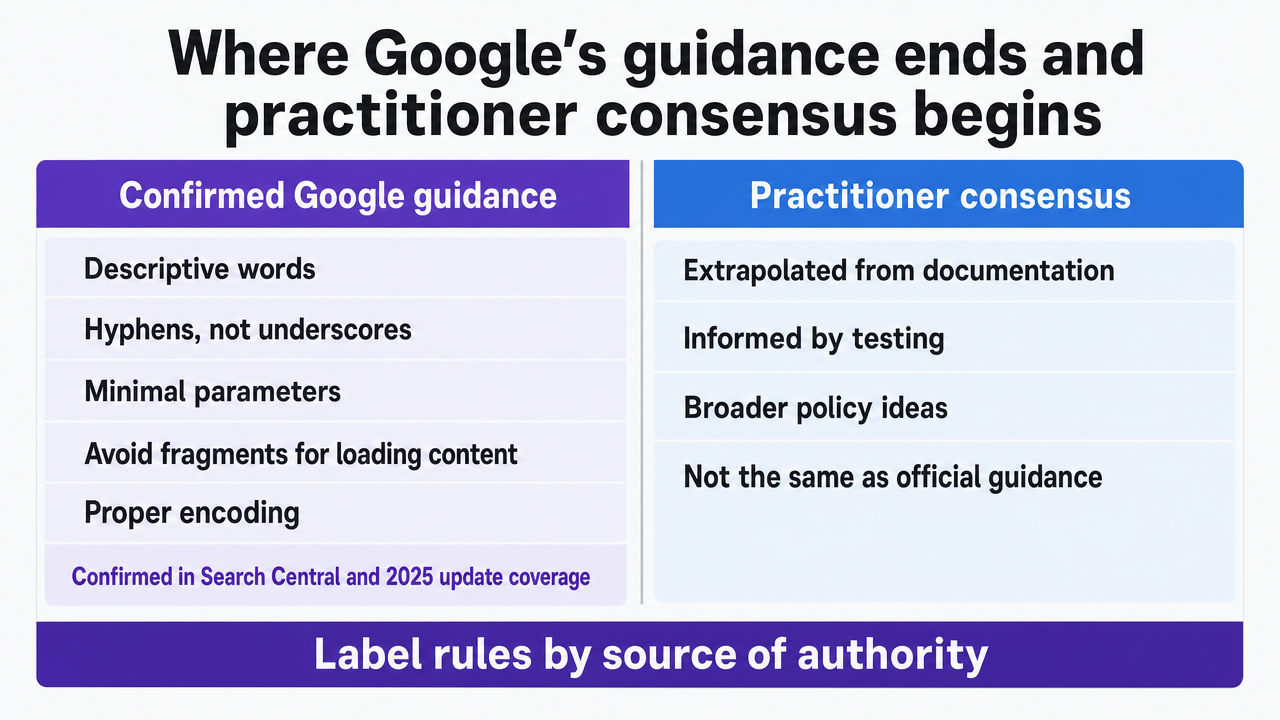 Compare confirmed Google guidance versus practitioner consensus in a two-column framework, directly supporting the section's core argument about labeling rules by source of authority
The rules a slug standard should encode
Length: the practitioner band Google never specified
Google's URL guidance does not name a maximum slug length. Practitioner sources fill that vacuum, and they land in a surprisingly tight band. One synthesis guide advises keeping URLs under 60 characters 2. A strategic URL structure piece recommends aiming for roughly 50 to 60 characters 7. Two checklist-style resources drop the unit of measurement to words, converging on three to five words as the working ceiling 4, 9.
Plotted against each other, these recommendations describe the same target from two directions. Three to five descriptive English words, once hyphenated, typically land between about 25 and 55 characters. A 60-character cap catches the outliers where a compound noun or a longer keyword pushes the count higher. Neither number is Google policy, but the overlap is close enough to defend as house convention.
The operational value of picking a number is not that Google will punish a 62-character slug. It is that a written cap gives editors something to enforce during review and gives developers a validation rule they can add to the CMS. Without one, slugs drift longer over time as writers append qualifiers, and archives develop the inconsistency that makes reporting and redirect maps harder to maintain.
A defensible policy language: target three to five content-bearing words and a soft ceiling of 60 characters, with the explicit note that this is house convention aligned to practitioner consensus, not a Google-stated limit.
Characters, case, and separators
Three character-level rules survive across every source in the research and align with Google's own documentation. Slugs should be lowercase. Words should be separated by hyphens, not underscores. Special characters, accents, and encoded fragments should be stripped or normalized before publish.
Case sensitivity is the rule most often broken by CMS defaults. A developer-facing guide is blunt about the consequence: consistent lowercase avoids case-sensitivity issues in routing and link sharing, where /SEO-Guide and /seo-guide can resolve differently depending on server configuration 8. Enforcing lowercase at the CMS level, rather than trusting editors to remember, removes the failure mode entirely.
The hyphen-versus-underscore question is settled by Google directly. Search Central documentation recommends hyphens over underscores because hyphens help both users and search engines identify separate concepts in the URL 1. Underscores read as word joiners to the parser, which collapses seo_slug_basics into a single token.
Special characters deserve the same treatment. Migration-focused guidance recommends stripping accents and normalizing to ASCII so slugs survive future platform changes without encoding artifacts appearing in redirect maps and analytics reports 6. A slug that renders cleanly in one system but breaks in the next is not a stable identifier.
Keyword placement and stop word removal
Practitioner sources agree on two composition rules that shape what actually goes into the slug: the primary keyword belongs early, and stop words come out. A checklist resource frames both as core rules alongside lowercase and hyphens 3. A developer guide reaches the same conclusion from the engineering side, recommending primary keyword inclusion to signal topical relevance 9.
Keyword placement is where the Google-versus-practitioner tension shows up most clearly. Google's documentation confirms that descriptive words help crawlers understand content 1, but does not claim keyword position inside the slug is a direct ranking factor. Practitioner sources treat early placement as high-leverage anyway. The defensible position is to include the primary keyword because it improves user-facing clarity in SERP snippets and social shares, and to place it early because that is the practitioner convention, not because Google has ranked it.
Stop word removal is less controversial. Articles, prepositions, and conjunctions—the, a, of, for, and—add length without adding signal 3. A slug written from the working title the-ultimate-guide-to-seo-slug-basics-for-marketers tightens to seo-slug-basics once stop words and scaffolding come out. The shorter version reads faster, indexes cleaner, and stays within the length band without editorial contortion.
The numbers-and-dates disagreement
Not every slug rule has consensus behind it. The clearest disagreement in the research concerns numbers and dates. One checklist advises avoiding both categorically, grouping dates and numbers together as things that force URL changes when content is updated 3. A migration-focused guide is stricter still: never put the year, day, or any time-bounded fact in the slug, because doing so guarantees a redirect obligation the next time the content is refreshed 6.
The rule holds for evergreen content, which is most content most content teams publish. It breaks for legitimate cases the research does not resolve. A year-based trend report—content-marketing-benchmarks-2026—uses the year as a factual identifier, not a freshness marker. A numbered guide framework—seo-basics-101—uses the number as part of the topic label. Treating either as forbidden overreaches.
The workable policy separates the two cases. Time-bounded slugs are prohibited for evergreen content and permitted for content whose identity depends on the year or number, with the trade-off documented: the URL will need a redirect when the content is refreshed or retired.
Test Data-Driven SEO Slug Creation Workflow
Experience measurable impact by publishing optimized URLs and tracking ranking performance on live content immediately.
Before-and-after slugs across five content types
Rules are easier to defend when they attach to concrete examples. The five slug pairs below apply the same standard—lowercase, hyphenated, three to five content-bearing words, stop words and CMS artifacts removed, no trailing extensions—to the content types most in-house teams publish 3, 4, 5. Each before shows a plausible CMS default or an editor's first draft. Each after shows what a policy-compliant slug looks like.
Pillar page.
Before: /blog/The_Ultimate_Guide_to_Content_Marketing_Strategy_2025.html
After: /blog/content-marketing-strategy
The original carries a year, an extension, mixed case, underscores, and scaffolding language. The compliant version keeps the topic label and lets the folder handle context.
Comparison post.
Before: /posts/hubspot-vs-marketo-vs-pardot-which-one-is-best-for-you
After: /posts/hubspot-vs-marketo-vs-pardot
The comparison itself is the query. Question framing, stop words, and second-person address add characters without adding search signal.
How-to article.
Before: /learn/how-to-write-a-brief-for-a-freelance-copywriter-in-2026
After: /learn/write-freelance-copywriter-brief
The verb survives; the year, articles, and prepositions come out. The slug reads as a topic, not a sentence.
Product or feature page.
Before: /product?id=4821&ref=nav
After: /product/call-tracking
Parameters and ID numbers give crawlers and users nothing to work with. A descriptive slug replaces the identifier with the concept the page actually covers.
Location page.
Before: /locations/Traverse_City_MI_Office_Location_Page
After: /locations/traverse-city-mi
Repeated words, capitalization, and underscores clutter the identifier. The compliant version relies on the folder to signal that this is a location page and uses the slug for the specific city and state.
Two patterns cut across all five. First, the folder structure carries the category, so the slug never has to repeat it—no /blog/blog-post-title, no /locations/office-location-traverse-city. Second, anything the CMS added by default—IDs, dates, extensions, tracking parameters, the working title verbatim—gets stripped before publish rather than lived with afterward. Enforcing that at draft time costs an editor thirty seconds. Cleaning it up after the URL is indexed and linked costs a redirect map.
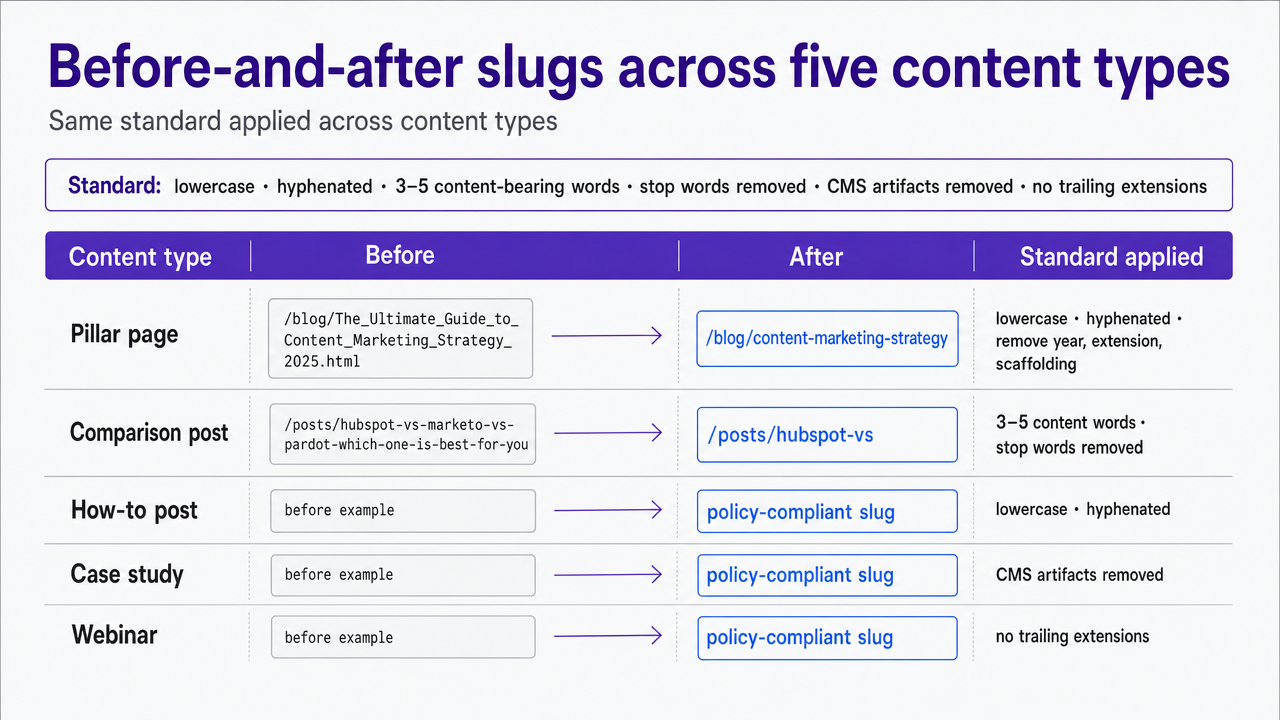 Visualize the five before-and-after slug transformations discussed in the section, giving readers a scannable reference for applying the standard across content types
When not to edit a live slug
The migration risk most beginner guides skip
The instinct to fix a legacy slug is strong. An editor auditing a content library finds a URL with an underscore, a stray year, or a working title that never got cleaned up, and the default reaction is to rewrite it. That instinct is where most avoidable SEO damage originates.
An indexed slug is not just a label. It is the address that has accumulated backlinks, internal links, social shares, search impressions, and analytics history. Changing it without a 301 redirect destroys the link equity tied to that URL 4. The page effectively resets: rankings drop, referring domains point at a 404, and the acquisition history that lived in reports under the old path becomes an orphan.
Migration-focused guidance recommends a specific gate before any edit: review the backlinks, search impressions, and internal link count for the URL, and change the slug only when the improvement is meaningful 5. A slug that violates house style but ranks in the top ten for its target query is usually not worth touching. A slug that violates house style, gets no traffic, and has no external links is a safer candidate.
The operating rule is narrower than most beginner guides suggest. Slug policy applies at draft time. On live URLs, the question shifts from does this slug follow the rules to does the improvement outweigh the migration cost. In most cases it does not.
Redirect discipline: what has to move together
When a slug edit clears the gate, the URL never moves alone. Practitioner guidance is explicit: change the slug only when the improvement is meaningful, then update internal links, canonicals, sitemap entries, and redirects together 5. Treating any one of those as optional creates the ambiguity that breaks rankings after a migration.
The 301 redirect is the anchor. Every changed URL needs a permanent redirect from the old path to the new one, applied for every URL that moves during a restructure 6. A 302 is not a substitute; it signals a temporary change and does not consolidate link equity the way a 301 does. Guidance aligned with Google's URL recommendations reinforces the same rule: never change a URL without a proper 301 redirect in place 12.
The redirect alone is not enough. Internal links pointing at the old slug should be rewritten to the new path so that crawlers and users do not hop through a redirect chain on every internal navigation. The canonical tag on the new page should reference the new URL, not the old one. The XML sitemap should list the new URL and drop the old one. If any of those steps lag, the site sends mixed signals about which version is the authoritative address.
The workflow that survives audits is a checklist attached to the slug edit itself:
- new slug published,
- 301 in place,
- internal links updated,
- canonical corrected,
- sitemap regenerated,
- redirect logged for future reference.
Skipping the log is the quiet failure mode. A year later, no one remembers why /blog/old-topic redirects to /blog/new-topic, and the next platform migration drops the redirect because it looks orphaned.
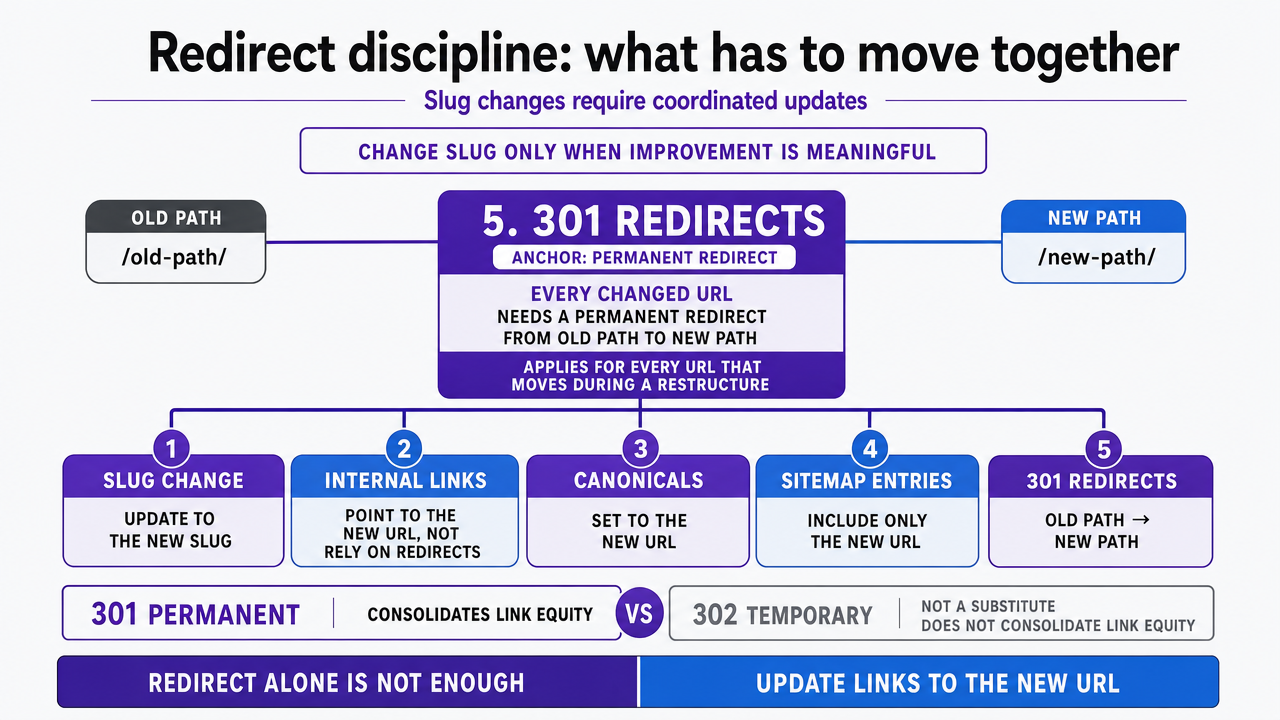 Visualize the coordinated redirect checklist described in the section, showing the five elements that must move together when a slug changes
Optimize Every URL: Data-Driven SEO Slug Strategies for Scalable Results
Connect with a specialist to see how enterprise teams streamline SEO slug governance across thousands of pages—reducing manual edits and improving ranking consistency at scale.
A slug policy template you can paste into a style guide
The rules above only produce consistency when they exist as a written standard editors and developers can point to. The template below consolidates the guidance in this article into a policy block short enough to live inside an internal style guide entry.
Slug policy (house standard).
- Format. Lowercase only. Hyphens between words, never underscores 1. No trailing slashes on individual post URLs, no file extensions, no encoded characters. Strip accents to ASCII before publish 6.
- Length. Target three to five content-bearing words. Soft ceiling of 60 characters. This is house convention aligned with practitioner consensus, not a Google-stated limit 9.
- Composition. Include the primary keyword. Place it early. Remove stop words—the, a, of, for, and, to—and remove scaffolding language from the working title 3.
- Prohibited elements. No dates in evergreen slugs. No CMS-generated IDs or query parameters. No company or product names unless the page is specifically about them 6.
- Permitted exceptions. Year-based reports and numbered frameworks may include the number when it is part of the topic identity. The redirect obligation on refresh is accepted as a tradeoff.
- Live URL edits. Do not edit an indexed slug unless the improvement outweighs the migration cost. Review backlinks, impressions, and internal link counts first 5.
- Redirect checklist. When a slug changes: 301 in place, internal links rewritten, canonical corrected, sitemap regenerated, redirect logged 12.
Pasted into a style guide, this block gives writers a draft-time rule set and gives developers a validation contract they can enforce at the CMS layer.
If you manage multi-location or high-volume publishing
The scope shifts here from a single content manager enforcing a slug standard across one blog to teams running location pages, service-area pages, or programmatic content at hundreds of URLs. The rules do not change. What changes is where enforcement has to live, because manual review at draft time stops being feasible once publishing volume outpaces editorial bandwidth.
Three shifts matter:
- The slug policy has to move from a style guide entry to a CMS-level validation rule that rejects capital letters, underscores, encoded characters, and slugs beyond the length ceiling before publish 8.
- Folder structure has to carry the category and geography so slugs stay short and non-repetitive—
/locations/traverse-city-mi, not/locations/traverse-city-mi-officerepeated across every market 1. - Redirect logging has to be automated, because a portfolio migrating fifty location URLs cannot rely on an editor to remember which old paths point where six months later 6.
The governance principle scales cleanly. What breaks at volume is manual enforcement. Teams that codify slug rules as validation logic rather than editor habit publish faster without the archive drift that turns future migrations into salvage projects.
Frequently Asked Questions
References
- 1.URL Structure Best Practices for Google Search.
- 2.The Ultimate Guide for an SEO-Friendly URL Structure.
- 3.Best Practices for Creating SEO-Friendly URL Slugs.
- 4.SEO Slug Best Practices — Free Guide & Cheat Sheet.
- 5.SEO slug best practices (with examples).
- 6.Avoid The Migrations That Break Your SEO: Slugs That Last.
- 7.How to Structure SEO-Friendly URLs.
- 8.Best Practices for Creating SEO-Friendly Slugs.
- 9.Mastering URL Slugs: The Developer's Guide to SEO and User Experience.
- 10.Google Just Updated Its URL Structure Guidelines.
- 11.SEO slug & title guide - University of Washington.
- 12.URL Structure Best Practices for SEO: What Google Wants.