
Key Takeaways
- Semrush replaces the weekly keyword research, SERP tracking, and competitive reporting hours typically delivered by a junior agency analyst, with native Search Console and GA4 connections.
- Ahrefs absorbs the link strategist role, turning two-week prospect list deliveries into afternoon work through Site Explorer, Content Explorer, and one of the category's largest link indexes.
- Conductor removes the senior account director function by automating executive dashboards and stakeholder reporting, making sense above roughly $5M ARR where reporting labor is most expensive.
- Clearscope replaces the senior editor reviewing drafts, scoring writers against ranking pages in real time so corrections happen before editorial review inside Google Docs or WordPress.
- Surfer eliminates on-page optimization tickets by exporting SERP-driven checklists writers and developers can apply directly, compressing a week of agency turnaround into an afternoon.
- MarketMuse replaces the content strategist building the editorial calendar, crawling sites to score topical authority and queue expand, merge, or retire decisions ranked by impact.
- Vectoron operates at the operating system layer, coordinating intelligence and execution under one approval workflow to remove the account director and production manager handoffs point tools still require.
Why SEO Software Buying Has Split Into Two Layers
Forrester's most recent SEO analysis frames the channel's central problem in plain terms: SEO is slow, technically dense, and expensive to coordinate across functions. The remedy, according to its analysts, is software that
"accelerates and simplifies the SEO process and derisks cross-functional collaboration"
1. This perspective has become a crucial filter for growth leaders navigating the crowded vendor landscape. Tools that align with this accelerate work, while others merely produce more dashboards.
Reading across the Q1 2025 Solutions Landscape and the Q3 2025 Wave, a clearer category structure emerges 9, 10. SEO software now sorts into three functional layers rather than a single feature checklist.
The intelligence layer covers data, audits, rank tracking, and competitive research. These platforms inform teams on what actions to take. Semrush, Ahrefs, Conductor, Moz, BrightEdge, and seoClarity, which Forrester names in its platform coverage 13, are examples of tools in this layer.
The execution layer covers content briefs, on-page optimization, topic modeling, and editorial scoring. These tools dictate what content is created and how it is deployed. Clearscope, Surfer, and MarketMuse are standard names in this category.
The operating system layer is the newest tier. It coordinates intelligence and execution under a single approval workflow, eliminating the manual handoffs that traditional agency retainers were designed to manage.
The buying decision is no longer about which tool has the best keyword database. Instead, it focuses on which combination of layers can replace the largest portion of an existing agency scope. The seven picks that follow are ranked based on this specific criterion.
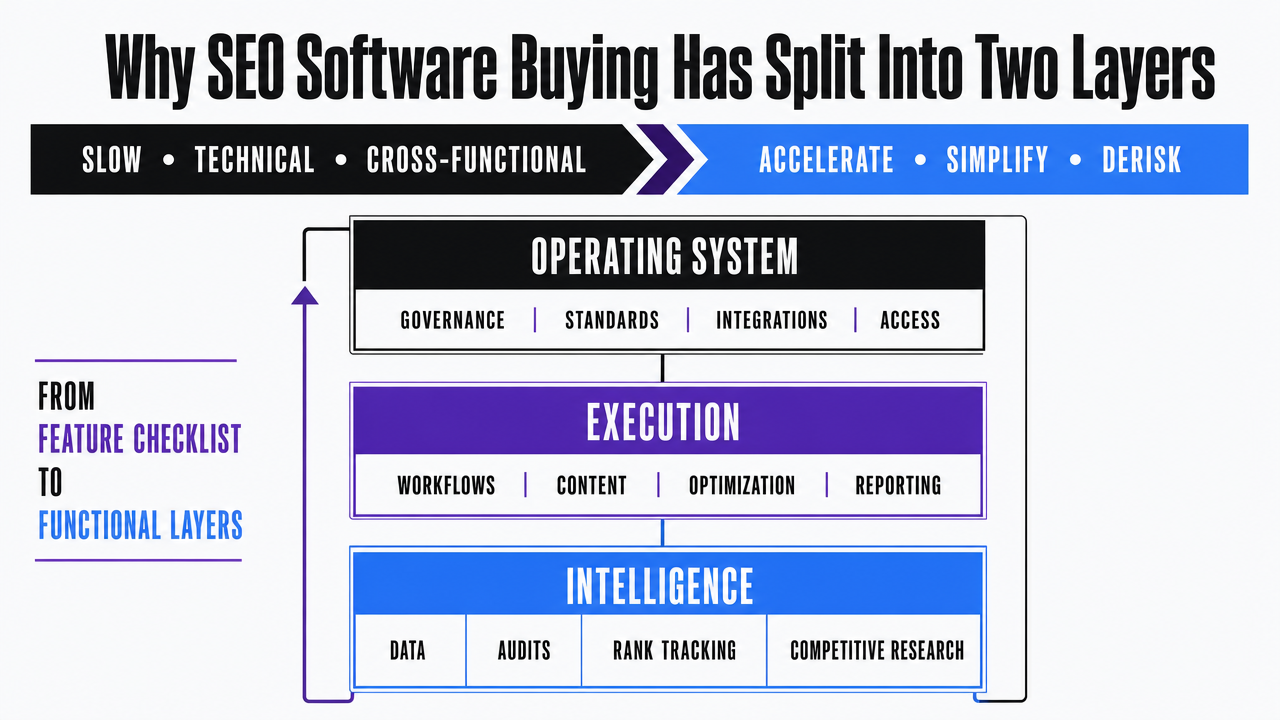 Visualize the three-layer category framework introduced in this section (intelligence, execution, operating system) since the article explicitly defines these tiers and assigns vendors to each
How the Seven Tools Were Scored
The shortlist was developed based on a single question, directly inspired by Forrester's framework: how much agency effort does this tool genuinely remove, and how much cross-functional friction does it absorb 1? Feature parity was considered a baseline expectation, not a distinguishing factor.
Three criteria were weighted heavily:
- First, scope replaced: identifying which line items on a typical $8K–$40K monthly retainer the tool can eliminate, from audits to brief production to link prospecting.
- Second, integration depth: assessing whether the platform can pull data from GA4, Search Console, and a CMS without requiring manual CSV exports.
- Third, execution distance: measuring the number of steps between an insight and a published change, given that McKinsey's analysis indicates productivity gains diminish rapidly when competitors can access the same tooling 11.
Vendor coverage in Forrester's Q1 2025 Solutions Landscape and Q3 2025 Wave provided the foundation for selecting intelligence-layer tools 9, 10. Execution-layer tools were chosen from those most commonly paired with these platforms by growth teams. Pricing tiers are categorized by segment—entry, mid-market, enterprise—because published rate cards frequently change, and contract terms vary based on seat count and content volume.
Intelligence Layer: Three Platforms That Replace Your Audit and Research Retainer
Semrush — Replaces Keyword Research and Competitive Tracking Hours
Semrush is often the default intelligence platform for growth team retainers, and Forrester includes it among the vendors defining the SEO platform category 13. It eliminates the weekly research deliverables typically handled by an agency: keyword gap reports, SERP movement updates, share-of-voice tracking, and the associated slide decks.
Its Position Tracking and Keyword Gap modules can perform work equivalent to what a junior SEO analyst produces in 8 to 12 hours per week on a typical retainer. A growth team using these modules can access the same data on demand, significantly reducing the lag between posing a question and receiving an answer.
Integration depth is a key differentiator. Semrush connects natively to Search Console and GA4, allowing competitive context to be viewed alongside first-party performance data without manual export. This directly aligns with Forrester's framework: the tool reduces effort and eliminates a handoff 1.
Pricing for the Business plan falls into the mid-market tier, with enterprise add-ons available for API access and additional user seats. Teams already paying an agency for monthly competitive reporting often find the Business plan sufficient to cover their full scope.
Ahrefs — Replaces Link Prospecting and Backlink Forensics
While Semrush excels in competitive tracking breadth, Ahrefs stands out for its depth in link data. It replaces the agency function of a link-building strategist, handling tasks such as prospect lists, anchor-text analysis, lost-link recovery, and the monthly backlink audit, which is often billed as a separate line item by agencies.
Site Explorer and Content Explorer together replace most manual prospecting. A growth team can generate a qualified outreach list in an afternoon, a task an agency might take two weeks to deliver, using the same referring-domain filters and traffic thresholds. Batch Analysis assists with disavow file preparation, another recurring agency deliverable.
The platform also offers technical audits through Site Audit, though most teams pair it with a dedicated crawler for large-scale operations. For link analysis, its data set is a key advantage—Ahrefs maintains one of the largest crawled link indexes in the category, which is crucial for ensuring prospect quality in outreach efforts.
Pricing is tier-based, determined by user seats and crawl credits, with the Advanced plan typically covering most mid-market needs. Enterprise pricing applies to teams managing multiple domains or running extensive outreach programs.
Conductor — Replaces Enterprise Reporting and Stakeholder Decks
Conductor operates at a different price point and addresses a distinct agency function. It is recognized in Forrester's platform coverage 13 and scored in the Q3 2025 Wave alongside BrightEdge and seoClarity 10. This tool eliminates the need for a senior account director who typically creates monthly executive reports and translates SEO data into narratives suitable for board-level presentations.
Its strength lies in its workflow and reporting infrastructure. Custom dashboards, automated stakeholder reports, and content workspaces enable a growth team to disseminate SEO insights to product, sales, and finance departments without having to rebuild presentations each cycle. For a Head of Growth reporting to a CRO, this removes one of the most expensive agency tasks—the time spent explaining performance changes and their rationale.
Conductor integrates with Search Console, GA4, and most major CMS platforms, and it pushes recommended changes directly into editorial workflows rather than leaving them in a PDF. This execution-adjacent capability distinguishes it from purely data-focused platforms.
Pricing is at the enterprise tier with annual contracts, and the platform is generally over-engineered for teams with less than approximately $5M ARR. Above that threshold, the reporting automation alone often justifies replacing a senior agency role.
Execution Layer: Three Platforms That Replace Content and On-Page Production
Clearscope — Replaces the Senior Editor Reviewing Briefs
Clearscope is designed for writers. It absorbs the role of a senior content editor—the individual who reviews drafts, compares them against top-ranking SERPs, and provides feedback on missing entities, weak coverage, and shallow sections. This review cycle is one of the most expensive recurring line items on a content retainer because it demands judgment and reading time, not just templated work.
The platform's Reports module scores drafts in real time against a model of what ranks for a given query, highlighting terms and concepts that a comprehensive piece should cover. For growth teams managing outsourced or in-house writers, this scoring loop replaces the back-and-forth communication that previously occurred in Google Docs comments. Writers can self-correct before an editor even sees the file.
Clearscope integrates seamlessly with Google Docs and WordPress, keeping the optimization step within the writer's existing workflow. It does not generate briefs from scratch at scale, so most teams pair it with an upstream research tool. Pricing is mid-market and seat-based; the Essentials plan suits a single content lead, while the Business plan supports a 2–4 person editorial team.
Surfer — Replaces On-Page Optimization Tickets
Surfer shares some functionality with Clearscope in draft scoring but is distinct in its ability to eliminate on-page optimization tickets. These tickets are typically sent by agencies to developers or content operations managers, detailing meta title adjustments, heading restructures, internal link additions, and keyword density modifications for existing pages. This type of work is high-volume and low-judgment, often where retainer hours quietly accumulate.
The Audit and Content Editor modules generate page-level recommendations based on live SERP data, then export them as a checklist that a writer or developer can implement without an analyst translating the output. For teams refreshing existing content—which typically accounts for 30 to 60 percent of organic gains on a mature site—this compresses a week of agency turnaround into an afternoon.
Surfer's NLP-driven scoring is more assertive than Clearscope's, which some editors may find prescriptive. However, the benefit is speed: drafts achieve target scores faster, with less editorial debate. Pricing is mid-market with usage-based limits on tracked pages and AI-assisted features. Teams optimizing fewer than 50 pages a month generally use the Essential plan; higher-volume programs move to Scale or Enterprise.
MarketMuse — Replaces Topic Planning and Content Inventory Audits
MarketMuse intervenes earlier in the workflow. Its primary function is to replace the content strategist who builds the editorial calendar—the person responsible for mapping topic clusters, identifying content gaps against competitors, and deciding which existing pages to expand, merge, or retire. This role typically costs an agency $6,000 to $12,000 per month and is often under-staffed in many retainers.
The Inventory and Strategy modules crawl a site, score each page for topical authority, and recommend a sequence of content actions ranked by expected impact. For a growth team inheriting hundreds of legacy content pages, this audit replaces a quarter of strategic work with a structured queue. McKinsey's analysis of generative AI in marketing reinforces the importance of this: planning and content tasks are areas where adoption is concentrated because the output is structured and inputs are stable 12.
MarketMuse's pricing is higher than Clearscope or Surfer because its value lies in strategy rather than execution scoring. The Standard plan is suitable for a single-site SaaS company; the Team and Premium tiers serve growth teams managing multiple domains or product lines.
Test AI-driven SEO execution at scale now
Experience hands-on results by publishing SEO content and campaigns during your trial—no delays, no limits.
Operating System Layer: One Platform That Replaces the Stack
Vectoron — Coordinates Intelligence and Execution as One Workflow
The intelligence and execution layers discussed previously each replace specific agency line items. The operating system layer, however, aims to replace something different: the coordination work that occurs between these layers. This coordination—briefing writers on audit findings, routing optimized drafts for approval, and integrating published changes into the next reporting cycle—often consumes a significant portion of a Head of Growth's week.
Vectoron operates in this tier. Designed for multi-location healthcare operators, digital agencies, and SaaS growth teams requiring coordinated marketing execution across complex service footprints without the delays and overhead of traditional agencies, the platform manages continuous strategy, content, SEO, PPC, and backlink work from a single account-level plan. It eliminates the need for retainers, account managers, or missed deadlines. A Lead Strategist coordinates specialist strategists for content, SEO, conversion, PPC, and backlinks, while a Command Center handles approval and publishing.
The agency functions it absorbs are those of the account director and production manager—roles that exist primarily because intelligence and execution tools typically do not communicate with each other. McKinsey's argument directly applies here: sustainable advantage comes from transforming the operating model, not merely layering better tools onto the same agency playbook 11. A coordinated system removes the manual handoffs that a stack of point solutions still requires a human to manage.
The Economics: What an Intelligence-Plus-Execution Stack Actually Substitutes
A strong business case for replacing agency retainers with software begins with a key insight from outside the SEO category. McKinsey's analysis of generative AI's economic potential estimates that marketing and sales functions could see productivity improvements worth 5 to 15 percent of total function spend, with the broader technology contributing between $2.6 trillion and $4.4 trillion in annual value across sectors 8. It's important to note this is a marketing-and-sales-wide figure, not SEO-specific, and it depends on a full stack of generative AI tools, not just one platform.
When applied to a growth team's specific line items, the economics become more tangible. A four-person agency retainer costing $25,000 per month typically allocates about 35 percent to research and reporting, 40 percent to content production and on-page work, 15 percent to link acquisition, and 10 percent to account management. An intelligence-plus-execution stack—such as Semrush or Ahrefs paired with Clearscope, Surfer, or MarketMuse—can replace the first two categories almost entirely. The software cost for such a pairing typically ranges from $1,200 to $3,500 per month at mid-market tiers.
What this stack does not replace is the coordination labor: briefing, routing, approval, and reporting cycles. This residual work still requires $4,000 to $8,000 per month in fractional or in-house time. Therefore, the net substitution against a $25,000 retainer falls within the $12,000 to $18,000 range, before any additional productivity gains from the remaining team.
Two caveats apply. First, the McKinsey range is an upper-bound estimate assuming mature deployment, not initial rollout. Second, productivity gains from common tools tend to diminish over time as competitors adopt the same stack, which is why McKinsey views efficiency alone as a weak source of durable advantage 11. The economic justification for switching is real, but it primarily lies in the substitution math, not solely in the tools themselves.
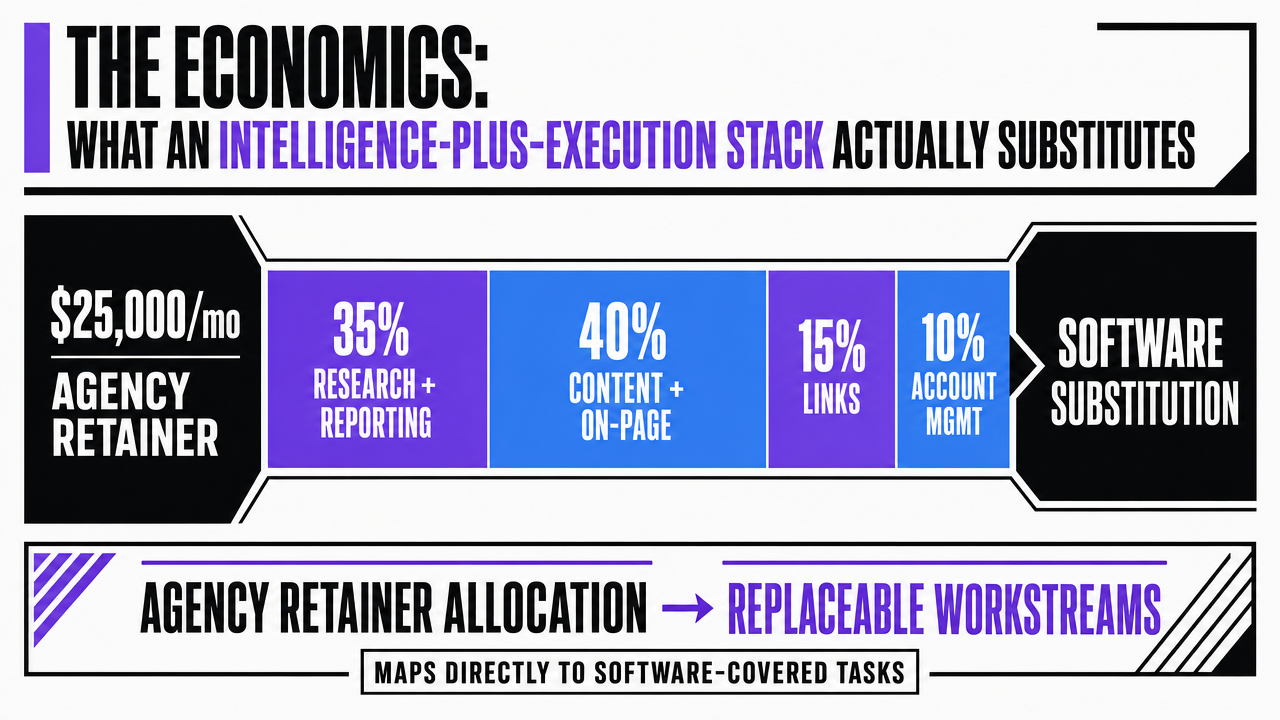 Visualize the retainer allocation breakdown and substitution math cited in this section (35% research/reporting, 40% content/on-page, 15% links, 10% account management) which maps directly to what software can replace
If You Manage Multiple Products or Locations: A Consolidation Comparison
The financial considerations change when a growth team is responsible for more than one domain, product line, or regional site. At this point, the question shifts from which tool suits a single program to which model scales efficiently without escalating retainer fees or requiring more account managers. Most agencies bill per location or per product, meaning a portfolio operator managing six sites would incur roughly six times the coordination overhead, not just six times the strategic work.
The table below compares three models against the workstreams a multi-property growth team must staff. Dollar values are intentionally variable as they depend on the reader's current retainer, seat count, and content volume.
| Workstream | Agency Retainer Model | Intelligence + Execution Stack | Operating System Model |
|---|---|---|---|
| Monthly fixed cost | Scales per site/product | Flat platform fees + seats | Single account-level fee |
| Sites or products covered | Billed individually | Unlimited within seat tier | Unified under one plan |
| Content output per month | Capped by retainer hours | Capped by writer capacity | Capped by approval throughput |
| Technical audit cadence | Quarterly, manual | On-demand, tool-driven | Continuous, automated |
| Reporting lag | 14–30 days | 2–7 days | Real-time dashboard |
| Headcount to manage | 1–2 FTE oversight | 1 FTE per 3–4 sites | Fractional approver |
The primary consolidation gain is not the per-site cost, but the elimination of duplicated coordination across the entire portfolio. McKinsey's estimate of 5–15 percent marketing-and-sales productivity gain assumes a change in the operating model itself, not just the tools used 8. For a team managing six product lines, this distinction is critical for determining whether a stack truly scales or merely replicates the agency's billing structure under a software label.
See How Leading Teams Automate SEO Execution Without Adding Staff
Request a walkthrough of AI-driven SEO operations purpose-built for agencies and enterprise brands managing multi-site or high-volume campaigns—benchmark efficiency, output quality, and measurable results against your current workflow.
The Headcount Question Most Listicles Avoid
The argument for SEO software often centers on cost reduction: fewer agency invoices, fewer freelancer engagements, and reduced marketing P&L line items. However, the actual experience of firms adopting AI tooling presents a different picture. MIT Sloan's analysis of AI adoption between 2010 and 2023 revealed that firms with significant AI use reported approximately 6 percent higher employment growth and 9.5 percent higher sales growth over a five-year period compared to non-adopters 4. Teams expanded, and revenue grew even faster.
Two important caveats apply before using this figure for planning. The study period largely predates the widespread rollout of generative AI, so it captures earlier waves of machine learning and automation rather than the current generation of tools. Additionally, the sample includes firms across various sectors, not specifically SEO teams. Nevertheless, the directional finding remains relevant: AI adoption at the firm level has historically correlated with growing headcount, not shrinking it, because the productive capacity unlocked by automation tends to fund expansion rather than reduction.
For a Head of Growth, this reframes the purchasing decision. The honest question is not "how many roles does this stack eliminate," but rather which roles are redirected. Research and reporting hours that previously occupied a junior analyst's week become available for experimentation, pipeline analysis, or product marketing work that no platform automates. The stack changes the composition of the team, not its overall size.
The Honest Trade-Off: What Heavy Automation Costs the Team
The argument for replacing agency hours with software often overlooks the fact that the remaining team must adapt to a new operating model. Georgia State University's review of automation research found that while AI tools can reduce stress by eliminating repetitive work, they also correlate with mixed effects on worker well-being, including a potential loss of meaning and increased surveillance when systems track every action 5. For a growth team managing a complex stack of intelligence and execution tools, this is not an abstract risk.
Three practical costs emerge:
- Editors spend more time reviewing machine-generated drafts and less on original arguments.
- Analysts dedicate more time to validating tool outputs than to conducting primary research.
- Furthermore, dashboards that report every keyword movement in near real-time can create pressure to react impulsively rather than plan strategically.
The solution is not fewer tools, but a deliberate focus on what humans should own end-to-end—typically strategy, narrative, and judgment calls—and what the stack can manage autonomously.
Where the Category Goes Next: Answer Engines and Task-Level Substitution
Two key shifts will define SEO software purchasing over the next 18 months. The first is the emergence of answer engines. Forrester's recent commentary suggests that SEO solutions are uniquely positioned to adapt decades of content, technical, and international search expertise to the evolving requirements of generative answer engines 2. The platforms that succeed in the AEO transition will be those that already prioritize structured data, entity coverage, and source attribution as primary signals, rather than those merely adding AEO modules to legacy rank trackers.
The second shift is task-level substitution within the workflow. Stanford HAI's summary of David Autor's research highlights that automation both replaces and augments expertise, depending on which rote tasks are removed and which expert tasks are added 3. Applied to a growth team's stack, this means the enduring questions are not just which tool to buy, but which tasks to delegate: keyword clustering and on-page scoring can move to software, while narrative judgment, customer interviews, and category positioning remain with the team.
The buying decision in 2025 is no longer feature-by-feature. It is about selecting the combination of layers—intelligence, execution, or operating system—that absorbs the largest share of an existing agency scope while preserving the team's highest-judgment work.
Frequently Asked Questions
References
- 1.SEO Must Solve Its Marketing Problem.
- 2.SEO's Hype-Fueled Move To The Center Of The Marketing Mix.
- 3.Assessing the Real Impact of Automation on Jobs.
- 4.How artificial intelligence impacts the US labor market.
- 5.The Benefits of Automation and AI are Mixed Regarding Worker Well-Being.
- 6.AI business case: Reduce cost and optimize resources.
- 7.The State of AI in the Enterprise.
- 8.The economic potential of generative AI: The next productivity frontier.
- 9.The Search Engine Optimization Solutions Landscape, Q1 2025.
- 10.Search Engine Optimization Solutions, Q3 2025.
- 11.Where AI will create value—and where it won't.
- 12.The state of AI in 2023: Generative AI's breakout year.
- 13.Every Company Needs An SEO Platform.