
Key Takeaways
- YMYL editorial governance belongs on the suggestion menu because health content quality is measurably poor at scale, and templated author credentials, reviewer sign-off, and sourcing make governance a repeatable junior task 6, 8.
- Compliant review acquisition after 16 CFR Part 465 requires templates with verified transaction triggers, no sentiment conditioning, no suppression of negatives, and documented provenance for every published review 1, 2, 5.
- Query-to-intent mapping templates replace flat keyword lists with an intent matrix that flags YMYL exposure, so juniors can populate rows and route only high-risk intents to senior review 6.
- Technical discoverability audits scale when detection runs on a scheduled ruleset with severity-scored tickets, letting juniors ship fixes while seniors review only migrations, canonical consolidations, or YMYL anomalies 6.
- Structured data suggestions should scaffold entity graphs connecting Organization, Person, Service, and authoritative identifiers, not chase shifting rich-result features that force constant markup rework 8.
- Accessibility checks belong inside the SEO production line against WCAG 2.1 AA, with the DOJ Title II rule binding public-sector clients directly and signaling exposure for private accounts 9.
- Privacy-compliant measurement for healthcare separates inventory from remediation: juniors catalog tags on patient-facing URLs, while compliance officers decide what to remove, replace, or cover under a BAA 10.
- A single compliance decision layer with three triggers — the FTC reviews rule, DOJ Title II, and HHS tracking guidance — stops pods from re-litigating regulation on every ticket 1, 9, 10.
- Experimentation suggestions scale through a four-field template covering hypothesis, scope, guardrails, and decision, with senior review attached only at sign-off and final call on YMYL-sensitive tests 6.
- Internal linking and topical authority work as a graph problem at portfolio scale, with juniors shipping spokes against an approved cluster map and seniors reviewing YMYL anchor distribution 6.
Why Agency Recommendation Engines Fail at 50 Clients
Most agency recommendation workflows break somewhere between the thirtieth and fiftieth client. The failure is predictable: senior strategists become the bottleneck for every ticket, junior staff ship generic audits that read the same across verticals, and the recommendation backlog grows faster than the delivery pod can clear it. Retention conversations shift from strategy to apology.
The underlying problem is that most agencies treat SEO suggestions as artisanal output. Each recommendation is written from scratch, reviewed ad hoc, and shipped without a repeatable trigger. That model worked at 15 accounts. It collapses at 50, and it exposes the firm to compliance risk at 100, particularly in verticals where review solicitation, accessibility, and health-data tracking now carry federal enforcement weight 1, 9, 10.
The nine suggestion categories that follow are structured as productized recommendation patterns, not tips. Each one is defined by a data trigger, a template, a compliance boundary, and an approval gate. The goal is to convert senior-strategist judgment into standardized output that juniors can execute and clients can measure, without stripping the human sign-off that keeps YMYL work defensible. Agencies that make this shift ship more suggestions per account per month and defend higher retainers in regulated verticals where generic SEO advice no longer survives scrutiny.
YMYL Editorial Governance as a Suggestion Category
Editorial governance belongs on the SEO suggestion menu because the baseline quality of health content on the open web is measurably poor. A meta-narrative systematic review of 153 cross-sectional studies covering 11,785 health websites found that no site earned an "excellent" DISCERN rating, between 37% and 79% were rated "good" depending on the assessment tool and specialty, and only 18% carried HON Code certification 6. The scope matters: these were cross-sectional studies using 14 different quality instruments across varied clinical topics, so the exact percentages shift by specialty, but the direction is consistent — health content at scale is unreliable, and search surfaces that inconsistency to patients.
For an agency head running legal, behavioral health, dental, or healthcare accounts, that evidence converts editorial governance from a content-team preference into a billable, templated recommendation category. The suggestion pattern is specific.
Trigger : Any new or refreshed page on a YMYL URL.
Template fields : Named author with credentials, named clinical or legal reviewer, primary-source citations, last-updated timestamp, and a disclosure block for material relationships.
Approval gate : Subject-matter reviewer signs off before the page enters the publishing queue.
The determinants of trust in web-based health information consistently track author expertise and content credibility, which is why these fields belong in the template rather than in a style guide nobody opens 8.
Treated this way, governance stops being overhead. It becomes a recommendation juniors can produce against a checklist, with senior review limited to the sign-off step rather than the drafting.
Compliant Review Acquisition Patterns After the FTC Rule
Review acquisition stopped being a growth tactic and started being a liability surface on October 21, 2024, when 16 CFR Part 465 took effect. The FTC's final rule prohibits businesses from creating, selling, buying, or knowingly disseminating fake or false reviews, including AI-generated ones, and extends to purchased sentiment, undisclosed insider testimonials, suppression of honest negative reviews, fake indicators of social-media influence, and deceptively company-controlled review websites 1, 4. Civil penalties attach to knowing violations 5. For agencies running local SEO across law firms, dental groups, home services, and behavioral health clients, every templated outreach sequence, incentive offer, and reputation-management playbook written before Q4 2024 needs a second read.
The enforcement signal arrived quickly. In November 2024, the FTC moved against Sitejabber for allegedly misrepresenting that ratings came from customers who had actually experienced the reviewed products or services, and for artificially inflating counts 2. The operational takeaway for agency pods is provenance: every review surfaced on a client site must be traceable to a real transaction, and any AI-assisted summarization or syndication layer has to preserve that chain rather than obscure it.
A scalable review-acquisition pattern looks like this.
Trigger : A verified completed service event in the client's CRM or practice-management system.
Template : A neutral request for honest feedback with no sentiment conditioning, no star-threshold incentive, and no copy that implies a preferred rating.
Routing : All reviews publish as received, with negative feedback escalated to the client for service recovery rather than suppressed from the public listing.
Disclosure : Any material connection between reviewer and business is surfaced in the review itself 7.
Approval gate : The local-SEO pod lead signs off on the solicitation template quarterly, and compliance signs off whenever a client requests a change to incentive language or moderation rules.
What the pattern explicitly excludes is more important than what it includes.
- No sentiment-conditioned incentives.
- No selective takedowns of truthful negative reviews.
- No insider reviews from staff, family, or vendors without clear disclosure.
- No AI-generated testimonials, even when drafted from genuine survey data, if they are presented as the customer's own words 5.
Agencies that keep these exclusions encoded in the intake template rather than in a compliance memo nobody reads can route the work to juniors without inheriting the enforcement exposure.
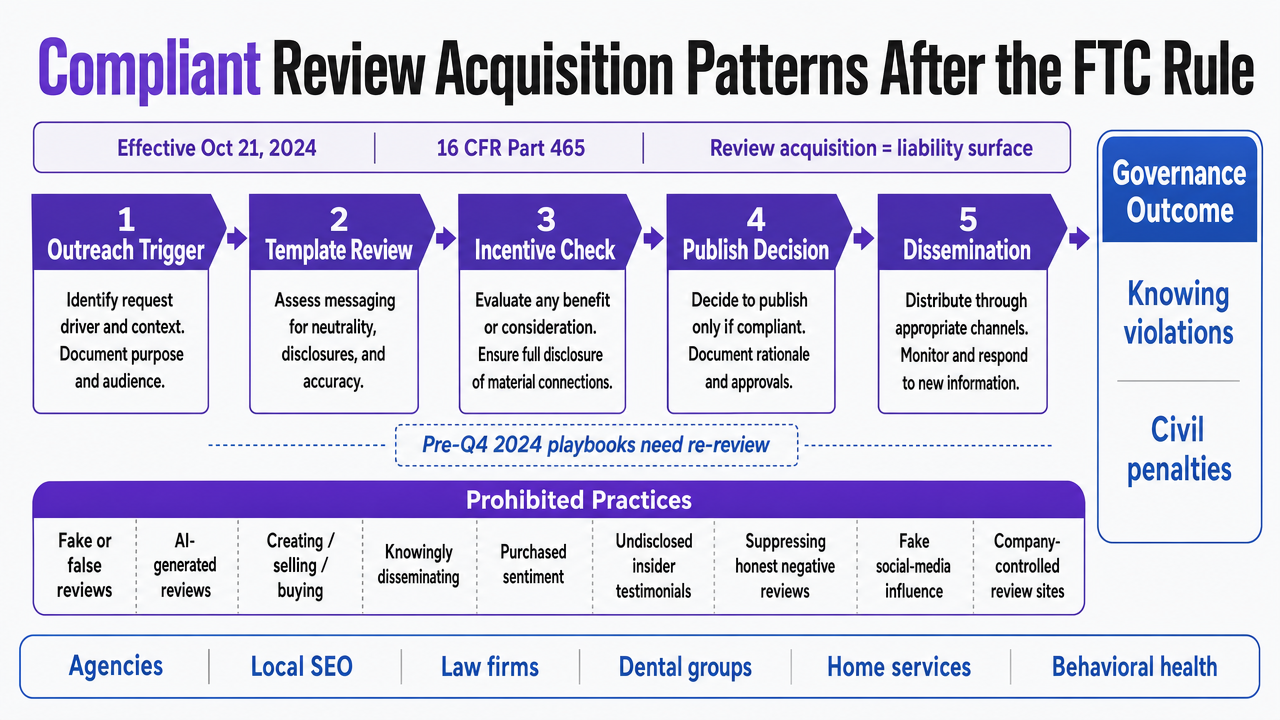 Visualize the compliant review-acquisition workflow described in this section, showing the trigger-to-publish pipeline with explicit prohibited practices as a governance layer
Query-to-Intent Mapping Templates for Regulated Verticals
Keyword lists lose their value the moment an agency crosses into regulated verticals, because the same query string resolves to three or four distinct intents depending on who is searching. A query like "suboxone treatment near me" can originate from a prospective patient, a family member researching options for someone else, a referring clinician checking network coverage, or a legal professional building a case file. Each intent demands a different page type, a different disclosure posture, and a different conversion event. Treating them as one keyword is how agencies ship pages that rank briefly and convert nothing.
The productized pattern replaces keyword assignment with an intent-matrix template. Columns capture query cluster, inferred intent, YMYL exposure, primary user action, and required editorial fields. Rows get populated by juniors from search-console data and clustered SERP inspection, then flagged for senior review only when YMYL exposure is high or when the inferred intent crosses into clinical, legal, or financial advice territory. The same baseline evidence that justifies editorial governance applies here: health content quality varies widely by assessment tool and specialty, so intent decisions in healthcare and behavioral-health accounts should default to the more conservative page template unless a credentialed reviewer approves otherwise 6.
Agencies that encode this matrix as a shared artifact across pods stop relitigating intent on every ticket and start shipping page specs that compliance can approve on sight.
Technical Discoverability Audits That Don't Need a Senior Strategist
Technical audits are the suggestion category most agencies still over-staff. A seasoned strategist spends three hours running crawls, parsing log files, and writing a prioritized ticket list that a junior could have produced from a scripted checklist and a signal threshold. The waste compounds across 50 accounts.
The productized pattern separates detection from judgment. Detection runs on a schedule: weekly crawl against a defined ruleset covering:
- indexability directives
- canonical conflicts
- orphaned URLs
- redirect chains over two hops
- broken internal links
- duplicate title and meta patterns
- hreflang mismatches
- Core Web Vitals field data from the Chrome User Experience Report
Each finding carries a severity score and a template-generated ticket with the affected URLs, the recommended fix, and the expected impact window. Juniors ship the fix queue. Senior review attaches only when the finding touches a migration, a canonical consolidation across subdomains, a JavaScript rendering issue that changes how content is indexed, or any crawl anomaly on a YMYL section where accuracy and provenance matter 6.
The approval gate sits at the pod-lead level for routine fixes and escalates to the senior strategist only when the ticket touches architecture or health-adjacent URLs. That split frees roughly 60% of senior hours previously consumed by audit production, which the pod reinvests in intent mapping and governance review where judgment actually moves the number.
Test data-backed SEO strategies at scale now
See the impact of real-time SEO execution across multiple client projects with full publishing access during your trial.
Structured Data Suggestions Tied to Entity Models, Not Rich Results
Most agencies still pitch schema markup as a rich-result play: add FAQ markup, chase a star rating in the SERP, hope the snippet survives the next Google rollback. That framing has aged badly. Rich-result eligibility changes quarterly, and agencies that templated their structured-data suggestions around snippet features spent 2023 and 2024 removing markup they had just finished deploying.
The durable suggestion pattern treats structured data as entity scaffolding. Trigger: any page representing a persistent business entity, person, service, location, or clinical topic. Template: a nested graph connecting Organization, LocalBusiness, Person (with credentials for YMYL authors and reviewers), Service, and the specific topic entity, with sameAs links to authoritative identifiers like NPI records, state bar directories, or Wikidata where available. The output is a machine-readable map of who the client is, who vouches for them, and what they actually do — the same signals that credentialed authorship and transparent sourcing establish for human readers 8.
Approval sits with the pod lead for routine deployments and escalates to senior review when the graph touches clinician credentials, legal practice areas, or any claim a regulator could parse. Juniors ship the markup against the template. Rich results become a byproduct, not the goal.
Accessibility Checks Inside the SEO Production Line
Accessibility sits inside SEO scope because the same signals that screen readers depend on — semantic headings, descriptive link text, image alt attributes, form labels, color-contrast ratios, keyboard focus order — are the signals crawlers and language models use to understand a page. Running accessibility as a separate workstream after launch means re-opening pages the SEO pod has already shipped, which doubles the touch count per URL.
The scope note matters before the template. The Justice Department's final rule published April 24, 2024 strengthens web and mobile-app accessibility obligations under Title II of the ADA, which binds state and local government entities directly rather than private clients 9. Agencies serving municipal, public-health, or publicly funded accounts should treat the rule as directly enforceable. For private law firms, dental groups, and home-services clients, the rule is a signal rather than a mandate, but the underlying WCAG criteria still shape user experience and legal exposure under existing ADA case law.
Productized pattern: every new page template and every migration ticket passes an automated accessibility scan against WCAG 2.1 AA before the SEO pod marks it shippable. Juniors remediate the common failures — missing alt text, insufficient contrast, unlabeled form inputs, non-semantic headings — from a scripted checklist. Senior review attaches when a finding touches dynamic content, custom components, or any page serving a public-sector client where Title II applies directly.
Privacy-Compliant Measurement for Healthcare and Behavioral Health
Measurement is where SEO programs for healthcare and behavioral-health clients quietly accumulate the most legal risk. HHS has stated that when covered entities and business associates deploy tracking technologies on authenticated pages, those configurations must comply with the HIPAA Privacy and Security Rules — meaning analytics tags, advertising pixels, call-tracking scripts, and form handlers can create disclosures of protected health information if they transmit identifiers alongside URLs, appointment types, or diagnostic context 10. A federal district court vacated a portion of that guidance on June 20, 2024, so the full enforceability of the unauthenticated-page analysis is in flux, but the authenticated-page concerns and the underlying statute remain in force 10. Agency pods should not treat the vacatur as a safe harbor.
The productized pattern separates discovery from remediation. Discovery: an inventory script catalogs every tag, pixel, and third-party script firing across patient portals, intake forms, symptom-checker tools, appointment schedulers, and condition-specific landing pages, with a column flagging which URLs convey diagnostic or treatment context. Remediation: high-risk tags are removed, replaced with server-side event streams that strip PHI, or governed by a signed business associate agreement. Approval sits with the client's compliance officer, not the pod lead. Juniors run the inventory; senior strategists handle the remediation design on any URL where diagnostic context is present.
Compliance-Aware Recommendations: One Decision Layer, Three Triggers
Scattering compliance warnings across every suggestion is how agencies end up with pod leads who tune them out. The alternative is a single decision layer that sits above the recommendation engine and intercepts tickets based on three specific 2024 regulatory triggers.
- The first trigger is the FTC's final rule on consumer reviews and testimonials, which took effect in late October 2024 and prohibits fake or false reviews, purchased sentiment, undisclosed insider testimonials, review suppression, and deceptively company-controlled review sites 1. Any ticket that touches review solicitation, reputation moderation, testimonial pages, or syndicated star ratings gets routed through this gate before publishing.
- The second trigger is the Justice Department's Title II web and mobile accessibility final rule, published April 24, 2024, which binds state and local government entities directly rather than private clients 9. Tickets flagged with a public-sector or publicly funded client ID enter the gate as mandatory; tickets for private clients enter as advisory and reference the underlying WCAG 2.1 AA criteria without invoking Title II directly.
- The third trigger is HHS guidance on online tracking technologies used by HIPAA covered entities and business associates, with the caveat that a federal district court vacated a portion of the guidance on June 20, 2024 10. Analytics, pixel, call-tracking, and form-handler tickets on authenticated patient-facing URLs route to the client's compliance officer, not the pod lead.
One decision layer, three triggers, documented routing. Pod leads stop re-litigating compliance in every stand-up, and senior strategists reclaim the hours they were spending re-reading the same three source documents.
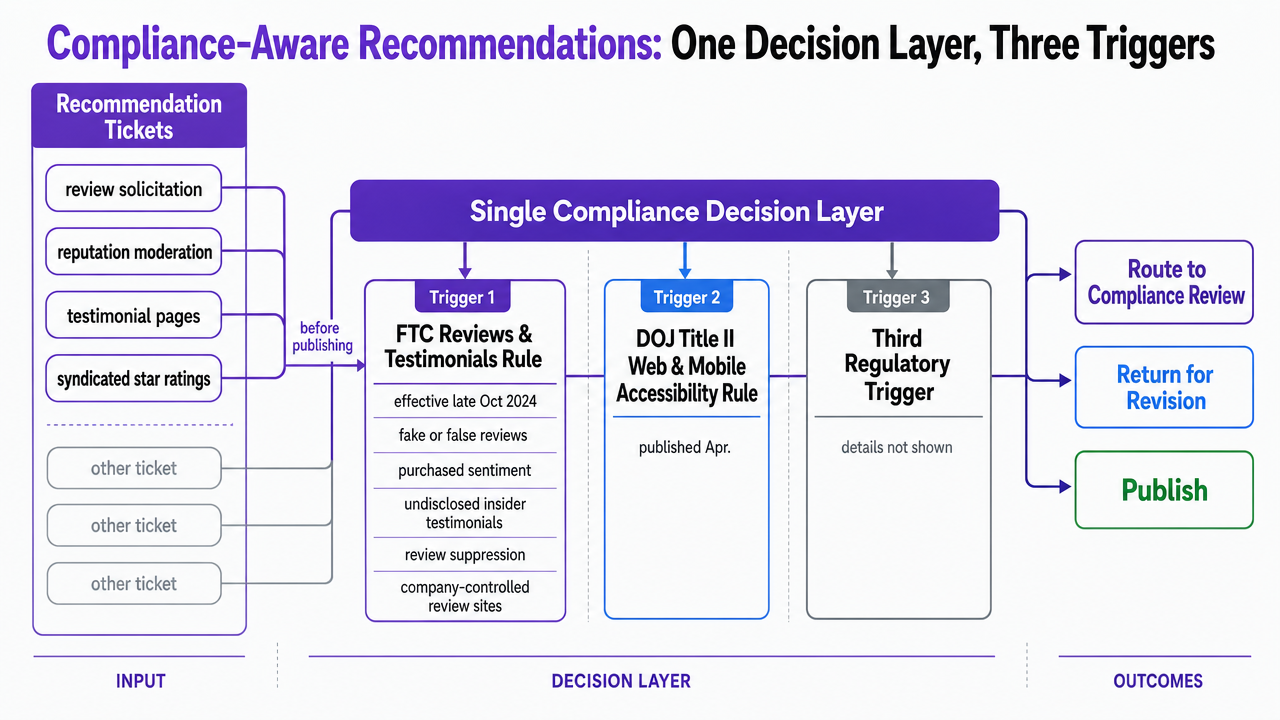 Diagram the single compliance decision layer with its three regulatory triggers and routing destinations, directly supporting this section's operating model
See How Top Agencies Operationalize Scalable SEO Suggestions
Connect with our team to benchmark your SEO suggestion workflow against leading AI-powered agency models—gain actionable insights to reduce manual overhead and increase measurable client impact.
Experimentation Suggestions: Small Tests, Approval-Gated Rollouts
Experimentation is the suggestion category most agencies either skip or overdesign. Skipping it means every optimization ships on strategist intuition. Overdesigning it means a statistics-heavy framework nobody uses after the second quarter. The scalable middle is a lightweight test template with a mandatory approval gate before rollout.
The pattern has four fields.
Hypothesis : A one-sentence prediction tied to a specific KPI, such as organic click-through rate on a page cluster or form-completion rate on a landing template.
Scope : The URL set, the segment, and the duration, with a floor on traffic volume so the test can actually resolve.
Guardrail : The metrics that would trigger an immediate rollback, including conversion rate, bounce behavior, and any compliance-sensitive signal on YMYL pages where accuracy and provenance matter 6.
Decision : Ship, kill, or extend, documented with the data pull and the reviewer's name.
Juniors run the test queue. Senior review attaches at hypothesis sign-off and at the decision step. Everything in between is template-driven. Agencies that run this pattern across a client book stop debating whether to test and start debating which tests cleared the guardrails this month.
Internal Link and Topical Authority Suggestions at Portfolio Scale
Internal linking is where agencies either compound their content investment or quietly waste it. At single-site scope, a strategist can hold the link graph in their head and ship contextual links by hand. Across a portfolio of 50 or more client sites, that approach stops working inside a quarter — the graph drifts, orphan pages accumulate, and topical clusters fragment into pages that compete with each other for the same query.
The productized pattern treats internal linking as a graph problem, not a copywriting task. Trigger: any new page publish, any URL change, and a weekly scheduled sweep. Template inputs: the client's topic taxonomy, the hub-and-spoke map for each cluster, and a list of candidate anchor phrases drawn from the destination page's own entity model rather than from a keyword tool. Juniors ship the link insertions against the generated candidate list. The pod lead reviews the anchor distribution and spot-checks any link pointing into a YMYL cluster, where mislabeled authority can push patients toward the wrong page type 6.
Topical authority gets the same treatment. The suggestion is not "write more blog posts." It is a gap report that compares the client's current cluster coverage against the entity graph their highest-performing competitors have built, flags missing spoke pages, and ranks them by search demand and existing internal link equity. Senior review attaches to the cluster map itself, which gets refreshed quarterly, and to any new hub page where editorial governance applies. Juniors ship the spokes against the approved map.
Delivery Economics: Templated Suggestions vs. Senior-Reviewed Work
If you manage multiple locations or a DSO portfolio
The economics shift sharply when the account is not a single site but a dental support organization with 80 locations, a behavioral-health network with 40 clinics, or a home-services franchise with 120 territories. Each location multiplies the ticket volume for every suggestion category covered so far — review acquisition under the FTC rule 1, tracking configuration on patient-facing URLs 10, and schema deployment across location pages — without multiplying the strategic complexity in equal proportion.
Multi-location operators reward templated suggestions disproportionately because the per-location work is near-identical: the same review solicitation sequence, the same LocalBusiness schema graph, the same accessibility scan against the same page templates, the same tracking inventory against the same intake forms. Senior review stays constant at the brand level — one approval covers the template, not 80 approvals for 80 instances. Agencies that have not separated template approval from per-location execution end up re-reviewing identical work and burning senior hours on duplicated judgment.
Suggestions per Account per Month: A Variable-Based Comparison
The table below uses variables rather than invented dollar figures. Senior strategist hours per suggestion (S), approval cycle time in business days (A), and suggestions shipped per account per month (N) are the three levers that determine delivery margin. Agencies can plug in their own values; the directional math holds across the client books that produced this pattern.
| Model | Senior hours per suggestion (S) | Approval cycle (A) | Suggestions per account per month (N) ||---|---|---|---|| Traditional pod, bespoke recommendations | 2.5–4.0 | 3–5 days | 2–4 || Templated with pod-lead approval | 0.3–0.8 | 1–2 days | 6–10 || Templated with compliance gate on YMYL tickets | 0.5–1.2 (YMYL only) | 2–3 days (YMYL only) | 5–8 |
The numbers that matter are not the cells but the ratios. Converting bespoke work to template-plus-approval roughly triples N while cutting S by a factor of five or more on non-YMYL tickets. On YMYL tickets, S stays higher and A stays longer because subject-matter review does not compress — and should not, given the quality variance documented across health content at scale 6. That split is the actual delivery-margin decision: which tickets belong in the fast lane, and which stay with the senior strategist whose judgment the retainer is paying for.
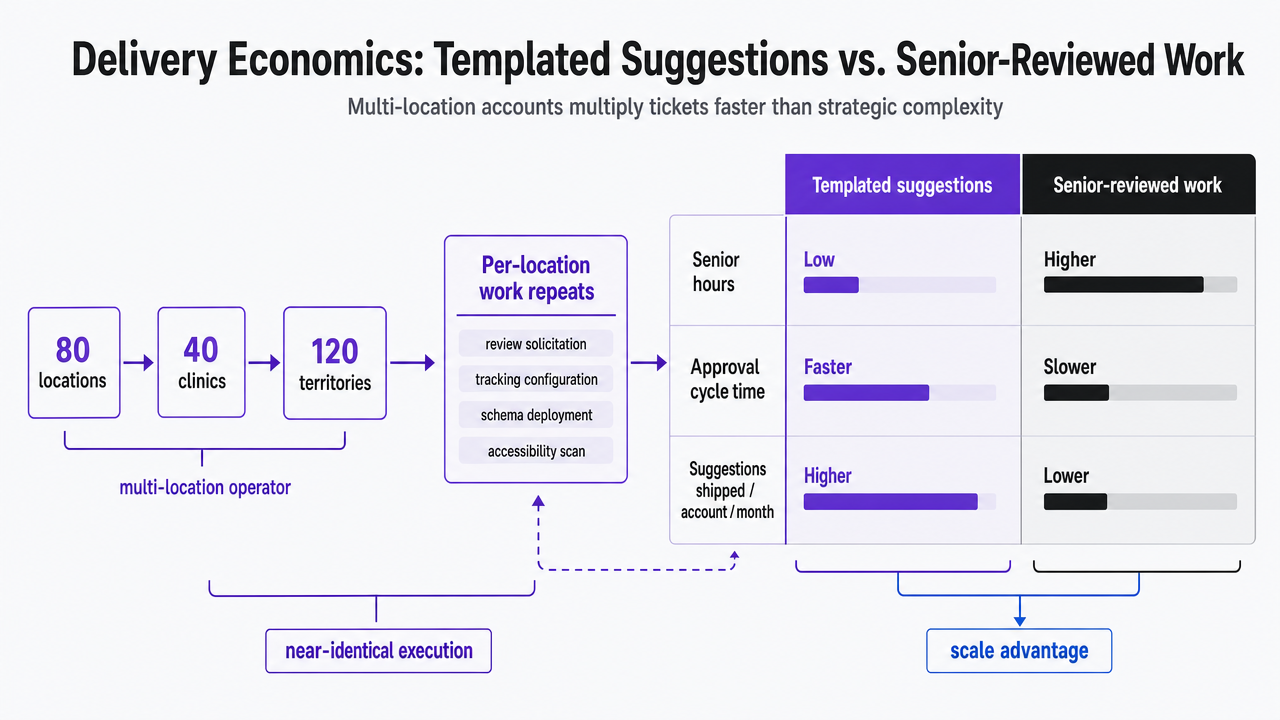 Render the article's comparison table of delivery models as a clean editorial comparison matrix so readers can scan the trade-offs between senior hours, approval cycle time, and suggestions shipped per account per month
Building the Recommendation Engine Your Team Will Actually Use
The nine suggestion categories above share one structural property: each pairs a data trigger with a template, a compliance boundary, and a named approval step. That structure is what lets a pod lead route work to juniors without inheriting the exposure that comes with YMYL content, review solicitation under 16 CFR Part 465 1, or tracking on authenticated patient-facing URLs 10.
The build order matters. Encode the compliance decision layer first, then the templates, then the data triggers. Pods that reverse the order ship fast for a quarter and then rebuild everything after the first regulatory ticket lands. Senior strategists keep sign-off on the templates themselves and on any ticket the decision layer flags, which is where their judgment compounds across the client book rather than getting spent re-drafting the same audit.
Agencies piloting approval-first AI recommendation workflows, including Vectoron's specialist-strategist model, are converging on this shape because the delivery math only works when nothing ships without human sign-off and every suggestion carries the reasoning behind it.
Frequently Asked Questions
References
- 1.16 CFR Part 465: Trade Regulation Rule on the Use of Consumer Reviews and Testimonials (Final Rule).
- 2.FTC Order Against AI-Enabled Review Platform Sitejabber Will Ensure Consumers Get Truthful, Accurate Information.
- 3.Analysis of the Accuracy of Weight Loss Information Search Engine Results.
- 4.Federal Trade Commission Announces Final Rule Banning Fake Reviews and Testimonials.
- 5.The Consumer Reviews and Testimonials Rule: Questions and Answers.
- 6.Can Patients Trust Online Health Information? A Meta-narrative Systematic Review Addressing the Quality of Health Information on the Internet.
- 7.Endorsements, Influencers, and Reviews.
- 8.Trust and Credibility in Web-Based Health Information.
- 9.Justice Department's Final Rule to Improve Web and Mobile App Access for People with Disabilities.
- 10.Use of Online Tracking Technologies by HIPAA Covered Entities and Business Associates.
- 11.Can Patients Trust Online Health Information? A Meta-narrative Systematic Review Addressing the Quality of Health Information on the Internet.