
Key Takeaways
- Keyword-first workflows collapse at portfolio scale because they hide intent, SERP format, and trust requirements that senior strategists then rebuild manually per account.
- Query data resolves into eight intent clusters rather than three, and intent ratios swing 15 to 24 points by vertical, so a single templated playbook misdelivers asset mix 3, 9.
- A four-layer model — intent segmentation with vertical calibration, SERP-format targeting, entity and trust signals, and downstream conversion mapping — is the framework a smaller team can execute consistently.
- Codifying the model into vertical baselines, typed briefs, format specs, and intent-segment reporting is where delivery leads should focus next to recover senior hours and report pipeline instead of rankings.
Why keyword-first targeting stalls at portfolio scale
A keyword list is a serviceable artifact for one campaign. Stretched across twenty client accounts, it becomes the reason senior strategists spend Fridays rewriting briefs a junior team already delivered on Tuesday.
The bottleneck is not the research itself. It is that keyword-first workflows treat every client as a fresh discovery exercise, then hand the output to writers who cannot see the intent, SERP shape, or trust requirements sitting behind the terms. Query classification research going back to Jansen and colleagues split intent into informational, navigational, and transactional categories to describe what searchers actually want from a result page 10. Most agency playbooks stopped there. The delivery model still runs on volume and rank tracking while the underlying search behavior has fragmented into finer segments that a keyword column cannot express 11.
At portfolio scale, three failure modes compound. Briefs miss intent because the keyword hides it. SERP format decisions get made by writers rather than strategists, so featured snippets and local packs go undefended. And client reporting drifts back to ranking screenshots because nothing downstream connects targeting choices to pipeline.
Head of SEO roles absorb the cost. Senior hours get burned on QA and rework instead of strategy, margin compresses, and the answer to any new client win is another hire. A layered targeting model — intent, SERP format, entity and trust, downstream conversion — is what a smaller team needs to execute consistently across a mixed book without rebuilding the wheel per account.
The intent map most agencies are still using is undersized
Eight clusters, not three: what the query data actually shows
The three-bucket intent model — informational, navigational, transactional — was useful when Jansen and colleagues formalized it, and it still shapes how most agency briefs get built 10. The problem is that the underlying query data no longer fits neatly into three boxes.
Kathuria and colleagues ran k-means clustering on 130,000 Dogpile queries using features like query length, source (web, images, video), reformulation rate, and an intent-weight signal. The queries resolved into eight distinct clusters, not three: six were primarily informational subtypes, one was primarily transactional, and one was primarily navigational. Automatic classification accuracy landed at roughly 87–88%, about 15 points higher than a binary-tree approach applied to the same data 3. At the aggregate level, about 76% of queries were informational, 12% transactional, and 12% navigational 3.
The aggregate ratio is not the interesting finding. The interesting finding is that informational intent fractures into six operationally different behaviors — different query lengths, different reformulation patterns, different vertical mixes — and a brief that treats all of them as "informational content" collapses that resolution.
For delivery teams, this changes what a keyword row on a spreadsheet is supposed to trigger. A short informational query with a high reformulation rate signals a searcher still narrowing the problem and warrants a different asset than a long informational query with low reformulation, which signals a searcher already deep in a specific sub-question. Both would sit under "informational" in a legacy brief. Neither writer would know which was which.
Scaling across a book of twenty accounts, that resolution loss is where senior QA time disappears.
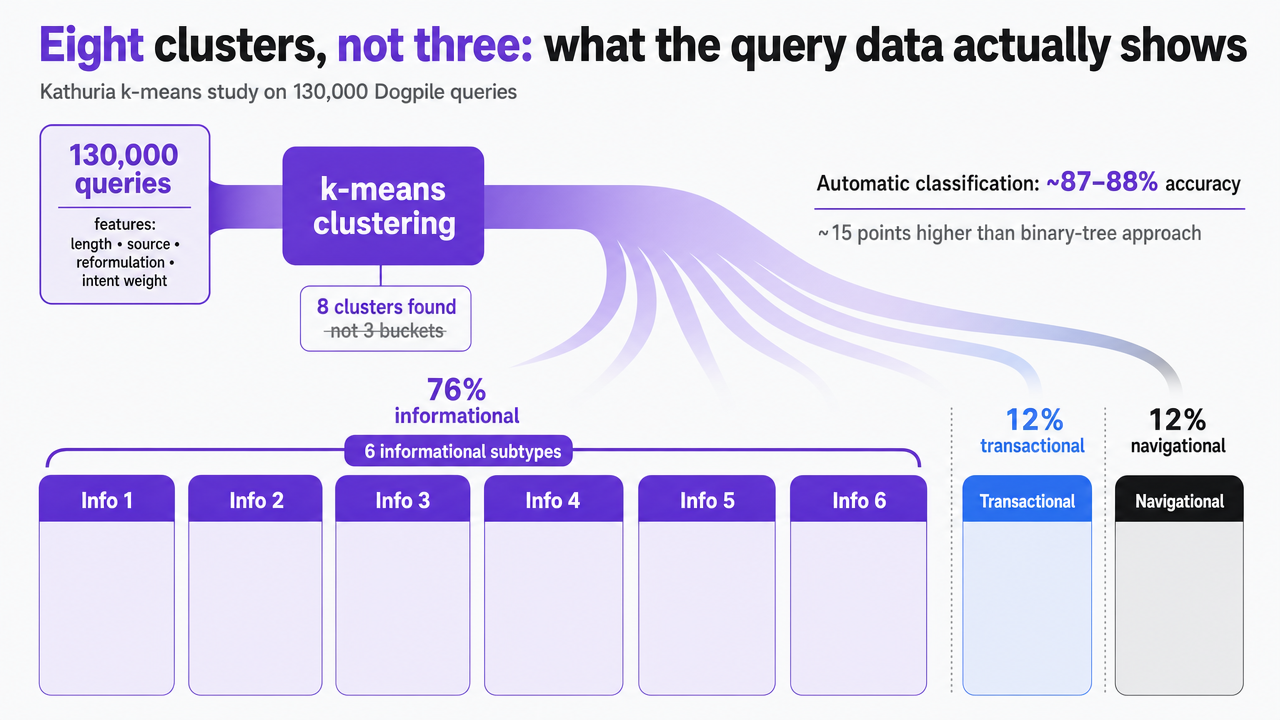 Visualize the eight-cluster intent breakdown from the Kathuria k-means study, which is directly cited in the section prose with matching numbers (six informational subtypes, one transactional, one navigational; 76% informational, 12% transactional, 12% navigational aggregate)
Intent distributions swing hard by vertical
Even if the eight-cluster resolution is set aside and the classic three-bucket model is used, the ratios still refuse to sit still across categories. A separate Jansen study manually labeled more than 20,000 AOL queries by topic and Broder-style intent, then measured how intent proportions moved as the topic changed. The variance was not small: intent ratios shifted 15 to 24 percentage points depending on the category 9.
Health queries were 89.6% informational. Business queries were 51.9% navigational. Organizational queries were 72.1% navigational. Shopping queries were roughly 35% transactional. Holidays queries were 50.8% navigational 9. The study is now over a decade old and the sample is AOL, not Google, so absolute numbers should not be quoted as current market share. What holds is the shape of the variance — the direction and magnitude of category-level skew, which subsequent classification work has continued to confirm 11.
The operational consequence is direct. An agency delivering across law, behavioral health, dental, home services, and senior living is not delivering into one intent distribution. It is delivering into five. A behavioral health book that runs 85%+ informational needs a brief system that produces symptom-explainer, treatment-comparison, and family-guidance assets by default, with transactional pages as a minority workload. A home services book skews toward transactional and local navigational queries and needs the opposite mix.
Running a single templated targeting playbook across both books guarantees one of them is served the wrong asset ratio. That mismatch does not usually show up as a ranking failure. It shows up as traffic that arrives and does not convert, which is the failure mode clients actually escalate.
Vertical calibration is not a preference. It is the input that decides whether the rest of the targeting layers have anything to work with.
![Support the section's cited vertical-by-intent variance numbers (health 89.6% informational, business 51.9% navigational, organizational 72.1% navigational, shopping ~35% transactional, holidays 50.8% navigational) — all appear in nearby prose with citation [9]](https://res.cloudinary.com/dyvtnnynh/image/upload/v1788231441/content_images/vectoron_ai/seo_targeting/aqmmjqgggkvtuybshj9s.png) Support the section's cited vertical-by-intent variance numbers (health 89.6% informational, business 51.9% navigational, organizational 72.1% navigational, shopping ~35% transactional, holidays 50.8% navigational) — all appear in nearby prose with citation [9]
Support the section's cited vertical-by-intent variance numbers (health 89.6% informational, business 51.9% navigational, organizational 72.1% navigational, shopping ~35% transactional, holidays 50.8% navigational) — all appear in nearby prose with citation [9]
A four-layer targeting model that a smaller team can execute
Layer one: intent segmentation with vertical calibration
The first layer is not a keyword list. It is a per-client intent distribution the delivery team can defend before a single brief gets written.
Calibration starts with the vertical baseline. A behavioral health book inherits a heavy informational skew; a home services book inherits a transactional and local navigational skew; a legal book sits somewhere between, with informational research queries feeding a smaller transactional pocket around consultation intent 9. That baseline then gets adjusted against the client's actual query pull — search console data, call transcripts, form submissions — to produce a target asset mix, not a target keyword count.
Once the mix is set, briefs get typed against it. Informational subtypes fracture into explainer, comparison, and decision-support formats, each with different query-length and reformulation profiles 3. Transactional briefs specify offer, proof, and conversion path. Navigational briefs specify entity coverage and branded SERP defense. A junior strategist working from a typed brief no longer has to guess what the keyword means.
The output of layer one is a ratio and a set of brief types, held per client and reviewed quarterly. That artifact is what the remaining three layers act on.
Layer two: SERP-format targeting as the real position decision
Ranking in the top ten stopped being the useful metric once the first result absorbed most of the clicks and the first page absorbed nearly all of them. Browsing-log analysis across Switzerland and Germany found users clicked the first search result in over 50% of cases, with over 97% of all clicks landing on the first page 6. The study runs on desktop logs and does not model AI overviews or mobile-first behavior, but the shape of the distribution — steep concentration at the top, near-total exclusion past page one — is what matters for a targeting decision.
That shape reframes what "position" means in a brief. Position four on a query with a featured snippet, a People Also Ask block, and a local pack is not four competitors away from the click. It is behind whatever formats sit above the ten blue links. The targeting decision is which format the asset is built to occupy, not what rank the keyword tool estimates.
For delivery teams, this collapses into three format calls per query cluster. Is the intent servable by a snippet, and is the current holder beatable on structure and freshness? Is there a PAA cluster the asset can answer directly to earn secondary presence? For local-service verticals, does the query trigger a map pack, and does the client's GBP profile support entry?
Briefs then specify format targets alongside the keyword — snippet-eligible answer at 40–55 words, PAA answers structured as question-headed paragraphs, schema types matched to the format. A junior writer working from that brief produces an asset the SERP can actually surface. Without it, the writer produces a page that ranks eighth on paper and receives almost nothing.
Layer three: entity and trust signals in regulated verticals
Layer three is the one that separates regulated-vertical delivery from everything else. In law, behavioral health, dental, and senior living, the asset is not competing on topical coverage alone. It is competing on whether the searcher — and the ranking system — treats it as a credible source.
The health-search evidence is direct on this point. A 2021 systematic review of online health information-seeking found that quality, trustworthiness, and utility were the dominant predictors of whether users sought and relied on a source, and that instrumental factors outweighed psychological ones 1. The review synthesizes studies through 2021 and does not measure ranking behavior, but the signal it captures — trust as a precondition for engagement — maps onto the same evidence surface search systems evaluate.
Operationally, this means the brief carries entity requirements alongside content requirements. Named author with verifiable credentials and a linked bio. Medical or legal reviewer where the vertical demands one. Citations to primary sources rather than to secondary explainers. Consistent entity references across the site — practitioner names, license numbers, facility addresses — matched by schema markup that reinforces the entity graph.
The trust layer also constrains what the intent layer is allowed to produce. A behavioral health explainer targeting a symptom query cannot ship without clinical review, regardless of how well it matches the informational intent distribution. That constraint sits in the brief template, not in the reviewer's memory.
For a Head of SEO scaling delivery, the payoff is that trust signals stop being a per-asset judgment call. They become a required field on the brief, checked before content production begins, which removes an entire class of late-stage rejection from the QA queue.
Layer four: downstream conversion targeting past the click
Layer four is where most agency targeting still ends at the wrong point. Rankings and sessions are inputs. What clients escalate on is whether the traffic converted.
Downstream targeting starts by mapping each intent segment to a downstream event the client actually values. Informational-early assets get measured on assisted conversions and return-visit rates. Informational-late and comparison assets get measured on consultation requests, quote starts, or appointment bookings. Transactional assets get measured on primary conversion and lead quality — qualified call, kept appointment, matter opened — not on form fills alone.
That mapping then feeds back into the brief. An asset targeting a comparison query carries a defined next action: a decision tool, a comparison table with a scheduling entry point, or a case-matched CTA. An asset targeting a symptom explainer carries a softer next action — a screener, a directory lookup, a guide download — because the intent does not support a booking ask yet.
The measurement layer closes the loop. Every brief specifies which downstream event it is optimizing for, and monthly reporting rolls up by intent segment rather than by page. Clients stop seeing ranking screenshots and start seeing which intent pockets are producing pipeline. Delivery teams stop rewriting assets that rank fine but were briefed against the wrong downstream event.
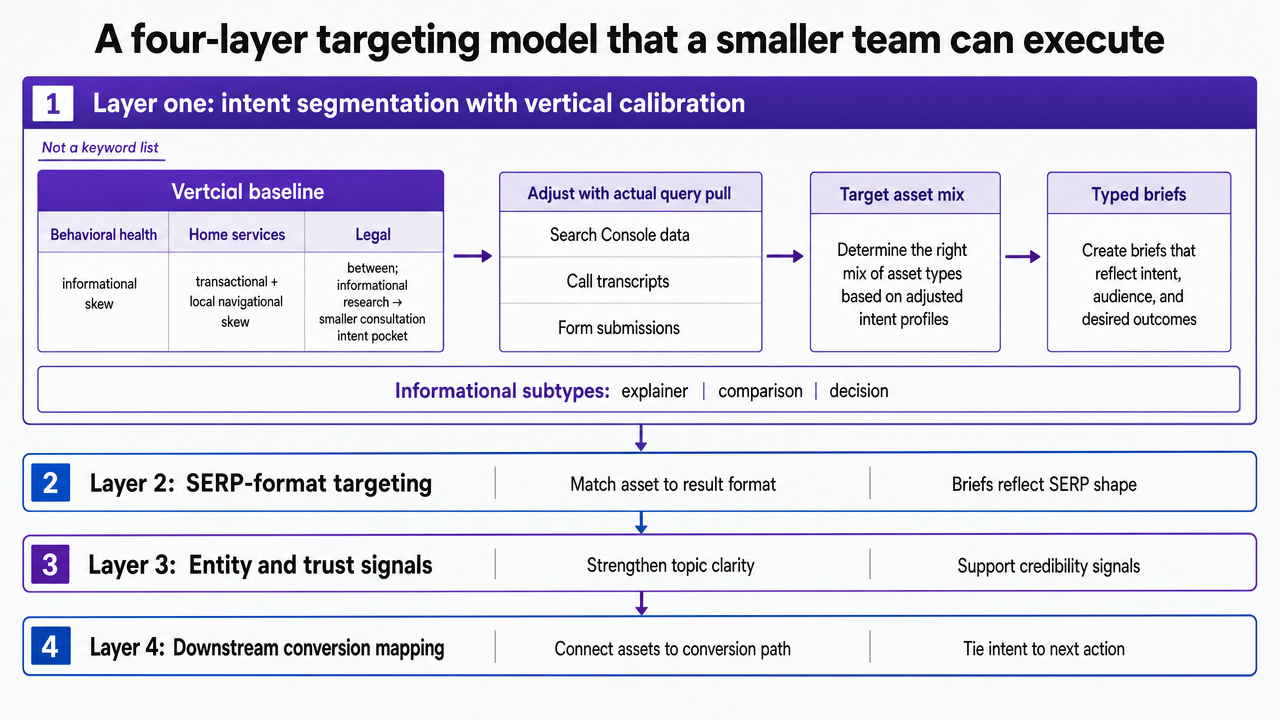 Visualize the four-layer targeting framework introduced in the section (intent segmentation with vertical calibration, SERP-format targeting, entity and trust signals, downstream conversion mapping) — each layer is expanded in the subsections that follow
Test data-driven SEO targeting on real sites
Experience measurable improvements in SEO targeting and content impact across live client domains during your trial.
Coordinating organic and paid targeting in the same brief
Most agencies still brief organic and paid targeting on separate tracks, then reconcile them in a monthly report. The click data does not support that separation.
Column-level clickstream analysis of real search-engine logs found that consumer click activity concentrates heavily on organic results, with roughly 95% of total clicks across searches landing on organic links 4. That does not make paid irrelevant. It sets the ratio. Paid targeting is a small share of click volume that has to earn its place against a dominant organic surface, and the two surfaces move together. A field-experiment and clickstream study measured the interdependence directly and found that organic clicks lift the utility of paid clicks about 3.5 times more strongly than paid clicks lift organic 5. Organic presence is the multiplier, not the substitute.
The query-type overlay matters here. Ad-versus-organic competition is sharpest on navigational queries, where users have a specific destination in mind and both surfaces fight for the same click 2. On commercial queries with clear purchase intent, sponsored results earn a higher share of engagement than they do on informational ones 8. Neither pattern justifies a blanket "always defend brand terms with paid" or "never bid on informational" rule.
Coordinated briefs make three calls per query cluster. Where organic already holds the top slot on a branded navigational query, paid gets scaled back to a monitoring bid unless a competitor is actively encroaching. Where the cluster is commercial and organic is climbing but not yet on page one, paid carries the volume until organic lands. Where the intent is informational-early, paid supports remarketing and audience building rather than head-term bidding, since the click share on organic is where the value sits 4.
Rolling that logic into the same brief — same intent segmentation, same SERP-format read, same downstream event — is what turns two channels into one targeting decision.
If the book includes multi-location clients: adapting the model for franchise and DSO delivery
A note on scope: the four layers work as described for single-location clients. Delivery teams running DSO groups, franchise home services brands, senior living operators with multiple communities, or law firms with regional offices need three adjustments before the model holds.
The first is that the intent distribution splits by location, not just by vertical. A dental group with forty practices does not run one health-informational book. It runs forty local navigational books stacked on top of a shared informational core. Branded and near-me queries at the location level skew navigational, matching the pattern Jansen recorded for organizational and business categories 9, while the symptom and treatment layer stays heavily informational.
The second is that SERP-format targeting inverts by query type. Local pack presence is the primary format decision on location queries; featured snippets and PAA carry the informational core published once at the brand level and syndicated with location-specific proof.
The third is entity consistency across locations. Practitioner names, license numbers, and NAP data have to match between the site, schema, and citations, because the trust signal that regulated-vertical audiences respond to is the same one search systems evaluate 1. Inconsistency at scale is the failure mode that quietly caps local pack entry across the group.
Scale SEO Targeting Without Compromising Strategic Oversight
See how unified AI-powered workflows enable agencies to deliver advanced SEO targeting and measurable client results—without expanding headcount or losing control over approvals.
Portfolio economics: senior hours recovered by standardizing the workflow
The strategic case for layered targeting is one argument. The delivery case is a different one, and it lives in senior strategist hours per client per month.
A traditional keyword-first workflow burns senior time in four predictable places across a book of twenty accounts: fresh keyword research per client, brief construction that translates rows into intent guesses, QA on drafts that missed the SERP format or trust requirements, and revision cycles when the first pass ranks but does not convert. A standardized layered workflow moves most of that work up-front and into templates — vertical intent baselines, typed brief formats, format-targeted output specs, downstream event mapping — so the per-client run cost drops to calibration and review.
The table below uses hours as the variable. Delivery leads can apply their own blended senior rate.
| Per-client monthly senior hours | Keyword-first workflow | Layered targeting workflow |
|---|---|---|
| Research and intent classification | 4.0 | 1.0 |
| Brief construction and format specs | 3.0 | 1.0 |
| Draft QA against intent and SERP format | 3.5 | 1.5 |
| Revision cycles and conversion rework | 2.5 | 0.5 |
| Total senior hours per client | 13.0 | 4.0 |
| Across a 20-client book | 260 | 80 |
The delta is 180 senior hours per month, recovered without changing headcount. Those hours are the ones a Head of SEO currently spends rewriting briefs on Fridays. Redirected, they cover new-client onboarding, competitive analysis on the accounts that are underperforming, and the pitch work that grows the book.
The economics only hold if the templates are actually built. A layered workflow that lives in one senior strategist's head is a personal preference. A layered workflow codified into per-vertical intent baselines, typed brief formats, and format-specific QA checklists is portfolio infrastructure — and it is what makes the difference between billing rankings and reporting pipeline movement by intent segment.
A workflow blueprint delivery teams can adopt Monday
The layered model only compounds if it lives in a repeatable sequence. The five steps below are what a delivery lead can put in front of a team on Monday without a platform migration or a rehire cycle.
- 1. Set the vertical intent baseline per client. Pull the client's top 500 queries from Search Console and label each against the topic-by-intent baselines the research establishes — heavily informational for health, navigational-leaning for business and organizational categories, transactional-weighted for shopping and local services 9. The output is a target asset ratio, not a keyword count.
- 2. Type every brief before it enters production. Informational briefs split into explainer, comparison, and decision-support formats, each with distinct query-length and reformulation profiles 3. Transactional and navigational briefs carry their own required fields. A junior strategist working from a typed brief no longer has to infer what the keyword means.
- 3. Specify the SERP format target alongside the keyword. Snippet-eligible answer length, PAA question structure, schema type, and local pack eligibility get called in the brief. Position one absorbs the majority of clicks and page one absorbs nearly all of them, so the format decision is the entry decision 6.
- 4. Bind organic and paid calls in the same document. Each query cluster carries a coordinated recommendation — defend, complement, or cede — informed by navigational competition patterns 2 and commercial-query engagement with sponsored results 8.
- 5. Report by intent segment, not by page. Monthly rollups map each segment to the downstream event it was briefed against. Clients see which pockets produced pipeline; delivery teams see which briefs need reformatting.
Codified into templates and checklists, this workflow is what platforms like Vectoron operationalize across a book — not as a replacement for the strategist's judgment, but as the infrastructure that keeps senior hours on strategy instead of rework.
Frequently Asked Questions
References
- 1.Online Health Information Seeking Behavior.
- 2.Competing for Users’ Attention: On the Interplay between Organic and Sponsored Search Results.
- 3.Classifying the user intent of web queries using k-means clustering.
- 4.Consumer Click Behavior at a Search Engine (PDF).
- 5.Analyzing the Relationship Between Organic and Sponsored Search Advertising: Evidence from Field Experiments and Clickstream Data.
- 6.You are how (and where) you search? Comparative analysis of web search behaviour in Switzerland and Germany.
- 7.What Were People Searching For? A Query Log Analysis of an Academic Search Engine.
- 8.Study of user behavior on sponsored search results.
- 9.Classifying Web Queries by Topic and User Intent.
- 10.Determining the informational, navigational, and transactional intent of Web queries.
- 11.Determining the User Intent of Web Search Engine Queries.