
Key Takeaways
- Adopt Google Search Essentials as one shared operating standard so every account is measured against the same eligibility, crawlability, and prohibited-practice criteria 1.
- Convert people-first content guidance into a four-gate editorial rubric—original value, expertise, trustworthiness, usefulness—so junior editors can review consistently without senior rework 2.
- Productize the technical checklist against Google's May 2025 AI-search eligibility bar, treating snippet and indexation controls as documented decisions rather than CMS defaults 5.
- Sort page-experience audit findings by revenue impact and Google's named elements first, so critical LCP and interstitial fixes precede minor Lighthouse warnings 6.
- Maintain a central structured-data inventory tracking schema types, URLs, and supported features so retirements like the June 2025 changes trigger clean bulk removals 7, 9.
- Consolidate spam-policy checks into one prohibited-practice gate applied to every draft and link acquisition before publication, catching stuffing, scraping, and manipulation 8.
- Build durable, comprehensive content assets rather than one page per AI query variation, since mass-produced thin pages qualify as scaled content abuse 4, 8.
- Treat generative AI as a governed production layer that accelerates drafting but never replaces human fact-checking, expertise, or editorial accountability 3.
- Wrap AI-assisted work in NIST AI RMF-aligned controls—approval thresholds, provenance records, source verification, and escalation paths—to make throughput defensible 11.
- Standardize on-page and technical delivery using the SEO Starter Guide as a shared spine, layering client-specific research on top of documented patterns 10.
- Report outcomes on a shared client scorecard populated from Search Console signals across eligibility, visibility, and outcomes, eliminating per-manager metric variance 10.
Why throughput, not tactics, is the ceiling on agency SEO
Most agency SEO leaders and their teams understand ranking factors. The challenge in scaling from 15 to 80 accounts isn't a lack of knowledge about canonical tags or Core Web Vitals. Instead, it's the inability to consistently apply the same standards, depth, and cadence across every client an agency serves.
This is a throughput problem, not a tactics problem. Google's guidance emphasizes search performance as a compounding function of crawlable structure, people-first content, appropriate structured data, and disciplined avoidance of prohibited practices 1. These requirements are not obscure. However, their consistent application degrades when delivery relies on individual specialists.
The following ten items are framed as productized components of a delivery operating model, each anchored to a specific Google source or the NIST AI Risk Management Framework where automation is involved 11. The aim is not to re-educate SEO professionals but to provide heads of SEO with a method to standardize checklists, protect expert judgment, and use AI to compress work without eroding client trust or Google's.
Adopt Google Search Essentials as the account-wide operating standard
To scale delivery, agencies must establish a single interpretation of Google's baseline requirements across all accounts. Google Search Essentials is not a philosophical guideline; it is Google's explicit list of criteria for a site's eligibility and performance in Search. This includes crawlable links, helpful and reliable people-first content, descriptive page elements, appropriate structured data, promotion, and avoiding spam practices 1. When treated as a shared operating standard, it defines the minimum and maximum expectations for every client.
Practically, this means applying one written definition of "eligible" across the entire client portfolio. A client's homepage, a location page, and a services article are all measured against the same crawlability checks, helpful-content criteria, and prohibited-practice list. While specialists still apply judgment regarding vertical and audience, they do not re-litigate fundamental requirements like indexability or the acceptability of keyword stuffing for a specific client.
The operational benefit is faster triage. When a new account is onboarded or a legacy site audited, the team avoids debating first principles. They execute the same Essentials-aligned pass, flag deviations, and escalate issues requiring strategic judgment rather than addressing them at a lower level.
Translate people-first content criteria into a reusable editorial QA rubric
Google's people-first guidance, while sounding like a values statement, functions as a practical checklist. It asks whether content demonstrates original value, first-hand or expert knowledge, trustworthiness, and genuine usefulness to the reader. It also warns that automated systems prioritize content created for people over content designed to manipulate rankings 2. Agencies that successfully scale editorial quality convert these questions into a rubric that a junior editor can apply efficiently without senior intervention.
An effective rubric distills this guidance into four review gates.
Original value : Assesses whether the draft contains unique claims, examples, datasets, or process details beyond what's found in top search results.
Expertise : Verifies that the byline, quoted sources, or client subject-matter input is documented.
Trustworthiness : Ensures every statistic, quote, and product claim is traceable to a citation within the working document.
Usefulness : Evaluates if the content clearly answers the search task, preventing the reader from needing to return to the SERP.
Each gate results in a binary pass or fail. A failure routes the draft back to the writer with the specific gate named. This process aims to make quality measurable across numerous accounts and reviewers, not to critique prose. With a documented rubric, a senior editor can spot-check multiple pieces quickly, and client-specific expertise is captured at intake rather than being hastily reconstructed under deadline.
Productize the technical checklist against a single AI-search eligibility bar
Technical SEO often becomes fragmented as an agency expands. Different specialists might handle crawl budget, hreflang, or Lighthouse reports independently, leading to inconsistent standards.
Google's May 2025 guidance on AI search experiences unifies these disparate tasks into a single eligibility bar. Pages must be discoverable, crawlable, indexable, and technically eligible for consideration in Search or AI formats. The guidance specifies controls agencies should check: nosnippet, data-nosnippet, max-snippet, noindex, and structured-data validation against currently supported features 5. This is a definitive list that a mid-level specialist can execute without senior oversight.
The operational strategy is to create a single technical checklist that evaluates every client site against this bar, in a specific order:
- Discoverability comes first: sitemap presence, submission, and inclusion of desired URLs.
- Crawlability follows: robots.txt review for accidental blocks, and sufficient internal linking to reach key pages within three clicks.
- Indexability is next: canonical tags resolving correctly, and noindex applied only with human approval.
- Technical eligibility: Core Web Vitals in the green, clean HTTPS, and error-free structured data validation 5.
Snippet and indexation controls are treated as deliberate decisions, not inherited defaults. Snippet controls warrant a dedicated checklist item due to their explicit trade-off, as stated by Google. Restrictive use of nosnippet, data-nosnippet, or a tight max-snippet limits content appearance in AI experiences. This might be appropriate for premium research but counterproductive for top-of-funnel pages 5. The goal of standardizing the checklist is not uniform application but ensuring these settings are documented decisions for each account, rather than accidental outcomes of a CMS migration.
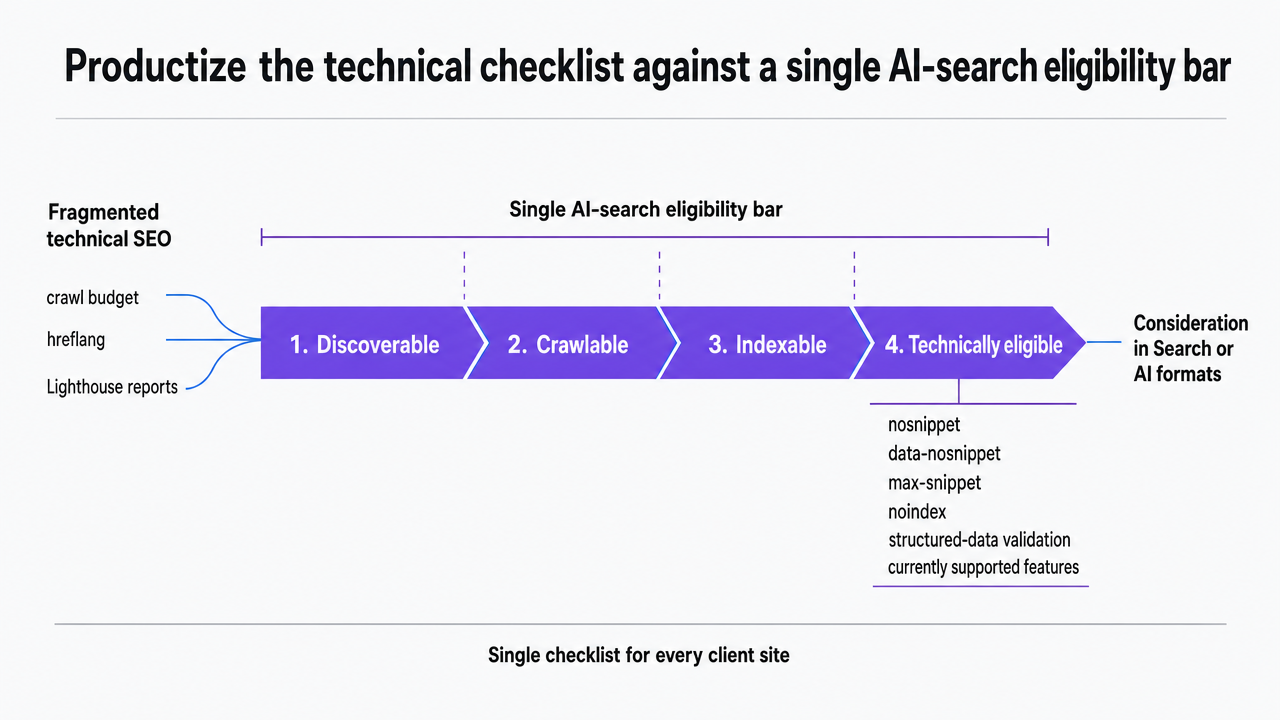 Visualize the four-step technical eligibility checklist Google names for AI search, matching the section's cited sequence
Prioritize page experience audits by user impact, not warning count
Lighthouse reports often generate extensive lists of warnings, which junior specialists may address sequentially. This can lead to significant time spent on minor accessibility issues on low-value pages, while critical revenue-driving pages still suffer from poor Largest Contentful Paint (LCP) scores on mobile.
Google's page-experience guidance explicitly states that Core Web Vitals influence ranking systems. Page experience encompasses HTTPS, mobile usability, intrusive interstitials, advertising behavior, and the visual separation of primary content 6. It also clarifies that there isn't a single page-experience signal and strong metrics alone don't guarantee high rankings 6. Both aspects are crucial for how an agency prioritizes work.
The operational approach is to sort audit findings by two criteria before creating tickets:
- Which URLs are critical for client revenue or lead generation.
- Which findings directly relate to Google's named page-experience elements, rather than generic performance warnings.
For example, a failing LCP on a money page takes precedence over numerous unused-CSS flags on a policy footer. An intrusive interstitial on a landing template is more critical than a contrast warning on a login screen rarely accessed by crawlers. Agencies should prioritize fixes that improve user experience on pages vital to client sales, deferring less impactful issues to subsequent quarterly reviews.
Test AI-driven SEO execution at scale now
Experience measurable SEO workflow efficiency and publish client-ready content during your free trial.
Maintain a structured-data inventory instead of shipping schema and moving on
Schema implementation is often treated as a one-time task. A specialist adds FAQ markup, validates it, ships it, and closes the ticket. Months later, if FAQ accordions disappear from SERP snippets, no one on the account can identify which pages use which schema types or if they still qualify for rich results.
Google's June 12, 2025, announcement highlighted the consequences of this approach. Six structured-data-driven features were retired from Search:
- Course Info
- Claim Review
- Estimated Salary
- Learning Video
- Special Announcement
- Vehicle Listing
These changes impacted Search results, Search Console reporting, the Rich Results Test, and the associated API 7. Agencies that had implemented and forgotten these markup types were left with obsolete code in their CMS templates and inaccurate metrics in client reports.
The operational solution is a centrally maintained structured-data inventory, not one per site. For each client, this inventory records deployed schema types, URL patterns, validation dates, and mapping to currently supported Search features. Google's documentation explicitly states that structured data makes pages eligible for certain Search features but doesn't guarantee a rich result will appear, and that markup must accurately represent visible page content 9. This inventory transforms the eligibility question into a quarterly review, preventing reactive discovery during client escalations.
Three rules ensure the inventory remains useful:
- Schema is only deployed if it maps to a supported feature and reflects visible content 9.
- Retirement announcements trigger a bulk removal across all affected accounts, bypassing individual client discussions 7.
- No client report claims a rich result as a KPI without corroborating Search Console appearance data from the same period.
Consolidate spam-policy checks into a single prohibited-practice gate
Compliance work, like technical work, often fragments. One specialist might monitor keyword stuffing, another might flag a link-buying suggestion, and a third might notice scraped content. While each observation is valid, they stem from individual memory rather than a shared, standardized list.
Google's spam policies directly name prohibited practices, including keyword stuffing, cloaking, link manipulation, scraped content, and scaled content abuse. The stated consequence is that pages or entire sites may rank lower or be omitted from Search 8. This finite list applies uniformly to all agency clients. Treating it as a single "prohibited-practice gate," applied before any content or link asset is deployed, consolidates multiple specialist checks into one enforceable step.
This gate operates at two key workflow points:
- It runs on every content draft before publication, checking for stuffing, thin scaled output, and content copied without transformation 8.
- It also runs on every link acquisition before acceptance, checking for Google's named manipulation patterns.
This gate does not require senior judgment for the majority of assets. Instead, it ensures that the flagged minority actually reaches a director for review, rather than being shipped without proper scrutiny.
Build durable content assets, not one page per AI-search query variation
With generative search, there's a temptation to chase every possible query variation. A single user prompt can trigger numerous sub-queries, leading clients to believe a separate landing page is needed for each potential AI-generated variation. This can cause content libraries to balloon with near-duplicate URLs that compete against each other for the same intent.
Google's guide for optimizing for generative AI features suggests the opposite approach. Conventional technical SEO still governs eligibility for AI experiences. The guide explicitly recommends creating non-commodity content that is helpful, reliable, people-first, and offers value beyond common knowledge 4. The mechanism for surfacing a page in an AI summary is the same as for classic Search: discoverability, crawlability, indexing, helpful content, and accurate structured data 4. A comprehensive, durable asset addressing a topic thoroughly can be pulled into multiple sub-queries. A thin page created for one hypothetical variation often competes unsuccessfully with the client's own superior content.
The operational strategy is consolidation. Agencies scaling delivery should quarterly audit client content inventories, merging near-duplicate pages targeting minor query variations into a single canonical asset. The production budget should then be reinvested in depth: original data, documented client expertise, and examples not already prevalent in top SERP results.
Google's spam guidance classifies mass-produced, low-value pages as scaled content abuse, regardless of whether they were human or AI-generated 8. Prioritizing fewer, stronger URLs is not a compromise; it's what makes the technical checklist and editorial rubric effective.
Treat generative AI as a governed production layer, not a shortcut
Agencies that struggle with AI often treat it as a direct replacement for human writers. Those that scale successfully integrate AI as a layer that accelerates the process between research and expert review, with human review remaining the critical component.
Google's guidance is clear on this distinction. Generative AI is acceptable for research, outlining, content transformation, and workflow acceleration. However, generating many pages with AI without adding user value may violate the spam policy on scaled content abuse 3. The key is not whether a model touched the draft, but whether a human expert verified facts, added original insight, and took editorial accountability before publication 3. This provides agencies with a clear operating rule: AI can draft, restructure, summarize, and accelerate, but it cannot be the final arbiter of content shipped to a client site.
In practice, this means treating every AI-assisted asset like any other draft moving through the editorial rubric. The four review gates—original value, expertise, trustworthiness, and usefulness—apply equally, with the trustworthiness gate becoming even more crucial when a model generates the initial draft 2. Every statistic must be traced to a source in the working document. Every claim about the client's service, market, or method must be confirmed by a client representative, not inferred from training data. All citation links must resolve.
The throughput gain from AI is significant and comes from the right place: it shortens the path from brief to reviewable draft. It does not, however, shorten the review process itself. This is a conscious trade-off agencies must make, and it is one that Google's guidance supports.
See How Leading Agencies Automate SEO Execution Without Expanding Headcount
Connect with a solutions expert to benchmark your agency’s SEO delivery efficiency and discover AI-powered workflows proven to scale client results across multiple accounts.
Wrap AI-assisted work in an AI RMF-aligned governance layer
While the editorial rubric ensures individual AI-assisted drafts meet quality standards, it doesn't address the agency's ability to explain, across numerous accounts and thousands of assets, what a model touched, who approved it, and how issues are handled. This gap is filled by the NIST AI Risk Management Framework (RMF). The RMF structures trustworthy AI around principles like validity, reliability, safety, security, accountability, transparency, explainability, privacy, and fairness, designed for translation into concrete organizational controls 11.
Four controls are particularly relevant for SEO delivery operations:
- Approval thresholds define which AI-assisted outputs a mid-level specialist can ship versus those requiring director sign-off, typically based on asset type, client sensitivity, and whether the output makes factual claims about the client's services or market.
- Provenance records document which model produced a draft, the prompt or source material used, and which human reviewed it before publication, storing this information within the working document.
- Source verification confirms that every statistic, quote, and external claim in an AI-assisted asset is traced to a citation actually reviewed by a human, reinforcing the trustworthiness gate of the rubric 2.
- Escalation paths ensure flagged issues—such as scaled-content-abuse concerns, factual disputes from clients, or hallucinated citations—are routed to a named owner with a defined response window.
This governance layer makes AI-driven throughput gains defensible. When a client inquires about AI usage on their account, the agency can provide a documented workflow, not just an ambiguous response.
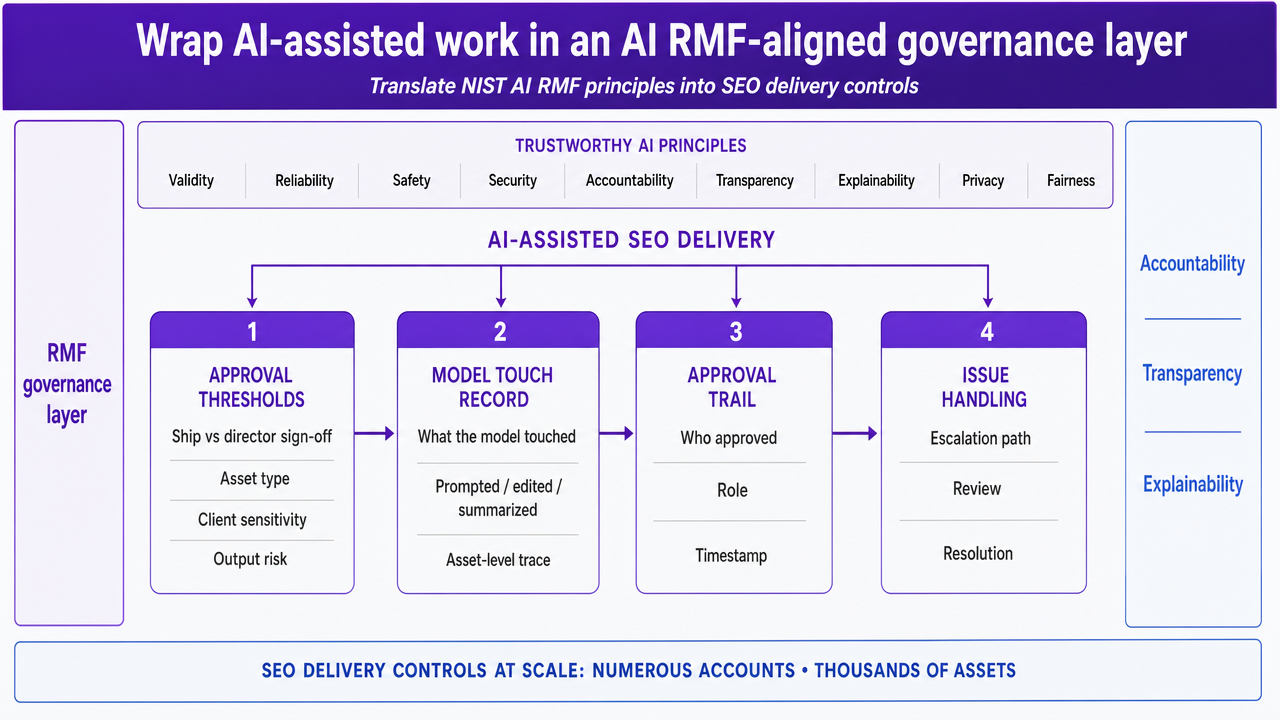 Diagram the four governance controls the section explicitly lists, translating NIST AI RMF principles into an SEO delivery layer
Standardize on-page and technical delivery with the SEO Starter Guide as the shared spine
The SEO Starter Guide is often underestimated as beginner material, but for agencies scaling across many accounts, it's a crucial resource. Google's guide provides the most concise and complete inventory of essential on-page and site-wide elements: descriptive titles and link text, useful meta descriptions, image alt text, sitemaps, robots.txt, noindex, canonicalization, duplicate-content handling, and Search Console monitoring 10. Using it as the shared foundation for on-page and technical delivery eliminates significant per-account reinvention.
The operational strategy is to build a single delivery checklist that mirrors the Starter Guide's structure, then attach client-specific work as branches.
- Titles, descriptions, and link text follow documented patterns per template, not per writer.
- Sitemaps and robots.txt are reviewed on a regular cadence, not reactively.
- Canonicalization decisions are logged, not inferred from CMS defaults.
- Search Console serves as the single source of truth for indexing and query data, checked weekly using consistent saved views for every account 10.
Client-specific keyword research, audience insights, and vertical judgment are layered on top of this standardized foundation, where they belong, rather than being intertwined with fundamental mechanics that any specialist should execute cleanly.
Report outcomes on a shared client scorecard tied to Search Console signals
Client reporting is a critical juncture for scaled delivery. If each account manager creates their own reports with unique metrics, retention discussions can devolve into debates about the value of a ranking. A shared scorecard, populated from a consistent source for all clients, eliminates this variance.
Search Console is the ideal source. Google's guidance identifies it as the primary monitoring tool for indexing status, query performance, and coverage issues, and the Starter Guide positions it as the default check for the effectiveness of on-page and technical work 10. Building the scorecard around Search Console signals—impressions, clicks, average position for tracked query clusters, indexed URL counts, and coverage errors—ensures every account is measured by the same instrument, rather than a rotating set of third-party rank trackers.
The scorecard should have three layers:
- Eligibility signals confirm the site is indexable and free of coverage errors on key URLs.
- Visibility signals track impressions and position for the targeted query clusters.
- Outcome signals link clicks to the client's desired conversions.
Reporting in this order, on a consistent cadence, allows a director to review delivery across the entire client portfolio efficiently.
Choosing a delivery model: three ways agencies scale the operating system
The checklists, rubrics, inventories, and governance controls discussed are model-agnostic. What varies across agencies is where human judgment is concentrated and how much standardization the delivery model can accommodate before quality suffers. Three dominant archetypes exist, each with different trade-offs against the Search Essentials framework 1 and the AI governance layer 11.
| Dimension | Traditional specialist pod | Offshore-augmented pod | Approval-first AI execution |
|---|---|---|---|
| Standardization surface | Per-pod checklists, high variance across accounts | Documented SOPs enforced through handoff | Platform-level checklists applied uniformly |
| Review load on senior staff | Heavy; directors touch most assets | Moderate; QA layer catches SOP deviations | Concentrated at approval gates rather than draft edits |
| Where human judgment concentrates | Distributed across every specialist | Onshore strategy, offshore execution | Strategy, source verification, and sign-off 3 |
| Governance requirements | Editorial rubric and spam-policy checks 2, 8 | Rubric plus handoff documentation | Full AI RMF-aligned controls: provenance, escalation, approval thresholds 11 |
| Scaling constraint | Headcount | Handoff friction and time-zone latency | Approval capacity of senior reviewers |
None of these models eliminate the need for a checklist. The approval-first model, exemplified by platforms like Vectoron, shifts the scaling question from how many specialists an agency can hire to how many decisions its directors can effectively review. This offers a more sustainable ceiling than headcount, provided the governance layer is robustly implemented 11.
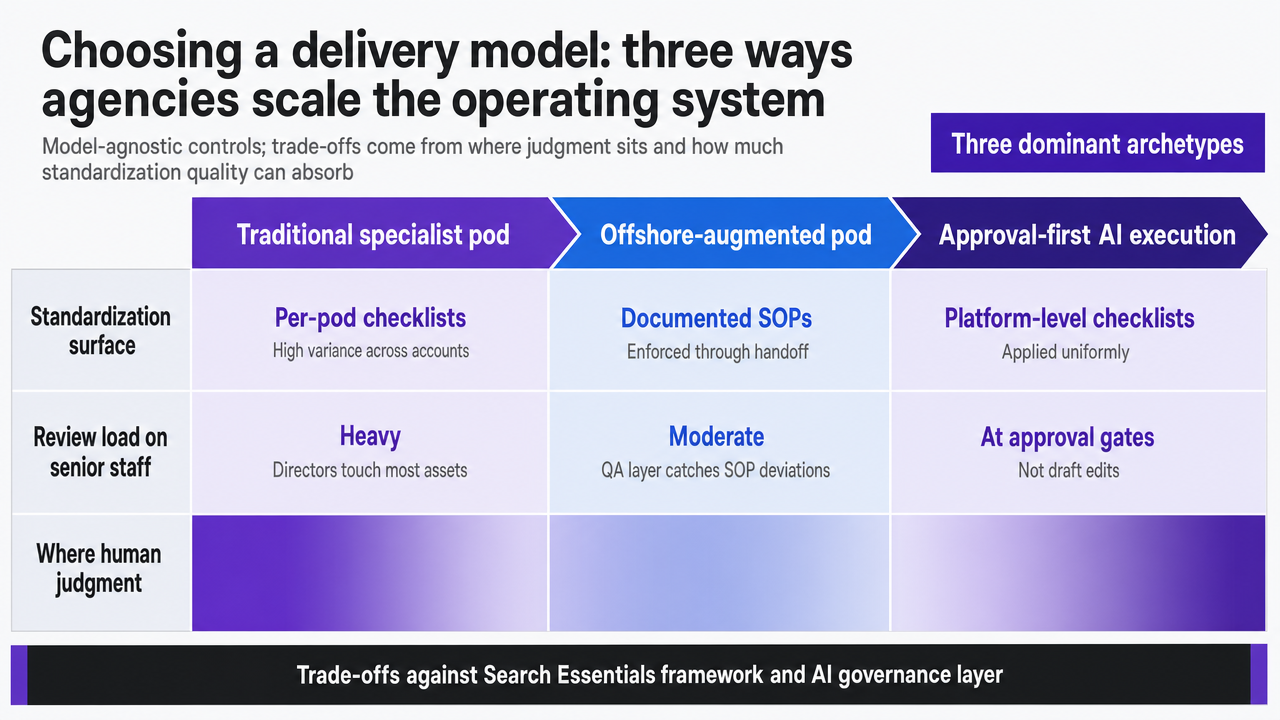 Render the section's three-model comparison table as a scannable side-by-side visual, since the article already provides the comparison content
Frequently Asked Questions
References
- 1.Google Search Essentials.
- 2.Creating Helpful, Reliable, People-First Content.
- 3.Google Search’s guidance on using generative AI content.
- 4.Google’s Guide to Optimizing for Generative AI Features on Google.
- 5.Top ways to ensure your content performs well in Google’s AI experiences.
- 6.Understanding page experience in Google Search results.
- 7.Simplifying the search results page.
- 8.Google Search Spam Policies.
- 9.Introduction to structured data markup in Search.
- 10.SEO Starter Guide: The Basics.
- 11.Artificial Intelligence Risk Management Framework (AI RMF 1.0).