
Key Takeaways
- Ahrefs anchors the data layer with its keyword and backlink graph, and its AI Overviews tracking flags generative citations without explaining structural reasons or covering ChatGPT and Perplexity.
- Semrush trades specialist depth for cross-channel breadth, giving small growth teams one workspace for keyword research, position tracking, audits, and competitive ad copy with first-party GA4 and Search Console connectors.
- Profound functions as a measurement instrument for AI-search visibility, reporting brand citation share across ChatGPT, Perplexity, AI Overviews, and Copilot rather than producing content or replacing a keyword database.
- Clearscope enforces editorial guardrails through real-time term coverage scoring, working best for hybrid human-AI writing where structural rigor matters more than tracking citations inside AI Overviews.
- Surfer SEO compresses keyword target to publish-ready draft inside one workspace, but its structural scoring does not verify claims, making a human fact-check pass non-negotiable 9.
- Frase optimizes the brief itself, bundling SERP analysis, headings, and topic models into a handoff document that travels well across distributed freelance writers without extra context.
- Vectoron coordinates SEO, content, conversion, PPC, and backlink work through a Lead Strategist and Command Center approval workflow, consolidating planning for teams otherwise stitching six tools together.
- MarketMuse runs portfolio-level orchestration through a topic model that scores entire sites, surfacing thin clusters and duplicate dilution rather than optimizing a single page at a time.
- Writesonic Chatsonic delivers throughput for programmatic pages and thin-post refreshes, but lacks the approval gates, citation handling, and audit trails NIST treats as baseline production controls 6.
The SEO tool category just split in two
Two distinct product categories now hide under the label "SEO tools." The first is the familiar set of point tools: keyword databases, backlink graphs, rank trackers, and site crawlers. They surface signal, but a human still has to translate that signal into briefs, drafts, technical fixes, and reporting. The second is a newer class of orchestration platforms that connect research to production to execution against analytics signals, with approval workflows in between. The distinction matters because the work a growth team can offload differs by an order of magnitude between the two.
What forced the split is a change in where discovery happens. McKinsey's consumer research on AI search reports that roughly 50% of surveyed consumers intentionally use AI-powered search engines, and frames AI search as a new front door to the internet that brands must adapt their content, structure, and credibility signals to win 1. That figure is a consumer survey, not a measure of enterprise search behavior or a share of total queries, and it should be read accordingly. Even read narrowly, it changes what an SEO tool needs to do: track visibility in generative answers, structure content for LLM extraction, and measure assisted pipeline rather than position alone.
The nine tools that follow are grouped into three tiers (Data and Intelligence, Production and Optimization, Orchestration and Execution) and graded against a fixed five-criterion rubric introduced in the next section.
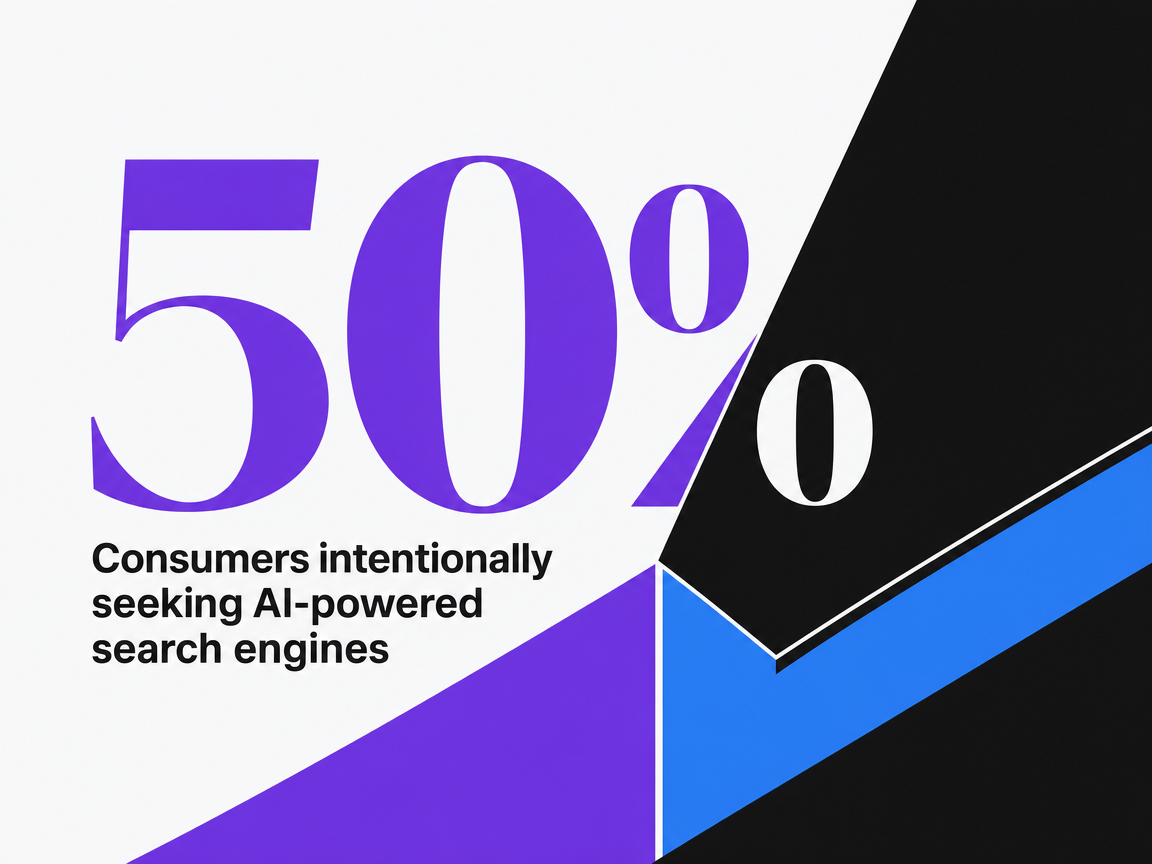 Consumers intentionally seeking AI-powered search engines
Consumers intentionally seeking AI-powered search engines
A five-criterion rubric for grading AI SEO tools
Feature lists rarely separate the tools that compress real work from the ones that demo well. The rubric below scores each tool on a 1–5 scale across five criteria a growth team can actually feel in monthly output. Each criterion is defined narrowly enough to score, and the scoring infographic accompanying this section applies the same rubric to all nine tools so the reader can extend it to any platform not covered here.
- GA4 and Search Console integration depth. Federal SEO guidance explicitly recommends Google Search Console and Google Analytics 4 as the primary signal sources for finding query terms and measuring page performance 5. A tool earns a high score when it pulls live GA4 and GSC data into its research, brief, and reporting layers, not when it merely exports a CSV.
- AI-search and GEO readiness. The criterion measures whether a tool tracks visibility in AI Overviews, ChatGPT, Perplexity, and similar surfaces, and whether its content output is structured for LLM extraction (clear headings, scannable claims, citable phrasing). Tools built only for ten blue links score lower.
- Governance and human-review controls. NIST's Generative AI Risk Management Framework treats review, documentation, and procurement controls as core requirements for any production use of generative AI 6. A high score requires approval workflows, citation handling, edit audit trails, and clear handoffs between AI output and human reviewers.
- Output quality at scale. The test is whether quality holds when monthly volume moves from 10 assets to 100. Tools that depend on a skilled operator to rewrite drafts score lower than tools with structural scoring, brand voice constraints, and editorial guardrails baked in.
- Cost per published asset. Feature-count pricing hides the real number. The rubric grades each tool on fully loaded cost per published, optimized, on-brand asset, including the operator time required to get there. Cheap seat licenses with heavy human stitching often lose to higher-priced platforms that ship finished work.
Scores in the accompanying scorecard are editorial judgments, labeled as such, and intended as a starting point for the reader's own evaluation rather than a sourced benchmark.
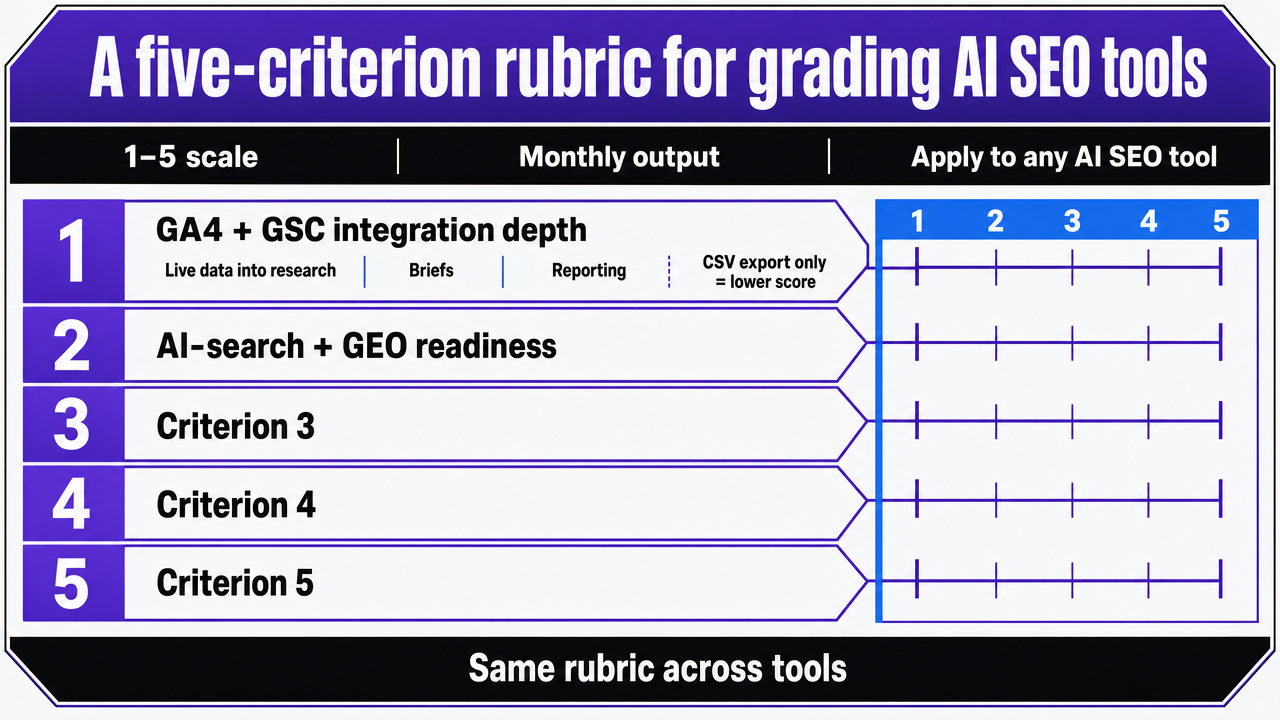 Visualize the five evaluation criteria introduced in this section as a scoring framework readers can apply to any AI SEO tool
Tier one: Data and intelligence layer
Ahrefs: the keyword and backlink graph, now with AI overviews tracking
Ahrefs remains the reference dataset for organic search competitive analysis. Its keyword index, backlink graph, and Site Explorer reports are still the source most in-house SEO operators reach for when sizing opportunity or diagnosing a ranking loss. The relevant change for growth teams is the addition of AI Overviews tracking in keyword reports, which flags queries where Google's generative answer appears and surfaces the cited domains.
That capability moves Ahrefs partway toward the AI-search readiness criterion, but only partway. It reports presence, not the structural reasons a page was or was not cited, and it does not extend coverage to ChatGPT, Perplexity, or Copilot surfaces. GA4 integration is shallow; most teams pipe Ahrefs data into a warehouse or BI tool to join it with conversion signals.
For a SaaS growth team, Ahrefs earns its license as the data spine: keyword discovery, content gap analysis against named competitors, and link prospecting. It is not a production tool, and treating it as one is how growth teams accumulate research that never ships.
Semrush: breadth over depth for cross-channel growth teams
Semrush trades some of the depth of a specialist crawler or backlink index for coverage across SEO, paid search, PR, and social listening in one workspace. For a Head of Growth running SEO, content, and paid as a single P&L, the practical value is one login that produces keyword research, position tracking, a technical site audit, and competitive paid ad copy in the same session.
The platform's recent AI features include AI-assisted content briefs, an AI Overviews position filter inside Position Tracking, and a separate AI search visibility product line. GA4 and Search Console connectors are first-party and feed several Semrush reports directly, which lifts the rubric score for analytics integration above Ahrefs for most SaaS configurations.
Breadth has a cost. Specialist tools beat Semrush on individual axes: Ahrefs on backlink freshness, dedicated crawlers on technical depth, dedicated AI-search trackers on LLM coverage. Semrush works as the data layer when a small team needs one workspace to brief, track, and report without stitching five vendors together.
Profound: a purpose-built AI-search visibility tracker
Profound is a narrower instrument. It exists to answer one question: where does a brand appear inside the answers generated by ChatGPT, Perplexity, Google AI Overviews, and Copilot, and which sources are those engines citing instead. The product runs prompt panels at scale, parses cited sources, and reports share of voice and citation frequency by topic.
For growth teams taking McKinsey's framing seriously, that data is what the legacy SEO stack does not produce 1. Position tracking on the ten blue links cannot see whether an LLM is recommending a competitor in response to a category prompt. Profound's category of tool fills that gap, alongside emerging entrants like Otterly and the AI-visibility modules inside Semrush and Ahrefs.
The tradeoff is scope. Profound does not produce content, audit a site, or replace a keyword database. It scores high on AI-search readiness, low on every other rubric criterion by design. A growth team adopts it as a measurement instrument, not as a workflow tool.
Test AI SEO workflows on real campaigns now
Deploy AI-driven SEO strategies and publish live content with measurable results during your 7-day free trial.
Tier two: Production and optimization layer
Why production tools matured faster than the rest of the stack
Content production is where generative AI hit product-market fit first. McKinsey's global survey identifies marketing and sales as the function with the highest reported generative AI usage, with content generation cited among the most common applications 2. That concentration of demand pulled venture funding and engineering effort into the production layer years before AI-search trackers or orchestration platforms reached comparable maturity.
The three tools below all attack the same problem from different angles: turning a keyword target into a draft that ranks and reads well. They differ on how much editorial structure they impose, how the brief travels between writers, and where human review sits in the workflow.
Clearscope: editorial guardrails for human-AI hybrid writing
Clearscope built its reputation on a single, narrow contract with the writer: hit the content grade, cover the recommended terms, match the target reading level, and the resulting draft will compete on topical coverage. The interface is deliberately spare. A writer pastes a draft into the editor, sees a real-time grade against a competitor-derived term model, and adjusts.
The AI features added since 2023 sit alongside that editorial spine rather than replacing it. Clearscope can generate an outline, expand a section, or rewrite a paragraph, but the term coverage report still drives the final shape of the page. For growth teams running a hybrid model where freelancers or in-house writers produce drafts and AI fills gaps, the structural scoring functions as a quality floor.
Clearscope scores well on output quality at scale and human-review compatibility, less well on AI-search readiness. Its grade is calibrated to traditional SERP coverage, not to whether a passage will be cited inside an AI Overview. Teams pair it with a separate visibility tracker for that signal.
Surfer SEO: production speed with structural scoring
Surfer leans harder on automation than Clearscope. Its Content Editor generates a structured brief from a target keyword, scores drafts against on-page factors, and its AI writing module can produce a full first draft inside the same workspace. The speed advantage is real: a small content team can move from keyword target to publish-ready draft in a single session without context-switching across four tools.
That speed compounds risk if the workflow does not include a substantive human review step. Peer-reviewed research on generative AI in publication workflows documents accuracy, citation, and integrity issues when AI output ships without expert review 9. Surfer's structural scoring catches coverage gaps and readability problems, but it does not verify claims or check whether a cited statistic exists.
For SaaS growth teams publishing 20 to 60 assets a month against competitive keywords, Surfer earns its license on throughput. The operating discipline is to treat its AI drafts as scaffolding for an editor, not as a finished product, and to add a fact-check pass before publication.
Frase: brief generation that travels well across writers
Frase optimizes for a different bottleneck. Its strongest feature is the brief itself, a structured document that bundles SERP analysis, suggested headings, competitor outlines, and a topic model into a single handoff a freelance writer can work from without additional context. Teams running a distributed writer bench gain the most from this design.
The AI writing tools inside Frase produce serviceable drafts, but the platform is most valuable upstream of the draft. A content lead can produce 15 to 25 fully scoped briefs in an afternoon, then route them to writers or to an AI drafting step elsewhere in the stack. That separation keeps editorial judgment at the brief stage, where it costs less to correct course.
Frase scores moderately across the rubric and high on cost per published asset for teams that already have writers. It is a poor fit for teams trying to run a single-tool production stack, because its drafting layer does not match the structural rigor of Clearscope or the speed of Surfer.
Tier three: Orchestration and execution layer
What orchestration absorbs from the layers below
Orchestration platforms differ from the tools above in one structural way: they own the workflow, not just a step inside it. A keyword database hands off to a writer. A content editor hands off to a CMS. An orchestration layer takes a strategic input (a target account list, a service line, a competitive gap) and runs research, brief generation, drafting, on-page optimization, internal linking, and reporting against connected analytics signals, with approval gates at the points a human needs to sign off.
Deloitte's enterprise AI tracking documents the shift from disconnected pilots to AI treated as a core strategic capability, with data quality and governance cited as the binding constraints on scaling 4. That description maps closely to the orchestration tier: the platforms that win here are the ones that hold output quality steady as monthly volume rises and that produce an audit trail the legal and brand teams can review.
Vectoron: coordinated AI strategists with approval workflows
Vectoron sits in the orchestration tier as a platform that runs SEO, content, conversion, PPC, and backlink work from a single account-level plan. Its design point is coordination: a Lead Strategist sequences work across specialist AI strategists, and a Command Center interface routes strategy, briefs, and finished assets through human approval before publication. Connected accounts feed GA4, Search Console, SEMrush, and Google Ads signals into the planning layer rather than leaving them as separate dashboards.
A third-party analyst reading the product honestly would note what it does not do. Vectoron is not a replacement for a deep backlink index like Ahrefs when an SEO operator wants to investigate a specific link graph, and it is not a measurement instrument for LLM citation share the way Profound is. Its value proposition rests on consolidating planning and production for teams that would otherwise stitch six tools and two contractors together. For SaaS growth teams under headcount pressure, the relevant test is whether the platform's approval workflow and integrated analytics produce a lower fully loaded cost per published asset than the alternative stack.
MarketMuse: topic-model orchestration for content portfolios
MarketMuse takes a narrower run at orchestration. Its core asset is a topic model that scores an entire site against a target subject area, surfaces clusters where coverage is thin, and proposes specific pages to write, update, or consolidate. The platform behaves less like a single-page editor and more like a portfolio manager: a content lead can see which clusters carry authority, which are diluted by near-duplicate posts, and which competitor topics are unclaimed.
The drafting features sit on top of that model, which is the right order of operations for a growth team that already has a writer bench. MarketMuse will produce briefs and AI drafts, but its rubric score reflects the structural value: portfolio-level prioritization rather than per-asset speed. It is weaker on AI-search visibility tracking and on technical SEO execution, so most teams pair it with a separate visibility tracker and a crawler. For SaaS sites with several hundred indexed pages and a real cluster strategy, MarketMuse compresses the planning work that otherwise eats a senior strategist's week.
Writesonic Chatsonic: assembly-line content with thinner governance
Writesonic markets Chatsonic and its associated SEO modules as a fast path from keyword to published article, including automated internal linking and bulk article generation. The throughput is real, and for teams that need to fill out programmatic page templates or refresh thin posts at scale, the platform moves quickly.
The rubric punishes it on governance. Peer-reviewed research on generative AI documents hallucinated citations, fabricated sources, and plagiarism risks as core unresolved issues in raw model output 10. Writesonic's workflow does not impose the approval gates, citation handling, or edit audit trails that NIST's generative AI framework treats as baseline production controls 6. A growth team can build review discipline around the platform, but the discipline has to come from the team, not the tool. That tradeoff is acceptable for low-stakes commercial content and a poor fit for anything the legal or medical reviewer will need to defend.
Cost structure: nine point tools vs. one orchestration layer
The unit economics of an orchestration layer get clearer when laid against the staffing and licensing pattern of a point-tool stack. Deloitte's enterprise AI work documents that the organizations realizing value treat AI as a consolidated capability rather than a series of disconnected experiments, and that coordination overhead is one of the constraints holding pilot work back from production 4. The table below sketches that structural comparison. The only concrete figure is Vectoron's published $599 per month post-trial price, drawn from supplied brand context; all other cells are structural variables for the reader's own modeling.
| Layer | Typical staffing pattern | Tool license pattern | Coordination overhead |
|---|---|---|---|
| Data and intelligence | In-house SEO analyst or contractor | Per-seat, per-domain | Low |
| Production and optimization | In-house writers plus freelance bench plus editor | Per-seat, usage-based credits | High |
| Technical and on-page | Contract developer or agency retainer | Per-domain crawl license | Medium |
| Reporting and orchestration | Growth lead stitching dashboards | BI per-seat plus connectors | High |
| Orchestration alternative | Growth lead reviewing in Command Center | Account-level platform fee (Vectoron: $599/mo post-trial) | Low |
The argument the table makes is not that an orchestration layer is automatically cheaper per seat. It is that the coordination overhead row, which rarely shows up in vendor comparisons, often dominates the real cost picture once monthly publishing volume crosses a threshold.
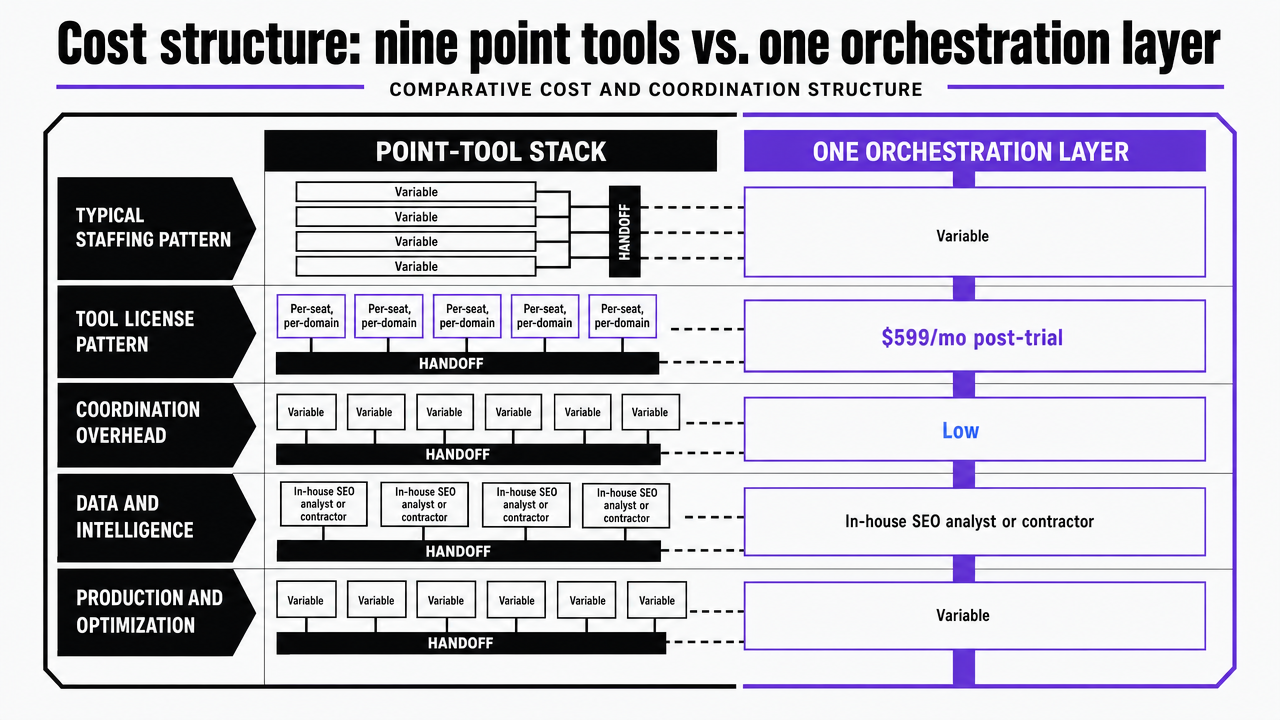 Visualize the comparative cost and coordination structure between a point-tool stack and an orchestration layer as described in the section's table
See How AI-Driven SEO Platforms Can Eliminate Workflow Bottlenecks
Connect with our team to benchmark your SEO tech stack against leading AI solutions for multi-site and high-volume content operations.
A note for operators running more than one site or service line
A note for operators running more than one site or service line: the economics of the tool stack shift in ways the single-site comparison hides. Each new location adds a per-domain crawl license, another set of GA4 and Search Console properties to wire up, another rank tracker scope, and another monthly retainer if an agency owns local execution. The coordination overhead grows faster than the marketing budget, and the data layer fragments into per-location dashboards that no one has time to read together.
An account-level orchestration model changes the slope of that curve. One plan covers every site and service line, one approval queue routes work across the portfolio, and analytics signals from every property feed the same planning layer. For multi-location healthcare operators, the governance argument matters as much as the cost one. Peer-reviewed work on AI in health research stresses that bias risk and the need for human oversight rise with output volume 3, and adjacent research on AI in scientific publications documents integrity and quality concerns when review is thin 9. A consolidated approval workflow gives the medical reviewer one queue instead of ten.
Choosing one data, one production, one orchestration tool
The shortlist a growth team should actually run is shorter than nine. One data layer feeds research and reporting. One production layer turns briefs into shippable drafts at the team's monthly volume. One orchestration layer holds the workflow together and produces the audit trail. Most stacks that fail are stacks built from three production tools and no orchestration, or three data tools and no production.
The decision logic is straightforward. Pick the data layer based on which dataset the in-house operator already trusts and which integrates cleanly with GA4 and Search Console, the signal sources federal SEO guidance treats as primary 5. Pick the production layer based on the team's writer model: structural scoring for hybrid writing, speed for high-volume drafting, brief depth for distributed freelancers. Pick the orchestration layer based on coordination overhead, not feature counts. If a growth lead spends more than a day a week stitching dashboards and routing approvals, the orchestration tier is where the next dollar belongs. Vectoron sits in that tier for teams that want one account-level plan instead of six tool logins and a contractor roster.
Frequently Asked Questions
References
- 1.Winning in the age of AI search.
- 2.The state of AI in 2023: Generative AI's breakout year.
- 3.Leveraging artificial intelligence to enhance systematic reviews in health research.
- 4.The State of AI in the Enterprise.
- 5.Communications Standards Updates: Search Engine Optimization.
- 6.Artificial Intelligence Risk Management Framework - Generative AI.
- 7.Considerations for the Use of Artificial Intelligence To Support Regulatory Decision-Making for Drug and Biological Products.
- 8.The Use of Generative AI for Scientific Literature Searches for Systematic Reviews and Clinical Decision Support Systems.
- 9.Generative Artificial Intelligence (AI) in Scientific Publications.
- 10.Generative-AI-Generated Challenges for Health Data Research.