
Key Takeaways
- Crawl and index governance becomes load-bearing past 15 clients, surfacing duplicate URLs, soft 404s, and response patterns as portfolio alerts rather than one-off audit findings 5.
- Content workflow with approval gates enforces brief, editorial, and client sign-off on SLAs, protecting Google's helpfulness and uniqueness standard as production volume scales 1.
- Integrated performance reporting earns its slot when one shared template answers page movement, preceding changes, and pipeline impact across every client without custom dashboards 8.
- AI-assisted production only delivers the 29% revenue lift Deloitte reports when paired with a human sign-off queue that catches intent misses before publish 12, 13.
- Internal link and architecture auditing exposes the site graph as data—click depth, orphan pages, anchor distribution—so template-level fixes propagate across a client's full inventory 4.
- Core Web Vitals prioritization pulls Search Console field data and weights failing URLs by traffic and conversion value, sequencing engineering time by impact rather than by client complaint 6.
- Cross-channel orchestration hooks earn their slot when they remove copy-paste steps between SEO, paid, CRM, and dev queues, compounding value in integrated retainers 9.
- Rights-aware asset management embedded in the workflow blocks expired licenses at publish and generates compressed variants that protect Core Web Vitals across reused creative 15.
The Shift From Feature Breadth to Workflow Orchestration
The SEO tools market has quietly reorganized itself. For most of the last decade, agency buyers evaluated platforms on feature counts: how many keywords tracked, how many backlinks indexed, how many pages crawled per audit. That framing is now a poor predictor of delivery outcomes. Forrester's DAM research, applicable well beyond asset management, argues that platform success depends on "integration, usability, and governance rather than feature breadth alone" 8. The same principle now defines how heads of SEO should evaluate their stack.
The reason is operational. A senior strategist managing five clients can absorb tool sprawl through personal effort. The same strategist managing 25 cannot. What breaks first is not the analysis itself but the connective tissue around it: briefs that never get approved, crawl issues flagged but never triaged, content drafts stuck between analyst and account manager, performance dashboards that no one opens because they live in a separate login.
Google's fundamentals have not moved. Crawlable links, descriptive titles, unique helpful content, and stable technical performance remain the substrate of ranking 1, 2. What has moved is where leverage comes from. Analyst research points to AI-enabled workflow coordination across channels as the current center of gravity in marketing operations 9. For agency SEO leaders, the eight feature categories that follow are ranked by how much operational leverage each one produces per additional client under management, not by how many checkboxes they fill.
Crawl and Index Governance at Portfolio Scale
Crawl budget is the first feature category that stops being optional as an agency's client count climbs. Google defines it as the set of URLs Googlebot can and wants to crawl, determined by two inputs: crawl capacity limit and crawl demand 5. On a single 200-page site, this is an abstraction. Across a portfolio of 20 clients averaging 40,000 URLs each, it becomes the daily operating question of which pages actually get seen.
Crawl capacity limit is shaped by server response time and error rates. Crawl demand is shaped by URL popularity, staleness, and Google's estimate of how many duplicate or low-value URLs sit in the index 5. A portfolio-scale tool has to expose both sides. That means:
- server response distributions per client, not just averages;
- duplicate URL clusters surfaced by parameter, faceted navigation, and canonical mismatch;
- soft 404 detection across templates, not spot checks;
- freshness signals mapped to the pages a client actually cares about, so recrawls prioritize revenue pages rather than archived tag indexes.
The failure mode without this governance layer is predictable. An analyst finds a crawl issue on Client A during a quarterly audit, fixes it, and never sees the same pattern replicate across Clients B through T until a ranking drop forces a look. Portfolio-scale crawl tooling flips that sequence. Issues surface as pattern alerts across the book, not as one-off findings. The strategist's job shifts from discovery to triage.
This is also where Google's own guidance most directly rewards tool investment. The starter guide and web developer guide both insist on crawlable links and descriptive titles as non-negotiable 1, 3. A crawl governance layer that reports title/meta coverage, orphan pages, and internal link reachability across every client property turns those requirements into a weekly operating report rather than an audit deliverable produced twice a year.
Content Workflow With Approval Gates
Content quality requirements have not changed. Google's starter guide still frames the standard as content that is "helpful, reliable, people-first" and "unique" 1. What has changed is how many pieces an agency has to move through that standard each month. Deloitte reports that content demands nearly doubled between 2023 and 2024, a shift that broke most of the shared-doc and ticketing systems agencies used to coordinate briefs, drafts, and approvals 12.
A workflow feature earns its slot in the stack when it enforces three checkpoints without human chasing:
- brief approval before writing starts,
- editorial approval before publishing, and
- client approval on a defined SLA.
Each gate exists because a specific failure mode exists behind it. Skipping brief approval produces drafts that miss intent and get rewritten. Skipping editorial approval produces inconsistent voice across a client's page inventory. Skipping client approval produces publish delays that stall the entire calendar and compress the next month's production.
The operational leverage shows up in queue visibility. A head of SEO running 15 clients needs to see, in one view, which briefs are awaiting approval past their SLA, which drafts are stuck in editorial review, and which approved pieces are queued for publish. Without that view, delivery quality becomes a function of which account manager remembers to follow up.
Approval gates also protect the underlying search-quality standard. Every piece that ships through a governed workflow has an accountable reviewer attached to the helpfulness and uniqueness criteria Google names 1. Without the workflow layer, that accountability collapses into whoever is least busy the day the draft lands.
Integrated Performance Data and Reporting
Reporting is where most agency stacks leak margin. A senior strategist who spends four hours a month per client stitching Search Console, GA4, rank tracker, and crawl data into a client-ready deck is burning 80 hours across a 20-client book before any analysis happens. That work adds no ranking, no revenue, and no retention lift. It is pure translation cost.
Integrated performance data solves a narrower problem than most vendors claim. It does not need to be a unified data warehouse. It needs to answer three questions for any client, in one view, without an analyst rebuilding the query:
- which pages moved in impressions and clicks over the last 28 days,
- which technical or content changes preceded those moves, and
- which pipeline metric downstream of the client's business goals responded.
Google's own guidance points strategists back to Search Console for Core Web Vitals and index coverage as the source of truth 6, which means a reporting layer earns its keep by pulling that data in rather than replacing it.
The scale test is whether the same view works across every client without custom configuration. Forrester's observation that platform value depends on "integration, usability, and governance rather than feature breadth alone" applies directly here 8. A reporting feature that requires per-client dashboard building recreates the problem it was bought to solve. A reporting feature that ingests each client's Search Console, analytics, and crawl feed against a shared template turns monthly reporting from an analyst task into a review task, which is the only version that scales past 15 accounts.
Test AI-driven SEO execution on live projects
See measurable impact by deploying content or SEO updates directly to client sites during your trial.
AI-Assisted Production Tied to Human Sign-Off
Content demand has outrun what fixed writer rosters can deliver. Deloitte Digital reports that in a survey of marketing leaders on content automation, users of automation saw 29% greater revenue impact from content marketing and were 24% more likely to meet content demand than non-users 12. That is the load-bearing evidence for why AI-assisted production has moved from experimental to expected in agency stacks. It is also the evidence most often misread.
The misread is treating those numbers as a case for autonomous drafting. The same Deloitte research on generative AI in content production frames the technology as a way to improve and adapt marketing content across personalization, delivery, and performance workflows, not as a replacement for editorial judgment 13. Agency SEO leaders who deploy AI drafting without a sign-off layer tend to reproduce the failure mode of cheap offshore content at higher speed: more pages, less consistency, more retractions.
The feature that matters is the pairing. AI produces the first pass on outlines, briefs, meta descriptions, FAQ blocks, internal link suggestions, and schema drafts. A human reviewer approves each artifact against the helpfulness, uniqueness, and freshness criteria Google names in its starter guidance 1. Google's May 2026 note on generative-AI search features reinforces the same point from the other direction: SEO fundamentals remain foundational, and most AEO and GEO shortcuts are misconceptions 7. Speed without a quality gate ships worse content, not better content.
Operationally, this looks like a queue. Every AI-generated artifact enters an approval state with a named reviewer, an SLA, and a rejection reason field. Rejected artifacts feed back into the model's context for the next pass. Approved artifacts move to publish. The strategist's time shifts from writing to reviewing, which is the only version of the workflow that scales past 15 clients without hiring.
The payback follows the Deloitte finding 12 only when the sign-off gate holds. Agencies that skip it get the volume without the revenue impact, because pages that miss intent do not rank and do not convert. Agencies that enforce it convert analyst hours into review hours at roughly a three-to-one ratio, which is where the operational leverage compounds across a client book.
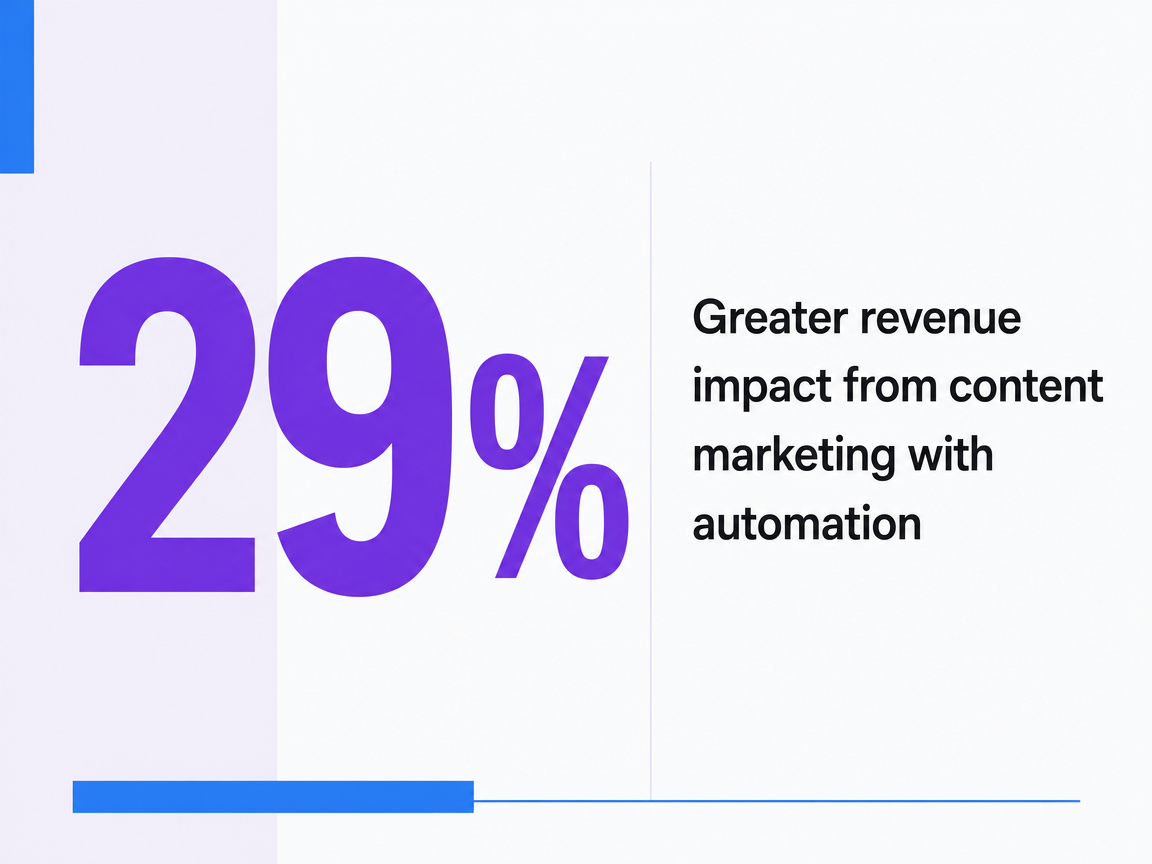 Greater revenue impact from content marketing with automation
Greater revenue impact from content marketing with automation
Internal Link and Site Architecture Auditing
Google's guidance on link discovery is unambiguous: every page an agency wants ranked needs at least one crawlable link from another page on the same site 4. That single sentence collapses a large share of ranking failures across a client book. Orphan pages, buried service subcategories, and location templates that link up to the parent hub but never sideways to sibling pages are the recurring pattern, and they compound as clients add inventory.
An auditing feature earns its place when it exposes the internal link graph as data, not as a per-page report. The useful outputs are:
- click depth from the homepage,
- incoming internal link counts per URL cluster,
- anchor text distribution against target queries, and
- orphan detection scoped to indexable pages only.
A head of SEO running 20 clients needs those four views refreshed weekly, filtered by revenue relevance, so analyst time goes to fixing patterns rather than finding them.
Site architecture auditing extends the same logic to templates. Faceted navigation that generates thousands of thin category permutations, breadcrumb structures that omit the parent hub, and pagination that traps link equity in tail pages all show up as architectural signatures rather than individual bugs. Tools that surface them at the template level let one fix propagate across every affected URL in the client's inventory.
The operational payoff is measurable. Internal linking is one of the few technical levers an agency can pull without waiting on client dev cycles, because most fixes land in the CMS. A portfolio-level graph view turns that lever into a monthly production line: identify the underlinked revenue pages, ship the internal links, and move on to the next client.
Core Web Vitals Prioritization Across Many Sites
Core Web Vitals are a page-level signal on paper and a portfolio-level triage problem in practice. Google directs SEOs to the Core Web Vitals report in Search Console as the source of truth for how pages perform against LCP, INP, and CLS thresholds 6. On one site, that report is a to-do list. Across 20 client properties, it is a firehose that a strategist cannot manually work through without a prioritization layer sitting on top of it.
The feature that earns its slot in the stack is not another lab-data speed test. It is a view that groups failing URLs by template, weights them by traffic and conversion value, and sequences the fix queue by expected impact per engineering hour. A checkout template failing INP on 40,000 sessions per month outranks a blog archive failing LCP on 400. Without that weighting, engineering time gets spent on whichever page a client complained about last.
The tool needs to pull field data from Search Console rather than replace it, because Google's own guidance treats that report as the reference 6. Lab tools like Lighthouse belong upstream, in the diagnosis step after a template is flagged. A portfolio operator running Core Web Vitals across 15 or more clients uses the Search Console feed to identify which templates are failing, lab tools to diagnose why, and a shared ticketing view to track fixes through client dev queues. That sequence is what turns a compliance signal into a monthly production line rather than a recurring audit finding.
Cross-Channel Orchestration Hooks
SEO no longer sits alone in the stack. Forrester's 2026 landscape of cross-channel marketing hubs frames the current center of gravity as AI-enabled workflows that orchestrate customer experiences across channels, not as siloed campaign tools reporting into a shared dashboard 9. For agency SEO leaders, that shift shows up as a specific tooling requirement: the SEO platform has to hand off signals to the rest of the marketing operation without a human copying values between tabs.
Three hooks matter most:
- keyword and query data flowing into paid search, so an SEO team's ranking gaps get bid on while the organic fix is in production;
- content performance data flowing into CRM and email, so pages that convert organically become the anchor for nurture sequences;
- technical alerts flowing into shared engineering queues, so a Core Web Vitals regression or an indexation drop opens a ticket in the same system the client's dev team already works from.
Forrester's earlier Wave evaluation of cross-channel hubs made the same point about orchestration and AI-optimized journeys as a platform expectation rather than a differentiator 16. The operational read for a head of SEO is narrower. An orchestration hook earns its slot when it removes a recurring copy-paste step from an analyst's week. If the integration produces a report nobody acts on, it is overhead. If it opens a ticket, triggers a bid adjustment, or updates an audience list without an analyst touching it, it compounds across every client on the book.
See How Unified SEO Tooling Accelerates Scalable Client Delivery
Connect with our team to discuss how multi-feature AI platforms streamline SEO workflows, centralize approvals, and reduce operational overhead for high-volume agency teams.
Rights-Aware Asset Management for Reusable Content
Asset management gets treated as a design-team problem until an agency tries to reuse a client's hero image on a landing page and discovers the license expired six months ago. Across a 20-client book, the recurring costs are quieter but larger: photographers rehired to reshoot assets nobody could find, stock licenses double-purchased across teams, and schema markup for images stripped because no one could confirm rights. Forrester's landscape view of DAM systems frames the category as a way to deliver cost-effective digital experiences, democratize content access and transformation, and secure brand value 15. For agency SEO leaders, those three functions map directly to page speed budgets, template consistency, and legal risk on client-facing pages.
The feature that earns its slot is not a media library. It is a rights layer attached to every asset, with expiration dates, usage scope, and approved transformations exposed as metadata the workflow can act on. A CMS integration that blocks publishing when a license has lapsed prevents the failure mode. A transformation pipeline that generates correctly sized, correctly compressed variants from a single source protects Core Web Vitals across every client template that reuses the asset.
Forrester's more recent DAM research reinforces the operating lens. Success depends on "integration, usability, and governance rather than feature breadth alone" 8. A DAM that sits outside the content workflow becomes a second search problem: analysts spend time hunting for assets instead of hunting for keywords. A DAM embedded in the brief, draft, and publish steps turns asset selection into a governed pick from a filtered set, with rights already cleared and variants already generated. That is the version that scales past 10 clients without adding a production coordinator to police reuse.
When Each Feature Starts Paying Back
The eight feature categories in this article do not activate at the same client count. Each one has a threshold where the manual workaround stops scaling and the tool moves from optional to load-bearing. Forrester's argument that platform value depends on "integration, usability, and governance rather than feature breadth alone" 8 frames the exercise: the question is not whether a feature exists in the stack but at what portfolio size its absence starts costing more than the license.
The thresholds below are operational, not financial. They map to what breaks first when an agency crosses a client-count line without the feature in place. Google's crawl budget guidance sets the technical floor for the first row, since crawl capacity limit and crawl demand only become portfolio-level variables once the URL count under management passes what one analyst can review manually 5.
| Feature Category | Optional | Load-Bearing | What Breaks Without It |
|---|---|---|---|
| Crawl and index governance | Under 10 clients | 15+ clients or 500k+ URLs | Pattern issues surface as one-off audit findings, not portfolio alerts |
| Content workflow with approval gates | Under 5 clients | 8+ clients producing 20+ pieces/month | Briefs stall, drafts miss intent, publish calendars compress |
| Integrated performance reporting | Under 8 clients | 15+ clients | Analyst hours drain into deck-building instead of analysis |
| AI-assisted production with sign-off | Under 10 clients | 15+ clients or doubling output | Writer roster capacity caps monthly output |
| Internal link and architecture auditing | Under 10 clients | 15+ clients or templated inventories | Orphan pages and thin templates propagate unnoticed |
| Core Web Vitals prioritization | Under 10 clients | 15+ clients with dev queues | Engineering time goes to loudest complaint, not highest impact |
| Cross-channel orchestration hooks | SEO-only engagements | Integrated retainers with paid, CRM, or dev | Analyst weeks fill with copy-paste between tools |
| Rights-aware asset management | Under 10 clients | 10+ clients with reusable creative | License lapses, duplicate purchases, stripped image schema |
Two patterns run through the matrix. The first is that most features move from optional to load-bearing between 10 and 15 clients under management. That range is where personal effort stops covering the gap and workflow governance has to. The second is that orchestration hooks do not scale with client count. They scale with the depth of each engagement. An agency running 30 SEO-only retainers may never need them. An agency running eight integrated retainers across paid, content, and dev almost certainly does.
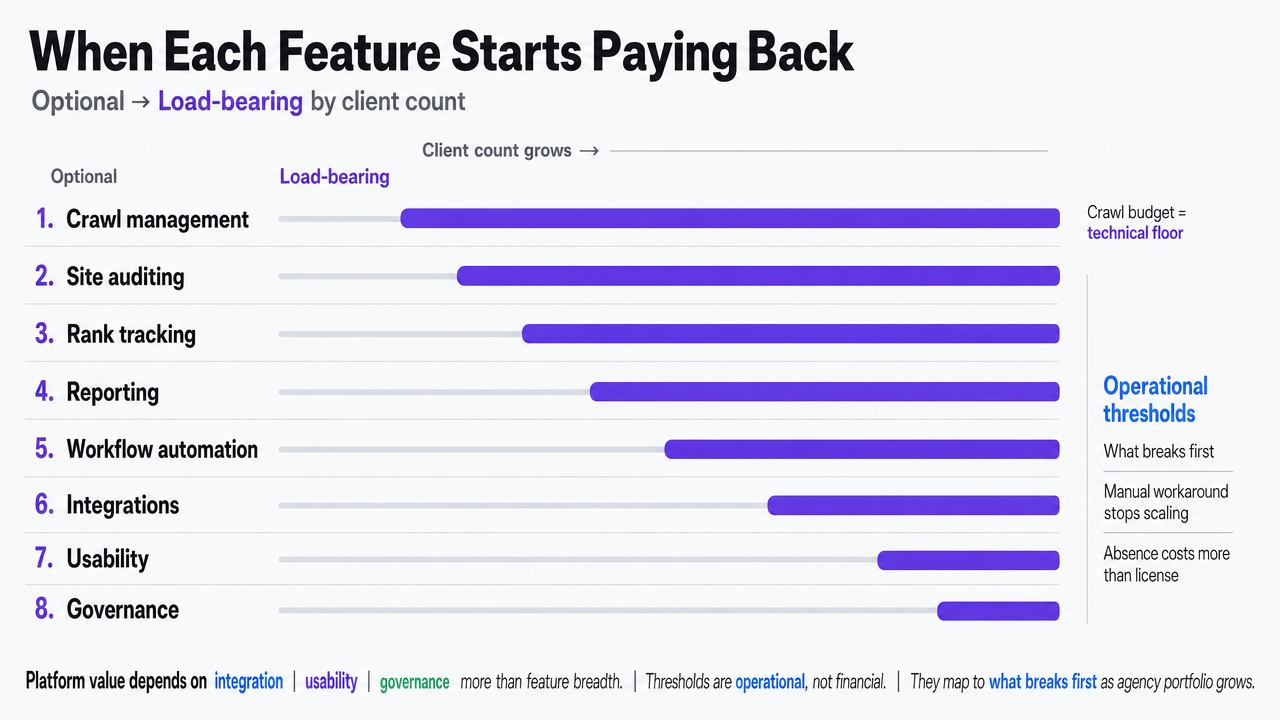 Translate the section's comparison table into a scannable maturity matrix showing when each of the eight SEO tool features moves from optional to load-bearing based on client count
What Agency SEO Leaders Should Prioritize Next
The sequencing question matters more than the shopping list. Heads of SEO scaling past 10 clients tend to buy features in the order they hear complaints, which produces a stack that reports well and delivers unevenly. The eight categories in this article rank differently. Crawl governance, content workflow with approval gates, and integrated reporting form the base layer, because they convert analyst effort into repeatable operations across the book. Internal link auditing, Core Web Vitals prioritization, and rights-aware asset management sit on top of that base and produce compounding gains once the workflow layer holds. AI-assisted production and cross-channel orchestration hooks are the highest-leverage additions, but only when the sign-off gate exists to catch what speed misses 7.
The through-line is governance, not feature count. Platforms like Vectoron that route every AI recommendation through a human approval queue reflect where the market is moving: execution speed paired with editorial control, evaluated on integration and usability rather than checklist depth 8.
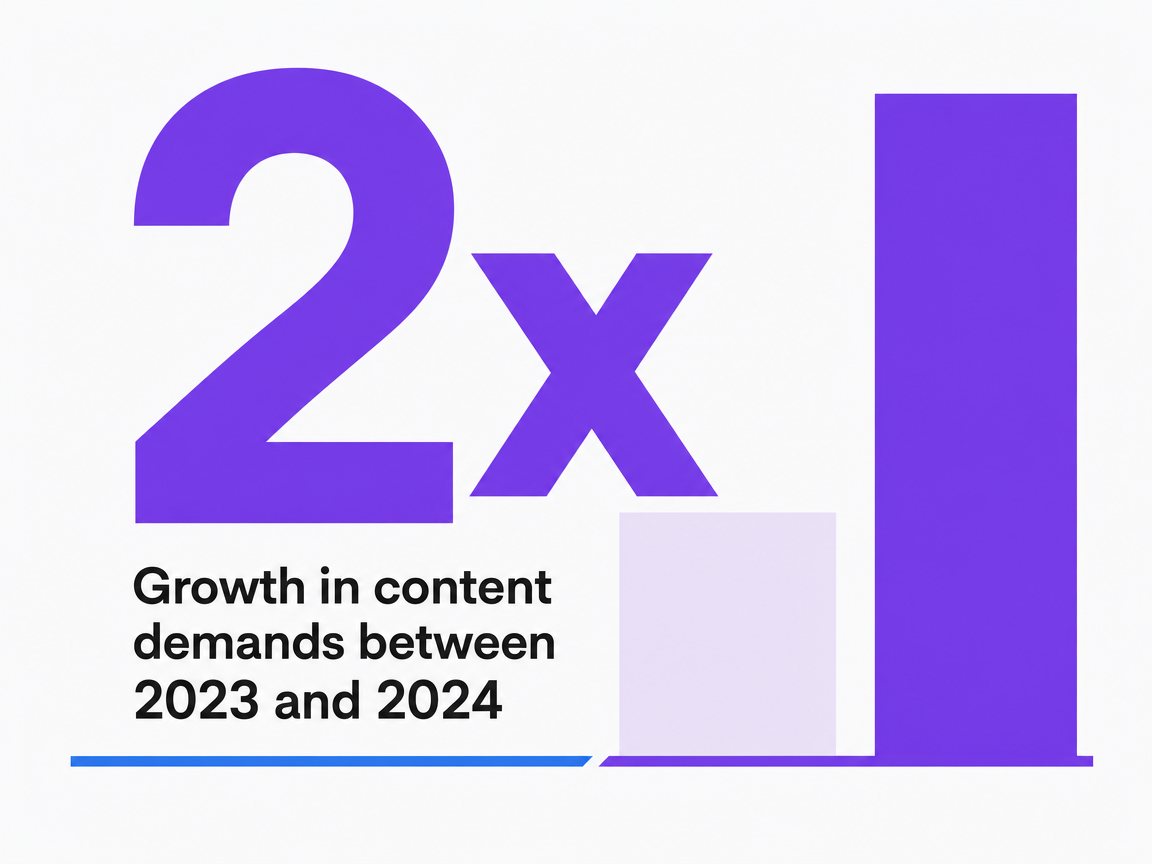 Growth in content demands between 2023 and 2024
Growth in content demands between 2023 and 2024
Frequently Asked Questions
References
- 1.Search Engine Optimization (SEO) Starter Guide.
- 2.Google Search Essentials (formerly Webmaster Guidelines).
- 3.SEO Guide for Web Developers.
- 4.SEO Link Best Practices for Google.
- 5.Crawl Budget Management.
- 6.Understanding Core Web Vitals and Google search results.
- 7.A new resource for optimizing for generative AI in Google Search.
- 8.Digital Asset Management Anchors Modern Content Operations.
- 9.The Cross-Channel Marketing Hubs Landscape, Q2 2026 - Forrester.
- 10.The Cross-Channel Marketing Hubs Landscape, Q2 2024 - Forrester.
- 11.The State Of Cross-Channel Marketing Hubs, 2023 - Forrester.
- 12.Marketing content automation - Deloitte Digital.
- 13.How Generative AI is powering next-gen.
- 14.THE STATE OF MARKETING AUTOMATION.
- 15.The Digital Asset Management Systems Landscape, Q3 2025.
- 16.The Forrester Wave: Cross-Channel Marketing Hubs, Q1 2023.