
Key Takeaways
- Botify absorbs crawl reconciliation and log analysis for high-URL enterprise clients, freeing analyst hours on technical audits but creating friction across mixed portfolios with lighter governance needs.
- Conductor consolidates content strategy, editorial calendars, and stakeholder-readable reporting, making it strong for content-heavy engagements though seat economics can erode margin across large client rosters.
- BrightEdge pushes ranked recommendations rather than raw data, compressing the interpretation tax on analysts and serving as a recommendation spine for enterprise-anchored books.
- seoClarity functions as data infrastructure with API depth and high tracked-keyword ceilings, suiting agencies folding SEO signals into custom reporting layers across many domains.
- Siteimprove pairs SEO with accessibility and compliance governance, earning its place in regulated verticals like healthcare, government, and financial services where audit trails matter.
- Semrush covers keyword, competitive, backlink, audit, and position tracking in one seat, absorbing daily-driver work for growth-stage agencies running 20 to 80 mid-market accounts.
- Moz retains value through Domain Authority as shared vocabulary and Moz Local for citation management, working best as a supporting link and local layer rather than platform of record.
- Searchmetrics indexes toward European markets and multilingual content research, fitting agencies whose core deliverable is content strategy across multi-market client footprints.
- Vectoron coordinates specialists through a Command Center with approval-first routing, absorbing briefing and drafting cycles that would otherwise scatter across freelancers and internal teams.
- Clearscope narrows to on-page relevance scoring, compressing the strategist-writer-editor review loop and layering over whichever platform holds the audit and reporting spine.
- Ahrefs delivers backlink intelligence and competitive research depth that broader platforms treat as secondary, saving more analyst hours on link work than its seat cost consumes.
Why the SEO tools conversation shifted from stacks to systems
For most of the last decade, agency Heads of SEO built stacks by category: a crawler here, a rank tracker there, a content optimizer bolted on, a backlink monitor running in parallel. That approach still works for a single client. It stops working at 30 clients, and it breaks entirely at 80.
The pressure is now economic, not technical. Forrester's Cannes Lions 2025 analysis found that 75% of marketing agencies fund generative AI capabilities directly, absorbing the cost rather than passing it to clients 2. That figure describes agency-side spending on GenAI tooling for content, media, and search activation, and it reframes the platform decision. When AI capacity is a line item on the agency P&L rather than a client pass-through, every additional seat license, every duplicate dashboard, and every hour spent reconciling data between tools cuts directly into margin.
Forrester's broader read on agency GenAI adoption sharpens the point: AI is being treated as a cost center, deployed primarily to enhance internal productivity across content, media, SEO, and strategy work 1. That framing matters because it changes what a good SEO tool has to do. It has to absorb execution work, not just surface more data.
The analyst consensus has moved in the same direction. Forrester now describes SEO platforms as core marketing infrastructure rather than optional add-ons, arguing that auditing, prioritization, and process management belong in a single system 6. The 2025 Landscape report reinforces that agencies should evaluate vendors by organizational size and market focus rather than feature parity 5. The conversation has shifted from which tools to buy to which systems to run.
The scaling rubric: how this list scores platforms
Throughput per analyst
Throughput measures how many client accounts one analyst can carry without quality slipping. It is the single most useful lens for agency margin because analyst salaries drive cost of delivery. A platform earns points here when it absorbs work the analyst would otherwise do by hand: crawl reconciliation, priority ranking, content brief generation, internal linking suggestions, and reporting assembly. Platforms that only surface data force the analyst to translate it into action, which caps throughput. Platforms that surface prioritized actions with the reasoning attached compress the loop between insight and execution, which is where per-analyst capacity actually expands.
Multi-client governance and approval depth
Governance is where most stacks quietly fail at scale. A tool built for one enterprise site rarely handles 40 client workspaces cleanly, and permissioning gaps create real risk when an analyst pushes a change to the wrong domain. The scoring here rewards platforms with tenant-level isolation, role-based approval routing, and audit trails that survive staff turnover. Approval depth matters separately: can a strategist queue a recommendation, a lead review the reasoning, and a client sign off before anything ships? Forrester's 2025 landscape guidance treats process management as core platform functionality, not an add-on 5.
AI search readiness as a scoring dimension
AI search readiness has moved from experimental to baseline, and the measurement gap is the reason it belongs in the rubric rather than a sidebar. McKinsey's analysis of the AI search shift found that only 16% of brands systematically track AI search performance, and it recommends building generative engine optimization as a core capability rather than a side project 3. That figure describes brand-side measurement discipline, not agency workflow maturity, which sharpens the implication: agencies are being asked to close a measurement gap most clients have not yet built the muscle to close themselves.
A platform scores well on this dimension when it can track citation appearances in AI answer surfaces, model content for machine readability, and attribute traffic and pipeline back to AI-referred sessions. Platforms that treat AI search as a reporting tab rather than a workflow layer score lower because they still push the interpretation work back to the analyst.
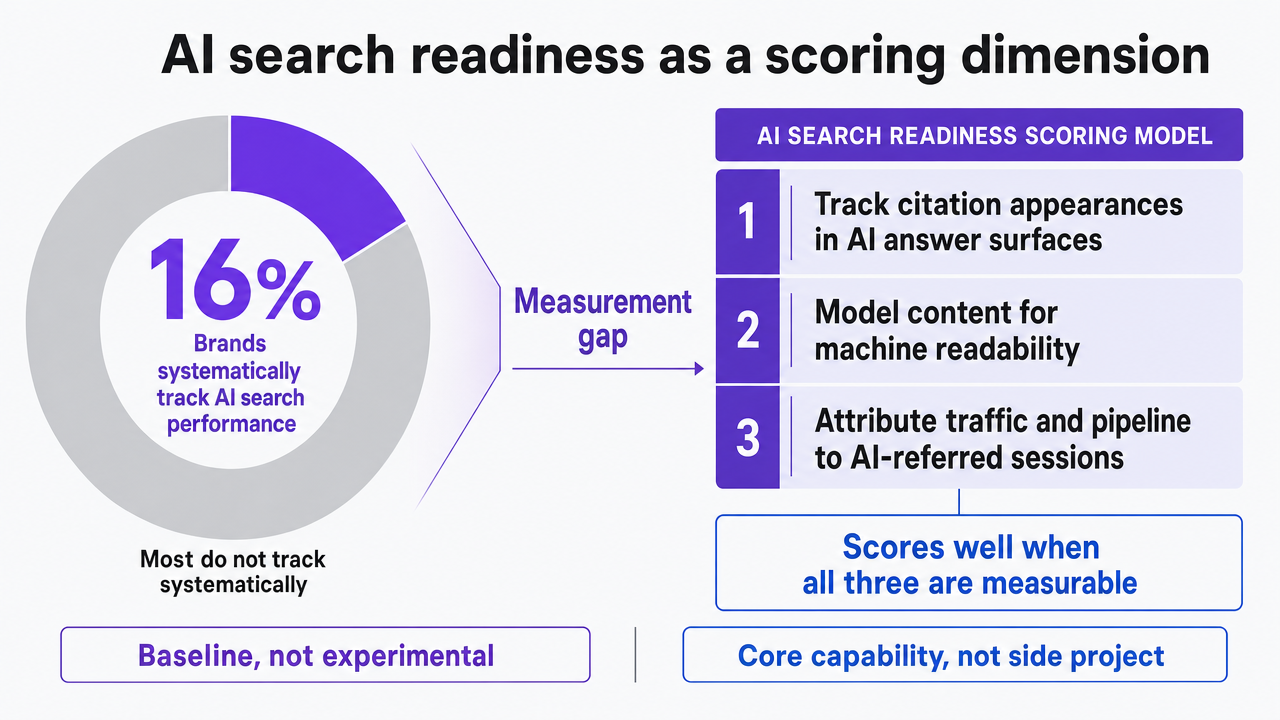 Visualize the McKinsey statistic that only 16% of brands systematically track AI search performance, which is explicitly cited in this section's prose
Workflow depth versus dashboard depth
Dashboards report. Workflows execute. The distinction sounds small and controls almost everything about whether a platform scales delivery or just scales visibility. A dashboard-heavy platform gives the analyst better charts and leaves the production work untouched. A workflow-heavy platform routes tasks, assigns approvers, generates artifacts, and closes tickets when work ships. Forrester's platform framing argues for exactly this consolidation of auditing, prioritization, and process management into a single system 6. Scoring rewards platforms that own the path from recommendation to shipped change, and penalizes those that stop at the chart.
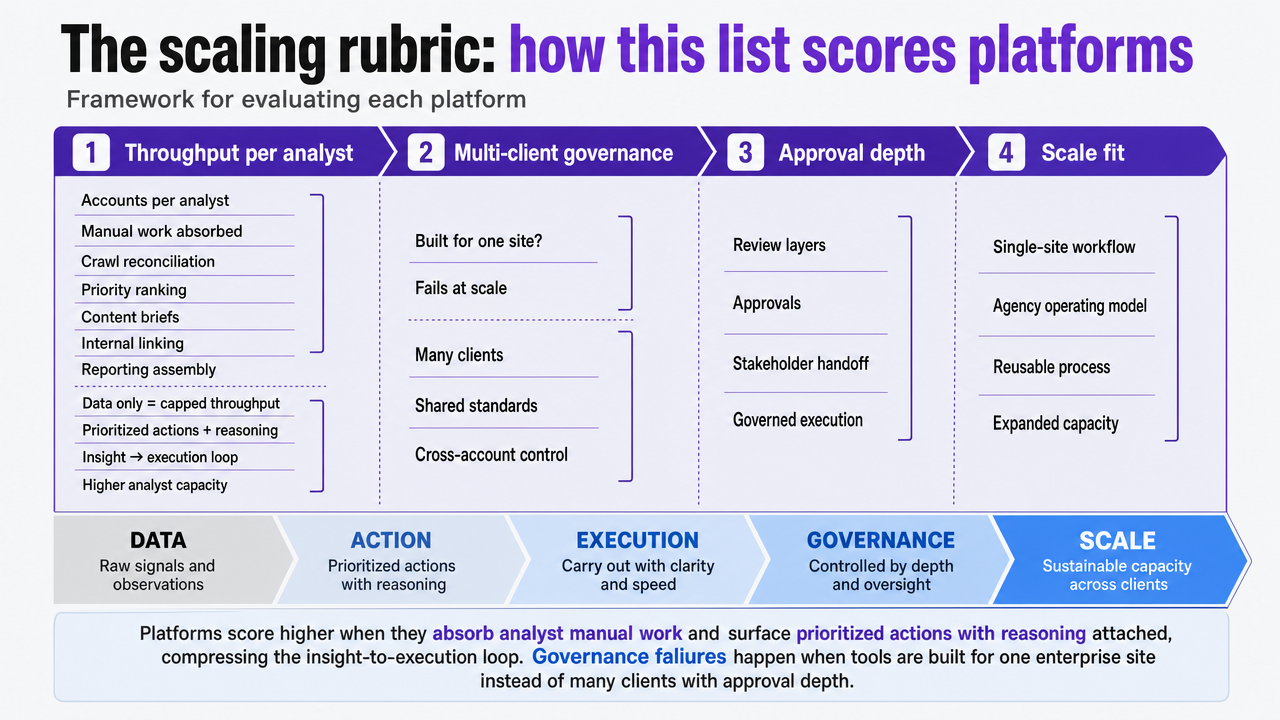 Visualize the four scoring dimensions used throughout the article to evaluate each platform, giving readers a framework reference before the 11-platform breakdown
Test AI-powered SEO workflows on live projects
Experience full-scale client SEO execution and publish actual deliverables before you commit.
The 11 platforms, grouped by how they absorb execution work
Enterprise SEO platforms for large client portfolios
Botify
Botify sits at the technical end of the enterprise tier, built around large-scale crawling, log file analysis, and rendering intelligence. For agencies carrying clients with millions of URLs — travel, retail, marketplaces, publisher networks — Botify absorbs the crawl reconciliation work that would otherwise consume analyst hours reconciling what Googlebot sees against what the CMS ships. Forrester's Wave evaluated Botify among the seven most significant SEO platform providers across 28 criteria, alongside Conductor, Moz, Searchmetrics, SEMrush, seoClarity, and Siteimprove 7.
On the scaling rubric, Botify scores highest on throughput for technical audit turnaround and workflow depth for engineering handoffs. It scores lower for content workflow and multi-tenant governance at agency scale, since the platform is optimized for one enterprise site rather than 40 client workspaces. Heads of SEO running mostly enterprise ecommerce or publisher clients will get analyst hours back. Agencies with a mix of local, mid-market, and enterprise accounts will hit governance friction.
Conductor
Conductor leans toward content strategy and organic marketing workflow rather than pure technical crawling. It has appeared in Forrester's Wave evaluations across multiple cycles as one of the significant enterprise platforms 7, 8, and Forrester's broader platform framing treats content auditing, prioritization, and process management as the core capabilities agencies should consolidate 6.
For agency use, Conductor's strength is the content workflow layer: keyword-to-brief pipelines, editorial calendars, and reporting views that non-SEO stakeholders can actually read. That absorbs briefing and approval cycles for content-heavy client engagements. On multi-client governance, Conductor handles workspace separation cleanly enough for portfolio use, though seat economics can compress margin fast when every analyst and every client stakeholder needs a login. Score it high on workflow depth for content, moderate on technical throughput, and moderate on AI search readiness relative to newer AI-native tools.
BrightEdge
BrightEdge is the recommendation engine of the enterprise tier. Its long-running Data Cube and recommendation surfaces push prioritized actions to the analyst rather than raw data, which is the workflow shape that most compresses time from insight to execution. Forrester's earlier Wave included BrightEdge alongside Conductor, Moz, Searchmetrics, SEMrush, seoClarity, and Siteimprove as one of the significant SEO platforms evaluated on 23 criteria 8.
On the rubric, BrightEdge scores well on throughput per analyst because ranked recommendations reduce the interpretation tax that dashboard-heavy platforms leave on the analyst. AI search readiness has been an active development area for the vendor, though agencies should treat that layer as evolving rather than mature. Governance and per-client cost remain the practical constraints for agency portfolios. Heads of SEO with enterprise-anchored books tend to keep BrightEdge as the recommendation spine and pair it with lighter tools for smaller clients.
seoClarity
seoClarity has built its position on scale of data and API access, which matters for agencies that need to fold SEO signals into their own client reporting layers. Forrester's Wave included seoClarity in its evaluation of the seven most significant SEO platform providers 7, 8, and the platform's rank tracking depth and content optimization workflow remain its recognizable strengths.
For agency delivery, seoClarity earns its keep when analysts need to run bulk operations across large keyword sets and many domains without hitting artificial ceilings on tracked terms or crawled pages. That translates directly to throughput on portfolios where rank monitoring volume alone would break lighter platforms. Multi-client governance is workable but requires deliberate workspace setup, and workflow depth for content leans on the analyst to drive rather than the platform to route. Treat it as data infrastructure with SEO workflow layered on, not the reverse.
Siteimprove
Siteimprove sits at an angle to the pure-SEO vendors. Its heritage is web governance — accessibility, content quality, policy compliance — with SEO capabilities layered in. Forrester evaluated Siteimprove among the seven significant SEO platforms in both the 2020 and 2018 Waves 7, 8.
Agencies serving regulated verticals — healthcare, higher education, government, financial services — get outsized value from Siteimprove because accessibility and compliance monitoring are part of the same workflow that surfaces SEO issues. That absorbs review work that would otherwise sit with a separate QA or legal function. On pure SEO throughput and AI search readiness, Siteimprove scores lower than the specialist platforms. Governance and audit trail depth score high, which matters when clients require documented remediation history. Keep it in the stack for regulated client tiers.
Mid-market execution platforms for growth-stage agencies
Semrush
Semrush is the platform most agency Heads of SEO already have a seat in, and its breadth is both the reason and the risk. Keyword research, competitive analysis, backlink monitoring, position tracking, on-page auditing, and content templates sit in one account. Forrester's Wave evaluations included Semrush across cycles 7, 8, and the 2025 Landscape guidance to select vendors by organizational size and market focus applies directly here 5.
For a growth-stage agency running 20 to 80 mid-market clients, Semrush absorbs the daily-driver work: pulling competitive gaps, running site audits, tracking positions across markets, checking backlink health. Throughput per analyst is where it scores best. Multi-client governance is workable through project structures, though approval routing and audit trails are lighter than enterprise platforms offer. Workflow depth stops at the recommendation; execution still lives in the analyst's queue.
Moz
Moz's role in agency stacks has narrowed as the mid-market has consolidated around all-in-one platforms, but its metrics — Domain Authority in particular — still function as a shared vocabulary between analysts, clients, and outreach teams. Forrester's Wave evaluations placed Moz among the significant SEO platform providers alongside BrightEdge, Conductor, Searchmetrics, SEMrush, seoClarity, and Siteimprove 7, 8.
Agencies use Moz most productively for link intelligence and local SEO workflows, where Moz Local handles the citation and listing management that would otherwise fragment across smaller point tools. On the rubric, Moz scores moderate on throughput and workflow depth, lower on AI search readiness relative to newer platforms, and workable on governance for portfolio use. Heads of SEO tend to keep Moz as a supporting layer for link and local work rather than the platform of record.
Searchmetrics
Searchmetrics has historically indexed toward European markets and enterprise content research, and Forrester's Wave evaluations included it among the seven significant SEO platform providers across cycles 7, 8. Its content research and topic modeling capabilities have been the recognizable strengths, particularly for agencies serving multilingual or multi-market clients.
On the scaling rubric, Searchmetrics scores well on content research throughput and moderate on workflow depth. Multi-client governance is workable but requires setup discipline, and AI search readiness has been an active development area rather than a settled feature set. Agencies with European client footprints or content strategy engagements as the core deliverable get the most from Searchmetrics. Purely North American agencies with heavy technical or link-driven work tend to prioritize other platforms first.
AI-native production platforms that absorb briefing and drafting cycles
Vectoron
Vectoron approaches the tools question from the production side rather than the reporting side. The platform coordinates specialist strategists across content, SEO, PPC, backlinks, social, and call intelligence through a single Command Center where every recommendation carries the strategic reasoning and routes through human approval before execution. That structure targets the workflow depth dimension of the rubric directly: the platform owns the path from insight to shipped artifact rather than stopping at the chart.
For agency Heads of SEO carrying content-heavy client books, the operational effect is that briefing cycles and drafting queues get absorbed rather than distributed across freelancers and internal specialists. Forrester's read on agency GenAI adoption — that AI is being deployed primarily to enhance internal productivity across content, media, SEO, and strategy 1 — matches this framing. Score Vectoron high on workflow depth and throughput, high on multi-client governance through the approval-first architecture, and evolving on AI search readiness alongside the broader market.
Clearscope
Clearscope is narrower than the platforms above by design. It focuses on content optimization: grading drafts against target queries, surfacing terms and entities to include, and giving editors and writers a shared scoring surface. For agencies where content quality is the primary deliverable, Clearscope compresses the review loop between strategist, writer, and editor.
On the rubric, Clearscope scores well on content workflow throughput and moderate on governance for portfolio use. It is not a substitute for an enterprise SEO platform or an AI-native production system; it complements them by handling the specific step of on-page relevance scoring. Heads of SEO tend to layer Clearscope over whichever platform holds the audit and reporting spine, letting analysts and writers work against a shared quality bar without renegotiating brief-to-draft standards on every project.
Specialist point tools worth keeping in the stack
Ahrefs
Ahrefs earns its slot in almost every agency stack for one reason: backlink intelligence at a depth that broader platforms treat as a secondary feature. Site Explorer, Content Explorer, and the keyword databases are analyst tools rather than executive dashboards, which is exactly why they scale for the specialist work.
On the scaling rubric, Ahrefs scores high on throughput for link and competitive research and moderate on the other three dimensions. It is not a governance layer or a workflow platform, and treating it as one creates duplicate work. Heads of SEO consolidating stacks tend to keep Ahrefs alongside the platform of record — enterprise or mid-market — because the marginal cost of the seats is low relative to the analyst hours saved on link auditing, competitor gap analysis, and outreach prospecting. Cutting it usually costs more in analyst time than it saves in license fees.
Consolidation economics across a client book
The margin math for agency Heads of SEO running 30 to 100 client accounts turns on a variable most vendor conversations skip: analyst hours per client per month. Forrester's Cannes Lions 2025 analysis found that 75% of marketing agencies fund generative AI capabilities directly rather than passing the cost to clients 2. That means every seat license, every duplicate dashboard, and every hour spent reconciling data between fragmented tools lands on the agency P&L, not the client invoice. The consolidation question is therefore not about feature parity. It is about how many analyst hours a stack absorbs versus how many it creates.
The comparison below uses variables rather than invented dollar figures. Substitute the fully-loaded analyst cost and seat pricing from actual contracts to run the math against a live client book.
| Stack shape | Tools in stack | Analyst hours per client / month | Seat licenses per analyst | Client capacity per analyst ||---|---|---|---|---|| Fragmented point-tool stack | 5–8 tools (crawler, rank tracker, content optimizer, backlink monitor, local, reporting, brief builder) | H (baseline) | 5–8 seats | C (baseline) || Partially consolidated | 3–4 tools (enterprise or mid-market platform + 1–2 specialists) | ~0.75H | 3–4 seats | ~1.3C || Consolidated platform stack | 2–3 platforms (platform of record + AI-native production + one specialist) | ~0.5H to 0.6H | 2–3 seats | ~1.6C to 2C |
Two mechanics drive the shift. Duplicate data reconciliation and context-switching between tools consume analyst hours that never show up on a timesheet as "waste." And seat license stacking compounds fast when every analyst needs logins across every tool. Cutting the stack from seven tools to three does not just trim license fees; it reclaims the hours analysts spend moving artifacts between systems. That is where per-analyst client capacity actually expands.
See How Top Agencies Automate SEO Workflow Without Expanding Teams
Connect with a specialist to benchmark your current SEO toolset against AI-powered execution platforms built for high-volume, multi-client delivery—streamline approvals, increase output, and maintain oversight across all campaigns.
Building the stack: matching platform tier to client mix
Client mix drives stack shape more than any feature comparison. An agency whose book skews toward enterprise ecommerce, publisher networks, or travel domains will pay for itself several times over on a Botify or seoClarity spine, because crawl volume and log analysis absorb the largest share of analyst hours on those accounts. Layering an AI-native production platform on top handles the content workstream that enterprise crawlers treat as secondary, and Ahrefs keeps link intelligence sharp without duplicating the platform of record.
Agencies weighted toward mid-market service businesses run a different shape. Semrush or Conductor as the platform of record, an AI-native production layer for briefing and drafting throughput, and Moz Local when franchise or multi-location listings are in scope. That configuration keeps seat counts contained and matches Forrester's 2025 Landscape guidance to select vendors by organizational size and market focus rather than by feature parity 5.
Regulated verticals — healthcare, legal, financial services, higher education — pull Siteimprove into the stack for audit trail and accessibility coverage. The pattern across all three shapes is the same: two or three platforms carrying the workflow, one specialist handling links, and no fourth dashboard added without a specific analyst-hour justification.
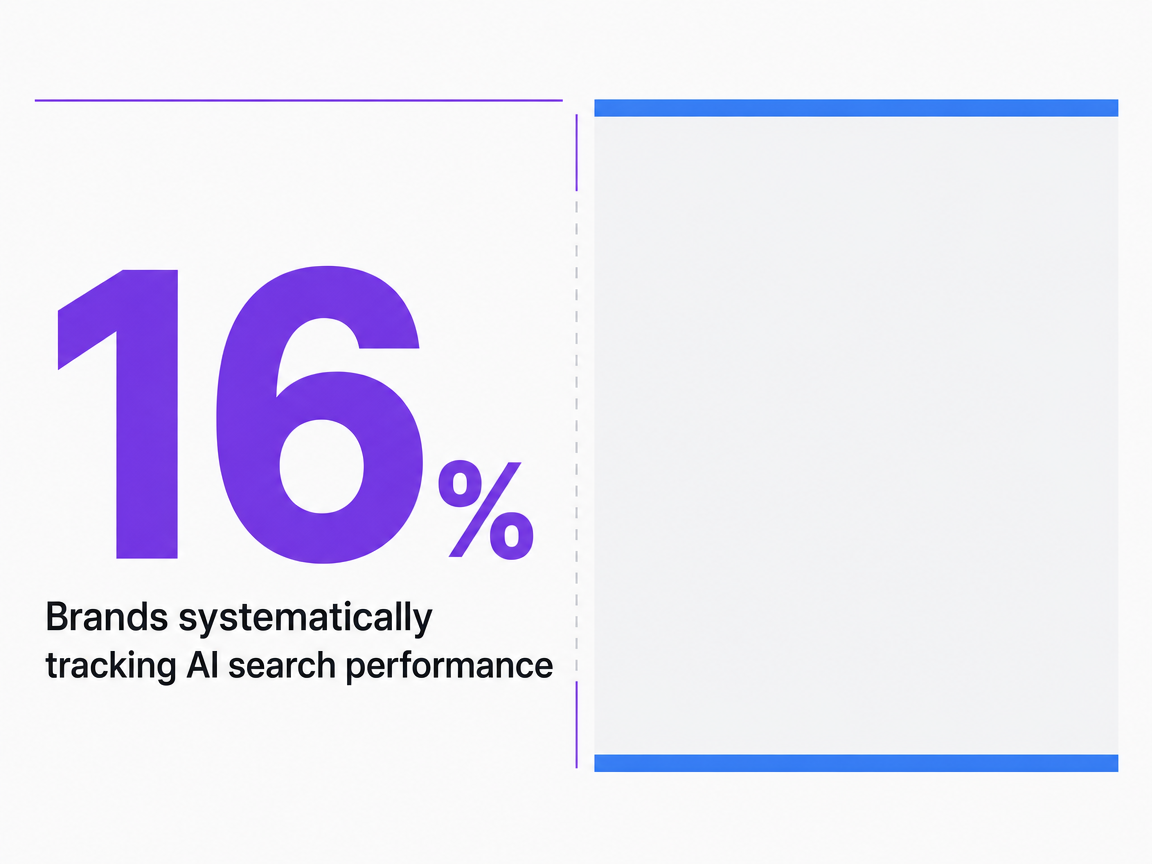 Brands systematically tracking AI search performance
Brands systematically tracking AI search performance
Frequently Asked Questions
References
- 1.The State Of Generative AI Inside US Marketing Agencies, 2025.
- 2.Cannes Lions 2025: The AI Challenge For Brands And Agencies.
- 3.New front door to the internet: Winning in the age of AI search.
- 4.The Prompt Imperative: How Generative AI Is Rewriting the Rules of Advertising.
- 5.The Search Engine Optimization Solutions Landscape, Q1 2025.
- 6.Every Company Needs An SEO Platform.
- 7.The Forrester Wave™: SEO Platforms, Q3 2020.
- 8.The Forrester Wave™: Search Engine Optimization (SEO)....