
Key Takeaways
- Service-plus-situation queries—pairing a specific service with urgency, eligibility, cost anxiety, or specialist match—outperform informational topics because they attract buyers already ready to book a consultation.
- Ship topics as clusters, not single posts: a service-plus-situation hub supported by location variants, proof assets, decision-stage comparisons, internal links, and measurement endpoints that close the loop to booked work.
- Score every candidate topic across intent-to-booking distance, substantiation feasibility, local pack eligibility, and production repeatability so topic selection becomes repeatable triage across 10 to 80 accounts.
- Start Monday by picking one account, identifying three revenue procedures and the buyer situations tied to each, then shipping one complete cluster with compliance gates cleared before publication.
The topic class that converts: service-plus-situation queries
The SEO topic that produces predictable client pipeline is narrow and specific: a service paired with a buyer situation the person is ready to act on. Queries like "emergency dental implant consultation," "adolescent partial hospitalization program," "contingency-fee employment lawyer near me," or "same-day HVAC compressor replacement" each include a service, a trigger, and an implicit decision stage. Each one maps to a booked consult, not a newsletter signup.
This asset class differs from the informational posts most agency content calendars still prioritize. Informational queries attract a broad, early-stage audience that may not convert. Service-plus-situation queries, however, draw a smaller, qualified audience already actively seeking providers. Forrester's December 2024 study of over 16,000 global business buyers found that buyers prefer self-guided answers early in their journey and expert interaction once they are ready for deeper conversations 6. The service-plus-situation page facilitates this crucial handoff.
Four signals define this class:
- the query names a service a provider can deliver,
- it includes a situation (urgency, eligibility, cost anxiety, or specialist match) that narrows the audience to in-market buyers,
- it is geographically resolvable (explicitly or via local-pack intent), and
- it can be substantiated with credentials, scope of service, and access information rather than mere opinion.
Agency leads managing 10 to 80 accounts should prioritize this class as the primary production target. Other content, such as category explainers, trend posts, and glossary pages, serves as supporting infrastructure. The key pipeline question is not which keyword has the highest volume, but which page a buyer lands on when they are ready to make a call.
Why informational volume leaks pipeline
Informational content often generates traffic that appears to be progress but converts poorly. A page like "what is a dental implant" may earn impressions from readers researching, comparing, or passing time between appointments with existing providers. Such a page can rank well and maintain session time, yet deliver zero booked consultations in a reporting month. For agency leads measured by client retention, this discrepancy often leads to account churn.
The fundamental issue is that informational pages frequently address the wrong questions for the wrong audience. A peer-reviewed study on consumer physician choice revealed that 47.0% of respondents considered internet reviews unimportant, while a higher proportion valued medical license, certification, and insurance participation 1. While this sample focuses on U.S. healthcare consumers and doesn't negate the influence of reviews entirely (another study found 67.2% of Millennials read reviews before choosing a physician 2), the clear implication for agency topic selection is that factors closing a buyer are credentials, access, and fit information. These details are best presented on service pages, not in general category explainers.
Informational posts also lead to pipeline leakage because they rarely consolidate the essential elements a ready buyer needs within a single view—such as accepted insurance or payment terms, specialty match, intake procedures, and verifiable provider information. A reader who lands on an educational post and then has to search again for a phone number is a reader the agency paid to acquire, only to potentially lose them to a competitor's service page.
Informational content is valuable when it supports a cluster that ultimately directs users to a high-intent page. However, as a standalone pipeline tactic, it underperforms. Production budgets should be allocated to pages where buyers land when they are ready to contact a provider.
Buyer-situation taxonomy: how to classify a topic before you brief it
The four buyer situations that predict booked work
Four distinct situations differentiate topics that generate booked work from those that merely accumulate impressions. Each situation narrows the audience to buyers already in-market and informs the content brief about what the page needs to convey.
Urgency is the first. Queries indicating time pressure—such as "emergency root canal tonight," "same-day furnace replacement," or "24-hour bail hearing attorney"—compress the research-to-call window to minutes. The page must answer three critical questions above the fold: availability today, location, and approximate cost. Blog explainers consistently fail to capture this traffic.
Eligibility is the second. Examples include "partial hospitalization program accepting Aetna," "Medicaid pediatric dentist," or "workers' comp attorney no win no fee." The buyer has already decided to act and is filtering providers based on specific criteria. A study on physician selection found that medical license, certification, and insurance participation were highly important to consumers 1. Pages that prominently display accepted plans, licensure, and fee structures are more likely to be shortlisted.
Cost anxiety is the third. Queries like "how much does Invisalign cost without insurance" or "IOP program cost per week" indicate a buyer willing to pay but hesitant to call without knowing the price. Transparent price ranges, financing options, and clear payment terms are crucial for conversion.
Specialist match is the fourth. Queries such as "OCD-specialized therapist," "revision rhinoplasty surgeon," or "construction defect litigator" seek deep expertise. In these cases, credential proof, rather than review volume, is the primary driver of the decision.
Why specialty specificity outperforms category coverage
Broad category pages, such as "Dental Services" or "Mental Health Treatment," aim to attract everyone but convert very few. They often require a buyer to navigate multiple clicks to find the specific information needed to make a decision. Specialty pages, conversely, name the exact procedure, condition, or case type, attracting buyers who have already self-identified their needs.
Behavioral evidence supports specificity for high-stakes decisions. An experimental study on patient choice found that participants were more inclined to choose physicians with higher ratings for technical skills, with this effect being more pronounced for specialists than for primary care physicians 3. This directly implies that for specialized services, the page must demonstrate technical competence in that specific area, not just general authority. A "cosmetic dentistry" page cannot carry the same weight as a "full-arch zirconia implant" page.
For agency leads, this necessitates a reordering of the content calendar. Specialty-level service pages—one for each procedure, condition, case type, or program—should be prioritized in the production queue for every client. Category pages primarily serve for navigation, not for ranking. Topics should be briefed at the resolution buyers actually search, which is almost always narrower than the client's general service menu.
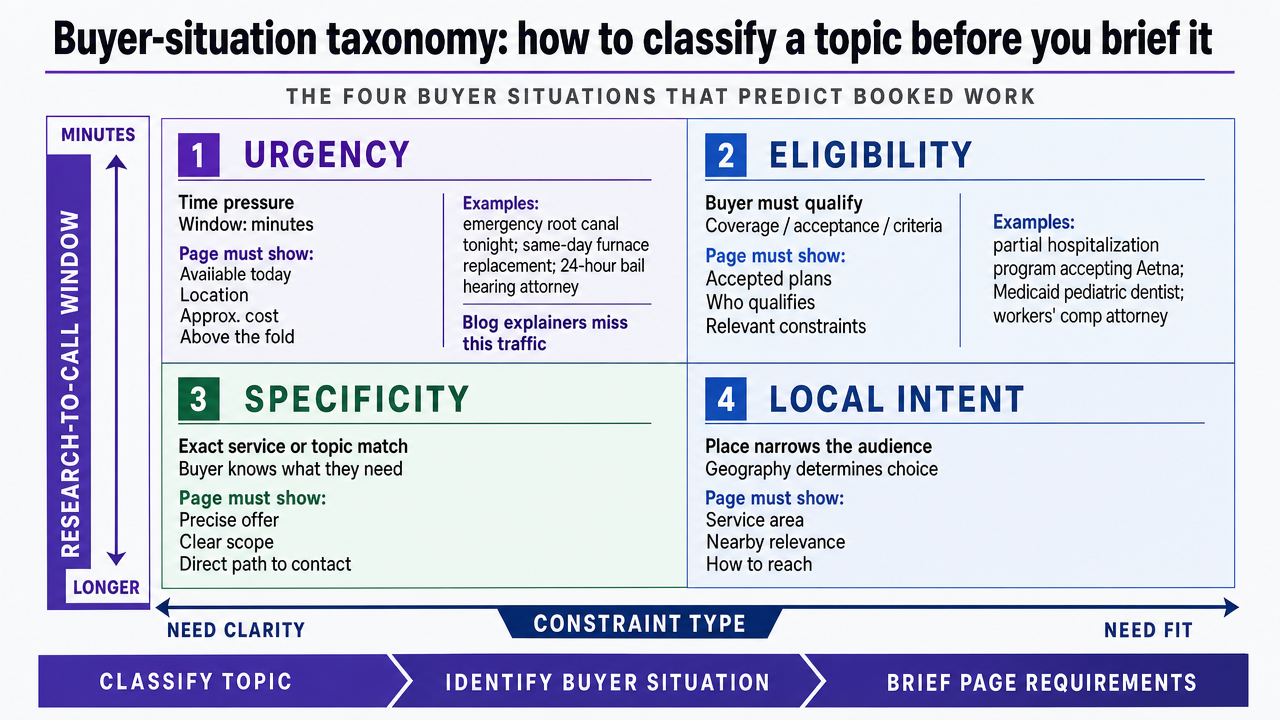 Visualize the four buyer situations framework described in the section as a classification grid for topic selection
Test SEO topic impact with live campaigns
Evaluate which SEO topics generate measurable pipeline results using real, published content during your free trial.
The cluster, not the post: what a high-intent topic actually ships as
A high-intent SEO topic is not a single page; it is a cluster designed to culminate in a page from which a buyer will make a call. Treating such a topic as merely a single blog post is a common reason why agency SEO programs fail to deliver on booked work.
The hub of this cluster is the service-plus-situation page itself—a specific procedure, condition, case type, or program paired with the buyer situation that triggered the search. Surrounding this hub are five supporting spokes:
- location variants address geographic questions for each market served;
- proof assets provide credentials, licensure, accepted insurance/payment terms, and verified reviews to establish provider legitimacy;
- decision-stage comparisons answer critical shortlist questions (e.g., program A vs. program B, in-network vs. cash-pay);
- internal links guide readers from adjacent informational pages to the hub; and
- measurement endpoints (call tracking, booking forms, chat handoffs) close the loop, allowing the agency to prove which cluster generated the consultation.
The cluster model also mitigates risks associated with shifts in buyer research platforms. A peer-reviewed comparison of health information quality across traditional search and generative platforms found that Google achieved mean DISCERN and JAMA scores of 3.33 and 3.70, respectively, which were higher than the generative platforms tested. However, the authors noted this study was limited to rosacea-related content and should not be generalized across all health topics 11. For Your Money or Your Life (YMYL) verticals, traditional search remains the authoritative source for credible answers, making high-intent clusters a sound investment. While AI-channel experimentation is important for future roadmaps, the infrastructure for booked consultations should be built around the service-plus-situation cluster now.
For an agency lead, the production unit is the cluster, not the individual article. A client account that produces twelve blog posts a month but zero complete clusters is running a content program, not a pipeline program. Reorienting the brief to the cluster level—encompassing the hub, spokes, proof, and measurement—ensures that specialist hours are invested in assets that can actually book work.
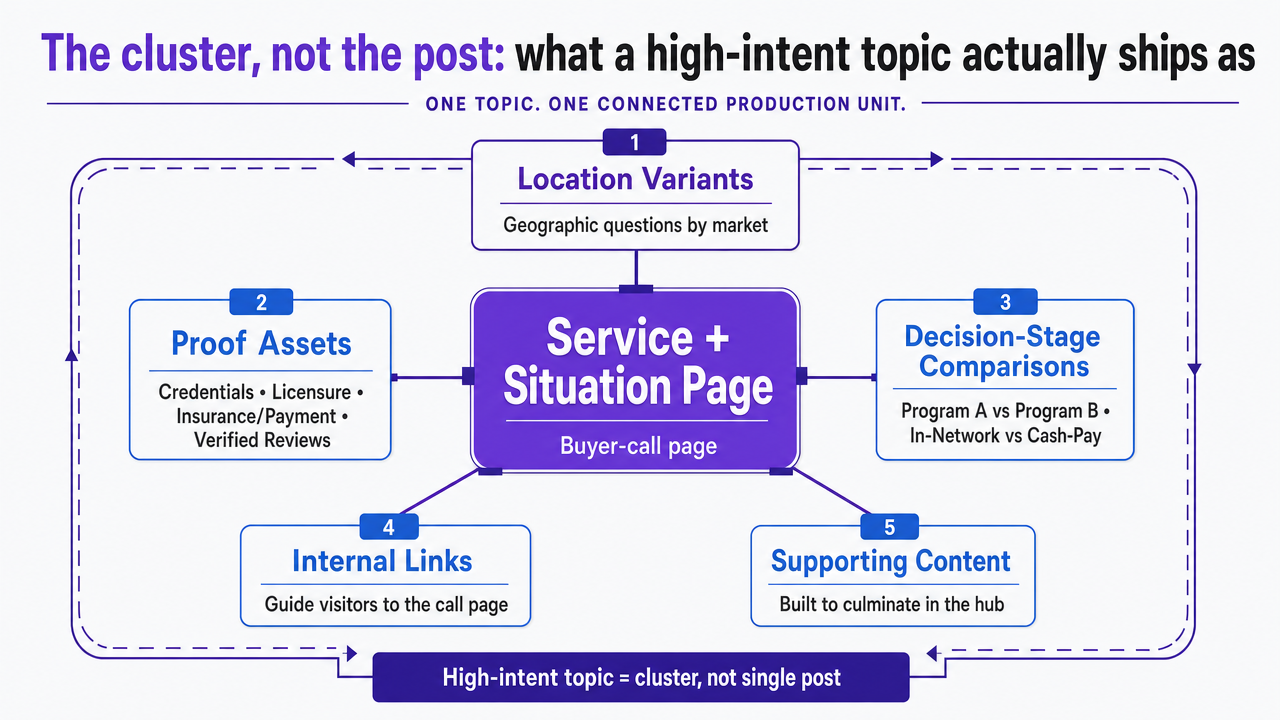 Diagram the hub-and-spoke cluster model described in the section so readers can see how a service-plus-situation page ships as a connected production unit
A scoring model for topic selection across a client book
Agencies managing 10 to 80 accounts cannot rely solely on specialist judgment for every candidate topic. A shared scoring model allows strategists, account managers, and production leads to evaluate topics consistently across all clients. This model uses four key axes.
Intent-to-Booking Distance measures the number of steps between a query and a booked consultation. A page answering "same-day root canal near me" is one phone call away from revenue. A page addressing "what causes tooth pain" is three or four decisions removed, assuming the reader even returns. Score this distance by clicks and decisions, not just impressions.
Substantiation Feasibility assesses whether the client can actually provide evidence for claims made on the page. A topic requiring outcome claims, efficacy language, or specialist credentials that the client cannot document should be deprioritized, regardless of search volume. The FTC's health advertising guidance emphasizes that health-benefit claims generally require competent and reliable scientific evidence, and testimonials are not a substitute for substantiation 9. If proof assets are unavailable, the topic is not ready for production.
Local Pack Eligibility determines if the topic is geographically relevant. Service-plus-situation queries in local verticals compete significantly within the map pack, as well as organic results. Topics that align with a serviceable location, verified business information, and genuine reviews score higher than those that must rely solely on blue links.
Production Repeatability evaluates whether the topic template can be deployed across multiple accounts without requiring a specialist to rebuild the brief each time. A "specialty + situation + city" pattern that works for a dental group can also apply to a behavioral health network, a plumbing franchise, or a senior living operator with minor variable adjustments. Topics demanding bespoke research for every instance should be placed at the bottom of the queue.
Forrester's December 2024 research, involving over 16,000 global business buyers, highlighted that buyers seek self-guided answers early and expert interaction when ready for deeper conversations 6. This scoring model respects that distinction: topics scoring high on all four axes represent the expert-interaction surface where the handoff occurs. Lower-scoring topics can still function as supporting assets within a cluster but should not consume specialist hours as the primary production unit. This approach transforms topic selection from a per-client debate into a repeatable triage process across an entire book of accounts.
Governance: the compliance gates every high-intent topic has to clear
Reviews, substantiation, tracking, and access in one pass
A high-intent service page in a regulated vertical must clear four critical gates before publication. Treating these as separate projects—such as a reviews policy here, a HIPAA review there, and an accessibility audit next quarter—can significantly slow agency production and leave potentially revenue-generating pages stuck in legal review for months. Instead, these should be integrated into a single editorial checklist attached to the cluster brief.
The first gate is review authenticity. The FTC's final rule on consumer reviews and testimonials, effective October 21, 2024, authorizes civil penalties for knowing violations, including buying or selling fake reviews, AI-generated reviews that misrepresent a reviewer or experience, undisclosed insider reviews, review suppression, and company-controlled sites falsely appearing independent 7, 8. For a cluster relying on proof assets, this means every testimonial, star rating, and case study on the service page requires a documented provenance trail: who wrote it, when, under what disclosure, and how negative feedback is handled. Agencies managing reputation programs across multiple clients should standardize the request template, moderation log, and disclosure language once, then apply them consistently per account.
The second gate is claim substantiation. In healthcare, behavioral health, and related verticals, the FTC expects competent and reliable scientific evidence for health-benefit and safety claims; testimonials are not sufficient for substantiation 9. The practical implication for topic selection is that outcome language on a service-plus-situation page must be traceable to evidence the client can produce upon request. If a brief calls for success rates, remission figures, or efficacy comparisons that the client cannot document, the page must be rewritten before it ships, not after a complaint arises.
The third gate is measurement privacy. The HHS OCR's bulletin on online tracking technologies for HIPAA-covered entities and business associates addresses analytics, pixels, call tracking, forms, and CRM integrations that might transmit protected health information. While a June 20, 2024 federal court order vacated part of this guidance, the remaining legal context should be reviewed with qualified counsel 12. For agencies, the operational rule is that healthcare measurement stacks must be configured differently than those for lower-stakes industries: server-side containers, scrubbed URLs, consented call recording, and documented business associate agreements should be part of the deployment checklist, not a post-launch retrofit.
The fourth gate is access. The ADA applies to businesses open to the public, and the Department of Justice's web accessibility guidance points to WCAG and Section 508 as helpful technical standards 10. On a high-intent page, inaccessible forms, missing phone alternatives, or keyboard-trapping chat widgets can prevent qualified buyers from converting, creating both a compliance exposure and a pipeline leak. An accessibility pass should be conducted before launch, not during remediation.
Implementing one checklist with these four gates, applied to every cluster, establishes a governance posture that ensures high-intent production continues across multiple accounts without legal bottlenecks.
Pinpoint SEO Topics That Consistently Move Pipeline Metrics
Request a data-driven analysis of topic selection frameworks proven to correlate with pipeline outcomes—built for agencies managing multiple client verticals at scale.
If you manage multiple locations: production economics of the cluster
Three production models compared on a per-client, per-month basis
This section addresses agency leads managing multi-location clients—such as DSOs, behavioral health networks, home services franchises, senior living operators, or regional law firms—where a single cluster must be deployed in five, fifteen, or fifty location variants before generating any bookings. In these scenarios, one cluster per client is no longer the unit; instead, one cluster per location per client becomes the unit, fundamentally altering the economics.
The target production unit is the cluster described earlier: a service-plus-situation hub, three to five situation spokes, location variants, proof assets, schema, internal linking, and measurement endpoints. The variables below are agency-supplied and should be populated with actuals from the account before using the table as a planning tool.
Variables (agency-supplied):
H : fully loaded specialist hourly cost
A : hours to produce one asset at agency quality
N : assets per complete cluster (hub + spokes + location variants + proof + schema)
L : number of locations the cluster must ship across
F : freelance hourly cost (pod model)
R : specialist review hours per freelance-produced asset
| Production model | Monthly cost per client cluster | Specialist hours consumed | Scales to L locations by |
|---|---|---|---|
| Specialist-led manual | H × A × N × L | A × N × L | Linear hour multiplication |
| Specialist + freelance pod | (F × A × N × L) + (H × R × N × L) | R × N × L | Freelance capacity + review hours |
| AI-assisted with human approval | Platform fee + (H × approval hours per asset × N × L) | Approval hours only | Platform throughput + approval capacity |
Regardless of the specific inputs, two consistent results emerge from this arithmetic. Specialist-led manual production is the only model where both cost and hours scale linearly with L. This explains why agencies that acquire a 40-location DSO on a manual pricing model often lose margin on the second cluster and risk losing the account by the fourth. Freelance pods can reduce cost but not quality-control hours; R rarely falls below 25% to 40% of A when the brief requires specific proof and compliance language. AI-assisted production with human approval is the only model where specialist hours decouple from L, offering the only viable path to maintaining margin as the number of locations grows.
Where approval-first AI production fits the agency P&L
Approval-first AI production should be viewed on the P&L as a throughput enhancement, not solely as a labor replacement. The specialist retains responsibility for writing the brief, setting proof standards, and approving final content. What changes is the time spent on repetitive tasks—drafting the fifteenth location variant, applying schema, routing internal links, or formatting proof blocks using established templates.
For an agency serving clients across legal, behavioral health, dental, home services, and senior living sectors, this model also resolves the quality-variance issues often associated with freelance pods. A single approval checklist, applied consistently to every cluster across all accounts, enforces the same substantiation, review-provenance, tracking, and accessibility gates established in the governance section. The specialist's judgment remains the core asset, while the platform acts as the underlying production line.
Vectoron's AI Content Platform is an example of approval-first production, with a trial priced at $599/month. For an agency lead, the key deployment question is not just vendor comparison, but rather: at what location count (L) does the specialist-hour line in the current model cease to generate sufficient margin, and what approval capacity does the team need to address this.
Measurement: proving the topic booked the work
Ranking reports alone do not secure client renewals. Instead, booked consultations, qualified calls, and intake-stage conversions are the metrics that matter. The measurement stack supporting a high-intent cluster must connect the landing page directly to the appointment, rather than just linking a keyword to an impression.
Three instruments facilitate this. Dynamic call tracking at the page level attributes inbound calls to the specific service-plus-situation hub that generated them, with numbers swapping by source to differentiate, for example, a buyer who landed on a "same-day crown" page from one who arrived via a brand search. Form submissions include hidden fields capturing landing page, cluster, and location, allowing the CRM to filter booked work by topic cluster, not just by channel. Call scoring—whether manual or AI-assisted—distinguishes qualified prospects from irrelevant calls, resolving debates about whether SEO is driving revenue or merely call volume.
In healthcare and behavioral health, the measurement stack requires specific configurations. The HHS OCR's bulletin on online tracking technologies for HIPAA-covered entities addresses analytics, pixels, call tracking, and CRM integrations that may transmit protected health information. While a June 20, 2024 federal court order vacated part of this guidance, the current legal context should be reviewed with qualified counsel 12. Operationally, this means implementing server-side containers, scrubbed URL parameters, consented call recording, and signed business associate agreements before counting the first conversion. The critical metric to report is booked consultations per cluster per location per month, as this is the number that drives account renewals.
What to brief on Monday
To begin, select one client account. Gather their service menu, the top three revenue-generating procedures or case types, and the list of locations. For each procedure, identify the three buyer situations most likely to result in a call this week—urgency, eligibility, cost, or specialist match—and disregard others. This forms your cluster queue.
- Brief the hub page: service plus situation, including credentials, accepted payment or insurance, and a tracked phone number prominently displayed above the fold.
- Queue the location variants, the proof block, and the measurement endpoints as part of the same work order, not as separate follow-up tasks.
- Before a specialist begins the brief, score every candidate topic against intent-to-booking distance, substantiation feasibility, local pack eligibility, and production repeatability.
By the end of the week, the account should have one complete cluster deployed, rather than twelve individual blog posts. Repeat this process for each account until the production line, not the specialist's calendar, becomes the limiting factor.
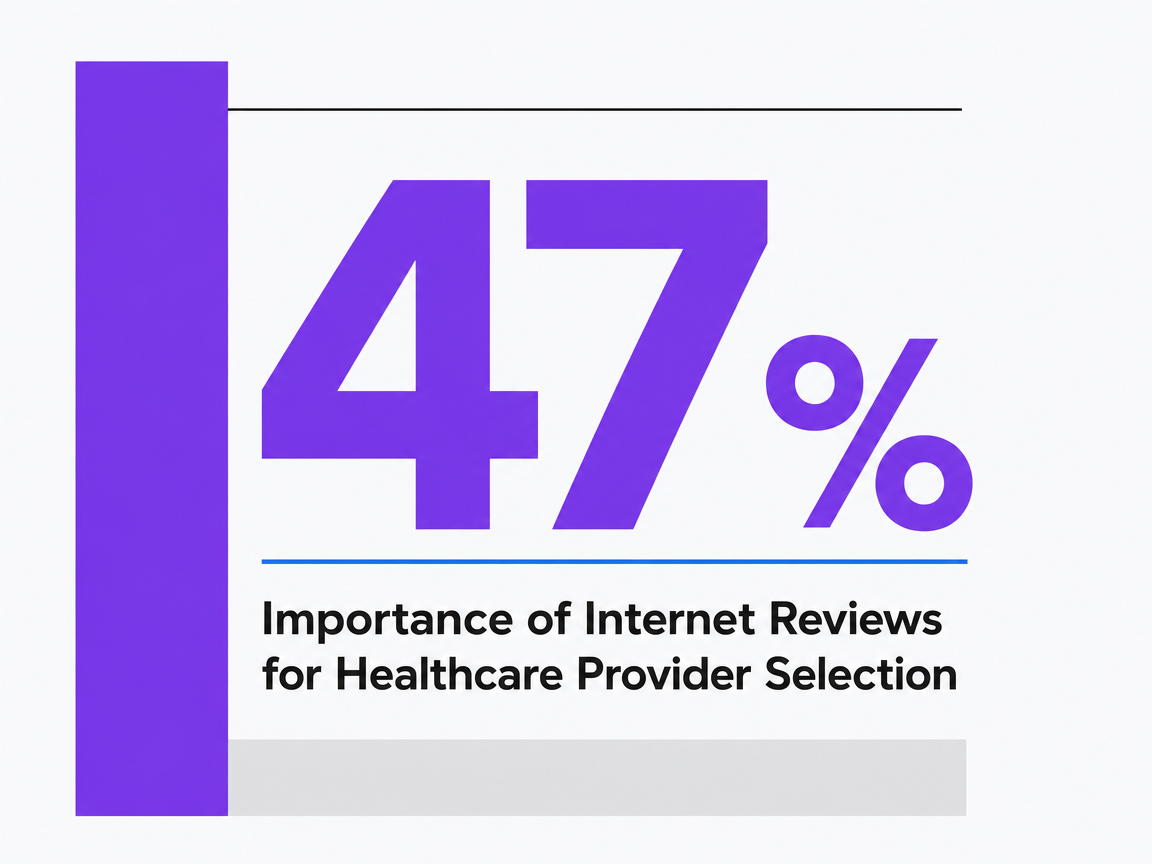 Importance of Internet Reviews for Healthcare Provider Selection
Importance of Internet Reviews for Healthcare Provider Selection
Frequently Asked Questions
References
- 1.Choosing a Provider: What Factors Matter Most to Consumers and What Do They Mean for Physician Practices?.
- 2.Millennials Seeking Healthcare: Examining the Degree to Which Online Information Impacts Healthcare Decisions.
- 3.The Impact of Web-Based Ratings on Patient Choice of Primary Care Physicians and Specialists.
- 4.Popularity of internet physician rating sites and their apparent influence on patients’ choices of physicians.
- 5.The Impact of Narrative Reviews on Patient E-doctor Choice in Online Health Communities.
- 6.The State Of Business Buying: Companies Still Struggle To Meet Buyers’ Expectations.
- 7.Federal Trade Commission Announces Final Rule Banning Fake Reviews and Testimonials.
- 8.The Consumer Reviews and Testimonials Rule: Questions and Answers.
- 9.Health Products Compliance Guidance.
- 10.Guidance on Web Accessibility and the ADA.
- 11.The Reliability Gap: How Traditional Search Engines and Generative AI Platforms Compare in Health Information Quality.
- 12.Use of Online Tracking Technologies by HIPAA Covered Entities and Business Associates.