
Key Takeaways
- Revenue-first topic research treats each published asset as capital allocation, ranking topics by pipeline contribution per production hour rather than by search volume and difficulty scores.
- The Revenue Topic Score combines four 0-3 inputs — commercial intent, cluster leverage, SERP durability under AI Overviews, and a measurable conversion path — into one portfolio decision.
- Cluster architecture and format selection turn scored topics into compounding assets, while triangulated measurement across direct response, journey reconstruction, and quarterly incrementality holdouts defends retainers in QBRs 19.
- Scale the model through an approval loop: automate candidate scoring, SERP screenshots, and draft briefs, but keep overrides, format calls, and client narratives with the strategist 18.
The portfolio problem no keyword tool solves
Picture the standing Monday call at a mid-sized agency: 40 client accounts, one senior SEO strategist, and a shared spreadsheet of 3,200 keyword candidates pulled from Ahrefs the previous week. Each row has a search volume, a difficulty score, and a proposed URL. None of the rows show which topic will pay a retainer for another quarter.
That gap is the portfolio problem. Keyword tools rank queries by volume and competition. They do not rank topics by pipeline contribution, cluster leverage, or resistance to AI-mediated search results. For a Head of SEO defending retainers across a book of service-business clients, those are the variables that decide which topics get published and which get cut.
The pressure has intensified because Google's own results page now competes with the content agencies produce. Independent analysis of browsing data from 900 U.S. adults found that about 18% of Google searches in March 2025 generated an AI summary, and users clicked result links less often when those summaries appeared 5. Google's counter-position is that AI Overviews surface higher-quality clicks and that included links outperform traditional listings for the same query 6. The debate is unsettled. The operational consequence for topic selection is not.
Revenue-first SEO topic research treats topic selection as capital allocation. Each published asset consumes strategist time, writer hours, editorial review, and internal linking capacity. The question is not "can this rank?" but "which topic, in which client account, returns the most pipeline evidence per hour of production?" The rest of this piece gives Heads of SEO a scoring model, a cluster blueprint, and a measurement stack built for that question.
Why traditional topic research fails a book of clients
Volume-and-difficulty scoring was built for a single site with a single conversion path. It breaks down the moment a strategist has to allocate production hours across a dozen legal accounts, five DSO groups, and a home services franchise with 18 locations. The scoring inputs do not distinguish between a 2,400-search-per-month term that produces consult requests and a 2,400-search-per-month term that produces students writing homework.
The economic consequence shows up in client reporting. Enterprise research published by the Content Marketing Institute found that 56% of B2B marketers cite ROI attribution as a top challenge, 56% cite customer journey tracking as a top challenge, and 39% expect content marketing budget increases in 2025 9. Budgets are growing while the ability to prove what those budgets produce is not keeping pace. Agencies absorb that gap. When a client cannot connect a topic to a booked call, the retainer conversation shifts from "expand the program" to "justify the current one."
Traditional topic research also treats each page as an independent bet. That framing ignores two realities of agency delivery:
- First, a strategist's time is the scarce resource, not the client's word budget — a poorly scored topic still consumes a brief, an outline, an edit pass, and an internal link plan.
- Second, Google's quality guidance rewards originality, completeness, and evidence of first-hand value, not raw keyword coverage 2. Publishing 40 thin pages against 40 mid-volume terms produces the exact profile Google is now designed to suppress.
Revenue-first research replaces per-page keyword scoring with portfolio-level topic scoring. The next section defines the four inputs that make that scoring defensible in a client QBR.
The Revenue Topic Score (RTS): a four-input scoring model
Input 1 — Commercial intent signal
The first input asks a narrow question: does the query surface a person who could become a client this quarter? Search volume is irrelevant if the demand is informational, academic, or price-shopping at the wrong tier. Google's own publisher guidance advises creators to think about what words a searcher would actually type and whether the resulting content provides original information, reporting, or analysis worth ranking 18. Applied to topic selection, that translates into a scored variable, not a gut call.
Score commercial intent on a 0-3 scale:
- A 3 is a query with explicit hiring, buying, or booking language — "chapter 7 attorney near me," "emergency HVAC repair," "invisalign consultation."
- A 2 is a problem-diagnosis query where the searcher is inside the buying window but not yet asking for a vendor — "why is my furnace short-cycling," "signs I need to file bankruptcy."
- A 1 is educational content adjacent to the service.
- A 0 is homework, curiosity, or misaligned geography.
Cut every 0. Publish 3s first. Use 2s to feed the cluster, not to anchor it. That single filter removes roughly a third of the candidate list from a typical Ahrefs export before any other input is applied.
Input 2 — Cluster leverage
The second input measures how much a topic reinforces other topics on the same site. A page that stands alone earns links only from its own external backlinks. A page inside a well-linked cluster earns internal authority from every sibling and every pillar it connects to. Google's technical guidance treats internal linking and crawlable structure as first-order signals for discovery and relevance 3.
Score cluster leverage on a 0-3 scale as well:
- A 3 is a topic that can serve as a pillar or a spoke inside an existing pillar, with at least four supporting subtopics already scored or published.
- A 2 is a topic that fits a cluster but requires two or more new supporting pages to be worth building.
- A 1 is a topic with weak cluster fit but strong intent.
- A 0 is an orphan — no natural parent, no natural siblings.
Orphans are the most common failure mode in agency topic lists. They pass keyword filters, get published, and never rank because nothing on the site tells Google the page belongs to anything. Cut 0s unless a specific commercial-intent 3 forces the exception.
Input 3 — SERP durability under AI Overviews
The third input asks whether a topic can still deliver clicks after Google's own summary answers the question at the top of the page. Independent analysis by Pew Research of browsing data from 900 U.S. adults found that about 18% of Google searches in March 2025 generated an AI summary, and users clicked result links less often on those pages than on standard SERPs 5. Google's counter-position is that AI Overviews surface higher-quality clicks because the right web pages are being featured 7. Both can be true. Neither changes the operator question: which topics still send traffic when the SERP answers itself?
Score durability 0-3 by testing the live SERP for each candidate:
- A 3 is a query where the AI Overview is absent, or where the summary requires clicks to complete (pricing, provider selection, jurisdiction-specific answers, scheduling).
- A 2 is a query where the Overview appears but the summary is generic enough that the searcher still needs a source.
- A 1 is a query where the Overview effectively resolves the question but the topic still supports internal linking value.
- A 0 is a fully resolved informational query with no downstream commercial hook.
Run the test in an incognito window from the client's target metro. Screenshot the SERP. Attach it to the topic brief. Six months from now, that screenshot is the artifact that defends the topic decision when the SERP has shifted again.
Input 4 — Measurable conversion path
The fourth input tests whether a topic can actually be tied to pipeline evidence once it ranks. A topic without a tracked conversion path is invisible in the QBR, regardless of how well it performs in Search Console. Enterprise research has repeatedly shown that measurement is the weak link — more than half of enterprise marketers say crafting content that prompts a desired action is a challenge 9.
Score the conversion path 0-3 on infrastructure, not aspiration:
- A 3 is a topic with a defined next step already instrumented: a form submission tied to CRM, a tracked phone call routed through call intelligence, a booked appointment, or a gated asset with lead capture.
- A 2 is a topic where the next step exists but the tracking requires setup before publication.
- A 1 is a topic with only a soft conversion — newsletter signup, blog subscribe.
- A 0 is a topic with no plausible conversion within two clicks.
The scoring forces a production rule: no topic ships until its conversion path is instrumented. That rule is the single biggest driver of defensible reporting at renewal time.
Combining the four inputs into a portfolio decision
Each topic now has four scores between 0 and 3. Sum them for a Revenue Topic Score between 0 and 12. Weight is optional — most agencies find equal weighting sufficient once the 0s have been eliminated from any single input. Topics scoring 10-12 are portfolio priorities. Topics scoring 7-9 are cluster fillers scheduled after priorities are published. Topics scoring below 7 stay on the list but do not consume brief-writing time.
Apply the RTS across the entire book, not one account at a time. A strategist supporting 40 clients should be able to rank the top 20 topics globally by score, then allocate production capacity where the marginal hour returns the most pipeline evidence. That is the portfolio move keyword tools cannot make.
The score is a decision aid, not a verdict. Override it when a client priority, seasonal window, or competitive gap demands it — but log the override. Six months of override logs reveal which client accounts consistently produce topics that the score would have cut, and that pattern is itself a retainer conversation.
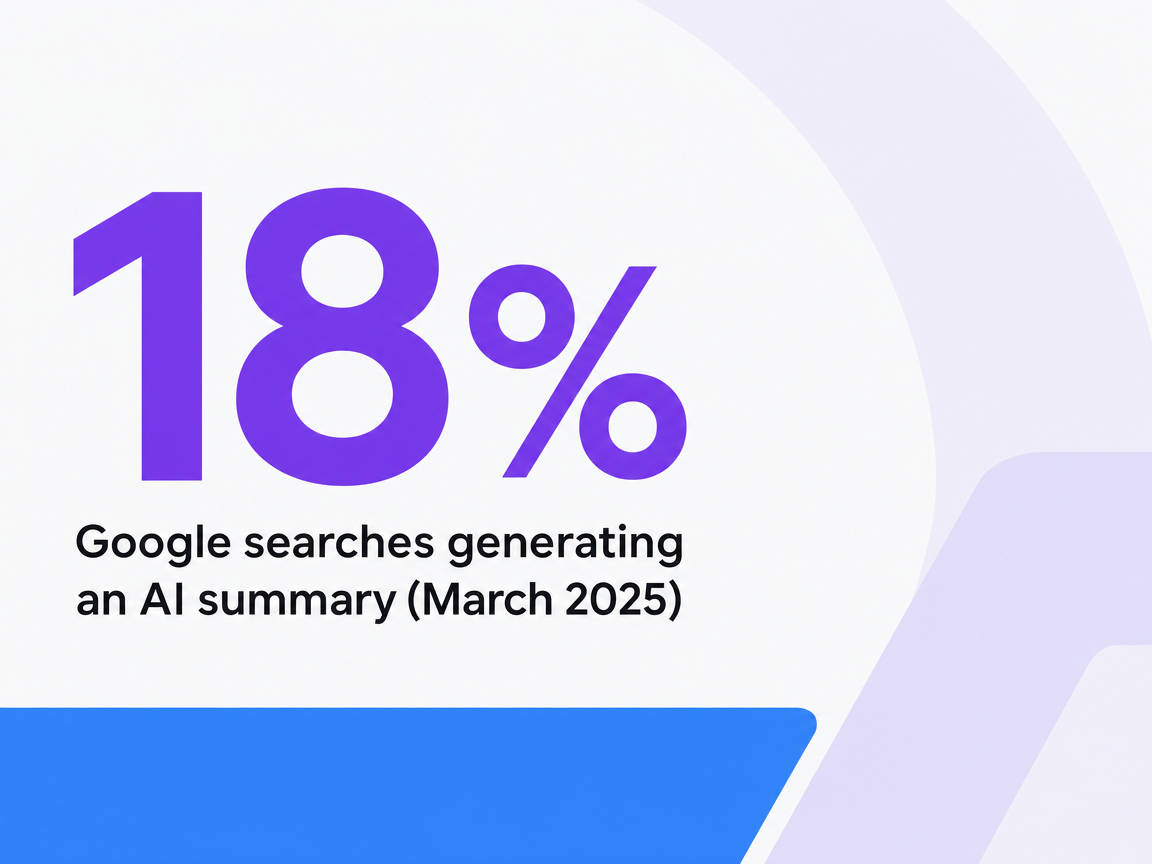 Google searches generating an AI summary (March 2025)
Google searches generating an AI summary (March 2025)
Test Revenue-Driven Topic Research on Live Campaigns
Validate new SEO topic strategies with full publishing rights and measure real performance during your trial.
Cluster architecture: turning scored topics into a defensible site
A high-scoring topic list is worthless without an architecture that lets internal authority flow between the pages. The scoring model produces winners; the cluster structure produces compounding. Academic work on document clustering reports that clustered search can be up to four times faster than non-clustered approaches in controlled experiments 14, and related research shows that combining content and link analysis improves the precision of grouped results 13. The takeaway for site architecture is not the exact multiplier — it is that grouping related documents is a first-order signal for retrieval systems, not decoration.
The blueprint is straightforward. Each priority topic scoring 10-12 becomes either a pillar page or a spoke inside an existing pillar. Pillars target the highest commercial-intent query in the cluster and link down to every subtopic. Subtopics link back to the pillar and sideways to two or three sibling pages inside the same cluster. No page inside a cluster is more than two clicks from the pillar. Nothing gets published without its internal link plan attached to the brief.
Three architectural rules keep clusters defensible under Google's current quality guidance:
- Unique, descriptive titles across the cluster stay unique and descriptive rather than variations of the same phrase, matching what Google's own developer documentation asks for 1.
- Original contribution per page — every page inside the cluster adds original information, reporting, or analysis the sibling pages do not — the completeness test Google publishes for creators 2.
- Discoverable at scale — the discovery layer works: XML sitemap current, robots.txt permissive, semantic HTML clean, so cluster pages are actually crawlable at the scale an agency portfolio requires 16.
Orphan pages are the failure mode to police. Any published page without at least three inbound internal links from cluster siblings gets flagged in the monthly audit and either linked or retired. That single rule closes the gap between a topic list that scores well and a site that ranks well.
Format selection belongs in the topic brief
A topic brief that specifies subject and search intent but not format leaves the most consequential decision to the writer. Format determines whether a scored topic converts. Buyer preference data from Demand Gen Report found that 67% of respondents found short-form content valuable in decision-making, and 65% said the same for webinars or digital events 10. Long-form explainers still rank, but they do not always convert the same audience that the query attracted.
The operational rule is simple. Every topic brief specifies a primary format before the outline is written:
- short-form answer page
- long-form pillar
- comparison table
- decision tool
- gated webinar recap
- short video with transcript
Format choice flows from the commercial intent score. A booking-language query scored 3 rarely rewards a 2,400-word essay — it rewards a scannable answer with a clear next step, matching what government content guidance describes as writing for user intent with clear headings and complete answers 15.
Two formats deserve explicit slots in the production calendar. Short-form answer pages capture the 67% who scan before they commit, and event recaps or on-demand webinar pages capture the 65% who evaluate through longer sessions 10. Score the topic once, then assign the format that matches the buyer behavior behind the query. Briefs without a format field get rejected at intake.
Measurement stack: triangulating pipeline evidence
The measurement problem in agency SEO is not a shortage of data. It is a surplus of single-source data that cannot survive a challenge from the client's CFO. Google Search Console shows impressions and clicks. GA4 shows sessions and events. The CRM shows deals. None of those systems, alone, explains which topic produced which booking. Enterprise research published by the Content Marketing Institute found that 56% of B2B marketers cite ROI attribution as a top challenge and 56% cite customer journey tracking as a top challenge, with 39% expecting content marketing budgets to increase in 2025 9. Budgets are moving in the direction of measurement pressure, not away from it.
Triangulation is the answer the measurement literature has already converged on. A comparative study of marketing-mix models, multi-touch attribution, and incrementality testing argues that no single method captures true marketing impact and that combining approaches produces stronger evidence, with incrementality testing highlighted as a particularly strong tool for isolating causal effect 19. Applied to SEO topic research, that means three layers running in parallel rather than one dashboard doing all the work.
- The first layer is direct-response tracking at the page level: form fills, tracked calls, booked appointments, gated downloads. Each conversion event maps back to the topic that produced the entry session. This is the ground-truth layer the RTS conversion-path score already forces into existence.
- The second layer is journey reconstruction across sessions. Multi-touch attribution assembles the sequence of topic pages a converter visited before the booked call. Cluster-level rollups matter more than page-level ones — the pillar plus its spokes is the unit that earned the pipeline, not any single URL.
- The third layer is incrementality. Hold out a cluster from new publication for a quarter. Compare pipeline contribution against a matched cluster that continued publishing. The delta is defensible in a QBR in a way that assisted-conversion reports are not. Run one holdout per quarter, per major client. Log the result. That log becomes the evidence file that carries the retainer conversation.
See How Leading Agencies Scale Revenue-Focused SEO Topic Research
Connect with our team to access a data-driven workflow for high-impact SEO topic research—engineered for agencies managing complex, multi-client portfolios.
If you manage multi-location clients: cluster build economics
The reader shifts here. This section is for agencies running SEO for DSO groups, franchise operators, home services rollups, senior living portfolios, and multi-office law firms — anywhere the same service is sold across five or more locations. The math that governs cluster investment for a single-location client does not apply once location count enters the equation, because the pillar work amortizes across every additional market the client operates in.
The rule of thumb professional-services SEO guidance has surfaced is that local visibility compounds when Google Business Profiles, consistent NAP data, localized keywords, and location-specific pages are treated as one connected system rather than a batch of standalone deployments 20. Applied to cluster architecture, that means one national pillar per service line, one localized spoke set per location, and shared subtopic pages that every location links to. The pillar and shared subtopics get built once. Location pages replicate a template with unique intent-matched copy per market.
The economics change accordingly. Score topics at the service-line level, then multiply the localized spoke build across the location count. Use the client's own numbers — average deal value, sessions-per-cluster, close rate — never invented benchmarks.
| Locations | Pillar + shared subtopic pages | Localized spoke pages | Pipeline contribution formula |
|---|---|---|---|
| 1 | 1 pillar + 4 shared | 4 | Sessions × conversion rate × avg. deal value × close rate |
| 5 | 1 pillar + 4 shared | 20 | (Sessions per location × 5) × conversion rate × avg. deal value × close rate |
| 25 | 1 pillar + 4 shared | 100 | (Sessions per location × 25) × conversion rate × avg. deal value × close rate |
Two operational rules keep the model defensible:
- Location pages must add original information a national page cannot — provider names, jurisdiction rules, service-area specifics — or they violate the completeness standard Google publishes for creators 18.
- The crawl layer has to scale with the location count: XML sitemap segmented by location, semantic markup consistent across templates, internal linking from each location page to the pillar and to two localized siblings 16.
Price the cluster build once for the shared assets, then price the localized spokes per location. The retainer conversation gets easier when the invoice matches the architecture.
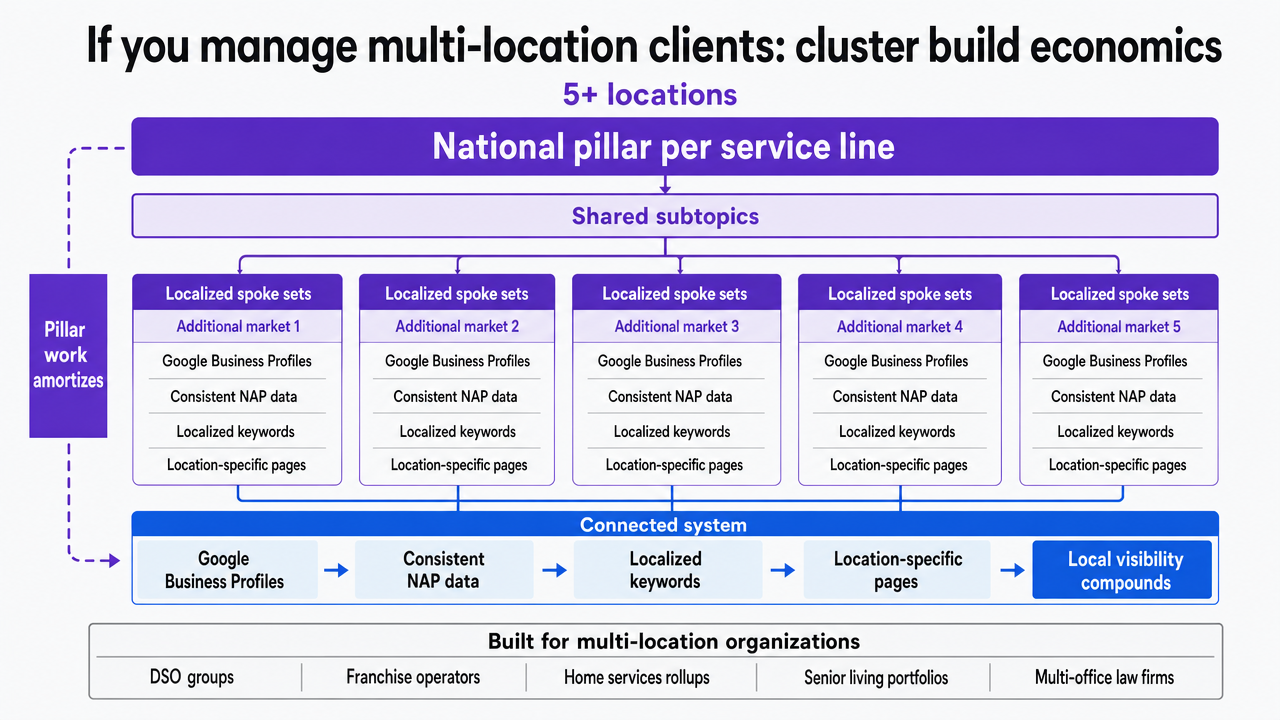 Visualize the multi-location cluster build model described in the section — one national pillar plus shared subtopics reused across localized spoke sets — reinforcing the economics table with a structural view
Operating the model: strategist capacity and AI-assisted execution
The scoring model, the cluster blueprint, and the triangulated measurement stack all assume something the average agency does not have: strategist hours to spare. A senior SEO running 40 accounts cannot personally score 3,200 candidate queries, screenshot every SERP for durability testing, or write 40 internal link plans per month. The model breaks at the capacity layer, not the logic layer.
The practical fix is a division of labor the strategist controls:
- Automatable inputs: candidate lists, SERP screenshots, cluster gap analysis, and first-draft briefs.
- Strategist judgments: score thresholds, override decisions, format assignments, and QBR narratives.
Keep the two lanes separate. Google's own guidance rewards content that shows originality and evidence of first-hand value 18, which is exactly what strategist judgment produces and what unattended automation does not.
Run the model as an approval loop: automated scoring proposes, the strategist disposes. Every published topic carries a scored brief, a screenshot artifact, an instrumented conversion path, and a link plan — assembled in minutes, reviewed in an hour. That is how one strategist defends 40 retainers without a hiring plan. Platforms like Vectoron are built around that approval-first pattern for teams that want the capacity without ceding the judgment.
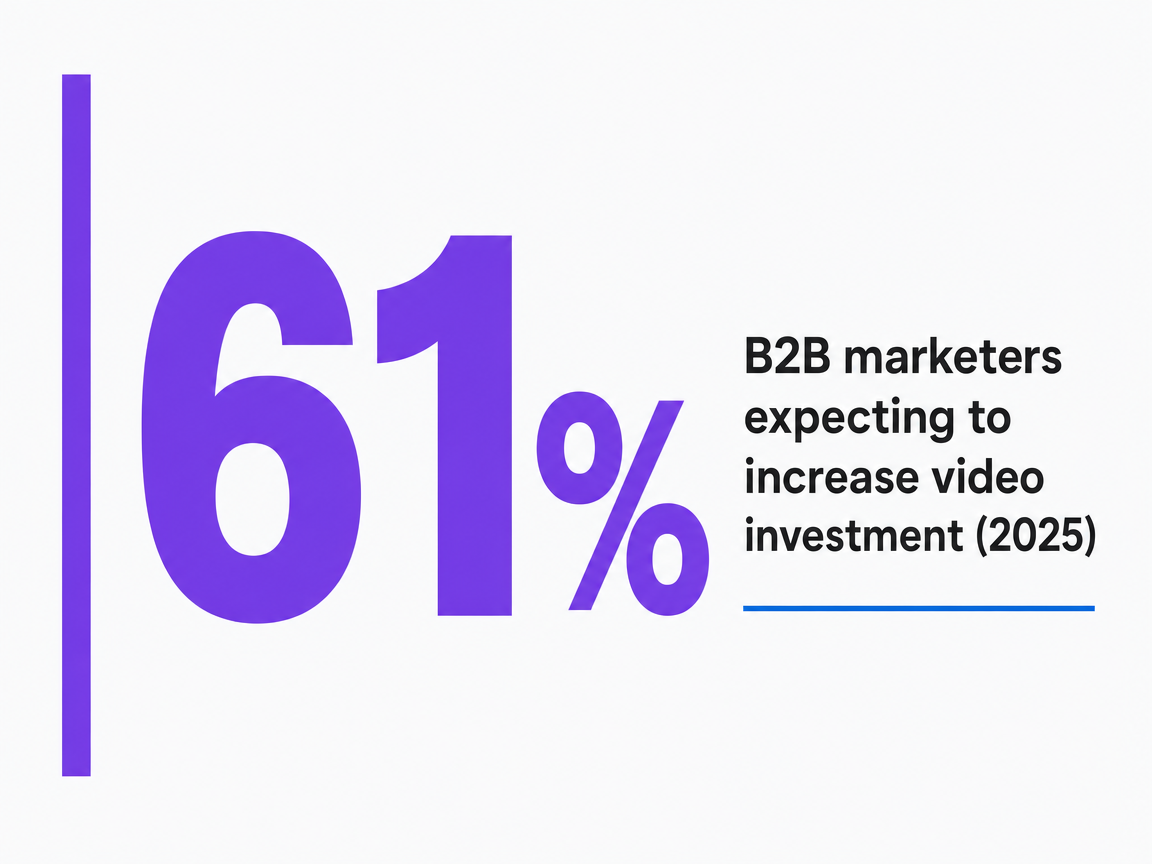 B2B marketers expecting to increase video investment (2025)
B2B marketers expecting to increase video investment (2025)
Frequently Asked Questions
References
- 1.SEO Starter Guide: The Basics | Google Search Central | Documentation | Google for Developers.
- 2.Creating Helpful, Reliable, People-First Content.
- 3.SEO Guide for Web Developers | Google Search Central.
- 4.Search Engine Optimization Best Practices.
- 5.Do people click on links in Google AI summaries?.
- 6.Generative AI in Search: Let Google do the searching for you.
- 7.What happened with AI Overviews and next steps - The Keyword.
- 8.B2B Content Marketing: 2025 Benchmarks & Trends.
- 9.Enterprise Content Marketing Benchmarks, Budgets, and Trends.
- 10.Navigating The Attention Economy Via Snack-able & Shareable Content.
- 11.[PDF] arXiv:2006.09119v1 [cs.IR] 16 Jun 2020.
- 12.Content Clustering for Improved Web Search Efficiency (Madhulika Singh et al.).
- 13.LET:Towards More Precise Clustering of Search Results\*.
- 14.Faster Exact Search using Document Clustering.
- 15.SEO Tips for Content Writing | USAGov.
- 16.How to optimize your content.
- 17.Writing for SEO.
- 18.[OPG] Reference Publishers Search 101 - Google.
- 19.A study of marketing-mix models, attribution and incrementality.
- 20.7 Proven Strategies with SEO for Professional Services Businesses.