
Key Takeaways
- Topic planning is now a portfolio allocation problem across three surfaces—classic SERP, AI answer citations, and pipeline-proof evidence—each with distinct mechanics, measurement, and reasons to exist inside a client book.
- AI Overviews compress the click pool on informational queries, with traditional click rates dropping from 15% to 8% and session-end rates rising from 16% to 26% when a summary appears 1.
- Retrieval eligibility decides citation odds before writing quality does, so bounded chunks, dense named entities, and triangulated sources produce more citation inventory than broad authority pieces built for keyword targeting.
- Agency heads should rescore backlogs against the three jobs, stand up citation measurement through weekly sampled prompts, and shift one client to an approval-first workflow that protects pipeline-proof output 3.
The Portfolio Problem Hiding Inside Topic Selection
Topic selection used to be a volume game: pull the keyword list, sort by search demand, assign to writers, ship. This model assumed one audience—the human typing a query—and one outcome: a click on a blue link.
Both assumptions have quietly broken. AI Overviews now intercept a meaningful share of Google traffic before the ten blue links appear. Pew Research measured the impact in March 2025 across the browsing behavior of 900 U.S. adults: users clicked a traditional result in 8% of searches with an AI summary versus 15% without one 1. The click pool is compressing on the exact queries agencies have historically prioritized.
The strategic problem is not the click loss itself. It is that most agencies still plan topics as if only one surface matters. Every cluster gets scored on volume and difficulty, then produced against a single-audience brief. Nothing in the workflow asks whether a topic is engineered for citation inside an AI answer, whether it produces evidence a client CFO recognizes, or how the three jobs should be weighted across a client book.
Topic planning has become a portfolio allocation problem across three surfaces: classic SERP, AI answer layer, and pipeline-proof content. The rest of this piece treats it that way.
The New Click Economy: What Changed Between 2024 and Late 2025
The shape of a Google results page in late 2025 does not resemble the one agencies built topic plans against two years ago. AI Overviews sit above the classic organic block on a growing share of queries, and the click math underneath has moved.
Pew Research measured the browsing behavior of 900 U.S. adults in March 2025 across Google desktop and mobile sessions. On the 18% of searches that produced an AI summary, users clicked a traditional result only 8% of the time. On searches without an AI summary, that click rate was 15% 1. Nearly half the click opportunity disappears the moment an AI answer appears above the fold.
Two adjacent numbers from the same study matter for topic planning. Session-end rate jumped from 16% without an AI summary to 26% with one 1. More searches now terminate on the results page itself. The AI answer is often the destination, not a preview of one.
The exposure side is not niche behavior. Pew's separate 2025 survey found 65% of U.S. adults at least sometimes encounter AI summaries in search results, and 20% call them extremely or very useful 2. Encounter rates that broad, paired with mixed but non-trivial usefulness ratings, suggest the surface is durable rather than a novelty phase.
What changed between 2024 and late 2025 is not the ranking algorithm. It is the distribution model. A topic that ranks first can still be bypassed if the AI answer above it resolves the query without a click. The same topic, engineered differently, can appear inside that AI answer as one of the cited sources feeding the summary. Both outcomes are now possible from the same query, and topic planning has to account for which one a given cluster is being built to win.
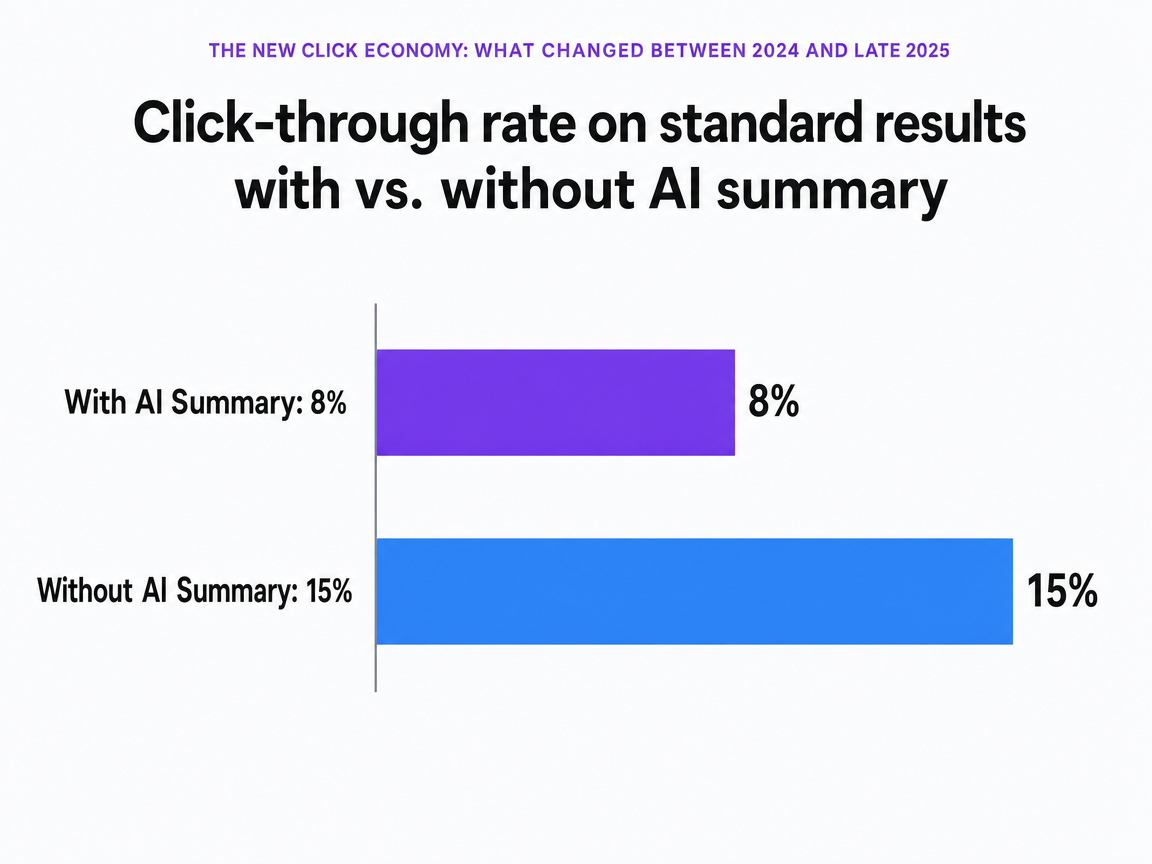 Click-through rate on standard results with vs. without AI summary
Pew Research data comparing user clicks on traditional blue links when an AI summary is present versus when it is not, showing a significant reduction in clicks.
Three Surfaces, Three Topic Jobs
A topic cluster is no longer built for one destination. The same subject can rank in the classic organic block, feed the AI Overview above it, or sit deeper in a client's funnel as evidence a prospect reads before booking. Each surface has different mechanics, different measurement, and a different reason to exist inside a portfolio. Treating them as one job is the fastest way to under-produce on all three.
Classic SERP: Where Ranking Still Pays
The traditional ten blue links have not disappeared. They still resolve the majority of queries where the searcher wants a specific page, not a synthesized answer. Transactional intent, branded searches, comparison shopping, and long-tail service-plus-location queries continue to produce clicks that convert.
What has changed is the query mix that pays. Informational queries at the top of the funnel now more often terminate on the results page itself, with session-end rates climbing from 16% to 26% when an AI summary appears 1. That does not kill classic ranking as a job. It narrows it. Topics with clear commercial intent, comparison structure, or geographic specificity still deliver the traffic agencies have always been paid to produce. The mistake is spending the full topic budget on informational pieces that used to feed the funnel and now feed the AI answer instead.
AI Answer Layer: Topics Engineered for Citation
The second job is getting quoted. AI summaries are not single-source rewrites of the top-ranking page. Pew's analysis of Google AI summaries found that 88% cite three or more sources, and only 1% cite a single source 1. The summary is a synthesis, and the citation slots are the visibility.
That distribution has a direct implication for topic architecture. A piece built as a definitive, all-in-one authority article competes for one slot against every other definitive piece on the query. A piece built as a triangulated, entity-dense reference on a specific sub-question competes for one of several slots that will be filled regardless. The second design has more inventory to win against.
Topics engineered for citation share a few traits. They define entities precisely, in language a retrieval system can match against a query. They include the specific numbers, dates, and named methods that make a passage quotable. They cover a bounded question deeply rather than a broad question shallowly. On a portfolio scorecard, these clusters are graded on citation frequency inside AI answers, not on organic click-through, because the click is often not the outcome the topic was built to produce.
Pipeline-Proof Topics: Methodology, Data, and Case Evidence
The third job is proving the client's business, not ranking for a query. Pipeline-proof topics are the pages a qualified prospect reads after they already know the brand exists—methodology write-ups, original data drops, case evidence with named outcomes, and comparison content that walks through how a service is actually delivered.
These clusters rarely win high-volume keywords. They are not built for volume. They are built to convert traffic that other clusters bring in, and to feed the AI answer layer with citable proprietary data that generic content cannot match. A survey of 400 client engagements, a cost-per-consult benchmark by vertical, or a methodology paper on how a specific service is scoped all serve both jobs at once: they are quotable inside AI summaries because the data is not available elsewhere, and they close deals because they answer the questions a buyer asks in the last mile.
On a QBR slide, pipeline-proof topics map to booked consults, qualified calls, or cost per lead. That is the metric a client CFO recognizes, and it is what keeps a topic budget defensible when informational click volume compresses.
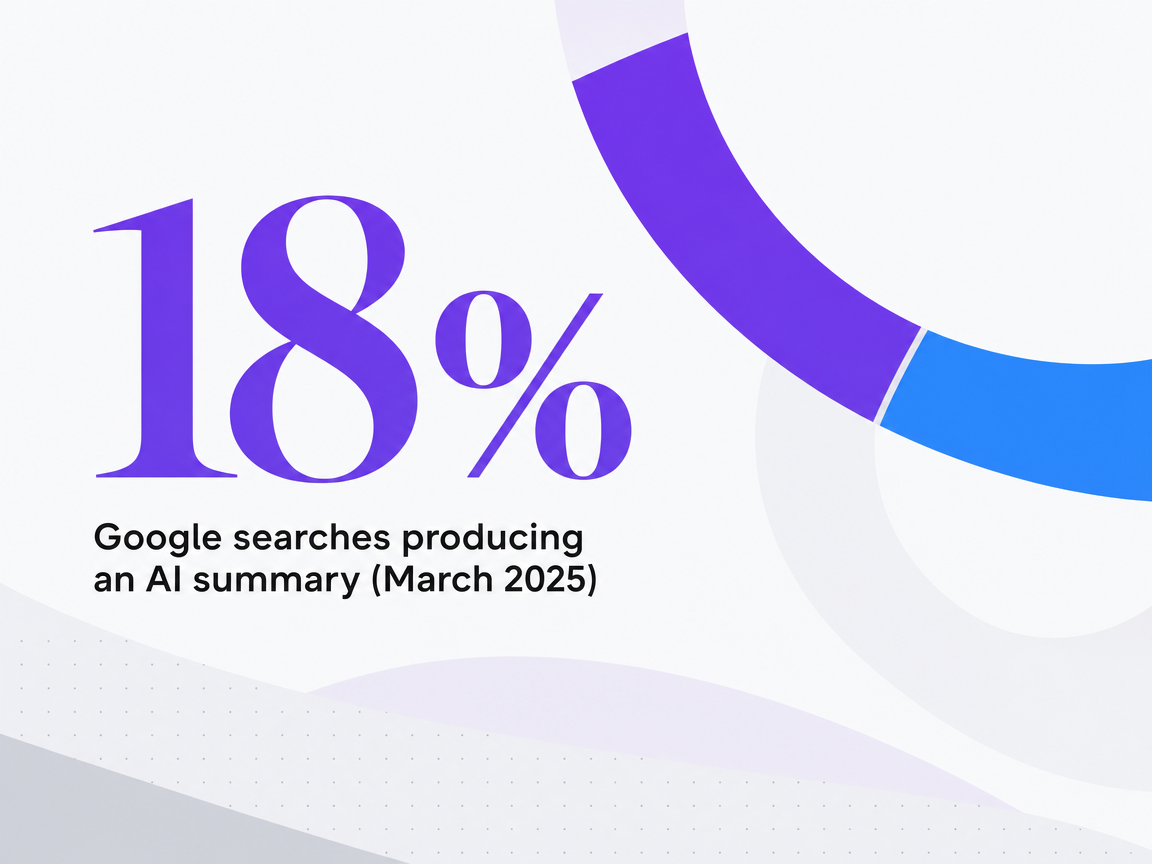 Google searches producing an AI summary (March 2025)
Google searches producing an AI summary (March 2025)
The Measurement Gap Agencies Can Exploit
Buyer behavior has moved faster than agency instrumentation. McKinsey's 2025 analysis of AI search adoption found that 44% of AI-powered search users call it their primary and preferred source of insight, while only 16% of brands systematically track AI search performance 3. That 28-point gap is the operational opening for agencies willing to build measurement infrastructure before their competitors do.
Most agency reporting stacks still answer questions from the 2022 playbook. Organic sessions, keyword rankings, page-level engagement, form fills attributed through last-click. None of those signals capture whether a client's content is being retrieved and cited inside an AI answer, or whether an AI-referred visitor arrived with materially different intent than a classic organic click.
Three instrumentation layers matter now:
- First, AI-referral traffic segmentation—breaking out sessions from ChatGPT, Perplexity, Copilot, and Google's AI surfaces where referrer data is available, then comparing conversion rate and lead quality against classic organic.
- Second, brand mention frequency inside LLM outputs, measured through sampled prompts run against a fixed query set each week.
- Third, pipeline attribution at the cluster level, not the page level, so a topic that never ranks in the top ten but consistently feeds AI citations still shows its downstream impact on booked consults or qualified calls.
The measurement gap is also a positioning asset. Agency heads who can walk a client into a QBR with citation frequency, AI-referral quality scores, and cluster-level pipeline attribution are selling something 84% of the market cannot produce. That is a retention argument, not just a reporting upgrade.
Test AI-driven SEO topic workflows in production
Evaluate real-time topic ideation and publishing for live client campaigns before making a commitment.
Retrieval-Aware Content Architecture
Getting cited inside an AI answer is a retrieval problem before it is a writing problem. Before a language model generates a summary, an information retrieval layer decides which passages are candidates. Content that never clears retrieval never gets quoted, regardless of how well it reads. The architecture of the page—how entities are named, how passages are bounded, how claims are sourced—determines whether a topic is even eligible for the citation slots agencies now compete for.
How RAG Selects What Gets Quoted
Retrieval-augmented generation (RAG) pairs a classical information retrieval step with a generative model. Stanford's chapter on the subject describes the basic pattern plainly: an IR system retrieves documents "likely to have useful information," and the language model generates an answer conditioned on those documents and the query 10. The generation stage cannot cite what the retrieval stage did not surface.
That sequence matters because most agency content is still optimized for the ranking stage of classic search, not the retrieval stage of an AI answer. Retrieval scores passages against a query using lexical and semantic signals. A page that hides its answer inside a narrative preamble, buries entities behind pronouns, or spreads a definition across three scrolls of scene-setting produces weaker passage-level matches than a page that states the entity, the definition, and the supporting number in a tight, self-contained block.
The practical consequence for topic planning is that retrieval eligibility is a document-design decision. Pages built as continuous prose compete for retrieval on the strength of their strongest paragraph. Pages built as a series of bounded, self-explanatory passages give the retrieval layer more surface area to match against more query variants, which is what turns a single topic into a source cited across dozens of adjacent AI answers.
Chunking, Entities, and Source Triangulation
Three design choices shape whether a passage clears retrieval and earns a citation slot.
- The first is chunking. Retrieval systems operate on passages, not full pages, so the useful unit is a self-contained block that answers a bounded question without requiring the reader to have started three headings earlier. Short, titled passages with a clear question-and-answer shape produce cleaner matches.
- The second is entity density. AI answers are assembled by matching query entities to passages that name the same entities precisely. A page that refers to "the platform" or "the approach" without repeating the actual named entity loses matches that a competitor with more literal language will win. Definitions, proper nouns, numeric values, dates, and named methods all raise the density of retrievable signals in a passage.
- The third is source triangulation. AI answers are built as syntheses, and passages that already reference multiple credible sources tend to be treated as more reliable synthesis inputs themselves. Content that names its data origins, links to primary sources, and includes counter-evidence where relevant reads to a retrieval layer the way peer-reviewed writing reads to a human editor: verifiable, bounded, and safe to quote.
Topic clusters designed with these three properties—bounded chunks, named entities, triangulated sources—produce more citation inventory per hour of production than clusters optimized only for keyword targeting.
Allocating the Topic Budget Across a Client Book
Most agencies treat topic budget as a per-client production quota: X briefs, Y drafts, Z publishes per month. The number rarely gets broken down by which of the three jobs each piece is doing. That is where margin quietly leaks—half the pipeline goes to informational clusters that now feed AI summaries instead of clicks, and the pipeline-proof work that would defend the retainer never gets scheduled.
A defensible allocation across a mid-market client book runs roughly 40% classic-SERP clusters, 35% AI-citation clusters, and 25% pipeline-proof assets. The classic block still carries commercial and geographic queries where clicks convert. The citation block covers bounded sub-questions engineered for retrieval, with entity density and triangulated sources built in. The pipeline-proof block produces methodology, original data, and case evidence—lower volume, higher unit cost, direct line to booked consults.
The ratio shifts with client maturity. New accounts with thin domain authority weight classic and citation clusters higher to build coverage. Established accounts with strong ranking already in place move budget toward pipeline-proof, because incremental ranking gains no longer move the QBR needle the way a cited data drop or a benchmark report does. McKinsey's finding that only 16% of brands systematically track AI search performance 3 means agencies allocating even a third of budget to citation-engineered clusters are producing inventory their clients' competitors are not measuring, let alone building.
If You Manage Multi-Location or Portfolio Accounts
This section is for teams managing multi-location groups—DSOs, legal networks, senior living portfolios, home-services franchisors—where topic planning has to hold up across dozens or hundreds of location pages without collapsing into duplicate content.
Portfolio accounts break the standard cluster math. A single-brand client runs one topic map. A 60-location DSO runs one shared pillar layer and 60 location-specific expressions of it, and the AI answer layer treats every location as a separate retrieval target for geo-modified queries. Producing that at depth without templating every page into indistinguishable filler is where most agency workflows fail.
The allocation shifts accordingly. Below is a working frame for how the three topic jobs map to portfolio output, using variables rather than invented benchmarks.
| Cluster Type | Output Unit | Instrumented Against |
|---|---|---|
| Location-page depth | Per location, per quarter | Qualified calls, booked consults by location |
| Service pillar | Shared across portfolio, refreshed quarterly | Non-branded organic sessions, ranking coverage |
| AI-answer bait | Bounded sub-question, portfolio-wide | Citation frequency in AI summaries, AI-referral sessions |
| Pipeline-proof | Original data, methodology, case evidence | Cost per lead, consult-to-close rate |
Two operational notes for portfolio work. Location-page depth is the only cluster where volume scales linearly with the account—everything else is produced once and syndicated with entity-level variation. And AI-answer bait for portfolio clients works best when the underlying data is proprietary to the network: aggregated wait times, procedure mix, outcome benchmarks. That is content competitors cannot triangulate against, which is what makes it citation-durable 10.
Streamline SEO Topic Strategy for AI Search—Without Expanding Your Team
See how leading agencies use unified workflows to generate, approve, and deploy high-impact SEO topics at scale—enabling faster content velocity and measurable pipeline impact across client portfolios.
Production Capacity: What Breaks First
Every allocation model assumes the team can actually produce the work. That assumption fails first in the citation and pipeline-proof blocks, where per-unit production time is higher than a keyword-targeted informational piece and where the writer's skill profile is different. A generalist SEO writer can produce ten informational drafts a week. The same writer producing entity-dense, triangulated citation content or original methodology write-ups moves at a fraction of that pace.
Three constraints tend to snap in order:
- Editorial review capacity goes first, because triangulated content requires source-checking that a keyword brief does not.
- Subject-matter access goes second, because pipeline-proof pieces need input from the client's operators—consult coordinators, intake teams, clinical or legal reviewers—and those calendars are the bottleneck, not the writer's.
- Strategist attention goes third, when the person who should be scoring citation performance and reallocating budget is instead approving individual briefs. See strategist attention in practice.
McKinsey's productivity range for AI in the marketing function is 5 to 15 percent of total marketing spend, tied to workflow redesign rather than tool deployment 5. That band shows up in agency production when AI handles first-draft research, entity extraction, and brief assembly, freeing editorial and strategist hours for the work that actually protects margin: source verification, portfolio-level allocation calls, and the pipeline-proof clusters no tool produces on its own 4.
Governance and Oversight in Regulated Verticals
Legal, healthcare, DSO, and senior living clients raise the stakes on every topic that ships. A miscited procedure claim, an outdated fee schedule, or an unreviewed clinical statement can trigger board complaints, bar inquiries, or CMS scrutiny—none of which show up in a keyword report. AI-assisted production makes that risk more acute, because first-draft speed outpaces the reviewer bandwidth that used to catch these issues.
NIST's AI Risk Management Framework offers a workable spine for topic workflows in regulated accounts. It is voluntary, but it gives agencies a defensible structure for embedding trustworthiness into how AI-drafted content is designed, reviewed, and released 9. Practically, that means three controls inside the approval loop:
- A licensed reviewer sign-off on any clinical, legal, or financial claim before publish.
- A source-verification pass that confirms every cited statistic traces to a primary document.
- A versioned audit trail showing which passages were AI-drafted, which were human-edited, and who approved each publish.
Approval-first workflows are the operational form of that governance. Nothing ships without sign-off, every recommendation carries its reasoning, and the audit record survives the next regulatory review.
What Agency Heads Should Change This Quarter
Three moves separate agencies building for the next cycle from those still optimizing for the last one.
- First, rescore the existing topic backlog against three jobs instead of one: which clusters are built for classic ranking, which for AI citation, and which for pipeline proof. Anything that cannot answer that question goes to the bottom of the queue.
- Second, stand up citation measurement before the quarter ends. A weekly sampled prompt set against a fixed query list, run through the AI surfaces clients care about, produces the baseline that makes the next QBR defensible. Without it, agencies compete on the same reporting stack as the 84% of brands not yet tracking AI search performance 3.
- Third, move at least one client's production workflow to an approval-first loop where AI handles first-draft research and briefing, and human strategists spend recovered hours on citation scoring and pipeline-proof assets. That is the operational shape Vectoron was built to run.
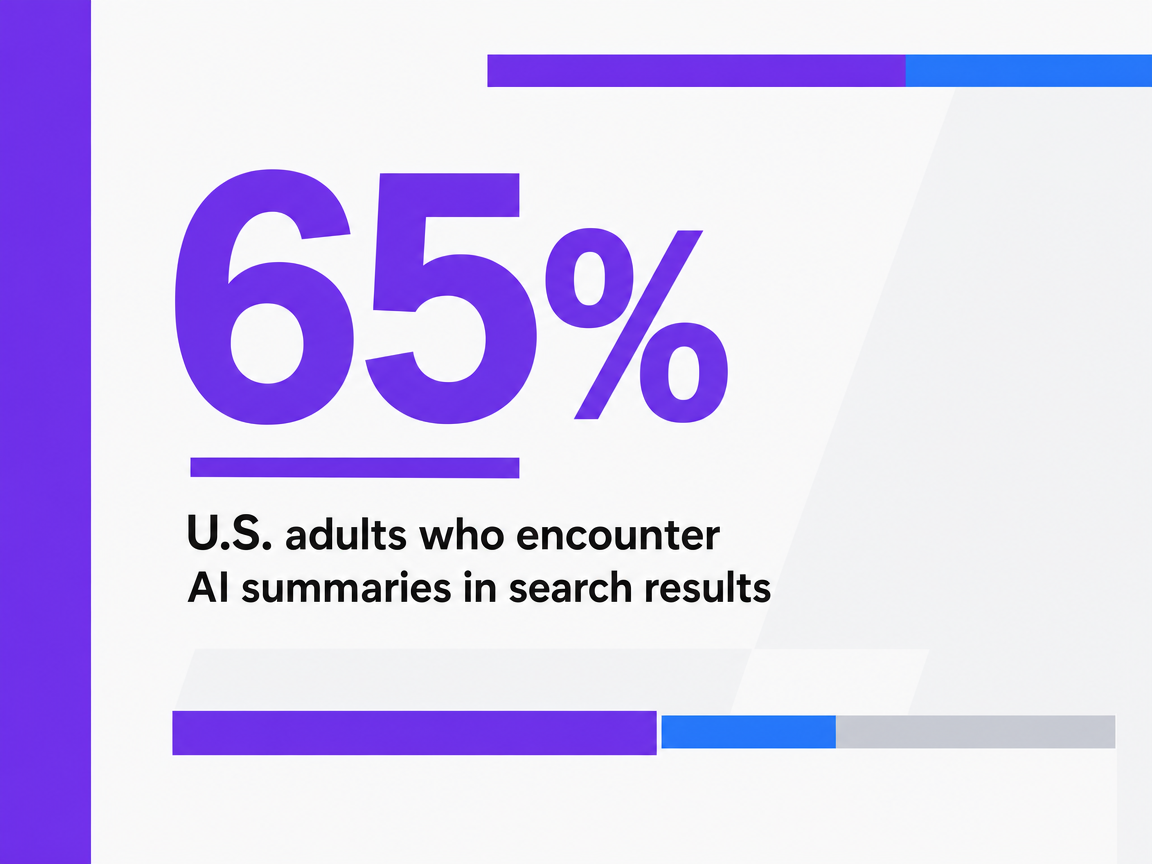 U.S. adults who encounter AI summaries in search results
U.S. adults who encounter AI summaries in search results
Frequently Asked Questions
References
- 1.Do people click on links in Google AI summaries?.
- 2.How Americans feel about AI summaries in search results.
- 3.New front door to the internet: Winning in the age of AI search.
- 4.A marketing organization that thrives with AI.
- 5.The economic potential of generative AI: The next productivity frontier.
- 6.Marketing and sales soar with generative AI.
- 7.How generative AI can boost consumer marketing.
- 8.Harnessing generative AI for B2B sales.
- 9.AI Risk Management Framework | NIST.
- 10.Information Retrieval and Retrieval-Augmented Generation.