
Key Takeaways
- Google Search Console's Generative AI performance report gives agencies a free baseline for AI visibility on Google surfaces, mapped to URLs already tracked, though it misses ChatGPT, Perplexity, and Claude 10.
- AI Results Tracker captures daily citations at the page level across six engines, turning AI Overview appearances into actionable editorial priorities rather than brand-only mentions 6.
- Rankscale focuses on prompt-level share of voice, letting strategists build client-specific prompt libraries and monitor brand versus competitor mentions across ChatGPT, Gemini, Perplexity, and AI Overviews 3.
- Peec AI supports board-level competitive narratives by benchmarking brand visibility, sentiment, and rival share of voice across AI engines, though its per-domain pricing scales linearly with client count 2, 8.
- Otterly.AI suits boutique rosters of eight to twelve clients by reporting brand appearance for a defined prompt set in ChatGPT and Perplexity, but per-domain pricing limits scalability 2.
- AiCarma reduces reporting overhead through daily visibility scoring and automated weekly emails covering AI Overviews, ChatGPT, and Perplexity, though it omits Gemini, Claude, and Copilot 8.
- SE Ranking's GEO tool consolidates keyword rankings and AI visibility inside one dashboard, cutting reconciliation work for mid-sized rosters while lagging on Claude, Copilot, and Grok coverage 3, 7.
- Vectoron functions as an execution layer rather than a tracker, routing citation gaps from measurement tools into a specialist approval workflow across content, SEO, backlinks, and PPC.
- Agencies running 40-plus clients should sequence the stack: Search Console first, then a citation-depth tracker for non-Google engines, then selective enterprise benchmarking where retainers justify per-domain cost 2, 10, 12.
The measurement layer agencies are missing
Traditional rank tracking tells agency SEO leads where a client ranks for a query on a ten-blue-link results page. However, it doesn't indicate whether ChatGPT recommends that client, if Perplexity cites the client's blog, or if Google's AI Overview names a competitor above them. These AI-driven responses now influence a growing portion of buyer journeys that conclude within an AI interaction, often without generating a click to a tracked landing page 7. Nielsen Norman Group's research confirms this shift, noting that generative AI is reshaping search behavior, yet many users still rely on Google. This necessitates that agencies cover both traditional and AI search surfaces simultaneously 15.
The vendor landscape has responded aggressively, with over 50 GEO tools claiming to measure AI search visibility across engines like ChatGPT, Google AI Overviews, Perplexity, Gemini, and enterprise extensions for Claude, Copilot, Grok, and DeepSeek 7. This abundance creates a challenge rather than a solution, as feature comparisons become complex due to overlapping claims and widely divergent pricing models. A tool that is viable for 10 clients might become unsustainable for 40.
This shortlist focuses on eight tools that address the specific needs of an agency SEO lead: establishing a free baseline, capturing daily citation data, benchmarking competitive share of voice, and linking visibility signals back to execution across a client portfolio. Each tool's profile highlights its primary function rather than a comprehensive feature list.
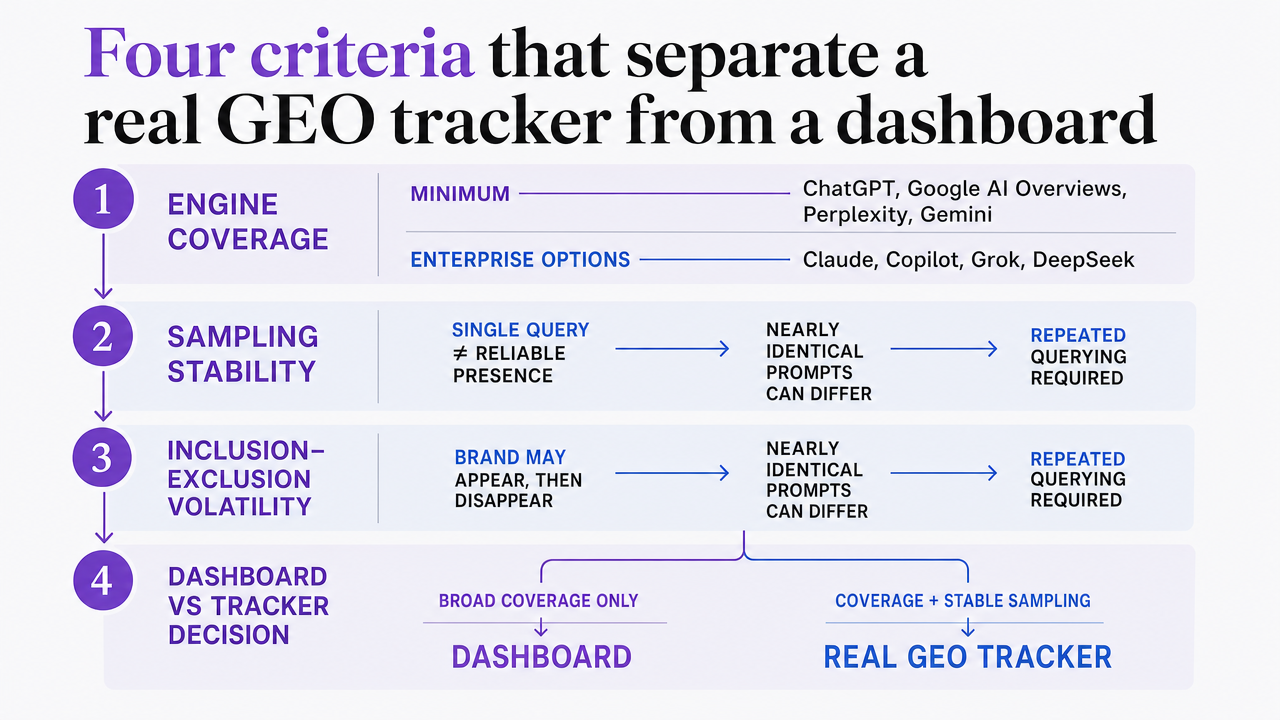
Four criteria that separate a real GEO tracker from a dashboard
Engine coverage and sampling stability
Engine coverage is an easily verifiable criterion, though its importance can be overstated. A robust tracker should, at minimum, query ChatGPT, Google AI Overviews, Perplexity, and Gemini, with enterprise options for Claude, Copilot, Grok, and DeepSeek if a client base requires it 7. While vendors often highlight broad coverage, such claims are meaningless if the underlying sampling is insufficient.
Sampling stability is a more challenging, yet crucial, criterion. Research on AI visibility measurement indicates that a single query cannot reliably assess brand presence. Generative search exhibits an inclusion-exclusion dynamic, where a brand might appear in one response but be absent from the next, even for a nearly identical prompt 12. This volatility means a dashboard that reports one-shot visibility scores offers a snapshot rather than a consistent metric.
Agency SEO leads evaluating tools should prioritize three questions before examining the user interface:
- how many times is each engine queried per prompt,
- how frequently is the prompt set re-run, and
- does the tool expose the raw response distribution or only a smoothed average?
Tools that sample each prompt once a week and obscure variance will produce client reports with inexplicable shifts. Conversely, tools that sample repeatedly and provide confidence intervals offer defensible data for client presentations.
Integration with existing SEO data and per-client cost shape
The third criterion is whether a GEO tool integrates with an agency's existing rank tracker, Search Console data, and log analysis, or if it creates a redundant, parallel silo. An effective GEO layer maps AI citations to the specific URLs already monitored by a rank tracker. This allows strategists to identify pages that achieve both traditional blue-link positions and inclusion in AI answers. Tools that only report brand-level mentions leave the URL-level attribution work to the agency.
The fourth criterion, per-client cost structure, is often where agency evaluations falter. Recent taxonomies categorize GEO tools into four groups: enterprise deep-analytics platforms, self-serve dashboards, free graders, and content optimization engines 2. Each category has distinct pricing, and this pricing model dictates scalability.
| Category | Typical pricing shape | Engine coverage | Scales linearly per client? |
|---|---|---|---|
| Enterprise deep-analytics platforms | Flat platform fee plus per-domain | Broad, including Claude and Copilot | Yes, cost rises with each added client |
| Self-serve dashboards | Per-domain or per-prompt tier | ChatGPT, AI Overviews, Perplexity, Gemini | Yes, punitive above 40 domains |
| Free graders | None, one-off audits | Limited, often ChatGPT only | N/A, not built for portfolios |
| Content optimization engines | Per-seat or per-workspace | Varies; often paired with editorial tooling | No, closer to flat as clients grow |
GEO tool categories mapped to pricing and portfolio scalability 2.
Per-domain pricing can be a significant pitfall. A tool that is affordable for ten clients can quickly exceed the retainer budget when scaled to forty. Per-seat and per-workspace models offer more stable costs as client numbers grow, a factor often more critical than any feature on a comparison sheet.
 Visualize the four evaluation criteria as a decision framework that agency SEO leads can apply when auditing GEO tools, directly supporting the section's comparison logic
Google Search Console Generative AI performance report
The essential free baseline for any agency, before investing in paid GEO tools, is already available within Google's own ecosystem. Search Console's Generative AI performance report provides data on impressions, pages, countries, devices, and dates for content appearing in AI features on Search and Discover 10. Google's optimization guide explicitly directs site owners to this report to understand how users discover content through generative AI experiences 4.
For agencies managing 40 or more client properties, this report offers operational rather than strategic value. The data is accessible within the familiar Search Console interface, incurs no per-domain cost, and maps AI-feature impressions to the exact URLs already monitored by existing rank trackers. This URL-level anchoring is a key advantage, as most paid GEO tools report brand mentions within AI responses rather than specifying which page earned the citation.
It's equally important to acknowledge the report's limitations. It covers only Google surfaces, leaving ChatGPT, Perplexity, and Claude visibility unmeasured. It reports impressions, not clicks or conversions, thus not directly addressing business value 10. Furthermore, Google's documentation notes that AI-feature traffic is integrated into the standard Performance report under the Web search type 9, making it harder to isolate AI-driven behavior in downstream analytics than the dedicated view might suggest.
The practical approach is to enable this report across all client properties immediately, then identify which paid tools are needed to cover the ChatGPT, Perplexity, and Gemini gaps that Search Console cannot address.
AI Results Tracker for daily page-level citation data
After establishing the Search Console baseline, agencies typically need to address the blind spots concerning ChatGPT, Perplexity, and Gemini. AI Results Tracker fills this gap by offering daily citation monitoring across Google AI Overviews, AI Mode, ChatGPT, ChatGPT Search, Gemini, and Perplexity. Crucially, it captures citation URLs at the page level, not just the domain level 6.
Page-level URL capture is a significant operational advantage. While brand-mention tools inform strategists that a client was named in an AI response, URL-level tools specify which article, service page, or FAQ earned the citation. This data point directly links an AI Overview appearance to a specific piece of content the agency produced, transforming a visibility dashboard into an actionable editorial priority list.
Daily sampling also mitigates the issue of single-shot volatility 12. Querying a prompt set daily across six engines generates enough observations weekly to differentiate genuine trends from noise. This meets the minimum requirement for client-facing charts that won't necessitate monthly caveats.
The trade-off is scope. AI Results Tracker is designed for citation depth on a defined prompt list, not for prompt discovery or sentiment scoring. Therefore, it functions best when paired with a broader analytics platform rather than as a standalone solution for an entire portfolio.
Test real-time SEO tracking for your clients
Validate AI-driven SEO insights and publish results before committing to a full platform rollout.
Rankscale for prompt-level share of voice
Rankscale addresses a question left open by the AI Results Tracker workflow: not just which URLs are cited, but how a client's brand performs in terms of share of voice against competitors for specific prompts relevant to the buying journey. The platform is positioned as an all-in-one GEO console that tracks, analyzes, and optimizes visibility across AI search engines, with prompt-level reporting as its core analytical unit 5.
For an agency SEO lead, the operational value lies in prompt curation. A rank tracker's keyword list differs from a GEO prompt set. Buyers using ChatGPT for recommendations phrase queries as full sentences with specific intent and constraints, and share of voice can vary significantly between a broad category prompt and a narrower comparison prompt. Rankscale's console allows strategists to build client-specific prompt libraries and then monitor brand mentions, competitor mentions, and cited sources across ChatGPT, Gemini, Perplexity, and AI Overviews for that fixed set 3.
Two important considerations for evaluation are that fixed prompt sets can bias measurement towards queries the agency already knows to ask, potentially understating long-tail exposure. Additionally, prompt-level dashboards are susceptible to the same inclusion-exclusion volatility as any single-shot sample 12. Therefore, strategists should confirm the sampling cadence before using share-of-voice charts to inform client narratives.
Peec AI for competitive visibility benchmarking
Peec AI falls into the enterprise deep-analytics category of GEO tools, designed for marketing leaders and SEOs who require competitive positioning data across AI engines, rather than just raw citation logs 5. The console tracks brand visibility, mentions, sentiment, and competitor rankings across ChatGPT, Gemini, Perplexity, and AI Overviews, providing benchmarking reports that prioritize competitor share of voice as a key metric 8.
For an agency portfolio, Peec AI facilitates board-level narratives. When a client's CMO questions why a competitor consistently appears in ChatGPT recommendations for their category, a citation-only tracker cannot provide an answer. Peec AI's competitive rankings directly expose this disparity, showing which rival brands dominate specific prompt clusters and how that share fluctuates weekly. This is the type of chart a strategist would present in a quarterly review, not a raw URL feed.
Two operational points are crucial for evaluation. Enterprise deep-analytics platforms often have a pricing structure that can be challenging for portfolios: flat platform fees combined with per-domain charges scale linearly with each client added to the account 2. Furthermore, sentiment scoring within AI responses still employs fragmented methodologies across vendors. Therefore, strategists should verify how the tool classifies neutral versus positive mentions before communicating sentiment differences to a client.
Otterly.AI for lightweight monitoring across small client rosters
Not every agency portfolio requires an enterprise deep-analytics platform. For a boutique roster of eight to twelve clients, particularly those focused on local service verticals, the prompt set is often small enough for a lightweight monitoring tool to provide adequate coverage without excessive overhead. Otterly.AI fits this niche within curated GEO tool inventories, alongside tools like AiCarma and Am I on AI?, which are designed to check brand appearance within AI answers for a defined set of prompts 8.
Otterly.AI performs a practical, albeit unglamorous, function: a strategist inputs the prompts that a client's buyers actually use in ChatGPT and Perplexity, and the tool reports whether the brand appears, which competitors appear instead, and how these appearances change over time 3. This output can directly feed a monthly client update without requiring a data-engineering step. For an agency SEO lead needing a visibility signal for a dental group or a regional law firm, this lightweight option directly answers the client's question.
However, its scalability is limited. Self-serve dashboards in this category typically price per domain, meaning a tool suitable for a twelve-client roster can become a significant budget item long before the roster reaches forty 2. Small prompt libraries also exacerbate the single-shot sampling problem, so strategists should confirm the sampling frequency before interpreting week-over-week changes as trend data 12.
AiCarma for daily visibility scoring and client-facing reports
Many GEO tools overlook the challenge of generating client-friendly weekly reports. AiCarma, featured in curated GEO tool inventories, functions as a daily visibility scorer that delivers weekly email reports detailing how Google AI Overviews, ChatGPT, and Perplexity describe a brand 8. The output is intentionally concise: a single trended score per brand, accompanied by narrative context explaining what these engines are saying week over week.
For an agency SEO lead, AiCarma significantly reduces client communication overhead. A daily score sampled across three high-traffic engines provides strategists with enough observations to distinguish signal from noise amidst the inclusion-exclusion volatility that affects single-shot dashboards 12. The automated weekly email format eliminates a manual reporting step for account managers, which is particularly beneficial for a 40-client portfolio compared to a 10-client one.
The primary limitation is scope. Coverage of only three engines leaves Gemini, Claude, and Copilot unmonitored, and a single visibility score compresses the URL-level attribution that a citation-depth tool provides. AiCarma is best utilized as a reporting layer on top of a tracker like AI Results Tracker, rather than as a replacement for it.
See How Leading Agencies Track AI Search Performance at Scale
Request a walkthrough of unified SEO tracking workflows purpose-built for agencies managing multi-client portfolios, including live dashboards, automated reporting, and advanced AI-driven SERP visibility analysis.
SE Ranking's GEO tool for hybrid rank and AI reporting
While many tools assume strategists will use a separate console for AI visibility data, SE Ranking's Generative Engine Optimization tool caters to the opposite preference. It offers a hybrid workflow where keyword rankings and AI answer engine visibility are accessible within the same platform an agency already uses for daily rank tracking. This tool falls into the hybrid SEO-plus-AI category of the GEO tool taxonomy, similar to dashboards like Beamtrace and Searchable that integrate generative visibility into an existing SEO suite 2, 3.
For an agency SEO lead, its main benefit is workflow consolidation. When a strategist can access a client's traditional keyword position, Google AI Overview citation status, and ChatGPT mention rate from a single login, the reporting cycle becomes more efficient. Account managers no longer need to reconcile data from two vendor exports before each client review, and the URL list already monitored by a rank tracker becomes the same list scored by the GEO layer. This unified view is a practical reason why hybrid platforms have gained traction among agencies with mid-sized rosters 3.
The trade-off is depth. Hybrid tools typically prioritize coverage of the highest-traffic AI engines and may lag in supporting Claude, Copilot, and Grok. This can be a concern for agencies with clients in verticals where these surfaces are important 7. Sampling cadence and prompt-set flexibility also differ from dedicated GEO consoles. Therefore, strategists should confirm both aspects before relying on a hybrid dashboard as the sole AI visibility source, rather than viewing it as a consolidated interface above a citation-depth tracker.
Vectoron for closing the loop between visibility data and execution
The seven tools discussed so far primarily focus on measurement. They do not facilitate the creation of content, backlinks, or on-page changes that a detected citation gap might necessitate. This transition from dashboard insights to editorial calendar and publishing queue is where many agency SEO leads lose efficiency at scale. Vectoron addresses this by acting as an execution layer, rather than just another visibility tracker. It coordinates specialist strategists across content, SEO, backlinks, PPC, social, and call intelligence within a single approval workflow.
Vectoron's role for an agency SEO lead is to close the loop. When a hybrid tool like SE Ranking identifies a client losing AI Overview citations on a service-page cluster, or when Peec AI shows a competitor gaining share of voice at the prompt level, the subsequent brief, draft, and publish cycle often involves multiple vendors and account managers. An execution platform streamlines this process: the visibility signal enters a Command Center, a specialist strategist prioritizes the response against other pending work, and the recommended fix is routed for human approval before implementation.
The trade-off is its category. Vectoron is not a replacement for the citation-depth tracking provided by AI Results Tracker or the competitive benchmarking offered by Peec AI 8. Instead, it complements them. The measurement stack identifies the gaps, and the execution layer closes them across 40-plus client accounts without requiring additional delivery headcount.
If you manage 40+ client accounts: sequencing the stack
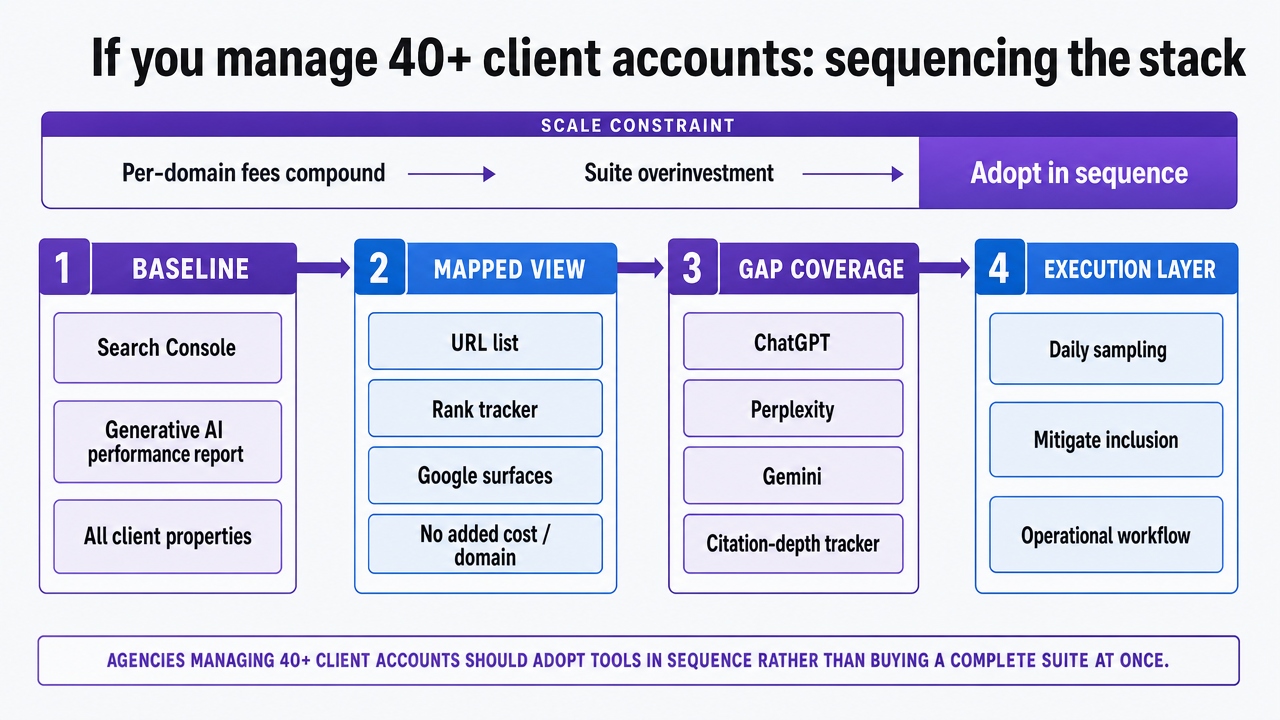
For agencies managing a large portfolio, the tool selection process changes significantly. A stack suitable for a boutique roster can become a budget burden when per-domain fees compound with each added client. Conversely, an enterprise-grade stack might be an overinvestment when spread across forty mid-market clients. Agency SEO leads at this scale should adopt tools in sequence rather than purchasing a complete suite at once.
- The first step is establishing a free baseline: enabling Search Console's Generative AI performance report across all client properties, mapped to the URL list already monitored by the rank tracker 10. This covers Google surfaces at no additional cost per domain.
- The second layer addresses the ChatGPT, Perplexity, and Gemini gaps, using a citation-depth tracker with daily sampling to mitigate inclusion-exclusion volatility in client-facing reports 12.
- The third layer involves adding competitive share of voice for critical prompt clusters, selectively for clients whose retainers justify the enterprise per-domain cost structure 2.
The execution layer sits above all three. Visibility data without a clear implementation pipeline still leaves account managers triaging fixes across various vendors. Platforms like Vectoron bridge this gap by routing prioritized recommendations from the measurement stack through a single approval workflow. This enables a 40-client roster to act on GEO signals efficiently without increasing delivery headcount.
 Visualize the sequenced three-layer measurement stack plus execution layer described in the section, giving agency leads a workflow diagram matched to the article's operating model
Frequently Asked Questions
References
- 1.13 Best Generative Engine Optimization (GEO) Tools 2026.
- 2.Best GEO (Generative Engine Optimization) Tools in 2026.
- 3.Top Generative Engine Optimization Tools [By Category].
- 4.Google's Guide to Optimizing for Generative AI Features on Search.
- 5.Top 18 Generative Engine Optimization Tools To Try in 2025.
- 6.27 Best Generative Engine Optimization Tools in 2026 (Review).
- 7.What are generative engine optimization (GEO) tools?.
- 8.izak-fisher/generative-engine-optimization-tools.
- 9.AI Features and Your Website | Google Search Central.
- 10.Introducing Search Generative AI performance reports in Search Console.
- 11.GEO: Generative Engine Optimization.
- 12.Don't Measure Once: Measuring Visibility in AI Search (GEO).
- 13.Latest Google Search Documentation Updates | Google Search Central | What's new | Google for Developers.
- 14.AI Overviews and AI Mode in Search - Google Search.
- 15.How AI Is Changing Search Behaviors.