
Key Takeaways
- Search Console is the non-negotiable visibility baseline because it reports what Google actually showed and clicked, while paid tools like Ahrefs and Semrush earn their seat only for competitor context and gap analysis 4.
- Screaming Frog and Sitebulb belong on a deployment-tied schedule, catching redirect chains, canonical conflicts, and structured-data breakage the week a change ships rather than surfacing lost impressions weeks later 2.
- GA4 carries routine conversion reporting but hits a known ceiling on click-based attribution, so agencies must name last-click limitations before finance does and document the window in use 5.
- Experimentation tools like SearchPilot, RankScience, and geo-holdout designs produce the causal, counterfactual read that defends retainers during procurement review, validated against MRC's randomized-trial truth standard 9.
- Looker Studio assembles Search Console, GA4, crawler, and experiment outputs into one client artifact where every tile discloses source, model, and attribution window for placement-level traceability 7.
- A coordination tier such as Vectoron sits above the tracking stack, ranking recommended actions and routing approvals across a portfolio so analyst reconciliation stops eating retainer margin.
- Privacy governance is a measurement standard, not a footnote: CNIL's three-part exemption on scope, no cross-site reuse, and 13-month lifetime should be applied once per property and re-verified 10.
- At 20-plus accounts, tool licenses typically represent only 10–20% of measurement cost while analyst reconciliation hours dominate, making standardized windows and consolidated reporting the real margin lever 7.
- Clients get moved up the measurement ladder quarter by quarter — visibility and conversions first, disclosed models second, one causal experiment third — so procurement meets a defended retainer, not a rankings report.
What Actually Proves SEO ROI to a CFO-Minded Client
Rank movement does not survive a quarterly business review with a finance team. What survives is a defensible line from search visibility to booked revenue, with the measurement method disclosed and the assumptions written down. Agency leaders who have sat through those reviews already know the pattern: the CMO asks about traffic, the CFO asks what changed in pipeline, and the room goes quiet if the SEO lead can only produce a keyword report.
The measurement bodies have been explicit about why that gap exists. Click-through rate is only an intermediate proxy for the outcome a client actually pays for, and click-based attribution methods carry known flaws that get worse when offline conversions matter 5. The MRC's data-quality standards go further, treating single-touch attribution as something that requires disclosed assumptions and periodic validation against a truth standard rather than a default setting 9.
That reframes what an SEO tracking stack is for. Its job is not to prove that rankings moved. Its job is to connect a content or technical change to a conversion event, hold that connection to a disclosed attribution window, and give the retainer a factual defense when finance pressure-tests the number. The tools that do that well share a structure, which the rest of this piece organizes by measurement layer.
Organizing the Stack by Measurement Layer, Not Brand
Most agency tracking stacks grew by acquisition, not by design. A rank tracker got added when a client asked about keywords, a crawler got added when a technical audit went sideways, and GA4 got layered in because it was free. The result is a bundle of tools that each answer a different question, none of them designed to hand off cleanly to the next.
A more defensible way to organize the stack is by measurement layer. Visibility sits at the bottom: what did search actually surface, and for which queries. On-page and technical sits above it: what changed on the site, and did the change ship correctly. Conversion attribution sits above that: which sessions produced a booked event, and under what disclosed window. Experimentation and incrementality sit at the top: would the outcome have happened without the SEO change at all. A reporting and consolidation layer wraps the whole thing so a client sees one story, not five dashboards.
That framing matters because the MRC treats attribution as a method that requires disclosed assumptions and annual review, not a default setting to leave running 9. Once the stack is organized by layer, each tool has a job to defend, and swapping vendors becomes a decision about capability rather than habit.
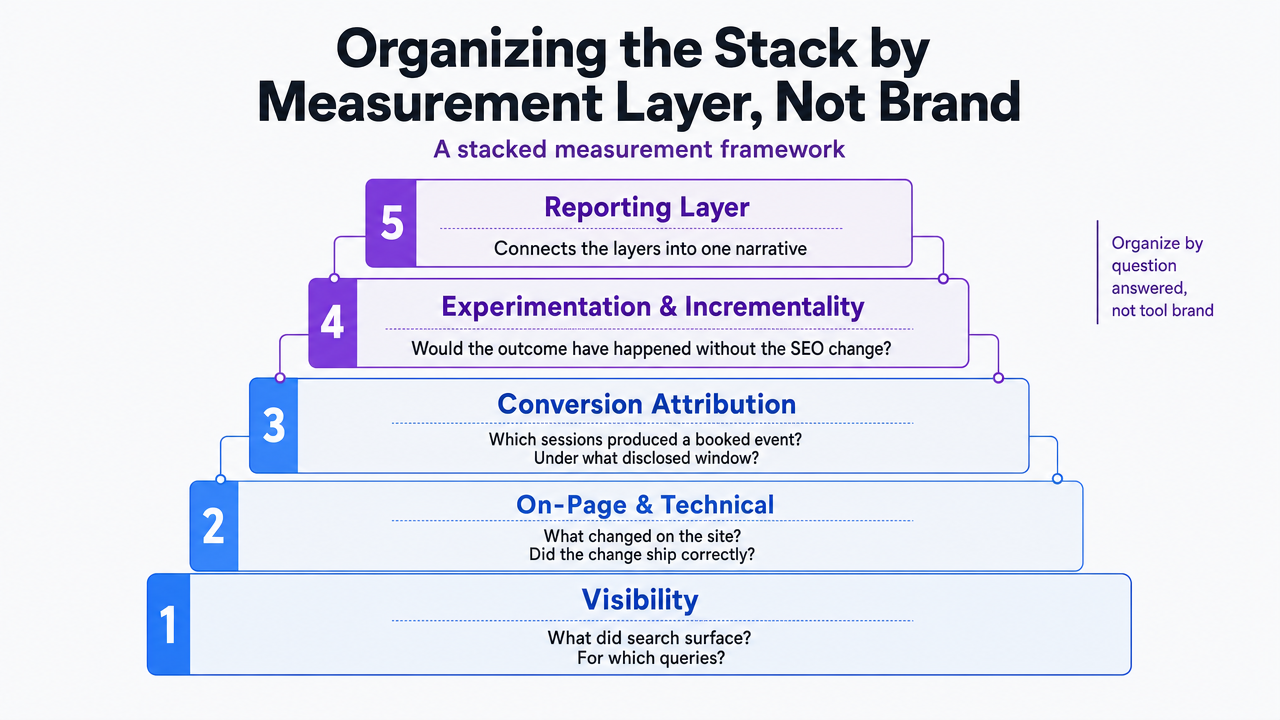 Visualize the five measurement layers described in this section as a stacked framework, which is exactly the structural mental model the section defines
Layer 1: Visibility — Search Console as the Non-Negotiable Baseline
Google Search Console: The Free Layer Every Agency Underuses
Search Console is the only source of truth for what Google actually showed, what users actually clicked, and where a page actually ranked at the moment of the impression. Third-party rank trackers estimate. Search Console reports. That distinction matters when a client's finance team asks why the agency's number disagrees with the platform's own record.
The late-2024 recent-performance view sharpened that baseline. It surfaces clicks, impressions, average CTR, and average position broken down by query, page, and country, with a faster refresh than the standard 16-month report 4. For an agency running weekly stand-ups on a client account, that dimensional cut is the difference between reacting to a ranking shift on Monday and finding it in a monthly export three weeks later. The 2025 Insights update layered a stakeholder-facing summary on top, comparing total clicks and impressions to the prior period without requiring a query builder 3.
Most agencies still treat Search Console as a diagnostic tool the SEO lead opens once a week. The stronger operating model treats it as the primary reporting substrate: query-level and page-level exports feed the client dashboard, and paid tools annotate rather than replace. Google itself positions Search Console as the monitoring layer for crawl, index, and performance health 2, which means the free tier already covers the visibility questions a CFO-minded client is likely to ask first.
Ahrefs and Semrush: Where the Paid Visibility Layer Earns Its Seat
The paid visibility layer earns its seat when it answers a question Search Console structurally cannot. Search Console reports on queries a client's own domain already ranked for. It says nothing about the competitor set, the keyword universe the domain is absent from, or the backlink graph shaping who ranks in the first place. That is the specific job Ahrefs and Semrush do, and it is the only job worth paying for at the visibility layer.
Agency SEO directors already know the feature overlap between the two platforms is close enough that the choice usually comes down to workflow habit, API pricing, and the local index depth for the client's geography. The more useful discipline is deciding what each tool is allowed to report on to clients. Share-of-voice movement across a defined competitor set, keyword gap analysis tied to a content roadmap, and backlink acquisition velocity against a named peer group all hold up in a QBR. Estimated traffic numbers pulled from a third-party clickstream do not, because the client can and will compare them to Search Console clicks and find a gap.
The operational rule that keeps the paid layer defensible: Search Console owns the performance number the client sees, and Ahrefs or Semrush owns the competitive context around it. Mixing the two into a single traffic estimate is where retainers lose credibility during finance review, especially once attribution assumptions start getting audited against MRC-style disclosure expectations 9.
Layer 2: On-Page and Technical — Screaming Frog and Sitebulb as the Diagnostic Tier
The on-page and technical layer answers a narrower question than most agencies use it for: did the change ship correctly, and is the site structurally capable of being measured by the layers above it. A crawler that surfaces 40,000 issues is not doing that job. A crawler tied to a release cadence and a defined set of index-hygiene checks is.
Screaming Frog earns its seat as the SEO director's forensic tool. It reads the site the way a crawler does, exposes redirect chains, indexable-URL drift, canonical conflicts, and structured-data breakage, and does it fast enough to run before and after a content release. That before-and-after posture is the point. Google's own guidance treats crawlability, indexing, and structured content as the operational prerequisites for anything downstream to be measurable 2, which means a technical audit that does not tie to a shipped change is a report, not a diagnostic.
Sitebulb sits in a slightly different job. Its strength is the scored, prioritized audit that a junior analyst can hand to a client's dev team without translation. For agencies delivering technical SEO into engineering-led clients, that translation layer compresses the review cycle. Screaming Frog surfaces the raw signal; Sitebulb packages it for a JIRA ticket.
The operating rule at this layer: the crawler runs on a schedule tied to deployments, not to reporting calendars. A technical issue caught the week it shipped is a fix. The same issue caught six weeks later is a story about lost impressions the client already noticed in Search Console.
Test real-time SEO tracking on live campaigns
See how unified analytics and reporting drive measurable ROI across your client portfolio before you commit.
Layer 3: Conversion Attribution — GA4 and the Limits of Click-Based Credit
GA4 as the Attribution Workhorse and Its Known Ceiling
GA4 is where most agency stacks try to close the loop between a search click and a booked event. It captures the session, ties it to a conversion definition the client's team configured, and applies whichever attribution model the property was set to at the time. That is useful. It is also the point where the measurement conversation stops being about SEO and starts being about the credibility of the number itself.
The academic critique of click-based attribution is direct: click-through rate is only an intermediate proxy for the outcome that actually matters, and the attribution step that turns clicks into credited conversions carries known flaws — flaws that get worse when the conversion happens offline, on a different device, or after a window the model does not see 5. GA4 does not fix that. It reports within the assumptions it was configured with.
That is the ceiling agency SEO directors need to name in front of clients before finance does. Last-click and data-driven models inside GA4 are cheap to run and easy to report, which is why they anchor most retainers. Multi-touch improves the credit picture but adds configuration cost and model-drift risk. Experiment-based incrementality delivers the reliability a CFO will accept as causal, at meaningfully higher operational cost — the MRC treats randomized controlled trials as the truth standard against which other methods should be validated 9. Naming that reliability-versus-cost curve out loud is what keeps GA4 in its lane as a workhorse, not a verdict.
Attribution Window Discipline: What Sophisticated Clients Now Ask About
The attribution window is the assumption most agencies never write down and most sophisticated clients now ask about by name. A 30-day post-click window applied to a legal intake with a 90-day consideration cycle credits the wrong touches and undercounts the SEO contribution. A 90-day window applied to an emergency home-services call inflates it. Neither is defensible without a stated reason.
The IAB/MRC guidance on this is unambiguous: attribution windows must be empirically supported and logically tied to the campaign objective and the sales cycle they are measuring against 8. That is a documentation requirement, not a preference. The window gets chosen, the reasoning gets written down, and the disclosure travels with the number into the QBR deck. The broader guideline set also expects attribution to be reported at the placement level, so organic-search credit does not get quietly bundled into a channel-agnostic total 7.
The operating rule at this layer: every client property has a documented attribution window, a documented model, and a documented review date. When the finance team asks why the SEO number is what it is, the answer is a paragraph, not a shrug.
Layer 4: Experimentation and Incrementality — The Retainer-Defending Tier
The experimentation layer is where SEO stops being reported and starts being proven. It answers the one question the layers below cannot: would the booked conversion have happened without the SEO change at all. That is the question a CFO-minded client eventually asks, and the answer that keeps a retainer intact when procurement runs its next vendor review.
The MRC's position on this is direct. Attribution methods should be reviewed at least annually, their assumptions disclosed, and their outputs validated against randomized controlled trials as the truth standard 9. That is the standard the top of the stack has to meet. Tools that support it include SearchPilot and RankScience for server-side SEO split-testing on template-level changes, Conductor and seoClarity for controlled rollouts across page groups, and geo-holdout designs run through platforms like Statsig or in-house BigQuery pipelines when the client's footprint supports a matched-market cut.
The operating discipline matters more than the vendor choice. A template change ships to half the URL set; the other half holds. Traffic and conversion deltas are measured against the control group, not against last quarter. The result is a causal number the agency can put in front of finance without hedging. It is also the number that reframes the retainer conversation from cost to contribution, because the counterfactual is measured rather than assumed.
Experimentation carries real operational cost — engineering coordination, statistical power requirements, and longer read windows on lower-traffic properties. Agency leaders should reserve this tier for the two or three changes per quarter that most need a defensible causal read, and let GA4 continue to carry the routine reporting underneath.
Layer 5: Reporting and Consolidation — Looker Studio, Vectoron, and the Coordination Problem
Looker Studio as the Client-Facing Assembly Layer
Looker Studio is the seam where the tracking stack becomes a client artifact. Search Console feeds the visibility number, GA4 feeds the credited conversion, the crawler feeds the technical release log, and the experimentation platform feeds the causal read. Looker assembles them into one view the account team can defend line by line.
The assembly discipline matters more than the visual polish. Each tile carries the source system, the attribution window, and the model in use, so a finance reviewer can trace the reported number back to the property it came from — the placement-level reporting posture the IAB/MRC guidelines describe as the baseline for credible attribution disclosure 7. Native GSC and GA4 connectors handle most agency needs; BigQuery becomes the intermediary once query volume or blend logic exceeds what the direct connectors sustain.
What Looker does not solve is the reconciliation work upstream of the dashboard.
Vectoron: The Coordination Tier Above the Tracking Stack
The reconciliation problem is where agency margin quietly leaks. An SEO director running 25 accounts has five tools per account reporting into a dashboard, each with its own refresh cadence, attribution window, and export schema. Analysts spend the first week of every month reconciling numbers that should already agree, and the coordination cost lands on the retainer rather than the license line.
A coordination tier sits above the tracking stack rather than replacing it. Its job is reading the signals the tracking tools already produce — ranking shifts, indexation drift, conversion trend changes, competitor movement — ranking the response by expected impact, and routing the recommended action through an approval workflow before anything ships. Vectoron operates in that tier, coordinating content, technical, and reporting decisions across accounts under a single approval loop, with the strategic reasoning attached to each recommendation.
That framing keeps the tracking stack intact. Search Console still owns the visibility number, GA4 still owns the credited conversion, and the experimentation platform still owns the causal read. The coordination layer decides what to do about them across a portfolio without adding analyst headcount — which is the operating model most agencies now need to defend margin at 20-plus accounts.
See How Leading Agencies Quantify SEO Impact With Unified Tracking
Request a walkthrough of advanced SEO tracking workflows purpose-built for agencies—connect rankings, traffic, conversions, and client reporting in a single approval-driven dashboard. Discover how to streamline ROI proof across every client engagement.
Privacy and Governance as a Measurement Standard, Not a Footnote
Privacy configuration is where a tracking stack either holds up to a client's legal review or quietly disqualifies itself. Agency SEO directors serving regulated verticals — health systems, behavioral care, legal intake, senior living — increasingly see analytics setups audited alongside the retainer scope, and the audit does not distinguish between an SEO tool and a marketing tool. It asks what is being collected, how long it is kept, and whether the configuration would survive a regulator's read.
CNIL's guidance draws the operational line clearly. Audience-measurement cookies may be exempt from consent only when three conditions hold together: the trackers are limited to audience measurement and A/B testing, the data is not cross-checked or reused across sites, and the tracker lifetime is capped at 13 months 10. That is a configuration checklist, not a philosophy. Every client property gets the same three settings applied once, documented, and re-verified when a new tool joins the stack.
The forward posture is privacy-preserving measurement as infrastructure rather than exception. NIST's evaluation guidance for differential privacy signals where sophisticated buyers will push next: analytics outputs that carry mathematical guarantees about what an individual record can reveal 1. Agencies do not need to deploy that today. They do need to name it in the governance section of the QBR deck, so the client's legal team hears the stack described in the vocabulary its own auditors are already using.
If You Manage 20+ Accounts: Tracking Stack Cost vs. Analyst Reconciliation Hours
The audience for this section is narrower: agency operators running 20 or more client accounts through a shared analyst team. At that portfolio size, the license line stops being the interesting number. Reconciliation hours are.
A typical setup carries four to five tracking tools per account — Search Console, GA4, a paid visibility platform, a crawler, and whatever the client's own martech contributes. Each has its own refresh cadence, export schema, and attribution assumption. The analyst work of aligning those into one defensible number lands every month, on every account, and scales linearly with the roster. Placement-level reporting standards make that reconciliation non-optional rather than a nice-to-have, because credit has to be traceable back to the source system 7.
The compact model below uses variables rather than invented vendor pricing. Agency leaders can drop in their own seat costs and blended analyst rate to see where the true measurement cost sits.
| Line item (25 accounts) | Variable | Monthly cost ||---|---|---|| Tracking tool licenses (per-seat, all platforms) | L | L || Analyst reconciliation hours per account | H | — || Blended analyst hourly cost | R | — || Total reconciliation cost | 25 × H × R | 25HR || Tool spend as share of total measurement cost | L ÷ (L + 25HR) | typically 10–20% |
The wedge is the 25HR line. Consolidating reporting substrates, standardizing attribution windows across the roster, and routing cross-account decisions through a single approval layer is where agency margin at portfolio scale actually gets recovered.
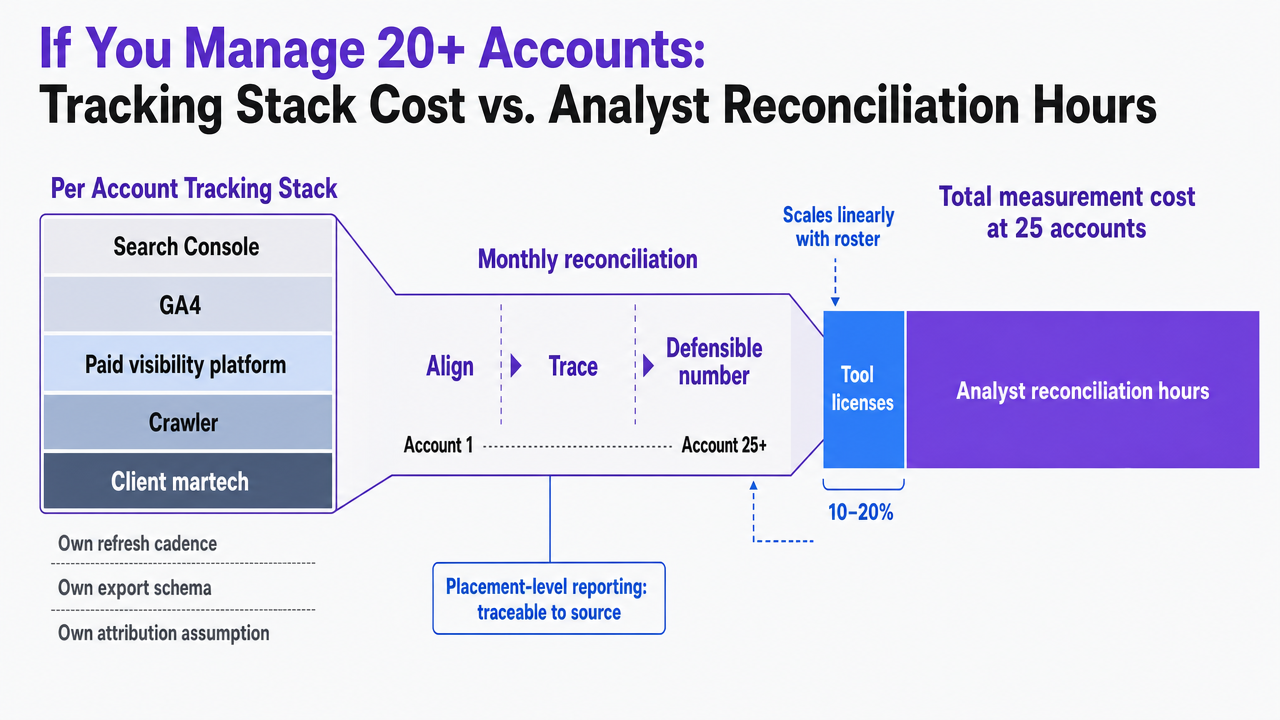 Visualize the cost-composition point the section makes explicitly: that at 25 accounts, tool licenses are only 10–20% of total measurement cost while analyst reconciliation hours dominate. The section states this share directly, so the number is cited in nearby prose
Moving Clients Up the Measurement Ladder Without Losing the Retainer
Clients rarely arrive asking for causal proof. They arrive asking for rankings, then traffic, then leads, in that order. The agency's job is to move them one rung at a time without breaking the retainer while the vocabulary shifts underneath.
A workable sequence: start the first quarter reporting on visibility and credited conversions from Search Console and GA4, with the attribution window written into the dashboard. Use the second quarter to introduce placement-level disclosure and named model assumptions 7. Reserve the third quarter for one experiment on a template change, with the causal delta reported alongside the routine number.
By the time procurement runs its review, the retainer is defended by measurement discipline the client's finance team has already learned to read.
Frequently Asked Questions
References
- 1.Guidelines for Evaluating Differential Privacy Guarantees.
- 2.Search Engine Optimization (SEO) Starter Guide.
- 3.The new Search Console Insights report is here.
- 4.An improved way to view your recent performance data in Search Console.
- 5.Measuring the Effects of Advertising: The Digital Frontier.
- 6.Measuring the Effects of Advertising: The Digital Frontier.
- 7.IAB/MRC Retail Media Measurement Guidelines.
- 8.IAB/MRC Retail Media Measurement Guidelines.
- 9.MRC Outcomes and Data Quality Standards.
- 10.Sheet n°16: Use analytics on your websites and applications.