
Key Takeaways
- Run SEO as three concurrent clocks—daily monitoring, weekly optimization, monthly strategy—each with its own owner, trigger conditions, and definition of done rather than one merged checklist.
- Allocate roughly 15-20% of hours to monitoring, 45-55% to weekly optimization, and 25-35% to compounding work like pruning, consolidation, and competitive gap analysis.
- Protect indexation checks, metadata QA on recently changed pages, and internal linking on new content; defer net-new production before cutting maintenance when capacity tightens.
- Audit cadence using the pruning ratio, maintenance-to-publish ratio, and whether compounding work survives capacity cuts—these predict organic performance more reliably than tooling 8.
Three Clocks, Not One Checklist
Most SEO articles flatten the work into a single 40-item checklist. That format hides the only thing directors actually need to manage: cadence. A title tag fix and a quarterly content prune are not the same kind of work, do not deserve the same review queue, and almost never share an owner.
The more useful frame is three concurrent clocks. The daily clock runs monitoring and anomaly response, watching indexation, ranking drift, and traffic shape. The weekly clock runs optimization, content updates, internal linking, and technical QA. The monthly clock runs strategy, audits, pruning, and competitive gap work. Each clock has its own owner, its own trigger conditions, and its own definition of done.
This is consistent with how authoritative guidance already describes the discipline. Public-sector and university references treat SEO as ongoing content quality and maintenance work rather than a launch task 1, 3, 8. A 2024 peer-reviewed study of SEO strategy among small and medium enterprises identified persistence, differentiation, and value as the elements that predict visibility outcomes, reinforcing that continuous optimization outperforms ad hoc edits 12.
The directors who outperform are not running more tasks. They are running tighter loops on each clock, consolidating low-leverage execution, and reserving human judgment for the work that compounds. The rest of this article maps that operating model.
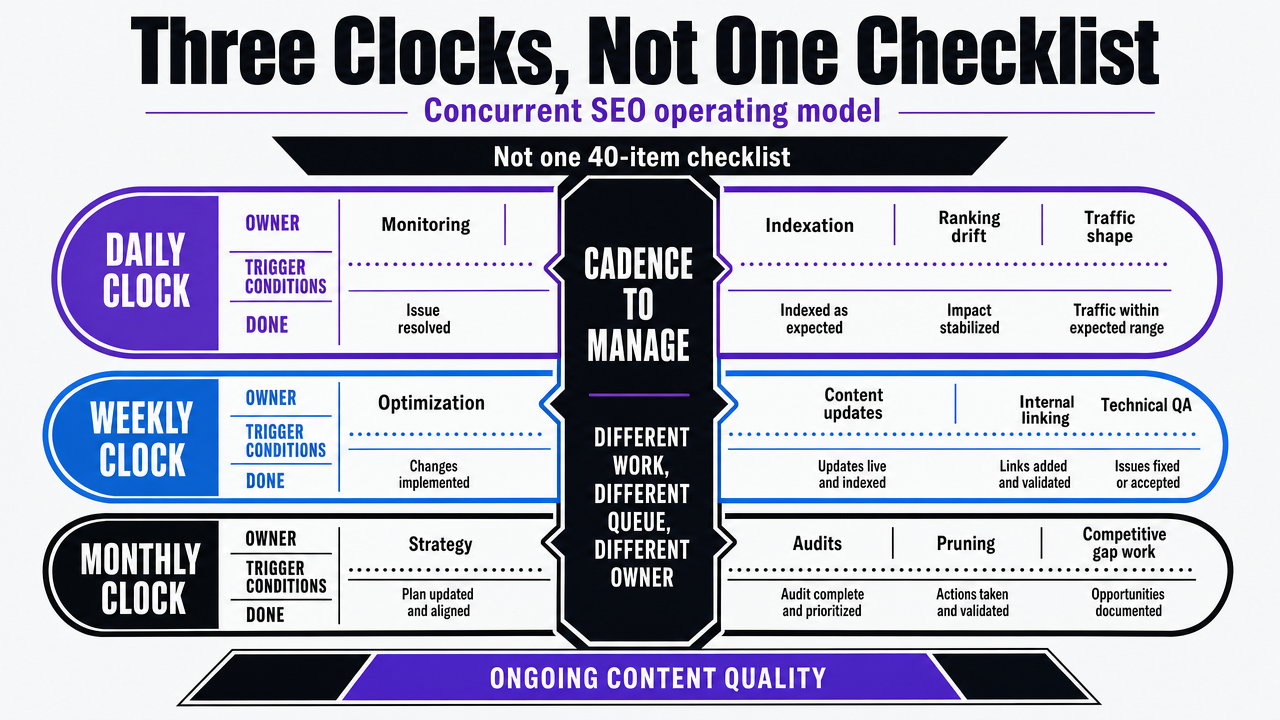 Visualize the three concurrent SEO clocks operating model introduced in this foundational section, showing the distinct cadence, ownership, and focus area for each clock
The Daily Clock: Monitoring and Anomaly Response
What Belongs on the Daily Clock
The daily clock is narrow on purpose. It exists to catch breakage before it compounds, not to ship optimization work. Three categories belong here:
- Indexation checks
- Ranking drift detection
- Traffic anomaly triage
Everything else is weekly or monthly work in disguise.
Indexation monitoring asks a single question every morning: did pages that should be in the index stay in the index, and did pages that shouldn't be there stay out? A new noindex tag pushed by a release, a robots.txt change, or a canonical pointing to the wrong URL can vanish a page section overnight. Government guidance frames SEO as ongoing maintenance precisely because these failure modes do not announce themselves 1, 4.
Ranking drift detection is not about position-checking every keyword. It is about watching a fixed set of revenue-weighted queries — usually 20 to 50 — and flagging movements of three or more positions for a same-day look. Below that threshold is noise.
Traffic anomaly triage uses session, click, and impression deltas against a rolling baseline. The output of the daily clock is not a report. It is a decision: ignore, log for the weekly queue, or escalate now. Owners should be a specialist or an automated monitor with a defined escalation path, not a generalist marketer scanning dashboards.
Time-on-Task Ranges and Triage Logic
Daily monitoring should consume 15 to 30 minutes of human attention on a quiet day, and 60 to 90 minutes when a release ships or a core update lands. Anything longer is a sign the work is not being filtered before it reaches a person.
A workable triage rule:
- Tier one issues — index coverage drops above five percent, a top-20 query falling off page one, or a same-day traffic decline beyond two standard deviations — get a same-day investigation.
- Tier two issues, like a single page slipping two positions or a small impression dip, queue for the weekly review.
- Tier three is logged and aggregated for the monthly audit.
The triage decision matters more than the dashboard. Most teams over-invest in the daily clock by reacting to tier two and tier three signals as if they were tier one. That trains the SEO lead to live inside Search Console rather than ship optimization work. The CT.gov framing of SEO as steps that help users find content is a useful corrective: daily activity exists to protect discoverability, not to demonstrate effort 4.
What to Skip When Capacity Is Constrained
When capacity is tight — a vacation, a launch week, a hiring gap — the daily clock is the easiest place to cut without losing performance, provided cuts follow a clear rule. Keep indexation monitoring on every working day. Index loss is the one failure mode that does not self-correct and compounds with each crawl cycle.
Drop daily rank tracking to a twice-weekly check on the revenue-weighted query set. Position movement under five places resolves itself often enough that daily inspection rarely changes the next action.
Defer traffic anomaly review to alert-driven only. Set a threshold, ignore everything below it, and trust the weekly clock to surface slower trends. Skipping daily competitor checks, SERP feature scans, and backlink monitoring entirely for two to four weeks rarely changes outcomes. These are monthly activities mislabeled as daily ones in most operating models.
The Weekly Clock: Optimization and Content Maintenance
Content Updates as a First-Class Weekly Activity
Most programs treat content maintenance as an annual project. That is the wrong unit of time. Pages decay continuously — facts go stale, intent shifts, competitors publish deeper answers — and the gap between a useful page and a thin one widens week by week. Public-sector guidance has been explicit on this point for years: ongoing maintenance is part of SEO, not a separate initiative 1, 3.
A defensible weekly cadence treats content in three buckets with different review intervals:
- Time-sensitive pages — pricing, product specs, regulatory or clinical references — get a weekly check on a rotating schedule, with the highest-traffic pages cycling every two to four weeks.
- Evergreen pages that drive meaningful organic sessions get a quarterly refresh, queued into the weekly clock so the work distributes across the year rather than piling into a year-end audit.
- Thin or underperforming pages get a weekly triage call: refresh, consolidate, or remove.
VA.gov guidance on unique title tags and meta descriptions, paired with Cal Poly's principle of publishing fewer, better, durable pages, gives directors a benchmark to audit against 2, 8.
The production standard for any updated page is narrow: two to three primary keywords, a search-friendly title, and the target query repeated in discoverable text elements such as the H1, the first paragraph, and at least one subheading 11.
Internal Linking and Crosslink Discipline
Internal linking is the highest-leverage weekly activity that most teams under-invest in. New pages enter the site with zero incoming internal links by default, and existing pages that should point to them rarely do without a deliberate pass.
A weekly crosslink session has a defined input: every page published or substantially updated in the prior seven days. For each one, the SEO lead identifies three to seven existing pages that should link to it, using descriptive anchor text tied to the target query rather than generic phrases like "learn more" or "click here." Government guidance is direct on both points — link to related pages, and use descriptive link text 1.
The second pass goes the other direction: the new page itself should link to two to four related existing pages, building lateral paths through the site rather than dead-end leaves. State guidance frames this as crosslinking that helps users and crawlers find related, useful content 3. A weekly cadence keeps the link graph current; a quarterly cadence guarantees orphaned pages.
Weekly Technical QA: Indexation, Metadata, Thin Pages
Weekly technical QA is not a full audit. It is a fixed scan of three failure modes that compound if left for the monthly clock.
Indexation reconciliation compares the previous week's published or updated URLs against what is actually indexed. Anything published more than seven days ago that is still missing from the index gets a same-week investigation: canonical conflicts, noindex tags carried over from staging, robots directives, or quality signals dragging the page below the indexing threshold.
Metadata QA scans new and updated pages for duplicate title tags and meta descriptions. VA.gov flags duplicates as bad for SEO and confusing for users, which makes them a weekly check rather than a quarterly cleanup 2. A simple query against the CMS or a crawl report surfaces collisions in minutes.
Thin-page review uses two thresholds: pages under roughly 300 words of unique body content, and pages with high impressions but low click-through that suggest a title-intent mismatch. Each flagged page enters the weekly content queue with a disposition — expand, consolidate, or remove — rather than waiting for a monthly audit to surface it. The principle behind the standard is consistent across authoritative guidance: maintain fewer, better, durable pages 8.
Experience Full-Cycle SEO Execution in One Week
See daily, weekly, and monthly SEO workflows in action—publish real content and measure immediate impact.
The Monthly Clock: Strategy, Pruning, and Competitive Gaps
Monthly Audits Worth Running
Most monthly audits fail by trying to cover everything. A defensible monthly clock runs three audits in depth and leaves the rest to the weekly queue.
- The first is a full crawl audit against the canonical site map. The output is a reconciliation list: pages that exist but should not, pages that should exist but are not linked, and pages indexed under unexpected URLs. This is where staging leaks, parameter sprawl, and orphaned PDFs surface. Daily and weekly checks catch single-page failures; only a monthly crawl exposes architectural ones.
- The second is a metadata uniqueness audit across the full corpus. Weekly QA catches new duplicates; the monthly pass catches drift accumulated across templates, category pages, and programmatic content. VA.gov flags duplicate titles and meta descriptions as bad for SEO and confusing for users, which makes a full-corpus sweep a monthly minimum rather than a quarterly project 2.
- The third is a performance audit tied to revenue-weighted query groups: which pages gained, which decayed, which never ranked despite traction in adjacent queries. The deliverable is not a slide deck. It is a ranked input list for the next month's weekly queue — pruning candidates, refresh candidates, and net-new content slots — built from the persistence and differentiation logic that predicts visibility outcomes in continuous SEO programs 12.
Pruning, Consolidation, and the Durable-Page Standard
Pruning is the monthly activity that most teams defer indefinitely, and the one with the highest compounding payoff. The standard to audit against is straightforward: fewer, better, durable pages outperform large libraries of thin or overlapping ones 8.
A workable monthly pass uses three dispositions:
- Consolidate covers pages that compete with each other for the same query — typically two or three blog posts, a landing page, and a category page all chasing the same intent. The consolidation merges the strongest content into one canonical URL, redirects the others, and inherits the combined link equity.
- Refresh covers pages that still earn impressions but have decayed in click-through, depth, or accuracy; these enter the weekly content queue with a defined scope.
- Remove covers pages with no impressions, no internal links worth preserving, and no strategic role. A 410 or a redirect to a relevant parent is cleaner than leaving the page to drag down crawl efficiency.
The Department of Energy and Georgia state guidance both frame this work as ongoing content maintenance rather than a one-time cleanup, which is the right mental model: the durable-page standard is a monthly discipline, not an annual project 1, 3.
Competitive Gap Analysis and Content Planning
Competitive gap analysis belongs on the monthly clock because the inputs do not change faster than that. A monthly pass examines three to five direct competitors against the revenue-weighted query set, identifies queries where competitors rank in the top ten and the program does not, and segments the gaps by intent: informational, comparative, and transactional.
The output feeds the next month's content plan with three categories of work:
- Net-new pages target gaps where no existing page is a credible candidate.
- Expansion targets gaps where an existing page covers the topic shallowly and a refresh could close the distance.
- Defensive work targets queries where the program already ranks but competitors are publishing deeper answers.
The production standard carries over from the weekly clock: two to three primary keywords per page, search-friendly titles, and the target query repeated in discoverable text elements 11. The monthly plan sets the queue; the weekly clock ships the work.
Leverage Tiers: Monitoring, Optimization, Compounding
Not all SEO work pays back at the same rate. A useful way to audit a cadence is to sort every activity into one of three leverage tiers and check whether time and judgment are allocated against payoff.
Monitoring is the bottom tier. Indexation checks, rank tracking, anomaly alerts, and backlink scans are necessary but defensive — they protect existing performance and do not generate new visibility. This work should consume the smallest share of human attention and the largest share of automation. A reasonable allocation puts monitoring at roughly 15 to 20 percent of total SEO hours, mostly compressed into the daily clock.
Optimization is the middle tier. Content updates, internal linking, metadata QA, and thin-page triage move performance on existing assets. This is where the weekly clock concentrates and where most programs should spend 45 to 55 percent of their hours. It rewards consistency more than brilliance, which is why a tight weekly loop outperforms a heroic quarterly sprint.
Compounding is the top tier. Pruning, consolidation, competitive gap analysis, net-new content planning, and architectural decisions create assets that earn for years. The monthly clock should hold 25 to 35 percent of total hours here. Public-sector and university guidance consistently frame this work — ongoing maintenance, crosslinking, and durable pages — as the foundation of sustained organic visibility 3, 1, 8. The audit question is direct: does the calendar reflect that allocation, or is the team trapped in monitoring work that should run on its own?
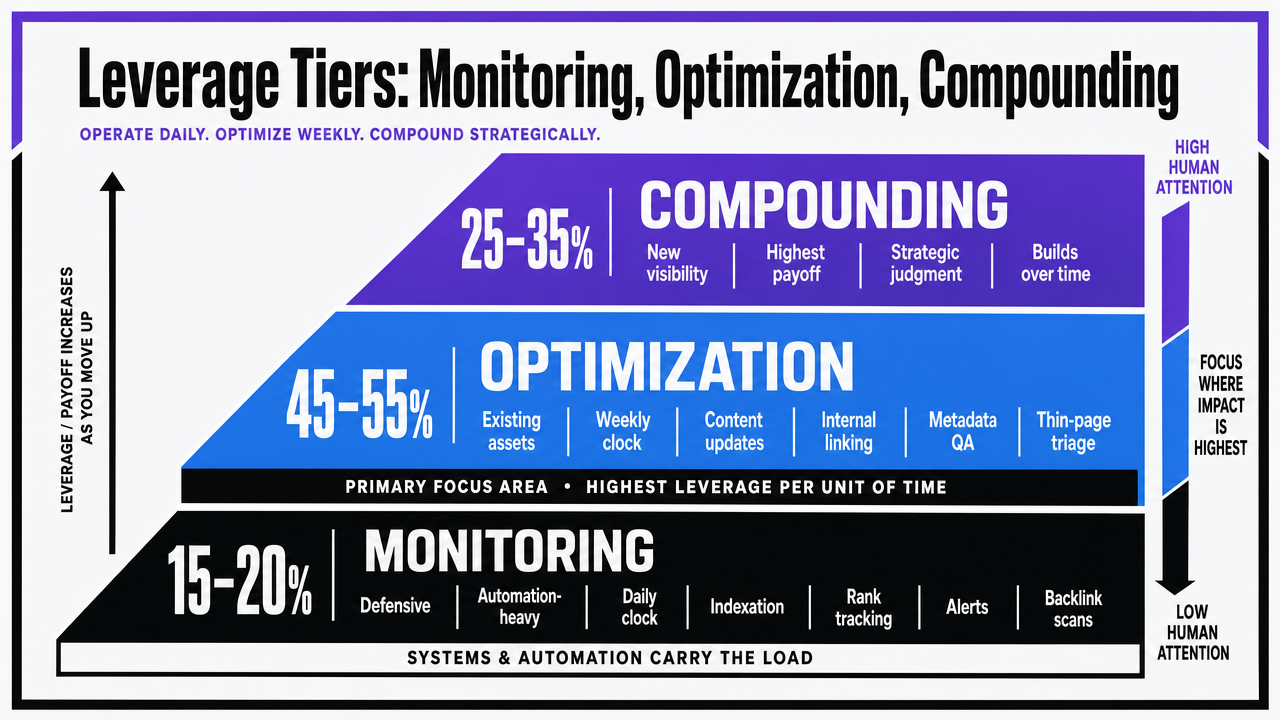 Visualize the three leverage tiers and their recommended time allocation percentages (15-20%, 45-55%, 25-35%) explicitly cited in the section prose
See How Automated SEO Execution Streamlines Daily, Weekly, and Monthly Activities
Request a walkthrough of coordinated, AI-driven SEO workflows designed for agencies and enterprise teams managing multi-site or complex client portfolios—optimize resource allocation and eliminate manual bottlenecks.
Scaling Execution: 5, 50, or 500 Pages
What Breaks at Each Scale
The operating model that works at five pages collapses at fifty and is incoherent at five hundred. The breakage is predictable, and naming it is the first step in deciding what to automate, what to consolidate, and what to keep on a human's calendar.
At roughly five to twenty meaningful pages, a single SEO lead can hold the entire site in working memory. Daily monitoring is a glance at one dashboard. Weekly internal linking is manual and accurate because the lead knows what links to what. The risk at this scale is not capacity — it is neglect, because the work feels small enough to defer.
Between fifty and a few hundred pages, working memory fails. Internal linking becomes guesswork without a crawl report. Duplicate metadata appears as templates multiply. Thin-page triage requires queries against the CMS rather than recall. This is the scale at which most teams keep running the five-page playbook and quietly lose ground, because the weekly clock no longer covers the surface area.
Above a few hundred pages, the work is structurally different. No single person can review every page on a useful cadence. The cadence has to shift from page-level execution to category-level governance: templates, content standards, and automated checks that enforce the durable-page principle at scale 8.
If You Manage Multiple Locations or a Portfolio
Scope shift: this section addresses directors running multi-location healthcare groups, agencies managing many client sites, or SaaS teams with large product and feature footprints. The cadence model still applies, but the unit of work is the account, not the page.
The failure mode at portfolio scale is duplicated execution. A weekly metadata QA pass run independently across forty sites is forty separate workflows, forty review queues, and forty chances for drift. The same is true for indexation monitoring, internal linking, and content maintenance. Per-site execution scales linearly with headcount; account-level execution does not. For healthcare operators specifically, the stakes on content quality are higher — search engines are a primary entry point for consumers seeking health information, and the downstream care decisions amplify the cost of stale or inaccurate pages 13.
The cadence-cost math is worth running with variables rather than invented dollars. If a single site consumes roughly two to four hours of weekly SEO labor at a blended rate, a fifty-site portfolio carries one hundred to two hundred labor hours per week before any strategy work happens. Consolidated account-level execution — shared monitoring, shared content standards, shared crosslink logic, and shared monthly audits — compresses that surface area without compressing quality.
This is the scale where continuous account-level execution platforms earn their keep. At a category cost point in the range of a few hundred dollars per month for entry tiers, the question shifts from per-site retainer math to whether the portfolio's cadence is even possible under the current operating model.
Auditing Your Current Cadence
A short audit is more useful than another framework. Five questions surface whether a program is running three clocks or one busy queue.
- Can the team name the owner, trigger, and definition of done for daily monitoring, weekly optimization, and monthly strategy work? If the answer collapses into one person and one inbox, the clocks are merged and the compounding work is being eaten by monitoring noise.
- What share of weekly hours goes to content maintenance versus net-new production? Programs that publish more than they maintain accumulate decay faster than they offset it, against guidance that treats ongoing maintenance as core SEO work 1.
- When did the last metadata uniqueness sweep and full crawl reconciliation run? Anything longer than thirty days is overdue 2.
- What is the pruning ratio over the last quarter — pages removed or consolidated versus pages added? A ratio near zero indicates the durable-page standard is aspirational, not operational 8.
- Does the calendar reflect the leverage tiers, or is compounding work the first thing cut when capacity tightens? The answer to that question predicts next year's organic performance more reliably than any audit tool.
Frequently Asked Questions
References
- 1.Search Engine Optimization Best Practices - Department of Energy.
- 2.Writing for SEO - VA.gov Design System.
- 3.3.3 Search Engine Optimization (SEO) | Digital Services & Solutions.
- 4.SEO-Best-Practices - CT.gov.
- 5.How Does Search Engine Optimization Work?.
- 6.Tapping Into SEO: How Government Websites Can Improve Content ....
- 7.What is SEO? (Search Engine Optimization).
- 8.Search Engine Optimization.
- 9.SEO Basic Principles | Digital Experience Studio.
- 10.Title, abstract and keywords: a practical guide to maximize ....
- 11.Search engine optimization: What is it and why should we care?.
- 12.Search engine optimisation (SEO) strategy as determinants to ....
- 13.Online Health Information Seeking and the Role of Search Engines.