
Key Takeaways
- Modern SEO writing has moved past keyword mechanics toward editorial judgment: audience definition, structural clarity, evidence quality, and review discipline that automation cannot replicate 2.
- Treat the curriculum as an editorial operating system where judgment precedes production, with audience, literacy level, objective, and main message documented before any writing begins 4.
- Six disciplines carry the work: audience research, information design, technical fundamentals, accessibility as a ranking lever, evidence quality in high-stakes verticals, and defensible outcome metrics 8.
- Adopt the CDC Clear Communication Index's 100-point scale with 90 as the publish threshold, routing scores of 80 to 89 back for a structural pass 3.
- Pre-publication QA requires both automated scans and manual review for alt-text meaning, link clarity, reading order, and keyboard access that scanners cannot evaluate 7.
Why a Modern SEO Curriculum Looks Nothing Like a Keyword Tutorial
The phrase "SEO writing course" still conjures images of keyword density charts, meta tag templates, and header-tag hierarchies drilled into fresh writers. This curriculum is obsolete. Stanford's 2025 AI Index reports that marketing and content support is now the single most common business application of AI, cited by 27% of surveyed organizations 2. When drafting is partially automated, the keyword mechanics that once filled a syllabus take minutes to execute and offer no durable advantage.
What separates competent output from content that earns rankings and conversions has shifted up the stack. A 2024 peer-reviewed audit of 71 diabetic retinopathy websites found that pages with better readability also showed stronger SEO metrics and earlier search visibility 8. This signal was correlational and tied to one medical topic, but it points at the direction modern retrieval systems are moving: toward estimating whether a page is understandable, not just whether it contains the right strings. Related work on consumer health search found that machine-learning models outperformed traditional readability formulas at predicting understandability, and that learning-to-rank systems could fold those estimates into ranking 9.
A curriculum built for this environment teaches editorial judgment that machines still cannot replicate: audience definition, structural clarity, evidence quality, and review discipline. Keyword mechanics belong in an appendix, not the opening module.
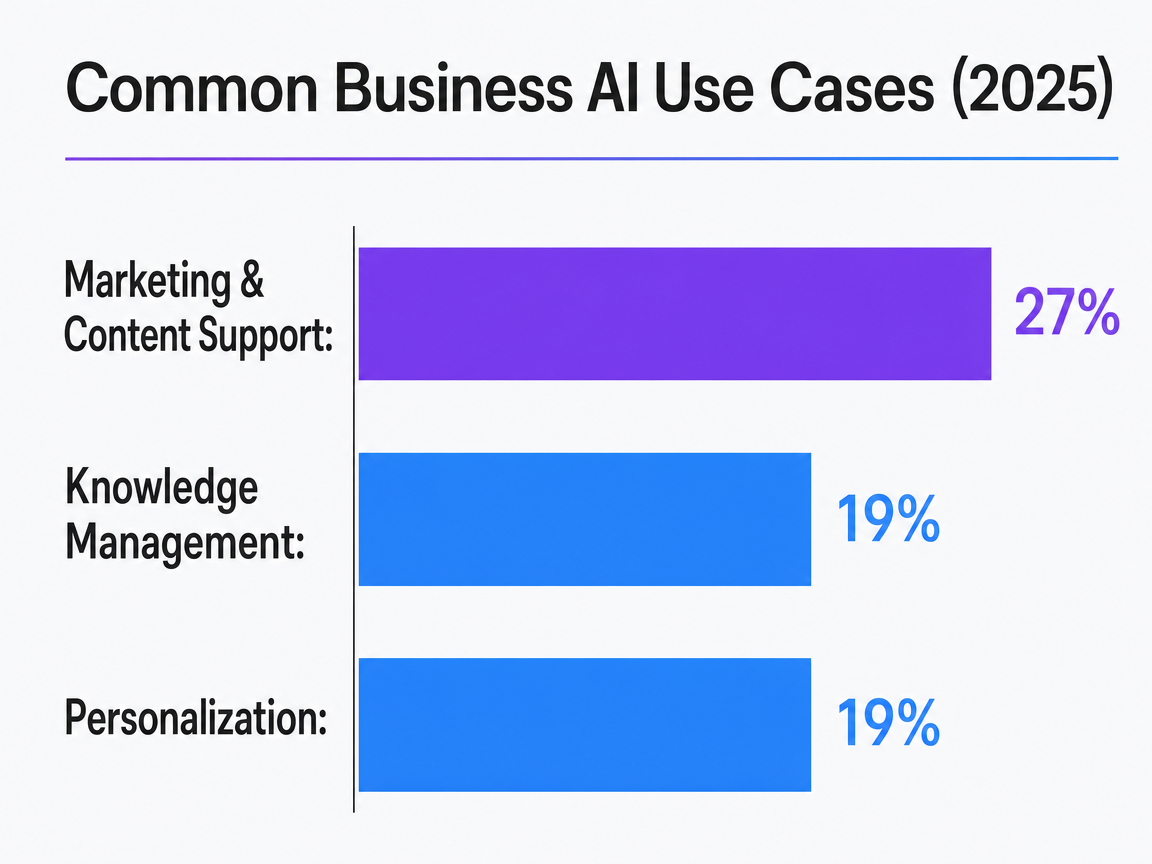 Common Business AI Use Cases (2025)
Breakdown of the most common applications of AI in businesses, as reported in the Stanford 2025 AI Index.
Course as Editorial Operating System, Not Tactical Checklist
A checklist tells a writer what to insert. An operating system tells an editorial team how decisions get made, who signs off, and what evidence must be on the page before it ships. The distinction matters because the bottleneck in modern content production is no longer drafting speed. It is review capacity, source verification, and structural judgment at scale.
Treating the curriculum as an operating system reframes what a course should produce. The output is not a writer who memorized title-tag conventions. It is a team member who can define a primary audience and health-literacy level before writing a word, structure a page so that the main message surfaces in the first screen, and defend each factual claim with a traceable source. The CDC's clear communication framework encodes this discipline explicitly, requiring reviewers to identify the primary audience, communication objective, and main message before any scoring begins 4. That sequencing is the operating system in miniature: judgment precedes production.
Tactical checklists still have a place inside the system, but they live downstream of editorial decisions, not upstream of them. A heading hierarchy check or an alt-text audit catches execution errors; it does not fix a page written for the wrong reader. AHRQ makes the same point when it warns that an easy readability score does not prove a document is understandable 6. Mechanical checks confirm compliance. They do not confer meaning.
The Six Disciplines That Belong in the Curriculum
Audience Research Before the First Outline
Audience research is where editorial judgment either exists or does not. Before a writer builds an outline, the reviewer should be able to name the primary audience, that audience's health-literacy or technical-literacy level, the questions they will arrive with, and the single decision the page is meant to support. The CDC score sheet refuses to let a reviewer begin scoring until those four variables are documented 4. That constraint belongs in any serious curriculum because it blocks the most common failure mode in commercial content: writing for a persona the writer has not actually described.
NIH plain-language guidance pushes the discipline further by instructing authors to list the questions the target audience will ask and organize each section around a single theme 10. A content manager who runs it on an existing service page usually finds two or three competing audiences stacked into one document, which explains why the page converts poorly and ranks for terms no one on the team intended.
Information Design: Structure as a Comprehension Lever
Structure does work that word choice cannot. A peer-reviewed study of hypertension self-care passages revised the organization, headings, paragraph breaks, and bullet lists of online health information and tested comprehension against the original versions. Participants remembered the revised passages better, summarized them more accurately, and retrieved information more efficiently, even though the average readability scores did not change between versions 12. The grade-level formula missed the improvement entirely. Readers felt it.
That finding should reshape how a curriculum teaches page architecture. Heading hierarchy is not an SEO ritual; it is a navigation layer that lets a reader locate the one paragraph that answers their question. Chunking long explanations into short sections reduces the cognitive load of scanning. Bullet lists convert dense procedural prose into parallel items the eye can parse. Section 508 guidance reinforces the same discipline from the accessibility side, noting that headings organize content for screen-reader users and improve readability for everyone 11.
A course module on information design should produce writers who draft the heading structure before the prose, who break any paragraph longer than five sentences, and who convert enumerated prose into lists by default. Those three habits move comprehension metrics without touching sentence-level readability scores at all.
Technical Discoverability Without the Folklore
Technical discoverability deserves a tight, unsentimental module. The durable items are a logical heading tree, descriptive link text, semantic lists, clean table markup, and alt text that conveys the purpose of an image rather than describing its pixels. Section 508 guidance treats these as authoring fundamentals because they serve assistive technology and crawlers through the same underlying signal: machine-readable structure 11.
What a modern curriculum should strip out is the folklore. Keyword density targets, exact-match anchor rituals, and header-tag superstitions no longer carry weight in retrieval systems that estimate meaning. Research on consumer health search found that machine-learning models outperformed traditional readability formulas at predicting understandability, and that learning-to-rank systems could incorporate those estimates into retrieval directly 9. That shift explains why mechanical keyword tactics have diminishing returns: the systems reading the page are increasingly scoring whether it answers the query, not whether it contains the string.
Writers trained on the fundamentals ship pages that are legible to crawlers, assistive technology, and human readers at once. That is the entire technical module.
Accessibility and Readability as Ranking Disciplines
Accessibility is usually taught as a compliance obligation. The curriculum should teach it as a discoverability advantage. A 2024 peer-reviewed audit of 71 diabetic retinopathy websites found that only 2 of the 71 sites met the sixth-grade reading-level recommendation, the average reading level was grade 10.5, and 97% exceeded the median U.S. health-literacy level. Better readability in the sample was associated with stronger SEO metrics and earlier search visibility 8. The study examined one medical topic and reports a correlation rather than causation, but the direction is consistent with what retrieval research has been showing: pages readers can actually understand tend to earn visibility.
The practical implication for a content team is that readability is not a post-publication cleanup task. It is a drafting constraint. AHRQ cautions, correctly, that an easy readability score does not prove a document is understandable, and that formula-based checks should be combined with user feedback and design review 6. A mature module teaches both halves: writers draft at the audience's literacy level, then reviewers confirm understandability through structured checks and, where possible, user testing.
The same module should cover the accessibility items that automated tools miss. Section 508 guidance notes that keyboard access, meaningful alt text, reading order, and link clarity still require manual review because automated scanners cannot evaluate meaning 7. Those checks protect ranking signals and real users at the same time, which is the point.
Evidence Quality in YMYL and High-Stakes Verticals
In healthcare, legal, behavioral health, dental, senior living, and home services categories, evidence quality is the difference between a page that earns trust and one that quietly harms a reader. AHRQ's health-IT literacy guidance frames the standard plainly: content should use plain and clear language, explain unavoidable technical terms, avoid jargon, and support claims with sources appropriate to the audience 5. A curriculum built for these verticals should require writers to cite primary sources inline, note the scope and date of any statistic, and flag claims that need subject-matter or legal review before publication.
The CDC framework encodes the same discipline in its scientific accuracy and numbers categories, which ask whether numeric information is clear, whether risk is explained in context, and whether the main message is supported 3. Those items translate directly to commercial pages that quote outcomes, pricing ranges, success rates, or regulatory language. A writer trained to anticipate those review questions produces drafts that pass legal and clinical review on the first pass instead of the third.
Measurable Business Outcomes the Team Can Defend
The final discipline is the one most courses skip: tying editorial work to outcomes the team can defend in a quarterly review. Stanford's 2025 AI Index reports that marketing and content support is the most common business application of AI at 27%, with knowledge management and personalization tied at 19% 2. Adoption is widespread; effective operating models are not. The curriculum should teach writers and editors to track a short, honest set of metrics per page:
- Organic impressions and clicks for the target query cluster
- Scroll depth or time on page as a proxy for comprehension
- Assisted conversions tied to the page in analytics
- Qualified downstream actions such as booked consultations or form submissions
Those four metrics let a content manager retire pages that do not perform, double down on structures that do, and justify headcount or tooling investment with evidence rather than assertion.
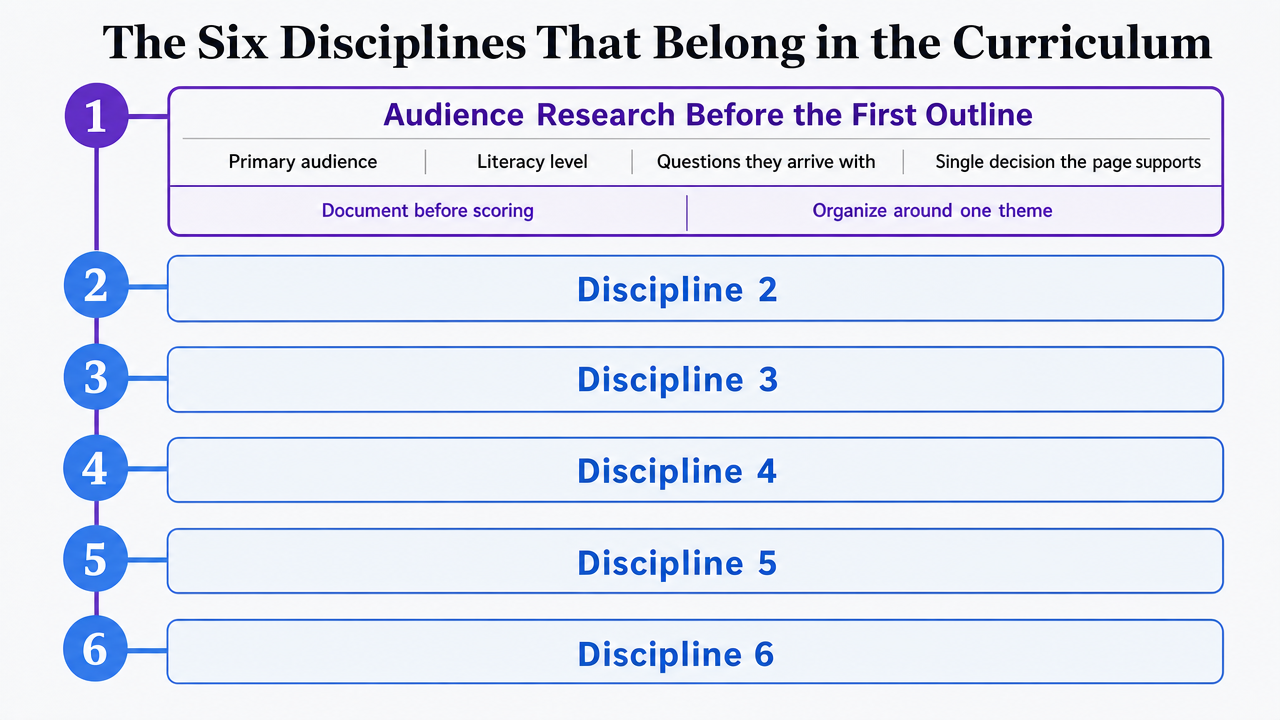 Visualize the six editorial disciplines as a cohesive curriculum framework, directly supporting the section that enumerates them
Test AI-powered SEO content workflows risk-free
Experience streamlined SEO content creation and publish live articles during your free trial—no delays, no commitment required.
A 100-Point Scoring Rubric Adapted From Federal Review Frameworks
The CDC Clear Communication Index gives editorial teams a scoring instrument that already does most of the hard work. The Index contains 20 scored items grouped into seven areas, uses a 100-point scale, and identifies 90 or higher as passing 3. Before any scoring begins, the reviewer must document the primary audience, the audience's health-literacy level, the communication objective, and the main message 4. That gating step is what makes the rubric useful outside public health: it forces the reviewer to name who the page is for and what it should accomplish before judging whether it succeeds.
Adapting the Index for commercial pages is a translation exercise, not a rewrite. The seven areas map cleanly onto editorial workflow stages. Main message and call to action belong in the brief, where a content manager locks the single decision the page is meant to drive. Language and information design belong in the draft, where sentence-level clarity, heading hierarchy, chunking, and lists get built in rather than retrofitted. State of the science, behavioral recommendations, numbers, and risk belong in the review stage, where a subject-matter or legal reviewer confirms that every claim is sourced, every statistic is dated and scoped, and every risk statement is contextualized.
A content team can lift the 100-point scale directly and set 90 as the pre-publication threshold. Pages that score between 80 and 89 go back for a structural pass before republishing. Pages below 80 are rewritten against the brief or killed. The score does not replace clinical, legal, or user-testing review, which the CDC guide notes explicitly 3. It does give editors a defensible, repeatable number to cite in a quarterly review when leadership asks how quality is being measured against velocity.
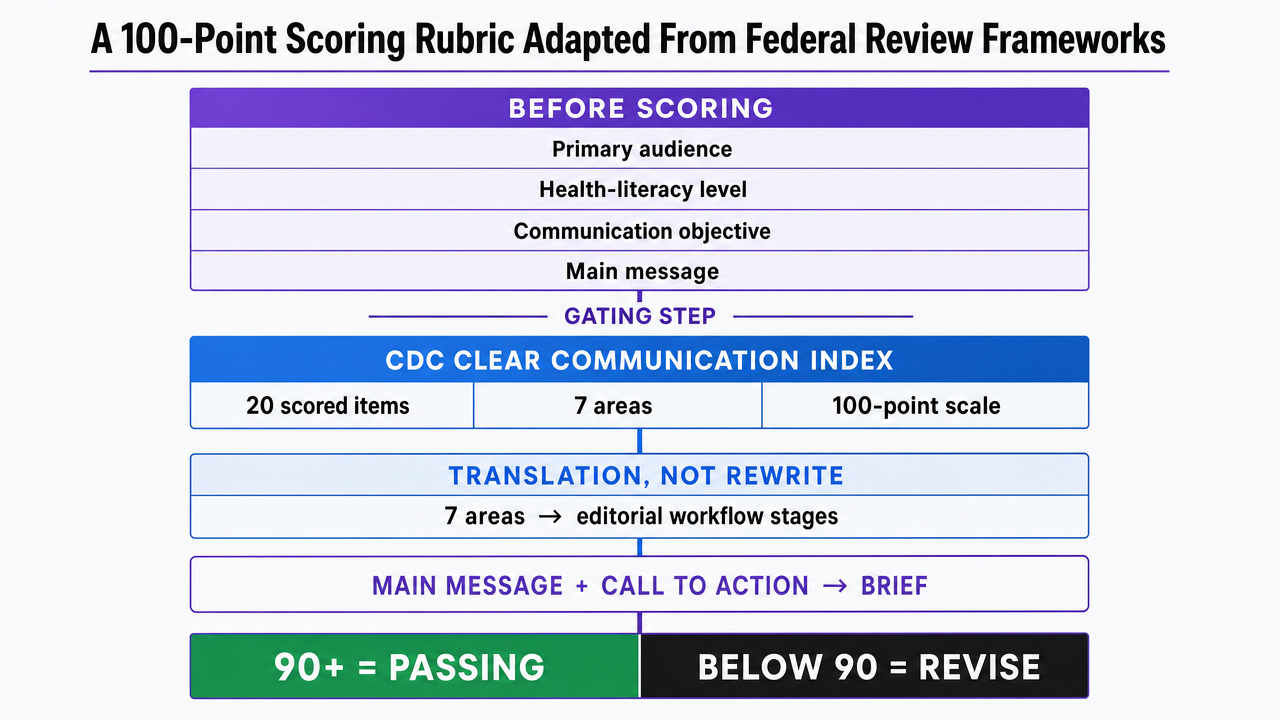 Translate the CDC-adapted 100-point rubric and publish-threshold decision logic into a clear scoring gate that mirrors the article's prose
AI-Assisted Production With Editorial Governance Intact
Generative tools have moved drafting from a bottleneck to a commodity, which is precisely why governance now carries the weight that drafting speed used to. NIST defines synthetic content as information significantly altered or generated by algorithms, including text, and recommends provenance tracking that records content origins and history to support authenticity and credibility 1. Translated into editorial practice, that means a page produced with AI assistance should carry a record of which sections were machine-drafted, which sources the model was given, which claims a human reviewer verified, and who approved publication. Without that trail, a content team cannot defend a page under legal review, retract a claim cleanly, or diagnose why an output drifted off-brand.
The curriculum should teach three governance habits that sit on top of the drafting layer:
- Writers feed the model vetted sources rather than letting it retrieve its own, because unverified retrieval is where fabricated citations and misattributed statistics enter the draft.
- Reviewers check every numeric claim against the cited source, since AHRQ's warning that an easy readability score does not prove understandability applies with equal force to fluent AI prose that reads well but misstates a figure 6.
- Editors log the review in a system the team can audit later, which is the operational form of the provenance NIST describes 1.
Governance also changes how a team interprets adoption data. Stanford's 2025 AI Index reports that 27% of surveyed organizations use AI for marketing and content support, the single largest business application 2. Adoption at that level says nothing about whether those teams ship accurate pages. The curriculum should treat AI as a production layer that compresses drafting time, not a substitute for the audience, structure, evidence, and review disciplines that determine whether the page earns rankings and holds up under scrutiny.
A Pre-Publication QA Gate That Catches What Automation Misses
Automated scanners catch the obvious failures: missing alt attributes, broken heading sequences, unlabeled form fields, color-contrast misses. They do not catch the editorial errors that cost a page its ranking or its reader. Section 508 guidance is explicit that automated accessibility tools can identify common problems but cannot detect all issues, and that manual testing remains necessary for keyboard access, meaningful alt text, reading order, and link clarity 7. A publication QA gate has to run both passes, in sequence, before anything ships.
The automated pass belongs first because it is cheap. A scanner clears heading structure, image attributes, link targets, table markup, document tags, and caption presence in seconds. The manual pass is where an editor confirms that alt text conveys the image's purpose rather than describing its pixels, that link text makes sense out of context, that the reading order matches the visual order, and that keyboard tabbing reaches every interactive element 11. Those checks also surface the editorial issues scanners miss: a heading that misrepresents its section, a bullet list that hides a procedural step, a numeric claim without a dated source.
Pages that fail the manual pass go back to the writer with a specific defect list, not a general note to revise.
Accelerate SEO Content Production Without Sacrificing Quality or Oversight
See how leading teams streamline SEO writing workflows, maintain brand voice, and multiply output velocity—powered by approval-first automation designed for agencies and enterprise-scale content operations.
If an Editorial Team Supports Multiple Locations or a Portfolio
The scope changes when a content manager stops serving one brand and starts serving a portfolio: a DSO with 40 practices, a legal network with 12 offices, a senior living operator with 25 communities, or a multi-site behavioral health group. Review discipline that worked for a single site becomes the binding constraint, because every location needs its own service pages, every page needs the same evidence quality, and reviewer hours do not scale linearly with location count.
The economics are easier to see when the variables sit in one table. The figures below are placeholders a content manager plugs with their own operational numbers; nothing here is a benchmark.
| Locations | Pages per Location per Quarter | Review Hours per Page | Total Review Hours | Reviewer FTE Equivalent |
|---|---|---|---|---|
| L | P | R | L × P × R | (L × P × R) / 480 |
| 10 | 6 | 1.5 | 90 | 0.19 |
| 25 | 6 | 1.5 | 225 | 0.47 |
| 40 | 6 | 1.5 | 360 | 0.75 |
The CDC framework's requirement that reviewers document audience, literacy level, objective, and main message before scoring begins is what makes portfolio review defensible 4. A shared rubric and a shared brief template let one reviewer apply consistent judgment across sites instead of relearning each location's audience from scratch.
Rolling the Curriculum Into Weekly Editorial Practice
A curriculum that lives in a slide deck does not change throughput. The disciplines earn their keep only when they become weekly habits attached to specific calendar events. A workable cadence runs on a four-touch week:
- Monday brief lock — where the audience, literacy level, communication objective, and main message get documented before any writing begins, matching the gating step the CDC score sheet requires of its reviewers 4.
- Midweek draft review — scores the page against the adapted 100-point rubric, with 90 as the publish threshold.
- Thursday QA pass — runs the automated accessibility scan first, then the manual pass for alt-text meaning, link clarity, reading order, and keyboard access that scanners cannot evaluate 7.
- Friday publish and metrics log — closes the loop by logging organic impressions, scroll depth, assisted conversions, and qualified actions against the page.
Teams that install this rhythm stop debating whether the curriculum is working. The scores, the defect lists, and the per-page metrics answer the question every quarter.
Frequently Asked Questions
References
- 1.Reducing Risks Posed by Synthetic Content: An Overview of Technical Approaches to Digital Content Transparency.
- 2.CHAPTER 4: Economy.
- 3.CDC Clear Communication Index: A Tool for Developing and Assessing CDC Public Communication Products.
- 4.CDC Clear Communication Index Score Sheet.
- 5.Accessible Health Information Technology (IT) for Populations with Limited Literacy: A Guide for Developers and Purchasers of Health IT.
- 6.Assess, Select, and Create Easy-to-Understand Materials.
- 7.Accessibility Review and Approval Best Practices for Low-Code Content.
- 8.Search engine optimization and its association with readability and accessibility of diabetic retinopathy websites.
- 9.Consumer Health Search on the Web: Study of Web Page Understandability and Its Integration in Ranking Algorithms.
- 10.Presenting Your Information.
- 11.Core Accessibility Principles for Content Authors.
- 12.A Multi-faceted Approach to Promote Comprehension of Health Information.
- 13.Health Information on the Internet: Accessibility, Quality, and Readability in English and Spanish.